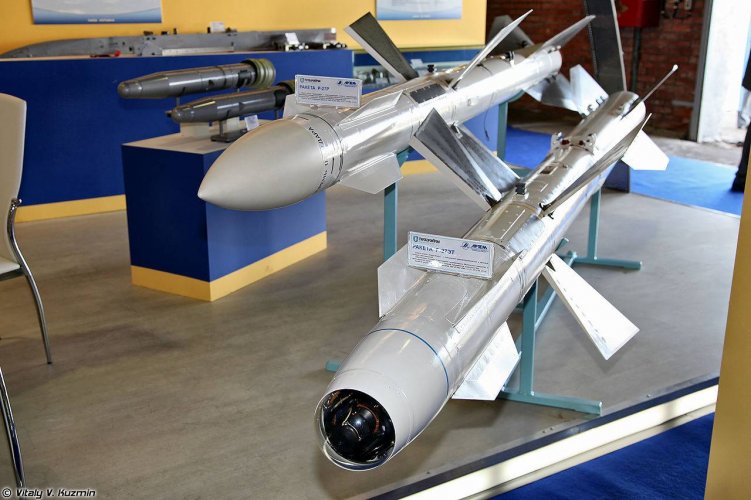
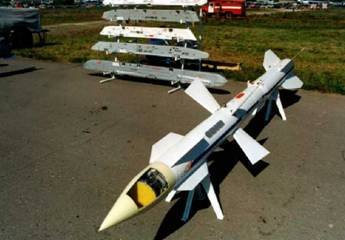
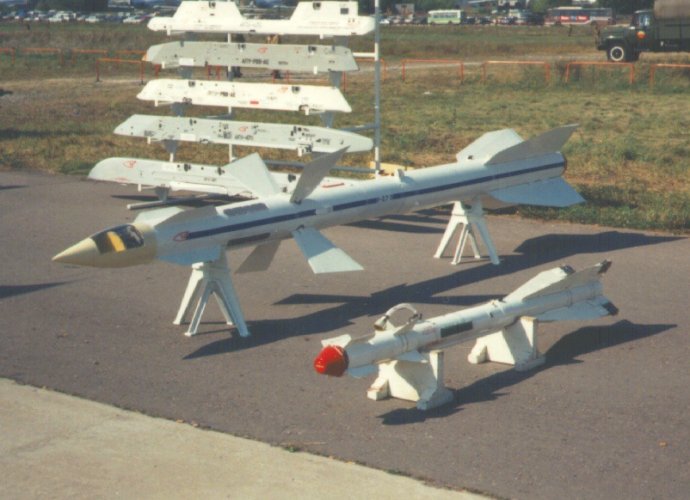
Some details in the connection with the IR guided versions as R-23T ,R-24T and R-27T/ET.First, they are all-aspect AAM's and with them it is possible to engage target in both front/rear hemisphere.All of their IR seekers use nitrogen,usually compressed for its cooling before launch,thus they are more sensitive .All of them have only LOBL capability. Now there is one more catch. All IR seekers can be adjust to work in dual IR band ,for the detection/tracking of the average wavelength of the aircraft's skin and same of the average wavelenght of the exhaust.Adjusting is done on the testbed ( AAM's test station).

Btw ,IRST's work in that way to see some 'hot spot' in the air.The higher temp of some 'spot' is ,the greater will be detection/tracking distance.Example, fighter flying on the Full/Max AB mode is one very hot spot in the air ,approx 1000°C-2000°C and this is particularly evident in the very cold stratosphere ( -60°C).Exactly that can IRST or IR seeker see or detect/track from the max possible distance.

Most people believe that with IR guided AAM's ,it is only possible to engage receding but not incoming target.When it comes to max launch ranges in contrary,with IR guided AAM's, it is possible to engage incoming target from much greater distance then in case of receding one.Logical ,engaging in the front hemisphere/incoming air target is always with greater launch distances ,same case with the inertial-radar guided AAMs.

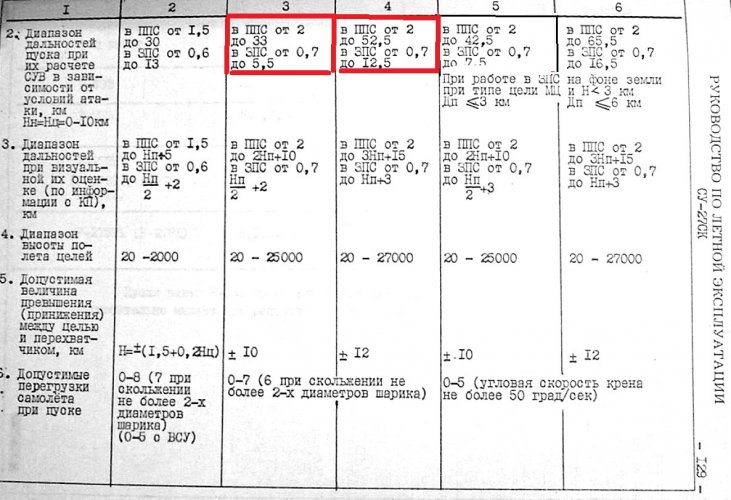
Again data from the 'Su-27SK Flight Manual',launch ranges for the R-27T1/ET1 when target flies in the troposphere ( under 10km alt ) :

R-27T1 max launch ranges : 2-33km in the front hemisphere and 0.7-5.5km in the rear hemisphere.
R-27ET1 : max launch ranges : 2-52.5km in the front hemisphere and 0.7-12.5km in the rear hemisphere.
Those 30+ and 50+ km launch ranges are only possible if fighter flies in AB mode.

Old Soviet combat tactics for the BVR combat was to use medium/long-range radar/IR guided AAM's combo where IR guided ones would be launched as first.That tactics was in practice from 1960's and we could see that even one supermodern Su-35S carried that AAM's combo in Syria ( R-27T with R-77-1).
 
What is the source for the r73 seekerhead ranges?
A MiG-29 manual. And a Chinese document describes its flare rejection method

Squirrel, I still think ranged you mention from Su-27 manual are purely ballistic ranged and not indicative of normal seeker performance. Look at all the graphs showing R-73 doing 30 km front aspect and then look at this chart and tell me when it cAn fire at a supersonic after burning F-15 head on at 30 km.

The R-27T/ET brochure gives 16-17 km for front aspect, looking at this chart it is very reasonable
 

Attachments

  • IMG_8256.jpeg
    IMG_8256.jpeg
    233.3 KB · Views: 50
Once again, apples aren't bananas. The ranges listed in the manual are real launch ranges, but dependent on the seeker being able to detect the target.

As @Aeria Gloria notes, short of an SR-71 in full afterburner its hard to see what target would give a 52.5km front aspect lock-on range for an R-27ET. 16-17km is not far off double the best lockon range of an R-73 seeker in a head on engagement against an F-15, seems reasonable for the bigger R-27T seeker.

This problem would afflict any lock-on-before-launch BVR AAM. The best range of the seeker is in rear aspect, but the missile launch range is tiny in rear aspect. The best range is in head-on, but the lockon range in headon is tiny.

IR MICA uses radar lockon and midcourse guidance to square this particular circle.
 
Last edited:
Squirrel, I still think ranged you mention from Su-27 manual are purely ballistic ranged and not indicative of normal seeker performance. Look at all the graphs showing R-73 doing 30 km front aspect and then look at this chart and tell me when it cAn fire at a supersonic after burning F-15 head on at 30 km.

The R-27T/ET brochure gives 16-17 km for front aspect, looking at this chart it is very reasonable

Hm ,this is what is precisely described in the Su-27SK F.M. , page 85:

''Диапазон дальностей пуска при их расчете СУВ в зависимости от условий атаки, км Нн=Нц=0-10 км''

''Launch range with FCS calculating with the depending on attack conditions, km Нf=Нt=0-10 km''

So it is calculated launch distance against incoming/receding target,yes .

I don't know if you understand Russian but you gave me the table with calculated launch ranges against fighter flying on the non-AB mode ( Maximal or MP mode). AAM's IR seeker works exactly as some IRST and can see only some spot on the sky,of course ''temperature spot '' and the higher temp of some 'spot' is ,the greater will be detection/tracking distance, it is logical.

There is big difference between fighter flying on non-AB mode and the fighter flying on the Full / Max AB Mode.Comparison, fighter flying on the non-AB mode can be 'hot spot' on the sky with value maybe about 500°C ( of course from the rear) but fighter flying on the Full AB mode can be much hotter spot with temp value 1000°C or even more.IR seeker is not IIR and can't see aircraft's shape , only can see is that spot as incoming-closing or as receding.

This problem would afflict any lock-on-before-launch BVR AAM. The best range of the seeker is in rear aspect, but the missile launch range is tiny in rear aspect. The best range is in head-on, but the lockon range in headon is tiny.

Logically, yes.

To increase detection/lock on range of the IR seeker against incoming target ( especially fighters flying on the AB mode) they have :

''Ракета Р-27ЭТ отличается от Р-27ЭР только типом головки самонаведения и отсутствием линии радиокоррекции. Тепловая головка самонаведения имеет два фотоприемника: один с глубоким охлаждением до температуры Т=—360° С, другой—неохлаждаемый. Основной режим работы ТГС—с охлаждаемым фотоприемником. При израсходовании охлаждаемого газа (азота) включается неохлаждаемый фотоприемник, при этом дальности захвата цели резко уменьшаются и возможна ее атака только в ЗПС. ТГС имеет хорошую помехозащищенность от активных и естественных помех.

В отличие от РГС тепловая головка самонаведения захватывает цель на подвеске по целеуказанию от прицельной системы (РЛПК, КОЛС, НСЦ, ОПТ) или без целеуказания в режиме Ψо и сопровождает ее после пуска ракеты до поражения. Дальности захвата целей ТГС ракет приведены в таблице.​
ТГС имеет ограничения по захвату цели при пеленге на Солнцe или солнечную дорожку (Луну) менее 15°(4°)
Разрешенные дальности пуска ракеты Р-27ЭТ практически такие же, как и у ракеты Р-27ЭР однако в ППС они ограничены дальностью захвата цели ТГС.​

Пуск ракет Р-27ЭТ возможен одиночно с интервалом не менее 8 с, исключающим возможность захвата ТГС вновь пущенной ракеты теплового излучения двигателя предыдущей.
Пуск ракет Р-27Т возможен только одиночно с интервалом не менее 6 с, исключающим возможность захвата ТГС вновь пущенной ракеты теплового излучения предыдущей.''

Transl...

''The R-27ET missile differs from the R-27ER only in the type of homing head and the absence of a radio correction line. The thermal homing head has two photoreceivers: one is deeply cooled to a temperature of T = -360° C, the other is uncooled.
The TGS's primary operating mode is with a cooled photodetector. When the cooled gas (nitrogen) is exhausted, the uncooled photodetector is activated. This significantly reduces target acquisition ranges, making it possible to attack only receding target. The TGS has good immunity to active and natural interference.

Unlike a radar-guided homing head, a thermal homing head acquires only LOBL using target designation from a targeting system (RLPK/ radar, KOLS/ IRST, NSTs/HMS, OPT) or without target designation in Ψo mode and tracks it after missile launch until destruction. The target acquisition ranges of thermal homing heads for missiles are listed in the table. The TGS has target acquisition limitations when the bearing to the Sun or the solar path (Moon) is less than 15° (4°).
The permitted launch ranges of the R-27ET missile are almost the same as those of the R-27ER missile, but in the PPS, they are limited by the TGS target acquisition range.

The launch of R-27ET missiles is possible individually with an interval of at least 8 seconds, eliminating the possibility of the OR seeker of a newly launched missile being captured by the thermal radiation of the engine of the previous one.
The launch of R-27T missiles is only possible singly with an interval of at least 6 seconds, eliminating the possibility of the thermal ray of a newly launched missile being captured by the previous one.''


Source ,same as 'Aeria Gloria' gave for those launch distances :

РЛЭ и БП МиГ-29 (Руководство по летной эксплуатации и боевое применение МиГ-29) or MiG-29 F.M.

Bolded is very interesting beacuse these are max calculated launch ranges for the R-27ER1 and R-27ET1 against incoming target: 65.5km and 52.5km.

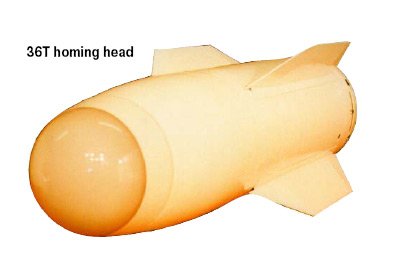
Question is, can IR seeker '36T' lock on incoming target from 50+km away ( of course fighter flying in the Full AB mode) .

This is info from one article about then new R-27T/ET 's IR seekers developed by the Ukr. company 'Radionix' several years before war started .

''Инфракрасная ГСН-203Т с диаметром в 220 мм обеспечивает дальность захвата типичной цели на встречном курсе - до 30 км, вдогон - более 100 км. Поле увлечения: 2,0x2,0 °. Время подготовки к пуску - до 2 минут.''

The infrared seeker 'GSN-203T' with a diameter of 220 mm provides a lock-on range of the typical incoming target - up to 30 km, and receding one from over 100 km. Field of attraction: 2.0x2.0 °. Preparation time for firing - up to 2 minutes.

Source: https://bmpd.livejournal.com/4152603.html

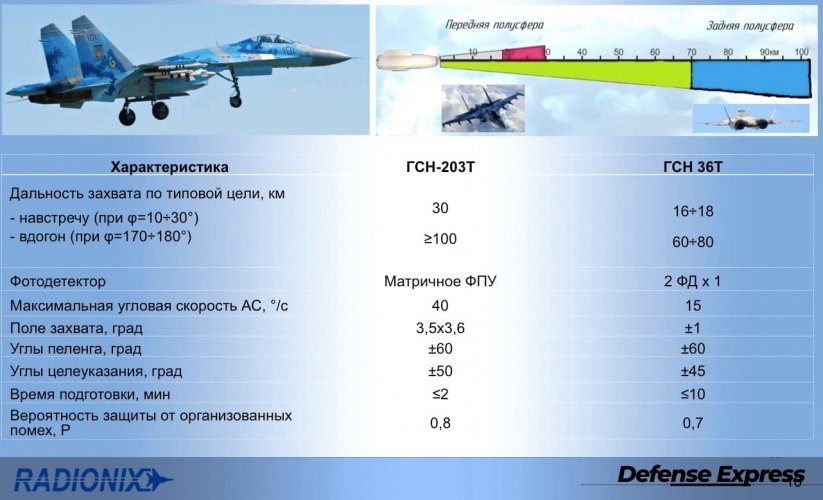
30km against the fighter flying on the non-AB mode.Lock on range against the fighter flying on the Full AB mode?

203T vs 36T.jpeg

'203T' was to be better than the older '36T'.

So the cooling by the nitrogen of the IR seeker is very important especially in the case when incoming target is engaged. That is the case for the R-23T,R-24T and R-27T/ET.

Another source:

''Р-27Т/ЭТ - всеракурсная ИК ГСН 9-Б-1023 (?). Разработка ИК ГСН "36Т" велась НПО «Геофизика» Министерства общего приборостроения СССР. Захват цели ИК ГСН должен был осуществляться при подвеске ракеты под самолетом-носителем, а для повышения дальности захвата на ней предусматривалась установка двух фотоприемников, один из которых был охлаждаемым. В качестве хладагента использовался сжижаемый азот. В совместном полете, при подвеске ракеты под носителем, азот подавался от баллона высокого давления, расположенного в пусковом устройстве, а в автономном полете ракеты - от накопителя в самой ГСН. Наличие в ГСН второго, неохлаждаемого, фотоприемника позволяло применять ракету при отсутствии хладагента на борту самолета, но - с меньшими реализуемыми дальностями захвата цели.

Сектор захвата ГСН - 110 град
Время непрерывной работы ГСН с включенной системой охлаждения фотоприемника - 3 часа''

Transl ...

The R-27T/ET , an all-aspect infrared seeker with the 9-B-1023 (?) design. The "36T" infrared seeker was developed by NPO Geofizika of the USSR Ministry of General Instrument Engineering.
The target was to be captured by the IR homing head while the missile was suspended under the carrier aircraft, and to increase the capture range, two photoreceivers were to be installed on it, one of which was cooled.Liquefied nitrogen was used as a coolant. During combined flight, when the rocket was suspended beneath the launch vehicle, nitrogen was supplied from a high-pressure cylinder located in the launcher, and during independent flight, from a reservoir in the seeker itself.The presence of a second, uncooled, photodetector in the seeker allowed the missile to be used in the absence of coolant on board the aircraft, but with shorter target acquisition ranges.
The seeker acquisition sector is 110 degrees.
The seeker's continuous operation time with the photodetector cooling system turned on is 3 hours.''


P.S.

As we know, IRST can only track target by two angular coordinates: azimuth and elevation.Distance data is coming from the radar which works in the so-called KVO mode ( Quasi-search) ,and radar will be automatically turned on every 5 sec if I remember well . It is used when ''heat channel'' is the leading channel in the Cooperation mode. From MiG-23,via MiG-25PD/PDE/PDS,MiG-29 and MiG-31 then Su-27/30 'FFF' , this was/is typical for using medium/long range IR homing AAM's especially in the BVR combat.


Some data about R-27T/ET and its '36T' we can find here: https://nevskii-bastion.ru/r-27/
 
Last edited:
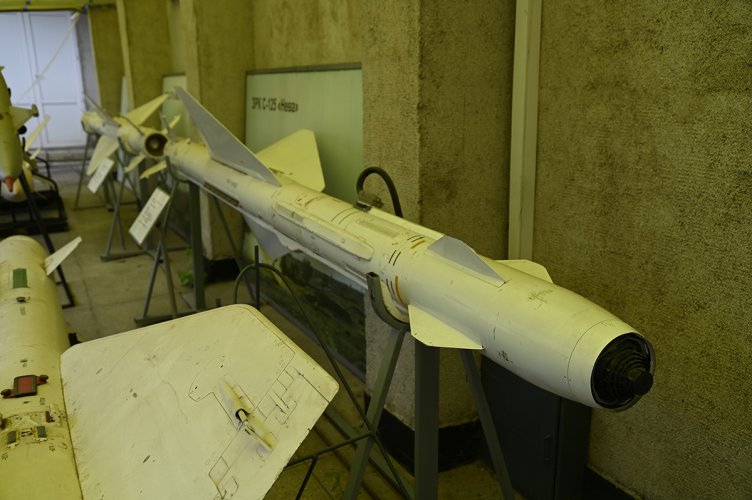
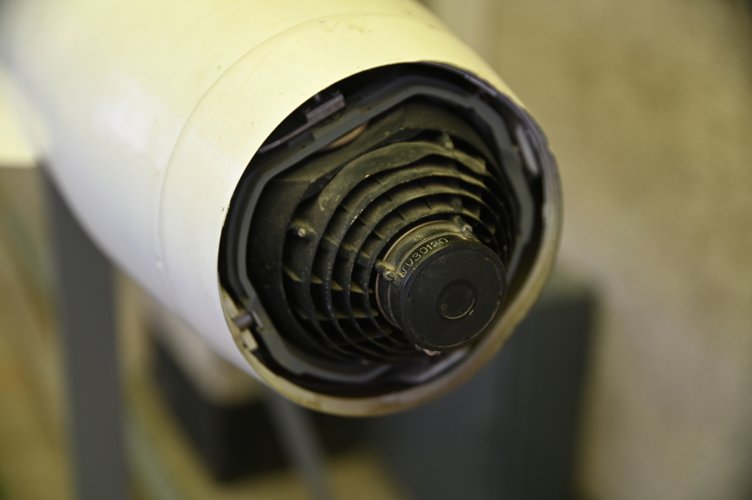
IR seeker of the R-23T ,GSN-23T .

dsc_2036.jpg

dsc_2037.jpg

Interesting detail :

Реализовать все заложенные достоинства полностью не удалось: Р-23 оказалась сложной в устройстве, включавшем, помимо прочего, и встроенные контрольно-проверочные цепи. Это требовало от летчика точного соблюдения последовательности операций по подготовке и проверке ракеты перед пуском. И все же, по данным пусков в 1975 - 1978 гг., на сбитие одной мишени требовалось 1,8 - 2 Р-23Р, 1,1 - 1,2 Р-23Т и 1 - 1,5 Р-60.

It was not possible to fully realize all the intended advantages: the R-23 proved to be complex in design, including built-in control and checkout circuits. This required the pilot to precisely follow the sequence of operations for preparing and checking the missile before launch.
And yet, according to launch data from 1975–1978, 1.8–2 R-23Rs, 1.1–1.2 R-23Ts, and 1–1.5 R-60s were required to shoot down one target.

Source: Марковский Виктор «Советские авиационные ракеты "Воздух-воздух"»

Data for the GSN-24T ,citation :

''The R-24T on the other hand had a very powerful IR seeker; it could actually lock an SR-71 from 123 km from an aspect of 180° at an altitude of 20,000 m! As well as being able to lock an F-15 from 80 - 90 km at an altitude of 5,000 m between an aspect of 60° to 90°. ''

Source: https://forum.warthunder.com/t/hist...ussian-air-to-air-missiles-ir-sarh-arh/190245

Questionable ?
 
Last edited:
I think you’re forgetting the laser designator but okay. And I don’t think MiG-23/25 have any cooperation mode. Only interaction is radar range finding and IFF of IRST targets. Cooperation is a MiG-29 only thing, and an “always on” feature in Su-27 family
 
I think you’re forgetting the laser designator but okay. And I don’t think MiG-23/25 have any cooperation mode. Only interaction is radar range finding and IFF of IRST targets. Cooperation is a MiG-29 only thing, and an “always on” feature in Su-27 family

IRST detectors like 8TK, TP-23 and TP-26 don't have lasers, LD/LR. KOLS/OLS of course have but with very small range,under 10km. Hm, Cooperation mode ( взаимодействие) have MiG-29/-31 and FFF for sure. I will check that for the MiG-23/25 but one of things that can be achieved in the 'KVO mode' is exactly that bolded.
 
Last edited:
Mentioned IR seeker type GSN-203T for the R-27T/ET from Ukr. company 'Radionix'.

''Инфракрасная головка самонаведения СН-203Т типа IIR с запоминанием образа цели разработки украинской компании "Радионикс" ''

''The OSN-203T IIR infrared homing head with target image storage developed by the Ukrainian company Radionix.''

GSN-203T.jpg

''Гирокоординатор ГСН ОСН-203Т, в который входит прибор изображения с матричным охлаждаемым фотоприемных устройством, закрепленный на гиростабилизированной платформе.''

''The OSN-203T homing gyrocoordinator, which includes an imaging device with a cooled matrix photodetector, mounted on a gyrostabilized platform.''

GSN-203T 1.jpg

IIR ( Image IR) means that this new IR seeker see 'aircraft's shape' and works in the LWIR band ( 8μm-14μm) ?
 
''In cases of maximum head-on range launches where lock-command cannot be utilised, missile can be fired in PPS: In this mode, missile will fly straight until achieves target lock.''


''После захвата цели ракетами с ТГС или готовности ракет с РГС и достижения зоны возможных пусков ракет и при наличии ПР выполнить пуск ракеты (ракет).''

''5.6.2. After the target has been locked on by missiles with a IR seeker or the missiles with a RGS are ready and the zone of possible missile launches has been reached, and if there is a LA , launch the missile (missiles).''

This is for both cases when OLS-27 ( OEPS-27 ) or radar N001 are leading or trailing channel of the WCS. R-27T/ET ( T1/ET1) can be also used in the Optika and Shlem /HMS combat modes.They can be also used in the
''φ 0'' mode ( both radar and IRST are not working).

''Режим φо применяется с ракетами с ТГС при отказе ЦВМ РЛПК и ОЭПС. Для поражения цели в режиме φо необходимо:

установить переключатель режимов СУВ в положение φо, переключатель ПР АВТ-РУЧ – в положение РУЧ и переключатель НОЧЬ-ДЕНЬ-СЕТКА в положение СЕТКА;​

маневром самолёта наложить перекрестие -2° СЕТКИ на цель, нажать после захвата ТГС ракет Р-27ЭТ1 (Р-27Т1), Р-73Э цели и удерживать гашетку П до схода ракеты.''

''The φо mode is used with missiles equipped with a IR seeker when the radar's digital computer and IRST fail. To engage a target in the φо mode, it is necessary:

−set the WCS mode switch to the φо position, the PR-MANUAL switch to the MANUAL position and the NIGHT-DAY-GRID switch to the GRID position;

maneuver the aircraft to place the -2° GRID crosshair on the target, press the trigger after the R-27ET1 (R-27T1), R-73E missiles have locked onto the target and hold the P trigger until the missile launches.''

R-27T/ET ( T1/ET1) are of course IR guided AAM's with LOBL capability only. T/ET(T1/ET1) have no RC-channel receive antennas,only R/ER ( R1/ER1) with max range from the radars N001/N019 of 50km.
 
R-27ET with its IIR seeker GSN-203T from Ukr. company GAHK 'Artem'.

R-27ET Artem.jpg

Interesting info, this company produced about 200 R-27P with the passive radar seeker before the dissolution of the USSR and majority of them were transfered to Russia. 12 pcs were sold to USA.

 
I've collected some material from this and other topics ( photos,data,info, etc) and have some questions ...

We already commented this :

''The permitted launch ranges of the R-27ET missile are almost the same as those of the R-27ER missile, but in the PPS, they are limited by the TGS target acquisition range.''

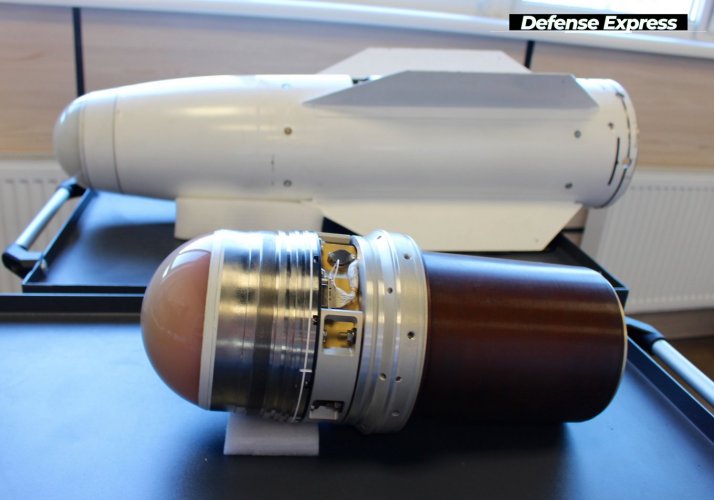
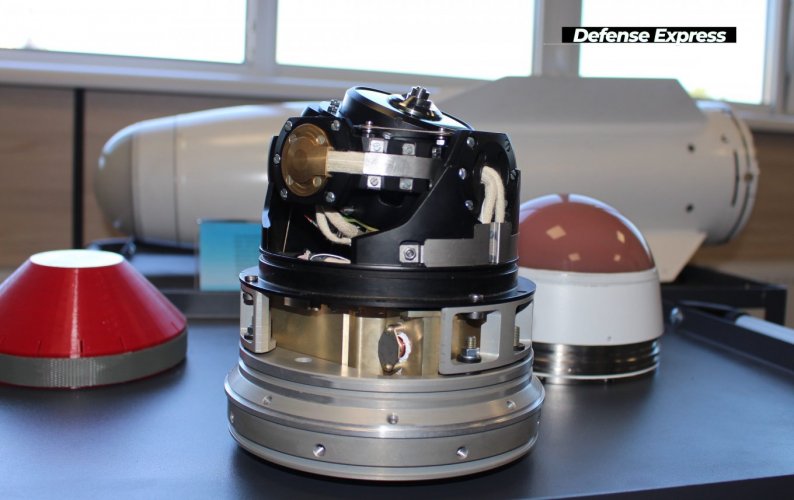
This is IR seeker type '36T' from R-27T/ET ( exported T1/ET1) .It works in the MWIR band ( 3μm-5μm ).

36T.jpg


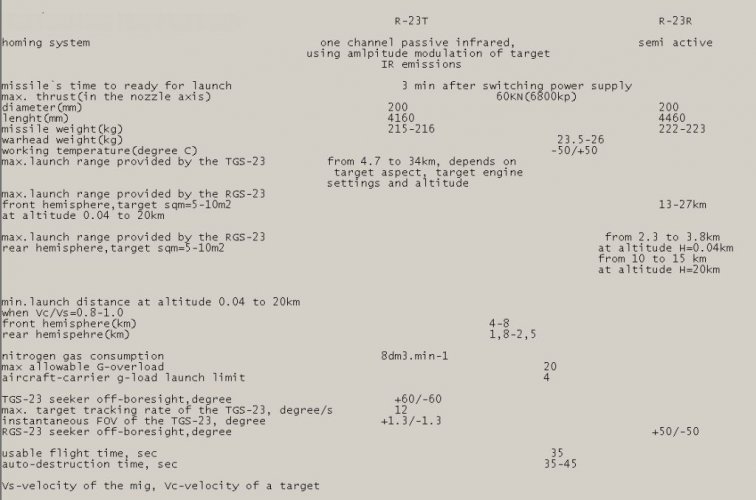
Now as we can see, older TGS-23 from the R-23T can lock-on target from 34km.

''The R-23T was lighter at 215 kg (474 lb) and used a liquid nitrogen-cooled IR seeker which required it be locked on to the target before launching, either by the launching aircraft's radar or IRST''.

R-23T.jpg

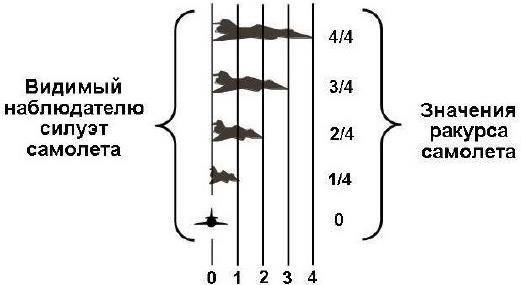
For the max values or the max launch range : Target aspect can only be forward hemisphere, head to head -incoming course. Target engine settings can only be Full/Max AB mode .Some details about target's angle aspect we have here :

Target angle aspects.jpg

0/4 - view strictly in front or behind the aircraft
1/4 - +/-15° or right / left front or rear
2/4 - +/-30° or right / left front or rear
3/4 - +/-60° or right / left front or rear
4/4 - +/-90° ,perpendicular to the side of the aircraft

Altitude, as we know in the dry and cold stratosphere /10-50km/ where temp. is about minus 60°C - minus 90°C ( depends on latitude) ,there is greatest possibility for the max detection/tracking from the fighter's IRST and the AAM's IR seeker. Especially when we talk about fighters flying on the Full AB mode ( temp is higher then 1000°C).

If we choose that incoming target's flight parameters are next : angle aspect from 0/4 to 1/4 ( 0 to +/15° ) , Full AB mode and flying in the cold stratosphere we have max( authorised) launch range against incoming flighter flying provided by the TGS-23?

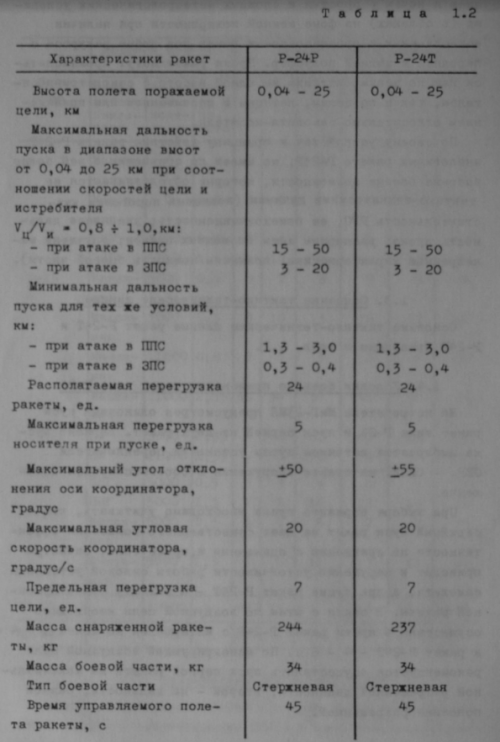
With newer TGS-24 max launch range can be even 50km or TGS-24 can lock on incoming target from 50km?

R-24T.png

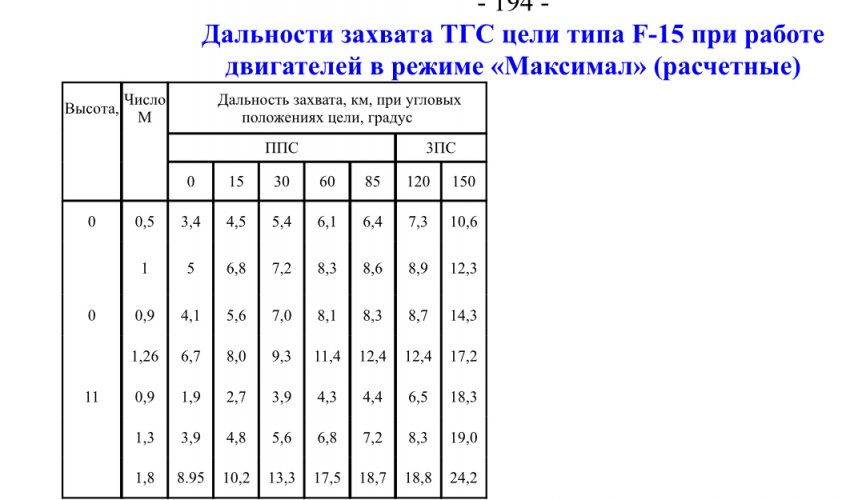
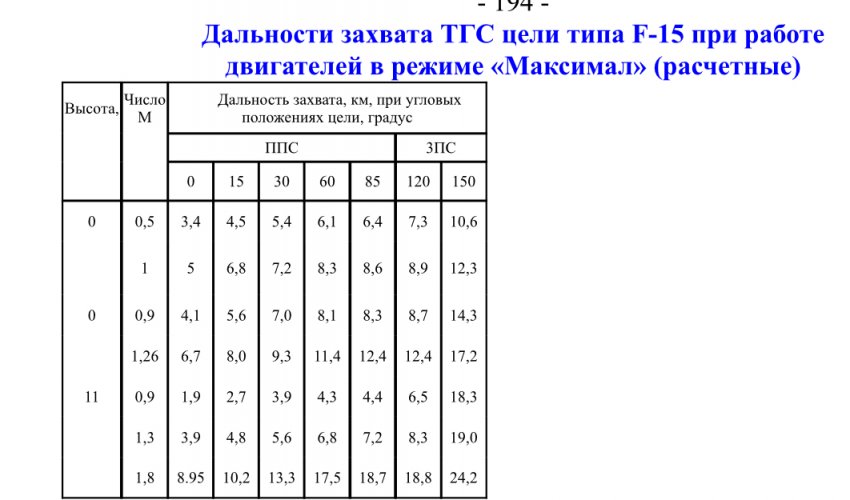
Now some question in relationship with newer and maybe more capable 36T. As we can see on this page ,we have max launch ranges against F-15 flying on MP ( so non-AB ) mode.

36T 1.jpeg

From angle aspects 0 to 1/4 ( +/- 15° ) we must count on the aircraft's skin temp ( about 100°C ??? ), incoming fighter flying on the non AB mode. 36T can lock on that target from about 10 km.

Now what about the max launch ranges for the incoming fighter flying on the Max AB mode? From the Su-27SK F.M. we have that max values :

No 3 for the R-27T1 =33km ,No 4 for the R-27ET1 =52.5km

zonypuska mod.jpg

Those values are for the troposphere,fighter's and the target's height : 0-10km as it is mentioned in the table. In the stratosphere,max launch ranges would be much greater ?

Now if we compare those launch ranges of the older TGS-23 and 24 with '36T' , maybe these values are possible to achieve in the real combat situation ?

Also as we can see max controlable flight time of the R-23 is 35 sec,for R-24 is 45 sec and for the R-27 is 60sec. Now the real question is ,what is the value for the max controlable flight time / time of the aerodynamic stability and controlability/ ,for the ''energetic'' R-27E with its 100kg booster ( 7500kgf of thrust)? It can not be the same for R-27 and R-27E ? If it is ,than where is the logic to have one 250kg heavy AAM and one 100kg heavier ( 350kg) heavy AAM ?

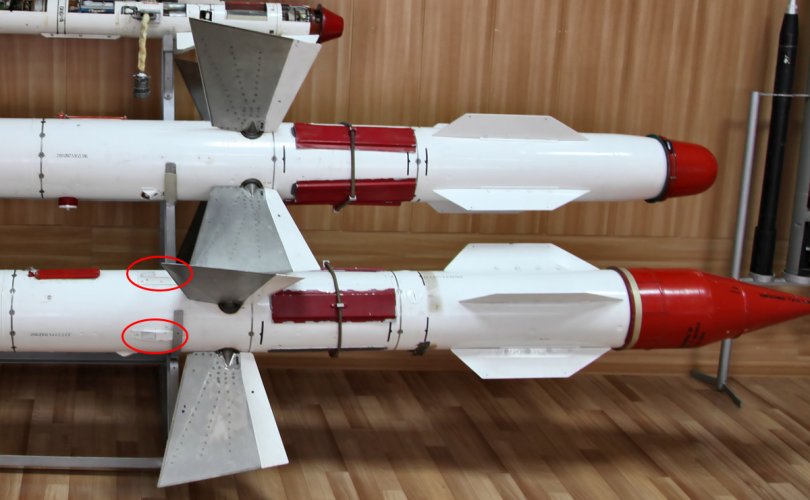
Again, as we know R-27T/ET ( T1/ET1) have no RC channel receive antennas and are IR guided AAM's with LOBL only. On the pic are RC -channel antennas on the R-27R/ER.

R-27T, ET and R-27R,ER.jpg

I think that '36T' can lock-on target from much greater distance then older TGS-23/24 could/can. '36T' is not integrated into long range R-27ET w/o the reason and we know that R-27ER e.g. has max launch range against big incoming target even 130km. Of course, thanks to the inertial guidance with use of the RC-channel and the SARH in the terminal phase.

From the Radionix 's advertising material ,we can see that '36T' can lock on incoming fighter flying on non-AB mode from 16-18km range ( 10°-30°) in the forward hemisphere and can lock on receding fighter( non AB mode? ) ,in the rear hemisphere ( 170°-180° ) from 60-80km.
For comparison : IRST OLS-27 can detect fighter flying on non AB mode in the rear hemisphere from 50km ( 0/4-2/4) in ideal weather cond. ,from 20-35km against a cloudy background and ground /sea surface.Then 90- 100km for the incoming fighter flying on Full AB mode ( 1/4 ) where lock on range is 70% of detection range.

Is it possible that max launch range with R-27T can be 50km and with R-27ET maybe 70 km or more during engagement in the stratosphere ? Of course ,in the cases where we have incoming fighter flying on Max AB mode ?

About lock-on capabilities of one IR seeker ( surface temp of the Sun is about 5500°C).

R-74M Sun lock on.jpeg
 
I've collected some material from this and other topics ( photos,data,info, etc) and have some questions ...

We already commented this :

''The permitted launch ranges of the R-27ET missile are almost the same as those of the R-27ER missile, but in the PPS, they are limited by the TGS target acquisition range.''

This is IR seeker type '36T' from R-27T/ET ( exported T1/ET1) .It works in the MWIR band ( 3μm-5μm ).

View attachment 795655


Now as we can see, older TGS-23 from the R-23T can lock-on target from 34km.

''The R-23T was lighter at 215 kg (474 lb) and used a liquid nitrogen-cooled IR seeker which required it be locked on to the target before launching, either by the launching aircraft's radar or IRST''.

View attachment 795656

For the max values or the max launch range : Target aspect can only be forward hemisphere, head to head -incoming course. Target engine settings can only be Full/Max AB mode .Some details about target's angle aspect we have here :

View attachment 795657

0/4 - view strictly in front or behind the aircraft
1/4 - +/-15° or right / left front or rear
2/4 - +/-30° or right / left front or rear
3/4 - +/-60° or right / left front or rear
4/4 - +/-90° ,perpendicular to the side of the aircraft

Altitude, as we know in the dry and cold stratosphere /10-50km/ where temp. is about minus 60°C - minus 90°C ( depends on latitude) ,there is greatest possibility for the max detection/tracking from the fighter's IRST and the AAM's IR seeker. Especially when we talk about fighters flying on the Full AB mode ( temp is higher then 1000°C).

If we choose that incoming target's flight parameters are next : angle aspect from 0/4 to 1/4 ( 0 to +/15° ) , Full AB mode and flying in the cold stratosphere we have max( authorised) launch range against incoming flighter flying provided by the TGS-23?

With newer TGS-24 max launch range can be even 50km or TGS-24 can lock on incoming target from 50km?

View attachment 795671

Now some question in relationship with newer and maybe more capable 36T. As we can see on this page ,we have max launch ranges against F-15 flying on MP ( so non-AB ) mode.

View attachment 795672

From angle aspects 0 to 1/4 ( +/- 15° ) we must count on the aircraft's skin temp ( about 100°C ??? ), incoming fighter flying on the non AB mode. 36T can lock on that target from about 10 km.

Now what about the max launch ranges for the incoming fighter flying on the Max AB mode? From the Su-27SK F.M. we have that max values :

No 3 for the R-27T1 =33km ,No 4 for the R-27ET1 =52.5km

View attachment 795674

Those values are for the troposphere,fighter's and the target's height : 0-10km as it is mentioned in the table. In the stratosphere,max launch ranges would be much greater ?

Now if we compare those launch ranges of the older TGS-23 and 24 with '36T' , maybe these values are possible to achieve in the real combat situation ?

Also as we can see max controlable flight time of the R-23 is 35 sec,for R-24 is 45 sec and for the R-27 is 60sec. Now the real question is ,what is the value for the max controlable flight time / time of the aerodynamic stability and controlability/ ,for the ''energetic'' R-27E with its 100kg booster ( 7500kgf of thrust)? It can not be the same for R-27 and R-27E ? If it is ,than where is the logic to have one 250kg heavy AAM and one 100kg heavier ( 350kg) heavy AAM ?

Again, as we know R-27T/ET ( T1/ET1) have no RC channel receive antennas and are IR guided AAM's with LOBL only. On the pic are RC -channel antennas on the R-27R/ER.

View attachment 795675

I think that '36T' can lock-on target from much greater distance then older TGS-23/24 could/can. '36T' is not integrated into long range R-27ET w/o the reason and we know that R-27ER e.g. has max launch range against big incoming target even 130km. Of course, thanks to the inertial guidance with use of the RC-channel and the SARH in the terminal phase.

From the Radionix 's advertising material ,we can see that '36T' can lock on incoming fighter flying on non-AB mode from 16-18km range ( 10°-30°) in the forward hemisphere and can lock on receding fighter( non AB mode? ) ,in the rear hemisphere ( 170°-180° ) from 60-80km.
For comparison : IRST OLS-27 can detect fighter flying on non AB mode in the rear hemisphere from 50km ( 0/4-2/4) in ideal weather cond. ,from 20-35km against a cloudy background and ground /sea surface.Then 90- 100km for the incoming fighter flying on Full AB mode ( 1/4 ) where lock on range is 70% of detection range.

Is it possible that max launch range with R-27T can be 50km and with R-27ET maybe 70 km or more during engagement in the stratosphere ? Of course ,in the cases where we have incoming fighter flying on Max AB mode ?

About lock-on capabilities of one IR seeker ( surface temp of the Sun is about 5500°C).

View attachment 795677
Yes R-27E has identical flight time to non-E, it is the same guts so to say. Same electronic insides. Same battery. Only difference is the motor and some programming so it tells the pylon that it’s an ER and not an R. Why question the logic? As we see, 60 seconds was enough time for both R and ER to reach their design ranges of 90/130 km in best conditions. It was enough, so there was no need to change it and upset the modularity of the missile that was its strength. In a regular shot, 60 seconds is far far longer then R-27R would typically fly in a usual engagement I bet. A fast shot at 20-30 km would take about 20-25 seconds. At low altitudes the missile will always be out of energy by 30-40 seconds. When we look at fly out chart you see that more then 50 second flight time only possible at 10 km over Mach 2 launch speed.
 
Yes R-27E has identical flight time to non-E, it is the same guts so to say. Same electronic insides. Same battery. Only difference is the motor and some programming so it tells the pylon that it’s an ER and not an R. Why question the logic? As we see, 60 seconds was enough time for both R and ER to reach their design ranges of 90/130 km in best conditions. It was enough, so there was no need to change it and upset the modularity of the missile that was its strength. In a regular shot, 60 seconds is far far longer then R-27R would typically fly in a usual engagement I bet. A fast shot at 20-30 km would take about 20-25 seconds. At low altitudes the missile will always be out of energy by 30-40 seconds. When we look at fly out chart you see that more then 50 second flight time only possible at 10 km over Mach 2 launch speed.

Hmm ,yes, maybe you're right, but but. There is more details and things we can discuss. Example and comparison :

R-27R/R1 ,250kg heavy,with its single chamber ,single stage rocket engine ,so max controlable flight time is 60sec.From the book :

"Бортовой комплекс самолётовождения, прицеливания и управления вооружением самолёта МиГ-29Б (СУВ-29Э и сопрягаемые системы)"

We can read that max launch distance can be 90km against incoming big air target ( supersonic-stratosferic launch from max 16km of alt with use of the 'Gorka'/climb to engage target which flies at max 26km .That is because R-27R/ER have no loft capabilities. So target in this case is also supersonic ,stratospheric height of course. Maybe in this case we have that 60sec of controlable flight time.We also know that N019/E has that DNP mode ( quasi continuous wave illumination ) for use of the R-27R/R1 which lasts exactly 60sec.

Also we have data for the N019/E and the R-27R/R1:

''Для обеспечения заданной вероятности поражения цели в различных условиях максимальная разрешенная дальность пуска ракеты в ППС, вычисляемая в БЦВМ РЛПК, ограничена до 90, 70 и 30 км соответственно для большой, средней и малой цели.''

''To ensure a given probability of hitting a target under various conditions, the maximum permitted missile launch range in the forward hemisphere , calculated in the radars's onboard computer, is limited to 90, 70 and 30 km, respectively, for large, medium and small targets.''

R-27ER/ER1, 350kg heavy,double chamber,dual stage rocket engine ( booster with 7500kgf of thrust lasting about 10sec). OK we have that 60sec .I think that R-27E is even faster than R-27R with greater Mach number after acceleration phase ended .

''За время работы двигатель при пуске ракеты обеспечивает приращение скорости ракеты к скорости полета истребителя для Р-27ЭР (ЭП) до 800—1000 м/с и для Р-27ЭТ до 700—1100 м/с.''

"During its operation, the engine during missile launch provides an increase in the missile's speed to the fighter's flight speed for the R-27ER (EP) up to 800-1000 m/s and for the R-27ET up to 700-1100 m/s."

We know that max ( possible,authorised or calculated whatever) ,launch range against some big incoming target can be 130km.That is almost 50% greater than in R-27R's case.

So the total flight time of the R-27ER can be those 60sec in the case of the launch range of 130km. Parameters are the same as previous : supersonic-stratosferic launch vs supersonic-stratospheric flying target.

Some interesting details and data about the R-27ER and that RC-channel :

'' Ракета Р-27ЭР с полуактивной РГС обеспечивает с достаточной вероятностью (Р=0,5—0,85) поражение воздушных целей днем и ночью в простых и сложных метеорологических условиях (в облаках) при атаке под различными ракурсами, в том числе и на фоне различных подстилающих поверхностей земли и моря, а также поражение целей, летящих на высотах от 30 м до 25— 27 км со скоростью до 3500 км/ч, при активном маневренном, помеховом и огневом противодействии противника.Мала вероятность поражения малоразмерных низколетящих целей при пуске ракет Р-27ЭР с максимальных дальностей (Р=0,1—0,2) из-за влияния переотражения сигнала от подстилающей поверхности (антипод) на систему управления ракетой и недостаточной точности выдачи целеуказания ракете от РЛПК-29. В связи с этим до устранения указанного недостатка пуск ракет Р-27ЭР на высотах 4 км и менее по низколетящим малоразмерным целям (тип цели — малая) целесообразно производить с дальности 2 км и менее в ЗПС и 12 км и менее в ППС.

Минимальная скорость поражаемых целей ограничена боевыми возможностями РЛПК.

На ракетах с полуактивной РГС применены комбинированная система инерциального наведения с радиокоррекцией и полуактивное радиолокационное самонаведение после захвата цели РГС, которое происходит в конце инерциального участка на разрешенных дальностях захвата. Разрешенные дальности захвата РГС составляют: при пуске по бомбардировщикам — 40 км, по истребителям — 25 км, по крылатым ракетам — 12 км. Тип атакуемой цели устанавливается летчиком вручную по информации с НАСУ с помощью рукоятки БАЗА (Б, С или М).

Радиокоррекция инерциального участка полета ракеты введена для повышения точности наведения в случае маневра цели после пуска, а также для исправления ошибок начальных условий пуска, что значительно увеличивает вероятность захвата цели РГС и позволяет полностью использовать баллистические характеристики ракеты (при радиокоррекции Др.max 1=2,5 Др. захв ргс, без радиокоррекции Др. max1= 1,3 Др. захв ргс ). Радиокоррекция инерциального участка полета ракеты включается на дальностях пуска, превышающих в 1,5 раза разрешенную дальность захвата цели РГС, и отключается при достижении разрешенной дальности захвата цели РГС.​

В связи с тем что информация по крену при радиокоррекции обновляется с частотой 18—20 Гц, сигналы радиокоррекции правильно выдаются только при угловой скорости вращения истребителя не более 60°/с (при применении ракет выпуска до июля 1986 г. — не более 30°/с). По этой причине не обеспечивается наведение ракеты Р-27ЭР на цель в инерциально-корректируемом режиме при выполнении истребителем противоракетного маневра типа «кадушка».

Суть радиокоррекции заключается в следующем. До схода ракеты ее РГС отрабатывает углы целеуказания от РЛПК-29. В момент схода вычислитель РГС запоминает начальное положение и скорость цели в системе координат, связанной с антенной РГС, вычисленные БЦВМ системы управления вооружением и переданные на ракету. После схода антенна гиростабилизируется и вычислитель РГС, интегрируя показания датчика линейных ускорений и запомненную скорость цели, вычисляет взаимное положение цели и ракеты. Управление ракетой построено так, чтобы к моменту предполагаемого захвата РГС направление ее антенны совпадало с линией визирования на цель. При этом захват цели возможен, если она летит прямолинейно к не изменяет скорость полета. Если же цель выполняет маневр, захват ее без радиокоррекции невозможен.

При наличии радиокоррекции на борту самолета в БЦВМ вычисляется положение цели по алгоритму бортового вычислителя ракеты. Вычисленные координаты цели сравниваются с измеренными РЛПК-29 координатами цели. Полученные поправки по линии радиокоррекции передаются на ракету, по которым корректируется траектория ее полета. После захвата РГС цели осуществляется ее автоматическое сопровождение по углам и частоте и наведение ракеты по методу пропорционального сближения.''

''The R-27ER missile with a semi-active radar provides with a sufficient probability (P = 0.5-0.85) of hitting air targets day and night in simple and difficult meteorological conditions (in clouds) when attacking from various angles, including against the background of various underlying surfaces of the earth and sea, as well as hitting targets, flying at altitudes from 30 m to 25-27 km at speeds up to 3500 km/h, under active maneuvering, jamming and fire countermeasures from the enemy.

The probability of hitting small-sized low-flying targets when launching R-27ER missiles from maximum ranges (P=0.1–0.2) is low due to the influence of signal reflection from the underlying surface (antipode) on the missile control system and the insufficient accuracy of target designation to the missile from the RLPK-29.
In this regard, until the said deficiency is eliminated, it is advisable to launch R-27ER missiles at altitudes of 4 km or less against low-flying small-sized targets (target type - small) from a range of 2 km or less in the ZPS and 12 km or less in the PPS.

The minimum speed of targets hit is limited by the combat capabilities of the radar.

Missiles with a semi-active radar homing system use a combined inertial guidance system with radio correction and semi-active radar homing after the radar homing system has captured the target, which occurs at the end of the inertial section at the permitted acquisition ranges. The permitted target acquisition ranges for the radar are: 40 km against bombers, 25 km against fighters, and 12 km against cruise missiles. The pilot manually selects the target type based on information from the GCI using the BASE (B, M, or S) control.
Radio correction of the inertial phase of the missile's flight was introduced to improve the accuracy of guidance in the event of a target maneuver after launch, as well as to correct errors in the initial launch conditions, which significantly increases the probability of target acquisition by the radar and allows full use of the missile’s ballistic characteristics (with radio correction Dr.max 1=2.5 Dr. capture radar, without radio correction Dr.max1=1.3 Dr. capture radar).

The radio correction of the inertial section of the missile's flight is switched on at launch ranges exceeding the permitted target acquisition range of the radar by 1.5 times, and is switched off when the permitted target acquisition range of the radar is reached.Due to the fact that the roll information during radio correction is updated at a frequency of 18-20 Hz, radio correction signals are correctly issued only when the angular velocity of rotation of the fighter is no more than 60°/s (when using missiles manufactured before July 1986 - no more than 30°/s). For this reason, the R-27ER missile cannot be guided to the target in an inertial-corrected mode when the fighter performs a “bucket” type anti-missile maneuver.

The essence of radio correction is as follows. Before the missile's launch, its radar receiver processes targeting angles from the radar-guided targeting system (RLPK-29). At the moment of launch, the radar receiver's computer stores the target's initial position and velocity in the coordinate system linked to the radar receiver's antenna, calculated by the weapon control system's onboard computer and transmitted to the missile.
After launching, the antenna is gyrostabilized, and the radar computer, integrating the linear acceleration sensor readings and the stored target velocity, calculates the relative positions of the target and the missile. Missile control is designed so that by the time of expected acquisition, the radar's antenna's direction coincides with the target's line of sight.

Target acquisition is possible if it flies straight and maintains its speed. However, if the target maneuvers, acquisition is impossible without radio correction.
If radio correction is available onboard the aircraft, the onboard computer calculates the target's position using the missile's onboard computer algorithm. The calculated target coordinates are compared with those measured by the RLPK-29.The received corrections are transmitted to the missile via the radio correction line, which adjusts its flight trajectory. Once the radar acquires the target, it is automatically tracked by angles and frequency, and the missile is guided using the proportional approach method.''


I underlined '25-27km' as something questionable because Su-27S/SK can fly at 18km armed with four R-27ER/ER1 's with which is possible to engage target flying 12km above fighter. Value of 3500 km/h is suspicious because max speed of the aircraft detected and tracked in the V/PPS- HPRF mode of the N019/E and N001/E is 2500km/h.

This is also one interesting detail from the Su-27SK F.M.

''При пуске ракет с РГС в режиме НПО РЛПК переходит в режим ДНП на 60 сек, в течение которых необходимо продолжать отслеживать цель, если цель не будет поражена раньше.''

''When launching missiles with a radar in the NPO mode, the radar-guided missile system switches to the DNP mode for 60 seconds, during which it is necessary to continue tracking the target, unless the target is hit earlier.''

НПО (NPO) -неполное приборное обеспечение (incomplete instrumentation)
ППO (PPO) -полное приборное обеспечение ( full instrumentation)

Now ,for how long lasts DNP mode in the PPO?

 
Hmm ,yes, maybe you're right, but but. There is more details and things we can discuss. Example and comparison :

R-27R/R1 ,250kg heavy,with its single chamber ,single stage rocket engine ,so max controlable flight time is 60sec.From the book :

"Бортовой комплекс самолётовождения, прицеливания и управления вооружением самолёта МиГ-29Б (СУВ-29Э и сопрягаемые системы)"

We can read that max launch distance can be 90km against incoming big air target ( supersonic-stratosferic launch from max 16km of alt with use of the 'Gorka'/climb to engage target which flies at max 26km .That is because R-27R/ER have no loft capabilities. So target in this case is also supersonic ,stratospheric height of course. Maybe in this case we have that 60sec of controlable flight time.We also know that N019/E has that DNP mode ( quasi continuous wave illumination ) for use of the R-27R/R1 which lasts exactly 60sec.

Also we have data for the N019/E and the R-27R/R1:

''Для обеспечения заданной вероятности поражения цели в различных условиях максимальная разрешенная дальность пуска ракеты в ППС, вычисляемая в БЦВМ РЛПК, ограничена до 90, 70 и 30 км соответственно для большой, средней и малой цели.''

''To ensure a given probability of hitting a target under various conditions, the maximum permitted missile launch range in the forward hemisphere , calculated in the radars's onboard computer, is limited to 90, 70 and 30 km, respectively, for large, medium and small targets.''

R-27ER/ER1, 350kg heavy,double chamber,dual stage rocket engine ( booster with 7500kgf of thrust lasting about 10sec). OK we have that 60sec .I think that R-27E is even faster than R-27R with greater Mach number after acceleration phase ended .

''За время работы двигатель при пуске ракеты обеспечивает приращение скорости ракеты к скорости полета истребителя для Р-27ЭР (ЭП) до 800—1000 м/с и для Р-27ЭТ до 700—1100 м/с.''

"During its operation, the engine during missile launch provides an increase in the missile's speed to the fighter's flight speed for the R-27ER (EP) up to 800-1000 m/s and for the R-27ET up to 700-1100 m/s."

We know that max ( possible,authorised or calculated whatever) ,launch range against some big incoming target can be 130km.That is almost 50% greater than in R-27R's case.

So the total flight time of the R-27ER can be those 60sec in the case of the launch range of 130km. Parameters are the same as previous : supersonic-stratosferic launch vs supersonic-stratospheric flying target.

Some interesting details and data about the R-27ER and that RC-channel :

'' Ракета Р-27ЭР с полуактивной РГС обеспечивает с достаточной вероятностью (Р=0,5—0,85) поражение воздушных целей днем и ночью в простых и сложных метеорологических условиях (в облаках) при атаке под различными ракурсами, в том числе и на фоне различных подстилающих поверхностей земли и моря, а также поражение целей, летящих на высотах от 30 м до 25— 27 км со скоростью до 3500 км/ч, при активном маневренном, помеховом и огневом противодействии противника.Мала вероятность поражения малоразмерных низколетящих целей при пуске ракет Р-27ЭР с максимальных дальностей (Р=0,1—0,2) из-за влияния переотражения сигнала от подстилающей поверхности (антипод) на систему управления ракетой и недостаточной точности выдачи целеуказания ракете от РЛПК-29. В связи с этим до устранения указанного недостатка пуск ракет Р-27ЭР на высотах 4 км и менее по низколетящим малоразмерным целям (тип цели — малая) целесообразно производить с дальности 2 км и менее в ЗПС и 12 км и менее в ППС.

Минимальная скорость поражаемых целей ограничена боевыми возможностями РЛПК.

На ракетах с полуактивной РГС применены комбинированная система инерциального наведения с радиокоррекцией и полуактивное радиолокационное самонаведение после захвата цели РГС, которое происходит в конце инерциального участка на разрешенных дальностях захвата. Разрешенные дальности захвата РГС составляют: при пуске по бомбардировщикам — 40 км, по истребителям — 25 км, по крылатым ракетам — 12 км. Тип атакуемой цели устанавливается летчиком вручную по информации с НАСУ с помощью рукоятки БАЗА (Б, С или М).

Радиокоррекция инерциального участка полета ракеты введена для повышения точности наведения в случае маневра цели после пуска, а также для исправления ошибок начальных условий пуска, что значительно увеличивает вероятность захвата цели РГС и позволяет полностью использовать баллистические характеристики ракеты (при радиокоррекции Др.max 1=2,5 Др. захв ргс, без радиокоррекции Др. max1= 1,3 Др. захв ргс ). Радиокоррекция инерциального участка полета ракеты включается на дальностях пуска, превышающих в 1,5 раза разрешенную дальность захвата цели РГС, и отключается при достижении разрешенной дальности захвата цели РГС.​

В связи с тем что информация по крену при радиокоррекции обновляется с частотой 18—20 Гц, сигналы радиокоррекции правильно выдаются только при угловой скорости вращения истребителя не более 60°/с (при применении ракет выпуска до июля 1986 г. — не более 30°/с). По этой причине не обеспечивается наведение ракеты Р-27ЭР на цель в инерциально-корректируемом режиме при выполнении истребителем противоракетного маневра типа «кадушка».

Суть радиокоррекции заключается в следующем. До схода ракеты ее РГС отрабатывает углы целеуказания от РЛПК-29. В момент схода вычислитель РГС запоминает начальное положение и скорость цели в системе координат, связанной с антенной РГС, вычисленные БЦВМ системы управления вооружением и переданные на ракету. После схода антенна гиростабилизируется и вычислитель РГС, интегрируя показания датчика линейных ускорений и запомненную скорость цели, вычисляет взаимное положение цели и ракеты. Управление ракетой построено так, чтобы к моменту предполагаемого захвата РГС направление ее антенны совпадало с линией визирования на цель. При этом захват цели возможен, если она летит прямолинейно к не изменяет скорость полета. Если же цель выполняет маневр, захват ее без радиокоррекции невозможен.

При наличии радиокоррекции на борту самолета в БЦВМ вычисляется положение цели по алгоритму бортового вычислителя ракеты. Вычисленные координаты цели сравниваются с измеренными РЛПК-29 координатами цели. Полученные поправки по линии радиокоррекции передаются на ракету, по которым корректируется траектория ее полета. После захвата РГС цели осуществляется ее автоматическое сопровождение по углам и частоте и наведение ракеты по методу пропорционального сближения.''

''The R-27ER missile with a semi-active radar provides with a sufficient probability (P = 0.5-0.85) of hitting air targets day and night in simple and difficult meteorological conditions (in clouds) when attacking from various angles, including against the background of various underlying surfaces of the earth and sea, as well as hitting targets, flying at altitudes from 30 m to 25-27 km at speeds up to 3500 km/h, under active maneuvering, jamming and fire countermeasures from the enemy.

The probability of hitting small-sized low-flying targets when launching R-27ER missiles from maximum ranges (P=0.1–0.2) is low due to the influence of signal reflection from the underlying surface (antipode) on the missile control system and the insufficient accuracy of target designation to the missile from the RLPK-29.
In this regard, until the said deficiency is eliminated, it is advisable to launch R-27ER missiles at altitudes of 4 km or less against low-flying small-sized targets (target type - small) from a range of 2 km or less in the ZPS and 12 km or less in the PPS.

The minimum speed of targets hit is limited by the combat capabilities of the radar.

Missiles with a semi-active radar homing system use a combined inertial guidance system with radio correction and semi-active radar homing after the radar homing system has captured the target, which occurs at the end of the inertial section at the permitted acquisition ranges. The permitted target acquisition ranges for the radar are: 40 km against bombers, 25 km against fighters, and 12 km against cruise missiles. The pilot manually selects the target type based on information from the GCI using the BASE (B, M, or S) control.
Radio correction of the inertial phase of the missile's flight was introduced to improve the accuracy of guidance in the event of a target maneuver after launch, as well as to correct errors in the initial launch conditions, which significantly increases the probability of target acquisition by the radar and allows full use of the missile’s ballistic characteristics (with radio correction Dr.max 1=2.5 Dr. capture radar, without radio correction Dr.max1=1.3 Dr. capture radar).

The radio correction of the inertial section of the missile's flight is switched on at launch ranges exceeding the permitted target acquisition range of the radar by 1.5 times, and is switched off when the permitted target acquisition range of the radar is reached.Due to the fact that the roll information during radio correction is updated at a frequency of 18-20 Hz, radio correction signals are correctly issued only when the angular velocity of rotation of the fighter is no more than 60°/s (when using missiles manufactured before July 1986 - no more than 30°/s). For this reason, the R-27ER missile cannot be guided to the target in an inertial-corrected mode when the fighter performs a “bucket” type anti-missile maneuver.

The essence of radio correction is as follows. Before the missile's launch, its radar receiver processes targeting angles from the radar-guided targeting system (RLPK-29). At the moment of launch, the radar receiver's computer stores the target's initial position and velocity in the coordinate system linked to the radar receiver's antenna, calculated by the weapon control system's onboard computer and transmitted to the missile.
After launching, the antenna is gyrostabilized, and the radar computer, integrating the linear acceleration sensor readings and the stored target velocity, calculates the relative positions of the target and the missile. Missile control is designed so that by the time of expected acquisition, the radar's antenna's direction coincides with the target's line of sight.

Target acquisition is possible if it flies straight and maintains its speed. However, if the target maneuvers, acquisition is impossible without radio correction.
If radio correction is available onboard the aircraft, the onboard computer calculates the target's position using the missile's onboard computer algorithm. The calculated target coordinates are compared with those measured by the RLPK-29.The received corrections are transmitted to the missile via the radio correction line, which adjusts its flight trajectory. Once the radar acquires the target, it is automatically tracked by angles and frequency, and the missile is guided using the proportional approach method.''


I underlined '25-27km' as something questionable because Su-27S/SK can fly at 18km armed with four R-27ER/ER1 's with which is possible to engage target flying 12km above fighter. Value of 3500 km/h is suspicious because max speed of the aircraft detected and tracked in the V/PPS- HPRF mode of the N019/E and N001/E is 2500km/h.

This is also one interesting detail from the Su-27SK F.M.

''При пуске ракет с РГС в режиме НПО РЛПК переходит в режим ДНП на 60 сек, в течение которых необходимо продолжать отслеживать цель, если цель не будет поражена раньше.''

''When launching missiles with a radar in the NPO mode, the radar-guided missile system switches to the DNP mode for 60 seconds, during which it is necessary to continue tracking the target, unless the target is hit earlier.''

НПО (NPO) -неполное приборное обеспечение (incomplete instrumentation)
ППO (PPO) -полное приборное обеспечение ( full instrumentation)

Now ,for how long lasts DNP mode in the PPO?
That is becuase these numbers are for the target, not the launching aircraft. 18 km ceiling right? Well. DeltaH can go 10 km up, so that’s how we target someone flying at 27-28 km. R/T gives max altitude of 25 km and 27 for E variant.

And while N-019 has a 2500 kmh head on speed limit in head on mode. This is radial speed so to say, so it’s a 5,000 kmh speed limit if the target is traveling at a 60 degree angle. So you could target someone at 3500 kmh, just at an angle.
 
That is becuase these numbers are for the target, not the launching aircraft. 18 km ceiling right? Well. DeltaH can go 10 km up, so that’s how we target someone flying at 27-28 km. R/T gives max altitude of 25 km and 27 for E variant.

And while N-019 has a 2500 kmh head on speed limit in head on mode. This is radial speed so to say, so it’s a 5,000 kmh speed limit if the target is traveling at a 60 degree angle. So you could target someone at 3500 kmh, just at an angle.

Take a look on the table which I posted previously. For No 6 it is for teh R/27ER1 ,yes we can see target's alt as 20m-27000m, but Su-27S/SK with max four R-27ER/ER1 can reach Mach 2.2 at 18km and can engage target which flies 12km above .So that is 30km.

Example , with R-27R1/T1 and ER1/ET1 attached on the underwing stations No 3 and 4 ,Su-27SK can reach 15000-18000m of height with max Mach number 2.2

This is also very interesting :

''При срыве захвата цели РЛПК, после схода ракеты с РГС и повторном захвате той же цели, режим ДНП для пущенной ракеты не возобновляется.''

''After the launch of R-27R/ER ( R1/ER1) ,DNP is activated but if target is lost ( went out of the radar cone-scan zone) ,new radars's lock on of the target is required but in that case DNP mode will be no more used.''
 
Take a look on the table which I posted previously. For No 6 it is for teh R/27ER1 ,yes we can see target's alt as 20m-27000m, but Su-27S/SK with max four R-27ER/ER1 can reach Mach 2.2 at 18km and can engage target which flies 12km above .So that is 30km.

Example , with R-27R1/T1 and ER1/ET1 attached on the underwing stations No 3 and 4 ,Su-27SK can reach 15000-18000m of height with max Mach number 2.2

This is also very interesting :

''При срыве захвата цели РЛПК, после схода ракеты с РГС и повторном захвате той же цели, режим ДНП для пущенной ракеты не возобновляется.''

''After the launch of R-27R/ER ( R1/ER1) ,DNP is activated but if target is lost ( went out of the radar cone-scan zone) ,new radars's lock on of the target is required but in that case DNP mode will be no more used.''
Yes, it seems a difference of Su-27 and MiG-29 that breaking lock turns off the datalink process in Su-27, but in MiG-29 breaking lock does not stop datalink

Where do you get that Su-27 can attack a 11 km higher target? DeltaH knob only goes to +10. Unlike MiG-29 also goes -10, which must be really nice over MiG limiting you to -6
 
Where do you get that Su-27 can attack a 11 km higher target? DeltaH knob only goes to +10. Unlike MiG-29 also goes -10, which must be really nice over MiG limiting you to -6

I've posted table for the launch ranges of the R-27/E ( from the 'Su-27SK F.M.' ) on this page and we can see that with R-27ER1/ET1 it is possible to engage target flying +/- 12km ( for the No 4 and 6 ).

One more thing, in that F.M. we can find info that pilot of the Su-27SK is strictly forbidden to fly at the same height as his target.
 
Well for Su-27 to target one one so high up would require enough distance for the upper 2 bars of the scan to detect the target 2 km higher then the highest deltaH setting of 10 km, or use datalink to slew the antenna, or descend after locking a target flying above 12 km.
 
Well for Su-27 to target one one so high up would require enough distance for the upper 2 bars of the scan to detect the target 2 km higher then the highest deltaH setting of 10 km, or use datalink to slew the antenna, or descend after locking a target flying above 12 km.

In either way ,pilot will use 'Gorka' (Г↑) оr 'pop out' maneuver. From F.M. , there is also interesting detail:

Переключатель НАВЕД АВТ-РУЧН с положениями:

АВТ – для включения автоматического управления центром зоны обзора РЛПК или ОЛС, излучения РЛПК при работе истребителя в поле наведения наземной автоматизированной системы управления (НАСУ) или при целеуказании с ведущего самолёта и для автоматического ввода дальности с НАСУ после захвата цели РЛПК в режиме НПО или ОЛС;​

РУЧН – для управления центром зоны РЛПК или ОЛС вручную и ручного ввода дальности.

Три кнопки: ←, ↑, → – для ручного управления центром зоны обзора РЛПК или ОЛС. При нажатии кнопки центр зоны смещается в сторону, указанную стрелкой, на половину величины зоны обзора.

''Переключатель ΔН на 11 положений (0, 2, 4, 6, 8, 10, -2, -4, -6, -8, -10) для установки центра зоны обзора РЛПК или ОЛС по углу места при ручном управлении.''

Swicth GUIDANCE AUTO-MANUAL with positions:

AVT – to enable automatic control of the center of the scanning area or the radar or IRST, radar's illumination when the fighter is operating in the guidance field of the ground-based automated control system (GAS) or when target designation is provided by the lead aircraft, and to automatically enter the range from the GAS after lock on by the radar in the NPO mode or IRST;

MANUAL – for manual control of the zone 's center of the radar or IRST and manual range input.

Three buttons: ←, ↑, → – for manual control of the center of the search zone for radar or IRST. Pressing a button shifts the center of the zone in the direction indicated by the arrow by half the detection zone's size.

Switch ΔН with 11 positions (0, 2, 4, 6, 8, 10, -2, -4, -6, -8, -10) for setting the search zone center of the radar or IRST by elevation during manual control.

There is maybe possibility that in automatic control mode,radar /IRST can scan for that '+/-12km ' in the elevation.
 
Last edited:
In either way ,pilot will use 'Gorka' (Г↑) оr 'pop out' maneuver. From F.M. , there is also interesting detail:

Переключатель НАВЕД АВТ-РУЧН с положениями:

АВТ – для включения автоматического управления центром зоны обзора РЛПК или ОЛС, излучения РЛПК при работе истребителя в поле наведения наземной автоматизированной системы управления (НАСУ) или при целеуказании с ведущего самолёта и для автоматического ввода дальности с НАСУ после захвата цели РЛПК в режиме НПО или ОЛС;​

РУЧН – для управления центром зоны РЛПК или ОЛС вручную и ручного ввода дальности.

Три кнопки: ←, ↑, → – для ручного управления центром зоны обзора РЛПК или ОЛС. При нажатии кнопки центр зоны смещается в сторону, указанную стрелкой, на половину величины зоны обзора.

''Переключатель ΔН на 11 положений (0, 2, 4, 6, 8, 10, -2, -4, -6, -8, -10) для установки центра зоны обзора РЛПК или ОЛС по углу места при ручном управлении.''

Swicth GUIDANCE AUTO-MANUAL with positions:

AVT – to enable automatic control of the center of the scanning area or the radar or IRST, radar's illumination when the fighter is operating in the guidance field of the ground-based automated control system (GAS) or when target designation is provided by the lead aircraft, and to automatically enter the range from the GAS after lock on by the radar in the NPO mode or IRST;

MANUAL – for manual control of the zone 's center of the radar or IRST and manual range input.

Three buttons: ←, ↑, → – for manual control of the center of the search zone for radar or IRST. Pressing a button shifts the center of the zone in the direction indicated by the arrow by half the detection zone's size.

Switch ΔН with 11 positions (0, 2, 4, 6, 8, 10, -2, -4, -6, -8, -10) for setting the search zone center of the radar or IRST by elevation during manual control.

There is maybe possibility that in automatic control mode,radar /IRST can scan for that '+/-12km ' in the elevation.
Gorka isn’t a mode but the targeting circle being biased by your deltaH position to guide you to fly to maintain an altitude difference from the target until within missile range. Once you see “r/G” on HUD you know the circle now shows actual missile aiming point.
 
Gorka isn’t a mode but the targeting circle being biased by your deltaH position to guide you to fly to maintain an altitude difference from the target until within missile range. Once you see “r/G” on HUD you know the circle now shows actual missile aiming point.

Nobody wrote that 'Gorka' is some kind of mode. It 's simply maneuver recommended to pilot by the WCS comp. You have ''Г↑'' and ''Г↓'' symbols on the HUD.
 
In this regard, until the said deficiency is eliminated, it is advisable to launch R-27ER missiles at altitudes of 4 km or less against low-flying small-sized targets (target type - small) from a range of 2 km or less in the ZPS and 12 km or less in the PPS.
what source stated this?
 
I think this was not posted.
From book ИСТРЕБИТЕЛЬ Cy-27 НАЧАЛО ИСТОРИИ pages 267, 268

I put orginal text - as it automatic translation in important points - seems to switch some words.
I corrected them (marked correction with bold) - as this is somehow technical one.
You can also do own translation.

"К системе управления К-27, которая разрабатывалась МЗ «Вымпел» в содружестве с коллективом 3-го
МПЗ МАП, предъявлялись весьма жесткие требования.
Кроме выполнения традиционных задач, обеспечения
приемлемого уровня качества наведения и стабилизации ракеты, она должна была обеспечить управление в
режиме радиокоррекции (для варианта с ПАРГС). Система стабилизации должна была обеспечивать для
всех модификаций ракет (при существенном их отличии по массе, моментам инерции, жесткости и центровке) 3-канальную устойчивость статически неустойчивой на некоторых режимах полета ракеты и ее
аэроупругую устойчивость. Для К-27Э был разработан принципиально новый автопилот, относящийся к классу систем с переменной структурой, адаптирующийся к условиям автономного полета на основе начальной информации о высоте полета цели, текущего времени и оценок высоты и скорости полета ракеты, формируе
мым в бортовом вычислителе и использующий измере ния входящих в его состав датчиков.
В состав системы управления входили: ГСН, бортовой вычислитель, автопилот и линия связи с носителем.
К моменту разработки К-27, БЦВМ в СССР еще не достигли уровня совершенства, при котором их можно бы
ло бы разместить на борту ракеты «воздух-воздух», по этому вычисления на борту необходимо было свести к
минимуму. Это было достигнуто тем, что вычислитель построили на базе схемы, получившей название «псев
докинематического звена» (ПКЗ). На начальной стадии работ, в период параллельной разработки РГС-1 и РГС-
2 для реализации была предложена схема ПКЗ с двухосным подвесом антенны. В 1980 году, в связи с приня
тием решения о переходе на унифицированную ПАРГС, для обеспечения возможности захвата при больших ра-
курсах цели и ошибках прицеливания, потребовалось введение трехосной системы стабилизации антенны.
Таким образом, окончательно ПКЗ на ПАРГС, обозначавшейся «9Б-1101К», было основано на применении
трехстепенного гиростабилизатора антенны ГСН. Именно эта схема осуществляла управление ракетой на
этапе ее автономного полета. При реализации такого способа наведения система
управления самолета по измерениям РЛС определяет положение и относительную скорость полета цели в
опорной инерциальной системе координат, одной и той же для самолета-носителя и ракеты, и вырабатывает в
этой системе координат начальное целеуказание и команды радиокоррекции. На ракете опорную систему координат формирует вышеуказанный гиростабилизатор антенны ГСН, сохраняющий свое положение в пространстве с момента пуска до захвата цели. Его начальная ориентация согласуется перед стартом с опорной системой координат носителя. В полете, после захвата
цели происходит переход на самонаведение, а ПКЗ становится частью нестационарного фильтра калмановской структуры, в котором производится оценка относительного движения цели путем фильтрации
измерений РГС.
На всех участках полета ракета наводится в упрежденную точку встречи с целью в антенной системе координат в соответствии с методом пропорциональной навигации. Оценки, формируемые в ПКЗ, используются
для адаптации закона наведения к изменяющимся по времени условиям сближения с целью и для управления
антенной головки после захвата цели. Кроме того, эти оценки и информация с носителя о типе цели используются для управления боевой частью - согласования подрыва БЧ с помТГС и ПРГС захватывают цель на подвеске под самолетом и в этих головках отсутствует измерение скорости сближения с целью, поэтому в их бортовых вычислителях реализована схема ПКЗ, в которой осуществляется прогнозирование только скорости сближения и дальности до цели.
Много проблем пришлось решать при проектировании и в процессе конструктивно-технологической отра-ощью задержек в цепи подрыва, окончательного взведения взрывателя вблизи цели и адаптация его чувствительности к размеру цели.
ТГС и ПРГС захватывают цель на подвеске под самолетом и в этих головках отсутствует измерение скорости
сближения с целью, поэтому в их бортовых вычислителях реализована схема ПКЗ, в которой осуществляется
прогнозирование только скорости сближения и дально сти до цели."


"The K-27 guidance system, developed by the Vympel Plant in collaboration with the 3rd MPZ MAP team, was subject to extremely stringent requirements. In addition to performing traditional tasks, ensuring an acceptable level of guidance quality and missile stabilization, it had to provide guidance in radio correction mode (for the version with a PARGS (semi-active)).
The stabilization system had to ensure three-channel stability for all missile modifications (despite their significant differences in mass, moments of inertia, rigidity, and center of gravity) and aeroelastic stability. A fundamentally new autopilot was developed for the K-27E. This system belonged to the class of systems with a variable structure, adapting to autonomous flight conditions based on initial information about the target's flight altitude, the current time, and estimates of the missile's altitude and speed, generated by the onboard computer and using measurements from its sensors.
In The control system consisted of a seeker, an onboard computer ("вычислитель" - calculator, computer*), an autopilot, and a communication link with the carrier.
By the time the K-27 was developed, onboard computers in the USSR had not yet reached the level of sophistication that they could be installed on board an air-to-air missile, so onboard computing had to be reduced to a minimum. This was achieved by building the computer on a design known as a "pseudo-kinematic link" (PKZ). At the initial stage of development, during the parallel development of the RGS-1 and RGS-2, a PKZ design with a two-axis antenna suspension was proposed for implementation. In 1980, with the decision to transition to a unified PARGS, a three-axis antenna stabilization system was required to ensure acquisition capability at large target angles and with aiming errors.
Thus, the PKZ on the PARGS, designated "9B-1101K," was finally based on the use of a three-degree-of-freedom gyrostabilizer in the seeker antenna. This system controlled the missile during its autonomous flight. When implementing this guidance method, the aircraft's guidance system, using radar measurements, determines the target's position and relative flight velocity in an inertial reference coordinate system, which is the same for both the launch aircraft and the missile, and generates initial target designation and radio correction commands in this coordinate system. On the missile, the reference coordinate system is formed by the aforementioned seeker antenna gyrostabilizer, which maintains its position in space from launch until target acquisition. Its initial orientation is matched with the launch vehicle's reference coordinate system before launch.
In flight, after target acquisition, the homing system switches (to homing) self-guidance (самонаведение, semiactive ,self guidance), , and the seeker antenna gyrostabilizer and PKZ (algorithm, "а ПКЗ") becomes part of a non-stationary Kalman filter, which estimates the target's relative motion by filtering the radar measurements.
During all phases of the flight, the missile is guided to the anticipated target rendezvous point in the antenna coordinate system in accordance with Proportional navigation method. The estimates generated in the PKZ are used
to adapt the guidance law to time-varying target approach conditions and to control
the antenna head after target acquisition. Furthermore, these estimates and target type information from the carrier are used to control the warhead—coordinating the warhead's detonation with the TGS (termal guidance)and PRGS (passive guidance). These heads do not measure the speed of approach to the target, so their onboard computers implement a PKZ circuit that only predicts the speed of approach and the range to the target.
Many issues had to be addressed during the design and engineering process, including delays in the detonation chain, final arming of the fuse near the target, and adapting its sensitivity to the target size.
TGS and PRGS acquire the target suspended below the aircraft, and these heads do not measure the speed of approach
to the target, so their onboard computers implement a PKZ circuit that only predicts the speed. approach and distance to the target."


*I think still digital, but probably with hardware strictly designed to perform particular algorithm
 
Last edited:
By the time the K-27 was developed, onboard computers in the USSR had not yet reached the level of sophistication that they could be installed on board an air-to-air missile, so onboard computing had to be reduced to a minimum.

Hm,strange if we know that K-/R-33 which was developed earlier had digit comp inside and had digit link inside of the missile and between the MiG-31.


From 9:35 about R-33. In this video we can learn that R-33 e.g. belongs to 2nd gen of the AAM's and K-/R-27/E belong to 3rd gen.

View: https://www.youtube.com/watch?v=WA2pewYPA8s


Yes. Sure. They called missiles in development as "K" . When in use "R". But the same missile

Exactly, designation letter 'K' is used during test launches for the test version ( with or w/o guidance unit). Letter 'R' is used for the serial/operational version.
 
Hm,strange if we know that K-/R-33 which was developed earlier had digit comp inside and had digit link inside of the missile and between the MiG-31.

The AA-9 is a significantly larger missile so more room in its' seeker section for guidance computer?
 
The AA-9 is a significantly larger missile so more room in its' seeker section for guidance computer?
The same I thought. And by computer you can think many different devices.
General computer - is device that take program written in memory. Reads command - intepret it - executes on registers. And do that until end of program. But there may be other approach. Imagine set of digital components (registers, combination ciruts, comparators, Arthmetic - Logical Units and so on. Its structure may be designed to perform specific algorithms. This not means that there are no digital data , registers and so on. But to be honest I do not know- maybe there was simple computer. It was used word
"бортовой вычислитель"
 
The same I thought. And by computer you can think many different devices.
General computer - is device that take program written in memory. Reads command - intepret it - executes on registers. And do that until end of program. But there may be other approach. Imagine set of digital components (registers, combination ciruts, comparators, Arthmetic - Logical Units and so on. Its structure may be designed to perform specific algorithms. This not means that there are no digital data , registers and so on. But to be honest I do not know- maybe there was simple computer. It was used word
"бортовой вычислитель"
R-73 also has 'digital computer' inside, smaller than R-27 and earlier. The reason that R-27 didn't 'has it', is that the so-called 'pseudo kinetic linkage' is inherited from RGS-24 and RGS-23, with analog methods to maintain target dynamic characteristics (like maintain the target approaching speed as a doppler frequency, which is stored within a controlled STALO, e.g.).
I remember it is said in E.A.Fedosov's book(or somewhere else) that RGS-27 'cannot get digital computers' thus can only apply the 'pseudo kinetic linkage', so the yes-or-not on this is indeed focusing on the 'high-level' capabilities such as signal processing and targeting. When it is about whether the logic units exists- the answer is yes. RGS-27 switch its modes with controlling pulses and gates.
 
It seems that R-27A/EA's ARGS-27 with ARH was to get on-board digital comp.Btw, R-27A/EA was never in serial production nor in operational use.

''В АРГС-27 предусматривалось использование бортовой цифровой ЭВМ «Алиса» на микросхемах серии 588, но ее отработка шла настолько тяжело, что стало рассматриваться и применение вычислителей других типов. Время было упущено, и в 1988—1989гг. в связи с сокращением финансирования исследования по АРГС-27 были практически приостановлены ради продолжения работ по ГСН для ракеты РВВ-АЕ. Тем не менее работы в данном направлении были продолжены НИИ «Агат» в инициативном порядке. В результате удалось снизить массу этой модификации ГСН в полтора раза — с 21,5 до 14,5кг, а также увеличить дальность захвата.''

''The ARGS-27 was designed to use the onboard digital computer "Alice" on 588 series microcircuits, but its development was so difficult that the use of other types of computers began to be considered.
Time was lost, and in 1988-1989, due to funding cuts, research on the ARGS-27 was practically suspended in favor of continuing work on the seeker for the RVV-AE missile.
Nevertheless, the Agat Research Institute continued work in this area on its own initiative. As a result, the weight of this seeker modification was reduced by half—from 21.5 to 14.5 kg—and the lock-on range was increased.''


R-27EA model.

R-27EA.jpg

R-27EA 1.jpg
 

@LukaszK


One interesting detail about the seeker 9B-1101K :

''PARGSN 9B-1101K operates in the range of 10-20 GHz.

Used antenna system with three-axis stabilization and digital computing devices, providing the implementation of adaptive logic under the influence of natural and organized interference.''

Source: https://en.missilery.info/missile/p27/9b1101k
 

Similar threads

Back
Top Bottom