E.g. one Su-27S can launch R-27ER from 18km of height and with max Mach number 2.2. As we know ,N001 Myech has max detect/track distance in the HPRF working mode of its TWT or PPS combat mode of 150km. That can be max detect range/distance. Lock-on distance can be 70-80% of the detection distance.Speed of the target is not so important here ,something else is and that is height.

You have about 350kg heavy AAM with the great kinematic/energetic potential where only booster weighs 100kg and with max thrust of 7500 kgf, awesome.

But what are limiting factors in this story? First ,it is radar itself with only 150km of max detection distance in the HPRF mode. Then it is its RC-channel with only 50km of max distance from the antenna with the signals via the sidelobe. Then it is that DNP mode which is limited to 60 sec for illumination of the engaged target. There is no limitation of 60sec from batteries.

With the more powerful radars like N011M Bars-M and especially with the N035 Irbis ,R-27ER has much greater launch distances 'cause those radars have much greater detection distances ,RC-channels have 100km range and DNP mode lasts more. But why R-27ER then do not have any or very little perspective? Reasons are: it is AAM with analogue connections, it hasn't newer BINS ( as strapdown INS), have older SARH ,today easier to jamm. For comparison, newer R-37M and R-77-1 have also SARH or combined ARH-SARH in the terminal phase but much more advanced.
It if we calculate this a slower target would need to be compensated by a faster launch. A slower target does matter because the missile cannot fly longer then 60 seconds, that is the length of time the thermal-turbo battery lasts.

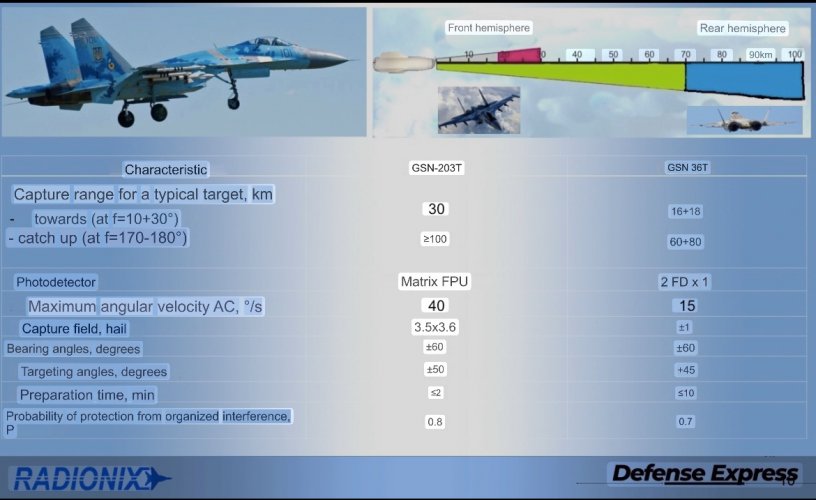
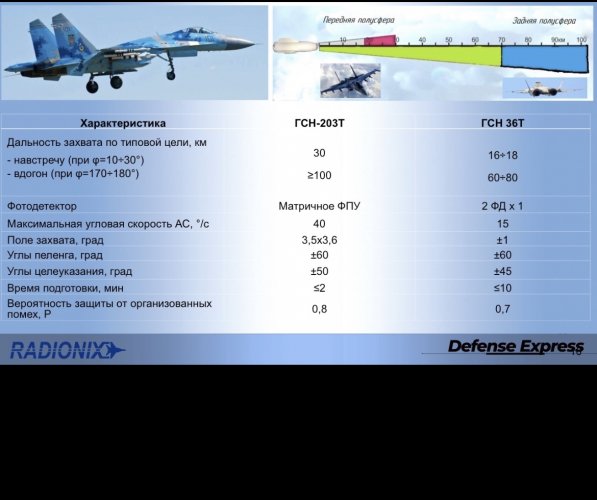
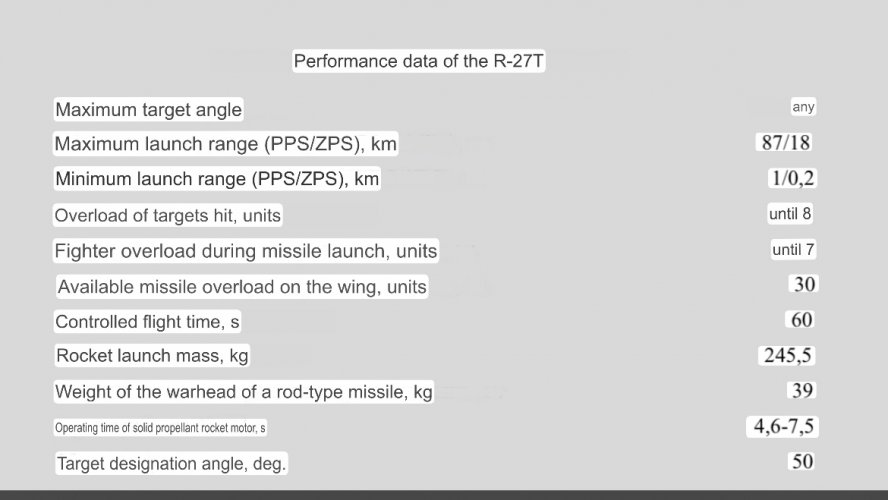
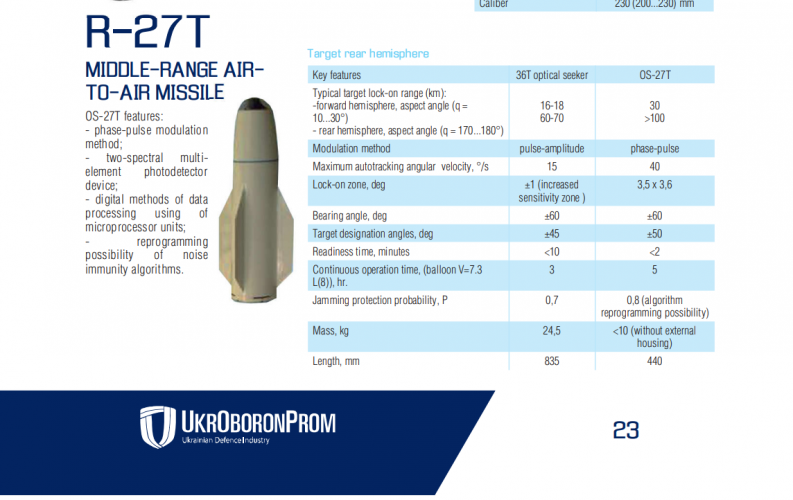
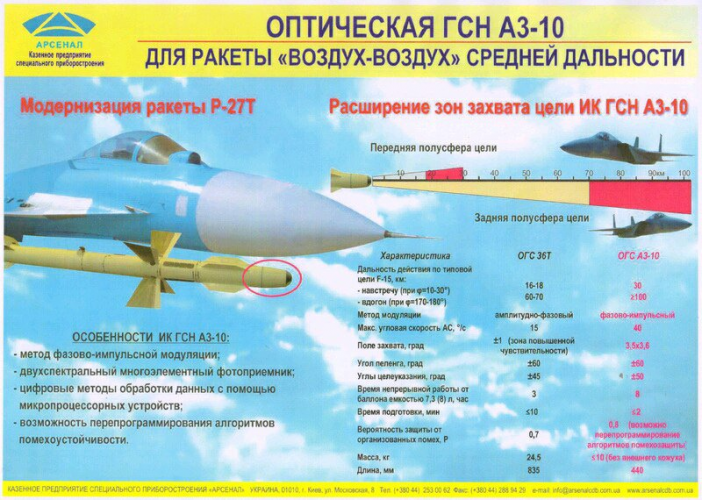
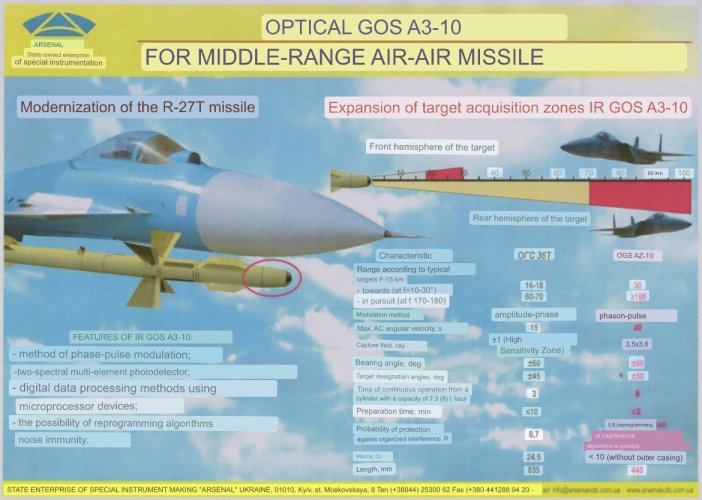
And I’m really not sure the 36T seeker of R-27T/ET can do the front aspect launches you say, brochures give it only 16-18 km range in front aspect 10-30 degrees. I would assume the 70 km given is for rear aspect burner

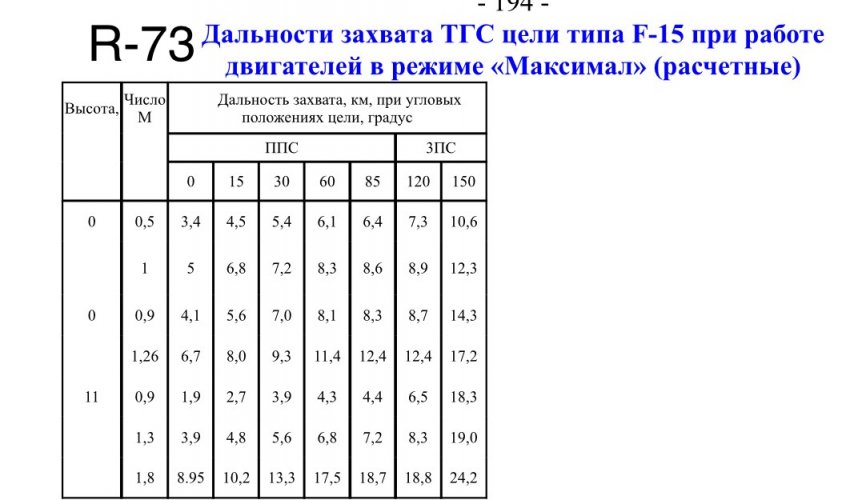
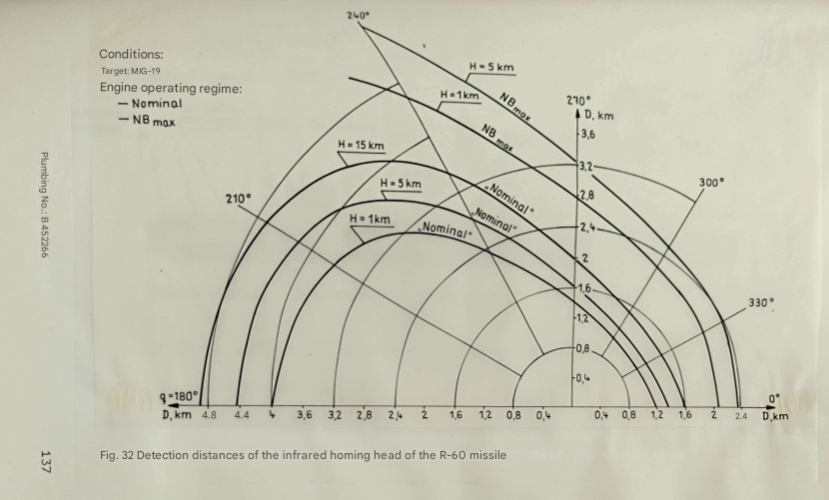
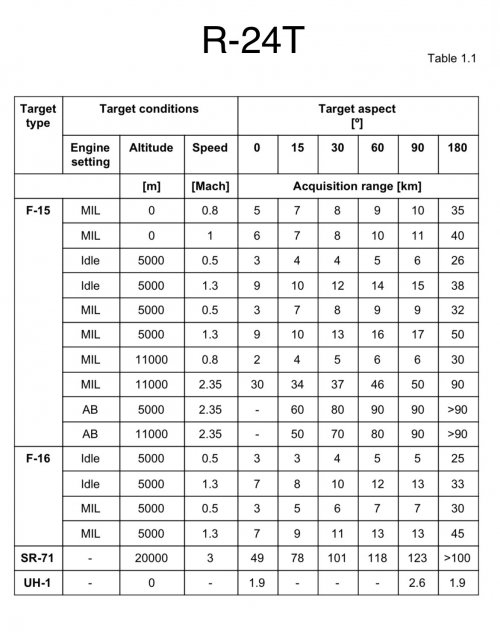
When we look at seeker charts for R-60, R-73, and R-24T, afterburner is maybe good for a 2-3x range boost at the most
 

Attachments

  • IMG_7706.png
    IMG_7706.png
    187.5 KB · Views: 91
  • IMG_7707.png
    IMG_7707.png
    778.9 KB · Views: 49
  • IMG_7708.jpeg
    IMG_7708.jpeg
    1,013.4 KB · Views: 40
  • IMG_7710.jpeg
    IMG_7710.jpeg
    728.3 KB · Views: 42
  • IMG_7709.jpeg
    IMG_7709.jpeg
    636.5 KB · Views: 36
  • IMG_7711.jpeg
    IMG_7711.jpeg
    108 KB · Views: 44
  • IMG_7712.png
    IMG_7712.png
    392.2 KB · Views: 43
  • IMG_7713.jpeg
    IMG_7713.jpeg
    230.9 KB · Views: 37
It if we calculate this a slower target would need to be compensated by a faster launch. A slower target does matter because the missile cannot fly longer then 60 seconds, that is the length of time the thermal-turbo battery lasts.

And I’m really not sure the 36T seeker of R-27T/ET can do the front aspect launches you say, brochures give it only 16-18 km range in front aspect 10-30 degrees. I would assume the 70 km given is for rear aspect burner


When we look at seeker charts for R-60, R-73, and R-24T, afterburner is maybe good for a 2-3x range boost at the most

As mentioned earlier ,height is more important than speed because higher alt will give you greater launch distances. Now how can one AAM with which you can engage incoming target from 130km away( in case of the Su-27) has the batteries which last only 60sec ??? From where that wrong data comes from anyway? The 'wrong catch' is that some sources gave data that 250kg heavy R-27 (R/T) have the ''time of the aerodynamic stability and controlability'' of 60sec ,in Russian 'время управляемого полета'.Even for the 100kg heavier R-27E ( ER/ET) they gave also that data. But but ...

Practical example:

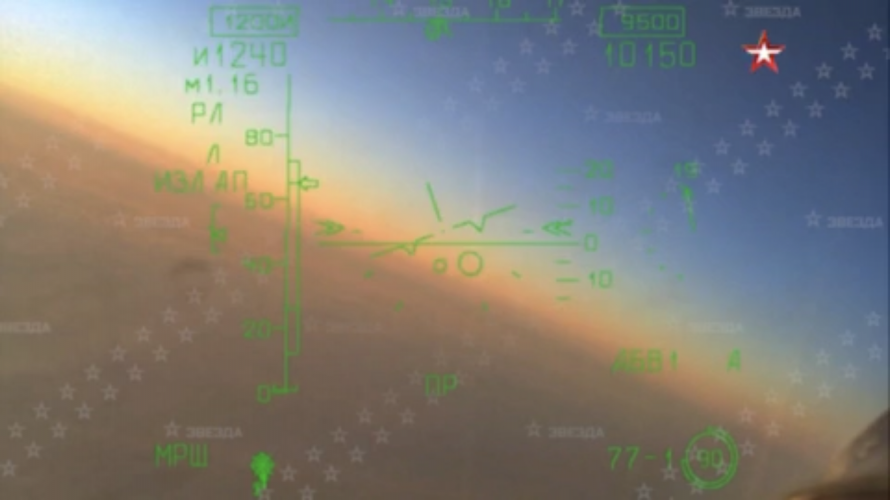
As we can see ,pilot of the Su-35S engaged his target with almost 200kg heavy R-77-1 where launch distance was more than 60km.What we can see in that green circle in the bottom right angle is the calculated flight time of the launched AAM until impact. 90 seconds ! R-77-1 like older R-27/E has also max real speed of 4.5M after acceleration phase.Of course,speed of the AAM will begin to slow and will be less and less. 90 sec for the target which is about 60km away. What about the target which is 130km away,so when launch distance is 130km?

Su-35S IKSh-1M.png


Brochures or the Flight/Pilot Manual for the Su-27S/SK? Who will give us mоrе correct data/info?

In the meantime ,keep in mind that medium/long range R-27T/ET like short range R-73 can be launched only with LOBL .On the other side, it is logical that engaging incoming target will have much greater launch distances than in the case when you engage receding target. Catch is that those values which I gave for the max launch distances for the R-27T/ET ( from the mentioned FM ), is in the case when enemy fighter fly on the AB mode. In that case, the heat/temperature ( very hot dot ) which IR seeker should see become max possible.We are talking about 1000°C-2000°C especially in stratosphere where temp is -50°C/-60°C.

In the FM's you will always find data for the engaging of the fighters which fly on the MP mode in the rear and front hemisphere( as receding /incoming) and which fly on the AB mode in the front hemisphere (as incoming).

PS

For those who maybe didn't know,R-27R1/ER1 were used in the Ethiopian/Eritrean war during several days in Feb 1999.Ethiopian AF Su-27SK launched several R-27R1/ER1 against Eritrean AF MiG-29B and shot down three of them .Launch distances were from 10-50kms.

Source: https://www.ridus.ru/svoi-protiv-svoih--kak-su-27-sbivali-mig-29-v-chuzhom-nebe-279417.html
 
As mentioned earlier ,height is more important than speed because higher alt will give you greater launch distances. Now how can one AAM with which you can engage incoming target from 130km away( in case of the Su-27) has the batteries which last only 60sec ??? From where that wrong data comes from anyway? The 'wrong catch' is that some sources gave data that 250kg heavy R-27 (R/T) have the ''time of the aerodynamic stability and controlability'' of 60sec ,in Russian 'время управляемого полета'.Even for the 100kg heavier R-27E ( ER/ET) they gave also that data. But but ...

Practical example:

As we can see ,pilot of the Su-35S engaged his target with almost 200kg heavy R-77-1 where launch distance was more than 60km.What we can see in that green circle in the bottom right angle is the calculated flight time of the launched AAM until impact. 90 seconds ! R-77-1 like older R-27/E has also max real speed of 4.5M after acceleration phase.Of course,speed of the AAM will begin to slow and will be less and less. 90 sec for the target which is about 60km away. What about the target which is 130km away,so when launch distance is 130km?

View attachment 791699


Brochures or the Flight/Pilot Manual for the Su-27S/SK? Who will give us mоrе correct data/info?

In the meantime ,keep in mind that medium/long range R-27T/ET like short range R-73 can be launched only with LOBL .On the other side, it is logical that engaging incoming target will have much greater launch distances than in the case when you engage receding target. Catch is that those values which I gave for the max launch distances for the R-27T/ET ( from the mentioned FM ), is in the case when enemy fighter fly on the AB mode. In that case, the heat/temperature ( very hot dot ) which IR seeker should see become max possible.We are talking about 1000°C-2000°C especially in stratosphere where temp is -50°C/-60°C.

In the FM's you will always find data for the engaging of the fighters which fly on the MP mode in the rear and front hemisphere( as receding /incoming) and which fly on the AB mode in the front hemisphere (as incoming).

PS

For those who maybe didn't know,R-27R1/ER1 were used in the Ethiopian/Eritrean war during several days in Feb 1999.Ethiopian AF Su-27SK launched several R-27R1/ER1 against Eritrean AF MiG-29B and shot down three of them .Launch distances were from 10-50kms.

Source: https://www.ridus.ru/svoi-protiv-svoih--kak-su-27-sbivali-mig-29-v-chuzhom-nebe-279417.html
Why would a SARH missile he designed to have a longer battery then its period of illumination (60 seconds DNP).

It achieves 130 km in under 60 seconds, I’m sure any more was not co soldered necessary as 130 km already nearly completely improbable in combat. An R-27e is not a R-77-1, CFD simulations put it at reaching over Mach 6 in the conditions for this 130 km shot and hitting an average speed that often puts impact at 58-59 seconds. R-24 had a 45 second battery. R-77 and 77-1 one even more then 60, the trend continues but R-27 of all variants were stuck at 60. And this 77-1 shot you reference does not have combined Mach 4 closure at 15-17 km!

The N-019/N-001 illumination is 60 seconds. Why would the missile guide beyond that?

There is a very good reason the missile flight timer of the Su-27 HUD has a max length of 60 secs…….

For 36 T seeker, I can only imagine it reaching its max ballistic range in front hemisphere against a MiG-25 type target, the only type of target OLS-27 itself can see At 100 km. I can’t see anything else having the necessary skin and engine heat when launch range of some engine setting for 10-30 degree aspect is only 16-18 km per brochure and 70 km only in rear aspect (for F-15 type target but likely tested against Su-15)

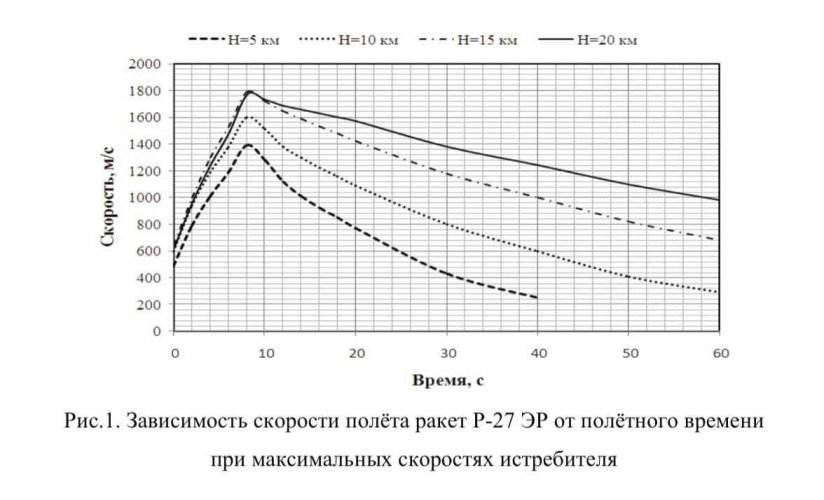
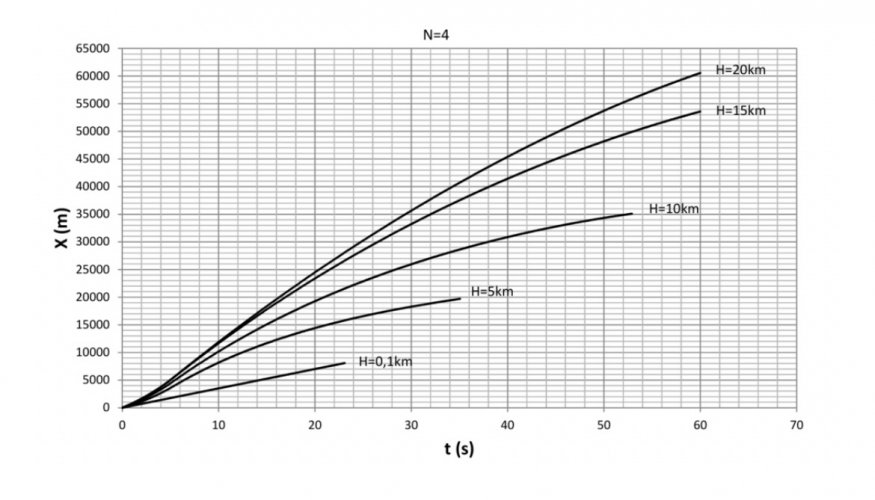
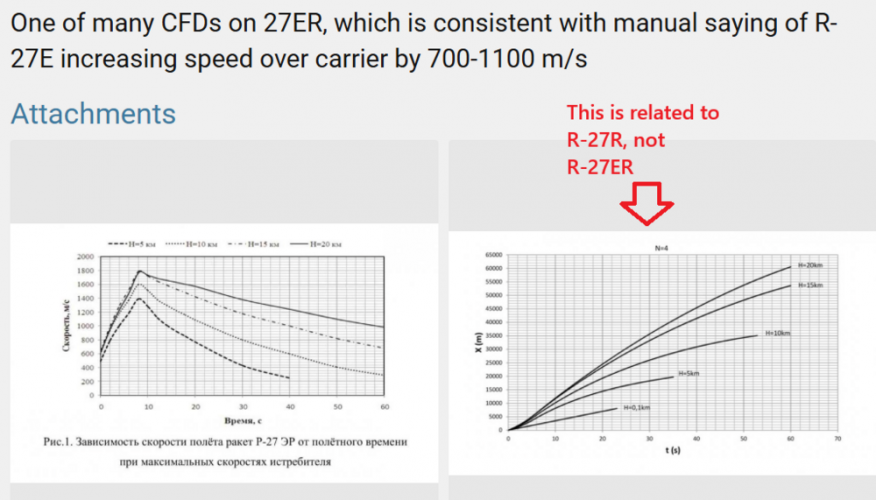
One of many CFDs on 27ER, which is consistent with manual saying of R-27E increasing speed over carrier by 700-1100 m/s
 

Attachments

  • IMG_7725.jpeg
    IMG_7725.jpeg
    58.3 KB · Views: 36
  • IMG_7726.jpeg
    IMG_7726.jpeg
    280.9 KB · Views: 38
Last edited:
Why would a SARH missile he designed to have a longer battery then its period of illumination (60 seconds DNP).

It achieves 130 km in under 60 seconds, I’m sure any more was not co soldered necessary as 130 km already nearly completely improbable in combat. An R-27e is not a R-77-1, CFD simulations put it at reaching over Mach 6 in the conditions for this 130 km shot and hitting an average speed that often puts impact at 58-59 seconds. R-24 had a 45 second battery. R-77 and 77-1 one even more then 60, the trend continues but R-27 of all variants were stuck at 60. And this 77-1 shot you reference does not have combined Mach 4 closure at 15-17 km!

The N-019/N-001 illumination is 60 seconds. Why would the missile guide beyond that?

There is a very good reason the missile flight timer of the Su-27 HUD has a max length of 60 secs…….

For 36 T seeker, I can only imagine it reaching its max ballistic range in front hemisphere against a MiG-25 type target, the only type of target OLS-27 itself can see At 100 km. I can’t see anything else having the necessary skin and engine heat when launch range of some engine setting for 10-30 degree aspect is only 16-18 km per brochure and 70 km only in rear aspect (for F-15 type target but likely tested against Su-15)

One of many CFDs on 27ER, which is consistent with manual saying of R-27E increasing speed over carrier by 700-1100 m/s

What did you write about anyway ? Even one monster like R-37M cannot achieve reaching 130 km under 60 sec . That 600kg heavy AAM after acceleration phase reaches 6 Mach and has 30sec acceleration time.I already wrote, the limitation factors for the 350kg heavy R-27ER was DNP mode , 60sec only limit (illumination).

Stop writing about batteries because there is no data about batteries at all.
 
What did you write about anyway ? Even one monster like R-37M cannot achieve reaching 130 km under 60 sec . That 600kg heavy AAM after acceleration phase reaches 6 Mach and has 30sec acceleration time.I already wrote, the limitation factors for the 350kg heavy R-27ER was DNP mode , 60sec only limit (illumination).

Stop writing about batteries because there is no data about batteries at all.
Well, maybe not Data on how long the thermal turbo plant operates. But there is certainly a lot of data about it.

The Soviet Union says it can reach 130 km as you say. The plane only illuminates for 60 seconds. They say it can exceed the launch vehicle speed by 1100 m/s which is pretty much Mach 6 when launching over Mach 2. It is firing at a Mach 2 target that is traveling 36 km or more during that flight. I would truly doubt the manufacturers would quote a maximum range of a SARH missile that requires more flight time than the maximum illumination period! And pretty much every CFD you see done supports this Mach 6.1-6.2 about top speed when launched over Mach 2 at 15-17 km altitude. The CFD I posted above shows it reaching only Mach 4 when launched above Mach 1 near sea level.

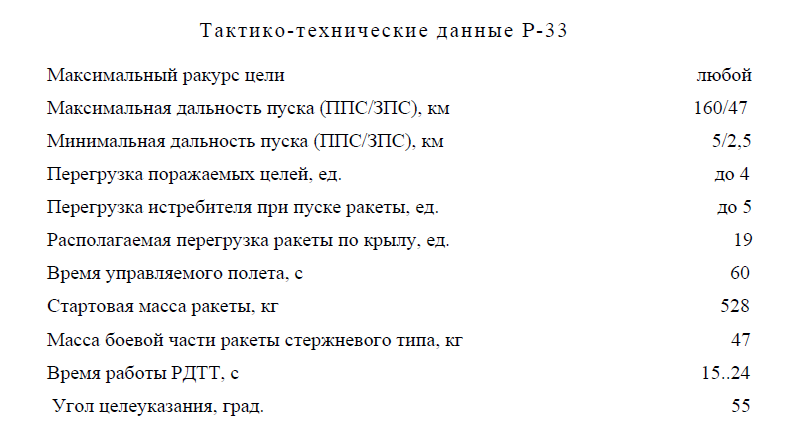
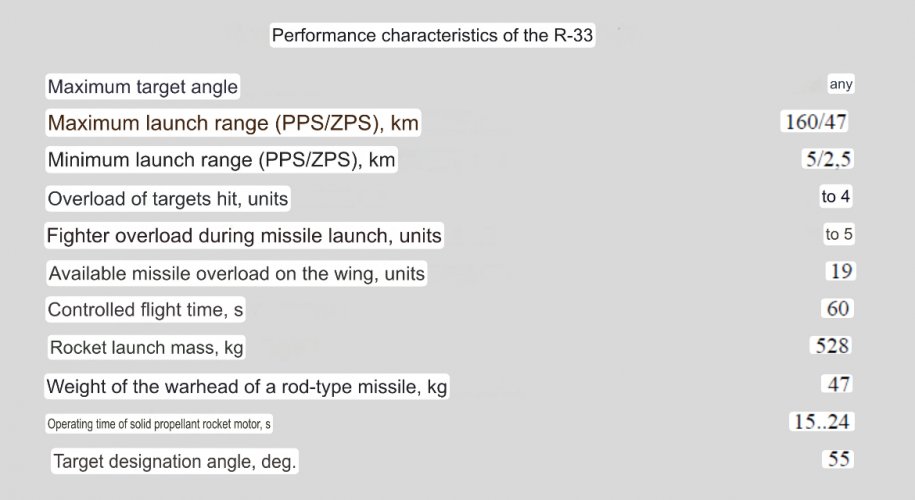
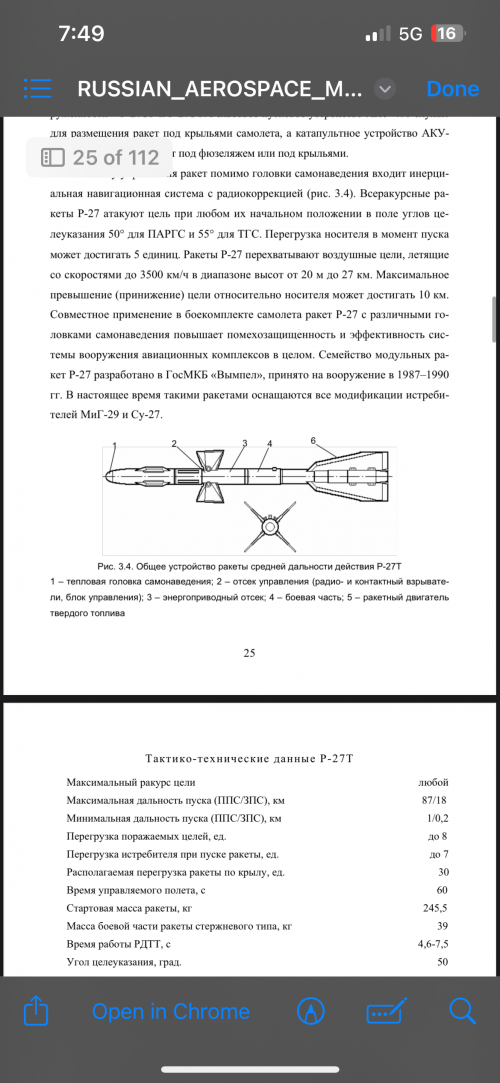
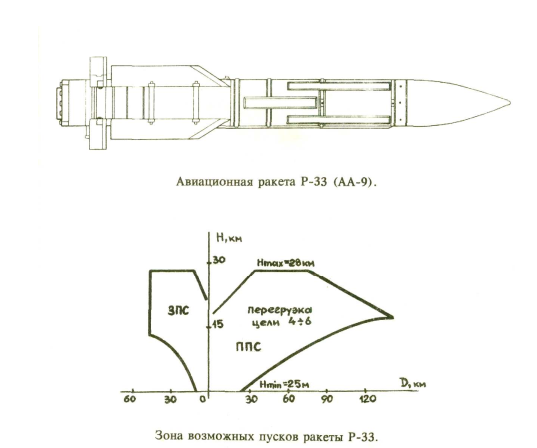
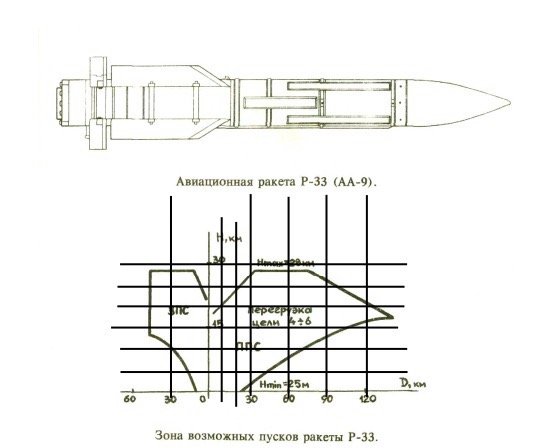
By the way, R-33 also has 60 second battery, and will fly 120 km. R-73 is quoted at 30 km and can only power its canards for 21-23 seconds!
Here is a book that describes 60 seconds flight time for both. When you see a speed like 4.5 Mach listed it is not some wall the missile hits and cannot fly past but an average. Thus MiG-29 manual saying R-27E increases carrier velocity by 800-1100 m/s after launch.
 

Attachments

  • IMG_7735.jpeg
    IMG_7735.jpeg
    259.4 KB · Views: 42
  • IMG_7731.png
    IMG_7731.png
    63.8 KB · Views: 38
  • IMG_7732.jpeg
    IMG_7732.jpeg
    234.7 KB · Views: 38
  • IMG_7733.png
    IMG_7733.png
    603.2 KB · Views: 40
  • IMG_7734.jpeg
    IMG_7734.jpeg
    182.2 KB · Views: 43
Last edited:
Same as dozens of similar late Soviet projects: money and dissolution of the Soviet Union.

Note that Ukrainian part was important for seekers, as R-27AE didn't truly die there until late 2010s(Ukraine tried to make it into SAM together with Poland).
View attachment 791145
Furthermore, at least until 2000s 3(6 including E) R-27s were seen as good enough for the sorry state of economy.
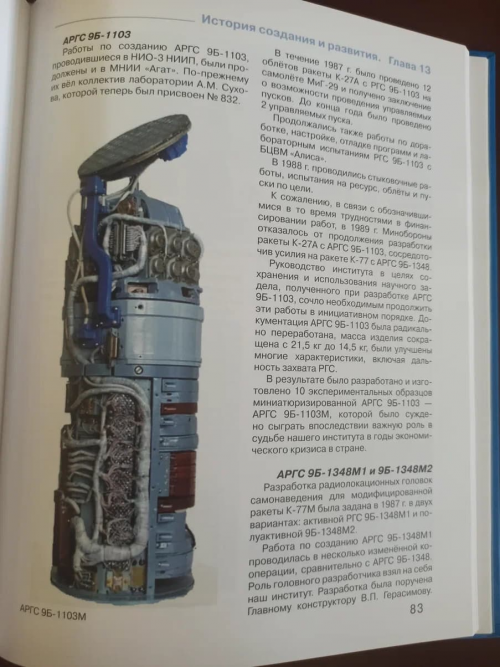
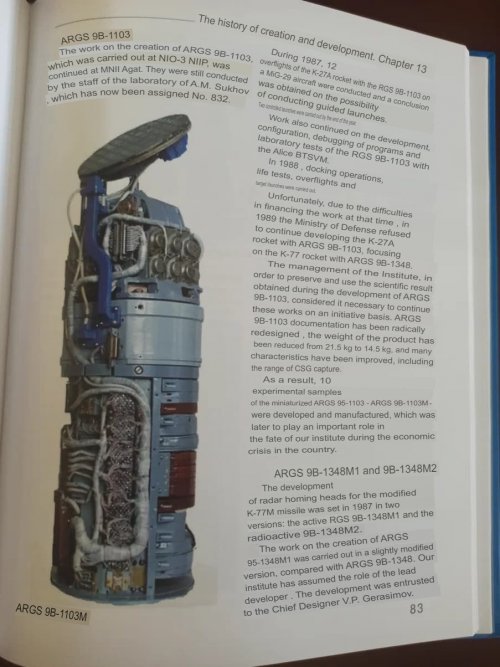
did not know r27ea existed. according to vympel book, r27a was canceled after only 12 test firings and program was canceled in 1989, so kinda surprised r27ea exists.
 

Attachments

  • 1763355987493.png
    1763355987493.png
    831.9 KB · Views: 308
  • gdfsgdfs.jpg
    gdfsgdfs.jpg
    466.4 KB · Views: 16
Last edited:
Well, maybe not Data on how long the thermal turbo plant operates. But there is certainly a lot of data about it.

The Soviet Union says it can reach 130 km as you say. The plane only illuminates for 60 seconds. They say it can exceed the launch vehicle speed by 1100 m/s which is pretty much Mach 6 when launching over Mach 2. It is firing at a Mach 2 target that is traveling 36 km or more during that flight. I would truly doubt the manufacturers would quote a maximum range of a SARH missile that requires more flight time than the maximum illumination period! And pretty much every CFD you see done supports this Mach 6.1-6.2 about top speed when launched over Mach 2 at 15-17 km altitude. The CFD I posted above shows it reaching only Mach 4 when launched above Mach 1 near sea level.

By the way, R-33 also has 60 second battery, and will fly 120 km. R-73 is quoted at 30 km and can only power its canards for 21-23 seconds!
Here is a book that describes 60 seconds flight time for both. When you see a speed like 4.5 Mach listed it is not some wall the missile hits and cannot fly past but an average. Thus MiG-29 manual saying R-27E increases carrier velocity by 800-1100 m/s after launch.

Not SU but some people. 130km for R-27ER is btw max launch distance when it is carried by Su-27. Yes ,DNP ( tracking/illuminating) mode of the N001 in the NPO mode lasts 60sec and that is limiting factor.

Half a tone monster like R-33 certainly has much greater launch distance than that 120 km. There is no way that R-27ER can have greater launch range in comparison with R-33(S) or even newer R-37M.

OK , 21-23sec for 30km range of R-73 and only 60 sec for both R-27ER and R-33 ? Yes, in book which you presented.Pls take a look again on the sequence with R-77-1 almost launched on the incoming target which was more than 60km away. Btw ,flight speed of one AAM in the terminal phase can droped/be to/about 1M.
 
did not know r27ea existed. according to vympel book, r27a was canceled after only 12 test firings and program was canceled in 1989, so kinda surprised r27ea exists.View attachment 791833

Only 2 test launches were performed during 1987. 12 is the number for test flights with K-27A with active radar seeker 9B1103 attached on MiG-29.
 
did not know r27ea existed. according to vympel book, r27a was canceled after only 12 test firings and program was canceled in 1989, so kinda surprised r27ea exists.View attachment 791833
If it could have been programmed with loft, it would be multiple steps above RVV-AE in lethality. Give it a loft and an extended thermal turbo power plant operating time, and it could easily achieve 200 km level ballistics for pairing with Irbis radars

I believe R-77 was chosen becuase of the wide variety of platforms it could be carried by and the push for an AMRAAM equivalent

Not SU but some people. 130km for R-27ER is btw max launch distance when it is carried by Su-27. Yes ,DNP ( tracking/illuminating) mode of the N001 in the NPO mode lasts 60sec and that is limiting factor.

Half a tone monster like R-33 certainly has much greater launch distance than that 120 km. There is no way that R-27ER can have greater launch range in comparison with R-33(S) or even newer R-37M.

OK , 21-23sec for 30km range of R-73 and only 60 sec for both R-27ER and R-33 ? Yes, in book which you presented.Pls take a look again on the sequence with R-77-1 almost launched on the incoming target which was more than 60km away. Btw ,flight speed of one AAM in the terminal phase can droped/be to/about 1M.
Yes becuase R-77-1 has extended operating time vs R-27 series

R-33 only reaches 120 km. It could be not far from the truth that R-27ER was in some ways a superior missile if launched at equal altitudes and velocities, which is of course where R-33 gets its advantage ( the launch vehicle and twice the motor operating time). Like R-27ER R-33 does not loft. I’m not sure how a larger missle has to have a longer range Many such examples of large missiles that do not go far. The calibre of R-33/AIM-54 is also not good for drag compared to slimmer missiles Like R-27. Look it up and you will see that in service original R-33 is only ever quoted with 120 km max range. Compare it to the 27AE chart posted above
 

Attachments

  • IMG_7741.png
    IMG_7741.png
    101.6 KB · Views: 53
  • IMG_7742.jpeg
    IMG_7742.jpeg
    1.2 MB · Views: 49
  • IMG_7743.png
    IMG_7743.png
    214.1 KB · Views: 51
Last edited:
R-33 only reaches 120 km. It could be not far from the truth that R-27ER was in some ways a superior missile if launched at equal altitudes and velocities, which is of course where R-33 gets its advantage ( the launch vehicle and twice the motor operating time). Like R-27ER R-33 does not loft. I’m not sure how a larger missle has to have a longer range Many such examples of large missiles that do not go far. The calibre of R-33/AIM-54 is also not good for drag compared to slimmer missiles Like R-27. Look it up and you will see that in service original R-33 is only ever quoted with 120 km max range. Compare it to the 27AE chart posted above

Pls friend. R-33 can be launched at alt almost 22 km with true air speed of the MiG-31BM of 2.8M. If I remember well ,target can be even 10km or more higher than MiG-31.So that data from the book is not correct. Of course R-33 can climb/'loft' after launch.

About max launch distances ,some examples:

April 1973 ,USN F-14A launched AIM-54A against supersonic incoming target,launch distance was 110nmi (203km).
Jan 1979, IRIAF F-14A launched AIM-54A against supersonic incoming target ,launch distance was 244km.

MiG-31BM can launch its R-33 with much greater speed and from much higher alt then F-14. R-33 is heavier and faster than AIM-54.
 
Pls friend. R-33 can be launched at alt almost 22 km with true air speed of the MiG-31BM of 2.8M. If I remember well ,target can be even 10km or more higher than MiG-31.So that data from the book is not correct. Of course R-33 can climb/'loft' after launch.

About max launch distances ,some examples:

April 1973 ,USN F-14A launched AIM-54A against supersonic incoming target,launch distance was 110nmi (203km).
Jan 1979, IRIAF F-14A launched AIM-54A against supersonic incoming target ,launch distance was 244km.

MiG-31BM can launch its R-33 with much greater speed and from much higher alt then F-14. R-33 is heavier and faster than AIM-54.
AIM-54 is a different missile than R-33. If you have a better source to show why this Russian 1991 book is incorrect In regards to launch ranges we would all be very interested in it. I have also seen no indication that R-33 was capable of a lofted trajectory, and since R-27R/ER by the same bureau and even later timeframe was not capable of it, I have little belief it could. There is not even evidence of R-77 being capable of lofted trajectory, that was first done for R-77-1 and R-37M. Until there’s a better source idk what to say, there are many written sources giving a 120 km range also, one of which I already provided, so that’s two sources from Russian books on 120 km range. Such a range isn’t incompatible with climbing 10 km or launching high up, these do not disprove it at all as much as we want or wish to believe the original MiG-31 to be “better.” As far as literature says, increased range was left only to upgrade and test versions.

The AIM-54 is not only capable of lofting up to 30 km altitude, but also has a longer lasting rocket motor then R-33, 22-30 seconds depending on Mk47 or 60 and 18-20 seconds for R-33. After all, original Zaslon only has 90-130 km detection against fighter size target, and Soviet Union was never in practice of giving planes a missile that outranged their radars.

There is also a page that tells us the thrust to weight of the R-33, if we compare to public figures for the thrust of the AIM-54, we get 73:1 kgf/kg compared to 83:1 kgf/kg. As you see here, R-27ER actually has a much higher thrust to weight along with R-77. I’m sure R-33 benefits from its inertia (which is about 15% more then AIM-54).

Part of loving Soviet equipment is accepting it was not always the besto_O
 

Attachments

  • IMG_7757.jpeg
    IMG_7757.jpeg
    613.5 KB · Views: 53
  • IMG_7756.png
    IMG_7756.png
    995.7 KB · Views: 45
Last edited:
AIM-54 is a different missile than R-33. If you have a better source to show why this Russian 1991 book is incorrect In regards to launch ranges we would all be very interested in it. I have also seen no indication that R-33 was capable of a lofted trajectory, and since R-27R/ER by the same bureau and even later timeframe was not capable of it, I have little belief it could. There is not even evidence of R-77 being capable of lofted trajectory, that was first done for R-77-1 and R-37M. Until there’s a better source idk what to say, there are many written sources giving a 120 km range also, one of which I already provided, so that’s two sources from Russian books on 120 km range. Such a range isn’t incompatible with climbing 10 km or launching high up, these do not disprove it at all as much as we want or wish to believe the original MiG-31 to be “better.” As far as literature says, increased range was left only to upgrade and test versions.

The AIM-54 is not only capable of lofting up to 30 km altitude, but also has a longer lasting rocket motor then R-33, 22-30 seconds depending on Mk47 or 60 and 18-20 seconds for R-33. After all, original Zaslon only has 90-130 km detection against fighter size target, and Soviet Union was never in practice of giving planes a missile that outranged their radars.

There is also a page that tells us the thrust to weight of the R-33, if we compare to public figures for the thrust of the AIM-54, we get 73:1 kgf/kg compared to 83:1 kgf/kg. As you see here, R-27ER actually has a much higher thrust to weight along with R-77. I’m sure R-33 benefits from its inertia (which is about 15% more then AIM-54).

Part of loving Soviet equipment is accepting it was not always the besto_O

Theory nothing else. In practice happened something else.MiG-31 can engage low flying cruise missile like Kh-55 from 90 km with R-33.Cruise missile which fly subsonically at alt 100-300m above the ground.

90km for the low flying target,yes. For something that fly in stratosphere ?
 
Theory nothing else. In practice happened something else.MiG-31 can engage low flying cruise missile like Kh-55 from 90 km with R-33.Cruise missile which fly subsonically at alt 100-300m above the ground.

90km for the low flying target,yes. For something that fly in stratosphere ?
I believe it can detect a cruise missile from 90 km, and shoot them flying on the deck, but I do not believe it can shoot them 90 km away with a 120 km max range!

This chart shows about 25 km range on the deck. From a high position sure it can go higher, but I do not believe 90 km possible on the deck even from its max -60 degree look down angle.
 

Attachments

  • IMG_7758.jpeg
    IMG_7758.jpeg
    36.5 KB · Views: 47
Pls friend. R-33 can be launched at alt almost 22 km with true air speed of the MiG-31BM of 2.8M. If I remember well ,target can be even 10km or more higher than MiG-31.So that data from the book is not correct. Of course R-33 can climb/'loft' after launch
This tells me everything I need to know about your credibility.

R-33 (base missile) cannot loft. It flies directly towards the target. If the target is 10km higher, the missile will climb, but it is still pointing directly at the target. This is not lofting.

Modern upgraded R-33 missiles might have this capability, R-37M definitely does, but it has a whole new guidance system and massively improved INS/autopilot.
 
Last edited:

@Aeria Gloria

Again ,R-33 has max launch distance much over 120km.Of course in the case of engaging something high flying and with bigger RCS.

Your 'books' and all that you presented are nothing in comparison with the MiG-31/ 'Izdeliye 01 Flight Manual ' .
 
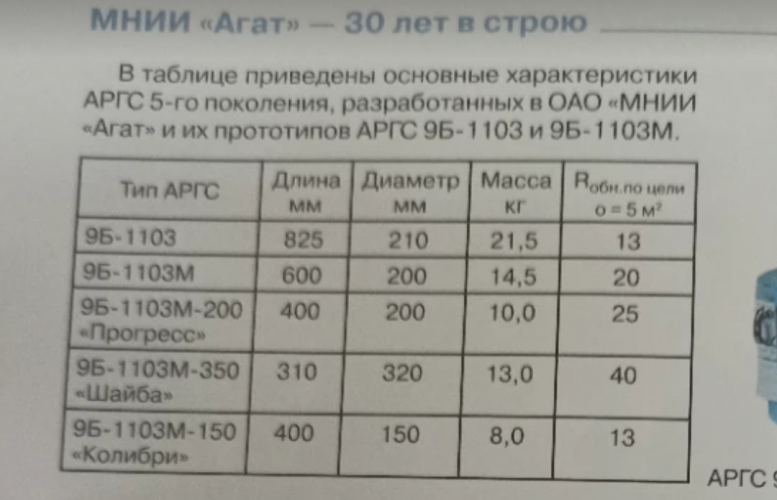
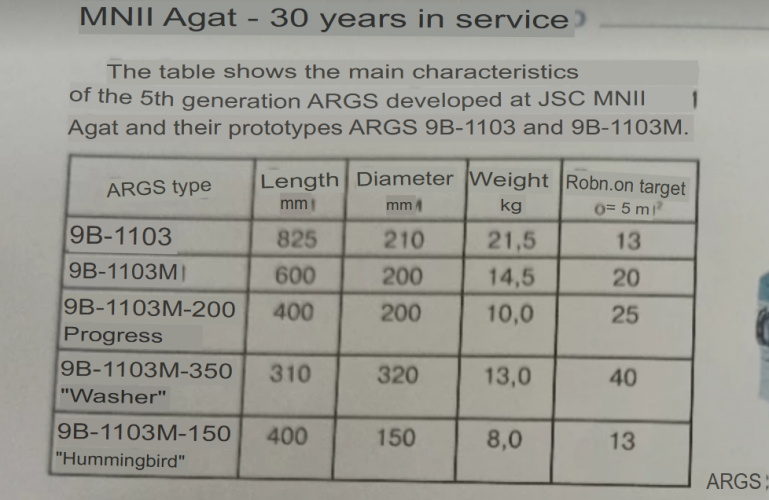
9b-1103 of r-27ea
 

Attachments

  • 1763388472659.png
    1763388472659.png
    525.8 KB · Views: 324
  • 1771716331976.png
    1771716331976.png
    397.8 KB · Views: 7
Last edited:
This tells me everything I need to know about your credibility.

R-33 (base missile) cannot loft. It flies directly towards the target. If the target is 10km higher, the missile will climb, but it is still pointing directly at the target. This is not lofting.

Modern upgraded R-33 missiles might have this capability, R-37M definitely does, but it has a whole new guidance system and massively improved INS/autopilot.
r-33s is the same as normal r-33 just with nuclear war head if i remember right. first real modernization of r-33 was r-37 with active radar seekerhead
 
This is not thread about R-33 but here are some real data :

R-33 can fly in the ballistic trajectory with only 20% of the first phase ( first phase is inertial guidance with possible use of RC-channel which max range is 100km via sidelobe from the radar antenna) . Another 80% of the complete flightpath is SARH guidance.

Now ,question,how can R-33 has max 120km of the launch range/distance when RC channel alone has max range 100km??? Another question ,ballistic trajectory is?

I already explained some details from the RIO cockpit of the basic MiG-31 where we can see e.g. max Mach number during launch, flight path sort etc....

@kizvy

There is no nuclear warhead in the R-33S. That version was specially designed to intercept then new USAF stealth strategic low flying subsonic cruise missile type AGM-129A ACM.
 
This is not thread about R-33 but here are some real data :

R-33 can fly in the ballistic trajectory with only 20% of the first phase ( first phase is inertial guidance with possible use of RC-channel which max range is 100km via sidelobe from the radar antenna) . Another 80% of the complete flightpath is SARH guidance.

Now ,question,how can R-33 has max 120km of the launch range/distance when RC channel alone has max range 100km??? Another question ,ballistic trajectory is?

I already explained some details from the RIO cockpit of the basic MiG-31 where we can see e.g. max Mach number during launch, flight path sort etc....

@kizvy

There is no nuclear warhead in the R-33S. That version was specially designed to intercept then new USAF stealth strategic low flying subsonic cruise missile type AGM-129A ACM.
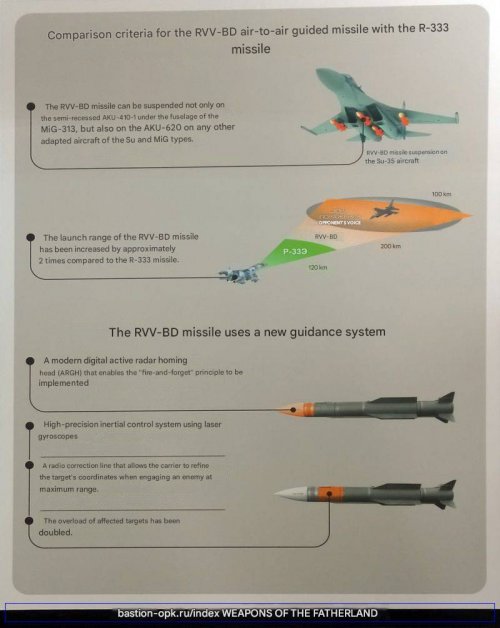
Even this old brochure for rvv-bd states max range of 120km for r-33. I don’t understand how you’re getting ranges greater than 120km, based off what?I can’t find a source that has more than 120km for r-33. Your conjecture seems to be based off theory, not of reality imo
 

Attachments

  • 1763393097791.jpeg
    1763393097791.jpeg
    127.4 KB · Views: 325
Last edited:

@Aeria Gloria

Again ,R-33 has max launch distance much over 120km.Of course in the case of engaging something high flying and with bigger RCS.

Your 'books' and all that you presented are nothing in comparison with the MiG-31/ 'Izdeliye 01 Flight Manual ' .
And can you post a page, a picture, anything from this manual showing the range over 120 km? Or do you imagine that a manual would show this range over 120 km?
 
This tells me everything I need to know about your credibility.

R-33 (base missile) cannot loft. It flies directly towards the target. If the target is 10km higher, the missile will climb, but it is still pointing directly at the target. This is not lofting.

Modern upgraded R-33 missiles might have this capability, R-37M definitely does, but it has a whole new guidance system and massively improved INS/autopilot.

Now I will present you ( and of course to the other members ) ,some I hope very interesting details and data about R-27R ( R1) and of course about R-33. In the meantime I've found this thread about R-33 so I will present data on the right topic .


Now back to the medium range about 250 kg heavy R-27R/R1. When we talk about some given AAM ,it is very important to know that 'relationship' between the radar of the carrier-fighter and the given AAM especially radar guided AAM .I think that I already gave some info about those LITER codes,programmes and the LITER 'carrier' frequencies.What is in fact that LITERING ? Simple translation will be pairing,so pairing between the on-board radar ,radar's comp and the given ( inertial+radar guided )AAM's onborad comp.

During the LITERING process ,onboard radar comp will transfer to onboard AAM's comp all necessary data like LITER code and LITER ( carrier/working) frequency.LITER code is very important during lock on mode.With the given LITER code, given AAM will be designated for launching.LITER frequencies are very important for determine given working frequency of the RC-channel signals ( max range is 50km from the radar) and for the DNP/Illumination mode.It is important to know that when LITER code is activated ,it takes only 1 sec to translate all given data from the onboard radars'comp to the AAM's onboard comp about the given target.

Now some data about the N019 Rubin .That radar ( like all other) has three max calibrated/calculated launch distances and they depend on the target's RCS. All possible targets ( during lock on mode) can be determined as small,medium and big .Small target has 3sqm,medium target has 10sqm and bigger target has more then 10sqm of the frontal RCS( specific parameters).There is also one switch called BAZA where pilot can determine the working distance for the radio-proximity fuse of the R-27R/R1. BAZA switch has three letters: M = maliy-small, S=sredniy- medium and B =Bolshoy-big ,so fo the small,medium and big air target. Now, those three calibrated/calculated launch distances for the R-27R/R1 are : 30km for the small incoming target,70km for the medium incoming target and 90km for the big incoming air target.

I think that I also gave earlier some data about the three main launch parameters of the radars in Russian fighters : Dr max1 as the max calculated /allowed launch distance against non-maneuvering air target ,Dr max2 as the max calculated/allowed launch distance against maneuvering air target and Drmin as the min calculated/allowed launch distance against given air target.

When we mention R-27ER/ER1 ,we know that max launch distance is 130 km.Yes but we must also know that 130km is in fact calculated/calibrated launch distance only for the N001 Myech radar .That radar as I mentioned earlier has max detect/track range in the HPRF mode of 150km. 130 km is of course calibrated launch distance against bigger incoming air target. Radars like N011M Bars-M and especially N035 Irbis are more powerfull and with much greater detect/track ranges in the HPRF mode.So the max possible calibrated/calculated launch distance for the R-27ER can be even greater thanks to the energetic,kinematic capabilities of the 350 kg heavy long range AAM.
 
Last edited:
Even this old brochure for rvv-bd states max range of 120km for r-33. I don’t understand how you’re getting ranges greater than 120km, based off what?I can’t find a source that has more than 120km for r-33. Your conjecture seems to be based off theory, not of reality imo
View attachment 791884

Yes ,120km but against small air target, e.g. MiG-21 with its 3sqm frontal RCS flying at alt over 1000m in head to head course ( PPS mode). Is all of this mentioned in that brochure ? No ,because it is only brochure, nothing else. Clean numbers w/o any of the parameters ,factors etc.
 
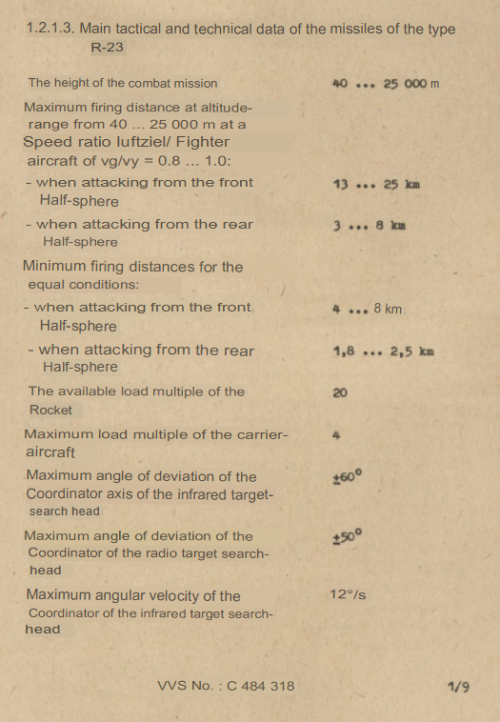
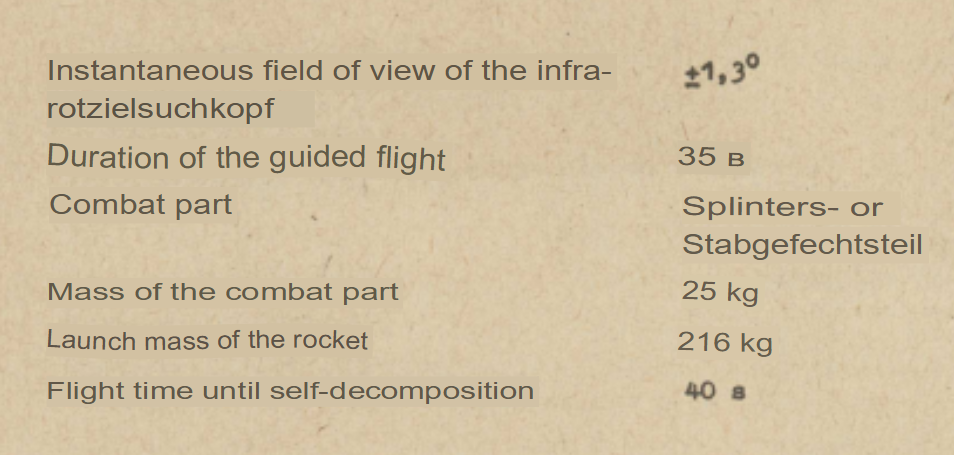
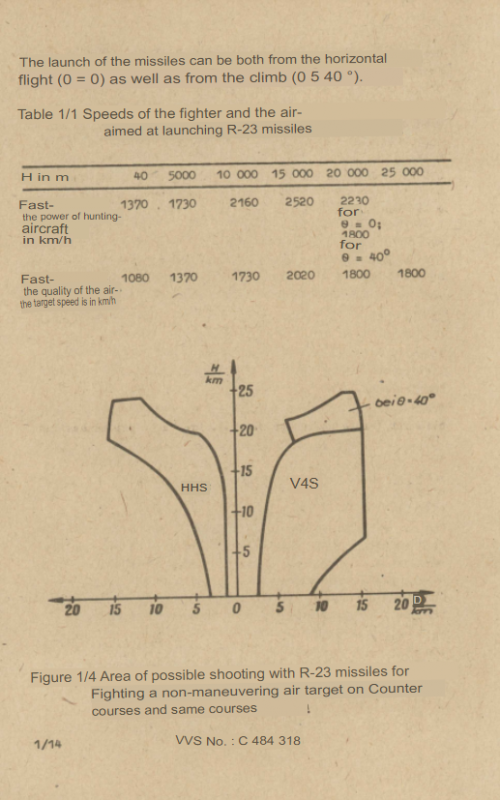
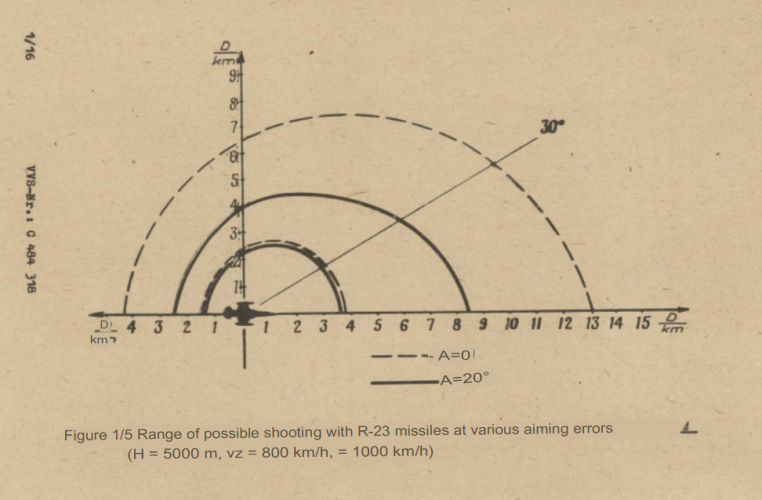
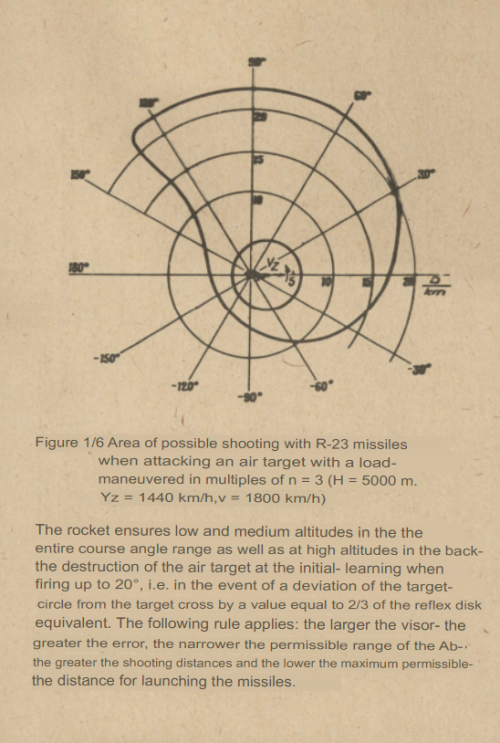
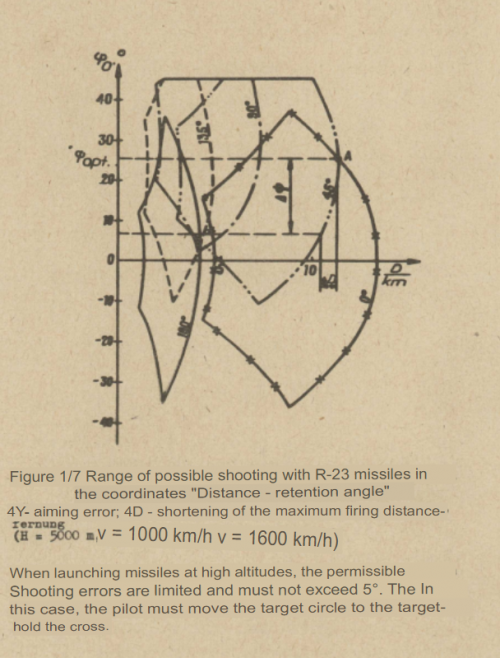
r-23 missile info dump
 

Attachments

  • 1763512234660.png
    1763512234660.png
    441.5 KB · Views: 36
  • 1763512249292.png
    1763512249292.png
    332.2 KB · Views: 31
  • 1763512334896.png
    1763512334896.png
    509.2 KB · Views: 31
  • 1763512345398.png
    1763512345398.png
    671.8 KB · Views: 32
  • 1763512357225.png
    1763512357225.png
    515.6 KB · Views: 25
  • 1763512367099.png
    1763512367099.png
    556.2 KB · Views: 34
Now I will present you ( and of course to the other members ) ,some I hope very interesting details and data about R-27R ( R1) and of course about R-33. In the meantime I've found this thread about R-33 so I will present data on the right topic .


Now back to the medium range about 250 kg heavy R-27R/R1. When we talk about some given AAM ,it is very important to know that 'relationship' between the radar of the carrier-fighter and the given AAM especially radar guided AAM .I think that I already gave some info about those LITER codes,programmes and the LITER 'carrier' frequencies.What is in fact that LITERING ? Simple translation will be pairing,so pairing between the on-board radar ,radar's comp and the given ( inertial+radar guided )AAM's onborad comp.

During the LITERING process ,onboard radar comp will transfer to onboard AAM's comp all necessary data like LITER code and LITER ( carrier/working) frequency.LITER code is very important during lock on mode.With the given LITER code, given AAM will be designated for launching.LITER frequencies are very important for determine given working frequency of the RC-channel signals ( max range is 50km from the radar) and for the DNP/Illumination mode.It is important to know that when LITER code is activated ,it takes only 1 sec to translate all given data from the onboard radars'comp to the AAM's onboard comp about the given target.

Now some data about the N019 Rubin .That radar ( like all other) has three max calibrated/calculated launch distances and they depend on the target's RCS. All possible targets ( during lock on mode) can be determined as small,medium and big .Small target has 3sqm,medium target has 10sqm and bigger target has more then 10sqm of the frontal RCS( specific parameters).There is also one switch called BAZA where pilot can determine the working distance for the radio-proximity fuse of the R-27R/R1. BAZA switch has three letters: M = maliy-small, S=sredniy- medium and B =Bolshoy-big ,so fo the small,medium and big air target. Now, those three calibrated/calculated launch distances for the R-27R/R1 are : 30km for the small incoming target,70km for the medium incoming target and 90km for the big incoming air target.

I think that I also gave earlier some data about the three main launch parameters of the radars in Russian fighters : Dr max1 as the max calculated /allowed launch distance against non-maneuvering air target ,Dr max2 as the max calculated/allowed launch distance against maneuvering air target and Drmin as the min calculated/allowed launch distance against given air target.

When we mention R-27ER/ER1 ,we know that max launch distance is 130 km.Yes but we must also know that 130km is in fact calculated/calibrated launch distance only for the N001 Myech radar .That radar as I mentioned earlier has max detect/track range in the HPRF mode of 150km. 130 km is of course calibrated launch distance against bigger incoming air target. Radars like N011M Bars-M and especially N035 Irbis are more powerfull and with much greater detect/track ranges in the HPRF mode.So the max possible calibrated/calculated launch distance for the R-27ER can be even greater thanks to the energetic,kinematic capabilities of the 350 kg heavy long range AAM.
More then 130 km only if target is extremely fast to fit within 60 second powered flight time.

What evidence is there that target size switch changes DLZ? My interpretation of manual was these distances for small/medium/large target are recommendations, DLZ is computed purely based on kinematic factors of closure, aspect, etc

It also does not change fuze distance, but fuze timing. It likes a delay for large targets to explode near center, smaller delay for medium, no delay for small. This is described in both MiG-29B book and 9.12/9.13/9.13S manual.
Yes ,120km but against small air target, e.g. MiG-21 with its 3sqm frontal RCS flying at alt over 1000m in head to head course ( PPS mode). Is all of this mentioned in that brochure ? No ,because it is only brochure, nothing else. Clean numbers w/o any of the parameters ,factors etc.
There is no information it can hit anything over 120 km. Target size doesn’t determine everything such as ballistics. Unless you can post an actual document saying it is more for a larger target.
r-23 missile info dump
Yes the German docs have a lot of info!!!!!!!
 
Not really a big surprise, but visible how array size really affects performance; all things equal, scanned volume is substantially different, and so is acceptable mistake.
If we extrapolate beyond Russian missiles somewhat - derby or especially mica(older) probably won't really like positioning mistakes; on the other hand, it may be quite a good explpanation of E-2Ds' ability to faciliate fire control with its low band "sort of 3D" radar. If you guide big enough seekers which can make up for big enough mistake(SM series, AIM-174) - why not?
 
More then 130 km only if target is extremely fast to fit within 60 second powered flight time.

What evidence is there that target size switch changes DLZ?
My interpretation of manual was these distances for small/medium/large target are recommendations, DLZ is computed purely based on kinematic factors of closure, aspect, etc

It also does not change fuze distance, but fuze timing. It likes a delay for large targets to explode near center, smaller delay for medium, no delay for small. This is described in both MiG-29B book and 9.12/9.13/9.13S manual.

There is no information it can hit anything over 120 km. Target size doesn’t determine everything such as ballistics. Unless you can post an actual document saying it is more for a larger target.

Yes the German docs have a lot of info!!!!!!!

Powered or aerodynamically controllable?

From the ''MiG-29 FM '' ,very simple.

''Для обеспечения заданной вероятности поражения цели в различных условиях максимальная разрешенная дальность пуска ракеты в ППС, вычисляемая в БЦВМ РЛПК, ограничена до 90, 70 и 30 км соответственно для большой, средней и малой цели.''

''To ensure a given probability of hitting a target under various conditions, the maximum permitted missile launch range in the PPS, calculated in the RLPK onboard computer, is limited to 90, 70 and 30 km, respectively, for large, medium and small targets.''

Are you sure for that 120km ???
 
Powered or aerodynamically controllable?

From the ''MiG-29 FM '' ,very simple.

''Для обеспечения заданной вероятности поражения цели в различных условиях максимальная разрешенная дальность пуска ракеты в ППС, вычисляемая в БЦВМ РЛПК, ограничена до 90, 70 и 30 км соответственно для большой, средней и малой цели.''

''To ensure a given probability of hitting a target under various conditions, the maximum permitted missile launch range in the PPS, calculated in the RLPK onboard computer, is limited to 90, 70 and 30 km, respectively, for large, medium and small targets.''

Are you sure for that 120km ???
We have literally provided over 5 sources in this thread giving 120 km, no where does it say this 120 km is for a small target.

The R-27 case is not just about the size of the target, its launch ranges you see for different RCS is also limited by the maximum length of the datalink phase since smaller targets need more datalink, radar acquisition rates, clutter of the seeker, etc. Yes target RCS CAN effect launch distance, but in this area we have NO sources that 120 km is for a specific size, but all sources do point to 120 km as a “maximum” range. There is no other reason to put it under “maximum range” in the 5 sources we have listed. And yes, there is an improved variant with 160 km range that is also listed, but this like the 120 km appears to be a maximum range, not a “small targets only!”
 
Why would a SARH missile he designed to have a longer battery then its period of illumination (60 seconds DNP).

It achieves 130 km in under 60 seconds, I’m sure any more was not co soldered necessary as 130 km already nearly completely improbable in combat. An R-27e is not a R-77-1, CFD simulations put it at reaching over Mach 6 in the conditions for this 130 km shot and hitting an average speed that often puts impact at 58-59 seconds. R-24 had a 45 second battery. R-77 and 77-1 one even more then 60, the trend continues but R-27 of all variants were stuck at 60. And this 77-1 shot you reference does not have combined Mach 4 closure at 15-17 km!

The N-019/N-001 illumination is 60 seconds. Why would the missile guide beyond that?

There is a very good reason the missile flight timer of the Su-27 HUD has a max length of 60 secs…….

For 36 T seeker, I can only imagine it reaching its max ballistic range in front hemisphere against a MiG-25 type target, the only type of target OLS-27 itself can see At 100 km. I can’t see anything else having the necessary skin and engine heat when launch range of some engine setting for 10-30 degree aspect is only 16-18 km per brochure and 70 km only in rear aspect (for F-15 type target but likely tested against Su-15)

One of many CFDs on 27ER, which is consistent with manual saying of R-27E increasing speed over carrier by 700-1100 m/s

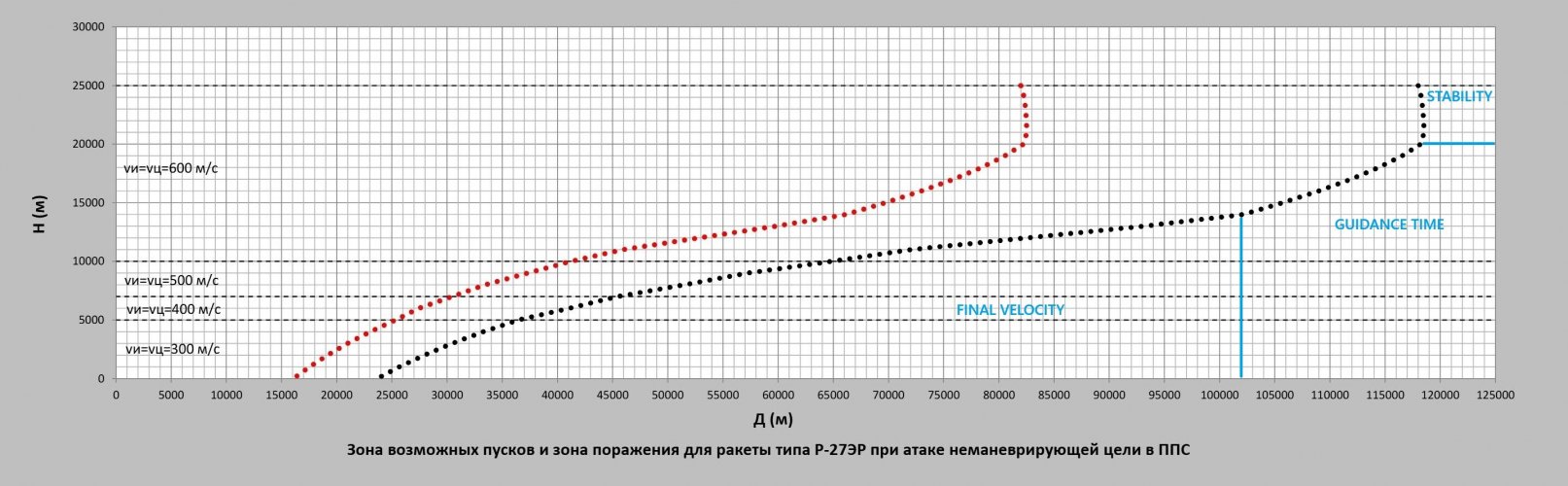
The creator of these graphs wanted me to reach out and advise that one is for the R-27r not the ER.
 

Attachments

  • IMG_4909.png
    IMG_4909.png
    275.6 KB · Views: 57
Well dammit I’ll have to find it again:)
He sent me these
In just part of launching envelope, guidance time which is limited to 60 seconds (active time of gas-generator, not battery) is factor for creating boundaries of envelope. Rest is in case of such forward hemisphere intercepts, final velocity of missile (velocity of missile=velocity of target) and stability of missile

And depending of starting conditions, altitudes and velocities (fighter, target) envelopes can be in various shapes

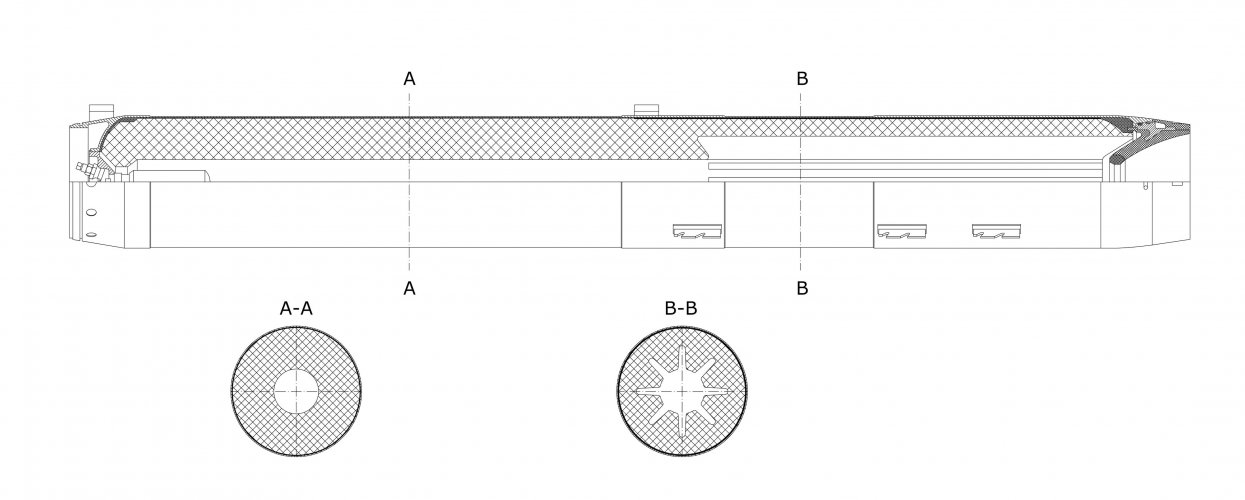
I'm not sure they had chance to see how motor looks like inside, could be interesting for some
 

Attachments

  • IMG_4939.jpeg
    IMG_4939.jpeg
    525.1 KB · Views: 45
  • IMG_4938.jpeg
    IMG_4938.jpeg
    435.5 KB · Views: 51
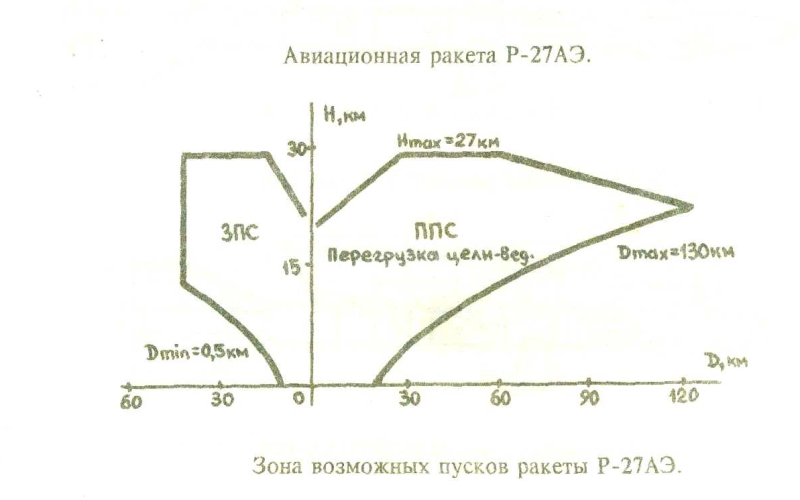
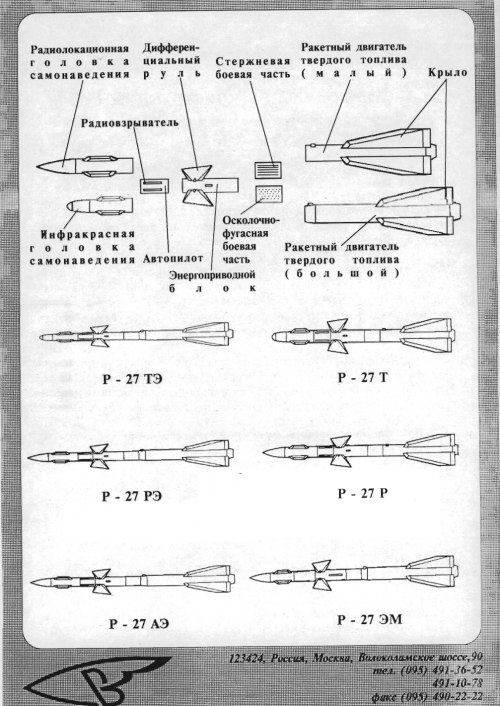
From some very old Vympel data pamphlets I found this drawing of R-27AE and R27EM.
I still can’t figure out if k/r-27ae/ea was ever test fired. having launch and range figures for it would lead me to believe so, but all the literature I’ve seen states that k-27a was about as far as the program of putting an active seekerhead on a r-27 got, as after it was test fired on mig29s, it got canceled before the r-27ea seemed to materialize.
 
It if we calculate this a slower target would need to be compensated by a faster launch. A slower target does matter because the missile cannot fly longer then 60 seconds, that is the length of time the thermal-turbo battery lasts.

And I’m really not sure the 36T seeker of R-27T/ET can do the front aspect launches you say, brochures give it only 16-18 km range in front aspect 10-30 degrees. I would assume the 70 km given is for rear aspect burner

When we look at seeker charts for R-60, R-73, and R-24T, afterburner is maybe good for a 2-3x range boost at the most
What is the source for the r73 seekerhead ranges?
 

Similar threads

Back
Top Bottom