Sadly. after its third incarnation imploded it moved to the forums of a video game, for reasons that never made much sense to me. There, it got swamped by gamers, and then disappeared behind a paywall.
It always seemed to me that this site was a more natural home for the old Warship Projects Board, but for some reason that wasn't on the cards.
I have four complete files with the tittle Soviet Nuclear Cruisers Warships Projects Discusion boards from 2006 in Chrome HTML format. How can I put here?
Ákos (Csatahajós) does not wanted to make another forum (costly, other issues) and he was already part at that time the Wows test group so that is why the wows forum was chosen, but I knew at that time it wasn't the best idea. Most members of the old forum are spread over various other forums like Secret Projects but they mostly gathered at the battlecruisers forum here: https://www.tapatalk.com/groups/alltheworldsbattlecruisers/
I have four complete files with the tittle Soviet Nuclear Cruisers Warships Projects Discusion boards from 2006 in Chrome HTML format. How can I put here?
This is probably its spiritual home now. Many of the old crowd (including me) are members of All the World's Battlecruisers, but as a forum it tends to focus on pre-1945 topics and has a strong what-if/modelling focus rather than projects as such. It certainly goes into more depth on naval research topics though and is well worth a visit.
Joined: 31 Dec 2005
Posts: 156
Location: Great Britain
Posted: Sat Mar 25, 2006 2:33 pm Post subject: Soviet Nuclear Cruisers
Can anybody help?
Were there any plans for nuclear powered cruisers in the 1960s or any smaller alternatives to the Kirov Class in the 1970s? The Soviets had many nuclear powered submarines and I would have thought the Navy would have planned surface ships with nuclear reactors.
Thanks.
_________________
"There is a might-have-been which is more true than the truth"
Posted: Sat Mar 25, 2006 4:05 pm Post subject: Soviet CGN's
The Soviets generated a lot of designs for nuclear powered surface ships. V. P. Kuzin hinted at a bewildering variety in his four-part article on the Project 1144 (Kirov CGN's) published in Taifun but I haven't got much more than that. Had the Soviet Union been able to survice, there would have been more nuclear surface ships.
In addition to political opposition, I expect that economics and the demands on the Soviet nuclear industry in meeting the needs of the nuclear submarine programme probably delayed implimenation of any programme of Nuclear Powered surface ships in the first place.
I do have some information and graphics on some of the versions of the Project 63 CGN from Jim Anderson's previous posts and some correspondence with V. Yakubov a couple of years ago. I also have some information on Project 1126 which I posted on version 2 of this board and obtained from Breyer's Schlachtshiffe and Schlactkruezer 1921-1997 if you are interested.
Posted: Sun Apr 02, 2006 8:41 pm Post subject: Re: Soviet CGN's
Anonymous wrote:
I do have some information and graphics on some of the versions of the Project 63 CGN from Jim Anderson's previous posts and some correspondence with V. Yakubov a couple of years ago. I also have some information on Project 1126 which I posted on version 2 of this board and obtained from Breyer's Schlachtshiffe and Schlactkruezer 1921-1997 if you are interested.
Hi
As I am interested to know more about those ships, pleas may you post here or send privately to me what you should be able to share?
Posted: Tue Apr 04, 2006 2:25 am Post subject: Soviet CGN's
There is an ld of nuclear powered cruiser Projekt 63 of 1958 in
Stalin's Ocean -going Fleet by Rohwer and Monakov
but it is a smallish longitudinal section and not all that clear.
My scanner never gives good results with a drawing like this.
If MAR can post anything it might well be better.
Two reversed tripod masts at about 25% and 50% from stern.
76mm turrets approx alongside masts, 2 each side
Helicopter well aft on quarterdeck.
flush deck, not much superstructure - a block in front of mainmast to about halfway to foremast. Sharply raked bow, spoon stern
whole drawing about 4 in long with lots of numbered lines pointing to things with no key and confusing the drawing
The caption says
3 launchers for missiles P-40 1 aft the mainmast, two sided (?? I don't see another way to interpret the drawing) before the foremast by about 1/8 the length. If the boat and the 'copter are about 40 ft long, the large missiles in their launchers are about the same and the ship is 600 ft +
2 twin launchers for aa missiles M-3
2 aa missile launchers M-2
8 x 7.6cm (4x2 from drawing)
Credit Sudostroenie
the missile numbers mean little to me as my interests are in earlier ships
Joined: 25 Jun 2005
Posts: 163
Location: Regina, SK., Canada
Posted: Tue Apr 04, 2006 7:38 am Post subject: Alrightee then!
Alrightee then! I have statistical information on these two versions plus drawings for a couple more. I'll get the stats up tonight and work on the other two drawings!
This is the Stalin's Fleet one, but the original I think with (Russian) captions, and a bit bigger.
I was wrong with at least one of my interpretations. What I thought were P40 are M-3
Joined: 25 Jun 2005
Posts: 163
Location: Regina, SK., Canada
Posted: Wed Apr 05, 2006 7:33 am Post subject: Project 63 stuff.
This post editted April 14th for ship dimensions and other info. Editted on april 29 for dimensions, displacement and errors on P-20 and P-40 corrected.
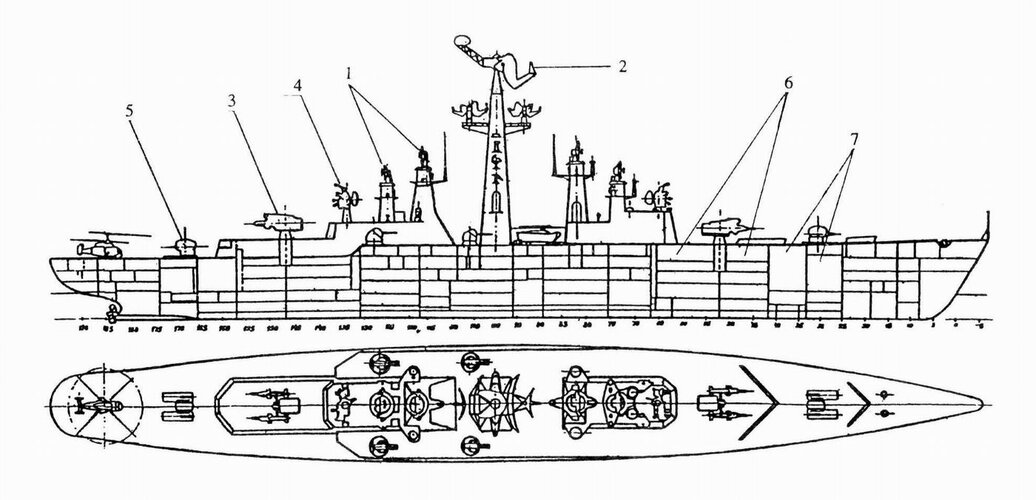
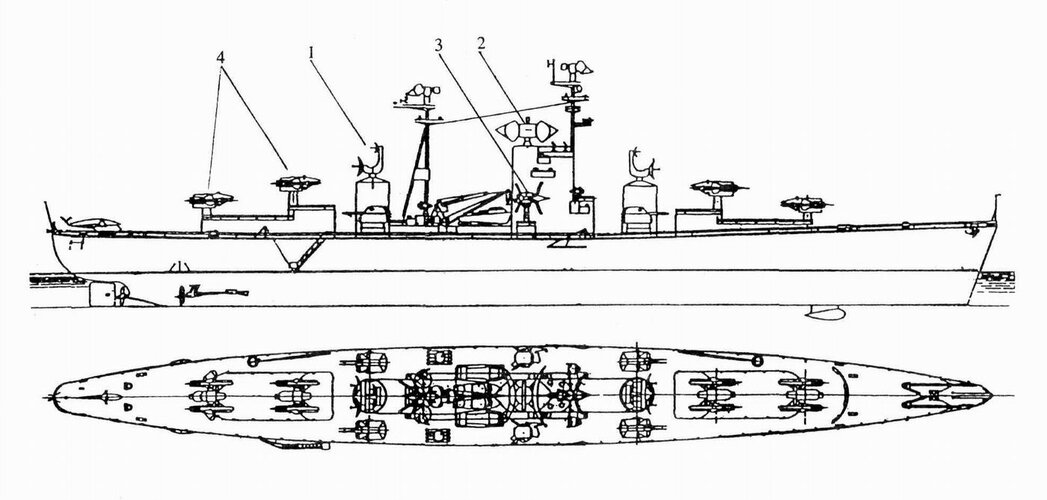
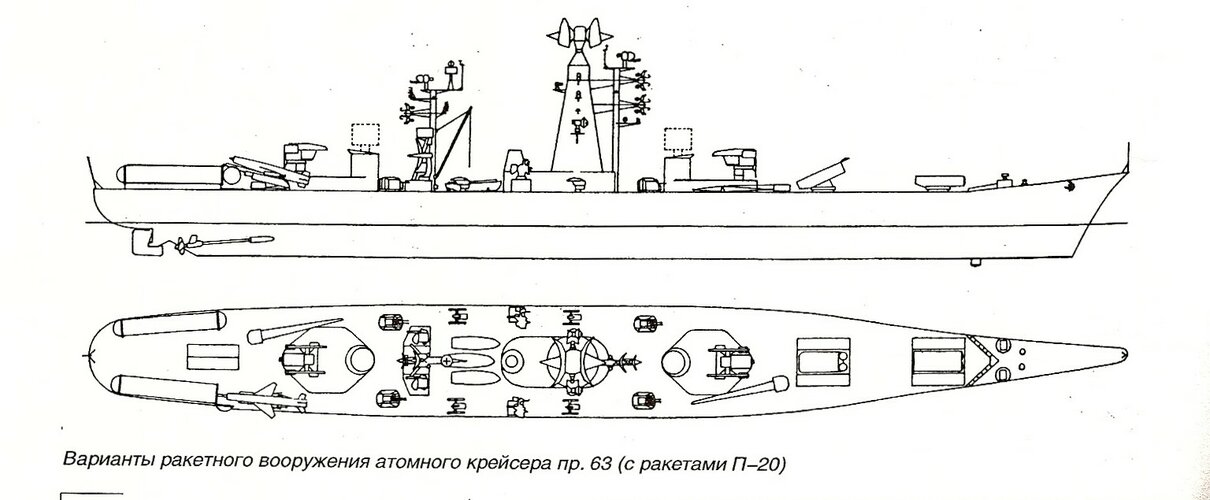
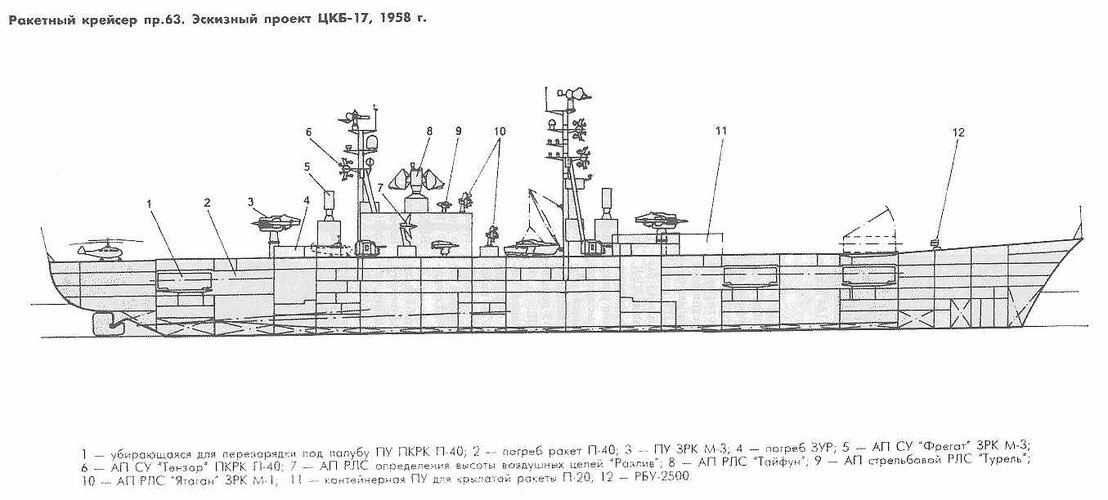
Thanks, Smurf. This is one of the three other drawings I have for Project 63. Accordin to V. P. Kuzin, this was the final version of Project 63. Regretably, it is one for which I have the least amount of information but I will post what I have.
Based on scale comparision with other drawings, I've come up with the following approximate dimensions for this version;
LOA: 196.0 metres
LWL: 183.2 metres
Beam: 19.8 metres (based on similarLength to beam rations of L-2 and Eh-4
Draught: 6.5 metres to the keel
According to Shirokorad, the final version of Project 63 was to displace approximately 16000 tons (which matches the estimate I came up with) and have a speed of 32 knots, carry two P-20 nuclear tipped strategic land attack cruise missiles and carry 18-24 P-40 cruise missiles for either anti ship or land attack with either nuclear or conventional warheads. Neither missile made it into service.
In this version, P-20 was carried in two fixed deck-mounted container-launchers, one on each side of the forward M-3 SAM launcher. I have to confirm this but I believe P-20 was inertially guided with no other form of terminal guidance so it wasn't something to be used against a moving target and, once launched, it was on it's own. It was to carry a megaton range warhead to make up for navigational inaccuracies.
P-40 would be fired from three retractable trainable launchers with three or four (don't know for sure which) launch tubes each. Each launcher was served by a below deck magazine right behind the launcher which carried one reload for each tube.
Looks like P-40 was going to be a combined inertial-command-active radar homing missile, like P-6/P-35 SS-N-3 Shaddock. It was to use the Tenzor (Scoop Pair) guidance system and there were three such systems on this version of Project 63; Two forward, one aft so it could guide six missiles simultaneously.
For AAW, like most of the big nuclear powered versions of this design, she would carry two M-3 long range SAM batteries, one forward, one aft with 10 V-800 missiles per battery. Each battery had a Fregat fire control radar, one forward, one aft.
As an alternative, M-2bis (SA-N-2 Guideline) with Korvet radars (Fan Song E) in the same positions with the same number of missiles.
Short-medium range SAM coverage was to be provided by two M-1 Volna batteries (SA-N-1 Goa) with each battery composed of one Yatagan fire control radar (Peel Group) and two ZIF-101 launchers with sixteen missiles per launcher.
Guns were four AK-726 76-mm mounts, two port and two starboard with each pair likely to be controlled by a Turel GFCS (Owl Screech), one port, one starboard. Ammunition carried would likely equal about 5000 rounds total.
Radars; Looks like two MR-300 Angara (Head Net A) radars at the mastheads, a Taifun long range airsearch radar (no specifics on this but it looks like bigger versions MR-500 Kliver (Big Net) placed back to back) and two Razliv (High Lune) Height finders. Obviously there would be navigation radars (probably Don's) and other stuff.
The EW outfit specified for other big ship versions of Project 63 was four Krab Jammers (Top Hat) and Four Bizan (Watch Dog/Guard Dog) systems but, by the time the ship might have come into service, I think it likely that the next generation of systems, Gurzuf (Side Globe), might be available. Considering the very high value this ship would have had, I believe that Gurzuf would have been installed or backfitted. This would probably require changes in the masts to the enclosed pyramid towers seen on the Kresta 1 of Kynda classes.
Sonars: All the big versions I have info for were to carry two GAS-372 Gerkules sonars. I think it likely would have changed to the MG-312 Titan-1 and MG-311 Vychegda sonars due to likely delays in getting the ship and all of its systems online, allowing these to be substituted.
All of the big designs I have information for had armour protection to a level equal to or better than the heavy cruisers of the World War Two era. Regretably, I have no specifics for the armour protection for this version but it is likely to have been armoured to a similar level.
And finally, the key for the drawing from Smurf.
1. P-40 launcher
2. P-40 magazine
3. SM-68 (I think) launcher for M-3 system
4. missile magazine for M-3
5. Fregat radar for M-3
6. Tenzor radar system for P-40
7. Razliv heightfinder radar
8. Taifun Air surveillance radar
9. Turel GFCS radar
10. Yatagan Fire Control radars for M-1 system
11. P-20 container-launcher
12. RBU-2500 mount. there were two side by side.
That's it for now.
More to follow, like it or not!
Last edited by M. A. Rozon on Sun Apr 30, 2006 7:17 am; edited 4 times in total
the ship design is from the operator's point of view, "odd" as there is little provision for effective ship manning. The near-Fisherite reduction of superstructure for reasons of CBN containment, no doubt, is extreme. Indeed, one would think that the ship was of the "one mission" type, since operator concerns are firmly seconded to weapon employment.
Yet the size of the ship tells one that she is not an "expendable."
So - what is missing in this equation, you SovNavy experts?
Joined: 25 Jun 2005
Posts: 163
Location: Regina, SK., Canada
Posted: Wed Apr 05, 2006 9:15 pm Post subject: One consideration might be...
MJB, one consideration might be that these designs took one tendency to an extreme.
At this point, Soviet design was moving what in western parlance is called the Combat Information Centre, Combat Direction Centre or Operations Room down to the Lower deck within the hull, specifically for reasons of NBC and general combat survivability. The ship could be conned and fought completely from this position. A greatly simplified Navigation Bridge on the upper deck was in place for pilotage and close quarter's maneuvering situations. An example of this can be seen in Project 61, the Kashin Class DDG's. However, because the Kashin is much smaller, the impression is less extreme. The versions we've seen here of Project 63 are all monster ships. As such a similar sized navigating bridge looks like a postage stamp by comparison.
I am of the opinion that the navigating bridge on the Project 63 ships pictured here would located in the same position as that of Project 61: in the pylon superstructure directly under the forward Fregat Missile fire control radar. All things considered, I thing there would have been some changes made to the bridge structure as soon a trials were finished, making it bigger and adding bridge wings for visibility.
There is certainly an emphasis on strategic nuclear attack using cruise missiles in these designs. I expect that this would have changed as it did for all of the platforms, surface and subsurface, that carried the P-6/P-35/SS-N-3 missiles. These ships would have become AAW/AsuW oriented and task force flagships to boot. P-20 would have been landed and the space and weight used for other, more productive things.
Hopefully I answered the right question.
Last edited by M. A. Rozon on Thu Apr 13, 2006 10:09 am; edited 2 times in total
Font colour: Default Dark Red Red Orange Brown Yellow Green Olive Cyan Blue Dark Blue Indigo Violet White Black Font size: Tiny Small Normal Large Huge
Jump to: Select a forum General Board----------------News, announcements Never-were warships----------------United States NavyRoyal NavyNihon KaigunMarine NationaleRegia MarinaDeutsche KriegsmarineDeutsche HochseeflotteRussian/Soviet NaviesOther, smaller navies Other never-were related forums----------------Never-were modelsNever-were sources,books,websitesNever-were fleet tactics, concepts etc. Non-never were but ship related forums----------------Real ships Own Designs----------------Own designs
You can post new topics in this forum
You can reply to topics in this forum
You can edit your posts in this forum
You can delete your posts in this forum
You can vote in polls in this forum
Power Plant - 132000 horsepower nuclear plant with four (maybe eight?) reactors supplying 2 turbines of 55,000 horsepower each (don't know why there is the disparity)
Speed - 32.5 knots
Armour - Massive! This is not much explanation given in the tables and without cross sections difficult to figure out for sure so here is my best shot. Any errors are strictly mine:
Bulkheads
Transverse armoured - 30 - 80 mm
Longitudinal - 14-20
Belt - 140 mm, increasing to 150 mm over reactor spaces
Deck - several decks with armour grade steels with thicknesses varying from 20 to 80 mm increasing to 150 mm over the reactor spaces. There was also armour running near the bottom of the ship varying from 95mm to 100 mm, the heavier thivknesses under the reactor spaces.
Armament
2 x P-20 strategic cruise missiles in containers on the quarterdeck. These were to be run out onto trainable launchers for firing.
3 x twin tube missile launchers for P-6 anti-ship missiles, two forward and one aft. These were retractable and trainable. These likely would have had below deck magazines behind each launcher with 1-2 reloads per tube.
The table says the P-6 missile was to be used. I think this is an error. The P-6 was used as the antiship weapon for the submarine based versions of the SS-N-3 system whereas the P-35 missiles was used by surface ships (Kynda's and Kresta 1's). There are some differences and I think the P-35 would have been used.
2 x SM-68 twin launchers for the M-3 system, one forward and one aft with 10 missiles per launcher. Control provided by 2 Fregat radars, one forward and one aft.
Again, M-2bis is an alternative with the same number of the associated launchers, missiles and radars in hte same positions.
4 x Zif-101 launchers for M-1 Volna (SA-N-1 Goa), two port and two starboard, each launcher with 16 missiles. Control provided by two Yatagan (Peel Group) radars, one port and one starboard.
4 x AK726 twin 76-mm mounts, two port and two starboard on the four corners of the ship, controlled by two Turel (Owl Screech) GFC radars, one port and one starboard on the big tower mast between the forward pole and after tripod masts. Ammunition load unknown but can be expected to be at least 5000 rounds aboard the ship.
ASW - 2 x RBU-2500, side by side on the bow. Probably ammunition carried for four full salvoes, a loadout common to most ships equipped with this weapon.
No helicopter and no position to place a pad to service aircraft from other ships, hence no fuel or stores embarked for one.
Radars
2 x Taifun, mounted back-to-back at the top of the tower mast, the tallest on the ship.
2 x MR-300 Angara (Head Net A) on the forward pole and after tripod masts.
2 x Razliv (High Lune) heightfinder radars either side of the after tripod mast.
3 x Tenzor radars (Scoop Pair) for controlling the P-6 missiles, two forward on the pole mast and one aft on the tripod.
EW
4 x Krab (Top Hat)
4 x Bizan (Watch Dog)
Navigation radars
at least two Don
IFF
2 x Nickel-Khrom systems
Heat detectors
1 x Zorkii
I am assuming this a passive IR system aimed at detecting ships. This was a common planned fitting for many Soviet surface ships of this period but which was apparently not successful. I'm looking for more info about this.
Other systems
Bug
Burevestnik
Grusha
As soon as I know what these are, I'll edit this post!
TV systems
7 x Kuznechik. as soon as I know which NATO code applies, I'll post it.
Sonars
2 x GAS-372 Gerkules.
The comments that I made in the previous two posts apply equally here.
I'll post the info for the other version later today or tomorrow.
As always, questions and comments are welcome.
Last edited by M. A. Rozon on Sat Apr 15, 2006 2:53 am; edited 8 times in total
Posted: Wed Apr 05, 2006 10:04 pm Post subject: You answered correctly!
although I'm of the school that looks at design also as indicative of several "mission statements" and a ship which basically operates as a dedicated strategic platform would have a low survival rate in any event (being such a high priority target) that one suspects less emphasis on the long-term qualities such as adequate conning
What throws me off on the CIC is the apparent lack of an armoured tube. I trust the schematic simply doesn't reflect armour thicknesses.
Also, I'm looking for periscopes since good old reliable soviet engineering wouldn't trust completely to some television system.
As for the "guess" on conning location, the only place is forwward of the missile launcher but what with that bow flare, much like some 90 year old driving one of the long hood Cadillacs of the 1950s!
Joined: 31 Dec 2005
Posts: 156
Location: Great Britain
Posted: Wed Apr 05, 2006 11:39 pm Post subject:
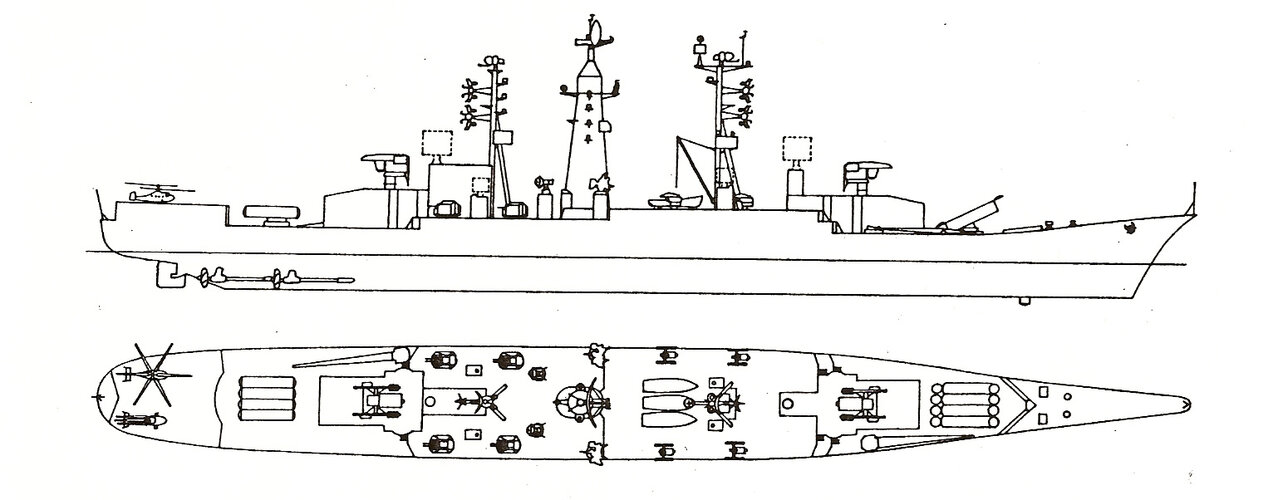
Here are some of the technical points/questions I've disscussed with Michel.
PROJECT 1126
1) I estimate the V-800 is about 8-9m long comparing it to the Ka-25, this is still a big missile, it is one of the aerodynamically cleanest SAMs of the period suggesting a Mach 3 capability. When the V-800 was abandoned the SA-4 Ganef would have made sense given that most naval SAMs were modified army missiles.
2) Possible future weapons either on completion or refit, replacing two 57mm mounts with SA-N-4 would have been a good move. The TT could have been internal quintuple like Moskva, but on the plan I can see no good place to fit them in the hull. This would later allow for SS-N-15 and give these ships a dual-role. On SSMs there is ample room abreast the forward superstructure for four P-15 or even SS-N-3 Shaddock (two twins) like Kreasta I.
3) These would have been good Anti-Aircraft escorts and with suitable A/S and Anti-Ship capability would have good multi-role escorts without Western equal. Just using them to escort the Moskva Class or ASW groups seems a waste, certainly their fates were linked to the supercarrier programme.
PROJECT 63
1) Eh-4: I’m assuming that the quarterdeck structure is a hangar. I’d go for internal quintuple 21in tubes. Overall a well-balanced design with masses of radars and missile systems. Where are the P-20 on this design, there seems to be no room for them?
2) I-L2: Again I’m speculating on hull torpedo tubes. The two P-20 takes up a lot of space, if they are for attacking land targets that makes these ships strategic, but I’m sure American SAMs would down those large missiles. Deploying them would take a long time.
3) Shirokorad Drawing 3: My favourite design, clearly this is a version of the Eh-4/ I-L-2 designs. The retractable P-40 seems to complicate the launchers but does improve reload times. The P-20 on here too, the outline suggests a neater container launcher rather than retracting the missile and then firing like the I-L2.
These are very powerful ships suitable for a blue water navy but the advances in technology made the Kirov with VLS a better proposition with a better all-round capability.
These are just thoughts/ specualtions from examining the drawings. I was puzzled too above the bridge but Michel's solution seems the most logical.
_________________
"There is a might-have-been which is more true than the truth"
Unfortunately, I lost the reference for the following text, but maybe it is worth to post it here
In the following program of military shipbuilding for 1959-1965, prepared with participation of new Commander-in-chief S.G. Gorshkov, was made the next attempt to provide air defence protection without aircraft carriers. In connection with change of TsKB-16 specializations, designing of the new missile air defence (pr. 1126) was charged back to TsKB-17 which V.V. Ashik supervised till leaving in 1960 for scientific-teaching work in Leningrad Shipbiuilding Institute.
The decree of 25 July 1959 determined the basic characteristics of this ship and its armament which was to be based around the M-31 air-defence missile complex. Application in a complex of rocket KS-42 created on base 3M8 with the minimal completions for accommodation by the ships was provided. Rocket KS-42 with launch weight of 3.200-3.500 kg and length 9-11 m should amaze air targets in radius of 50-60 kms from the launcher in a range of heights of 1-25 kms. For start of rockets by the ships it was supposed to place dvuhbalochnye launching sites of SM-92, for a loading of launching sites and storages of rockets in the filled condition with the combined wings in cellars were projected conveyor installations on 8 and 10 rockets. It was supposed to use modified a command radio station and antennyj a post of a complex 2K11. The 10.000 t ship should carry one ZRK M-31 with two launching sites, and also a M-11 complex.
However, in 1960 the number of the planned ships was reduced from three to two.
Work on pr. 1126 was stopped by the Decree N° 565-236 of 21 June 1961.
now, a machine translation from
pvo.guns.ru/naval/m31_s75.htm
In second studied variant of the M-31 complex it was supposed rockets V-757 (V-757M), still known under a designation 17D. This variant of a complex was supposed to be placed to the ships of the project 61Á which designing conducted OKB-53. Range of defeat of air targets should make 50 (45) km. Rockets V-757 had the mid-flight solid-fuel engine, that it should essential to simplify operation of rockets by the ships. The length of a rocket made 6,5 m, launch weight 2.800 kg.
The launching site of SM-98A with the feeder and storages of rockets was developed in OKB-34 and ÖÍÈÈ-173. The control system of a complex was similar to a control system Grom. Works on this variant also were stopped in 1961.
and here something to be translated about the M-3 system (V-800 missile)
Joined: 25 Jun 2005
Posts: 163
Location: Regina, SK., Canada
Posted: Thu Apr 06, 2006 7:41 pm Post subject: COOL!
More stuff about Project 1126. COOL!
As soon as I finish posting what I have on Project 63, I'll post what I have on Project 1126.
And I just took a look at the rest of the PVO site that you refered to, Ender. There is a whole pile of stuff, including line drawings and info on several other ships and missiles. Great!
This should answer some questions and raise some more!
Power Plant - 120000 horsepower nuclear plant supplying four turbines of 30,000 horsepower each.
Speed - 32.5 knots
Armour - Massive! A much simpler arrangement than L2 but still massive. Still no cross sections so this is still best guess. Any errors are strictly mine:
Bulkheads
No Armoured bulkheads listed in table
Belt - 75 mm, increasing to 200 mm over reactor spaces
Deck - Upper armoured deck of 20 mm increasing to 150 mm over the reactor spaces. There was also armour running near the bottom of the ship varying from 75mm to 100 mm increasing to the upper value under the reactor spaces.
Armament
2 x P-20 strategic cruise missiles. However, I have no idea where they are as they are not obvious on the drawing.
2 x quad SM-76 trainable missile launchers for P-40 anti-ship missiles, one forward and one aft. There are no obvious hatches or positions to run up reloads in the drawing although the possibility can't be ruled out.
2 x SM-68 twin launchers for the M-3 system, one forward and one aft with 10 missiles per launcher. Control provided by 2 Fregat radars, one forward and one aft.
As noted previously, M-2bis is an alternative weapon.
4 x Zif-101 launchers for M-1 Volna (SA-N-1 Goa), two port and two starboard, each launcher with 16 missiles. Control provided by two Yatagan (Peel Group) radars, one port and one starboard either side of the big tower mast in the middle.
4 x AK726 twin 76-mm mounts, two port and two starboard either side of the after tripod mast, controlled by two Turel (Owl Screech) GFC radars, one port and one starboard on their own pylons aft of the Yatagan radars. Ammunition load unknown but can be expected to be at least 5000 rounds aboard the ship.
ASW - 2 x RBU-2500, side by side on the bow. Probably ammunition carried for four full salvoes, a loadout common to most ships equipped with this weapon.
Two helicopters with the pad on top of the hangar on the stern. Several tonnes of fuel, torpedoes, depth charges, sonobouys and other expendable stores.
Radars
1 x Taifun although the information table I have says two, mounted at the top of the tower mast, the tallest on the ship.
2 x MR-300 Angara (Head Net A) at the mastheads of the forward and after tripod masts.
2 x Razliv (High Lune) heightfinder radars, not shown explicitely on the drawing but the obvious position is either side of the after tripod mast where the small dotted rectangle is shown, marking an antenna position.
4 x Tenzor radars (Scoop Pair) for controlling the P-40 missiles, two each on the tripod masts.
EW
4 x Krab (Top Hat)
4 x Bizan (Watch Dog)
Navigation radars
at least two Don
IFF
2 x Nickel-Khrom systems
Heat detectors
1 x Zorkii
Other systems
Bug
Burevestnik
Grusha
TV systems
7 x Kuznechik. as soon as I know which NATO code applies, I'll post it.
Sonars
2 x GAS-372 Gerkules.
The comments that I made in the previous posts apply equally here.
I have one more big and one more small version of this Project yet to come.
In addition, I've made a couple more edits to the post for Version L2
Enjoy.
Last edited by M. A. Rozon on Sat Apr 15, 2006 2:55 am; edited 1 time in total
Ilyushin's P-20
3 x 30 m body, designed to fly at 30 km at Mach 2.5-3 to a range of 3.500 km range, 30 t in a 4.6 x 25 m canister.
According to Polmar's Cold War Submarine: "The P-20 was to be a land-attack weapon that could carry a nuclear warhead against targets 3.500 km from the launching ship. The missile was to attain a maximum speed of Mach 3 and was to fly the last portion of its trajectory at low altitude and zigzag."
Joined: 25 Jun 2005
Posts: 163
Location: Regina, SK., Canada
Posted: Sun Apr 09, 2006 6:06 am Post subject: Just an add on........
Just an add on comment to MJB's words about television systems, I agree. Ship designs from this period, Project 61 (Kashin) being an example, have periscopes from the GKP/CIC/CDS/Ops room and the cruisers we've talked about would be no exception.
As for the lack of an armoured tube in Project 63, good question. Don't know the answer to that one. Food for thought.
Joined: 25 Jun 2005
Posts: 163
Location: Regina, SK., Canada
Posted: Thu Apr 13, 2006 8:00 am Post subject: And Now, More stuff!
Editted 22 April for artillery information, 29 April for displacement and torpedo armament.
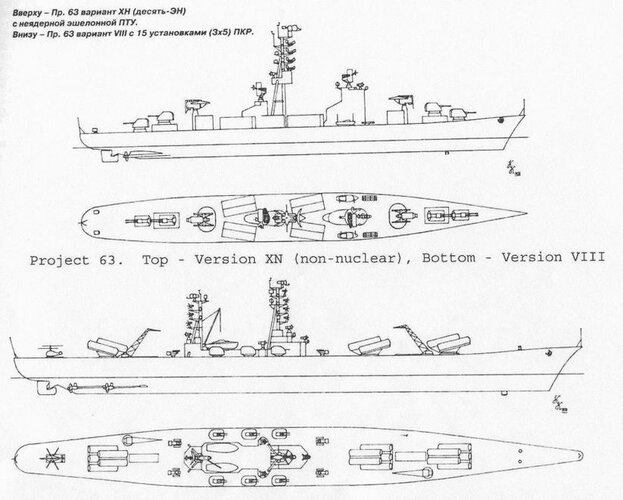
And now, here is more information for more versions of Project 63.
Thank you Big Rich for posting the drawings. Thanks again to V. Yakubov for passing them on to me in the first place.
I don't have hard stats for these two so I am making some educated guesses after doing some scaling and other measurements. Any errors are my responsibility. Hopefully I am in the ballpark.
This top version was designated XN. It was one of the conventionally powered versions investigated. While not a monster, it was still quite large;
Standard Displacement - I estimate approximately 10 000 tons.
Length - 179 metres
Beam - 19 metres
Draft - 5 metres to the keel, 7.2 metres to the bottom of the sonar dome in the lowered position.
Power Plant - Oil-fired pressure-fired steam plant based on the KV-41 plant trialed in Project 41 destroyer (NATO ASCC Tallin). Steam conditions 470 degrees C at approximately 64 kg/cm2. Power unknown but at least in the 100,000 horsepower range. The two shaft plant would likely be arranged in two units with two boilers and one double-reduction geared turbine each. The forward unit has it's uptake in the aft portion of the forward superstructure and the after unit uptake in the aft portion of the superstructure topped by a Fregat/Korvet missile fire control radar just aft of the tripod mast .
Speed - approximately 32 knots
Armour - No specifics but this ship is large enough for light cruiser level protection for boilers and turbines.
Armament
4 x twin two level fixed container launchers, two port and two starboard, for P-35 or P-40 anti-ship missiles. Eight missiles are in the upper levels ready for use. They would be elevated to a launch angle of about 20 degrees before firing. Eight reloads in the lower tier.
2 x SM-68 twin launchers for the M-3 system, one forward and one aft with 10 missiles per launcher. Control provided by 2 Fregat radars, one forward and one aft.
An alternative would be the M-2bis system (SA-N-2 Guideline) with the Korvet (Fan Song E) radars in the same positions with the same number of missiles.
Guns are a little different than in the versions previously discussed. The turrets in this drawing are much larger that of the AK-726. The only alternatives I can think of are:
4 x SM-52 (100-mm) or SM-62 (130-mm) twin mounts, two forward and two aft, controlled by two Turel (Owl Screech) GFC radars, one on the forward superstructure and one on the aft face of the tripod mast. Ammunition load likely to be at least 400 rounds per gun.
The SM-52 and SM-62 had both completed development and were ready for service entry on the last batch of Project 68bis cruisers (SM-52) and Project 56 destroyers (SM-62). With their higher training and elevation rates, rates of fire (40 RPMPG) and being fully enclosed, they addressed what the Soviet Navy perceived were the deficiencies in the previous SM-2 (130-mm) and SM-5 (100-mm) mounts. Unfortunately, Khruschev cancelled the ships they would have been deployed on and they never went to sea.
ASW - 2 x RBU-2500, side by side on the quarterdeck. Probably ammunition carried for four full salvoes, a loadout common to most ships equipped with this weapon.
2 x triple 533-mm torpedo tube mounts on the weather deck, one port and one starboard, just ahead of the forward superstructure. Likely no reloads carried with the ship laid out the way she is.
No helicopter and no position to place a pad to service aircraft from other ships because of the presence of the RBU's on the stern, hence no fuel or stores embarked for one.
Radars
1 x MR-300 Angara (Head Net A) at the masthead of the tripod mast. As this seems to be the only Air Search radar and unsupported as it is by any heightfinder radars, I expect it would be replaced by Angara-A (Head Net C) as soon as it became available.
2 x Tenzor radars (Scoop Pair) for controlling the P-35/P-40 missiles on the forward face of the tripod. This is problematic as there appears to be four antennas that look like half of a Tenzor radar. I believe they represent the equivalent of two Tenzor systems. That means they can control four missiles simultaneously.
EW
2-4 x Krab (Top Hat)
2-4 x Bizan (Watch Dog)
Navigation radars
at least two "Don"
IFF
2 x Nickel-Khrom systems
Heat detectors
1 x Zorkii
Other systems
Bug
Burevestnik
Grusha
As soon as I know what these are, I'll edit this post!
TV systems
4-7 x Kuznechik. as soon as I know which NATO code applies, I'll post it.
Sonars
2 x GAS-372 Gerkules.
The comments I've made in the previous two posts apply equally here.
This version has no short-medium range SAM's, fewer electronics and fewer systems enclosed within the hull. Although she is large and has heavier artillery, she is definitely on the lower end of the design spectrum for Project 63.
Next post will be for Version VIII and this one is truly a monster!
Last edited by M. A. Rozon on Mon Jul 31, 2006 9:49 am; edited 6 times in total
the "conventional" version with all of that topweight - now THAT'S scary, children!
Honestly, something does apperar remiss what with the weaponry and towering mast. I have to suspect that the weapons systems would have been reduced in design, if not then, once the ships took to the seas.
Joined: 25 Jun 2005
Posts: 163
Location: Regina, SK., Canada
Posted: Fri Apr 14, 2006 7:07 am Post subject: And Now for Version VIII
Editted April 22 for artillery information, 29 April for displacement.
VERSION VIII - Truly a MONSTER of a ship!
This version is the lower of the two in the drawing above. Thanks again to Big Rich and V. Yakubov.
Again, I don't have hard stats on this ship. The drawing also was a little confusing in that many of the Radar antennas don't seem to be the right shapes. I am, therefore, once again making what I hope are educated guesses on just about everything.
Here goes;
Standard Displacement - I estimate approximately 24 000 tons, which seems to agree with Smurf's estimate below.
Length - 250 metres
Beam - 26.4 metres
Draft - 6.7 metres to the keel, 8.4 metres to the base of the lowered sonar dome.
Power Plant - 120000+ horsepower nuclear plant with four - eight reactors supplying four turbines of 30,000+ horsepower each
Speed - approximately 32 knots
Armour - Massive! No specifics but this ship should be armoured to a level at least equal to that of L-2 or Eh-4.
Armament
3 x quintuple trainable launchers that appear to be fixed in elevation for P-40 or P-35 anti-ship missiles, two mounts forward, one aft. These batteries are supported by below-decks magazines carrying possibly up to another 15 missiles as reloads. Two cranes are situated on deck in the vicinity of the magazine lifts bringing reloads to the upper deck. These cranes assist reloading the launchers as well as striking down missiles into the magazine. This arrangement simplifies things greatly but makes reloading a very long evolution.
4 x Zif-101 launchers for M-1 Volna (SA-N-1 Goa), two port and two starboard in the four corners of the ship, each launcher with 16 missiles. Control provided by two Yatagan (Peel Group) radars, one forward on top of the forward superstructure (2nd from the forward edge of that structure) and one just aft of the trailing legs of the after tripod mast.
Bearing in mind the greater size of the ship, I think the Zif-102 is a better option, using a belt conveyor system providing 32 missiles per launcher. Replacing one of the Owl Screech systems (The forward most one) with another Yatagan director for M-1 is, in my opinion, a preferred alternative.
6 x SM-52 (100-mm) or SM-62 (130-mm) twin mounts, three port and three starboard amidships, controlled by Three Turel (Owl Screech) GFC radars, one forward on the forward superstructure (most forward antenna on top of the forward superstructure) and one each port and starboard amidships. Ammunition load unknown but can be expected to be at least 400 rounds per gun. The reasons for these choices are the same as for version XN above.
ASW - 2 x RBU-2500, side by side on the bow. Probably ammunition carried for four full salvoes, a loadout common to most ships equipped with this weapon.
2-4 helicopters with the pad on the quarterdeck. The hanger is below decks with an elevator serving the flight deck on the stern. Several tonnes of fuel, torpedoes, depth charges, sonobouys and other expendable stores.
Radars
2 x MR-300 Angara (Head Net A) at the mastheads of the forward and after tripod masts. As there are no heightfinders serving them, I expect that these radars would have been replaced by the MR310- Angara- A (Head Net C) as soon as they were available.
3 x Tenzor radars (Scoop Pair) for controlling the P-35/P-40 missiles, two on the forward tripod, one on the after.
Here, the same problem that occured with version XN cropped up again. I have been somewhat conservative here. Three Scoop Pair allow six missiles in the air simultaneously. If each of what I suspect is half a Scoop Pair is actually a complete guidance system, then there is potentially the equivalent of SEVEN Scoop Pair systems, allowing the ship to fire all but one of its launchers in one salvo.
EW
4 x Krab (Top Hat)
4 x Bizan (Watch Dog)
Navigation radars
at least two Don
IFF
2 x Nickel-Khrom systems
Heat detectors
1 x Zorkii
Other systems
Bug
Burevestnik
Grusha
TV systems
7 x Kuznechik. as soon as I know which NATO code applies, I'll post it.
Sonars
2 x GAS-372 Gerkules.
The comments that I made in the previous posts apply equally here.
No long range air defence SAM's but reasonable short-medium range AA coverage and the largest surface-to-surface missile battery by far of all the versions we've seen. The presence of helicopters guarantees over the horizon targetting ability. I think the absence of a really long range air search radar (as Taifun seems to have been intended to be) is a shortcoming in a ship this size which has obvious potential to become a fleet or task force command platform.
I'll be adding to all of the Project 63 posts with stats as I do some more reading and number crunching to fill in some of the holes.
Comments ?
Questions?
Last edited by M. A. Rozon on Mon Jul 31, 2006 9:52 am; edited 5 times in total
Font colour: Default Dark Red Red Orange Brown Yellow Green Olive Cyan Blue Dark Blue Indigo Violet White Black Font size: Tiny Small Normal Large Huge
Jump to: Select a forum General Board----------------News, announcements Never-were warships----------------United States NavyRoyal NavyNihon KaigunMarine NationaleRegia MarinaDeutsche KriegsmarineDeutsche HochseeflotteRussian/Soviet NaviesOther, smaller navies Other never-were related forums----------------Never-were modelsNever-were sources,books,websitesNever-were fleet tactics, concepts etc. Non-never were but ship related forums----------------Real ships Own Designs----------------Own designs
You can post new topics in this forum
You can reply to topics in this forum
You can edit your posts in this forum
You can delete your posts in this forum
You can vote in polls in this forum
Joined: 31 Dec 2005
Posts: 156
Location: Great Britain
Posted: Fri Apr 14, 2006 1:20 pm Post subject:
The XN conventional design, since the KV-41 oil-fired pressure-fired steam plant of the Project 41 destroyer 'Tallin' was unsuccessful and expensive I doubt they would have used for this larger ship. I think it would be uneconomical, more likely would be conventional oil-fired boilers and turbines, or even gas turbines given the choice made for the Project 61 'Kashin'. Although looking at the top view the funnels would be very narrow.
I agree with MJBurmaster that topweight on all these designs is a serious issue. The VIII is no exception with those massive fixed P-40/P-35 launchers and all those radars. The XN's mast is too high and cumbersome. With the poor seakeeping of Moskva and these designs it seems that most large Soviet ships of this period were poor sailers. The Soviet's seemed to love big superstructures, look at the Kiev Class.
I think Michel has done an excellent job 'filling the gaps', he can't be far off the truth.
_________________
"There is a might-have-been which is more true than the truth"
I don't think the KV-41 plant was unsuccessful. On the contrary, based on my reading to date, the plant was quite successful.
The reason why I say this is that the KV-41 plant of Project 41 (the Neustrashimmy, NATO called her the Tallin class) introduced the steam conditions and basic technology that characterised Soviet Steam plant engineering through to the Carrier Kuznetsov. It provided the increased fuel efficiency, faster start times and higher power densities sought by the Soviet Navy, based on it's experience during the WW2.
The KV-41 plant did have some teething problems as it was the first sea-going plant of it's type but they were addressed. The plant was a little short of power; It was intended to generate 66000 horsepower but generated only 62000. This was more a case of the designers not leaving themselves enough of a design margin and needing to get further along the learning curve.
The Neustrashimmy did have some problems. The ship was intended to make 36 knots but only made 33.5 during trials and had a great deal of cavitation which robbed the ship of power. The reason for this was that the lines of the hull aft were fuller than in previous designs. This affected water flow to the propellers and induced cavitation prematurely. The ship also experience vibration issues at certain propeller and speed combinations because of cavitation and because of the radius of the propellers, the number of blades on each propeller and the switch to double reduction geared turbines which changed propeller rotational speeds.
Initially, it was thought that the shortfall in power was responsible. The steam conditions and basic plant design were maintained when Project 56 (Kotlin class) was designed but power was increased to well over 70000 horse power to reach its intended 38 knots. The hull design maintained similar hull lines aft with similar propellers and shafting. During trials the first ship made only 34.5 knots and manifested the same cavitation and vibration issues. Then the necessary scientific resources were allocated to find out what the real problem was.
To resolve them, the propellers were changed from 3 bladed to four bladed and the shafts were faired over to smooth flow to the propellers. All other Kotlins were built with these changes and were also built with a large single rudder on the centreline rather than the two smaller ones in the propeller races to address some maneuvering issues (some writers indicate some adverse propeller-rudder interaction in Project 41 so this might also be part of this). After this was done, the Kotlins made their 38 knots and the class as a whole was deemed very successful in Soviet service.
The propellers and shafting of Neustrashimyy were never modified in this fashion and she received an unjustified reputation as a poor ship in some circles because of this. Her crews did not share this as the ship was a quantum improvement in Soviet destroyer design when compared to all previous Soviet destroyers.
Of course, Higher steam conditions do require more speciallized manpower to operate and more demanding quality control during manufacture and installation. Sometimes there were issues with this in the Soviet era.
The durability of the larger Soviet steam plants was sometimes adversely affected because of poor basing facilities. This required that a portion of the plant be kept at short notice for maneuvering in case of emergency (storm weather requiring the movement of a ship anchored in a roadstead for lack of adequate berthing space for large ships like the Kiev's (Project 1143) at some bases).
As this plant was adapted and modified for later, larger ships, some of the associated auxiliaries didn't keep up. This sometimes required serious modification and repair.
As gas turbines became more prevalent, the Soviets changed over to them whenever possible and appropriate. Steam was retained for the big ships. The exception was The Sovremeny class (Project 956) because of political and gas turbine production capacity shortfall reasons but that's another story.
Posted: Sat Apr 15, 2006 1:39 am Post subject: nuclear cruisers
I hope you don't mind, MAR. My stab at the displacement of version VIII is just over 22 000 tons. How does that compare with yours? Mine will be light if anything, I think.
I never have managed to get a picture from Caleb's post. Can anyone help, please? Using the link got the message 'try a proxy server' which is out of my depth.
Joined: 25 Jun 2005
Posts: 163
Location: Regina, SK., Canada
Posted: Sat Apr 15, 2006 9:22 pm Post subject: Caleb's Post and other stuff.
I haven't been able to get at Caleb's picture either. I'd like to!
As far as other stuff is concerned, those who participated in the second incarnation of this board may remember the post I did on Project 1126, another Soviet Nuclear Cruiser project. Thanks to Ender's post and some other research, I've learned a lot of new stuff that required me to change a lot of what I thought about the ship. This included a new LD with a some details on specific equipment. I'll get it posted and then add in the information.
Joined: 25 Jun 2005
Posts: 163
Location: Regina, SK., Canada
Posted: Wed Apr 19, 2006 9:14 am Post subject: And Now the discussion of Project 1126!
Project 1126
For those who have seen my previous post on Project 1126, some further research has necessitated a re-examination of the conclusions I came to. Sources I’ve used include Breyer’s Schlachshiffe & Schlachtkruezer 1921-1997, Aleksander Shirokorad’s Russian language encyclopedia of Rockets and missiles ( Entsyklopedyia Otevestvenny Raketny Oruzhiya 1817-2002), “Warships of the USSR and Russia 1945-1995” and the Russian language air defence missile site brought to our attention by Ender.
Any errors are mine, alone. Comments, questions and more information are solicited.
Project 1126 was intended to be a consort for the Moskva class helicopter cruisers (Project 1123), an anti-aircraft warfare unit with some surface-to-surface capability. The project ran through 1960-1961 in TSKB-17 with P. P. Milonov as head constructor (Other sources credit V. V. Ashik in this post). The ship was to be, at most, 10,000 tons displacement, speed between 33 and 34 knots and a range of approximately 3500 miles at 24 knots.
Twenty variants were examined. They ranged in size from 6,200 tons up to 11,000 tons and speeds from 29.7 knots up to 35.5 knots. Steam turbine, Nuclear, gas turbines, Diesel and combined steam-and-gas turbines were investigated as propulsion arrangements.
The final choice is reflected below and was set down in July of 1960. This is the one in the line drawing.
Approximate Dimensions
LOA…………………643 feet
Maximum Beam ……..79 feet 6 inches
Draught to Keel………17 feet 6 inches
(based on scaling of the helicopter, assumed to be a Kamov KA-25, NATO ASCC "Hormone" and the 57-mm AK-725 turrets)
Displacement………9000 tons
Power Plant
Probably two pressurised water nuclear reactors driving two 45,000 horsepower steam turbines driving two shafts. A likely alternative given Russian nuclear technology and practice at the time would be four reactors driving two turbines.
Speed………………..I estimate approx. 32 knots
No indication of armour protection of any kind. In my opinion, given the size of the ship and its tonnage, armour protection around the reactor system is possible and likely, given the preferences shown in Project 63 but that would be it.
Weapons
“Long” range SAM’s;
I have three versions here.
Version 1: 2 twin SM-68 or SM-69 twin launchers, 1 forward, 1 aft for the M-3 Naval SAM system firing the V-800 missile, (Normal missile loadout was to be 10 missiles per launcher). Although not known for sure, I believe it probably would have been command guided as was the M-1 (SA-N-1) and M-2 (SA-N-2) with the ability to guide 2 or 3 missiles at the same target. The systems range was to be approximately 55 kilometres. Warhead would probably similar to that of the M-2 (approx 195 kilogram blast-fragmentation). V-800 was big. As I understand it, they were to be carried on 2 drums of 4 missiles each with 2 more stored in racks vertically in the same manner as the V-750 missiles were for the M-2 system (SA-N-2 Guideline). Rate of fire would likely be 1.5 – 2 times per minute per launch rail.
Guidance was to be provided by two “Fregat” missile fire control directors; one forward, one aft. However, there are not obvious positions in the drawing for reasons which will become evident shortly.
Development of the M-3 and V-800 missile was never completed. The use of the M-2bis system (SA-N-2 Guideline) was an alternative.
Here is a link to see V-800 and its launcher. I am working on translating the page;
Version 2: (One of two versions possible with the above drawing) 2 SM-92 twin launchers, 1 forward and 1 aft for the M-31 Naval SAM firing the KS-42 missile, the which is itself a modified “Krug” missile (better known as Soviet mobile area-defense SAM SA-4 Ganef). This missile is command controlled in mid course (some sources say beam rider for mid-course control) with semi-active radar homing in the terminal phase. It is a liquid-fueled ramjet with four wrap-around solid fuel boosters. Ganef carries a HE blast-fragmentation of approximately 150 kilogram and has a range of 50-60 kilometres and expect the shipboard version would be no different in thes respects. As was the case with the V-800, this is a bulky missile and 10 rounds per launcher was the planned load.
Guidance was to be provided by 4 fire control radars based on the “Pat Hand” fire control radar used by SA-N-4 Ganef, each one capable of engaging a single target. The fact that there are four channels of fire and four launch rails on two twin rail mounts is very interesting.
The reason is that the firing policy was different with Ganef compared to all other Russian SAM’s of this generation and the revised drawing posted above seems to indicate that the same policy would apply to M-31. Instead of the usual Soviet method of shoot-shoot-look, where two or more missiles are fired in rapid succession to increase the probability of a kill and possibly wasting a missile, the standard method with Ganef seems to have been shoot-look-shoot. Once the fire control radar was locked on, a single missile would be fired. If it was deemed necessary, a second missile would be launched later, after hit or miss was assessed for the first shot, guided by the same fire control radar.
This is much closer to western practice for this generation of weaponry. That means that Project 1126 could engage four targets simultaneously out to 55 kilometres, making her a lot more dangerous than your average, missile-armed bear. Consequently, this would make her a very good air defence ship for her generation while the missiles lasted.
As noted above, this missile was big and it would have had folding fins and wings and be stored vertically on a belt-conveyor system. Rate of fire would likely be twice per minute per launch rail.
By virtue of its guidance system, this would have been a better missile. It also had the virtue of being based on a weapon actually deployed in numbers, albeit only by the army.
Version 3: 2 SM-98 twin launchers, 1 forward and 1 aft for the M-31 Naval SAM firing the V-757 missile, itself based on the SA-4 Ganef. This missile is command controlled in mid course (some sources say beam rider for mid-course control) with semi-active radar homing in the terminal phase. It was a solid fuel ramjet with a tandem mounted booster. It was to carry a HE blast-fragmentation of approximately 100-150 kilogram and have also a range of 50-60 kilometres. Although the smallest of the three versions it was still a big missile and 10 rounds per launcher was the planned load. Folding fins, vertical stowage and belt conveyor feed seem to have been the desired arrangement for this version as well.
Guidance was to be provided by 4 modified “Grom” (NATO ASCC Headlight) fire control radars based on those used for the M-11 Shtorm (SA-N-3 Goblet), each one capable of engaging a single target. As with version two, the shoot-look-shoot doctrine would likely be followed. I am assuming that it would use the same control method as version 2, just with a different director system. I estimate rate of fire similar to version 2.
There are two versions, both equally likely in my opinion;
2 twin launchers, 1 forward in the extreme bow, 1 aft just ahead of the stern helicopter platform, for the M-11 "Shtorm" Naval SAM using the V-611 missile (NATO ASCC SA-N-3 "Goblet")
The drawing shows the launchers originally intended; the SM-136 twin launcher. The missiles were to have been carried in boxes stored horizontally below deck and hoisted up from the magazine onto the launcher, container and all. Each launcher was to have been supplied with 18 rounds but in the diagram there is clearly designated additional space behind the forward and ahead of the after magazine for additionally missiles so if the SM-136 launcher was used, there would have been at least 36 missile per twin launcher.
As it was, the launcher used when this missile actually went into service on the Moskva (Project 1123) was the B-189 twin launcher which was fed from a two-storied missile magazine. Each story had four drums holding 6 missiles each. Each drum was under its own hatch. The drums of the lower story were directly under the drums of the upper story and fed the upper drums as needed. This was made possible by the depth of the Moskva’s hull. It might have been possible to use this whole system on Project 1126, given the size of the ship and its hull depth, but I expect the design of the ship favoured the use of a single level belt- conveyor system similar to that used on the Kresta I and Kanin class ships (the Zif-102 launcher and feed system was a single layer conveyor with 32 missiles per twin launcher) for their SA-N-1 systems and eventually used by the Kara (Project 1134B) and Kiev (Project 1143) classes (B-187A system with 36-48 missiles per twin launcher on a single deck conveyor system). Rate of fire was twice per minute per launch rail.
Shtorm is a command guided missile with a 35 kilometre range, carrying a 120 kilogram blast-fragmentation warhead. It was dual-purpose (AAW and ASuW) from the start. I have yet to find corroboration in Russian language sources for a later longer ranged version mentioned in western references (such as USNI Guide to the World’s Naval Weapons Systems) that could reach out to about 55 kilometres but improved versions of the system did enter service in the 1980’s.
In the drawing, the position for two “Grom” missile fire control system (NATO ASCC Headlight) used for Shtorm are shown being filled by “Yatagan (Pell Group) directors used for the M-1 SAN system (SA-N-1 Goa). The M-11 system followed the standard Soviet firing doctrine of shoot-shoot-look; Two missiles fired in rapid succession at the same target, guided by the same radar.
Which brings us to the other version, the one indicated in the drawing posted above.
The development of the M-11 system went slowly. It had also just barely started when this design was “finalized”. M-1 was almost ready at this point and already going into Project 61 destroyers (the Kashin class) using the Zif-101 launcher and feed system. Using M-1 made perfect sense if M-11 wasn’t ready when it was time to start building the ships; This forms part of the history of Project 1134 (Kresta I) which was intended to have M-11 to begin with. It wasn’t ready so M-1 was used in its place. M-11 first went to sea on the Moskva’s (Project 1123) and the Kresta II’s (Project 1134A). The drawing shows what in my opinion is the Zif-102 system already described above. If this is the case, there would be 32 missiles per twin launcher. Rate of fire for the Zif-101 and Zif-102 was identical; twice per minute per launch rail.
Guidance would be provided by two Yatagan (peel Group) directors as shown in the drawing.
Guns
4 AK-725 twin 57-mm gun mounts, two each side in the "waist" position (Ammunition probably about 9600 rounds total during wartime, 4800 in peacetime)
Torpedoes
2 triple 21-inch torpedo tube mounts for ASW and AsuW weapons. (These are not shown on the drawing and I am assuming they are either inside the hull and trained out when required or are to be on the deck but not shown. If internal, possibly up to 12 torpedoes carried with 6 in the tubes, if reloads were to be carried at all. If deck mounted, my guess is that they would be mounted amidships just forward of the 57-mm battery).
Depth Charge Throwers
2 RBU-1000 (not shown on the drawing but, given their intended purpose of anti-torpedo defence, likely to be mounted on the main deck just aft of the break of the Foc'sle deck. Probably at least 4 salvoes per mount)
Aircraft;
A pad on the stern to support operation of a KA-25 helicopter on a temporary basis (no hangar so permanent embarkation is not practical). Several tonnes of jet fuel, ammunition (ASW torpedoes and depth bombs) and other expendables (sonobuoys, flares, smokepots, etc.) would be carried. This ship would be a spare deck to support the Moskva’s air operations.
Electronics
The primary systems intended for this ship just were not ready for it at the time the project was going on. The drawing shows what can be seen as precursors to systems that eventually were found on Project 1123 (Moskva). Based on that, this what I believe would have been the electronics suite;
Air Search Radars:
One MR-600 Voskhod (Top Sail) 3-D long range air surveillance radar, seen in the drawing at the top of the BIG mast in what I believe to be a preliminary form.
Two MR-310 Angara (Head Net C) 3-D air and surface surveillance radars on forward and after positions of the BIG mast just below the Top Sail antenna.
Surface search and navigation:
At least two Don radars or equivalent.
SAM radars have already been discussed;
Gun Fire Control Radars:
Two MR-103 Bars (Muff Cob), one port and one starboard carried on the after superstructure just aft of the BIG mast carrying the Top Sail radar, either side of the third M-31 missile director when counting from ahead. Each radar would have controlled two AK-725 mounts.
EW/ECM;
I believe it would have carried a suite very similar to that of Project 1134 (Kresta 1) and/or Project 1123 (Moskva).
Sonar:
Probably MG-312 Titan and MG-311 Vychegda co-located in a retractable keel-mounted dome.
As designed, this ship would have been a powerful AAW unit with respectable surface warfare ability out to the horizon. As it was, it was just another interesting chapter on the way to Project 1144, the Kirov CGN.
One obvious refit that would have come, subject to the ship’s topweight capacity, would have been the fitting of 30-mm point defence batteries and their control systems. See the Kresta I and Kynda’s for examples. I expect 4-8 mounts with 2-4 fire control radars. This would be in addition to the AK-725’s
The M-11 system was intended to be dual-purpose from the start and with the torpedoes accounts for the majority of the ships surface warfare potential, obvious limited to the immediate area of the ship. This met the initial needs of the ship as it was intended to be primarily an AAW consort for the Moskva’s. Whether this ship could have accepted dedicated anti-ship missiles is a good question. I expect it could have accepted 4 – 8 P-15 missiles as in the Kashin Mod’s (Project 61. these ships were a little longer compared to the original Kashin’s) and would have needed weapons like these as time went on. The SS-N-25 Switchblade (had the ship and the missile been around at the same time) would have been the perfect strap-on remedy to this issue, much like Harpoon was for the USN.
I think that pretty covers this one. A lot of supposition on my part but I believe the conclusions I’ve drawn to be reasonable. As I find out more, this post will be amended.
Last edited by M. A. Rozon on Thu Jun 01, 2006 5:47 am; edited 5 times in total
Joined: 25 Jun 2005
Posts: 163
Location: Regina, SK., Canada
Posted: Sat Apr 22, 2006 6:33 pm Post subject: Updated Artillery information
I have updated the artillery information in the posts for Version VIII and Version XN.
Thanks to the link from ender, I have a line drawing of Project 81, a nuclear powered (I think) air defence cruiser that started life about the same time as Project 63. I expect that will be my next post in this thread.
According to Shirokorad, the abortive 1956-65 program called for five pr. 81 fleet air defense ships to have been built at Yard 194 (Leningrad) and placed in service in 1960-61. They would have been armed with the M-3 missile system (SM-68 launcher, forty V-800 missiles). This project, to be developed by TsKB-16, was canceled by decree of 5 July 1957.
source: A.S. Pavlov, Warships of the USSR and Russia 1945-1995
Font colour: Default Dark Red Red Orange Brown Yellow Green Olive Cyan Blue Dark Blue Indigo Violet White Black Font size: Tiny Small Normal Large Huge
Jump to: Select a forum General Board----------------News, announcements Never-were warships----------------United States NavyRoyal NavyNihon KaigunMarine NationaleRegia MarinaDeutsche KriegsmarineDeutsche HochseeflotteRussian/Soviet NaviesOther, smaller navies Other never-were related forums----------------Never-were modelsNever-were sources,books,websitesNever-were fleet tactics, concepts etc. Non-never were but ship related forums----------------Real ships Own Designs----------------Own designs
You can post new topics in this forum
You can reply to topics in this forum
You can edit your posts in this forum
You can delete your posts in this forum
You can vote in polls in this forum
Posted: Sun Apr 30, 2006 9:19 am Post subject: Project 81
I've edited several posts on Project 63, adding estimated displacements, correcting dimensions and fixing a few errors.
Here is Project 81:
As mentioned by Ender, Project 81 was intended to be a nuclear powered air defence cruiser. It was begun in parallel with Project 63. At that time Project 63 was to have no long range air defence missiles, carrying only the short-medium range M-1. As can be seen , Project 81 was a pure air defence ship with no anti-ship missiles or land attack missiles.
At this time, Khruschev is in power. He's displayed the following traits:
- A dislike for large ships, especially traditional large artillery ships;
- A huge desire to develop a strategic nuclear land attack capability;
- A fascination with missiles and nuclear weapons which he sees as THE decisive forces in war.
In order to maximize the chances of getting the nuclear cruiser built, S. G. Gorshkov ordered Project 63 and Project 81 combined into one ship under the designation Project 63. As a result, Project 81 doesn't get nearly as far as Project 63 will in terms of design by the time it is terminated. Project 63 shows the influence of Project 81 with the addition of longe range surveillance radars, heightfinder radars and the M-3 long range SAM.
Based on the LD above, I estimate the characteristics of Project 81 as follows:
Standard Displacement - estimated 20 000 tons
Length - 207 metres
Beam - 21.8 metres
Draft - 7.8 metres to the keel, 11.1 metres at the sonar dome.
Power Plant - 3 or 6 nuclear reactors producing approximately 120 000 horsepower driving 3 shafts.
Speed - approximately 32 knots
Armour - Probably massive! This ship is large enough to support armour to the same level as the Eh4 or L2 versions of Project 63.
Armament
4 x SM-68 twin launchers for the M-3 system, two forward and two aft with 10 missiles per launcher. Control provided by 2 Fregat radars, one forward and one aft.
Here we see the Fregat radars depicted as being very similar to the "Grom" system (NATO ASCC Headlight A) used by the M-11 missile system (SA-N-3 Goblet). Each director has two large dishes (target tracking) surmounted by two small dishes (missile tracking). This is the third configuration I've seen for the possible look of the "Fregat" missile fire control system.
M-2bis is an alternative weapon with launchers in the same positions, the same number of missiles and using two Korvet-sevan (Fan Song E) radars in the same positions as the Fregat radars.
4 x SM-52 (100-mm) or SM-62 (130-mm) twin mounts, two port and two starboard in the four corners of the ship, controlled by four Turel (Owl Screech) GFC radars, one port and one starboard on forward corners of the forward superstructure and one port, one starboard either side of the tripod mast. Ammunition load unknown but can be expected to be at least 400 rounds per gun.
ASW - 2 x RBU-2500, not shown but most likely to be side by side on the bow. Probably ammunition carried for four full salvoes, a loadout common to most ships equipped with this weapon.
2 quadruple 533-mm torpedo tube mounts on the weather deck, one port and one starboard either side of the tripod mast. The ship is certainly large enough to carry reloads but I think it unlikely. By the time the ship is built, effective ASW and ASuW homing torpedoes are available and I expect the ship will probably carry a mix of 60 percent ASW, 40 percent ASuW weapons.
A pad on the quarterdeck for temporary basing of a helicopter. Several tonnes of fuel, torpedoes, depth charges, sonobouys and other expendable stores.
Radars
1 x Taifun long range air search radar as indicated on the drawing on top of the forward superstructure.
2 x MR-300 Angara (Head Net A) at the mastheads of the forward pole and after tripod masts.
2 x Razliv (High Lune) heightfinder radars as indicated on the drawing, one on each side of the forward superstructure.
Navigation Radars
at least 2 Don radars
EW
4 x Krab (Top Hat)
4 x Bizan (Watch Dog)
IFF
2 x Nickel-Khrom systems
Heat detectors
1 x Zorkii
Other systems
Bug
Burevestnik
Grusha
TV systems
7 x Kuznechik. as soon as I know which NATO code applies, I'll post it.
Sonars
2 x GAS-372 Gerkules although the dome is very different than that used on other ships.
The comments that I made in the previous posts regarding EW equipment and sonars apply equally here.
In summary, although this ship has only two directors, there is at least a good supply of the very large V-800 missiles for them. I think another "Fregat" director was necessary to get the most out of the ships missile load. Its short range air defence is based on artillery and, although not bad, seems insufficient for such a large ship. One thing to remember is that the USSR could not manufacture reliable proximity fuses in quantity until about 1960. This will hinder the effectiveness of AAA fire until they are available.
Anti-surface capability out to the radar horizon is respectable, given the likely size of the warhead on the V-800 missile and the likely ability to fire four or possibly six of them at any surface ship target at the same time. The artillery fit and the availability of heavyweight torpedoes also help a lot.
I think the decision to fold this ship into Project 63 was certainly justified on both political, technical and tactical grounds. About the only thing missing from the final version of Project 63 seems to be the 533-mm heavyweight torpedoes which would have given the ship a reasonable medium range stand-off ASW capability, once Gerkules had been replaced by the Titan and Vychegda sonars.
As it was, Project 81 would have been a good flagship with a reasonable long range air defense capability but on a hull this size, as noted above, I think a few more things needed to be there. Certainly as time goes on, some kind of dedicated longer range anti-ship missile capability and point defence guns will need to be added.
Posted: Sun May 28, 2006 5:24 am Post subject: Armour scheme
you refer to te armour scheme as "nassive." Do you mean as to the extent of an armoured citadel or that there are layers of STS material? Otherwise "massive" denotes heavy strakes of armour.
Joined: 25 Jun 2005
Posts: 163
Location: Regina, SK., Canada
Posted: Sun May 28, 2006 8:10 pm Post subject: Perhaps a Poor choice of words
Possibly I used the wrong term.
Based on the specifications for Version Eh4 and L2 for Project 63, maybe a better word would have been "extensive", as in a lot of area covered using armour thickness appropriate for a traditional heavy gun-armed cruiser.
Project 68K (Chapaev) and Project 68bis (Sverdlov) and all the other Soviet large armoured ships of that design generation and just before (like Project 23, 24, 69, 66 and 82 and others) did not follow the All-or-Nothing school of armour. They had a lot of the hull covered by some form of armour in addition to the usual main belt armour and armoured deck. Some combination of this and box protection of certain spaces, in my opinion, was likely for the Missile cruisers discussed above. I believe this probably would have used mostly homogenous armour-grade materials worked in as load bearing members of the hull.
Did I answer the right question, MJ. Just got back from working a night shift.
Last edited by M. A. Rozon on Mon Jul 10, 2006 11:59 am; edited 1 time in total
Posted: Tue May 30, 2006 6:03 pm Post subject: Makes sense
although extensive splinter armour on a cruiser AND a traditional citadel armour system is a bit of weight.
The word "masive" in retrospect, given possible interpretations and given elementary armour design, is in a sense a correct interpretation.
Still, I was thinking that given the weights involved that you'd have either an option of "armoured redoubts" or multiple burster decks since a traditional AD is a bit of weight, and the threat is now more aerial than gunnery.
Joined: 25 Jun 2005
Posts: 163
Location: Regina, SK., Canada
Posted: Thu Jun 01, 2006 5:56 am Post subject: Edits
I editted the post on Project 1126 to correct the grammar used in describing the position of the fire control radars for the 57-mm gun batteries. It now reads as it was intended to.
Likely cause of the grammar problem was fingers desperately racing ahead of my then somewhat harried brain as I typed in the post.
Posted: Tue Jun 13, 2006 6:57 pm Post subject: The Soviet 130mm
just on the point, but given the spectacular range of this calibre on land, wouldn't a comparable set up on ship involve a bit of weight? And what was the barrel life as you note 400 rounds per barrel (or do you mean mount?)
Joined: 25 Jun 2005
Posts: 163
Location: Regina, SK., Canada
Posted: Wed Jun 14, 2006 1:27 am Post subject: Definitely meant per gun!
Hi, MJB.
Definitely meant 400 rounds per gun for the SM-52 and SM-62 mounts. They used the same basic guns as the 100-mm SM-5 and the 130-mm SM-2 and the barrel life for each of these was about 1700 rounds. Given the higher ROF of the new mounts and the lack of water cooling, barrel life might be lowered as a result but my guess would be 1400-1500 rounds unless they just went nuts.
320-400 rounds per gun was the normal load for the SM-5 and SM-2 mounts so that's what I started from.
As far as weight was concerned, the weight of the SM-2 mount was approximately 57 tons, the weight of the SM-5 mount was approximately 45 tons. I don't have the weights of SM-52 and SM-62 mounts right now but they were supposed to be close enough that the ships they were intended for could accept them on a one-for-one replacement basis in place of the older mounts.
Hopefully this answered your question. I'll check to see if I have the weights of the mounts and will post them if I do.
Font colour: Default Dark Red Red Orange Brown Yellow Green Olive Cyan Blue Dark Blue Indigo Violet White Black Font size: Tiny Small Normal Large Huge
Jump to: Select a forum General Board----------------News, announcements Never-were warships----------------United States NavyRoyal NavyNihon KaigunMarine NationaleRegia MarinaDeutsche KriegsmarineDeutsche HochseeflotteRussian/Soviet NaviesOther, smaller navies Other never-were related forums----------------Never-were modelsNever-were sources,books,websitesNever-were fleet tactics, concepts etc. Non-never were but ship related forums----------------Real ships Own Designs----------------Own designs
You can post new topics in this forum
You can reply to topics in this forum
You can edit your posts in this forum
You can delete your posts in this forum
You can vote in polls in this forum
Thanks for posting those Julio, and thanks for preserving part of Warship Projects. We lost a lot of good information when the site was hacked and destroyed.
I'll have to check my files. I recall hosting some images for Mike Rozon (M. A. Rozon from Warship Projects 3.0) on my old photobucket account.
I've since moved my stuff over to postimage.org, but I might have the images that go along with those posts.
Now I post all the cruisers images that (i believe) appears in the Warship Projects soviet cruisers page that I post yesterday. Enjoy it. ¡¡¡Soon more Warshipprojects files!!!
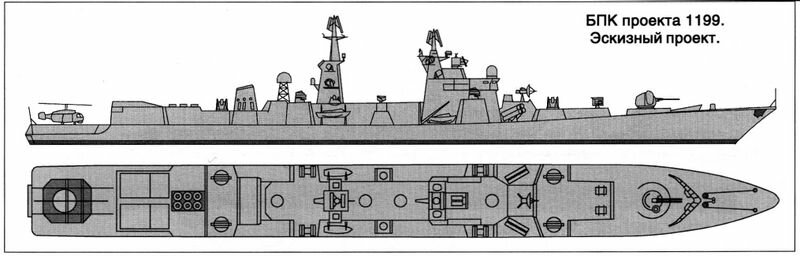
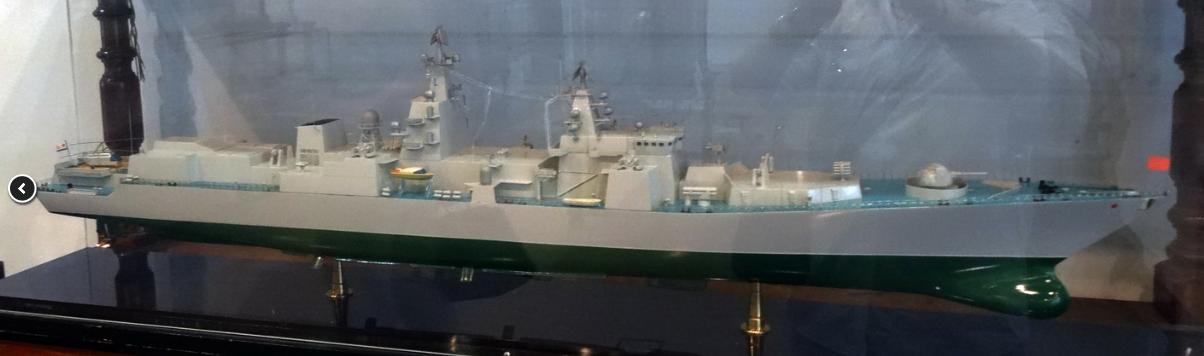
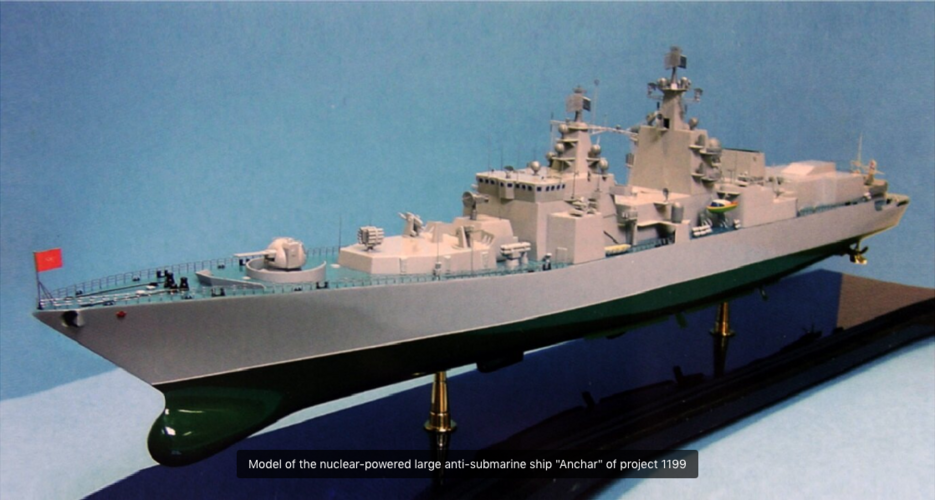
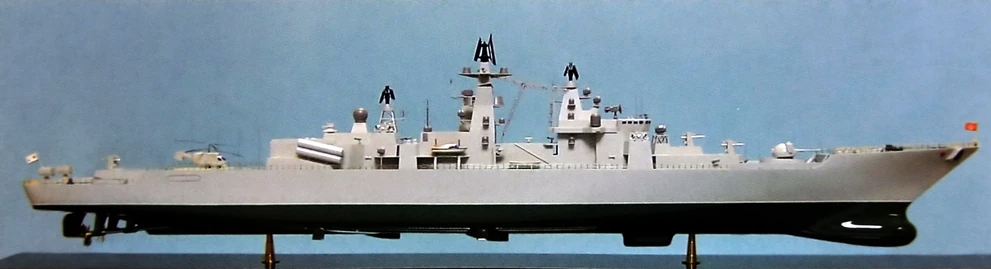
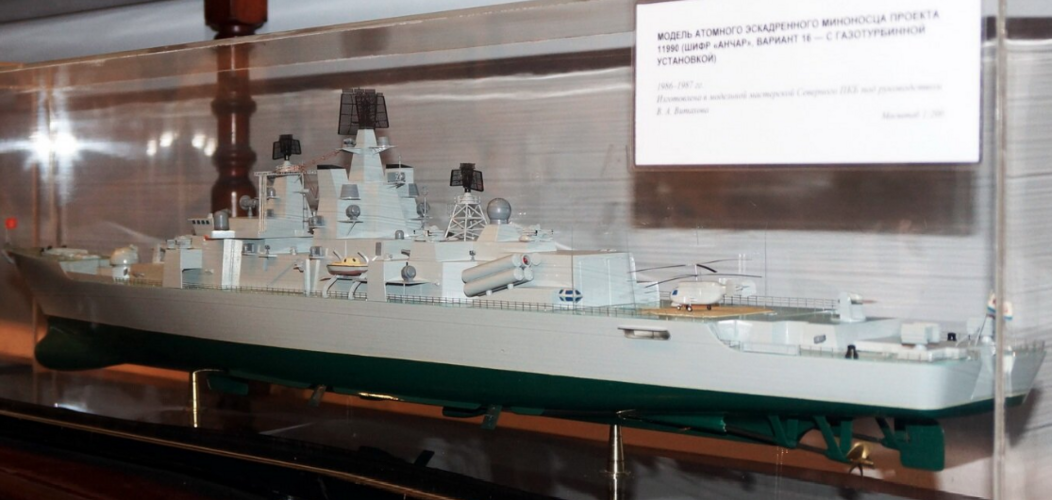
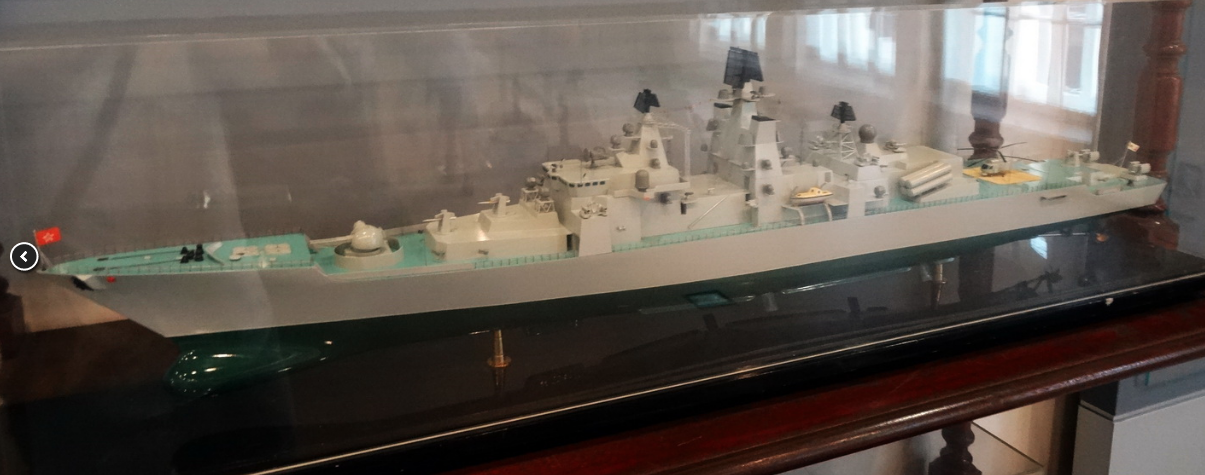
For 'Anchar' (Project 1199/11990) there are photos of models showing two different configurations with notable differences between them.
The first shows a vessel with an MR-650 and two MR-700 series radar sets in a configuration very similar to that planned for the Project 1143.8 carrier (the second Ulyanovsk class ship without Mars-Passat). Weapons wise there are three Shtil launchers, five Kortik systems, eight Moskits, and a twin 130mm gun. It's hard to tell from the photo of the model but I think there are eight Kinzhal launchers (for a total of 64 missiles) forward of the twin 130mm but there is no sign of the MR-360 director set usually associated with Kinzhal. There are eight MR-90 guidance sets though (I am ruling out there being any, similar looking, MR-123s as there are no AK-630s) so perhaps the Soviets managed to integrate the Kinzhal with the MR-90??? I initially thought the hangar was only large enough for a single helicopter but on reflection I think its big enough for two. The stern suggests either the MGK-355 or the later Zvezda-M2 sonar suite.
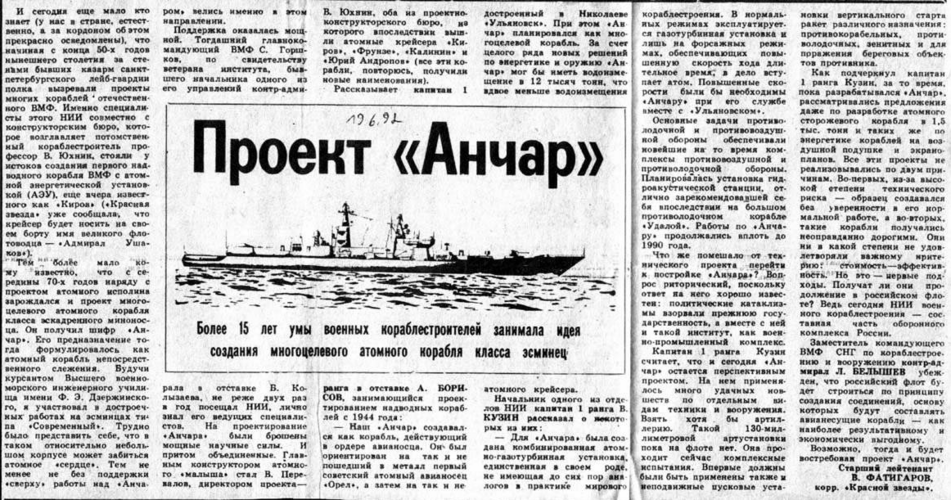
The second model is the same ship shown in the line drawing included in the ~1992 article that describes the history of the design. It has two MR-700 sets but not an MR-650. I believe there are a similar number of MR-90 guidance radars but the ship has acquired a fourth Shtil launcher. The number of Kortik systems is reduced to four. Some Russian internet sources claim there is a VLS, or space for one, for either Kinzhal or Oniks immediately forward of the hangar but from the photos I am unable to discern anything there and there are no VLS forward of the main gun. The ship also has two quadruple RPK-9 Medvedka ASW missile launchers not present on the first model.
For propulsion, most sources state that a CONAG plant was developed but I have not been able to find a more detailed description. Considering the supposed emphasis on cost, I would suggest a single KN-3 reactor sufficient for 70,000 SHP and two DT59 gas turbines with 22,500 SHP each. That would give maximum propulsive power of 115,000 SHP. Presumably the Soviets would have wanted the cruising speed when using the reactor only to match that of the standard cruising speed for Ulyanovsk.
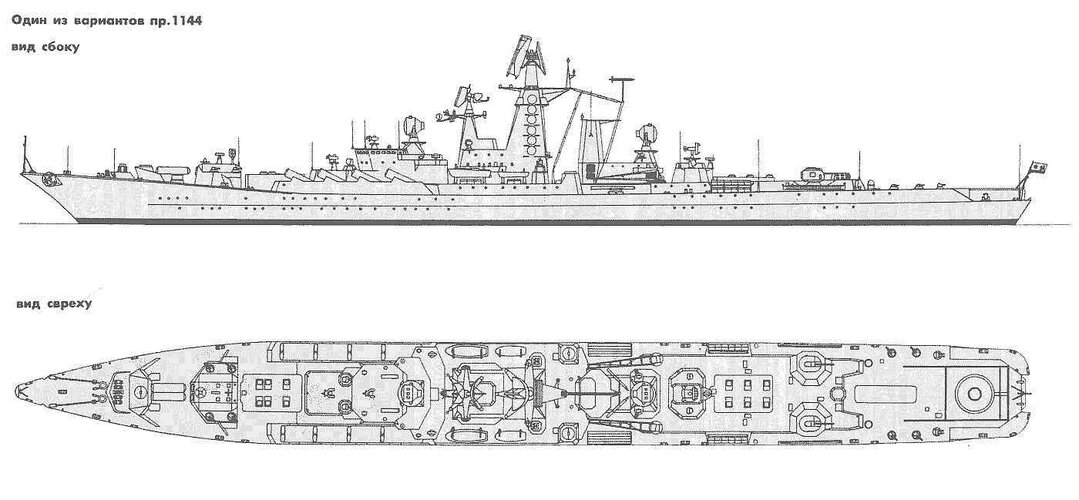
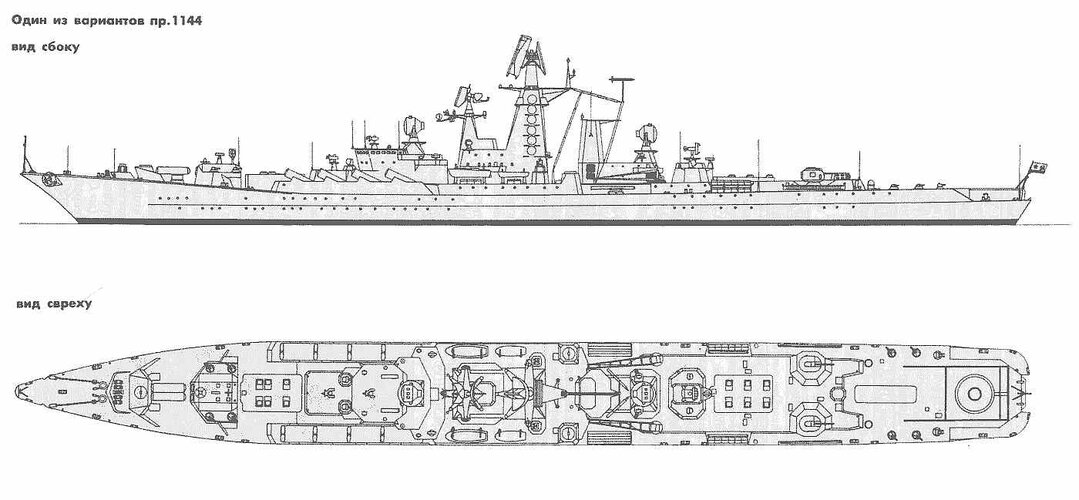
Does anybody have any details on the original Project 1144 Orlan Large Anti-Submarine Ship design, prior to it being merged with the Project 1165 Fugas?
I know we have images of an earlier Pr.1144 design, but given it's heavy anti-ship armament of SS-N-12s/P-500s (or alternatively early SS-N-19s/P-700s in external tubes rather than a VLS) it seems to be from after the merger with Pr.1165.
I figured it might be, but thought I would share just in case it wasn't.
After doing some digging, if those ASMs are P-120 Malakhit, then it probably is the pre-merger design, circa 1969-70.
I figured it might be, but thought I would share just in case it wasn't.
After doing some digging, if those ASMs are P-120 Malakhit, then it probably is the pre-merger design, circa 1969-70.
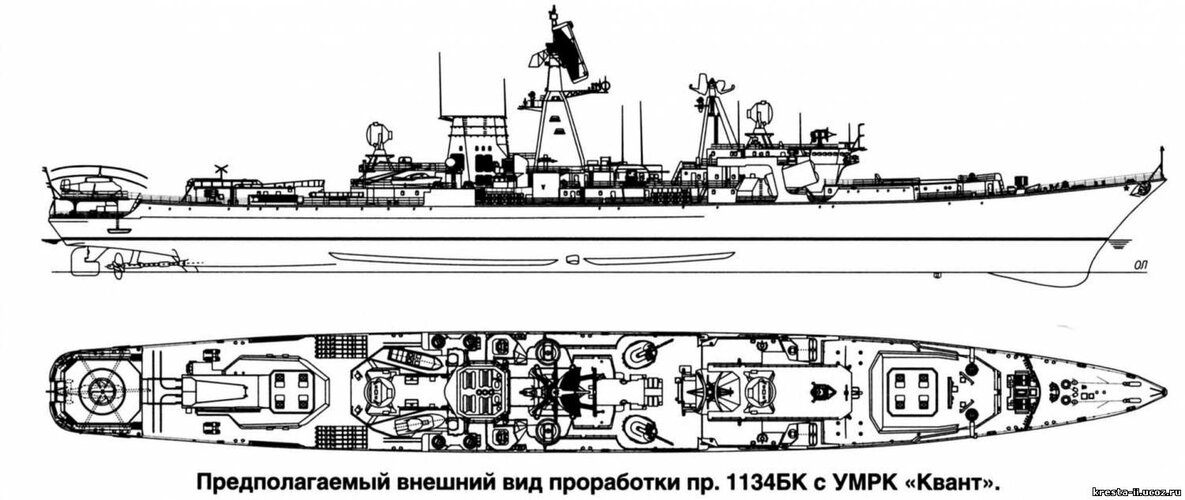
Well those VLS don't look like S-300F, they look more like they could be the 15-degree angled tubes (angled outboard it looks like) proposed for Kvant.
The fire-control radars don't quite look like 3R41 Volna - of course it could be a crude early approximation. But I don't know what kind of fire-control was planned for Kvant (its predecessor Korshun seemed to have fixed array illuminators, see https://www.secretprojects.co.uk/threads/vls-timeline.34391/#post-404042).
Well those VLS don't look like S-300F, they look more like they could be the 15-degree angled tubes (angled outboard it looks like) proposed for Kvant.
The fire-control radars don't quite look like 3R41 Volna - of course it could be a crude early approximation. But I don't know what kind of fire-control was planned for Kvant (its predecessor Korshun seemed to have fixed array illuminators, see https://www.secretprojects.co.uk/threads/vls-timeline.34391/#post-404042).
No, seems to be a mixture of multiple excerpts and different designs, including Pr. 63, Pr.1165 Fugas, Pr.1190 Anchar but not much in the way of details on early Pr.1144 designs, aside from from what I can already find elsewhere.
So I was reading up on Projects 1144 and 1165 again over on the Otvaga2004 site (the old Atrina articles), and noticed something interesting - the surface to air and surface to surface missile additions to 1144 predate the merger, which was more of a pro-forma "we didn't actually *cancel* the program we spent so much money on, we merged it into this other program".
Project 1144 and 1165 started out as "one ship does ASW, the other keeps the enemy off it", but because of the sheer size of 1144 due to having the nuclear reactor(s) *and* a conventional powerplant on top, there was so much room for extra stuff that everyone basically went "if it's cruiser sized, it should have cruiser weapons". Which means that just like Project 1165 went through "Malakhit, Korshun and Volna"; "Bazalt, Kvant and Osa-M", and "Granit, Fort and Osa-M" phases, so did Project 1144. Sadly, we only have the "Bazalt, Kvant, and Osa-M" and "Granit, Fort, and Osa-M" versions of Project 1144 to look at as far as I'm aware.
Speaking of Kvant, though - does anyone have any more info on that? I've only ever seen whole ship drawings with the launchers (which look like sliding hatches?) and the fire control radars (which look like ginormous search lights). And only on three drawings so far - the 1144 and 1134B drawings posted above, and one of the Atrina drawings of Project 1165.
Also, I would dearly love to know what a "Korhsun" surface to air missile is. Googling it only gives me a supersonic target version of SA-N-2 (S-75 Dvina), but there's a drawing of the 1165 with it and the launchers look *wild* - HUGE six-round circular vertical launchers, like the S-300 launchers on *all* the roids.
Six meters increased length, around 300 tons increased displacement, built with P-1000 missiles, Kortik CIWS instead of AK-630/Osa-M, and improved radars, ASW and electronic warfare systems.
So, as some of you may be aware, I have over on Spacebattles been using a bunch of the drawings found online to create 3D models of many of these projects, mostly to visualize what they'd look like. Literally the week after I found A.N. Sokolov's blog, where he has reposted full revised versions of his books along with shipbucket-style art for everything, *he* found my art thread on Spacebattles, and started posting my visualizations of the stuff from his book. I am fine with this, do not bother him about it, we are in contact and he is currently trying his best to help me with some of my model projects.
While I am currently sidetracking into building some carriers, some of the projects I found for the first time while reading the book and looking at his blog are tremendously interesting for later. Of special note is something called Project 11960, which looks like a Slava with four funnels and a VLS farm for Oniks in the middle. There is not a whole lot of text on the ship. Mr Sokolov is not a fan of the design himself, to put it mildly. (First link has his opinion on it, the second has uncolored top and profile line art).
I found these pictures of a model of Project 1293 whilst looking at Russian language sites. I am not 100% sure that this is a builders/designer model rather than an enthusiast build?
It appears to be somewhat less well proportioned than the Project 1293 drawings, the superstructure in particular looks rather bulky on the hull. The other feature that sticks out is the presence of the 4K33 Osa-M ,either side of the hangar, in addition to the 3K95 Kinzhal system between the hangar and forward superstructure, for close-in defence.
The objective of the Project 1293 was supposedly that it be 20% cheaper than the Project 1144 as built, I wonder if it was also hoped to make the ship small enough that it could be built at 61 Communards in Nikolayev where the Project 1164s were built.
I'm leaning towards it being an modeller's build given that the hull has been given weathering effects. I don't think that official Bureau models tend to do that.
It is an interesting model however (and as has been pointed in recent posts, details about these cruiser projects are sketchy and its hard to tell what is official or fan made half the time anyway).
I earlier speculated that the eight round lids, in two groups of four, on the foredeck of the three x 3S90 Uragan Project 11990 Anchar variant (apparently Option 16) were for the 3K95 Khinzhal system. I noted at the time that there was no MR-360 director which seemed odd. I have now found a close-up image of the cells and it appears that lids swing open and they generally don't look like 3K95 launchers. My new hypothesis is that these are a VLS for an ASW missile, on the basis the ship already has 3M80 Moskits, possibly a vertically launched RPK-6/7?
I previously stated that it was not possible to discern a VLS aft on either of the models of the different Project 11990 Anchar variants. However, having now found better photos I think there could be one (or rather six eight cell modules) on the four x 3S90 Uragan variant. Given the lack of any other AShM on the design, using these for Onyx would make sense if they are indeed VLS.
I previously stated that it was not possible to discern a VLS aft on either of the models of the different Project 11990 Anchar variants. However, having now found better photos I think there could be one (or rather six eight cell modules) on the four x 3S90 Uragan variant. Given the lack of any other AShM on the design, using these for Onyx would make sense if they are indeed VLS.
Nice finds. No idea what that forward system is, but it looks suspiciously like the intended layout of the forward Kinzhal battery on 1144.2. It *could* be a vertical launch ASW system, but I've never heard of the Soviets developing one (they went from Metel to Vodopad).
The aft system is definitely proto-UKSK for P-800, the Atrina article on 1199/11990 mentions that space was reserved aft for P-800 and that's most definitely it. The article didn't give a number, and I wasn't expecting 32 cells - I need to update my model.
(Edit: Holy moly the site is slow today, the images had trouble loading...)
Edit2: I was wrong, there are *48* cells back there! That's a lot of Oniks!
Been staring for a bit at @JFC Fuller's images, and I *think* what's going on with those aft VLS cells is that there's four blocks of Redut (Sokolov told me this was in development at the time, with model photos of some of the 1143.7 concepts for proof, and was resurrected later) and two of UKSK (the aftmost blocks, separate from the others and barely visible).
The drawing based on this model has round Kinzhal cells here instead.
Also... how does Kinzhal reload? Do they do it one missile at a time through the launch opening, or might they actually do what's in the model here and flip open the big lid to switch the whole cylinder?
This site uses cookies to help personalise content, tailor your experience and to keep you logged in if you register.
By continuing to use this site, you are consenting to our use of cookies.



 FAQ
FAQ Search
 Memberlist
 Usergroups
 Profile
 You have no new messages
![Log out [ garayterrazas ]](https://www.secretprojects.co.uk/Warship%20Projects%20Discussion%20Boards%203_0%20%20View%20topic%20-%20Soviet%20Nuclear%20Cruisers_archivos/icon_mini_login.gif "Log out [ garayterrazas ]") Log out [ garayterrazas ]
Log out [ garayterrazas ]