Not much info is available only the armament, armour, displacement and speed/engine power.
They are draft proposals for the Central Committee requirements.
View attachment 758902
View attachment 758901

But take these displacement values as they say: "With a grain of Salt" as we are talking about a country which did not build battleships in the past 20 years (or anything larger than a Corvette/Guard Ship or Destroyer for that matter) (Leningrad construction started in 1932 and Uragan in 1927) and whose navy lost a good deal of experienced naval officers and architects after WW1.
Thank you so much.
 
MTI2NTAzNw.jpg

If I only take a rectangular shape for the hanger eg between the 5" twin turrets that means 83x25 meters (The flight deck triangular extensions are adding another 17m aft and 22m forward size for a total length of 122 meters for the flight deck)
The hanger area for one level should be 2.075m^2 plus the aft triangular section's area of around 212m^2
The Bogue had a flight deck of 133,1 x 24,4m and a hanger of 79.6 x 18.9 x 5.3m for an area of 1.504m^2

Even with one hanger level that would be enough for 36 aircrafts (Bogue carried 30)
That Moffett Battlecruiser you designed among the Admiral class Preliminary Designs, would be cool to see a 1944 Modernization. Also the Gibbs & Cox battlecarrier design would be awesome in deviantart to see. And also would be cool to see the Tillmans have a 1941 Pearl Harbor configuration, same for the Moffett Battlecruiser.
 
Last edited:
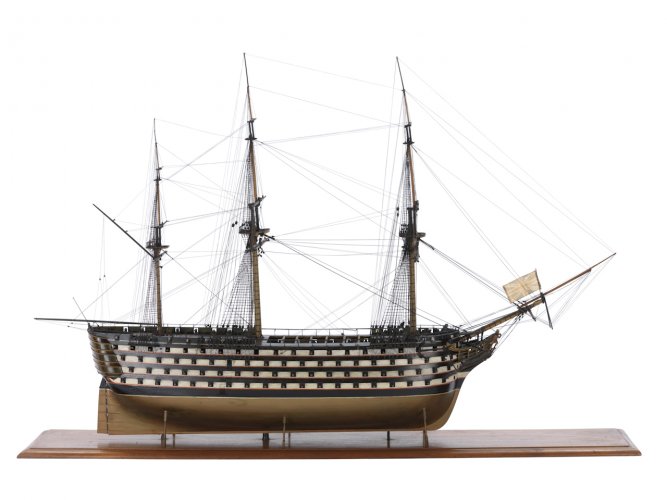
Would this 170-gun Duke of Kent proposal be considered the ultimate battleship of the age of sailView attachment 772609

If there's a bigger one, I don't know about it.

I suppose that anyone might have imagined a bigger one, but there are at least some drawings for this that are roughly contemporary.

There seems to have been some dispute about whether this was a "real" design. I'm not enough of an expert to authenticate the drawings.

DRW
 
If there's a bigger one, I don't know about it.

I suppose that anyone might have imagined a bigger one, but there are at least some drawings for this that are roughly contemporary.

There seems to have been some dispute about whether this was a "real" design. I'm not enough of an expert to authenticate the drawings.

DRW
Well the model exists and there is some information about the design, so it was considered at some point.
 
The "Big Leap Forward" in sailing ship of the line vessels was the new hull design that was invented by Sir Robert Seppings. His brilliant innovation was to introduce diagonally braced hulls that gave far greater rigidity and strength to wooden ships. This meant they could ship larger guns, when steam was introduced, vibrating steam engines, etc. In addition, he greatly increased the use of iron strapping to hold things together.

fig62.png


A Seppings hull on say a 90 gun design could use--in terms of shell / shot weight-- a battery composed mostly of guns firing 68 to 84, even 100 lbs. shot and shell that would outrange and demolish any traditionally built ship of the line as found in the Napoleonic era. Seppings first proposed this design in 1812 but it took to the late 1820's for such a ship to be completed.

https://rina.org.uk/industry-news/m...pings-the-recycler-who-worried-about-hogging/
This was realized with the HMS Rodney a 90-gun ship of the line in 1833. The Rodney carried a uniform battery of 32 pdr long guns on two decks rather than carronades on the upper gun decks like her predecessors. That gave Rodney a much greater weight of long-range fire. Rodney could also be built longer without compromising the ship's strength (hogging / sagging) and that allowed only two gun decks to be used. In turn, it improved ship speed and handling.

rodney-class-ship-of-the-line-e5f1cddb-8b8e-41d1-b25c-357cf789091-resize-750.jpg
 
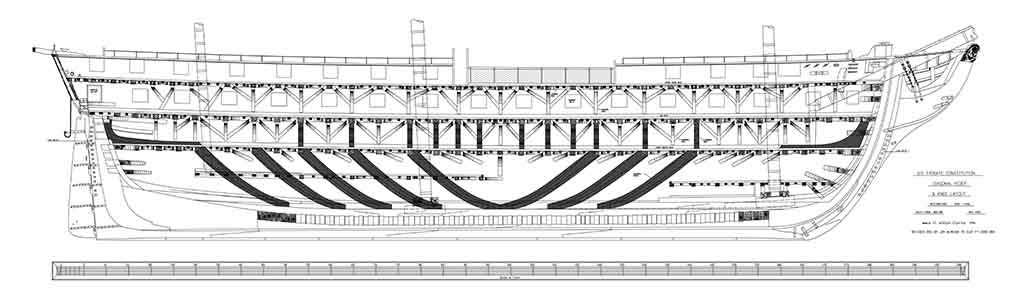
Diagonal bracing was introduced by the US, Joshua Humphreys' design of the Constitution etc in the 1790s
This is Constitution's hull ribs:

Diag-Riders-Model-1024x290.jpg

While there are some diagonal ribs, these don't translate into the cross braced diagonal rib design Seppings introduced. Seppings' design was a big leap forward in wooden ship construction.
 
This is Constitution's hull ribs:

Diag-Riders-Model-1024x290.jpg

While there are some diagonal ribs, these don't translate into the cross braced diagonal rib design Seppings introduced. Seppings' design was a big leap forward in wooden ship construction.
Still the design of the original six frigates did made them stand apart from the regular fourth rates.
 
Yamato was the streamlined battleship--quite futuristic for its time--I don't think it was made to ram things--otherwise it might have been more massive.
 
'Popular Mechanics' other Battleship of the Future.....
 

Attachments

  • battleship-carrier.jpg
    battleship-carrier.jpg
    199.4 KB · Views: 133
Seems pointless to use a battleship with a flight deck. One hit in an engagement and you lose the flight deck functions. About the only place a turret would make sense is in the rear, as your carrier should always run from a direct engagement.
 
For providing air cover and extended scouting it is quite realistic in my opinion.
 
Seems pointless to use a battleship with a flight deck. One hit in an engagement and you lose the flight deck functions. About the only place a turret would make sense is in the rear, as your carrier should always run from a direct engagement.

I mostly agree. In my opinion, the mission profiles of carriers and battleships are sufficiently different that they cannot be practically merged onto a single hull. For a battleship, you need to get relatively close to your target. For a carrier, you want to stay as far away as you can.

The only role where I could imagine a hybrid battleship being useful would be in the amphibious assault role. One could imagine that a single ship could have big guns for fire support, plus helos, landing craft etc. for putting marines on the beach. Even then, it is probably not the ideal arrangement. You could probably build a separate LHD/LHA cheaper.

DRW
 
Seems pointless to use a battleship with a flight deck. One hit in an engagement and you lose the flight deck functions. About the only place a turret would make sense is in the rear, as your carrier should always run from a direct engagement.
I forget the exact numbers, but when someone was pitching a hybrid battleship/aircraft carrier to the Royal Navy, the relevant admiral pointed out that for the cost of five hybrid ships, he could get three battleships and two aircraft carriers. The latter would give virtually the same number of heavier guns, more aircraft, and would allow each to be used to its full effect.

The hybrid cruiser makes a little sense for trade protection and colonial policing work, and maybe a distant screen ahead of a fleet, but it's still compromised by the need to perform two roles with one ship.
 
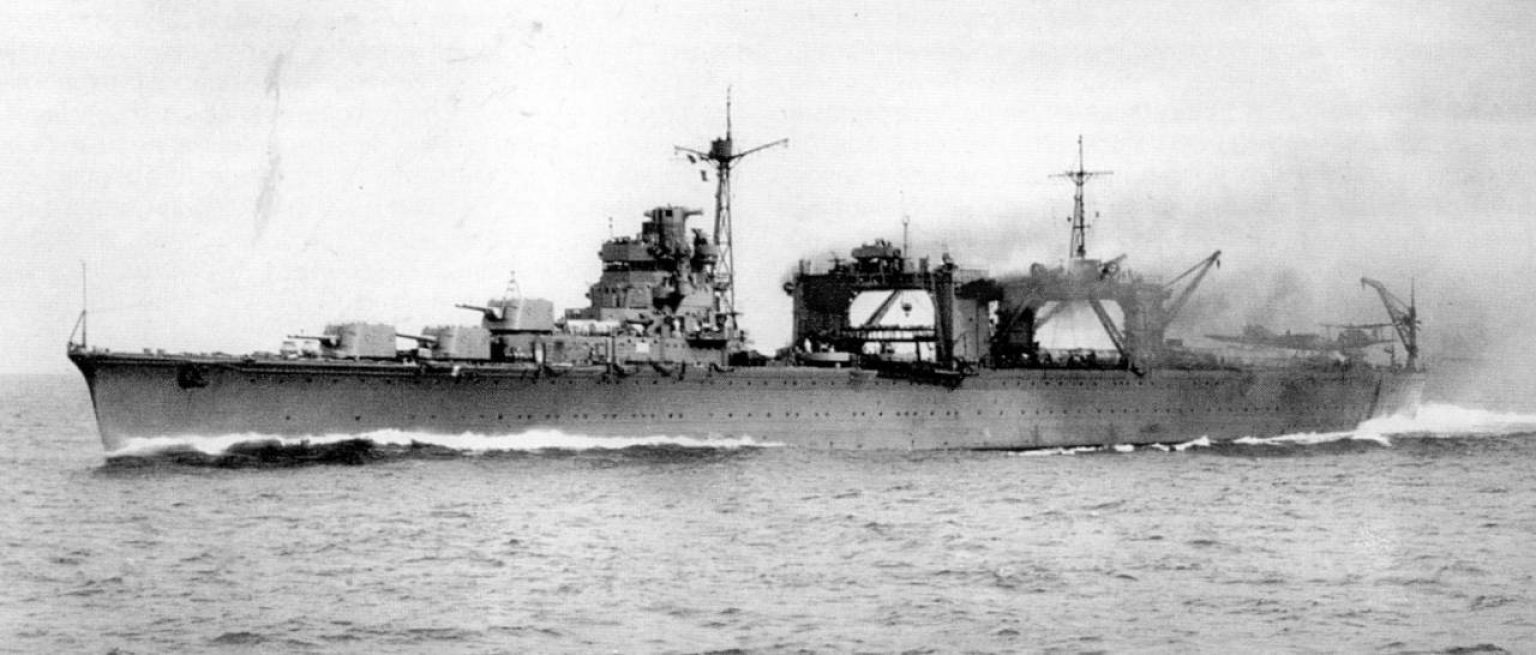
This is probably about as hybrid as you can get:
Japanese_seaplane_tender_Nisshin_1942.jpg


IJN Nisshin was a minelayer (hence the cruiser standard 5.5" guns), seaplane carrier carrying more scouting seaplanes than 6 heavy cruisers, mini-sub carrier, potential aircraft carrier and made an excellent fast transport.
 
This is probably about as hybrid as you can get:
Japanese_seaplane_tender_Nisshin_1942.jpg


IJN Nisshin was a minelayer (hence the cruiser standard 5.5" guns), seaplane carrier carrying more scouting seaplanes than 6 heavy cruisers, mini-sub carrier, potential aircraft carrier and made an excellent fast transport.
I'd argue that Tone-class might play a little better, though operationally they were the scouts for the carrier groups instead of truly independent-operations cruisers.

4x2 8"/50 guns, all forward (odd arcs, though: 1 and 2 face forward, 2 superfiring. 3 and 4 face aft so only fire broadsides!)​
4x2 5"/40 guns amidships (2 turrets port, 2 turrets starboard)​
6x2 25mm Type 96 AA guns​
4x3 610mm torpedo tubes​
plus "A maximum of four Kawanishi E7K2 'Alf' three-seat floatplanes and four Nakajima E8N1 'Dave' floatplanes could be carried, the normal complement being six, of which four were to be E8N1s. In practice, no more than five were ever embarked. As the war progressed these types were superseded by the Aichi E13A1 'Jake' and Mitsubishi F1M2 'Pete'." (from Wiki)​
F1Ms were mostly gunnery observation, E13As were the long-range scouts.

 
it's mentioned also in " Hybrid Warship"

Yes, indeed it is, on pages 117-118. Layman & McLaughlin cite The Illustrated London News (20 June 1942) rather than Popular Mechanics. They attribute the drawings to G.H. Davis. Layman & McLaughlin were not kind. The called it "imaginative - but completely impractical". They found the extensible flight deck to be particularly impractical.

DRW
 
I forget the exact numbers, but when someone was pitching a hybrid battleship/aircraft carrier to the Royal Navy, the relevant admiral pointed out that for the cost of five hybrid ships, he could get three battleships and two aircraft carriers. The latter would give virtually the same number of heavier guns, more aircraft, and would allow each to be used to its full effect.

The hybrid cruiser makes a little sense for trade protection and colonial policing work, and maybe a distant screen ahead of a fleet, but it's still compromised by the need to perform two roles with one ship.

I believe that @EwanS gave the exact quote in this thread, #21:

https://www.secretprojects.co.uk/threads/british-hybrid-battleships-projects-and-proposals.44047/
The quote was from DNC Stanley Goodall.

DRW
 
I'd argue that Tone-class might play a little better, though operationally they were the scouts for the carrier groups instead of truly independent-operations cruisers.

4x2 8"/50 guns, all forward (odd arcs, though: 1 and 2 face forward, 2 superfiring. 3 and 4 face aft so only fire broadsides!)​
4x2 5"/40 guns amidships (2 turrets port, 2 turrets starboard)​
6x2 25mm Type 96 AA guns​
4x3 610mm torpedo tubes​
plus "A maximum of four Kawanishi E7K2 'Alf' three-seat floatplanes and four Nakajima E8N1 'Dave' floatplanes could be carried, the normal complement being six, of which four were to be E8N1s. In practice, no more than five were ever embarked. As the war progressed these types were superseded by the Aichi E13A1 'Jake' and Mitsubishi F1M2 'Pete'." (from Wiki)​
F1Ms were mostly gunnery observation, E13As were the long-range scouts.
Tone possibly demonstrates the argument that a ship is deficient because it is trying to blend 2 roles. Perhaps another Mogami rather than Tone and the seaplane carrier for scouting. Tone is also taking up cruiser tonnage where as the seaplane carrier is not. While Tone is a gunship and surface escort, the Kido Butai routinely had Kongo class escorts making Tone redundant in the anti-surface role. With Destroyer plant, a seaplane carrier can make 29 knots and costs about ¥20m when a Tone class costs ¥31m. With 4 catapults, a seaplane carrier can launch double the number of planes. You want scouts to get information, not duke it out with other cruisers. A Tone has great forward firepower but is in trouble if she has to run.
 
A Tone has great forward firepower but is in trouble if she has to run.

Which applies to the Nelsons, Dunkerques and Richelieus as well, and you have to check the turrets firing angle not just their placement. All of these ships have designed that a minimal turn would allow the ship to fire it's chaser.
 
Which applies to the Nelsons, Dunkerques and Richelieus as well, and you have to check the turrets firing angle not just their placement. All of these ships have designed that a minimal turn would allow the ship to fire it's chaser.
Except these are capital ships, designed to fight in line and on the broadside with other ships. The Dunkerques were optimised to chase down and kill German 'pocket battleships' while trying not escalating an arms race. While Richelieu and Jean Bart had the forward arrangement this was to be dropped for future ships and the RN never repeated the Nelson arrangement. Nelson was expected to sit in line with other battleships, limiting tactical maneuvers but that running from an enemy wasn't an expected option.
 
Tone possibly demonstrates the argument that a ship is deficient because it is trying to blend 2 roles. Perhaps another Mogami rather than Tone and the seaplane carrier for scouting. Tone is also taking up cruiser tonnage where as the seaplane carrier is not. While Tone is a gunship and surface escort, the Kido Butai routinely had Kongo class escorts making Tone redundant in the anti-surface role. With Destroyer plant, a seaplane carrier can make 29 knots and costs about ¥20m when a Tone class costs ¥31m. With 4 catapults, a seaplane carrier can launch double the number of planes. You want scouts to get information, not duke it out with other cruisers. A Tone has great forward firepower but is in trouble if she has to run.
Tone were fleet scouts. As such, they could well get caught up in situations where air isn't available for whatever reasons. The 8" guns and cruiser torpedoes gives the option for fighting their way clear.
 
Yeah, with that top speed, they weren't running from anyone! LOL
The Nelsons were the very last of the Super Dreadnoughts, no one built any after them. Nelson & Rodney vs Scharnhorst & Gneisenau as they are about the same displacement. Yep speed is an expensive bitch and running away is not winning.
 
Tone were fleet scouts. As such, they could well get caught up in situations where air isn't available for whatever reasons. The 8" guns and cruiser torpedoes gives the option for fighting their way clear.
Yes but they would take double the number of flammable aircraft and avgas storage into a gunfight than other cruisers.
 
You guys still think they woild be still on deck when fighting an enemy ship? All of them would be in the air except when surprised say in bad weather or at night.
 
You guys still think they woild be still on deck when fighting an enemy ship? All of them would be in the air except when surprised say in bad weather or at night.
Exactly. And I'm assuming that the only time a Tone-class would be within gun range is in bad weather or at night. Never voluntarily entering gun range!
 
Never voluntarily entering gun range!
So they were a 'timid cruiser'? This was the criticism leveled at the US attempts to build a cruiser/carrier, the CF.

The Tones were intended as more Mogamis but the Tomozuru incident forced a redesign that eliminated a weighty 6.1" superfiring turret from the outcome. The IJN had always expected their 8" cruisers to function as 'light battleships' in a daylight fleet action with long range 8" fire but the Tone's like the Mogamis were modified to this standard later suggesting that they do want to be gun cruisers and that was the intent.

I guess there is a limit or line where too many aircraft is a liability for a ship designed for surface action. On one end we have HMS Formidable, 3rd in the battleline at Matapan behind Warspite and Valiant and leading Barham, told to leave but gets off a 4.5" AA broadside. The first carriers had 8" guns but they also were never intended to voluntarily enter gun range and the USN saw it was a dumb idea by 1930. British cruisers had 1 to 2 seaplanes and the RN wanted a hangar to protect from the elements and prolong the life of the aircraft. US cruisers initially had 4 aircraft and fires were an issue for the cruisers sunk at Savo Island. IJN cruisers would have 3 aircraft and no hangar but when you are lugging around oxygen fueled torpedoes, why worry about the risk from avgas.

It seems that aircraft are a necessary evil for cruisers, particularly when you need them for long range gunnery spotting but how many is too many and when does a cruiser become a hybrid?
 
So they were a 'timid cruiser'? This was the criticism leveled at the US attempts to build a cruiser/carrier, the CF.

The Tones were intended as more Mogamis but the Tomozuru incident forced a redesign that eliminated a weighty 6.1" superfiring turret from the outcome. The IJN had always expected their 8" cruisers to function as 'light battleships' in a daylight fleet action with long range 8" fire but the Tone's like the Mogamis were modified to this standard later suggesting that they do want to be gun cruisers and that was the intent.

I guess there is a limit or line where too many aircraft is a liability for a ship designed for surface action. On one end we have HMS Formidable, 3rd in the battleline at Matapan behind Warspite and Valiant and leading Barham, told to leave but gets off a 4.5" AA broadside. The first carriers had 8" guns but they also were never intended to voluntarily enter gun range and the USN saw it was a dumb idea by 1930. British cruisers had 1 to 2 seaplanes and the RN wanted a hangar to protect from the elements and prolong the life of the aircraft. US cruisers initially had 4 aircraft and fires were an issue for the cruisers sunk at Savo Island. IJN cruisers would have 3 aircraft and no hangar but when you are lugging around oxygen fueled torpedoes, why worry about the risk from avgas.

It seems that aircraft are a necessary evil for cruisers, particularly when you need them for long range gunnery spotting but how many is too many and when does a cruiser become a hybrid?
Nope.

Indeed the Tones as designed were modified Mogamis with four twin 12,7cm turrets instead of single ones, including the modified Takao bridge intended for the Mogamis. Then a decision was taken as the fleet required more scouting power (Remember the IJN carriers did not carried scout planes compared to the USN) hence they were re-designed for extended aviation facilities and 4 turrets (1 aft 3 forward) but the blast issue of the aft turret would be problematic and thus this 4th turret was moved forward, still with 15,5cm guns and around this time the decision was to install a 5th 12,7cm mounting on the centreline was taken. Shortly after the Tomozou incident was happened and the committee report was done hence Tone laid down with a modified simplified Mogami bridge structure but still with 5 twin 12,7cm turrets. Later this 5th mounting got deleted due to the bad firing arcs it had, and the bridge was further modified.

Both Mogamis and Tones were designed in the onset to be able to upgunned to 203mm weaponry. Bevcause of LNT I the IJN reached her 8" / 203mm cruiser quota resulting in the deletion of the Improved Takao class cruisers and forced the design of the 15,5cm cruisers.
 
Then a decision was taken as the fleet required more scouting power (Remember the IJN carriers did not carried scout planes compared to the USN)
Exactly.

A good scout should not be trying to get into a gunfight. Their duty is to find the enemy and tell the rest of the fleet where the enemy is.
 
Both Mogamis and Tones were designed in the onset to be able to upgunned to 203mm weaponry. Bevcause of LNT I the IJN reached her 8" / 203mm cruiser quota resulting in the deletion of the Improved Takao class cruisers and forced the design of the 15,5cm cruisers.
The upgunning requirement was perhaps not high on the priority list or not much design work given to it.
See NavWeaps: http://www.navweaps.com/Weapons/WNJAP_8-50_3ns.php
The original Naval General Staff requirements for the Mogami class as issued in 1930 called for the design to mount 15.5 cm guns in triple turrets but be able to have these replaced by 20 cm guns in twin turrets should the treaty be revoked or in case of emergency. However, the design of the triple 15.5 cm turret needed a larger roller race than the twin 20 cm mounting. As a result, when the Mogami cruisers were regunned in 1939/1940, their Modified E2 turrets needed a larger diameter roller path than the other E Models in order to fit the larger diameter roller path used for the 15.5 cm turrets. These turrets were also somewhat longer than the other Model E gunhouses in order to accommodate the larger roller path. As the 20 cm guns were longer than the 15.5 cm guns they replaced, the guns of No. 2 turret could not depress below +12 degrees when trained on the centerline as otherwise they would have struck No. 1 turret. These problems seem to indicate that little effort was expended during the initial design phase to meet the regunning requirement or that the designers were unable to come up with a solution that still met the very tight tonnage limits on this class.
The hull and barbettes of the Tone class had already been completed up above the armored deck when the main armament was changed from triple 15.5 cm turrets to twin 20 cm turrets. As described above for the Mogami class mountings, as the twin 20 cm turret needed a smaller diameter roller path than the triple 15.5 cm turret, this meant that the diameter of the completed portion of the barbettes was now too large to fit the standard turret races used for twin 20 cm turrets. To compensate, the design for the top of the barbettes was altered to a conical shape with a diameter of 18.7 feet (5.70 m) at the lower level and 16.4 feet (5.00 m) at the upper level. The follow-on Ibuki class were to use the same E3 turrets as the Tone class, but these later ships were designed from the start with 16.4 foot (5.00 m) diameter barbettes. However, the distance between the centerlines of No. 1 and No. 2 barbette on the Ibuki class was the same as for the Mogami class, which meant that the guns in No. 2 turret would have still have needed to be raised in order to clear No. 1 turret, similar to the problem with the Mogami class.​
Note that as Turret 2 on the Mogami class could not depress below +12 degrees when trained on the centerline and that the loading angle was +5 degrees, this meant that the guns in this turret could not be loaded until they were trained outwards enough to clear Turret 1.​

A good scout should not be trying to get into a gunfight. Their duty is to find the enemy and tell the rest of the fleet where the enemy is.
Then why upgun them? The 6.1" guns had a tighter spread when compared to the 8". The Chitose class seaplane carriers were part of the same program as the Tones. Why the need to burden the Tones with more aircraft when you had 2 ships with plenty.
 

Similar threads

Back
Top Bottom