Definitely disagree, the Turks are doing quite well with the development. Having flown a test article and being in the process to finish their first proper prototype aircraft. As for compactness, I highly doubt they'd want that. Turkey wants to operate across the entire Levant, incursions deep into Syria if necessary, operating over the Mediterranean etc. which in turn dictates a certain size, especially when the aircraft is meant to deliver a payload on target that is useful. All of which makes it doubtful they wanted something particularly compact. It's more progress than the likes of India made, and being able offer a stealth aircraft for export in the first place is something they have over Europe (excluding Russia) in it's entirety.

Still, while a big national effort, FCAS is a completely different ballgame. And it is simply a fact that no individual European nation has the resources and funds to create an NGAD style program on their own. A purely national program would have to make SEVERE concessions in order to become realistic. And at that point you're not cutting edge anymore, not on the forefront of military aviation and not introducing next gen capabilities. At that moment you're just doing a slightly rehashed and modernized version of something flown elsewhere since the 90s to 2010s, a 5th Gen with extra steps.

While we're on the subject… I could imagine the Turks going for a future single-engine derivative of the Kaan (something along the lines of the Su‑57/Su‑75) for their navy.
The Kaan will be too big and heavy for the MUGEM and the planned naval version of the Hürjet is clearly just a stopgap solution.
Apologies for the off-topic...
 
Compared to what the FCAS is supposed to be as laid out within the program, the Rafale (and Eurofighter) are archaic machines.

It's like saying that having built and developed the F-86 qualifies one to built and develop the F-47
.
This is bad faith exaggeration at his peak... Like if nothing was done between the Ouragan and the Rafale, or between the Hunter and the Typhoon and no experience was gained for doing a next generation ... Or like saying doing a FCAS is like doing a hyperdrive spaceship.
Say miss, as you seem to like these kind of things, what combat aircraft was designed/produced in series in Germany between the Me 262 and shares of the Tornado and Typhoon ? Is that what scares you ?

The amount of money and technological prowess required is magnitudes apart. Pulling off a fourth generation fighter isn't prohibitive, while developing a sixth generation fighter certainly is to such a degree that so far only the US and China are funding purely national efforts, while everyone els had to band together and pool money and resources in FCAS and GCAP.
Ask our dear politicians (French, British, Germans...) what they thought of Rafale or Typhoon prices after the fall of USSR...
The amount of money is there went there is a threat and political will.
Moreover developing a "sixth generation fighter" ( that denomination is so tiresome btw, feels like talking about the latest iPhone ) by Following blindly the "fighter design trend" US and China launches in their arms race is not the point. It's not WarThunder comparing what would be the best fighter and who can have enough points to get it.
Their needs are not necessarily our needs.
It's been well explained in some posts here already, check @H_Ks posts for example. Inform yourself.
Comparing Rafale to FCAS in terms of complexity and ability to develop independently is a fallacy.
If France were to develop a Rafale successor on their own it would be more akin to KAAN rather than the F-47 and J-50.
Suuure... KAAN development started roughly 10 years ago, it's perfectly logical and of good faith to say that "if France were to develop a Rafale successor on their own", now 10 years later, France would do the same kind of thing.
Talking about fallacy.
And OF COURSE, the point is NOT to do something like the F-47 or J-50. Again the point is to do something that fulfills our needs.
 
Last edited:
FCAS is a completely different ballgame. And it is simply a fact that no individual European nation has the resources and funds to create an NGAD style program on their own. A purely national program would have to make SEVERE concessions in order to become realistic. And at that point you're not cutting edge anymore, not on the forefront of military aviation and not introducing next gen capabilities. At that moment you're just doing a slightly rehashed and modernized version of something flown elsewhere since the 90s to 2010s, a 5th Gen with extra steps.

There's no question that a purely national FCAS would have to make some concessions and in particular adopt a more iterative development approach.

But that's not all bad, as there are plenty of opportunities to leverage existing investments rather than starting from scratch. NGF is really 3 different streams of investment: 1) a stealth platform + 2) advanced avionics (including combat cloud) + 3) a new engine. But if budget was a constraint, only the stealth platform really needs to be completely new.

While it would be ideal for the other elements (avionics + engine) to introduce transformational technology like adaptive cycle engines, the truth is that leveraging Rafale F5 avionics and scaling up M88 engine technology should be more than enough to maintain an edge over any opposition using the latest Chinese / Russian technology or older Western technology (including any future non-NATO F-35 customers with downgraded capabilities). Especially when combined with the other advanced elements that will move forward no matter what happens to NGF (UCAV, remote carriers, Meteor MLU, MBDA smart weapons).

Would the result be as good as F-47 or GCAP? No, but that's not the point as these won't be widely exported.

The cost savings would be substantial and would make FCAS viable on a purely national basis, more affordable and more exportable. There would also be substantial savings from eliminating all the waste that happens in a partner program with investments driven by work share leading to duplication, "make work" and reinventing the wheel. Further avionics enhancements could then be introduced over time, just as was the case for Rafale F1-F5 standards.

FYI Rafale has cost ~7% of the French defense equipment budget over the last 30 years, or ~2.5% of the total defense budget, or ~0.06% of GDP... even if a national FCAS was slightly more expensive it should still remain affordable.
 
Last edited:
@EmoBirb List the features of F-47 and J-36 that you judge are best proof of their high cost and technological advances.
 
With regard to respective budgets and ability to afford development without international partners, let's actually check the numbers (average of SIPRI and ISSS 2024 figures):

France: 64.35 Bn
France, - Force de Dissuasion: = 56.0Bn
South Korea: 45.75Bn
Turkey: 19.65Bn

And the raw comparison is only valid if everyone is starting from the same place, and they're not. France has a considerable head start in just about every relevant technology.
 
@EmoBirb List the features of F-47 and J-36 that you judge are best proof of their high cost and technological advances.

You mean like NGAP? Or the improved stealth features of the tailless, tri-engine J-35. The seamlessly bending control surfaces. NGAD being from the ground up designed to operate with and control the CCAs. NGAD being from the outset designed to surpass the F-35 and F-22 in technological leap with regards to avionics, sensor fusion, stealth and propulsion according to the AF.

Y'all realize that you try to argue that sixth generation fighters aren't significantly more advanced and complex than late 80s designs and thus require the same resources and funding. When in fact complexity is way beyond what people in the 80s could even dream up.

To break this, now several hour long, debate down. Some patriotic Frenchies once again act like Dassault/France could develop a sixth generation fighter and it's associated systems by themselves. When reality is that they need to pool together resources, knowledge and funding with Germany and Spain. Unlike China and the US, both the undisputed world leaders in the military aviation sector (that is a fact, anyone who denies this also believes the earth is flat). As these two have the money, the resources and the knowledge to have purely domestic sixth generation efforts. And their lead and technological prowess is so significant that China is already flying prototypes and the US had a (presumably lengthy) test and evaluation campaign for technology demonstrators associated with the Next Generation Air Dominance effort. Furthermore the US also had running VCE prototypes and is working hard to get NGAP rolling.

Germany, France and Spain decided it's necessary to come together to have a chance of delivering a system of comparable capability and something that's suitable for the French Navy, their nuclear carriers and the nuclear doctrine they roll with. Improved stealth, advanced avionics, VCEs, drone integration, all that good stuff. None of the member states could hope to develop an aircraft comparable to what the Americans and Chinese field on their own, they lack the funds, the industrial base and the know-how.

So this discussion, occurring over and over again is utterly pointless, because it's entertaining a delusion that's so far detached from reality, entertaining it at all is a complete waste of time. Dassault couldn't deliver an NGAD equivalent in a humane time frame and within budget, period.
 
France has a considerable head start in just about every relevant technology.

KAI developed a near stealth fighter with assistance from Lockheed Martin. France didn't develop anything comparable...ever.

I also don't know how anyone could think it's something positive to compare France with South Korea and Turkey. That's very telling about what kind of circumstances we're talking here.

Maybe Dassault should be kicked out of FCAS in favor of KAI or TAI, given they developed far more impressive aircraft with less experience and less money...hmm...
 
And yes, in 1985 things like fly by wire, composites, pulse doppler techniques, active AAM´s, data links, etc were incredibly complex, has complex has AI, variable cycle engines, etc, are today...
If anything I'd say AI now is _much_ more accessible than FBW, data linking and advanced radar was then. Back then it was one or two development teams per nation, now it's everyone and their dog.
 
Last edited:
KAI developed a near stealth fighter with assistance from Lockheed Martin. France didn't develop anything comparable...ever.

Rafale, reduced frontal cross-section, 1985 onwards. Do you really think they've done nothing since? There's Logiduc for a start, with Petit Duc being the stealth demonstrator and flying in 2003, the programme then transitioning to Neuron with flight trials from 2012. I also think it's unlikely there's not been some French equivalent of Replica somewhere along the way.

I also don't know how anyone could think it's something positive to compare France with South Korea and Turkey. That's very telling about what kind of circumstances we're talking here.

France is in a different league on its own, never mind in combination with Germany and Spain. People making the comparison were doing it without actually looking at real world numbers, experience or capabilities. Addressing that does not validate the argument.
 
the improved stealth features of the tailless, tri-engine J-35
I am not very good at eyeballing the degree of stealth of the J-35, but I believe that's a twin-engined aircraft. J-36?
The seamlessly bending control surfaces.
The 1985 AFTI/F-111A "could smoothly change the shape of its airfoil in flight":

NGAD being from the ground up designed to operate with and control the CCAs. NGAD being from the outset designed to surpass the F-35 and F-22 in technological leap with regards to avionics, sensor fusion, stealth and propulsion according to the AF.
They have yet to show how they will achieve this.

To repeat: which are the features on show of F-47 and J-36 that you judge are best proof of their high cost and technological advances? Some forum members may know more about that than I do. Do you? Share it?
US defence budget papers may give a clue on F-47 cost, but Chinese equivalent papers?
 
Last edited:
There's no question that a purely national FCAS would have to make some concessions and in particular adopt a more iterative development approach.

But that's not all bad, as there are plenty of opportunities to leverage existing investments rather than starting from scratch. NGF is really 3 different streams of investment: 1) a stealth platform + 2) advanced avionics (including combat cloud) + 3) a new engine. But if budget was a constraint, only the stealth platform really needs to be completely new.

While it would be ideal for the other elements (avionics + engine) to introduce transformational technology like adaptive cycle engines, the truth is that leveraging Rafale F5 avionics and scaling up M88 engine technology should be more than enough to maintain an edge over any opposition using the latest Chinese / Russian technology or older Western technology (including any future non-NATO F-35 customers with downgraded capabilities). Especially when combined with the other advanced elements that will move forward no matter what happens to NGF (UCAV, remote carriers, Meteor MLU, MBDA smart weapons).

Would the result be as good as F-47 or GCAP? No, but that's not the point as these won't be widely exported.
Depending on just how 3-stream engines are put together, I wouldn't be surprised if the final adaptive engine has a lot of parts from M88v4.

As-is, the M88v4 is in the right power levels to be an interim engine for the first Tranche of SCAF. Also, since we'd almost certainly be talking about "M88 with a bigger fan on it", you'd get most of the fuel economy of the adaptive engine early on. What you wouldn't get is the supercruise bonus.

I suspect that the avionics would be flying on Rafale F5s, as well.

So, basically, at least the first Tranche would only have development risk on the airframe.


Lemme guess, verbose incontinence, Sino Defense Forum and :

View attachment 779820
Hey, if you could be flying something with fusion turbofans and able to SSTO (or at least single stage to suborbital), you'd be absolutely giddy!
 
Indra voices positive assessments and would welcome the Belgian Industry within FCAS project:

Belgium's participation in the multi-billion-euro next-generation fighter project would be "a positive step in the current geopolitical context", Jorge San José, Indra's director of the FCAS project, told Euractiv.

Adding another country to the joint French-German-Spanish programme "strengthens the collaborative nature" of the programme, one of Europe's largest and most ambitious defence projects, San José said.

Indra “will work on identifying potential synergies with Belgian industries and see how they can contribute to and support the execution of the programme,” San José said.

 
WingMates – aerial teamwork as crewed meet uncrewed systems

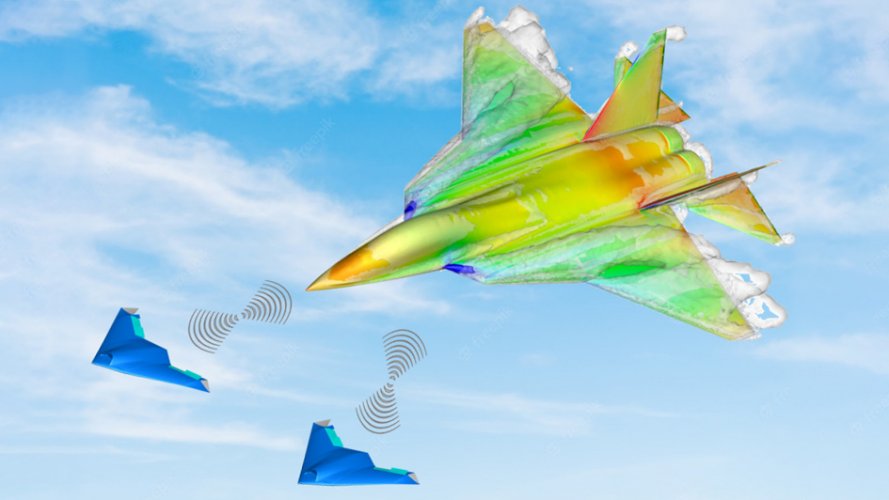
WingMates is a DLR project developing next-generation military aircraft concepts. The focus is on a highly agile, crewed 'Future Fighter Demonstrator' with an innovative engine, and 'Muldicon' – an uncrewed flying wing aircraft (Uncrewed Combat Air Vehicle; ACAV) designed for stealth and aerodynamic efficiency. Both systems are designed to operate in networked and cooperative formations, creating the basis of a modern, digitally networked air defence system that intelligently combines crewed and uncrewed platforms. DLR's research supports future European defence programmes and demonstrates how high-tech combat aircraft could operate as a team.

ProjectWingMates - Development of platforms and technologies as a contribution to a future air defence system
Term1/2024 - 12/2027

WingMates
How effective is European air defence and how can we improve it? To be able to assess the situation and develop new technologies, the Federal Ministry of Defence (BMVg) and the Federal Office of Bundeswehr Equipment, Information Technology and In-Service Support (BAAINBw) need the expertise of scientists. The Federal Government's aim is for DLR researchers to safeguard and expand the German Armed Forces' ability to analyse and evaluate military aircraft.

The air defence of the future is becoming increasingly complex. As European air forces will have to renew or replace their aircraft fleets in the foreseeable future. The necessary changes include the modernisation of existing weapon systems such as the Eurofighter and its midterm replacement by introducing the Next Generation Weapon System (NGWS), a German-French-Spanish common development program, which aims as well to find solutions for a future air defence system. The DLR project WingMates and the results from the predecessor projects Mephisto and Diabolo are making a significant contribution to the further development of scientific approaches and processes so that the Federal Ministry can use this expertise to investigate and assess the potential of future platforms - such as a combination of different flying units that operate optimally with each other within a defence system.


The objectives are:

  • Design, analysis and evaluation of multiple aircraft within an air defense formation..
  • Develop design, analysis and evaluation approaches to study how the design of the platforms changes as capabilities are moved from one platform to another.
  • Automisation of the design, analyses and evaluation process of military configurations within the RCE research software developed by DLR.
  • Improve\ prediction capabilities in the areas of flight physics, propulsion, signatures, structure and aeroelasticity and to improve the understanding of physical principles of action.
  • Improve the understanding of interaction between disciplines and technologies, systems and design rules through highly accurate experimental and numerical simulations.
The contributions of the Institute of Aerodynamics and Flow Technologies in Braunschweig and Göttingen are on the development of numerical and experimental aerodynamic method development, aerodynamic design and optimization, experimental and numerical configuration analysis and evaluation, transonic engine intakes, thrust vector control, weapon bay aerodynamics, active flow control, aeroacoustics and signatures as well as investigation to apply CFD for the qualification of defense applications.

image.jpeg
 
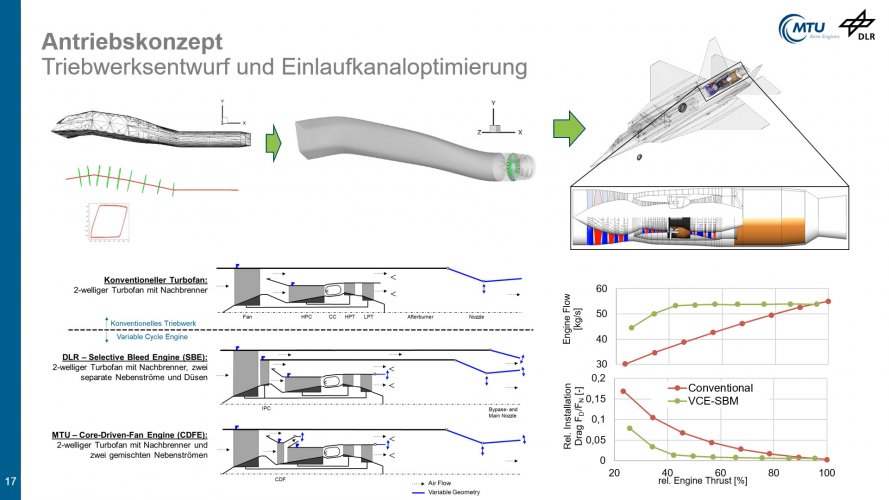
Here is some stuff likely relevant for what the engine of FCAS will be like in the end:
- Variable Cycle Technology using MTU's Core-Driven-Fan Engine (screenshot taken from a presentation on the DLR-FFD for ILA 24)
- Turbine inlet temperature (TIT) goal of 2,100 K (Safran News Article on the plans for the engine from 2019)
- thrust-vectoring nozzles by ITP (new concept shown mounted on an Eurojet EJ200 at FEINDEF 23)

https://event.dlr.de/ila2024/future-fighter-demonstrator-dlr-ffd/

https://www.safran-group.com/news/futuristic-engine-scaf-2019-04-18

https://www.itpaero.com/en/itp-aero...apabilities-and-fcas-developments-at-feindef/


Attachments

  • ILA-24_FFD_Engine.jpg
    ILA-24_FFD_Engine.jpg
    322.2 KB · Views: 109
Latest episode: Airbus could/will leave FCAS project if the present Dassault drift toward monopoly isn't reversed back to earlier agreements.

View: https://x.com/clemens_speer/status/1951198885562429593


"In summary, we no longer see any basis for a further continuation of FCAS – except for a return to and the actual implementation of the agreed principles."

 
Well, to be honest, I knew this was going to happen a long time ago
 
Last edited by a moderator:
Latest episode: Airbus could/will leave FCAS project if the present Dassault drift toward monopoly isn't reversed back to earlier agreements.
Good on Airbus to increase the pressure
 
Last edited by a moderator:
They still haven't got their acts together and slip into old habits.
At the very least both sides want the basic R&D done but eventually produce their own airframes. This goes against the a wider supply-chain security and increases company control/leverage over the governments. This is gonna cost a lot more for everyone.
 
Bill Sweetman has a good write-up on the French perspective, what's changed since 2018, and "Plan B".


The project is ostensibly splitting because the French sub-team insisted on responsibility being allocated according to corporate experience – which, given that France is 100% responsible for Rafale, would leave German and Spanish industry in the back seat. However, that is only one reason why the Rafale team – Dassault, Thales, Safran and the DGA (Direction Generale des Armements) – is headed for the exit. Things have changed since 2018.

Rafale’s success means that it has a much more solid future with better funding.​

Team Rafale had one export customer at the start of 2018 and production was a stately dozen or so per year. Now it has eight export clients and a 230-plus backlog, and its first job is to meet demand. Since 2018, the F3R upgrade with active electronically scanned array (AESA) radar has been delivered, and new aircraft and upgrades are to the F4 standard – so far, every production Rafale has been kept current – almost all done with fixed-price contracts.

That suggests a close-knit, cooperative team. The contractors are responsible to one customer, DGA. Unlike the F-35 programme, the prime contractor does not wield the whip of re-competing subcontracts, something that has resulted paper gains and real-world pain. And by now some of the same people have been doing this for decades. If the French team does not like the idea of three languages, three governments and three customers, it is hard to blame them.

Is Rafale F5 and the nEUROn CCA a better option than SCAF?​

Another important evolution in France’s planning was the October 2024 announcement of the development of a new Dassault unmanned combat air vehicle (UCAV), using technology developed under the nEUROn programme, to enter service in 2033. The new UCAV is expressly linked to the F5 programme. In SCAF, Airbus Defence has been the lead for unmanned complementary systems, but has been focused on designs much more modest than the new Dassault aircraft, which is a very stealthy flying wing with a non-afterburning M88 – 13,000lbs of thrust if it is the T-REX version.

The Dassault vehicle is close to the company’s early-2000s UCAV concept, for which the Adour-powered nEUROn was a subscale demonstrator. It’s a throwback to the big UCAV designs of that era, much bigger than the US Collaborative Combat Aircraft designs, and it’s going to cost a significant fraction of a manned fighter price tag.

Planners in the French air force, DGA and industry have clearly decided that Rafale F5, combined with a high-end UCAV and integrated through the newly ordered Saab GlobalEye, is an affordable approach that will beat the threat well into the 2040s. The same basic UCAV-plus-Rafale concept was floated in the 00s, but technology that is already being deployed will make it more practical. Major elements of F4 and F5 will include open architecture and more advanced networking, and upgrades to Rafale’s comprehensive Spectra electronic warfare suite, likely including cognitive EW: real-time signal analysis to dissect and defeat unknown threats.

nEUROn was not just a pretty shape. It was a full-range, about half-scale demonstrator with a suite of low-observable materials and structures, serpentine inlet and exhaust, a working weapons bay and electro-optical targeting system. After 130 flights its stealth was verified in the Solange indoor radar-cross-section range at Bruz in Brittany (one of the world’s largest, built to support the Rafale programme). Tests continued, quietly, through 2019. The experience has taken a lot of risk out of the new UCAV programme.

Going for a big, relatively expensive co-combatant aircraft is not the approach that other air forces are taking. But there is an argument that there is a natural bifurcation in unmanned combat aircraft between high-end survivable platforms and one-way, expendable, networked munitions. There are unanswered questions about how to deploy, house, and sustain hundreds of ‘attritables’ like the US CCAs.

The new UCAV is likely to be tasked with degrading the air defences so that the Rafale F5s can get in and out. That could be done with bombs and missiles – or whatever is available ten years from now. A large UCAV could drop a swarm of 50-plus loitering weapons and jammers on an IADS sector and depart, leaving the sector ineffective for as long as the batteries last.

The future?​

The first problem that F5 plus UCAV creates for FCAS/SCAF is a resource issue, as the Rafale team delivers F4.2, F4.3 and F5 alongside UCAV. Dassault is also busy with Falcon 10X, its second-biggest aircraft ever, and a bold assault on two entrenched incumbents. What’s left for a new crewed demonstrator?

Once Rafale F5 is in production, it will be tempting to make the next step a Rafale F6: it could be a matter of what one of my bosses called “changing the dustcover” on a state-of-the-art avionics system and engine, and keeping an evolved sustainment infrastructure. But F5 allows France to take its time on the next step – which may be important, for a couple of reasons.

Stealth technology may evolve. There is much work being done on radar-absorbent metamaterials (artificial structures so fine that they behave like homogenous materials) which are highly effective over a wide range of wavelengths and incidence angles. They could make conventionally-shaped aircraft stealthy.

Finally, the impact of artificial intelligence (AI) on air warfare is only beginning to be assessed. Small, smart weapons in self-forming networks could invent tactics on the fly. AI could make ‘turn and burn’ combat even more dangerous to all involved – so why make your jet 9G-capable?
 
Mr Sweetman said:
F5 allows France to take its time on the next step

Last time French Aeronautical industry though it had time... It didn´t end well.

Also, there is not such thing as Rafale 4, 4,2 or 4,3. The AdlAE expects the final setup as a complete deliverable and didn't create the intermediary steps that are Dassault own denomination.
 
Last time French Aeronautical industry though it had time... It didn´t end well.

Also, there is not such thing as Rafale 4, 4,2 or 4,3. The AdlAE expects the final setup as a complete deliverable and didn't create the intermediary steps that are Dassault own denomination.
France have no money and the end will be realy bad for the French Air Force, no 5 gen, no 6th gen it will end with a obsolete Rafale. When we see the last Chinese production 3 ,6th gen in flights, time is not to talking.
 
Last time French Aeronautical industry though it had time... It didn´t end well.
I imagine the key for non-stealthy fighters with cutting edge 6th gen electronics is going to be how good the new generation of active & passive networked sensors are at counter-stealth.

i.e. If a Rafale F5 (or F-15EX or Typhoon MLU etc) can (a) Detect a stealthy J35 or J36 at sufficient range using a combo of EO/IR sensors, passive ESM, multistatic GAN-based radar etc, (b) Leverage offboard remote carriers, jammers, and towed decoys to increase survivability, and (c) Engage via CCAs or UCAVs, then fielding expensive 6th gen fighters may become less urgent.
 
i.e. If a Rafale F5 (or F-15EX or Typhoon MLU etc) can (a) Detect a stealthy J35 or J36 at sufficient range using a combo of EO/IR sensors, passive ESM, multistatic GAN-based radar etc, (b) Leverage offboard remote carriers, jammers, and towed decoys to increase survivability, and (c) Engage via CCAs or UCAVs, then fielding expensive 6th gen fighters may become less urgent.
I guess the answer here is resounding no?

It is possible to engage(ambush) 5th generation aircraft, with sufficient probability of intercept, and proceed to fight on equal terms, provided you have cueing.
It, of course, requires long work on anti-stealth ecosystem, and eve then result ain't guaranteed, as degraded system loses tracking capability against LO targets very rapidly.(re:Iran)

Not even USAF, for some inexplicable reason, worked seriously enough on this capability(navair did more though). AdAs with updates to Rafale and adhoc drone thrown in for a good measure sounds kinda funny. Against broadband VLO at that.

You either fight stealth with all you have(Russia; still not proven btw), or you join them(China).
 
It is possible to engage(ambush) 5th generation aircraft, with sufficient probability of intercept, and proceed to fight on equal terms, provided you have cueing.
It, of course, requires long work on anti-stealth ecosystem, and eve then result ain't guaranteed
We know that the French MoD used the Neuron demonstrator to confront French ground and air systems against a real world VLO target (with an RCS signature much lower than your typical 5th gen fighter or the latest crop of large Chinese stealth fighters, so representative of a future threat in the 2030s-40s).

The lessons were fed into the Rafale F5 program (both the large UCAV and Rafale sensor evolution) so presumably they have a pretty good idea of the anti-stealth ecosystem needed to defeat current and future threats? And that would also explain the willingness to abandon SCAF if they feel less convinced of the urgent need for a 6 gen fighter.
 
No
I'd love to see Airbus team up with Saab instead when this is all done. I imagine the German and Swedish visions and needs line up far more neatly than the German and French outlooks. Not a jab at France here, they just have very distinct needs that are rather unique in Europe.
Not bad idea, Emo.
 
We know that the French MoD used the Neuron demonstrator to confront French ground and air systems against a real world VLO target (with an RCS signature much lower than your typical 5th gen fighter or the latest crop of large Chinese stealth fighters, so representative of a future threat in the 2030s-40s).

The lessons were fed into the Rafale F5 program (both the large UCAV and Rafale sensor evolution) so presumably they have a pretty good idea of the anti-stealth ecosystem needed to defeat current and future threats? And that would also explain the willingness to abandon SCAF if they feel less convinced of the urgent need for a 6 gen fighter.
No urgent need ? when China fly three 6th gen Fighters ? so laughing. A subsonic UCAV and a NO stealth aircraft to fight the last high tech Chinese production ? I make my bet :D
 
No urgent need ? when China fly three 6th gen Fighters ? so laughing. A subsonic UCAV and a NO stealth aircraft to fight the last high tech Chinese production ? I make my bet :D
Why is almost everyone talking like these 3 Chineses most likely prototypes are all sure "6th gen wonder super fighters", and all 3 already in full scale production, with the PLA fielding 250 of each and exporting hundreds ... ?
 
Last edited:
No
Not bad idea, Emo.
If a third partner were to be necessary, Indra or KAI, perhaps even TAI would be decent choices. Certainly easier to work with than Dassault.

But first FCAS has to be resolved one way or another.
 
Why is almost everyone talking like these 3 Chineses most likely prototypes are all sure "6th gen wonder super fighters", and all 3 already in full scale production, with the PLA fielding 250 of each and exporting hundreds ... ?
Open your eyes , China is in the way of taking the lead in the futur fighters, prototype yes , but they fly now the rest are paper plane the only other flying prototype is the F-47, the rest of the world are just watching.
 
French Air Force will be soon obsolete with nothing else than Rafale in the plan.
I appreciate your concerns, obsession and doomsday predictions for the French aviation industry and Air Force , but do you realize that you're responding to a joke about the Nord Stream pipeline?

Open your eyes , China is in the way of taking the lead in the futur fighters, prototype yes , but they fly now the rest are paper plane the only other flying prototype is the F-47, the rest of the world are just watching.
And ? what opening my eyes would change to that ? Two superpowers ( US - China ) are in a race to develop new big fighter planes, just like it happened before with US vs USSR. In that context, France not being a superpower, it's not like with her own resources alone could ever field toys as expensive as what both superpowers were fielding, and are doing now. So each time France developed something tailored to her needs and assigned budgets, and was quite successful at that for now, being able to keep an experienced aeronautical industry, capable Air Force, and even export some of their products. Thus money spend at home, foreign money coming in, while keeping jobs and experience.

It's not that Dassault would not have the technical abilities to develop such big "6th gen" fighter, it's that France doesn't want to assign a budget alone for it ( for now, note, that also doesn't mean it couldn't, the country is rich enough, it's just that the political will and needs are not there ). So pooling with Germany and Spain, fine, why not, but one have to balance the advantages of a bigger budget with the inconveniences of :
• Sharing decades of experiences with other foreign manufacturers, who you don't know may eat you alive in the future.
• Having less control on how you want the plane exactly tailored to your needs.
• Having to deal with foreign military equipment procurement policies that are not at all reassuring for the manufacturer (having to pass through votes and all these shenanigans...)
• Having to deal with the other parties when it comes to export the thing here and there, erm...
• Having a beautiful big "6th gen" fighter, but less exportable plane.
 
Last edited:
I appreciate your concerns, obsession and doomsday predictions for the French aviation industry and Air Force , but do you realize that you're responding to a joke about the Nord Stream pipeline?


And ? what opening my eyes would change to that ? Two superpowers ( US - China ) are in a race to develop new big fighter planes, just like it happened before with US vs USSR. In that context, France not being a superpower, it's not like with her own resources alone could ever field toys as expensive as what both superpowers were fielding, and are doing now. So each time France developed something tailored to her needs and assigned budgets, and was quite successful at than for now, being able to keep an experienced aeronautical industry, capable Air Force, and even export some of their products. Thus money spend at home, foreign money coming in, while keeping jobs and experience.

It's not that Dassault would not have the technical abilities to develop such big "6th gen" fighter, it's that France doesn't want to assign a budget alone for it ( for now, note, that also doesn't mean it couldn't, the country is rich enough, it's just that the political will and needs are not there ). So pooling with Germany and Spain, fine, why not, but one have to balance the advantages of a bigger budget with the inconveniences of :
• Sharing decades of experiences with other foreign manufacturers, who you don't know may eat you alive in the future.
• Having less control on how you want the plane exactly tailored to your needs.
• Having to deal with foreign military equipment procurement policies that are not at all reassuring for the manufacturer (having to pass through votes and all these shenanigans...)
• Having to deal with the other parties when it comes to export the thing here and there, erm...
• Having a beautiful big "6th gen" fighter, but less exportable plane.
Political in France are out of this world , sure Dassault could perfectly do the job to build a 6 th gen fighter, the problem is that our politician are ruining the budget and now it is impossible to stay in the race of new aerospace technology. And the European are unable to build a new fighter program together, look the last news Airbus want to stop the FCAS.
 
Political in France are out of this world , sure Dassault could perfectly do the job to build a 6 th gen fighter, the problem is that our politician are ruining the budget and now it is impossible to stay in the race of new aerospace technology. And the European are unable to build a new fighter program together, look the last news Airbus want to stop the FCAS.

And again ...
donald-sutherland.gif
Tsstss tsss... I agree our politicians are not the brightest we ever had, and would gladly change them, but we also have had much worst in history too.
"Airbus want to stop the FCAS"... No, not what they say. They say it's not worth continuing the program if previous shares agreements aren't kept, ie it's a response to Trappier trolling for 80% share which he himself likely knows will not happen.
 
Last edited:
If a third partner were to be necessary, Indra or KAI, perhaps even TAI would be decent choices. Certainly easier to work with than Dassault.

But first FCAS has to be resolved one way or another.
Honestly, I see more realistic opportunities for cooperation within Europe, although even that remains questionable. For instance, Spain’s involvement now appears more promising again (as of yesterday), but after their parliamentary elections, the situation could shift significantly — and Spain might become one of the largest european F-35 customers within the next decade.

Sweden is clearly going its own way, focusing on a manned fighter platform with MUM-T capability and a range of CCAs, and joining the alliance hasn’t altered its very specific doctrine of using tactical airpower from dispersed and even improvised airfields. That concept will likely be expanded with an unmanned component. Visuals recently released also suggest a relatively compact, probably single-engine manned aircraft (possibly with an engine related to GCAP?). So Sweden will most likely follow a separate path.

If the visuals Airbus has been publishing over the past decade are at all indicative, the manned core of the future system is expected to be a twin-engine fighter (often shown with LEVCONs), possibly two-seat, slightly larger than the Typhoon but not huge. If it’s more than just a placeholder, it seems like a pragmatic vision — one that could reflect the real requirements of a large Central European country, not burdened by the legacy of a fading colonial empire.

As for cooperation with KAI — I don’t find it very likely. European industry missed that train earlier in the KFX program, when it lost out to the U.S. EADS had offered either a Eurofighter derivative or assistance with canard-config designs (C201–C203), along with an EJ200-based engine. In the end, Lockheed + GE won, while European firms received only partial roles (e.g., IRST). Today, Korea is shaping its next-gen air system around what’s being called the "KF-21EX", and they’re moving fast on core tech. What they need isn’t tech partners — it’s funding. And they seem to be looking toward the Gulf region for that.

There’s more room for tech collaboration with TAI, but I wouldn’t call it a partnership. British and Italian industry are clearly stepping up engagement as Turkey’s R&D efforts accelerate, but for Germany, real technological cooperation seems highly unlikely — let’s say the chances of a genuine partnership are close to zero.
 
Last edited:
Those fighters 100% will be way less capable fighters than FCAS. If France does it alone they will also end up with a less capable fighter because of the cost to develop a high end fighter.
Not so sure.

What is costly in a modern fighter? Weapon system. more than 50% of the whole cost.

In case of the end of multinational FCAS, an option may be to developp a new stealthy frame thanks to the FCAS studies (frame & engines) and to produce it with the Rafale F5 weapon system. Rafale road map is clear up to 2050, with already a F6 and probably a F7 std. Why not using it, with for exemple a bigger antenna radar (not too costly) and a Spectra fine tune for the stealthier bird, in this new frame ?
Advantage : it is a mature systeme, with from the beginning a complete A to A, At o G and A to ship capacities. And for export customers the leap from Rafale to FrenchonlyFCAS will be easier.
 

Similar threads

Back
Top Bottom