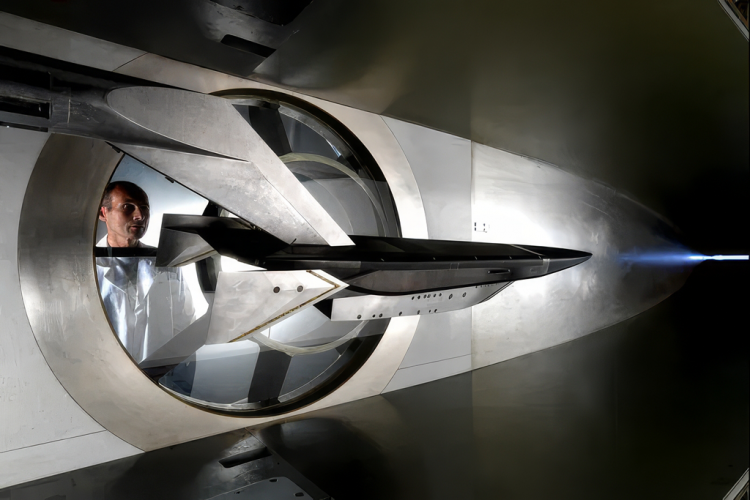
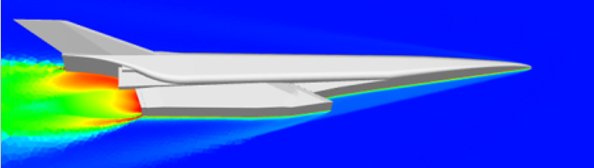
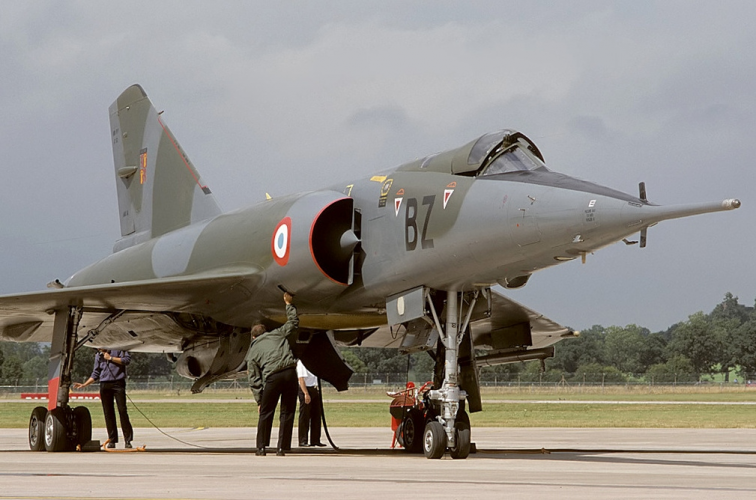
The scale up would allow for a bigger bay and more fuel to meet FCAS requirements... 9t internal fuel for example would give you a fuel fraction similar to an F-15E, with a combat radius (clean) of 800nm+. Then optimize to make it a true 6th gen fighter, e.g. higher fineness ratio for less supersonic drag, more advanced engines, replace the 4 post tail with ruddervators and LEVCONs etc.
For now ignoring the gross weight question, this isn't a design found in any of the official artwork by any of the companies involved with the FCAS program, is it? All I've seen is the tailless Levcon design with F-22-style intakes which seems to be proposed by Airbus, possibly without rudders enabled by the use of thrust-vectoring nozzles (proven possible by US/German X-31 Enhanced Fighter Maneuverability program), and the slimmed down F-35/KF-21/J-35-like design with ruddervators which seems to be associated with Dassault. Please correct me if I'm wrong!
Maybe for GCAP and what Germany wants.

France needs a striker, for both carrier aviation and for strategic strike.

Spain is replacing Legacy Hornets, so I suspect they're more in want for a striker that can dogfight than an Air Dominance plane that can carry bombs.
Somewhat interesting that it seems to be Dassault that seems to be the one pushing for such a design then? As for the kinematics required for air-superiority, I wouldn't be surprised if the tailless cranked-delta LEVCON design offers superior turn rate overall and especially at higher speed, looking at how the F-16XL seems to have offered a better lift-to-drag ratio than the baseline F-16, and at how delta-winged jets seem to compare to conventional jets in terms of ITR. If thrust isn't an issue this also translates well into the STR, doesn't it? I wonder if the Ruddervator F-35/KF-21/J-35 has something to do either meeting the requirements for carrier operation easier due to better low-speed handling, Dassault's take on a stealthy aircraft (it should be noted that Airbus is the primary for stealth characteristics for the FCAS program though and has experience in the area having experimented with the MBB Lampyridae, the DASA TDEFS, the LOUT, the Wingman and having been the primary on the Eurofighter's RCS reduction measures like RAM) or simply or being cheaper and easier to develop. I could though see such things coming back to hurt the NGF similar to how the Rafale's intentionally small nose limits the size and consequently achivable performance of the its radar.
I expect the aircraft to be fairly optimized around the air superiority/interceptor role, being designed around the absolute necessary A2G munitions but more so favoring VLRAAMs. On the other hand I expect the drone component of the FCAS program to take over the strike oriented missions for the most part, among other things. It's much more reasonable to leverage the unmanned system for dropping bombs and utilizing munitions of lesser range than full blown ALCMs. A stealthy striker has also use as a seperate system from the FCAS-NGF and export potential. More survivable and capable than most UCAVs today but also less costly than the next best thing, being an F-35. I'm thinking along the lines of nEUROn/S-70. And that's just the higher end strike component, I expect a whole array of unmanned companions which can be mixed and matched together with the NGF depending on what the mission at hand requires. Or even operating without the manned fighter in the loop but autonomously/or controlled from the ground or other airborne assets.
I agree with your assessment of UCAVs being more suitable for taking over air-to-ground roles. I however doubt that anyone is quite ready yet to fully rely on drones for any role, especially in France's core requirement of carrier-borne nuclear strike.
 
Maybe for GCAP and what Germany wants.

France needs a striker, for both carrier aviation and for strategic strike.

Spain is replacing Legacy Hornets, so I suspect they're more in want for a striker that can dogfight than an Air Dominance plane that can carry bombs.
Spain is replacing legacy Hornets with more Eurofighters and... something else... initially it was told it was going to be F-35, but after the current US presidency this looks difficult. Maybe even more Eurogihters.... even Rafales.. who knows.
GCAP, 15 years from now, will replace first/old Eurofighters in the SPAF.
 
Spain is replacing legacy Hornets with more Eurofighters and... something else... initially it was told it was going to be F-35, but after the current US presidency this looks difficult. Maybe even more Eurogihters.... even Rafales.. who knows.
GCAP, 15 years from now, will replace first/old Eurofighters in the SPAF.
You mean FCAS, don’t you? Also, isn’t the F-35/something else about replacing the EAV-8B, with the Halcón I and II already ordered to replace the F/A-18 with 45 Eurofighter T4?
 
You mean FCAS, don’t you? Also, isn’t the F-35/something else about replacing the EAV-8B, with the Halcón I and II already ordered to replace the F/A-18 with 45 Eurofighter T4?
You're right, FCAS. F-35B is mandatory for the Spanish Navy if they want to keep their fixed wing component. Halcón I and II only partially replace the Hornets. There was a lot of talk about a joint F-35 buy (SPAF and Navy)... but B is not a good choice for the Air Force. Before Trump, and after Halcón I, the F-35A buy was taken for granted, only a matter of time... Then Halcón II... looked like only between 18 and 24 F-35A were going to be bought... after Trump and all the talk about potential limitations to their use and political quarrels it looks like gone for the Air Force. The Navy is another story... There is no other option to them if they want to maintain the fixed wing... And now they have started a study about the feasibility of a CATOBAR carrier... The problem in this latter case is that the timeline points to a period in which the Navy won't have fixed wing... Pretty much like the Royal Navy and the end of the SHAR
 
Somewhat interesting that it seems to be Dassault that seems to be the one pushing for such a design then?
I suspect that designing a fighter that big is out of Dassault's comfort zone.


As for the kinematics required for air-superiority, I wouldn't be surprised if the tailless cranked-delta LEVCON design offers superior turn rate overall and especially at higher speed, looking at how the F-16XL seems to have offered a better lift-to-drag ratio than the baseline F-16, and at how delta-winged jets seem to compare to conventional jets in terms of ITR. If thrust isn't an issue this also translates well into the STR, doesn't it?
As I understand it, having lots of excess thrust does not help your Sustained Turn Rate. But it has been a long time since I went through that chunk of aerodynamics theory.


I wonder if the Ruddervator F-35/KF-21/J-35 has something to do either meeting the requirements for carrier operation easier due to better low-speed handling, Dassault's take on a stealthy aircraft (it should be noted that Airbus is the primary for stealth characteristics for the FCAS program though and has experience in the area having experimented with the MBB Lampyridae, the DASA TDEFS, the LOUT, the Wingman and having been the primary on the Eurofighter's RCS reduction measures like RAM) or simply or being cheaper and easier to develop. I could though see such things coming back to hurt the NGF similar to how the Rafale's intentionally small nose limits the size and consequently achivable performance of the its radar.
I would really hope that SCAF has a ludicrously big nose, for a 1m+ antenna.
 
I suspect that designing a fighter that big is out of Dassault's comfort zone.
Dassault has a history of sizing combat aircraft to fit what will actually be sold.
'In der Beschränkung zeigt sich erst der Meister' - Goethe.
It is in working within limits that the master reveals himself.
 
Last edited:
it should be noted that Airbus is the primary for stealth characteristics for the FCAS program though and has experience in the area having experimented with the MBB Lampyridae, the DASA TDEFS, the LOUT, the Wingman and having been the primary on the Eurofighter's RCS reduction measures like RAM
It’s Airbus Spain that is the designated leader for FCAS stealth, in one of those compromises that makes zero sense except from a workshare perspective, as they have no experience in this area. So the real stealth work will likely have to be done in France and Germany, but with Spanish teams « leading » and potentially driving towards the wrong decisions.
 
Dassault has a history of sizing combat aircraft to fit what will actually be sold.
'In der Beschränkung zeigt sich erst der Meister' - Goethe.
It is in working within limits that the master reveals himself.
And Trappier is on record saying ~33-35 tonnes MTOW. Which is 74,000-77,000lbs MTOW. That's Tomcat-sized on the low end and about halfway between Tomcat and F-111B or A-3 Skywarrior on the high end!

SCAF is going to be big. Has to be big to hold ASMP (5.4m) internally. ASN4G is likely to be even bigger due to increased speed and range requirements.
 
It’s Airbus Spain that is the designated leader for FCAS stealth, in one of those compromises that makes zero sense except from a workshare perspective, as they have no experience in this area. So the real stealth work will likely have to be done in France and Germany, but with Spanish teams « leading » and potentially driving towards the wrong decisions.
DASA/EADS/Airbus Germany was theoretically lead on the Eurofighter flight control system, because that was politically important to Germany, while all the FCS experience was actually British (BAE Systems Rochester).

So in practise there was a management and requirements team at Ottobrunn (staffed from all four nations), and everything else was done at Rochester.

There was a cartoon circulated that showed a management meeting at Ottobrunn with managers from all four nations sat around a table, except Rochester had a vulture sitting on its shoulder. In the next frame, there was just Rochester and the vulture.

Just because the org table says one nation is doing the work doesn't mean that's actually the case.
 
As I understand it, having lots of excess thrust does not help your Sustained Turn Rate. But it has been a long time since I went through that chunk of aerodynamics theory.
In combination with the ITR it should. High ITR means you can turn quickly and excess thrust means you don’t bleed as much energy doing so, translating into high STR. Assuming you still have excess thrust at higher AOA. At least that’s my amateurish conclusion based on stuff I’ve read.
 
SCAF is going to be big. Has to be big to hold ASMP (5.4m) internally. ASN4G is likely to be even bigger due to increased speed and range requirements.

Has that actually been confirmed?

For a missile with 1,000km range, and for the sort of targets ASN4G would be aimed at that then external carriage will be more than fine...

Can't believe that SCAF will carry a 5.5m metre missile internally when we're not even sure if the larger GCAP will carry FC/ASW internally...
 
How big is the existing ASMP for starters? Then we might find how big the next nuclear missile will be, I do not think that the next missile will be bigger than the ASMP for obvious reasons.
 
Has that actually been confirmed?

For a missile with 1,000km range, and for the sort of targets ASN4G would be aimed at that then external carriage will be more than fine...

Can't believe that SCAF will carry a 5.5m metre missile internally when we're not even sure if the larger GCAP will carry FC/ASW internally...
Indeed... the only precedent for internal carriage of such a large missile I can find is the Advanced F-106 proposal (1956) with a 5.5m long Sky Scorcher missile.

I guess that makes it technically feasible, but with obvious tradeoffs...

As for size, well Mirage IV was 27.5t clean TO weight (with 1 conformal nuke or belly tank), 32-33t MTOW. Mirage 4000 was 32t MTOW.
So when Trappier says 32-33t for FCAS he's implying the same size range... i.e. big but not huge (a couple tonnes less than a fully loaded F-15E).

f-106-ii-png.530303
 
Last edited:
How big is the existing ASMP for starters? Then we might find how big the next nuclear missile will be, I do not think that the next missile will be bigger than the ASMP for obvious reasons.
Approximate ASMP dimensions are:
- Missile body 5.4m x 64cm wide x 35cm high
- Tail fins 95cm wide x 62cm wide

So if the tail fins can be folded the dimensions aren't too unusual... about 1.3m longer than the typical A2G internal stores (JSOW, JSM etc) on other fighters.
 
Last edited:
I suspect that designing a fighter that big is out of Dassault's comfort zone.

And Trappier is on record saying ~33-35 tonnes MTOW. Which is 74,000-77,000lbs MTOW. That's Tomcat-sized on the low end and about halfway between Tomcat and F-111B or A-3 Skywarrior on the high end!

So, like this chap?
1753799514308.png

Cheers
 
In my view, Dassault is quite capable of handling that. Over the past few decades, Dassault didn't see much of a business opportunity there. If the consortium chooses to go big, Dassault will eagerly step forward.
This.
Its not like Dassault has not built the Mirage IV (or the Mirage 4000)...
Dassault has a very, very long story of proposing heavy fighters (F2, G8, ACF, 4000) just for the French MOD to order lighter aircrafts. If the French MOD chooses (and pays...) to go BIG, Dassault will deliver it.
 
Last edited:
It will be interesting to see what happens to the SCAF size wise Sintra whether Dassault goes big or goes back to the size of the Rafale, Rafale was designed to be small to fit on the deck of the Charles de Gaul but with the PANG going to be much bigger than the CdeG I could see the SCAF being larger than the Rafale.
 
Last edited:
F-35 is unusually short & fat and F135 is also unusually heavy for its thrust class, both linked to the STOVL requirements.

So KF-21 is probably a better starting point for sizing, being unencumbered by those constraints. Its length and wing area are both ~10% larger than an F-35A, while weighing 10% less, with equivalent thrust!

So what I’m saying - merely as a conceptual starting point mind you - is you could take much of the KF-21 almost as is (nose section, avionics, engines (uprated +20% using the latest tech obviously), with lighter YF-23 style ruddervators and then scale up the center section and wing by 20-30%… and that should give you a pretty good design baseline for FCAS.
I'd take F-35C instead as NGF also needs to operate from a carrier. It is already over your notional 15t empty weight, and carries 9t of internal fuel. KF-21 only seems more attractive as a baseline because it isn't designed around the same requirements.

F-35 is "fat" because of the internal weapon bays. KF-21 manages to get smaller cross sectional area because it has smaller weapon bays, which don't carry the same number or types of weapons. I would assume NGF would aim for the same as F-35 as minimum (i.e. 4 x Meteor). Repackaging to have twin engines would increase the maximum cross sectional area further.

You can definitely make a longer aircraft than F-35, which will help with wave drag, but it won't actually reduce it. Really you're gaining volume for limited impact on supersonic performance. Subsonic will decrease due to the extra wetted area. This longer fuselage will also increase empty weight because of the increased loads.

F135 is relatively heavy - but maybe that's just the accounting for having extra electrical power generation and cooling capacity? It's not that much worse T/W than F119? Lower BPR would reduce mass, but increase sfc and reduce range.

I'm unaware that ruddervators / butterfly tails are lighter than 4 tails; historically there hasn't seemed much difference in either drag or mass. You generally need about the same tail volume regardless, 2 tails end up being very large with large loads / big actuators etc.

At the same point there's definitely changes you could make to F-35C as a baseline e.g. extra wing sweep for lower supersonic drag. But then probably needs to increase wing area to generate the same lift on carrier approach.

There's definitely a good +/-10% on mass around all the above from detailed design, but combining much better performance, payload, and range together is going to result in a much heavier aircraft. Some compromises will be needed to limit empty mass to 15t
 
For the ASN4G it's hard to tell how large the missile will be, but it does seems to have a larger cross section than ASMP.
ASN4G will be constrained by Rafale centerline carriage constraints to approx 6.3m x 85cm (missile body size). Height likely no more than 50cm given the need for a flat glider profile. Fin size TBD... the fins will likely have to fold if the goal is internal carriage (which is not confirmed).

ASN4G_1.jpg
 
ASN4G will be constrained by Rafale centerline carriage constraints to approx 6.3m x 85cm (missile body size). Height likely no more than 50cm given the need for a flat glider profile. Fin size TBD... the fins will likely have to fold if the goal is internal carriage (which is not confirmed).
The plan is actually to have 2 versions of the ASN4G :
  • a "small" version for the F5 Rafale, still probably larger than ASMP
  • a "full size" version for NGF
So the latter version of ASN4G will be much larger than ASMP or even the ASN4G fitted to Rafale

Full quote from French parliament : https://www.senat.fr/compte-rendu-commissions/20241021/etran.html#toc4

The F5 is essentially a new Rafale. This latest aircraft is designed to carry the ASN4G, a future hypersonic missile — its speed will indeed exceed Mach 5 — and ultra-high-velocity, with maneuvering capabilities throughout its entire flight. This represents a true technological breakthrough.

The Rafale F5 will need to carry this missile, which is significantly heavy. As such, it will require a new engine, conformal fuel tanks, as well as enhanced radar detection, connectivity, and electronic warfare countermeasures.

Its successor, the SCAF, will in turn carry the final version of this missile, whose range will meet the specifications we initially requested.
 
Last edited:
Looking at the drawing above I doubt it can be made much longer (<0.8 m ~+14%) or larger without potentially hitting the front wheel/-cover or aft hook or even main wheels (if wider).
The hook being the greater concern with emergency landing... ofc the pilot could drop the nuke before landing (imaging the political trouble that would follow).
A minor issue: it could shift the center of gravity somewhat away from the ideal attachment location on the pylon.
 
Has that actually been confirmed?

For a missile with 1,000km range, and for the sort of targets ASN4G would be aimed at that then external carriage will be more than fine...

Can't believe that SCAF will carry a 5.5m metre missile internally when we're not even sure if the larger GCAP will carry FC/ASW internally...
SCAF is a striker and strategic bomber. Why wouldn't it be designed around internal carriage of a 1000km range missile?

While GCAP is primarily an air dominance fighter that may have bays big enough for 2000lb ordnance.


So, like this chap?
View attachment 779626

Cheers
physically bigger, but same rough MTOW.
 
SCAF is a striker and strategic bomber
No need to keep repeating the same point. We get it.

You’re entitled to your opinion, of course, however multiple posters here have corrected you that this matches neither the German & Spanish requirement for a Typhoon replacement, nor how the French Air Force and Aeronavale use their Rafales today, with about half the squadrons focused on strike with 2-seaters and the other half focused on air dominance with single seaters (with some swing role capability).

So by necessity FCAS *will* be multirole.
 
If France could have done FCAS alone, they would have done it from the very beginning. They can't and thus it's a joint development. Case closed, everyone move on.
Not really.
It was already said from Rafale in its time, and we made it alone.
Our main problem is our President : Macron. He pushed hard for european programs, in MBT and fighters, but probably with the worst partner. And I'm absolutely not sure the germans want it at the same level.
All the last try with germany failed : Tiger helo upgrade, maritime patrol to replace Orion & Atlantic2, anti tank missile....

Better made a collaboration with GB. It's probably too late now.
 
Not really.
It was already said from Rafale in its time, and we made it alone.
Our main problem is our President : Macron. He pushed hard for european programs, in MBT and fighters, but probably with the worst partner. And I'm absolutely not sure the germans want it at the same level.
All the last try with germany failed : Tiger helo upgrade, maritime patrol to replace Orion & Atlantic2, anti tank missile....

Better made a collaboration with GB. It's probably too late now.
Your main problem is not Macron, but lack of $$$..

Today Germany is the best partner in the world, cus they now spend money on military like they havent done in 80 years.. 10 years ago they were the worst partner cus no will to spend big $$ on military.

Lets face it.. without German $ France will be flying upgraded Rafale's for the rest of the century.
 
Last edited:
Lets face it.. without German $ France will be flying upgraded Rafale's for the rest of the century.
If South Korea and Turkey can afford to build their own stealth fighter designs starting from much less, with only 75-80% of France’s GDP (PPP adjusted for a fair comparison), why can’t France do the same?

Especially with an existing user base of 300+ export Rafales to sell to.

Mind you I’m not advocating dropping FCAS, as you are correct that German financing is very helpful. But absolutely critical? Probably not.
 
If South Korea and Turkey can afford to build their own stealth fighter designs starting from much less, with only 75-80% of France’s GDP (PPP adjusted for a fair comparison), why can’t France do the same?

Especially with an existing user base of 300+ export Rafales to sell to.

Mind you I’m not advocating dropping FCAS, as you are correct that German financing is very helpful. But absolutely critical? Probably not.
South Korea is in final stages of developing a 4.5+ gen fighter.
South Korea is currently doing feasibility study for blk3 of kf21.
Which Means there is no formal sanction of funds for blk3 development to begin yet.

Also, SK generally spends more than 2.5+% of its gdp in defense.
France only now is spending more than 2% of its gdp on defense with russo-ukraine war.
France also has nukes and its delivery platforms to maintain and pay for.


As, for turkey the less said the better.
These guys signed MOU with Indonesian airforce, giving their kaan as option that Indonesia can buy in future, kaan whoes first prototype hasn't flown yet.
Similar thing with the size of kaan, withturkeys's need they don't need as large of a fighter, kaan's demonstrator and final size being this large is an indication of limitation, they couldn't make a compact enough airframe for the needs.
Even the design of kaan is done mainly by BAE Systems getting assistance from Turkish industry into customizing kaan for Turkish needs and their industrial capacity.

I have little hope of this program actually succeeding in 2030s, with all the theatrics turkey has done to hyping up and in many point of views lying about actual progress of this program.


So far, both countries "plans" for a next gen stealth fighter similar to how France "plans" for SCAF.
Neither sk or turkey has succeeded.
And SCAF is supposed to be a notch above, belonging to the so called 6th gen category, more ambitious in terms of capability but also "money" required for SCAF.

 
It will be interesting to see what happens to the SCAF size wise Sintra whether Dassault goes big or goes back to the size of the Rafale, Rafale was designed to be small to fit on the deck of the Charles de Gaul but with the PANG going to be much bigger than the CdeG I could see the SCAF being larger than the Rafale.
It's clear. Any jet with internal bays is bigger thant its counterpart without bay.
 
If South Korea and Turkey can afford to build their own stealth fighter designs starting from much less, with only 75-80% of France’s GDP (PPP adjusted for a fair comparison), why can’t France do the same?

Especially with an existing user base of 300+ export Rafales to sell to.

Mind you I’m not advocating dropping FCAS, as you are correct that German financing is very helpful. But absolutely critical? Probably not.
Those fighters 100% will be way less capable fighters than FCAS. If France does it alone they will also end up with a less capable fighter because of the cost to develop a high end fighter.
 
Not really.
It was already said from Rafale in its time, and we made it alone.

Compared to what the FCAS is supposed to be as laid out within the program, the Rafale (and Eurofighter) are archaic machines.

It's like saying that having built and developed the F-86 qualifies one to built and develop the F-47. The amount of money and technological prowess required is magnitudes apart. Pulling off a fourth generation fighter isn't prohibitive, while developing a sixth generation fighter certainly is to such a degree that so far only the US and China are funding purely national efforts, while everyone else had to band together and pool money and resources in FCAS and GCAP.

Comparing Rafale to FCAS in terms of complexity and ability to develop independently is a fallacy. If France were to develop a Rafale successor on their own it would be more akin to KAAN rather than the F-47 and J-50.
 
Last edited:
If South Korea and Turkey can afford to build their own stealth fighter designs starting from much less, with only 75-80% of France’s GDP (PPP adjusted for a fair comparison), why can’t France do the same?

Especially with an existing user base of 300+ export Rafales to sell to.

Mind you I’m not advocating dropping FCAS, as you are correct that German financing is very helpful. But absolutely critical? Probably not.
Simply having a stealth fighter isn't the goal. The goal is to field an advanced next gen fighter with cutting edge avionics, VCEs and a whole array of new weapons and unmanned systems integrated into a wider framework.

KAAN is simply a fighter jet with stealth characteristics, IIRC primarily meant to replace the F-4s and F-16s. The KF-21 isn't even a full on stealth fighter with it's conformal weapon carriage. But even then, it's simply meant to replace existing ROKAF aircraft.

FCAS isn't simply about replacing the Rafale and Eurofighter. It's about providing an entirely new dimension of capabilities to France, Germany and Spain, it's so much more than just a stealth fighter. In the same way the NGAD program is so much more than just an F-22 replacement. Or the J-36 is far more than merely a successor to the J-20.
 
As, for turkey the less said the better.
These guys signed MOU with Indonesian airforce, giving their kaan as option that Indonesia can buy in future, kaan whoes first prototype hasn't flown yet.
Similar thing with the size of kaan, withturkeys's need they don't need as large of a fighter, kaan's demonstrator and final size being this large is an indication of limitation, they couldn't make a compact enough airframe for the needs.
Even the design of kaan is done mainly by BAE Systems getting assistance from Turkish industry into customizing kaan for Turkish needs and their industrial capacity.

Definitely disagree, the Turks are doing quite well with the development. Having flown a test article and being in the process to finish their first proper prototype aircraft. As for compactness, I highly doubt they'd want that. Turkey wants to operate across the entire Levant, incursions deep into Syria if necessary, operating over the Mediterranean etc. which in turn dictates a certain size, especially when the aircraft is meant to deliver a payload on target that is useful. All of which makes it doubtful they wanted something particularly compact. It's more progress than the likes of India made, and being able offer a stealth aircraft for export in the first place is something they have over Europe (excluding Russia) in it's entirety.

Still, while a big national effort, FCAS is a completely different ballgame. And it is simply a fact that no individual European nation has the resources and funds to create an NGAD style program on their own. A purely national program would have to make SEVERE concessions in order to become realistic. And at that point you're not cutting edge anymore, not on the forefront of military aviation and not introducing next gen capabilities. At that moment you're just doing a slightly rehashed and modernized version of something flown elsewhere since the 90s to 2010s, a 5th Gen with extra steps.
 
Simply having a stealth fighter isn't the goal. The goal is to field an advanced next gen fighter with cutting edge avionics, VCEs and a whole array of new weapons and unmanned systems integrated into a wider framework.

KAAN is simply a fighter jet with stealth characteristics, IIRC primarily meant to replace the F-4s and F-16s. The KF-21 isn't even a full on stealth fighter with it's conformal weapon carriage. But even then, it's simply meant to replace existing ROKAF aircraft.

FCAS isn't simply about replacing the Rafale and Eurofighter. It's about providing an entirely new dimension of capabilities to France, Germany and Spain, it's so much more than just a stealth fighter. In the same way the NGAD program is so much more than just an F-22 replacement. Or the J-36 is far more than merely a successor to the J-20.

This is something one can agree with. The question is what things will look like in 5 or 15 years.
The arms frenzy will subside significantly once the current conflict ends, and the willingness of people in Europe and the U.S. to pay for weapons programs will drop sharply in proportion to the rising cost of living—
in Europe due to a humiliating customs deal with the U.S., and in the States due to the onset of a tariff (and ultimately economic) war with BRICS, which controls a substantial share of the planet’s mineral resources.

As a result, wage demands will rise, and all technologically demanding programs—including SCAF, GCAP, and the F‑47—will become sharply more expensive. Projected orders will fall to such low numbers that the programs will lose the last remnants of their economic rationale.

Perhaps a somewhat bleak reflection—but our politicians are doing everything they can to make it a reality.
 
This is something one can agree with. The question is what things will look like in 5 or 15 years.
The arms frenzy will subside significantly once the current conflict ends, and the willingness of people in Europe and the U.S. to pay for weapons programs will drop sharply in proportion to the rising cost of living—
in Europe due to a humiliating customs deal with the U.S., and in the States due to the onset of a tariff (and ultimately economic) war with BRICS, which controls a substantial share of the planet’s mineral resources.

As a result, wage demands will rise, and all technologically demanding programs—including SCAF, GCAP, and the F‑47—will become sharply more expensive. Projected orders will fall to such low numbers that the programs will lose the last remnants of their economic rationale.

Perhaps a somewhat bleak reflection—but our politicians are doing everything they can to make it a reality.

I'm the wrong person to bring this up towards, as I'm highly critical of our (German) participation in this program anyway. But I don't make the decisions and as the decision so far looks like sticking with it, I hope that we (the partner nations) will somehow work this out and field in time to be a viable system for the cost.
 

Similar threads

Back
Top Bottom