And dragging this somewhat back to topic, the problem is that the European militaries are pretty consistently making miniature balanced forces instead of optimizing their roles in a NATO or EU-mil role.

Yes, I am aware that the EU treaty doesn't give Brussels broad central authority like the US Constitution gives the US federal government.

Splitting things up to say, "France and Italy will cover carrier aviation, Belgium and Denmark will cover ASW, Germany will cover littoral warfare..." (Yes, I know I went Naval there, I don't have a good mental model for how to split up Air Force tasks across European nations)
 
And dragging this somewhat back to topic, the problem is that the European militaries are pretty consistently making miniature balanced forces instead of optimizing their roles in a NATO or EU-mil role.

Yes, I am aware that the EU treaty doesn't give Brussels broad central authority like the US Constitution gives the US federal government.

Splitting things up to say, "France and Italy will cover carrier aviation, Belgium and Denmark will cover ASW, Germany will cover littoral warfare..." (Yes, I know I went Naval there, I don't have a good mental model for how to split up Air Force tasks across European nations)
Just consolidating on the same aircraft types for training, logistics etc commonality would be a good start
And doing so on a European airframe (so Gripen E, FCAS, GCAP, or even Typhoon - you’d think someone could / should take RAF tranche 1s
 
And Germany's needs are "replacing Typhoons" which are high end air to air fighters with minimal air-to-ground capabilities. If Germany needs strike, they have F-35s.
I maintain that Typhoon currently is multi-role. Its merits as a strike aircraft aside, Germany has explicitly assigned it as its Tornado IDS replacement. Whatever the FCAS / SCAF / FSAC project delivers will have to be multi-role to satisfy German needs.
 
Last edited:
Well, it indeed does though. I doubt in modern time and era it amounts to much in roles other than limited deep strike (taurus) and nuclear delivery.
A bit harsh on the good ol' Tonka. German Tornados can carry the AGM-88E AARGM. I believe this would still make them valuable assets for SEAD/DEAD missions. And of course their Taurus slinger capability is important. There is a reason why Ukraine wants this missile.
 
Somebody should take the RAF Tranche 1 Typhoons instead of scrapping them even if it is only for a limited time before the airframe life goes.
They're not electronically updatable. At least not without replacing a couple of fuselage bulkheads that require major disassembly to get to.

How usable is a Tranche 1, what all was it equipped with electronics wise and what weapons is it cleared to use?
 
Accusations are flying, not much else.


BERLIN, Aug 26 (Reuters) - French industry is blocking entry into the next phase in the development of the Franco-German fighter jet FCAS by demanding sole leadership of the project, the German defence ministry says in a document seen by Reuters on Tuesday.

Options for a solution will be worked out by the end of this year before a decision about further steps is taken, the ministry says in the document.
This timeline contradicts earlier statements that German Chancellor Friedrich Merz and French President Emmanuel Macron had agreed to try to find a solution by the end of August when both governments meet for consultations in Toulon, France.

The document seen by Reuters did not specify a French company in its criticism but industry sources have been pointing their fingers at French warplane maker Dassault Aviation.
 
Accusations are flying, not much else.
It's interesting that these one-sided "leaks" to the media always come from German sources with an axe to grind against Dassault. They always end up pointing the finger elsewhere, and never have anything constructive to offer. Very likely these ae officially sanctioned leaks by Berlin in order to put pressure on their French partner.

Whereas Dassault appears to be much more transparent about what it wants (e.g. best athlete principle for deciding who does what, a simple governance structure with clear lines of accountability etc).
 
Are you claiming Trappier hasn't been grinding his own axe in public? Because there's a whole slew of media interviews that contradict that.
Well that's precisely the difference IMHO. Trappier has said his piece in public, laying out the pros and cons of different partnership models (as he sees it obviously), and stating a very clear preference for a certain type of governance model. He's made his case and backed it with evidence (Neuron and F-35 vs. Eurofighter etc).

He's also not "demanded" anything, saying that ultimately it's the governments who will decide and will have to accept the extra cost, time and risk if they choose an overly complex and arguably suboptimal governance model.

Meanwhile, the German-side is leaking strawman arguments to the media, most of which are willful distortions of the truth ("Look Dassault wants 80% work share!" "Look they're blocking progess and demanding leadership!"), and has yet to offer any public evidence or counter-argument to rebut what Trappier is saying. A more honest approach IMHO would be to release a white paper on lessons learned from the Eurofighter partnership, what worked and what didn't, and how to build the right governance model. There are plenty of think tanks that could do that (similar to RAND in the US), and that would be a lot more constructive than constantly whining and leaking to the media.
 
Well that's precisely the difference IMHO. Trappier has said his piece in public, laying out the pros and cons of different partnership models (as he sees it obviously), and stating a very clear preference for a certain type of governance model. He's made his case and backed it with evidence (Neuron and F-35 vs. Eurofighter etc).

He's also not "demanded" anything, saying that ultimately it's the governments who will decide and will have to accept the extra cost, time and risk if they choose an overly complex and arguably suboptimal governance model.

Meanwhile, the German-side is leaking strawman arguments to the media, most of which are willful distortions of the truth ("Look Dassault wants 80% work share!" "Look they're blocking progess and demanding leadership!"), and has yet to offer any public evidence or counter-argument to rebut what Trappier is saying. A more honest approach IMHO would be to release a white paper on lessons learned from the Eurofighter partnership, what worked and what didn't, and how to build the right governance model. There are plenty of think tanks that could do that (similar to RAND in the US), and that would be a lot more constructive than constantly whining and leaking to the media.
This 80% history is nearly 100% false.
Sole "reality" may be that the FCAS prototyp may used 80% of rafale components (because Germany & Spain don't have the whole intelectual property of EF2000 parts).
 
This 80% history is nearly 100% false.
That would be 99,78 % of 80 % true ?
Sole "reality" may be that the FCAS prototyp may used 80% of rafale components (because Germany & Spain don't have the whole intelectual property of EF2000 parts).
I think you mean the demonstrator. A plane using 80% Rafale components, that would be a rafale F 8.2 or something ? I've never been good at math...
Sorry, I'm just kidding :)
 
(Subscription or registration may be required)

BERLIN, Aug 27 (Reuters) - The German government must swiftly decide whether to proceed with the development of a Franco-German fighter jet or leave the project, a prominent member of the German parliament's defence committee told Reuters on the eve of high-level talks.

Berlin blames French industry for blocking the next phase in the development of the FCAS program by demanding sole leadership of the project, Reuters reported on Tuesday.
 
That would be 99,78 % of 80 % true ?

I think you mean the demonstrator. A plane using 80% Rafale components, that would be a rafale F 8.2 or something ? I've never been good at math...
Sorry, I'm just kidding :)
99,9% false.

It is indeed the demonstrator.
Engine will be a derivative of M88, Fly by wire may come from Rafale or Falcon 10X, canopy & landing gear maybe from Rafale.
Spain & Germany has nothing without intelectual prorerty problems to offer. They are golden sub contractors.
 
I say you this program is born dead
Sigh...
What you can read in that piece are just the usual lobbying pressures put through press by people with no decision making power, but with interests on the matter, to the ones with decision making power (Gov), before a meeting where decisions are likely to be made.
ie, these are only the views of the ones who shout the louder for their interests to be heard. Do not take what makes the most noise as proof that a decision has been made.

This is funny :
"
Schmid cited the example of the Eurofighter, which was a joint success story for Germany, Britain and Italy, without France being involved.
"It would not be a catastrophe for Germany and France to part ways now if this is in the national or European interest," he said, while lobbying for ordering an additional 60 Eurofighter jets by 2029 to replace the country's ageing Tornado fleet."
Wait... I though it was Dassault pushing further away FCAS to be able to sell more Rafales :p
 
Last edited:
I say you this program is born dead
It may not be a problem for France. A new frame, stealthy and heavy for range with the very well born and with strong road map weapon system of Rafale is a cheap solution. Maybe working with the less greedy Spain, with SAAB? with India?
Germany has lost the whole knowledge to built a fighter.
 
That would be a lot of billions euros spent on just that.
only a small amount compared to the entire program.
It is not totally spent. The studies financed can only be well used by France, with a complete eco system.
Germany for exemple had lost how to make a jet fighter alone for decades.
 

BERLIN, Aug 26 (Reuters) - French industry is blocking entry into the next phase in the development of the Franco-German fighter jet FCAS by demanding sole leadership of the project, the German defence ministry says in a document seen by Reuters on Tuesday.
In the document, sent to members of the German parliament's budget committee on Friday, the ministry warns of severe consequences for the capabilities of the future fighter jet and the participation of German industry if concessions are granted to French industry.
 
That would be a lot of billions euros spent on just that.
Doubtful, Airbus has all the means to depart from this program with more than they came in with at the beginning. Previous studies already emphasized their investment into stealth technology, networking, and UCAVs. Being able to draw from decades of German research (and more) into the field of low observablility and drone development (Lampyridae, TDEFS, LOUT, Barracuda etc.) is certainly an advantage as well. Now having learned to coordinate and navigate, as well as define a truly ambitious next generation effort with it's various components is also valuable. And bringing equally ambitious and knowledgeable partners on board shouldn't be too difficult. I'd be surprised if plenty of up and coming or established names like Saab, KAI or TAI wouldn't be interested to work with the aerospace powerhouse that's Airbus in order to deliver a potent next generation fighter system. An opportunity that would present itself once in a lifetime. With GCAP being closed for new members and the US only offering the F-47 as a product to customers according to Trump, not as project for members. And the three mentioned companies are the embodiment of their home country's desire for a domestic, competitive, aerospace industry that's more and more detached from being subject to restrictions and bottlenecks associated with foreign purchases, like the ones from the US for example. Sweden, Korea and Turkey certainly emphasize autonomy in defence matters, which would make them good potential candidates for such a cooperation.
 
I'd be surprised if plenty of up and coming or established names like Saab, KAI or TAI wouldn't be interested to work with the aerospace powerhouse that's Airbus
Airbus is a powerhouse only in civilian aerospace. In military aerospace it's a midget with a checkered history (A400M and Eurofighter in which it was merely a minority partner).

Especially if you consider Airbus DS alone (separate from Airbus Spain)... no one is going to waste their time with a minor player which had only 29% share of Eurofighter, especially given all the well-known strings attached when dealing with German industry and the Bundestag's constant veto threats.
 
especially given all the well-known strings attached when dealing with German industry and the Bundestag's constant veto threats.
It seems certainly more appealing than the constant delusions of Dassault. Especially as the political portion of Germany only chimes in when sales to countries with questionable human rights records are discussed (Saudi Arabia, Turkey, for example). But even such issues tend to get resolved eventually, as seen with the Eurofighter sale to Saudi Arabia and the closing steps to sell the type to Turkey as well. For most countries that's not a concern unless they want to purge minorities on their soil.

On the other hand, the delusional stance of Dassault to be a relevant player in this day and age threatens programs they participate in before they even come to fruition. And given that FCAS is looking to fall apart because of that, it's unlikely France will find a new partner after FCAS, while Spain and Germany are very likely to cooperate with other countries. Given that nobody would ever want to join up with Dassault after their repeated track record of torpedoing programs they are a part of with their laughable attitudes.

All in all when this inevitably falls apart the aerospace giant with a fuck ton of money and resources and it's spanish sidekick are more appealing partners than the megalomaniac cooperation-crashers from yesteryear.
 
Last edited:
...
Meanwhile, the German-side is leaking strawman arguments to the media, most of which are willful distortions of the truth ("Look Dassault wants 80% work share!" "Look they're blocking progess and demanding leadership!"), and has yet to offer any public evidence or counter-argument to rebut what Trappier is saying. A more honest approach IMHO would be to release a white paper on lessons learned from the Eurofighter partnership, what worked and what didn't, and how to build the right governance model. There are plenty of think tanks that could do that (similar to RAND in the US), and that would be a lot more constructive than constantly whining and leaking to the media.
From 2023... https://www.airbus.com/en/newsroom/stories/2023-03-blue-versus-red-europe-wins

"...
Five years to the demonstrator's first flight

The clock is ticking, and Demonstrator Phase 1B is now in full swing: by 2025 the FCAS flight demonstrators will have been further developed. Demo Phase 2 will then see them take off for the first time: the remote carrier demonstrator in 2028 and the New Generation Fighter demonstrator in 2029. The production phase is scheduled to begin in the 2030s.

Including the FPL team, Airbus currently has 250 people working on the FCAS and plans to have 800 doing so by the end of 2023. “We want to fill the new positions with both internal and external candidates,” says Bruno Fichefeux, head of FCAS programme at Airbus, adding that 80 per cent of them will work in Engineering. Working on FCAS is rewarding, both for experienced and new talents, says Fichefeux: "After all, it’s not too often that you get the opportunity to work on the most important European defence project of the next decades.”

On the Airbus side, this will take place mainly in four plateaus or integrated work areas: in Manching, with a focus on the New Generation Fighter, Remote Carriers and stealth technologies; in Getafe near Madrid, where work is being done on the New Generation Fighter and stealth technologies; in Friedrichshafen on Lake Constance, where work is being done on the combat cloud and remote carriers; and in Elancourt near Paris, where teams are working on the overall system of systems and the combat cloud.

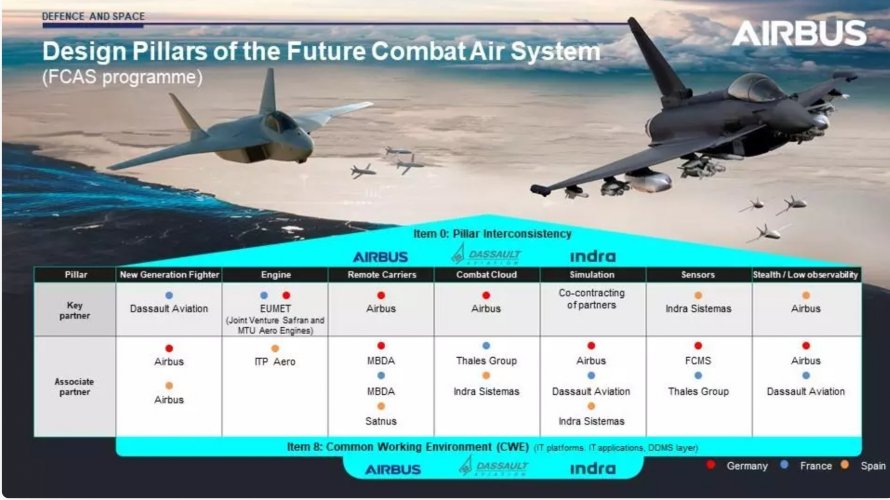
But how is collaboration with external partners set up? In the Phase 1B demonstration, it is divided into individual pillars (see infographic), each of which has a leading company with partners, according to the "best athlete" principle. Airbus, for example, is responsible for the remote carriers, combat cloud and stealth technologies. There will also be a plateau in Saint-Cloud, France, where Dassault Aviation will notably lead the New Generation Fighter pillar together with Airbus as a main partner.
..."
Screenshot_20250827_181146.jpg
 
It may not be a problem for France. A new frame, stealthy and heavy for range with the very well born and with strong road map weapon system of Rafale is a cheap solution. Maybe working with the less greedy Spain, with SAAB? with India?
Germany has lost the whole knowledge to built a fighter.
You need custom made sub systems and avionics for each airframe.
They can use same tech as avionics from rafale f5 but not the same avionics themselves.
Even the Antennas for examples would need to be made conformal for stealth reasons.
 
Here we go again. France wants sole leadership of the FCAS program, this can only go one way and it won't be pleasant.
Germany was and is not the right partner.
See Tiger helo upgrade, eee AC3G missile, see MAWS program.... Since HOT and MILAN there is nearly no germano french successfull weapon project.
 
Eurofighter in which it was merely a minority partner.
Of course it was only a minority partner, that's what happens when you divide by four, with two partners getting 33% each and the others splitting the remainder (actual current percentages 46% Airbus, 33% BAE Systems, 21% Leonardo), but implying that was the involvement of an aerospace 'midget' would be utterly wrong. Remember, over and above Typhoon, Airbus German was previously DASA and MTU and before that MBB, with all the programmes those companies were involved in.
 
Here we go again. France wants sole leadership of the FCAS program, this can only go one way and it won't be pleasant.
FCAS is not the same as NGF, which is only one of 7 pillars (though the most central one).

Dassault is only asking for leadership of NGF, as per the initial agreement. The allocation of the other 6 pillars is not being challenged.

The problem with NGF is that despite having nominal leadership on paper, in practice Dassault is being outvoted by the other 2 partners (Airbus DS + ES). This brings up a tricky question... what should "leadership" mean? Dassault thought it meant executive leadership, and wants to have the final say along with accountability for delivering results, much like it had for Neuron.

Germany wants design by committee, much like Eurofighter and NH90... how successful was that?
 
Even the Antennas for examples would need to be made conformal for stealth reasons.
A block 1 may use the AESA radar, with the same antenna (or just bigger to adapt to the igger nose cone) than Rafale F5 or F6.
Rafale F5 was expected with conformal side arrays... (true? I don't know).

A block 2 may arrive with brand new weapon system.
 
Of course it was only a minority partner, that's what happens when you divide by four, with two partners getting 33% each and the others splitting the remainder (actual current percentages 46% Airbus, 33% BAE Systems, 21% Leonardo), but implying that was the involvement of an aerospace 'midget' would be utterly wrong. Remember, over and above Typhoon, Airbus German was previously DASA and MTU and before that MBB, with all the programmes those companies were involved in.
The term "midget" to describe Airbus Defense doesn't come from me, the first time I heard it from a US industry analyst or journalist, back when it was still EADS (and separate from Airbus and Eurocopter).

I was very offended at the time (like you), but I now understand the point. Although on the surface it's a very large division (€12B annual revenue, >30,000 employees), once you split it out into its individual components and look only at the combat aircraft divisions, it's tiny (~€2B annual revenue). Further break that out into Airbus D&S Germany and its combat aircraft business is about ~1/3rd the size of Dassault's combat aircraft business (~€4B annual revenue), which is already a small player by U.S. standards.

TLDR... the difference in scale between developing a few Eurofighter systems and producing a handful of aircraft a year vs. developing and selling hundreds of F/A-18Es, F-15EXs, F-16Vs, F-22s and F-35s is just massive.
 
Last edited:
The term "midget" to describe Airbus Defense doesn't come from me, the first time I heard it from a US industry analyst or journalist, back when it was still EADS (and separate from Airbus and Eurocopter).

I was very offended at the time (like you), but I now understand the point. Although on the surface it's a very large division (€12B annual revenue, >30,000 employees), once you split it out into its individual components and look only at the combat aircraft divisions, it's tiny (~€2B annual revenue). Further break that out into Airbus D&S Germany and its combat aircraft business is about ~1/3rd the size of Dassault's combat aircraft business (~€4B annual revenue), which is already a small player by U.S. standards.
That's an economic point, it's not a point about capability. The capability to develop an aircraft is independent of numbers sold.
 

From 2023... https://www.airbus.com/en/newsroom/stories/2023-03-blue-versus-red-europe-wins

"...
Five years to the demonstrator's first flight

The clock is ticking, and Demonstrator Phase 1B is now in full swing: by 2025 the FCAS flight demonstrators will have been further developed. Demo Phase 2 will then see them take off for the first time: the remote carrier demonstrator in 2028 and the New Generation Fighter demonstrator in 2029. The production phase is scheduled to begin in the 2030s.

Including the FPL team, Airbus currently has 250 people working on the FCAS and plans to have 800 doing so by the end of 2023. “We want to fill the new positions with both internal and external candidates,” says Bruno Fichefeux, head of FCAS programme at Airbus, adding that 80 per cent of them will work in Engineering. Working on FCAS is rewarding, both for experienced and new talents, says Fichefeux: "After all, it’s not too often that you get the opportunity to work on the most important European defence project of the next decades.”

On the Airbus side, this will take place mainly in four plateaus or integrated work areas: in Manching, with a focus on the New Generation Fighter, Remote Carriers and stealth technologies; in Getafe near Madrid, where work is being done on the New Generation Fighter and stealth technologies; in Friedrichshafen on Lake Constance, where work is being done on the combat cloud and remote carriers; and in Elancourt near Paris, where teams are working on the overall system of systems and the combat cloud.

But how is collaboration with external partners set up? In the Phase 1B demonstration, it is divided into individual pillars (see infographic), each of which has a leading company with partners, according to the "best athlete" principle. Airbus, for example, is responsible for the remote carriers, combat cloud and stealth technologies. There will also be a plateau in Saint-Cloud, France, where Dassault Aviation will notably lead the New Generation Fighter pillar together with Airbus as a main partner.
..."
View attachment 782844

Actually, 3+ billions euros have been expanded already about the course of the program, a significant sum that amount for example to 5% of French DoD revised entire budget...
(and I am not sure if that even encompass the earlier partenaria with UK)
 

Similar threads

Back
Top Bottom