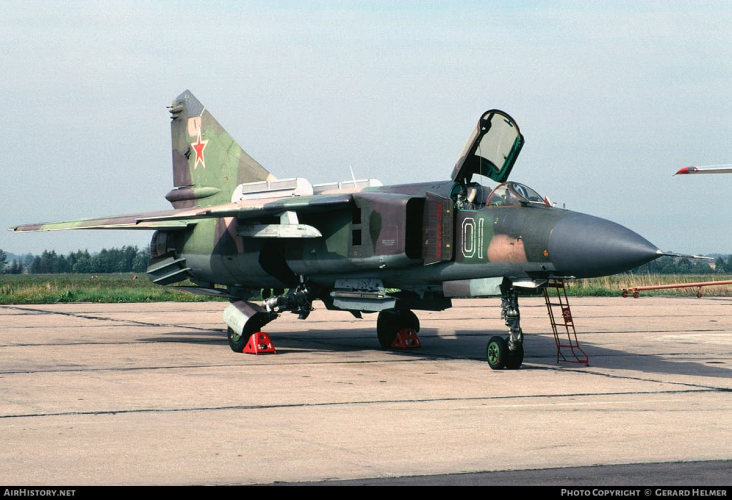
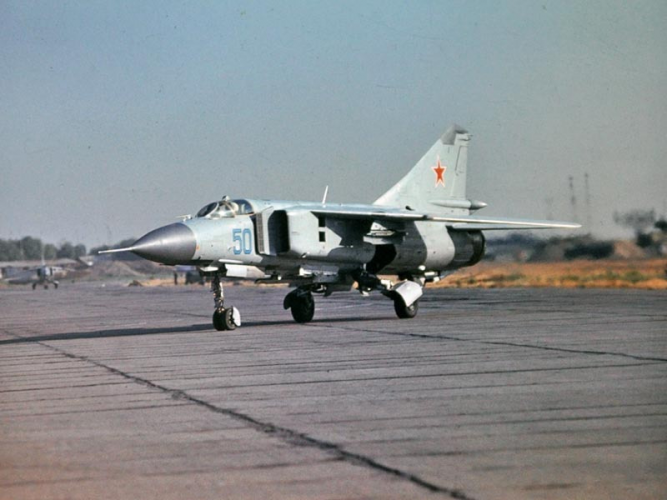
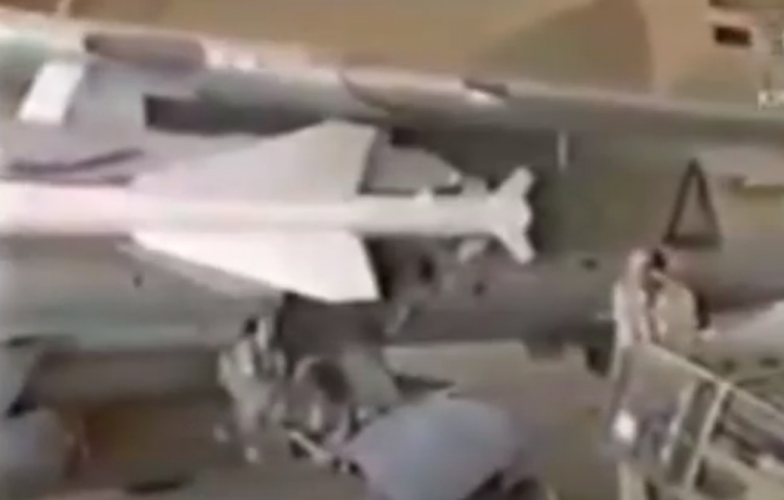
As a MiG-23 fan, I think he did not portrait well the fighter.
In History few aircraft surpass the production numbers of the MiG-23, I mean come on he said it was difficult to maintain why a difficult to maintain fighter will be built into 5000+ aircraft?
Only the F-4 gets close in production numbers to the MiG-23 and only the MiG-21 surpass it.
I think the Russians and Soviets had close to 2000+ MiG-23s in their fleet in the 1980s.
Since it had two variants I mean the MiG-23BN and MiG-23M, one is a MiG-27 without radar, in the wars it fought many of the downed MiG-23s were BNs.
In air combat, the reality is not so many MiG-23MFs or MiG-23MLs were downed in the 1980s when the MiG-23 was in its prime.
The loses in Syria or Libya after 2011 were of aircraft with little upgrades.
In my opinion the MiG-23 was not the best nor the worst fighter in History.
In air to air combat it is probable the fighter variants may had lost around 25 or 30 MiG-23MS, MiG-23MFs MLs or MLDs.
And downed around 25 aircraft.
See that in that video they mix the MiG-23BN loses with MiG-23M and fighter variants and give a 1:4 kill ratio
In 1982 only 6 MiG-23MFs and 4 MiG-23MS were downed for example of the more than 26 MiG-23 claimed and same it was in the Iran-Iraq war
The story of the Iraqi MiG-23 Flogger that mistakenly shot down an Iranian F-14 Tomcat that was defecting to Iraq
By Dario Leone
Nov 12 2022
The young lieutenant acquired a lock-on and fired a single R-24T. The hefty weapon detonated below the F-14A, setting it on fire, and forcing the crew to eject.
The sole foreign customer for the mighty F-14 Tomcat was the Imperial Iranian Air Force (IIAF), during the reign of the last Shah of Iran, Mohammad Reza Pahlavi. In the early 1970s, the service was searching for an advanced fighter, specifically one capable of intercepting Soviet MiG-25 reconnaissance flights. The Tomcat was selected by the IIAF in 1974 after a visit of US President Richard Nixon to Iran in 1972, during which Iran was offered the latest in American military technology. Initially Iran placed an order for 30 F-14s and 424 AIM-54 Phoenix missiles, initiating Project Persian King, worth US$300 million. A few months later, this order was increased to a total of 80 Tomcats and 714 Phoenix missiles as well as spare parts and replacement engines for 10 years, complete armament package, and support infrastructure (including construction of the Khatami Air Base near Isfahan). The first F-14 Tomcat arrived in Iran in January 1976.
The officer assigned the responsibility to receive Moradi’s defection was Ahmad Sadik. He was present at the ADOC but did not expect the Iranian to defect on Sep. 2, 1986. He recalled the drama that unfolded that afternoon:
“I entered the main hall and took a look at the huge screen in its centre. There I could see the track of an Iranian aircraft moving west from Esfahan, approaching the Iraqi border via Khoramabad, and then turning southwest toward al-Kut. The officer on duty scrambled a pair of MiG-23MLs from al-Bakr AB and the Kari system promptly calculated their interception point near the town of Numanya, well inside Iraq.’
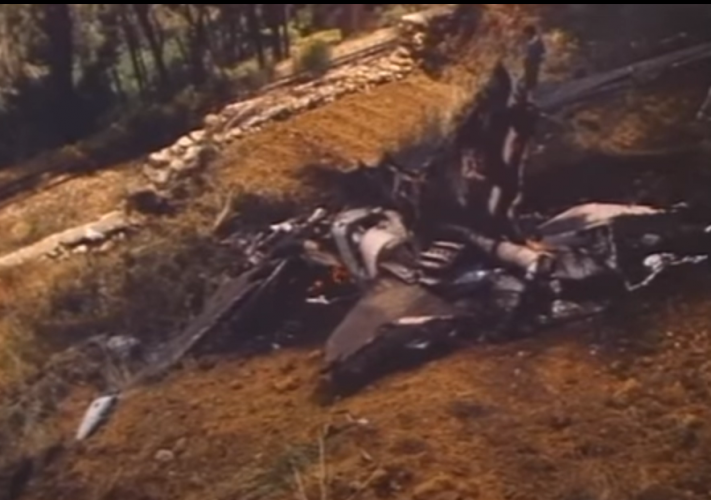
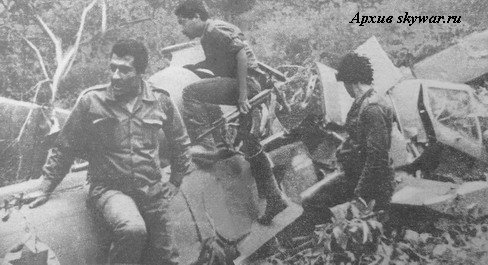
Shortly after taking a smooth right turn, the two MiG-23MLs from No. 63 Squadron rolled out barely 15 kilometres (8nm) behind the F-14A, meanwhile underway well inside the Iraqi airspace. The leader of the Iraqi pair then lost his radar to a malfunction: he had no choice but to advise his wingman to take over. The young lieutenant acquired a lock-on and fired a single R-24T. The hefty weapon detonated below the F-14A, setting it on fire, and forcing the crew to eject. Meanwhile, the two MiGs were critically short on fuel. They approached only close enough to identify and report the type of downed aircraft before breaking away. It was only at that point in time that Sadik realised what was going on: the Iraqis just missed a golden opportunity to get a fully intact F-14A Tomcat into their hands. Of course, the Iranian crew was captured and extensively interrogated. Moradi even took a flight manual with him. However, nearly all of the information he provided was already known to the Iraqis. Furthermore, the F-14A was completely destroyed in the crash, as recalled by Sadik, who inspected the wreckage on the next day: https://theaviationgeekclub.com/the...anian-f-14-tomcat-that-was-defecting-to-iraq/
He is a very famous historian in fact in most books about the MiG-23 by Yefim Gordon to other Russian or even western authors he was highly acknowledged, but he has a few facts that makes him not the only 100% verified author.
His main problem is there is little photographic evidence about the losses and victories, however he describes how the evolution of MiG-23 variants gave way to a better aircraft.
The MiG-23MS was more or less a F-4B and F-5 equivalent.
The MiG-23MF more or less an F-4E equivalent.
The MiG-23ML a fighter that was more or less capable to fight the early F-14A variants and Tornado ADV.
The MiG-23 was superior to the F-111, except in the early years of 1970s when in entered service.
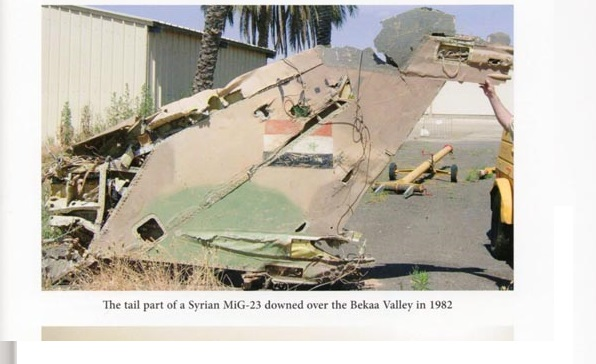
The main reason people claimed the MiG-23 was the worst fighter in history is because of the Bekka Valley air combats of 1982 gave it a bad reputation.
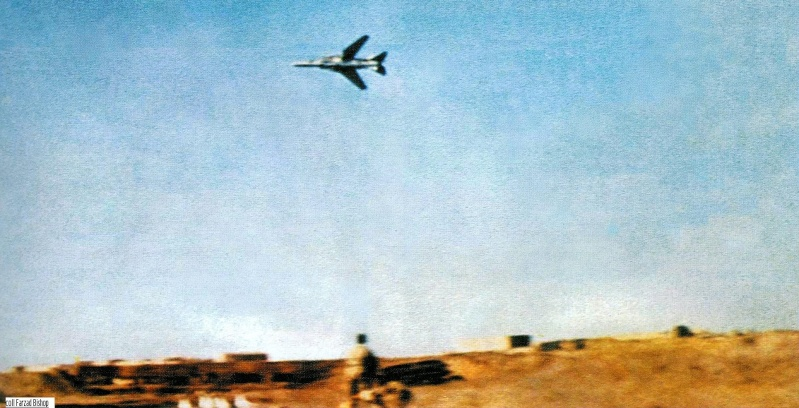
But the reality the photographic evidence is scarse
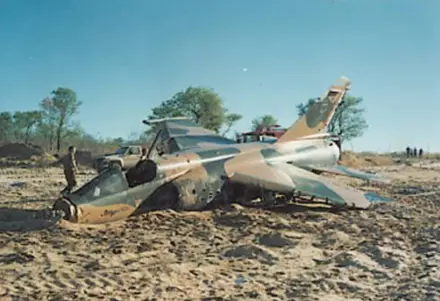
For its air to air losses this is the evidence i have found
war is narrative that sometimes becomes propaganda.
Of the probably 90? MiG-23s claimed as shot down in air to air, probably there is true evidence I mean you can see the wreckage well or the MiG-23 being shot down clearly in 4 or 5 pictures.
The rest is narrative, in 1982 for example Syria claimed their MiG-23s downed F-16s, F-15s and F-4s, I have never seen a single F-16 wreckage from a F-16 shot down in 1982 or F-15 wreckage of what Syria claims..
Syria admitted they lost several MiG-23MF in fact six and 4 MiG-23MS, in 1982, but Israel never accepted losses, so in total Syria acknowledged around 26 MiG-23s shot down most of them MiG-23BN, which basically are MiG-27s with very little air to air capability and are attack aircraft, closer to the sepecat Jaguar.
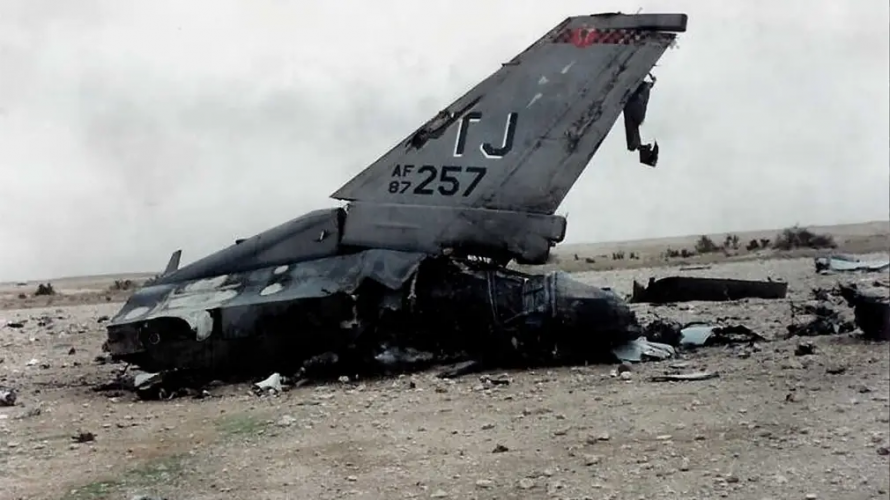
During the afghan-Soviet war, the same happened, Pakistan admitted the loss of an F-16 later to recanted it, according to soviet sources it was downed by a MiG-23MLD unofficially.
Pakistan official cause was the F-16 downed by Mistake by another F-16, go and figure it
Afghans Shot Down Intruding Pakistani F-16 That Ignored Warnings, Kabul Says
By RONE TEMPEST May 2, 1987 12 AM PT
TIMES STAFF WRITER
KABUL, Afghanistan — In the latest episode of an escalating undeclared air war between Afghanistan and Pakistan, officials here said Friday that an advanced Pakistani jet fighter was shot down after it strayed over Afghan territory and ignored warnings to change its course.
The official Bakhtar News Agency described the downed plane as a sophisticated F-16 fighter, one of 40 supplied to Pakistan by the United States as part of a military assistance program linked to the Afghan war.
Тhat happened on 12 Sept 1988 and MiG-23MLD piloted by the Capt. Sergey Privalov wasn't shot down at all. Here is the complete story about that event.
Истребители МиГ-23 в Афганистане
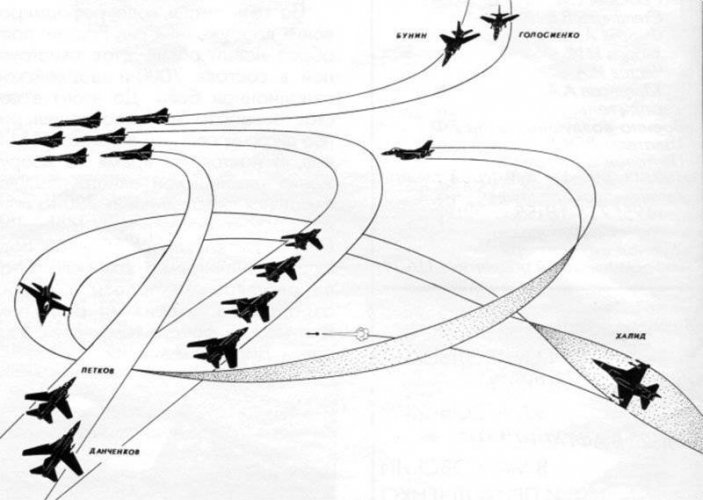
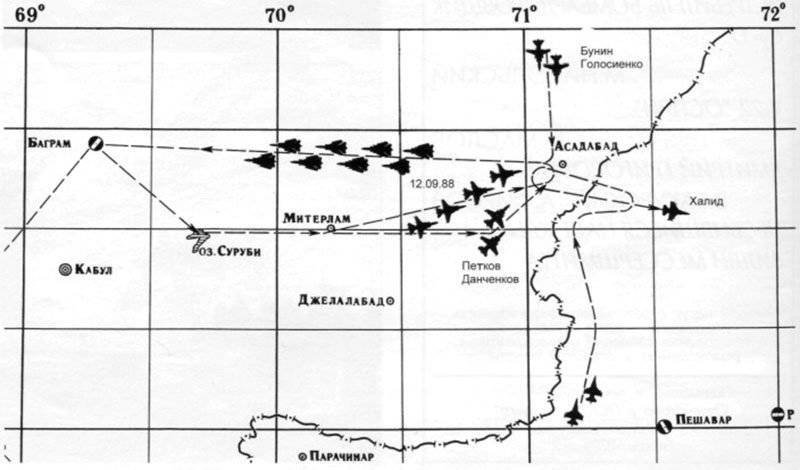
''12 сентября 1988 г. группа МиГ-23МЛД из 120-го иап вылетела на удар по объектам в долине реки Кунар восточнее Асадабада. Пакистанцы проявляли все большую активность, и летчики не раз докладывали о «визуальном контакте» с F-16, сопровождавшими со своей стороны ударные группы. Напряженность буквально висела в воздухе, разрядившись в этот день открытой стычкой. Собравшись над приметным ориентиром (озером Суруби), группа направилась к границе. Туда загодя ушли две пары прикрытия: цели лежали у самой пограничной полосы, из-за чего были выделены две пары прикрытия. Над горным массивом в 50 км северо-западнее места атаки зону патрулирования заняли истребители комэска подполковника Сергея Бунина и его замполита майора Николая Голосиенко, а в 40 км южнее находились майор Семен Петков и старший лейтенант Владимир Данченков. Однако F-16, привлеченные их появлением, уже находились в воздухе: с базы Камра поднялась пара истребителей лейтенанта Халида Махмуда из 14-й эскадрильи ВВС Пакистана, последовавшая за МиГами параллельным курсом. Уже через несколько минут с земли им сообщили, что в воздухе появилась колонна самолетов — к цели подтягивалась ударная группа. Над Куна-ром она повернула на север, ложась на боевой курс вдоль границы. Когда ударная группа выстроилась в колонну для захода на цель, она оказалась в считанных километрах от границы, чем и воспользовался противник. Прикрытие ушло довольно далеко, и ничто не мешало Халиду выйти к середине растянувшейся цели. Ближайшим к нему оказался МиГ-23МЛД (борт №55) капитана Сергея Привалова, крайний в пеленге второго звена. Вынырнув в 13 км от него из густой облачности, Халид услышал, что у него «зафонила» станция предупреждения об облучении: барражировавшие в нескольких минутах полета МиГи разворачивались в его сторону. В планы пакистанского летчика это не входило. Он начал маневрировать, в спешке из полупереворота с креном 135° пустил две AIM-9L и вышел из боя вверх ногами в 1500 м от атакованных МиГов. Одна ракета ушла далеко в сторону, но второй «Сайдвиндер» разорвался над самолетом Привалова, осыпав его осколками. Встряска была сильнейшей, летчик испытал чувствительный удар, даже ноги сшибло с педалей. Крупный осколок вошел в закабинный отсек в полуметре от его головы, остальные полоснули по закрылку и левой консоли, пробив топливный бак-кессон. За самолетом потянулся белесый шлейф топлива, однако после первого шока летчик убедился, что самолет не горит, держится в воздухе и слушается рулей.''
On September 12, 1988, a group of MiG-23MLDs from the 120th IAP took off to strike targets in the Kunar River valley east of Asadabad. The Pakistanis were becoming increasingly active, and the pilots repeatedly reported “visual contact” with the F-16s that were escorting the strike groups on their side.
Tension literally hung in the air, which was discharged that day by an open skirmish. Having gathered over a noticeable landmark (Lake Surubi), the group headed for the border. Two cover pairs had gone there in advance: the targets were located right at the border strip, which is why two cover pairs were allocated.
Over the mountain range 50 km northwest of the attack site, the patrol zone was occupied by fighters of the squadron commander Lieutenant Colonel Sergei Bunin and his deputy commander for political affairs Major Nikolai Golosienko, and 40 km to the south were Major Semyon Petkov and Senior Lieutenant Vladimir Danchenkov.However, the F-16s, attracted by their appearance, were already in the air: a pair of fighters of Lieutenant Khalid Mahmud from the 14th Squadron of the Pakistan Air Force took off from the Kamra base, following the MiGs on a parallel course. Within a few minutes, they were informed from the ground that a column of aircraft had appeared in the air - a strike group was approaching the target.
Above Kunar, it turned north, taking a combat course along the border. When the strike group formed a column to approach the target, it found itself a few kilometers from the border, which the enemy took advantage of. The cover had gone quite far, and nothing prevented Khalid from reaching the middle of the stretched-out target.
The closest to him was the MiG-23MLD (aircraft No. 55) of Captain Sergei Privalov, the last in the bearing of the second link. Having emerged 13 km from it from thick clouds, Khalid heard that his radiation warning station was "beeping": the MiGs, which were patrolling a few minutes away, were turning in his direction. This was not part of the Pakistani pilot's plans.
He began to maneuver, in a rush from a half-roll with a bank of 135° he launched two AIM-9Ls and left the battle upside down 1500 m from the attacked MiGs. One missile went far to the side, but the second Sidewinder exploded over Privalov's plane, showering him with shrapnel.The shaking was very strong, the pilot experienced a sensitive impact, even his feet were knocked off the pedals. A large fragment entered the cockpit compartment half a meter from his head, the rest slashed the flap and the left console, piercing the fuel tank-caisson.
A whitish plume of fuel trailed behind the plane, but after the initial shock, the pilot was convinced that the plane was not on fire, was in the air, and was responding to the controls.
Other details and photos are in this article as a source:
Many fighters for which it was said/wrote that were shot down ,in fact they were not.
When we talk or discuss about so many air battles from Korean war via US-Vietnam war,many Israeli-Arabic wars ( 1956,'67,'73,'82/'83 etc) ,then the First Gulf war in 1991 ,NATO intervention on FRY 1999 etc ,we mainly had two different sides of data sources, the Western (American and American-Israeli) and the Eastern (Soviet, Soviet-Chinese and Soviet -Arab).If we had to use US/Western data about air battles in the Korean and Vietnam war ,Americans won in most of air battles but the TRUE is that in both wars, Soviets and Vietnamese had much more Aces.Same story goes when we talk about Israeli/US/Western sources about those so many Isr-Arab wars and their air battles.Data about 85:0 in favor of the IDF/AF in air battles from 1982/83 are so unreal,simply to say, they are funny.
For me personally ,it is very interesting that Eastern side ( Soviet ) was more realistic besides an exaggeration that was far more pronounced in American and Israeli sources.E.g. when Soviets lost its 4 famous MiG-21 fighter-pilots in July 1970 against IDF/AF Mirages III ( oper. Rimon 20) they were shocked but they very soon admitted that loss and learned new things. Btw, combat tactics for the Soviet MiG-21 was then pure intercept missions where pilots were guided by the GCI officers w/o oportunity to be engaged in the real dogfight and that was really strange if we know that North Vietnamese MiG-17 and 21 were engaged in so many dogfights during US-Vietnam war.
Six years after that event ,they learned that e.g. US light fighter F-5 was far more capable,maneuverable and agile during real dogfight vs both MiG-21 and MiG-23.
Что почитать? Из истории авиации: Northrop F5 vs МиГ-21 и МиГ-23
https://n2367l.livejournal.com/10624.html
On the other side ,US admitted loss of a F/A-18C in the night of 17 Jan 1991 after so many years,decades btw.The TRUE is that Iraqi MiG-25PDE pilot Captain Zuhair Dawoud who shot him down helped to find the wreckage and the pilot who was KIA. I wrote earlier, that 'Flying Dutchman' Capt. Peter Tankink did not shot down anybody on that March 24th 1999 beacuse YuAF fighter-pilot Maj. Dragan Ilic landed safely on the Nis airport after his MiG-29B was hit from the front side by the AIM-120B launched by F-16AM.
Same story we have now in Rus-Ukr war where both side mention that they shot down and destroy tens or hundreds of combat aircraft,fighters and so on.TRUE is completely different.Russians managed to say that they destroyed almost all UkrAF fighters ,combat aircraft but that is far from reallity .On the other side,Ukrainians had that 'Ghost of Kiev ' who shot down so many RuA&SF fighters ( yes in CGI) but the TRUE is that only real air victory they achieved on Feb 28 2022 when one MiG-29 pilot ( Capt. Andrey Gerus) mistakenly shot down its collegue in the Su-27 with R-27R (Maj. Stepan Chobanu was KIA).
I am a big fan of MiG-23 and MiG-25, I own several MiG-23 hobby masters models, I own a polish MiG-23MF, a Soviet MiG-23MLD and a East German MiG-23ML
However in my many years more than 20, following loses and victories I have learnt there are few pictures showing aircraft in the air being shot down clearly
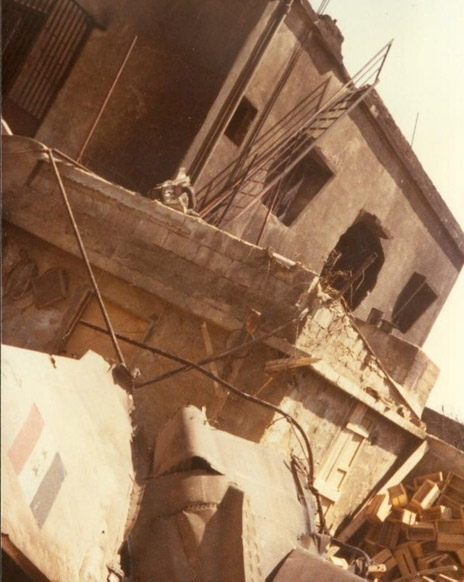
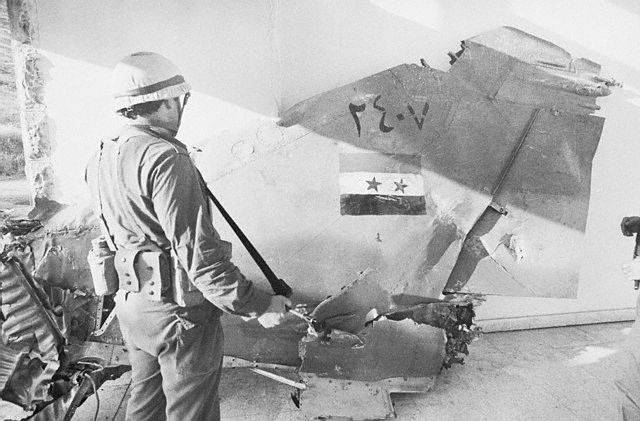
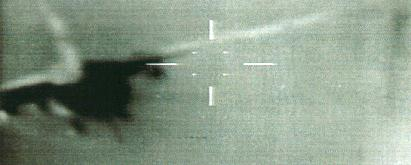
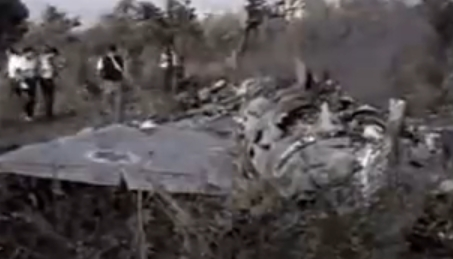
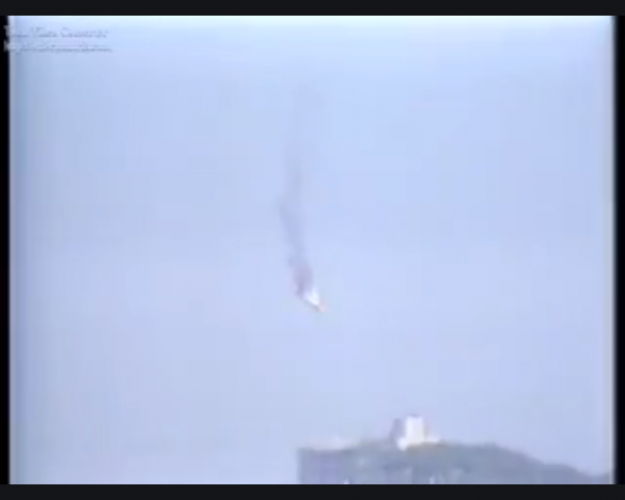
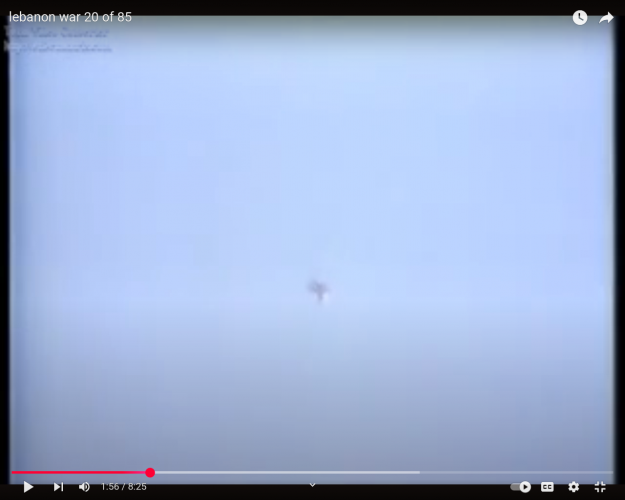
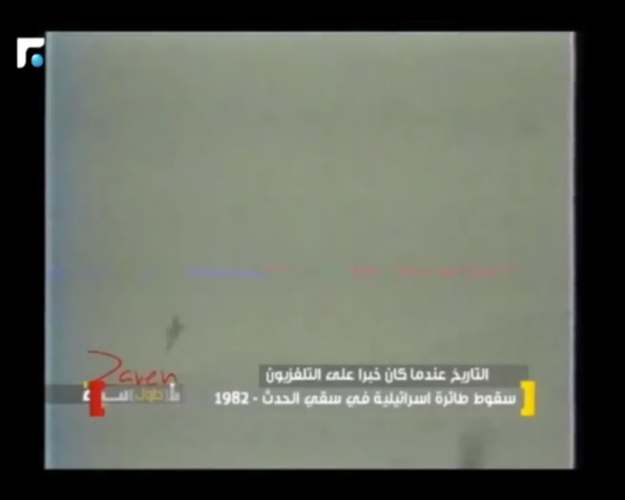
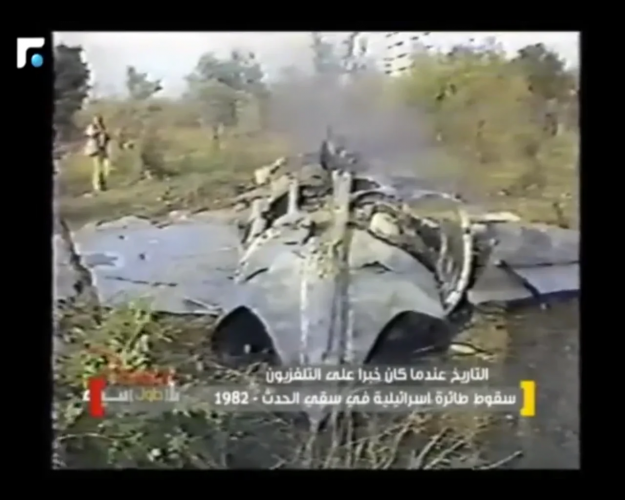
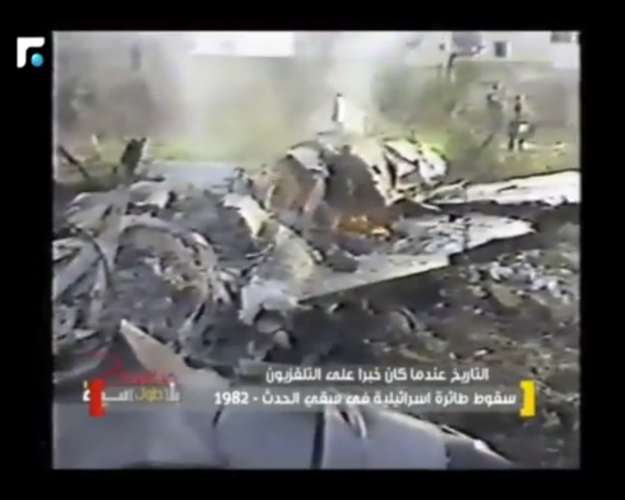
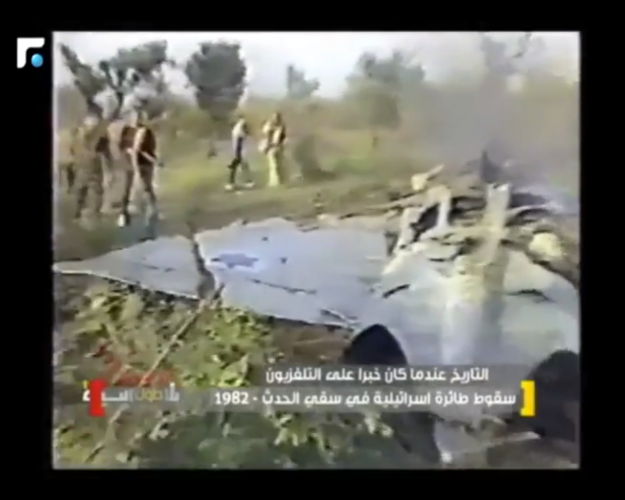
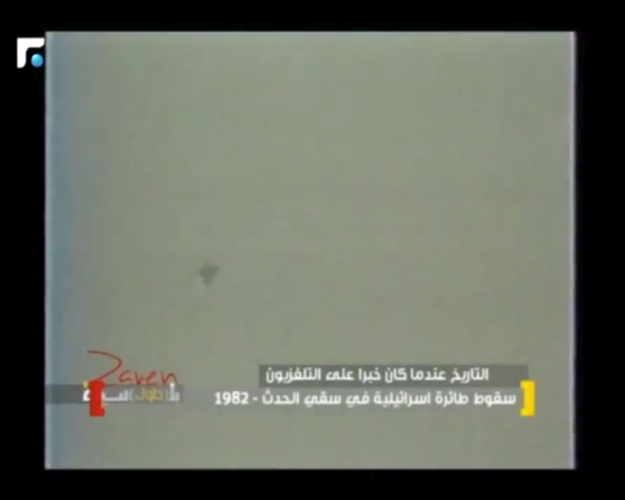
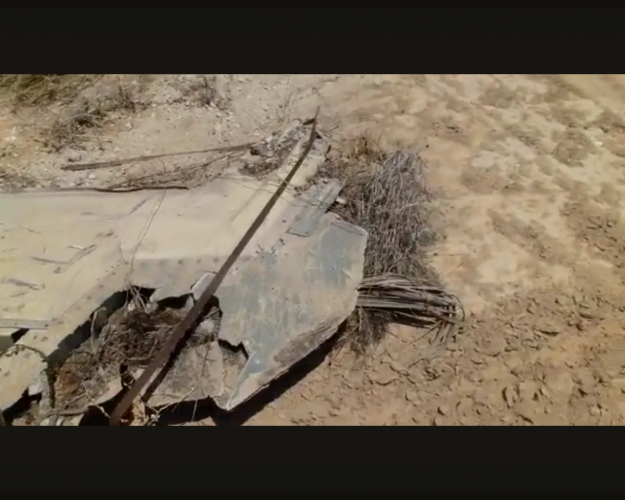
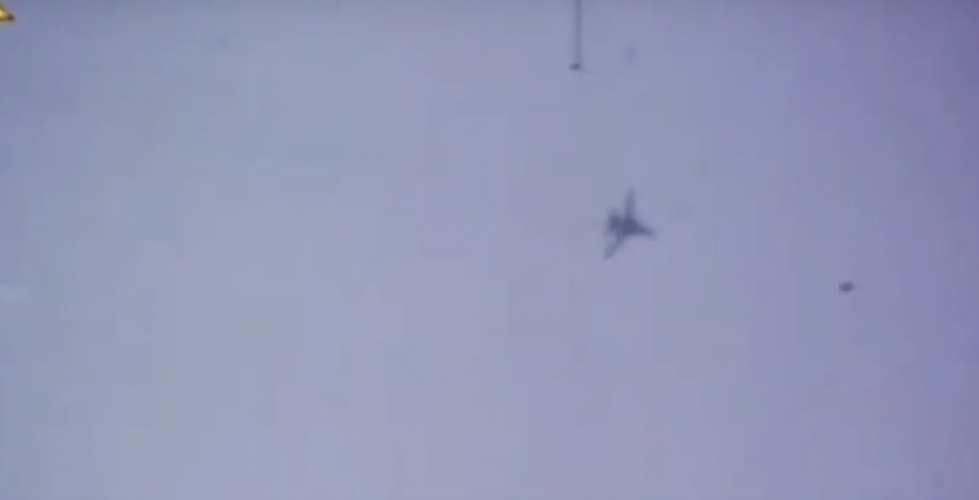
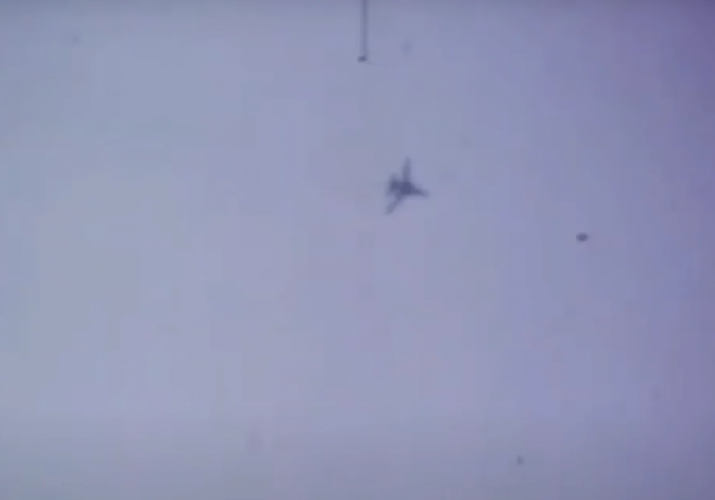
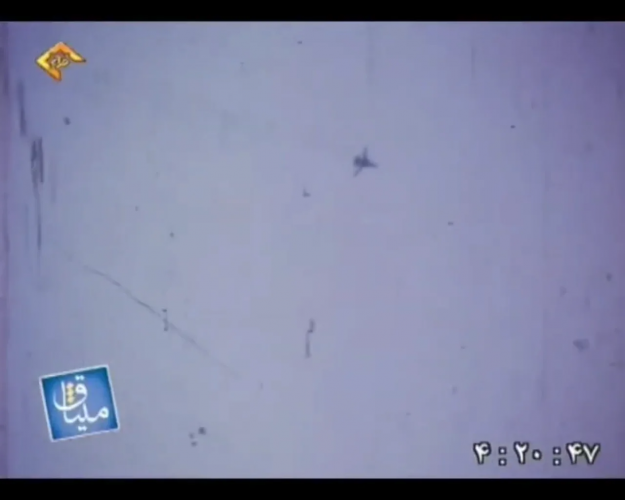
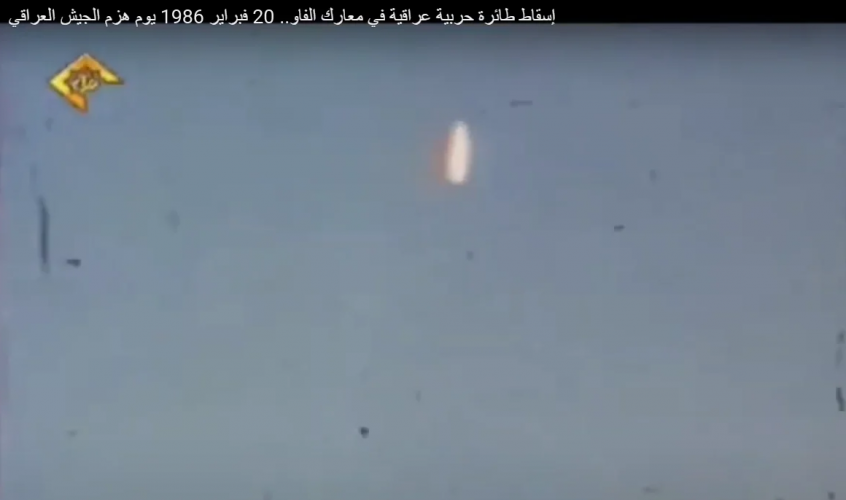
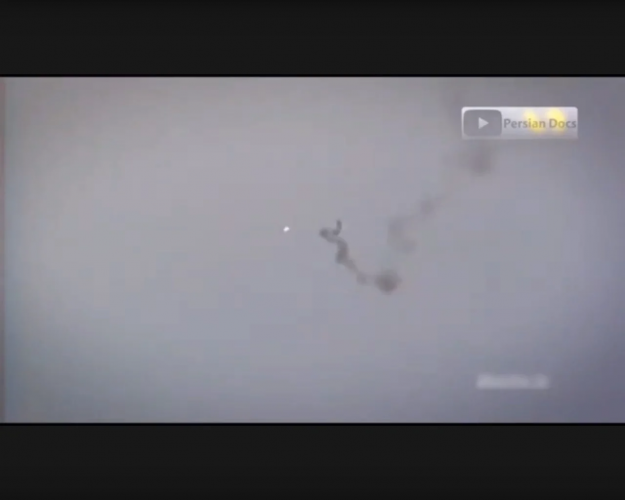
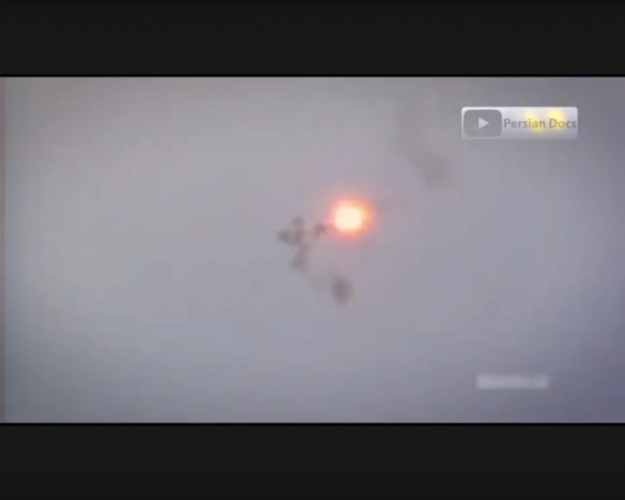
this is a video footage of what it seems a F-15 or MiG-25 that was shot down over the Bekka valley in 1982
To me it looks more like a Foxbat falling close to a castle on top of a hill
Minute 1:54 you can see the airplane coming down spinning However not each and every kill has picture like this, and a video to prove it, so when you have contradictory accounts you have to settle in what pictures they show or videos as proof and what each side admits.
Russian sources admitted Syria lost at least 2 MiG-25s, this video footage is from 1982, so very likely the Soviet side knew there was evidence so there was no need to hide the fact at least a Foxbat was downed.
In each war is the same unless there is good evidence.
The Americans admitted a F-18 was downed by a MiG-25 in 1991, it is not honesty most of the time. but simply they can not hide it.
The MiG-23 sadly there is evidence it was downed several times but it also downed other aircraft, war is like that
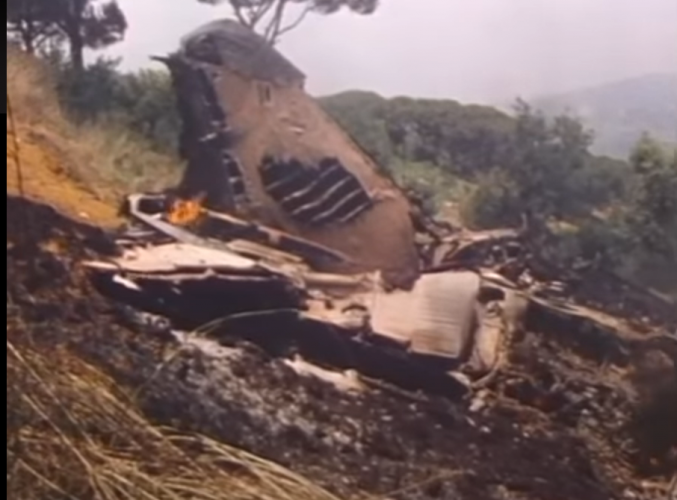
Tnx for the answer/comment . On your pics that is Syrian AF recce aircraft MiG-25RBT that was shot down over Lebanon on Aug. 31 1982 by IDF/AF SAM of the MIM-23B Hawk.
''In 1982, during the First Lebanon War, an Israeli MIM-23 Hawk (also known as HAWK) missile system successfully intercepted and shot down a Syrian MiG-25RB reconnaissance aircraft. This event is notable as it was the first time a MiG-25 had been downed by a surface-to-air missile and marked a significant achievement for the Israeli Air Force. '' https://www.britishpathe.com/asset/180077/Yes, Syrians lost two MiG-25PDE ,first on Feb 13 1981 and second on 29 July 1981 but IDF/AF never admitted that they lost its F-15A on that July 29th 1981 against MiG-25PDE.
When it comes to those 'scores' ,there is problem about reality ,true. Who is more or less real,precise and objective.To say that F-15 has 104:0 score,that is nothing but nonsense. E.g. USAF admitted lost one of its F-15C on Jan. 30 1991 ,exactly 30 years after that happened. That IDF/AF proclaimed score of 85:0 from 1982 was nothing but nonsense.Also about those so many IRIAF F-14A victories over Iraqi AF combat aircraft who even from 1970's and especially during 1980's had variety of SPO and SPS equipment. Iraqies were not stupid and were very inovative. Stories like F-14A shot down four MiG-23's with only one AIM-54A, hm, what we can say about that. Keep in mind that they modernise their MiG-29B to carry French ECM stations 'Remora' which were succesfully used during First Gulf war.
About that author Vladimir Babich ,I must find his articles where he very interestingly described what was SyAF MiG-23's combat tactics during air battles in 1982/83.He wrote that they used MiG-21 as some kind of bait to the IDF/AF fighters F-15A and F-16A .When they used AB mode during the chase ,they would exposed themselfs to the MiG-23's very usefull IRST TP-23M ( btw ,which could detect/track even incoming aircraft and we know that KOLS on the MiG-29 is not capable of that,it can only detect/track aircraft from the rear hemisphere ! ). They effectively used IR guided R-23T. SyAF was the first one which got MiG-23MLD(E) or Izd 23-22 as a Soviet reward for successful results.
Tnx for the answer/comment . On your pics that is Syrian AF recce aircraft MiG-25RBT that was shot down over Lebanon on Aug. 31 1982 by IDF/AF SAM of the MIM-23B Hawk.
''In 1982, during the First Lebanon War, an Israeli MIM-23 Hawk (also known as HAWK) missile system successfully intercepted and shot down a Syrian MiG-25RB reconnaissance aircraft. This event is notable as it was the first time a MiG-25 had been downed by a surface-to-air missile and marked a significant achievement for the Israeli Air Force. '' https://www.britishpathe.com/asset/180077/Yes, Syrians lost two MiG-25PDE ,first on Feb 13 1981 and second on 29 July 1981 but IDF/AF never admitted that they lost its F-15A on that July 29th 1981 against MiG-25PDE.
When it comes to those 'scores' ,there is problem about reality ,true. Who is more or less real,precise and objective.To say that F-15 has 104:0 score,that is nothing but nonsense. E.g. USAF admitted lost one of its F-15C on Jan. 30 1991 ,exactly 30 years after that happened. That IDF/AF proclaimed score of 85:0 from 1982 was nothing but nonsense.Also about those so many IRIAF F-14A victories over Iraqi AF combat aircraft who even from 1970's and especially during 1980's had variety of SPO and SPS equipment. Iraqies were not stupid and were very inovative. Stories like F-14A shot down four MiG-23's with only one AIM-54A, hm, what we can say about that. Keep in mind that they modernise their MiG-29B to carry French ECM stations 'Remora' which were succesfully used during First Gulf war.
About that author Vladimir Babich ,I must find his articles where he very interestingly described what was SyAF MiG-23's combat tactics during air battles in 1982/83.He wrote that they used MiG-21 as some kind of bait to the IDF/AF fighters F-15A and F-16A .When they used AB mode during the chase ,they would exposed themselfs to the MiG-23's very usefull IRST TP-23M ( btw ,which could detect/track even incoming aircraft and we know that KOLS on the MiG-29 is not capable of that,it can only detect/track aircraft from the rear hemisphere ! ). They effectively used IR guided R-23T. SyAF was the first one which got MiG-23MLD(E) or Izd 23-22 as a Soviet reward for successful results.
What I am trying to say usually most reports just repeat information but evidence is not so much, however usually what they do is equate a few pictures to dozen claimed kills.
Since I know Babich watched the same videos broadcasted on western TV he had no other option to accept the kills, there is not too much evidence at least 3 MiG-23s destroyed on June 1982, but Israel claimed a lot of kills,
And even Babich accepted around 26 MiG-23 kills, he said only 6 MiG-23MFs and 4 MiG-23MS
However I have never seen proof a F-16 or F-15 was downed in 1982.
In 1991 there was plenty evidence of F-16s and Tornados downed.
So very likely from MiG-23s to MiG-29s probably the Iraqi MiGs downed the F-111, Tornados and F-16s claimed but from the June 1982 bekka valley air combats to be honest there are also very few pictures of downed aircraft.
But I think Iran accepted they lost aircraft to MiG-23s.
Tnx again for the comment. I will write this openly for you.My cousin was former YuAF MiG-29B/UB technician officer and when he was in the USSR ( it was during Summer of 1987),he met many SyAF fighter-pilots and technicians who were on the training there. Pilots were trained in the Lugovaya station air base ( 715th training aviation regiment) and technician officer in the Frunze center. He was told that many of the Syrian AF MiG-23 pilots are there and they shot down some IDF/AF fighters during combat missions in 1982/83.They showed to him a golden watches as a gift from the Syrian president Hafez Assad for the successful air combat missions and aerial victories during 1982/83 engagements. Syrians were second after Indians to be trained on the MiG-29B/UB and that was not w/o reason. YuAF was the fourth in the World ( first in the Europe) to receive MiG-29B/UB after IAF,SyAF and IrAF.
As I wrote before ,it is not about military technics but about combat tactics to use that thing in the proper way.
Tnx again for the comment. I will write this openly for you.My cousin was former YuAF MiG-29B/UB technician officer and when he was in the USSR ( it was during Summer of 1987),he met many SyAF fighter-pilots and technicians who were on the training there. Pilots were trained in the Lugovaya station air base ( 715th training aviation regiment) and technician officer in the Frunze center. He was told that many of the Syrian AF MiG-23 pilots are there and they shot down some IDF/AF fighters during combat missions in 1982/83.They showed to him a golden watches as a gift from the Syrian president Hafez Assad for the successful air combat missions and aerial victories during 1982/83 engagements. Syrians were second after Indians to be trained on the MiG-29B/UB and that was not w/o reason. YuAF was the fourth in the World ( first in the Europe) to receive MiG-29B/UB after IAF,SyAF and IrAF.
As I wrote before ,it is not about military technics but about combat tactics to use that thing in the proper way.
I agree my point is that I have not seen, that does not mean they did not shot down some Israeli aircraft.
But I have to consider several factors, on 1982, we were far from 2000 a time you started with the internet in almost every country, by 2015 cell phones with cameras were available for every one.
So in 1982 video cameras, were mostly from TV channels, which were easy to censor or followed bias coverage.
To my memory, the evidence of downed Israeli aircraft is the Kfir I posted, the Cobra AH-1 and a F-4E.
By Rebecca Grant
June 1, 2002
Two weeks later, Ivry got a chance to test out real-time command and control against another small set of SAM batteries. The Syrians moved a new SAM battery into Lebanon. One F-4 Phantom loitering in the area was shot down by the ambush and “attacked by a missile coming from Syria, not from inside Lebanon.”
It was only the third time an Israeli jet has been shot down over Lebanon since before the start of the Israeli invasion on June 6, 1982. The pilot, who was said to have been slightly injured, parachuted to safety and was picked up by a Lebanese Army patrol. Hours later he was returned to Israel, an Israeli spokesman said.
The Israeli planes, the military officials said, managed to make only two or three bombing runs during the 45 minutes they circled their targets. The Israeli jets also consumed a great deal of time flying over Beirut, apparently looking for the downed plane's pilot.
The pattern of today's air raid involved two Israeli jets circling over Beirut then diving toward their targets just over the mountain ridge to the east, spewing thermal balloons all the time to confuse heat-seeking surface-to-air missiles. As usual, after dropping their bombs, the Israelis flew into the mid-afternoon sun, making it difficult for antiaircraft gunners to follow them. Residents Watch Plane Crash
However, according to British officers who watched the attack from their outpost overlooking Beirut, one Delta-winged Israeli Kfir, painted in yellow and green camouflage, was hit by a SAM-7 shoulder-fired surface-to-air missile just as it passed over a Syrian position near Arbanniye, seven miles east of Beirut.
The plane was just starting to head west into the sun when its engine stalled as it was over Beirut. Beirut residents watched the plane jerk back and forth for a moment before it began to spiral down in a wide arc.
4 Syrian Fighters Downed by Israeli Jets Over Lebanon
Sept. 25, 1979
BEIRUT, Lebanon, Sept. 24 (Reuters) — Syrian and Israeli fighter planes clashed over Lebanon today for the second time in three months, and both sides said four Syrian jets were shot down.
Israel said the air battle took place as its reconnaissance planes, escorted by American‐made F‐15's, were making a regular flight over Lebanon hunting for guerrilla bases. All Israeli planes returned safely from the air action, a spokesman said in Tel Aviv.
This account was disputed by Syria. A spokesman said his country's fighters intercepted Israeli combat jets flying attacks on Palestinian refugee camps near the town of Damur south of Beirut. He said two Israeli planes were downed. https://www.nytimes.com/1979/09/25/...ters-downed-by-israeli-jets-over-lebanon.html In 1982 were more TV channels and government press releases what accounted for the Information
See here The west at least acknowledge 3 kills, Russian accounts have different views most of the time
On June 7, large-scale air battles between the Syrian and Israeli aircraft began. Israeli aircraft began carrying out massive bombing strikes on Syrian army positions in the Bekaa Valley. As a rule, their battle formation consisted of a "screen" formed by F-15 and F-16 fighters, a strike group (Phantoms, Kfirs and Skyhawks), and an AWACS aircraft, which served as an airborne command post and patrolled beyond the reach of enemy fighters. Often, the formation also included a Boeing 707 EW aircraft, "hovering" over the Mediterranean Sea off the coast of Lebanon. In accordance with the tactics proposed by advisers from the USSR, four or three MiG-23MFs raised to intercept approached the enemy in tight battle formations (the distance between the aircraft was so small that on the AWACS radar indicator, three or four MiGs looked like one aircraft). Having reached the attack line, the MiGs opened up: some of the aircraft "dived" to extremely low altitudes, remaining invisible to the Israelis, while others played the role of bait, bringing the enemy fighters under a sudden attack by one of the link's aircraft, which was carrying out an attack "from the bottom up". The Israelis also presented a tactical surprise, having sent out as a "screen" not F-15s (as the Syrians and Soviet experts assumed), but light F-16s, operating at low altitude and homing in on the target using commands from the Hawkeye: it was assumed that the newest maneuverable fighters would be able to evade a missile strike on a collision course. Before the attack, a pair of Fighting Falcons opened up, trying to take the MiG in "pincers" (the "Sandwich" maneuver) and force the less maneuverable Syrian fighters into close air combat. In this situation, the MiG-23MF had two options for further action: turn back, abandoning the mission, or, by shifting the wing to the maximum sweep angle and using its speed advantage and good acceleration characteristics, try to break away from the F-16 and attack the designated targets. However, in this case, the MiGs came under missile attack from the Eagles, which made up the second echelon. T On the second day of the war, three MiG-23MFs (pilots Khalyak, Said and Merza) attacked a group of F-16As operating in the first echelon of the Israeli battle formation. Captain Merza was the first to spot the Israeli fighters at a distance of 25 km. From a distance of nine kilometers, he launched an R-23 and destroyed the first F-16. With a second missile from seven kilometers, Merza shot down another enemy fighter, but when exiting the attack, the Syrian aircraft itself was hit by a missile and the pilot ejected. Thus, on June 7, three “historic events” took place: the MiG-23 achieved its first victory over an enemy fighter in an air battle, and the F-16 and MiG-23 were shot down by air forces for the first time (Israeli media confirmed the destruction of the MiG, but modestly kept silent about their losses). Thus, on June 8, a pair of MiG-23MFs met with the F-16 again: Major Howe, having spotted a target at a distance of 21 km, “got” the enemy aircraft at a distance of seven kilometers with an R-23 missile, but was then shot down by another F-16, which fired a Sidewinder at the Syrian pilot (in total, according to Syrian data, three Israeli aircraft were shot down that day, including two Douglas A-4 Skyhawks, destroyed by MiG-21 fighters, and three Syrian aircraft - two MiG-21s and one MiG-23MF, shot down by F-15As; the Israelis announced the destruction of four MiGs). Overall, from June 6 to June 12 (when the ceasefire was formally signed), Syrian Air Force fighters destroyed 42 Israeli Air Force aircraft in aerial combat (including at least five F-15s and six F-16s) as well as one UAV, while losing 47 aircraft (four MiG-23MS, six MiG-23MFs, as well as 26 MiG-21bis and 11 MiG-21MFs). In addition, Israeli F-16A fighters managed to destroy seven Su-22M fighter-bombers. https://xn--b1atgapb.xn--p1ai/mig-23-na-blizhnem-vostoke-vojna-v-livane/
I like the MiG-23 a lot, the aircraft in my opinion was vastly misunderstood, and slandered, but it has a few firsts.
The F-111 was the first VG wing swing wing operational aircraft, but the MiG-23 was the first truly VG wing, swing wing operational Fighter, while the Panavia Tornado and F-14 were in some cases fighters or interceptors, the MiG-23 was built in the thousands, reaching 5000+ units, the Tomcat and the Tornado while in some instances were more sophisticated, both aircraft never got closer to a thousandth aircraft built.
I mean the MiG-23 was designed to combat and overwhelm the enemy with high speed, and large numbers, and was probably as good if not better in some areas to both the F-14 and Panavia Tornado, but it was really cheap around 3 to 5 times cheaper than a Tomcat in 1975.
The F-111 was never a fighter, but the MiG-23MLD it was really a dog fighter aircraft.
F-111B was cancelled and MiG-23 built more than 2500 MiG-23MF/MS/M/ML/MLD aircraft.
The MiG-23 was inspired by the F-111 and F-4E and basically was a single engine, single seat, hybrid of both.
Some of the videos I posted show the evidence I mean, the footage where a kill was verified, I know some are long 30 or 80 minutes long just to have 30 seconds of the proof the fighter was downed but these are the sources, quoting them is a must to say they are the source.
I agree, but some videos with music they show images where the fighter has a better way to comprehend how it really looks in real life, personally I have never seen a MiG or Su aircraft, but aircraft look very different in real life, I used to work with ATR-72s at an airport, the aircraft looks different when you see it on a picture or video to what it really looks in real life, I used to see at work too the E-175, the aircraft also looks 10 times more beautiful in real life.
Same F/A-18 it is a really cool aircraft, so these are the reasons sometimes you need videos and pictures despite some times they can not really give you a real view of the real thing but videos give more the 3D view than a 2D picture.
Real life gives you their human scale and details that get blurred by pictures and videos.
July 4, 1989: A pilotless Soviet MiG-23 crashes into a house in Kortrijk, Belgium, killing a resident. The pilot had ejected earlier over Kolobrzeg, Poland after the afterburner failed, but the engine kept running and the plane flew for another 900 km before running out of fuel and crashing.
Just going about your day and some MiG-23 without a pilot and out of fuel crashes into your house. That's lottery winning levels of luck, just the bad kind.
The MiG-23MS was more or less a F-4B and F-5 equivalent.
The MiG-23MF more or less an F-4E equivalent.
The MiG-23ML a fighter that was more or less capable to fight the early F-14A variants and Tornado ADV.
The MiG-23 was superior to the F-111, except in the early years of 1970s when in entered service.
I don't really know how the MiG-23 could be compared to the F-111, the ground attack MiG-23s were more for tactical air support than any sort of long-range interdiction, didn't have any radar, etc.
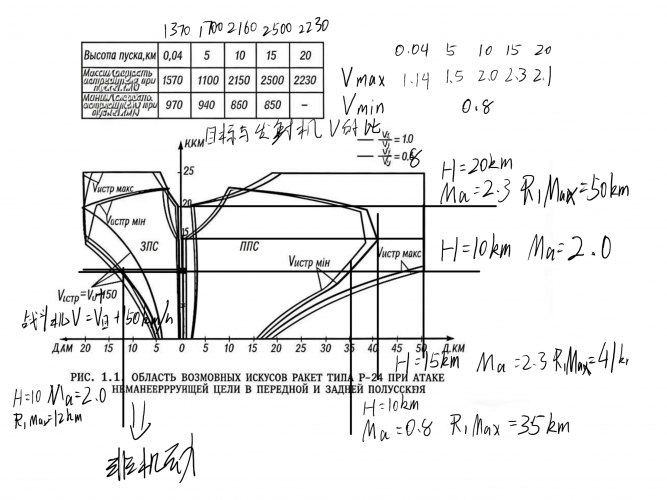
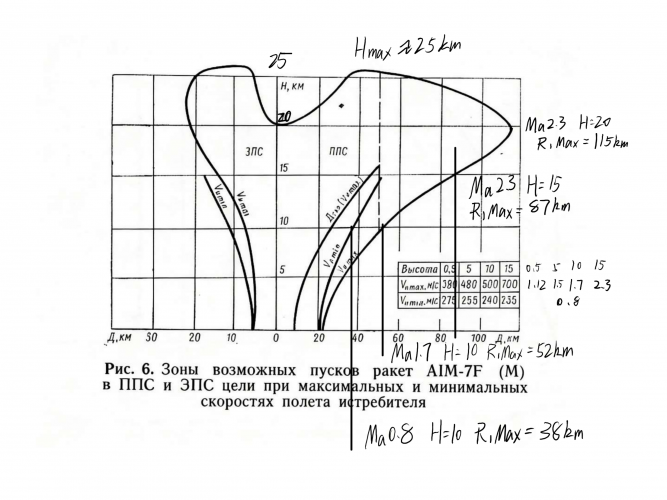
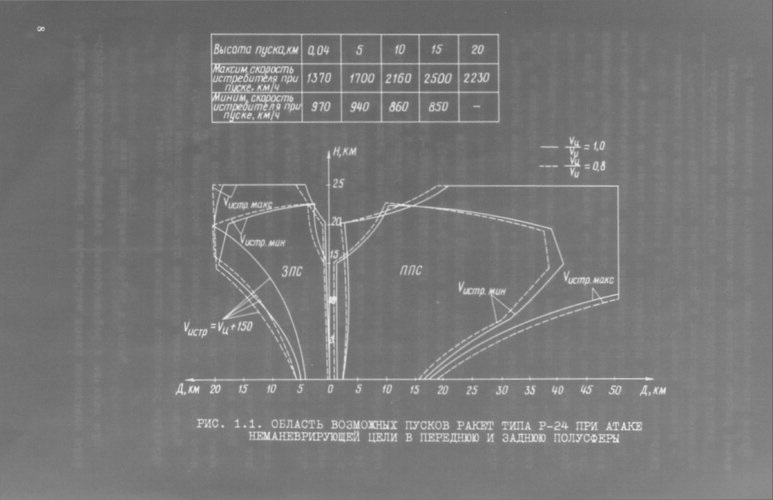
As for the comparison to the other fighters, I think a lot depends on just how effective the R-23/24 (AA-7 Apex) missiles were in service compared to the AIM-7E/F/M Sparrows fielded during the same time span.
After the reunification of Germany and the dissolution of the USSR the big subject of interest was the former East-German MiG-29s that NATO pilots were getting a chance to fly for themselves. But I'd imagine that during the same time period the western world also acquired some late model MiG-23s. I'd love to have read what they thought of those and how they compared to the earlier MiG-23s tested by the USAF Red Eagles. Those early aircraft definitely seemed to have a mixed reputation.
This link or book has one of the best compassion of the MiG-23 variants.
Basically Markovsky says in that book online , that the MiG-23 evolved from a very limited aircraft and each generation became more capable.
The MiG-23A was crap, until the MiG-23 edition 1971 appeared, the jet was crap, the MiG-23MS was a very limited aircraft, each variant modified avionics, engines and structures, by the MiG-23-98 the fighter was more or less a F-16 equivalent of the early 1990s.
The Early F-111 was multirole, but due to weight its equivalent is Su-24, but it supposed to become a fighter, but they saw as a fighter it had no future..
The MiG-23BN is comparable to the the Sepecat Jaguar
In page 177 Markovsky compares the variants in several aspects to the degree we can see the early MiG-23M was no match to MiG-23ML in acceleration, rate of climb and turn rate.
So everything will be what variant you ask to compare, the MiG-23ML was a variant that was in many aspects really good in example acceleration something that was proven by western tests.
According to the MiG-23ML technical manual, the MiG-23ML has a instantaneous turn rate of 16.7 deg/s and a sustained of 14.1 deg/s at 1 km of altitude and at a speed of 900 km/h; and at maximum 7G load factor. It will take to the MiG-23ML around 25 seconds to complete the horizontal turn.
Just going about your day and some MiG-23 without a pilot and out of fuel crashes into your house. That's lottery winning levels of luck, just the bad kind.
I don't really know how the MiG-23 could be compared to the F-111, the ground attack MiG-23s were more for tactical air support than any sort of long-range interdiction, didn't have any radar, etc.
As for the comparison to the other fighters, I think a lot depends on just how effective the R-23/24 (AA-7 Apex) missiles were in service compared to the AIM-7E/F/M Sparrows fielded during the same time span.
After the reunification of Germany and the dissolution of the USSR the big subject of interest was the former East-German MiG-29s that NATO pilots were getting a chance to fly for themselves. But I'd imagine that during the same time period the western world also acquired some late model MiG-23s. I'd love to have read what they thought of those and how they compared to the earlier MiG-23s tested by the USAF Red Eagles. Those early aircraft definitely seemed to have a mixed reputation.
Just going about your day and some MiG-23 without a pilot and out of fuel crashes into your house. That's lottery winning levels of luck, just the bad kind.
I don't really know how the MiG-23 could be compared to the F-111, the ground attack MiG-23s were more for tactical air support than any sort of long-range interdiction, didn't have any radar, etc.
As for the comparison to the other fighters, I think a lot depends on just how effective the R-23/24 (AA-7 Apex) missiles were in service compared to the AIM-7E/F/M Sparrows fielded during the same time span.
After the reunification of Germany and the dissolution of the USSR the big subject of interest was the former East-German MiG-29s that NATO pilots were getting a chance to fly for themselves. But I'd imagine that during the same time period the western world also acquired some late model MiG-23s. I'd love to have read what they thought of those and how they compared to the earlier MiG-23s tested by the USAF Red Eagles. Those early aircraft definitely seemed to have a mixed reputation.
I think nowadays it is well known in the west the MiG-23, since Egypt and East Germany delivered MiG-23MS/ML to the USA in the mid 1970s and mid 1990s respectively, add a NATO member, Poland operated the MiG-23MF for several years and other ex warsaw Pact now NATO members flew it.
In this video it is narrated a MiG-23 victory over an Iranian F-4, usually this will tell you that at least Iraqi pilots could attest the MiG-23MF was as good as the F-4 in real life
Date August 1983 The fastest enemy aircraft downing | From the memoirs of an Iraqi pilot.
In the fastest enemy aircraft downing | From the memoirs of an Iraqi pilot, the total flight time was 12 and a half minutes, and the target was destroyed within 6 minutes of takeoff. The response time was high, the execution precise.
Another factor that helped complete the mission was that our heroic pilot was alone, and the delay that befell number 2 may have been for the benefit of the flight or for the sake of surprise and avoiding the attention of enemy radars. Our heroic pilot was later honored by the then Chief of Staff of the Army, the late Lieutenant General Abdul Jabbar Shanshal. He was then honored by the Supreme Command of the Iraqi Armed Forces by granting him an excellent service for one year. The MiG-23MF from the 67th Squadron of the Al-Nasiriyah air base, was also honored by placing the Iranian Air Force F-4 kill badge on its fuselage, a symbol of victory and the downing of an enemy aircraft, to remain an honor in its record.
In the following video A special interview with the falcon pilot of the MiG-23ML, Brigadier General Pilot Shirvan Baban, about his aviation career where it is claimed that the Iraqi MiG-23ML were able to down six Iranian aircraft and a helicopter.
The Iranian ambush against the MIG-23ML formation on April 8th, 1986,. The major pilot Jalil Abdel Karim skillfully shot down an F-4 and efficiently hit an F-14.
Discover the secrets of the exciting aerial confrontation and the details of the tactics used to evade the Iranian ambush. Watch how the pilot skillfully and deftly led the way to downing the enemy aircraft and achieving a remarkable success. Learn about the MIG-23ML formation and its innovative weapons that made it invincible in this confrontation.
Foiling the Iranian ambush and shooting down an Iranian F-4 Phantom in southern Iraq. Over Iranian territory, engagement with F-14 Tomcats, one of which was hit. Today we talk about one of the heroic deeds of the Air Force Falcons during the Iran-Iraq War. The Third Air Defense Sector thwarted an Iranian ambush using a MiG-23 ML formation. Foiling the Iranian ambush and shooting down an Iranian F4 Phantom. Foiling the Iranian ambush and shooting down an Iranian F4 Phantom.
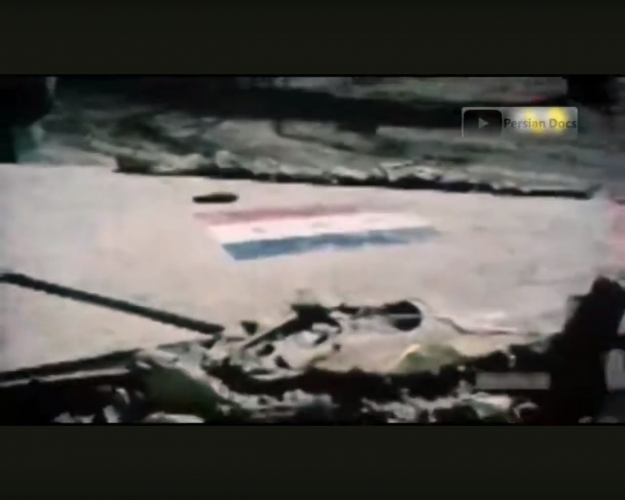
An Iraqi soldier looks at the wreckage of an Iranian F4 Phantom jet, shot down by Iraqi forces, at an open-air museum in Baghdad, April 27, 1984. Equipment seized from the Iranians is displayed here, the remains of six Iranian fighter jets among dozens of heavy equipment.
Iranian F-4 downed
July 4, 1989: A pilotless Soviet MiG-23 crashes into a house in Kortrijk, Belgium, killing a resident. The pilot had ejected earlier over Kolobrzeg, Poland after the afterburner failed, but the engine kept running and the plane flew for another 900 km before running out of fuel and crashing.
Comparison of the flight characteristics of the MiG-23 modifications
This comparison considers 3 main single-seat modifications of the MiG-23, equipped with a weapons system with the Sapfir-23 radar and R-23 missiles. The MiG-23 model 1971 is the basic modification with the R-27 engine; the MiG-23M is, accordingly, an "evolutionary" development of the 71st model with the installation of a significantly more powerful R-29 engine and a number of small improvements; the MiG-23ML, in turn, is a development of the MiG-23M with some modifications to the airframe to reduce weight and the installation of the R-35 engine. This comparison aims to compare the flight characteristics in order to display the real difference between the modifications of the machine.
Comparison of the flight characteristics of the MiG-23 modifications, image #1
Unfortunately, within the framework of this comparison it is not possible to take the entire "evolutionary series" of the MiG-23. There is no available documentation for the MiG-23S and MiG-23 mod. 69/70; there is no documentary data on the MiG-23MS; and finally, there is no publicly available documentary data on the aerodynamics of the MiG-23MLD, the pinnacle of the 23 family. But the three modifications considered in the comparison represent the bulk of the MiG-23s produced and show the development of the aircraft well. Over time, additional data may appear that will allow us to calculate the characteristics of the remaining modifications.
Brief description of the modifications.
Here we will list the features of the modifications that are important from the point of view of flight and technical characteristics. Differences in equipment and design are not considered in this case. We will simply note that all three compared modifications had a full-fledged radar with the ability to use R-23 missiles.
MiG-23 model 1971 is the first standard version of a single-seat aircraft, which implemented an aerodynamic configuration that became the basis for all subsequent MiG-23 variants. Unlike the early modifications (MiG-23S, MiG-23 mod 1969), the prototype has a larger wing and an increased shoulder to the tail unit, following the example of the MiG-23UB. This modification did not have deflectable wing leading edges, which caused difficulties during takeoff and landing, but later the wings of the already produced machines were modified and equipped with wing leading edges. The machine engine is the R-27-F2M-300. Another important difference from subsequent single-seat modifications was the maximum stabilizer deflection angle - 28.5 degrees, on subsequent versions it was reduced to 24.5 degrees. The calculated strength characteristics of the machine were quite high (judging by the documentation for the MiG-23UB of approximately the same years, which has approximately the same power structure, the operational overloads were 4.5G for a wing of 16 and 8G for a wing of 72). However, during production, major problems arose with the VNS-2 steel used in the main supporting structures, which did not allow the achievement of the calculated strength characteristics of the produced machines to be guaranteed. Subsequently, the maximum overloads of these machines were greatly reduced, even taking into account the fact that their wing consoles were repaired.
The MiG-23M is the most mass-produced version of the machine, equipped with the R-29-300 engine. The first MiG-23Ms were a development of the 1971 model with the installation of a new engine, a maximum stabilizer deflection angle reduced to 24.5 degrees (to reduce the likelihood of entering a spin and improve control characteristics), and a number of minor changes. The very first MiG-23Ms did not have deflectable wing leading edges, but this innovation was quickly introduced into production. During serial production, the machine was constantly improved, but from the point of view of maneuverability, only the refinement of the strength characteristics is significant, which during the production of the machine, through the development of technology and strengthening of the design, were brought to the calculated ones, although this took quite a long time.
MiG-23ML is a lightweight modification with an R-35 engine. Visually, this machine differs from the MiG-23M in the nose and keel, but there are many other changes. The fork was significantly reduced, but the stability margin of the machine remained approximately the same, due to the change in the configuration of the nose. It should be noted that the shoulder to the horizontal tail was also reduced somewhat, but only by 5 cm, so this also had almost no effect on the aerodynamic configuration. In the monograph "MiG-23 Fighter. In Defense of the Skies of the Motherland" it is mentioned that the total changes led to an improvement in aerodynamic quality and aerodynamics in general. But apparently the difference is not significant and is not reflected in the documentation. In terms of strength, this modification was already fully developed and could reach the maximum overloads possible for the pilot.
Details about the calculated data and machine configurations can be found in the description of the parameters and calculation conditions.
Comparison of turning characteristics.
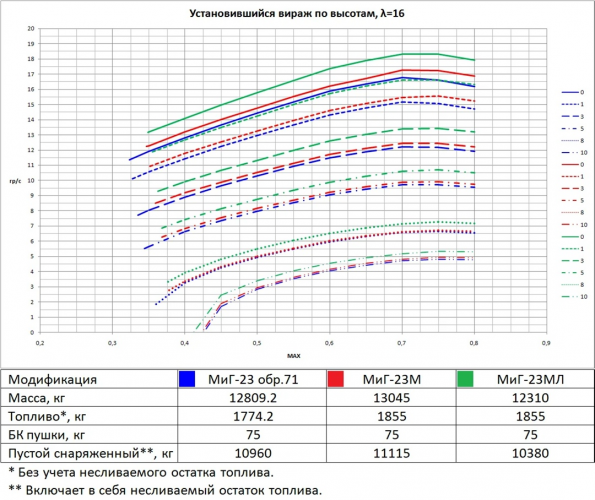
Let's start the comparison with a graph of steady turns by altitude on wing 16. The altitudes are 0, 1, 3, 5, 8 and 10 kilometers.
Graph of steady turns on wing 16 at altitudes of 0, 1, 3, 5, 8 and 10 kilometers.
As can be seen from the graph, with this sweep on the MiG-23M relative to the MiG-23 mod. 71, the parameters of the established turn were improved, but not so significantly (+0.5 degrees/sec at low altitudes and +0.1 degrees/sec or less at high altitudes). On the MiG-23ML, the improvement in maneuverability is much more significant, up to +1 degrees/sec at low altitudes and +0.5 degrees/sec at high altitudes relative to the MiG-23M. It is noteworthy that at an altitude of 1 km, the MiG-23ML maneuvers almost the same as the MiG-23 mod. 71 near the ground. In addition, the MiG-23ML has higher strength overload limits than the MiG-23 mod. 71 and MiG-23M, so the highest angular velocities achieved near the ground at Mach numbers greater than 0.6 are quite achievable on this aircraft. Taking into account the strength limitations, the maximum angular velocities near the ground in this configuration on the MiG-23 mod. 71 and MiG-23M are 16.5 degrees/sec, on the MiG-23ML 18.3 degrees/sec. On the later MiG-23M, angular velocities greater than 17 degrees/sec are probably achievable. It is worth noting separately that the values of the maximum achievable angular velocities cannot replace a full-fledged graph. The maximum angular velocities are only “leading” indicators; in real combat conditions, the speed and altitude are constantly changing, and to assess the maneuverability of the aircraft, it is important to take into account the values of angular velocities over the entire range of the graph. A similar graph for a 45 degree wing sweep.
Graph of steady turns on a 45 wing at altitudes of 0, 1, 3, 5, 8 and 10 kilometers.
In general, with this sweep, the difference between the modifications is about the same, with the correction that the turning characteristics on a 45 wing are significantly inferior to a 16 wing. The difference between the turn of the MiG-23 mod. 71 and MiG-23M at this sweep is slightly greater, and the turn of the MiG-23ML at 1 km even slightly exceeds that of the MiG-23 mod. 71 at 0 km. Maximum angular speeds at ground level: 13.35 g/s for MiG-23 mod. 71, 14.5 g/s for MiG-23M and 15.4 g/s for MiG-23ML.
A slightly greater difference in maneuverability of the MiG-23M and MiG-23 mod. 71 on the 45 wing, compared to the difference between them on the 16 wing, is explained by the following factors. On the 16 wing, there is relatively little induced drag, at which the R-27-F2M-300 engine thrust was enough to realize high values of lift, and maneuverability characteristics were largely limited by the aerodynamics of the aircraft, rather than by engine thrust. The increase in lift from increasing engine thrust was not so great, and was largely offset by the increase in weight of the MiG-23M relative to the MiG-23 mod. 71. On the wing 45, on the contrary, the induced drag is much greater, so the increase in thrust on the R-29-300 engine made it possible to realize significantly greater values of lift than those achieved with the thrust of the R-27-F2M-300 engine.
On the MiG-23ML, the R-35 engine did not add as much thrust relative to the R-29-300 as the R-29-300 added relative to the R-27-F2M-300. However, the significantly lower weight of the MiG-23ML made it possible to achieve a significant increase in maneuverability compared to the MiG-23M at all wing sweep angles.
Another graph is a steady turn on the wing 72.
Graph of steady turns on the wing 72 at altitudes of 0, 1, 3, 5, 8 and 10 kilometers.
As can be seen, on wing 72, the maneuverability of the aircraft is greatly reduced. The angular velocity of the turn changes insignificantly with increasing Mach number - this is explained by the low aerodynamic quality of the folded wing. The difference between the modifications is approximately the same as in the case of wing 45.
Comparison of acceleration and rate of climb characteristics.
Let's consider the graph of longitudinal accelerations on wing 16.
Graph of longitudinal accelerations (in km / h / s) on wing 16 at altitudes of 0, 1, 3, 5, 8 and 10 kilometers.
. At subsonic speeds, the acceleration value changes slightly with the MAX number, not counting the range of low speeds, where the machine reaches a higher angle of attack and acceleration slows down sharply. Therefore, the acceleration level at a specific altitude can be largely characterized by one number. In particular, at the ground, the acceleration of the MiG-23 mod. 71 in this configuration is about 23 km / h / s, the acceleration of the MiG-23M corresponds to approximately 27 km / h / s, and the acceleration of the MiG-23ML reaches 29 km / h / s. Converting this to the acceleration time, we can say that at the ground at subsonic speed, the MiG-23 mod. 71 gains 100 km / h in about 4.35 seconds, the MiG-23M in 3.7 seconds, and the MiG-23ML in 3.45 seconds. From the graphs and these digital parameters it is obvious that there is a very big difference in acceleration characteristics between the MiG-23 mod. 71 and the MiG-23M, especially at low altitudes, caused by a significant difference in the thrust of the R-27-F2M-300 and R-29-300 engines. The difference between the MiG-23M and MiG-23ML is slightly smaller, and is caused largely by the reduction in the weight of the MiG-23ML, and not only by the increase in the thrust of the R-35 engine. It is noteworthy that the MiG-23M accelerates faster at an altitude of 1 km than the MiG-23 mod. 71 at the ground, and the MiG-23ML at
in turn, at an altitude of 1 km, it is almost equal in acceleration to the MiG-23M at the ground.
Graph of longitudinal accelerations on the wing of 45 at altitudes of 0, 5 and 10 kilometers.
At subsonic speeds, the acceleration characteristics on the wing of 45 are in many ways similar to those on the wing of 16. At supersonic speeds, an improvement in acceleration characteristics is also visible on the MiG-23M and MiG-23ML.
Graph of longitudinal accelerations on the wing of 72 at altitudes of 0, 5 and 10 kilometers.
With the wing of 72, the difference in acceleration between the modifications is similar to that on the wing of 45. It is difficult to estimate the maximum speed from the graph, because The thrust curves used in the calculation do not reach the maximum flight speeds of the fighter. These speeds are very high. For the MiG-23 mod. 71 at an altitude of 0 km, the thrust curves were "extended" beyond 1.1 MAX, based on assumptions about the thrust of the R-27-F2M-300 engine in this mode. The calculation for this thrust gives 1.3 MAX of maximum speed, which is slightly less than 1600 km / h. It is highly likely that the MiG-23M and MiG-23ML have an even higher maximum speed near the ground. It is noteworthy that at high altitudes for all modifications with a wing of 72, the acceleration at supersonic speed exceeds the acceleration at subsonic speed.
Rate of climb graphs are essentially the same parameter, but in a different format. Maximum rate of climb is achieved at high subsonic and supersonic speeds, the highest maximum rate of climb is provided by wing 72.
Graph of energy rate of climb on wing 16 at altitudes of 0, 5 and 10 kilometers.
Graph of energy rate of climb on wing 45 at altitudes of 0, 5 and 10 kilometers.
Graph of energy rate of climb on wing 72 at altitudes of 0, 5 and 10 kilometers.
The graphs show that there is a big difference in the rate of climb between the MiG-23 mod. 71 and the MiG-23M, especially at low altitudes. The difference between the MiG-23M and the MiG-23ML is much smaller, but still noticeable. The maximum calculated rate of climb at subsonic speed of the MiG-23 mod. 71 is 174 m/s, which is not a very high figure for a fighter of this class. Due to a significantly more powerful engine, the MiG-23M's rate of climb increased to 222 m/s, almost 50 m/s. This figure already fully corresponds to the "status" of a powerful Mach 2 fighter. On the MiG-23ML, mainly due to a decrease in weight, the rate of climb reached 242 m/s, which corresponds to the most powerful machines of the 2nd and 3rd generations, as well as some fighters of the 4th generation. At supersonic speeds, the wing 72 has a relatively low Cx0, which leads to a rather remarkable result, when the maximum rate of climb at high speeds and altitudes is equal to the maximum rate of climb at ground level, this is especially evident in the graphs of the MiG-23ML, whose maximum rates of climb at 0 km, 5 km and 10 km are practically equal. At supersonic speeds, the climb rate of all three modifications of the MiG-23 is quite impressive.
Graphs of the area of available maneuvers.
Graph for wing 16.
The graph displays in detail various modes of aircraft maneuvers when flying near the ground - turns with acceleration (+10 km / h per second and +20 km / h per second), steady turn, turns with braking (-20 km / h per second and -50 km / h per second), available turn. In the turn modes with an acceleration of +20 km/h, the MiG-23M achieved a noticeable improvement in comparison with the MiG-23 mod. 71, from 1 to 4 degrees/sec at typical combat speeds. The MiG-23ML also noticeably improved this indicator compared to the MiG-23M, the angular speeds in a turn with a climb of +20 km/h/sec are approaching those of the MiG-23 mod. 71, in the turn mode with a climb of +10 km/h/sec. In this mode, the difference between the MiG-23M and the MiG-23 mod. 71 is not so significant, but nevertheless noticeable. The MiG-23ML has a large gap, the angular speeds of a turn with a climb of +10 km/h/sec are almost the same as those of the MiG-23 mod. 71 in a steady turn. A comparison of the steady turn was carried out when analyzing the corresponding graphs. When considering the turns with braking and the available maneuver, it is clear that the MiG-23 mod. 71 and MiG-23M have almost identical capabilities (in these modes, the increase in thrust of the MiG-23M is largely offset by the increased weight). But the MiG-23ML has a complete superiority in these modes over the previous modifications, since it has both a more powerful engine and less weight. If we imagine a situation of a training battle between the modifications, the MiG-23M will be able to beat the MiG-23 mod. 71 due to a noticeably better speed gain in a turn, and a slight advantage in a steady maneuver, while the transition of the battle to braking modes and low speeds will largely equalize the chances of the aircraft. The MiG-23ML, in turn, has a complete superiority over the previous modifications in all modes, allowing it to easily beat the previous modifications at any layout
hells of battle.
Graph for wing 45.
The same graph for the sweep of wing 45. As can be seen from it, the characteristics of turns in all modes are noticeably reduced in comparison with wing 16. The ratio between the modifications remains approximately the same as described above for the case of wing 16. The difference between the MiG-23M and MiG-23obr.71 as a whole becomes greater, including in braking modes, only the modes of available maneuvers remain equal. The reasons for this are mentioned when comparing the established turns on wing 45.
Comparison results.
In general, after examining the flight and technical characteristics of the 3 modifications of the MiG-23, the following conclusions can be made:
The characteristics of the machine improved from modification to modification, due to the improvement of the engine, and in the case of the MiG-23ML, due to a decrease in weight.
2. In the transition from the MiG-23 mod.71 to the MiG-23M, the most significant progress was made in the area of acceleration and climb characteristics, but an improvement in turning characteristics was also achieved.
3. The MiG-23ML significantly surpassed the MiG-23M in turning parameters, while the progress in acceleration and climb characteristics is also quite noticeable.
4. The improvement in flight performance from modification to modification clearly allows us to say that the MiG-23M will win in close combat with the MiG-23 mod.71 in most cases, and the MiG-23ML will win in close combat with the MiG-23M in most cases.
The MiG-23S has a wing loading of 490kg/m², the MiG-23M of 544kg/m², and the MiG-23ML of 370kg/m²,
In the area of thrust to weight ratio, the MiG-23S and MiG-23 edition 1971 have a thrust to weight ratio of 0.66:1
The MiG-23M has 0.81:1 and the MiG-23ML of 0.91:1
https://www.calameo.com/read/00188772198ad5eede3a8
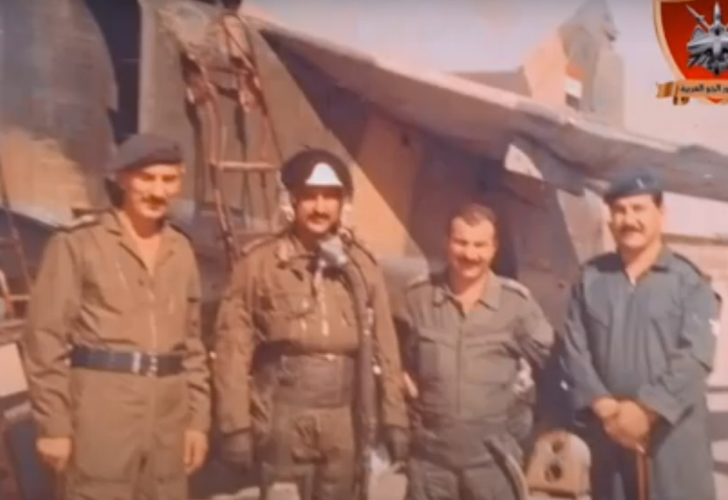
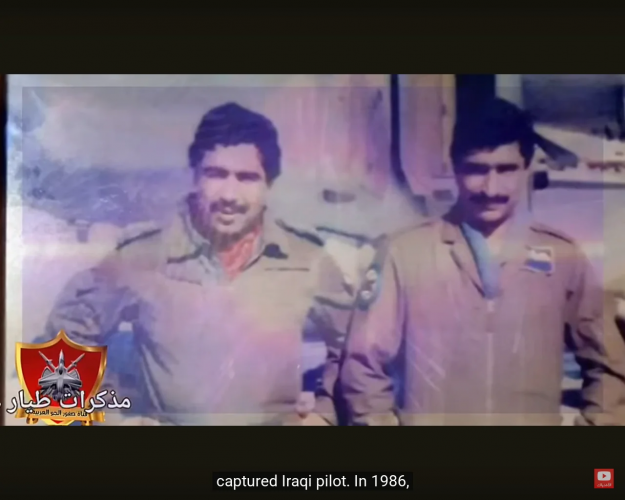
The journey with a captive Iraqi MiG-23BN pilot's memoirs about his last mission in a MiG-23BN from the 9th Squadron. Discover a story of survival and heroism in the midst of war, and learn about the sacrifices of Iraqi pilots. Explore the history of the Iraqi Air Force and tales from the battlefield.The video, titled “Memoirs of the Iraqi Pilot Captured in the Last Mission,” is an interesting and poignant journey that takes viewers on an emotional and historical journey. The video shows the life story of an Iraqi pilot who was captured during his last mission, and revolves around his experience and struggles during captivity, in addition to details of the mission he was performing before he was captured.The video addresses the pilot's feelings during his captivity, such as longing for his family and homeland, anxiety about his fate, and the internal conflicts he faces. The video also shows the human relationships between the prisoners and the treatment of neglect and torture they are subjected to. https://www.youtube.com/watch?v=pLF2MRo3PQ4
Exclusive interview: MIG-23BN pilot participating in the comprehensive air strike Memoirs of the First Gulf War (the Iran-Iraq war). This is exclusive interview with a pilot participating in the overall air strike, who was flying a MIG-23BN during the battle. In this meeting, we will discuss his experience and participation in this prominent military operation. The pilot spoke very important details about his experience in battle, including trivial preparations, details of the operation itself, and an analysis of what happened next. You'll get a unique look at crucial moments during the battle, and details never before revealed. Memoirs of the First Gulf War represent an important source for understanding personal experiences and participation in the important events that the region witnessed
The MiG-23BN was based on the 29th and 49th Squadrons at the Abu Ubaida air base.
On April 9th 1972 was signed the Soviet Union-Iraq treaty for the delivery of the MiG-23 to Iraq.
According to the Air Force Command Report - Movements, p. 13 19 Regarding the results of the first comprehensive air strike and individual strikes on 9/22/1980, he explained the following: (Amidiyeh Airport - Agha Jari - was targeted by a force of five MiG/23 aircraft, and the airport runways were directly hit and disabled.
. Shahrokhi Air Base. It was targeted at 12:18 by six MiG-23s, and at 12:30 by 12 Sukhoi 22s. The main runway, aircraft parking area, and ammunition stores were hit. Heavy resistance was seen at the base. Shahabad Airport. It was targeted at 12:18 by five MiG-23MS. The target was not seen due to bad weather conditions in the area. Bushehr Air Base was targeted at 12:26. With a force of 12 Sukhoi 22 aircraft, the main runway and stairwells were targeted in several places, destroying part of the base facility, radar and defenses of Dezful. It was targeted at 12:28 with a force of eight Sukhoi 7 aircraft, and the radar was directly hit. Kermanshah base. It was targeted at 12:30 with a force of 11 MiG 23MS aircraft, and the runway was completely destroyed, as well as the aircraft parking areas.
Get ready for an exciting flight with the famous Iranian aviation instructor, Iranian pilot Hashemi Al-Agha, an F-14 Tomcat pilot. In this video, we reveal amazing details about the life and skills of this professional pilot. Let's take a closer look at the exciting moment when his plane was shot down by a MiG-23 pilot over the Gulf. Iranian pilot Hashemi Al-Agha, featured in the video with the Ray Ban Sun Claas, the pride of Iranian Tomcat pilots, was a flight instructor on this fighter jet. His aircraft was shot down in an air battle over the Arabian Gulf after engaging a formation of two Tomcats against the heroic Iraqi MiG-23s. He was shot down after a dogfight, with a second pilot escaping with him. The Iranians claimed he was shot down near an island by mistake (friendly fire) with a Hawk surface-to-air missile after performing his parachute duty. In this amazing video, we review the key points that make the Iranian flight instructor and F-14 Tomcat pilot so unique and special. We reveal details about his training, his flying skills in the F-14, and the epic moment of confrontation with the MiG-23 pilot that led to his downing. Let's experience this unique aviation experience together
View: https://www.youtube.com/watch?v=keRY2M6PFTE&embeds_referring_euri=https%3A%2F%2Fdefenceforumbharat.com%2F&source_ve_path=OTY3MTQ
Iranian F-14 Tomcat plane is shot down by Iraqi MiG-23 fire.Our story is told by a heroic MiG-23ML pilot when he saw an Iranian F-14 Tomcat plane shot down by his Iraqi MiG-23 ML aircraft inside the Iraqi border. To achieve an aerial victory over an aircraft with a high combat reputation. It's a flood of flashbacks. In order to document it. So that present and future generations will know the value of the Iraqi pilot and the Iraqi man when he has the Will and courage. He is making great and precious efforts to preserve and defend the sky of the homeland.That afternoon, August 31, 1986, our First Lieutenant Pilot was the commander of the immediate readiness formation and No. 2 First Lieutenant Pilot S. R. was on standby duty in the readiness room and immediately took off for the squadron near the shelter of the aircraft assigned to this duty with a crew of technicians working on these aircraft. The aircraft's radar was opened and detected the Iranian F-14 Tomcat hostile aircraft. At those moments, a call came from the cutter controller, warning him to increase speed and pursue the target. The target was far away and the opportunity for convergence was slow, so the air defense controller decided to increase the speed to approach and follow the target at a distance of 25 km.
The F-14 was the king of the air in the extreme combat of the Iran-Iraq War. Around 180 Iraqi aircraft fell to Grumman’s deadly Tomcat, of these kills, sixteen can be attributed to Col. Mazandarani. We spoke to the world’s greatest living F-14 ace to learn more.
Combat aircraft pilot: Interview with sixteen kill Grumman F-14 Tomcat ace, among them some MiG-23s, on Sep 23, 1980 he claims he downed two MiG-23s, on Nov 13th, 1980 another MiG-23.
He admits 5 F-14 were shot down by Iraq.
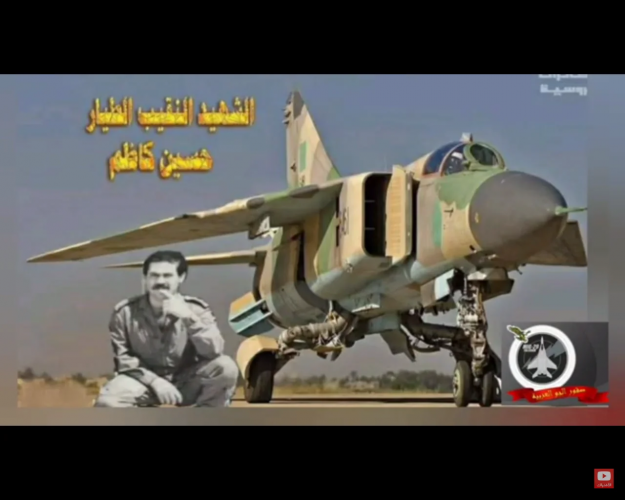
On the 90th anniversary of the founding of the Iraqi Air Force, we mourn our loved ones who fell in battle, were assassinated, or passed away. We apologize to those we mentioned for not publishing their photos, but they live on in our hearts.
Excellent video, it says Iraq was the main combat user of MiG-23 and Iraqi MiG-23BN account for most of the MiG-23 combat losses, around 60 MiG-23BN were lost by Iraq, plus around another 18 MiG-23BN of Syria were lost in combat.
The MiG-23ML Major Pilot Shaker Rayhan Al-Saadi was shot down in an air clash with an American F-15
On the night of the attack, he was assigned to night readiness duty. I anticipated the American attack that night, so I went to the shelter for the armed aircraft.
Duty
The MiG-23ML squadron is being transferred from Saad Air Base to Abu Ubaid Air Base. The squadron's pilots are transporting airworthy aircraft on the flight path. Saad Air Base / Talha Secondary Airport / Karbala / Abu Ubaidah Air Base. The aircraft are being prepared upon landing in preparation for transfer to Iran. On the night of 25/02/1991, the aircraft shelters of the Mirage detachment and the standby aircraft shelter of the 73rd Squadron, which includes MiG-23ML aircraft, were bombed. One aircraft was destroyed, and an entire crew of technicians preparing the standby aircraft were killed.
The absence of the squadron commander to speak with the Air Wing Commander and to head from Saad Air Base to Al-Bakr Air Base at a very low altitude instead of the movement order at a flight altitude of 7 km with a combat speed of 900 km/h, and on the basis that the MiG-29 aircraft would be waiting for us as an umbrella over Hit at an altitude of 7 km. This briefing was presented in advance by the Air Wing Commander, Samir Abdul Razzaq, at the time. After that, we received another briefing from Falcon Faisal, the formation commander, to complete the detailed briefing of the transfer operation.
Falcon Faisal Taha's briefing:
Brothers, the pilots executing the first formation (Pilot Faisal No. 2, Pilot Ismail Hamoud). The second formation: three aircraft (Pilot Shaker Rayhan, No. 2, Pilot Karim Hassan Raheel, and No. 3, Pilot Amer Hassan).
The final formation will include two twin-engine aircraft and one single-engine aircraft (Pilot Sherwan Salah al-Din / Pilot Mohsen Maki Maan, No. 2, Pilot Lotfi Nasser / Pilot Rahim Jassim, and No. 3, Pilot Raed Karim Ismail).
The execution altitude is the lowest altitude at which the pilot can fly, and the maximum possible speed, while conducting defensive maneuvers in cases of sensing enemy aircraft locking on.
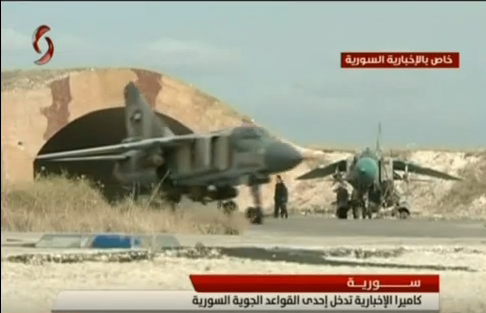
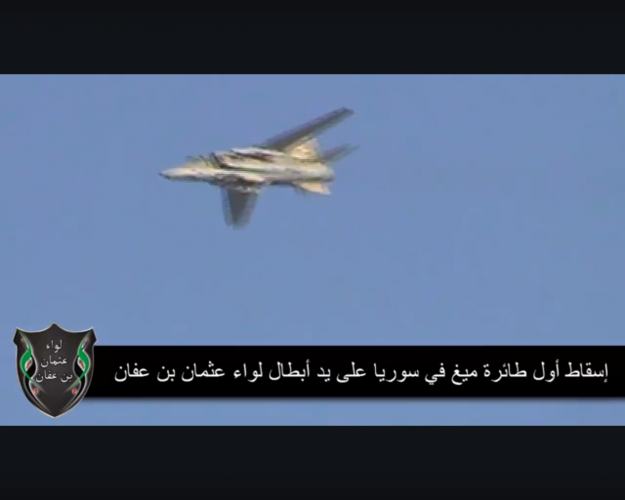
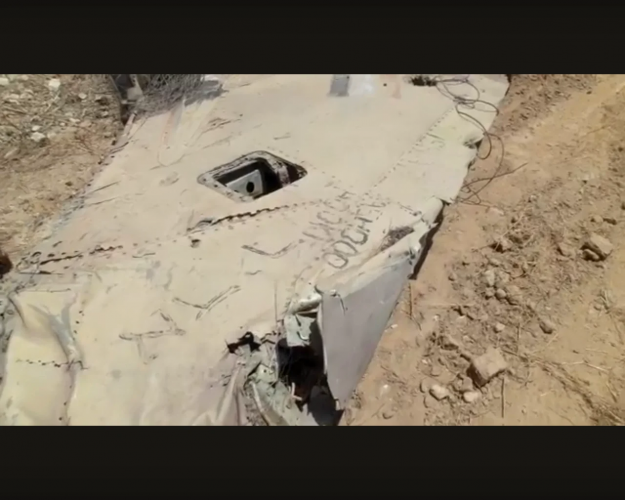
A MiG-23BN fighter jet was shot down in Syria by the Othman bin Affan Brigade - Air Defense Company, on August 13, 2012, in the city of Mohassan in the Deir ez-Zor countryside. Syria
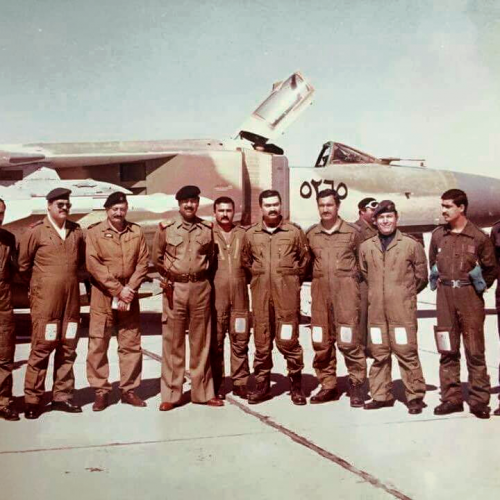
A photo of a group of Air Force Falcons with the Commander-in-Chief of the Armed Forces, Major General Pilot Taher Saleh Tawfiq, and Lieutenant General Hisham Sabah Al-Fakhri, at Al-Shuaiba Air Base, in Basra, and behind them appears the MiG 23 aircraft, 1980s.
MiG-23 Iraqi pilots destroyed Iranian ground forces during the Battles of East Basra / The Epic of the Second Khalid ibn al-Walid Brigade of the Former Iraqi Army, 1985
The Blitz Over Isfahan | A Response to Iran's Account of the Capture of Iraqi MiG-25 Pilot Thaer Sobhi
The Blitz Over Isfahan reveals the secrets behind the downing of Iraqi MiG-25 pilot Thaer Sobhi in one of the most dangerous chapters of aerial conflict in urban warfare
the full story of the daring MiG-25 sortie that faced a deadly ambush over the skies of Isfahan in 1987, and the reaction of hero Thaer Sobhi Ahmed before his capture. You'll see exclusive details about the attack plan, the Chinese Volga missiles that turned the tide, and the testimony of Air Force Major General Fayed Qasim, which reveals previously untold secrets. A story of courage and sacrifice that will forever be remembered in the history of the Iraqi Air Force, documenting an epic in the sky where sacrifice was the title and heroism was the identity.
1. The Lightning Battle over Isfahan Reveals the Secrets of the Shooting of Iraqi Pilot Thaer Subhi,
Untold Details About the Capture of the Iraqi Hero and the Truth About the Iranian Account of the Capture of the MiG-25
1. The true story of Thaer Sobhi and the capture of the MiG-25 in the Blitzkrieg Battle over Isfahan
2. The heroics of the Iraqi pilot reveal the enemy's deception in the Blitzkrieg Battle over Isfahan
3. Major General Fayed Qasim's testimony about the capture of Thaer Sobhi in the Blitzkrieg Battle over Isfahan
4. The secrets of the Chinese Volga missiles and the downing of the MiG-25 in the Blitzkrieg Battle over Isfahan
5. How Thaer Sobhi faced death in The Blitzkrieg Over Isfahan
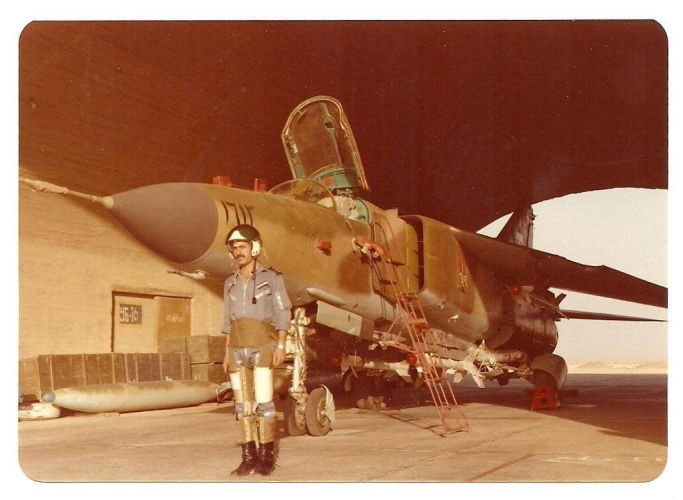
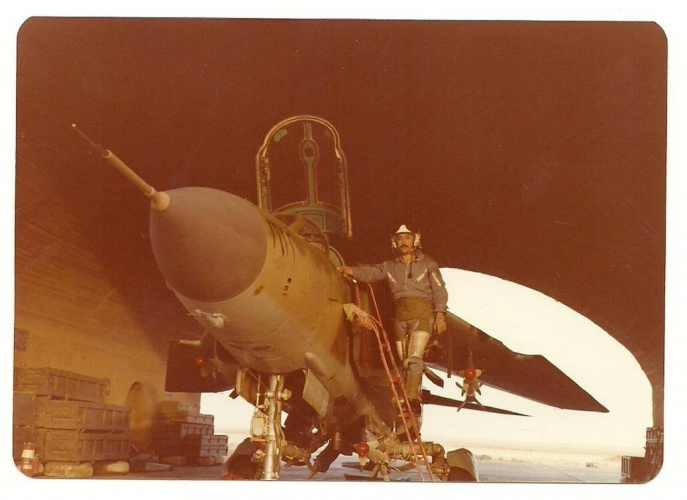
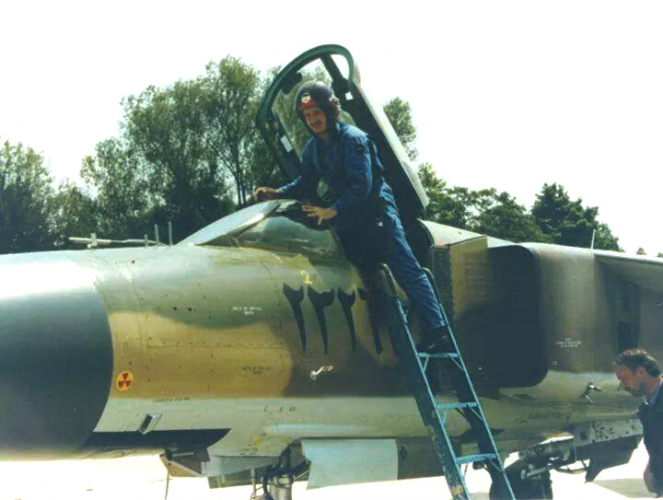
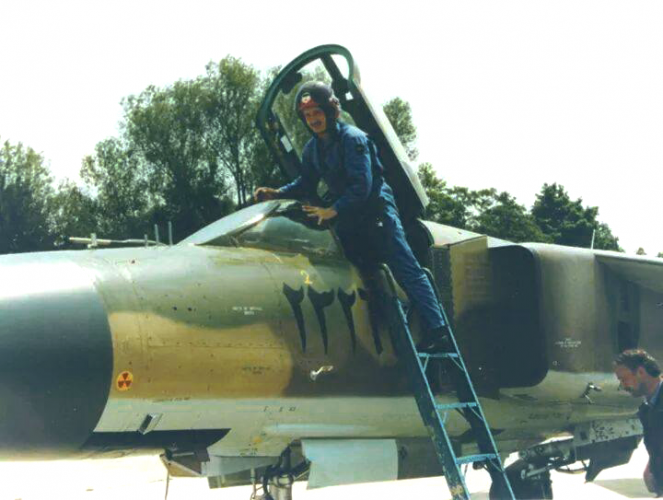
Friend , this photo of the IqAF MiG-23ML ( number 23269) ....
..was made in the Zmay air depot in Velika Gorica near Zagreb, former SFR of Yugoslavia, July 1990. We can see Yugoslav flag on his red helmet and YuAF coat of arms on his blue flying suit ( left shoulder). Test pilot was Omer Avdakovich.
MiG-23 (Irak) Pilot Omer Avdaković | MiG-23 (Irak) probni let 1990
..was made in the Zmay air depot in Velika Gorica near Zagreb, former SFR of Yugoslavia, July 1990. We can see Yugoslav flag on his red helmet and YuAF coat of arms on his blue flying suit ( left shoulder). Test pilot was Omer Avdakovich.
MiG-23 (Irak) Pilot Omer Avdaković | MiG-23 (Irak) probni let 1990
yes I knew the picture was taken in the former Yugoslavia, but thanks for the video, as a small comment my father is married to a Russian lady, well she is in her 70s, however in her first marriage, (my father is her second marriage) she was married to a Tu-144 pilot, back in the former USSR.
To be honest I have never seen a MiG, my personal experience, is F-15, F-16s and F-18.
I have seen the F-15 many many times I live not far from a F-15 base.
However I worked before at an airport with ATR-72s.
I like MiGs because in my childhood my father bought many Soviet books about Math, but from time to time he bought soviet books, about other subjects and one time I got in my hands a soviet military magazine where one article was dedicated to the MiG-23M, pretty good magazine for a 14 year old boy.
I used to play with an F-15 model pretending it was a MiG, now I am an aeromodelist so I have hundreds of aircraft models, but definitively Russian aircraft are really cool.
At least in the former Yugoslavia, you got a strong aircraft industry, my nation (Mexico) we have an aircraft Industry but we have up and downs but we never have built a complete jet.
But in history is very important to bring different sources from different countries because they give a more holistic view of a subject, and now youtube has subtitles and automatic translation.
As a Latin American I think the MiG-23 gave better service in the Cuban air force.
In the mid-’80s Cuba obtained fifty MiG-23MLs which were sent directly to Angola, where they were employed primarily in the ground attack role until late in the war. During late 1987 to middle 1988 – the time of the Cuito Cuanavale battles – they began to be used also as interceptors against the South African Air Force.
On March 20, 1991, Major Orestes Lorenzo took off from Cuban soil in a MIG-23 fighter jet, the most modern aircraft in the Cuban Air Force.
At full speed and low altitude, he crossed the 150 km separating Cuba from the United States in less than 10 minutes. Since he was flying almost at sea level, neither Cuban nor American radars detected his presence, so he was able to land safely at the Boca Chica Naval Air Station in the Florida Keys. Orestes requested asylum in the United States and, once he passed the interrogations he was subjected to, received political refugee status.
There was no way Castro would allow the family of an elite military officer who had betrayed the trust placed in him and ridiculed the regime to leave Cuba.
Orestes then appealed to the UN Human Rights Commission, to no avail. Coinciding with the Ibero-American summit held in Madrid in 1992, with Fidel Castro in attendance, he held a protest by chaining himself to the fences of Retiro Park. Queen Sofia, who enjoyed a good personal relationship with Castro, made personal efforts to secure the departure of his wife and two children from Cuba. The matter even reached Mikhail Gorbachev's office.
All of this was unsuccessful. Raúl Castro, through his personal assistant, sent Victoria the response:
Tell your husband that if he had the balls to take a plane, he should also have the balls to come and get them personally...
At 5:05 p.m. on Saturday, December 19, 1992, former Major Orestes Lorenzo climbed into the cockpit of a Cessna 310 at Marathon Key, south of Florida, for the most dangerous mission of his life: the rescue of his family in Cuba.
At the first press conference, he said:
Tell Raúl Castro that I took him at his word and personally went to pick up my family.
Today, Orestes is a successful businessman who runs his own construction company in Miami, something he would never have been able to do in Cuba.
A real-life combat pilot shares anecdotes about the Angolan conflict, including his experience flying the MiG-21 and MiG-23.
Overview:
00:00 - Introducing the pilot and how he started his career.
12:10 - MiG-21 in Angola.
13:20 - How many people were needed to maintain an aircraft.
17:01 - MiG-23s arrive in Angola
21:01 - How to achieve man-aircraft cohesion
27:19 - Formations and in-flight communications
35:47 - Anecdote: A MiG-21 shot down 45:30 - Attack capabilities of the MiG-23
51:21 - Flight characteristics of the MiG-23
At 16 degrees wing swept achieved its longest range, it could fly from Havana Cuba to Caracas Venezuela without external fuel tanks.
At 16 degrees of wing swept could spend less than 50% of fuel than at 72 degrees of wing swept
01:10:02 - Anecdote: The day I fired at a C-130 an R-23 (3 April 1986)
01:23:06 - Anecdote: A MiG-23ML pilot returns alive after being hit by two stinger missiles but the aircraft could not be repaired.
01:27:45 - Anecdote: Receiving anti-aircraft fire
01:38:24 - The Soviet Union's position on Cuba 01:51:37 - How the Cubans taught the Soviets night landing techniques
01:56:50 - What was the night flight like in Angola?
02:04:28 - Last flight
02:09:51 - Farewell
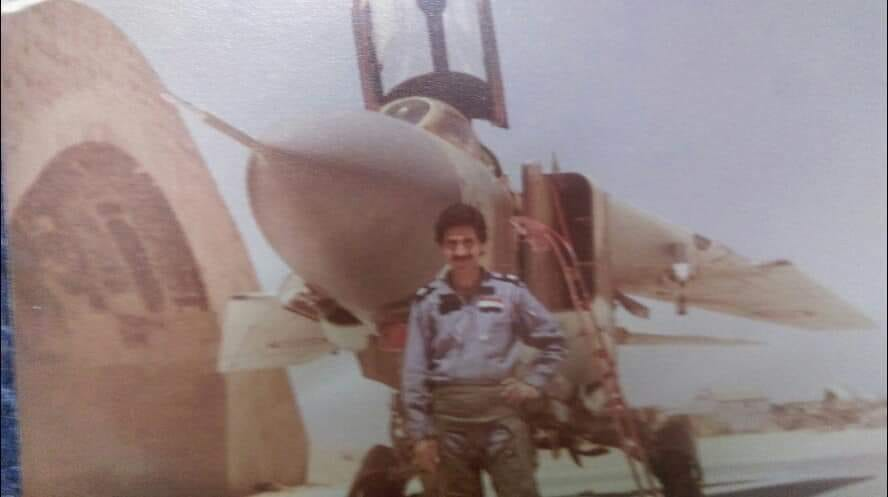
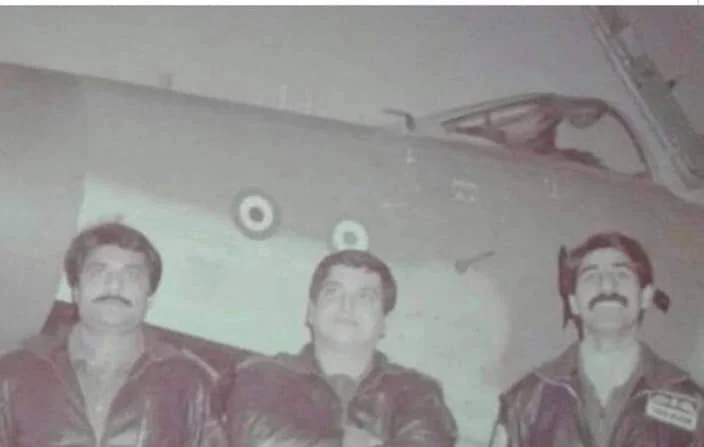
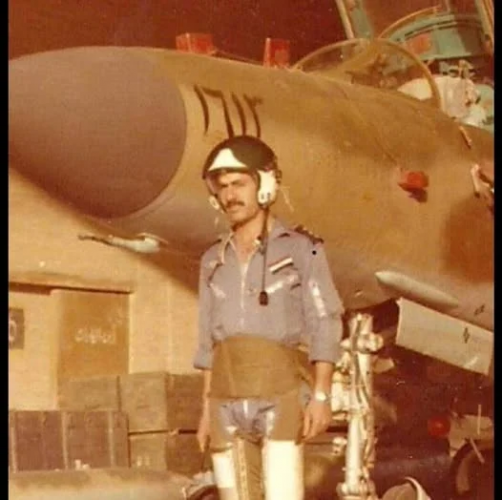
Interesting picture Iraqi MiG-23 with two Iranian roundels showing two victories over Iranian fighter aircraft
The Iraqi Air Force, Brigadier General Pilot (Basem Nouri Hibatullah Al-Khalifa), 29th Class
MiG-23, 67th Squadron, then a pilot trainer in the Transformation Squadrons. he is pilot in the center
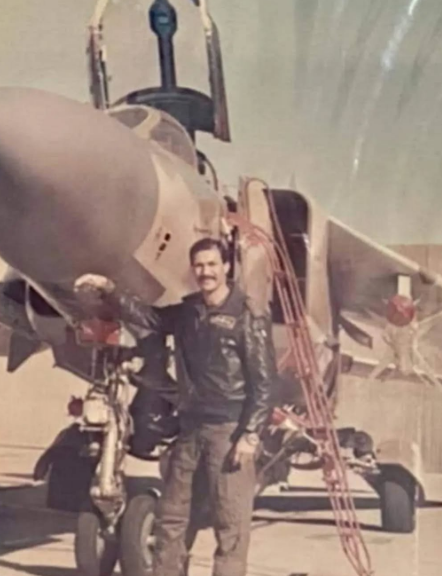
He is the Syrian hero pilot, Muhammad Ali Al-Hou. From the 19th grade. He is claimed to be the first to shoot down two Israeli F-16s over Beirut in a single engagement in 1982. Over Lebanon In a MiG-23MF aircraft. And R-23 thermal rockets, Israel denied the event.
Source:
حروب جوية le guerres de l'air _ the war in air Facebook, 19 December 2020
Such an assessment of the MiG-23 can be considered emotional.
When compared solely with its counterpart, the F-4J [and its more advanced versions] equipped with the APG-59, the production numbers of the MiG-23ML/P [and its more advanced versions] aircraft may exceed 1,500 units, and may even be higher in quantity.
Furthermore, dating back to the S-23D3 at the earliest, the MiG-23 series began utilizing Low PRF MTI look-down capability. Its advantage lies in providing range measurement, and variable PRF can eliminate approximately 90% of the blind speed zones. In contrast, the APG-59's HPRF in velocity search mode does not provide range measurement, reducing its tactical practicality.
Simultaneously, starting from the S-23D3, pulse-based angle measurement was adopted. According to the post on this site about the APG-59, it is confirmed that the APG-59 still employs conical scan for angle measurement.
The comparison between the R-24 missile and the AIM-7F missile also involves the generational gap issue between conical scan and pulse-based angle measurement.
Additionally, I am attaching missile envelope diagrams I have collected. Please note that I am a non-native English speaker. Regarding the R-24, AI super-resolution was applied, resulting in significant loss of detail. The original image is attached thereafter. The annotations indicate:
1. Speed ratio between the target and the missile-carrying aircraft.
2. V_missile-carrier = V_target.
3. [Below the arrow] Non-maneuvering.
4. R1-MAX = Maximum missile range.
''Ten years after the end of the Cold War, Alexander Mladenov surveys the official Soviet Air Force documents relating to the operational doctrine of the MiG-23MLD.''
This site uses cookies to help personalise content, tailor your experience and to keep you logged in if you register.
By continuing to use this site, you are consenting to our use of cookies.