16 carriers is one every 3 years, and you have two or three building at a time. But you can't build SSBNs fast enough to get a fleet of 36 either – at least not without cutting SSN numbers – so it's all somewhat academic.
Which gets us back to the problem: Can the US even build 2 carriers at the same time? I thought NNNS only had one drydock big enough for carrier building? They're certainly only building one at a time right now.
Given that loads in excess of eight warheads per missile are possible, it's entirely possible for that to be the average load, with some missiles carrying more and others fewer. For what it's worth, we do know that UK boats carry eight missiles with a maximum of 40 warheads - but the ability to put 192 warheads on a single boat was key to the justification to build four boats rather than five.
Depends on which warheads you're using. 8x W88, 12x W76.
- W88s are 475kt.
- W76-0 are 100kt.
- W76-1 are 90kt. (not sure for the reason behind the reduced yield)
- W76-2 are about 5-7kt (references aren't clear).
An advantage of using W76s is that they're a lot lighter than W88s, ~95kg versus ~175-180kg. So 8x W76 is roughly the same weight as 4x W88, which gets you more range. Per a 2007 report that I have attached, loading 4x W88s would get you a range of ~11,500km in a mathematical guesstimate. The tables in question are on Page 43 of the PDF.
There were ~400x W88 warheads made (production run greatly cut short), so W76s got recycled from Trident I. ~3400x W76s built, and the -1 and -2 variants were made by remanufacturing older warheads. There's about 2000 W76-1 warheads, and an unspecified number of -2s. For our purposes, I'm assuming less than 120x W76-2s deployed on boats, (14 boats * 3 warheads per missile * 2 missiles per boat makes 84, 14*4*2 makes 112).
400x W88s spread across 14 subs is 28.5 warheads per sub. I'm going to assume that a small number of W88/Mk5 RBAs would be held in reserve in case one bird tests bad. I'm going to assume 24x W88s per sub (
336 at sea, leaving 64 ashore). Several different ways we could assign those out,
I'm actually thinking 4 per bird to get all the missiles to have about the same range. So that's 6 birds per boat, and probably no change from reported deployed numbers.
Then we can grab 8x W76-1 per bird and 16 birds per boat, 1792 warheads at sea. This is the only actual increase of deployed warheads, and we're only doubling what's in use.
So an increase of 896 warheads.
Now comes the unexpected habanero. W76-2 low yield warheads. I'm assuming 2 birds per boat, loaded with 4 or fewer warheads each. (no change from reported deployed numbers!) If the boats have more Low Yield birds, that reduces the number of warheads going from stockpile to deployed.
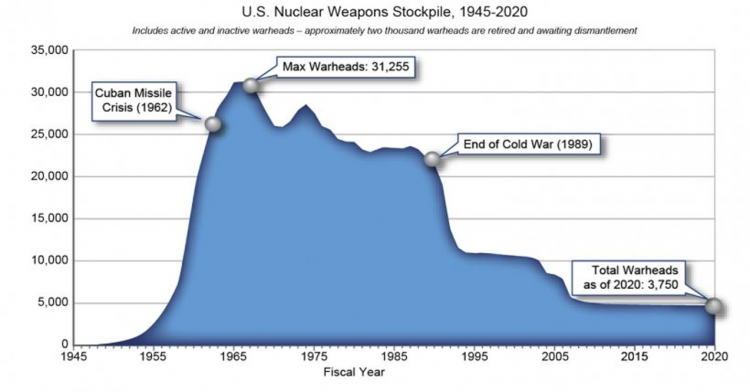
This plan moves ~900 warheads from stockpile to deployed for the US. That leaves ~1000 in stockpile and ~1500 dismantled.
But that's just Trident, we also have Minuteman.
There are 400x MM3s to upload back to 3x W78s or W87s each. There are ~1000x W78s and 525x W87s made. 175 of the MM3 could get 3x W87s (525 total, an increase of 350), and the remaining 225 MM3s would get 3x W78s (675 total, increase of 450).
This moves another 800 warheads from stockpile to deployed.
=====================
UK warheads are considered separately from this.
UK warheads are equivalent to W76-1s now, the US offered the UK the blueprints for the MC4700 arming, fuzing, and firing system. I believe that the UK maintains ~800x warheads, but that doesn't leave many in reserve if a bird tests bad. Uploading the UK Tridents to 8x warheads would be a massive increase in what's deployed if the RN really is only deploying with 8 birds and not more than 40 total warheads...
UK would be going to ~500 warheads deployed from ~160, an increase of ~340.
Note that this is not including any low yield warheads, I have not heard anything about the UK considering "escalate-to-deescalate" tactics that would require such small warheads on Tridents.