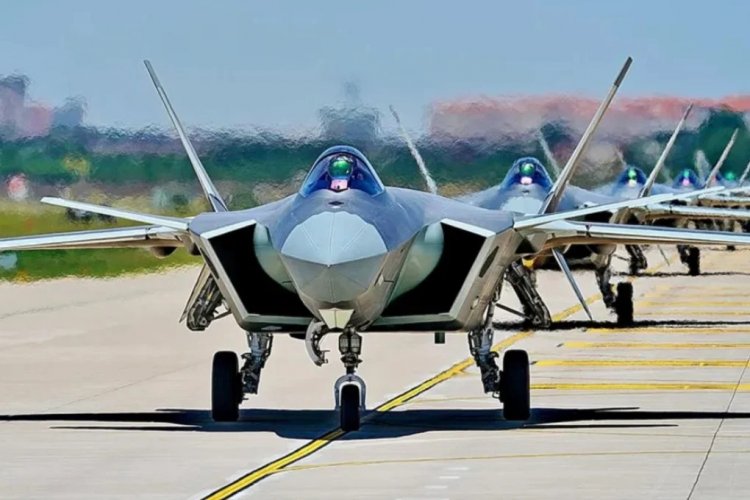
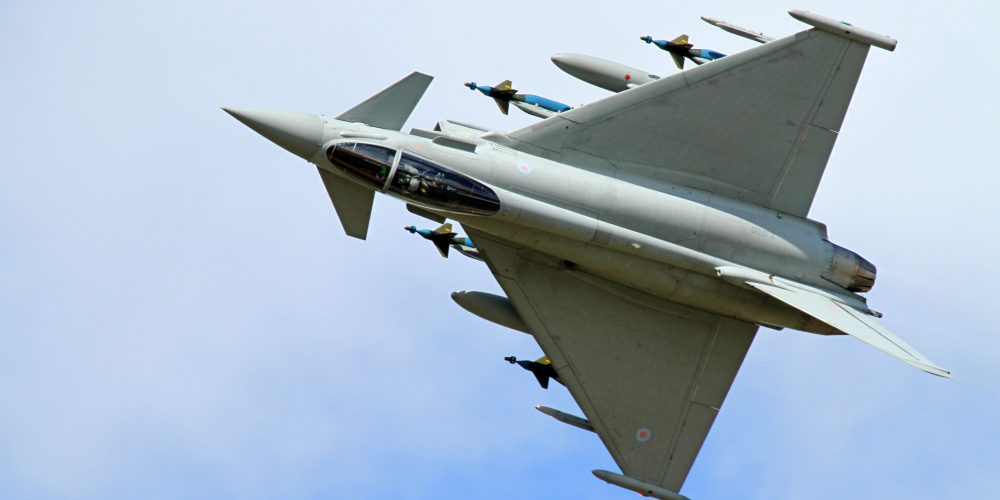
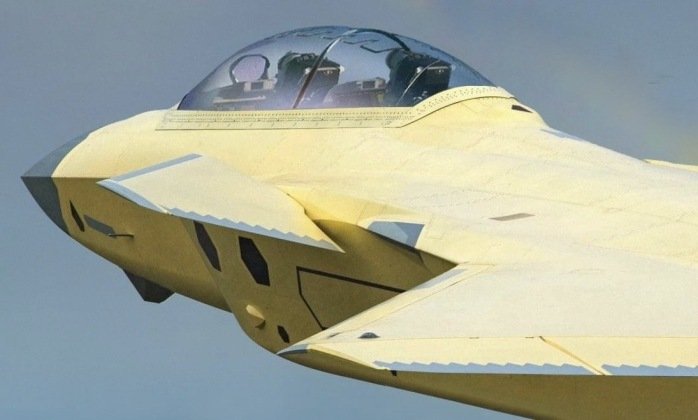
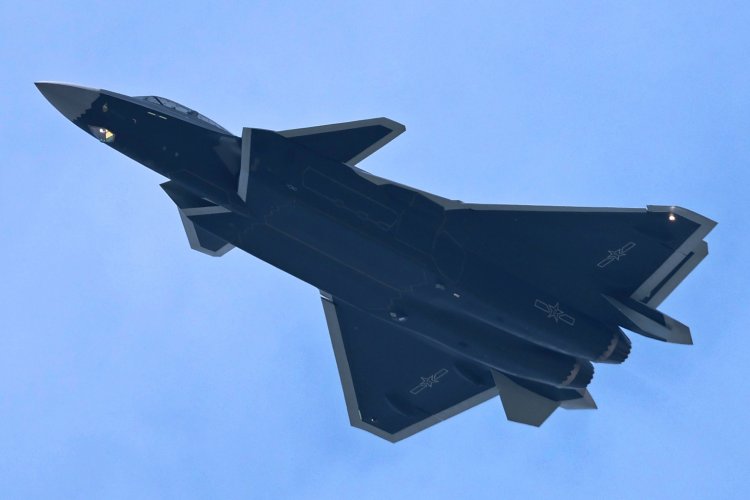
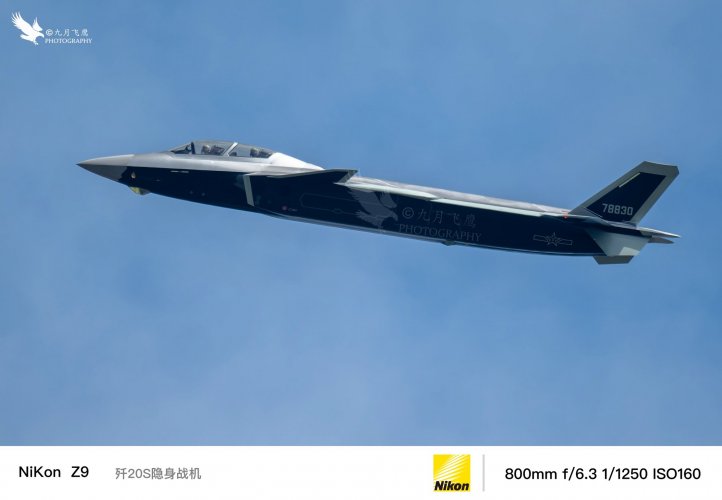
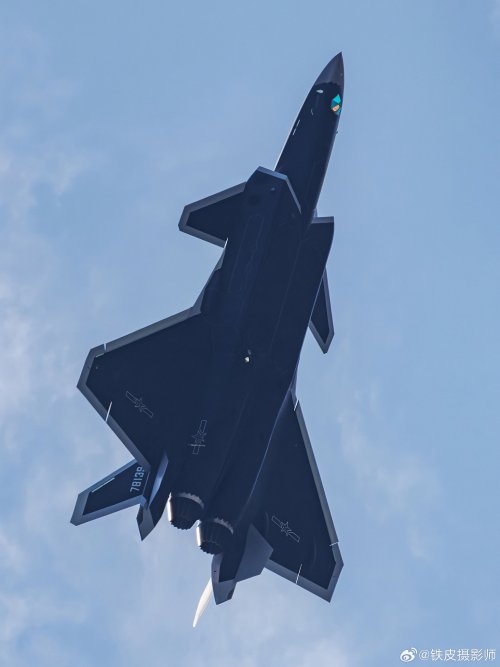
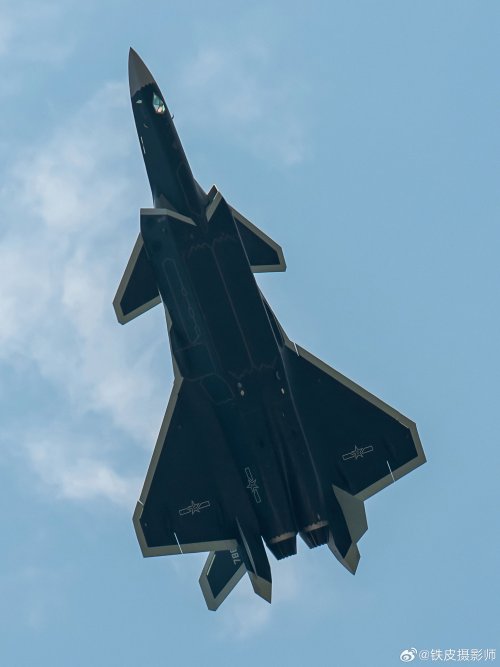
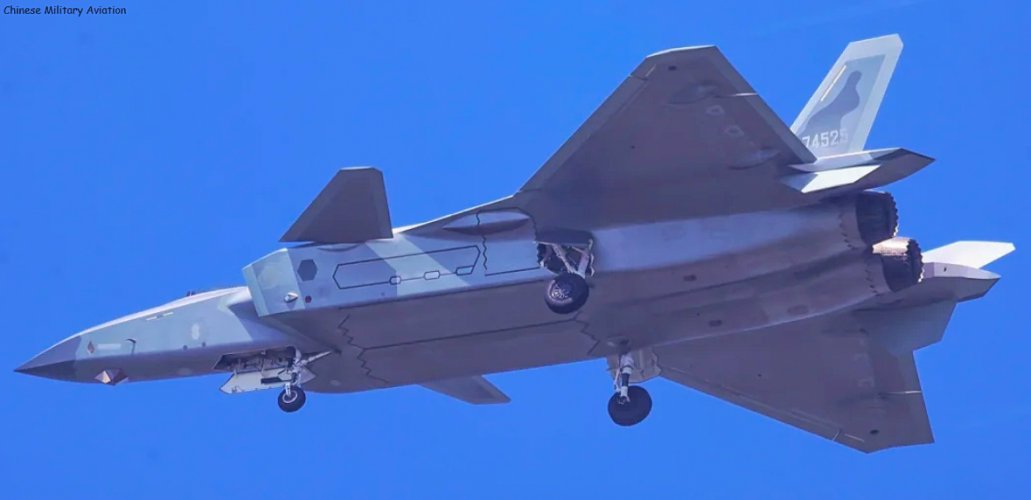
From this view, it is interesting that the edge alignment of the inlets, canard LE and TE, and wing LE and TE is quite variable, which is unusual for what is supposed to be an LO platform.

 
But the even side to side, the canard LE doesn’t match the angle of the inlet sweep or the wing LE sweep. Close, but ~10 degrees different.
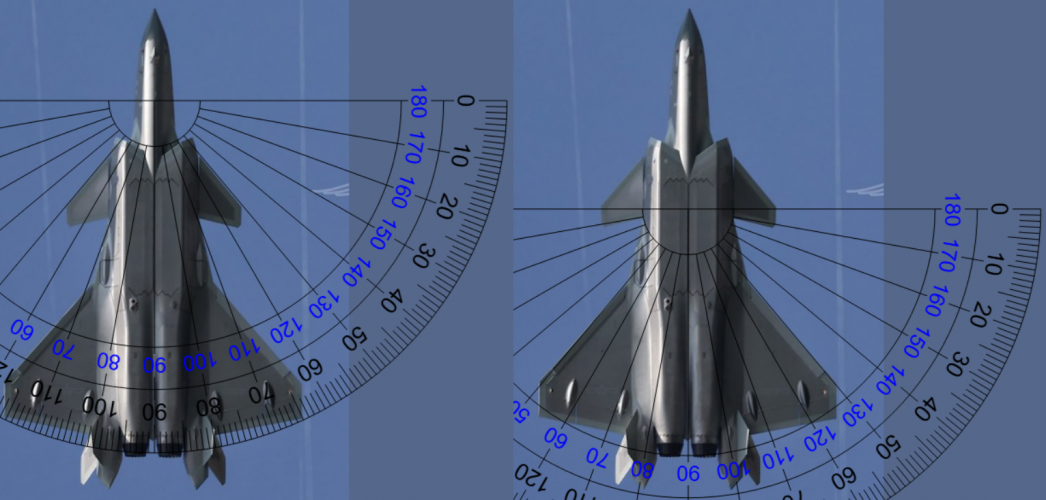
Are you basing it off that specific picture (which is taken at an angle of the aircraft in flight and the canard at a slight deflection), or have you looked at more representative pictures of the aircraft, such as direct dorsal or ventral perspectives?

For example, this picture is a bit better, taken from a more ventral angle, albeit the canards are still at a very slight deflection meaning the measurements aren't identical... but they're both pretty much 50 degrees.


We've had J-20 pictures from many angles for many years, it is a surprise that by this point anything as stark as "leading edge of canard and leading edge of main wing aren't aligned" could be considered a serious argument these days...

edit: I recall that you were the one who back last year said you thought J-35A didn't have serpentine intake ducting... which is about as eyebrow raising of a suggestion as the idea that J-20 wouldn't have edge aligned primary control surfaces. Come on.

It should be a rule of thumb where "how did they make such a simple mistake/omission" should be automatically met by "I'm probably the one who's wrong".


j-20 angle.png
 
Last edited:
But the even side to side, the canard LE doesn’t match the angle of the inlet sweep or the wing LE sweep. Close, but ~10 degrees different.
it will not affect it too much you are right, but from a frontal view, or head on, it will not affect it too much but compared to YF-23, of course it will have a less strict planform alignment, the compromises are made for better wing trailing edge effectiveness (elevons and Flaps effectiveness), wing area size, wing drag, and canard drag, that canard will have more area than X 36`s canards and less drag, but it pays a bit in LO treatment.

The canard is very conventional very standard in shape for a 4th fighter like gripen

Answer compromises
 
Last edited:
trailing edge of left canard aligns with trailing edge of right main wing.

trailing leading edge of right canard aligns with trailing edge of left main wing.

also of note, to avoid back scattering of trailing edges, soft surface with sawtooth edges aligning with leading edges. Surface waves would travel from the front toward the rear and hit these edges outlining the soft surface and back scatter in the same direction with frontal leading edges.

Since someone metioned, yf-23 forgoes this complexity by aligning trailing edges with leading edges among other simplified rcs solutions that save complexity/cost/weight.
 

Attachments

  • article_61ef91814859b0_80862844.jpeg
    article_61ef91814859b0_80862844.jpeg
    60.6 KB · Views: 117
From this view, it is interesting that the edge alignment of the inlets, canard LE and TE, and wing LE and TE is quite variable, which is unusual for what is supposed to be an LO platform.
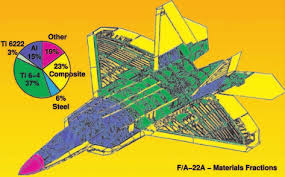
I'd guess it's much more complicated that just 'shaping'. Even back in the F-117 days they used special composites with a gradually transitioning permittivity in order to avoid sudden changes in impedance, which would've caused a reflection. I don't know much about the construction of the J-20, but I've found this diagram of the F-22, and there's something similar going on there as well.
1751887085548.png
My personal working assumption is the light grey parts are composite, either constructed to be transparent to radio waves (very likely in the case of the radome and the strakes), or are 'doped' so that they help eliminate reflections, with the dark gray parts being metal. The difference between the actual shape and the 'stealth shape' is the most apparent on the leading edge extensions, which appear to be somewhat rounded (likely for aero reasons), with the actual dark part being angular.
Stealth is insanely complicated, both in theory (despite having a degree in this, and having designed high-speed PCBs for a time, I have to admit, I did not have the tenacity to work through Ufmitsev's book, but hey maybe now's the time to try again), and the actual implementation details are secret, but there's a lot more going on that just planform alignment. And if you allow me to speculate a bit, there are wild and unexplored (at least to the public) technological solutions for both detecting and hiding aircraft (including 'plasma stealth', a term capable of inducing collective meltdown on most forums )
 
It should be a rule of thumb where "how did they make such a simple mistake/omission" should be automatically met by "I'm probably the one who's wrong".

Mistake/omission wasn't mentioned, just that they don't align. Which they don't.
Whether that's wrong or right is another question. It's likely some kind of compromise.
 
Mistake/omission wasn't mentioned, just that they don't align. Which they don't.
Whether that's wrong or right is another question. It's likely some kind of compromise.

The leading edges of the canards and wings do align.
The trailing edges of the canards and wings do align to their contralateral counterpart.

As for being a mistake/omission:
"From this view, it is interesting that the edge alignment of the inlets, canard LE and TE, and wing LE and TE is quite variable, which is unusual for what is supposed to be an LO platform."

The above in 1562 is clearly suggesting that the design features he supposedly observes would be a mistake or "interesting" on "what is supposed to be an LO platform" thus implying the platform is not LO.
 
I hadn’t seen an image showing the J-20 planform that clearly before, and it appeared that the edge alignment was close for the wing and canard, but slightly off (~10 degrees). I realize that the view wasn’t exactly 90 degrees underneath, and the dihedral of the canard may have added some additional visual distortion of the edge alignment. If I’m wrong, I’m wrong.

Achieving edge and surface alignment and minimizing the number of alignments has been one of the “rules” of LO signature reduction in most directions.
 
Who would those be?

Because the idea that this aircraft would not have appropriate edge alignment for its primary control surfaces should not pass the smell test, and if one did suspect it then I would think the natural path to take is to go and do some digging first, before suggesting the idea that the aircraft lacked one of the most basic tenets of LO design.

I have no issue having a constructive conversation, and in this case I'm very happy to find an appropriate picture and take out a literal protractor to demonstrate the edge alignments of the leading edges as I did above -- but at the very least shouldn't the skepticism be framed as a "guys this is weird, am I seeing this wrong" rather than "they don't have these features, therefore it doesn't seem LO to me".
 
Because the idea that this aircraft would not have appropriate edge alignment for its primary control surfaces should not pass the smell test,
Not really. Could be they traded it for something else. Look at the tails of the F-22 and YF-23. Both met requirements but they made different choices in how to get there.
 
Because the idea that this aircraft would not have appropriate edge alignment for its primary control surfaces should not pass the smell test, and if one did suspect it then I would think the natural path to take is to go and do some digging first, before suggesting the idea that the aircraft lacked one of the most basic tenets of LO design.

I have no issue having a constructive conversation, and in this case I'm very happy to find an appropriate picture and take out a literal protractor to demonstrate the edge alignments of the leading edges as I did above -- but at the very least shouldn't the skepticism be framed as a "guys this is weird, am I seeing this wrong" rather than "they don't have these features, therefore it doesn't seem LO to me".

My personal issue is just that it's disrespectful to the designer and people involved, claiming their work to be subpar and not taking into account things that are considered "basic" in that regard. It's the same with people who think the engineers at UAC or Boeing just eyeball stuff, shrug and say it's good enough. I have a hard time to understand such a mindset.

But yes, the tone is definitely playing a part too.
 
The leading edges of the canards and wings do align.
The trailing edges of the canards and wings do align to their contralateral counterpart.

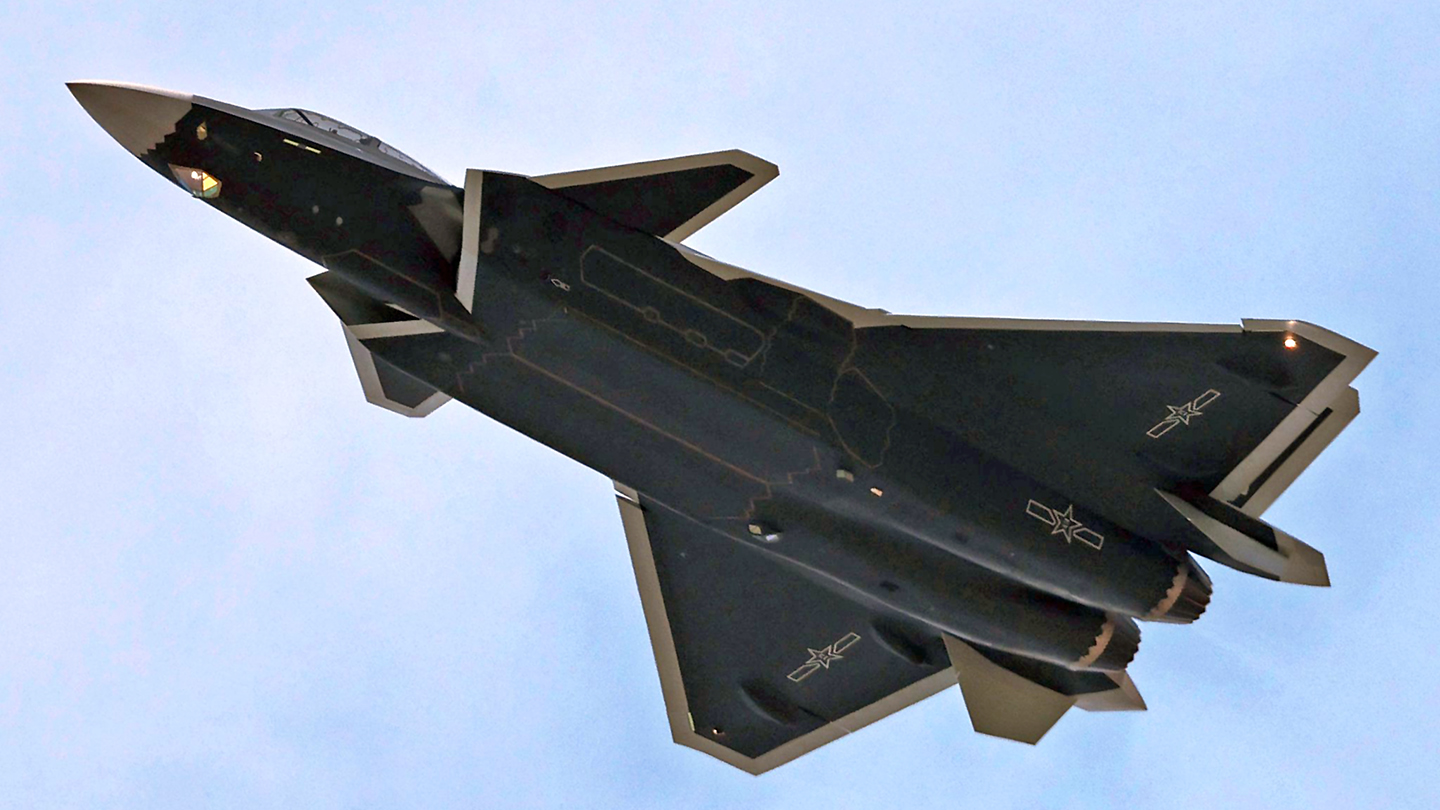
Yes these do align, perfectly I'm assuming.
There's still a lot of different angles, but all of them have a reason to be there probably... Otherwise, every aircraft would be a flying wing.
 

China’s Two-Seat J-20 Stealth Fighter Poised To Enter Operational Service​

 
My personal issue is just that it's disrespectful to the designer and people involved, claiming their work to be subpar and not taking into account things that are considered "basic" in that regard. It's the same with people who think the engineers at UAC or Boeing just eyeball stuff, shrug and say it's good enough. I have a hard time to understand such a mindset.

But yes, the tone is definitely playing a part too.

You should grow thicker skin. Imagine being Lockheed or Northrop, and spending over half a century developing stealth to the point it's everyday tech, and then some newb comes along and says, "look what I invented all by myself". This, after it's common knowledge you committed historic levels of industrial espionage and intellectual property theft through numerous cyberhacks. Talk about a "lack of respect".
 
You should grow thicker skin. Imagine being Lockheed or Northrop, and spending over half a century developing stealth to the point it's everyday tech, and then some newb comes along and says, "look what I invented all by myself". This, after it's common knowledge you committed historic levels of industrial espionage and intellectual property theft through numerous cyberhacks. Talk about a "lack of respect".
Except Chengdu aren't claiming they 'invented stealth by themself'. In fact, virtually nothing about J-20 stealth capabilities have been said officially. Forum members and Chinese internet denizens might have a lot to say but that's mostly just speculation. Emobirb isn't even Chinese.

My personal issue is just that it's disrespectful to the designer and people involved, claiming their work to be subpar and not taking into account things that are considered "basic" in that regard. It's the same with people who think the engineers at UAC or Boeing just eyeball stuff, shrug and say it's good enough. I have a hard time to understand such a mindset.

Its not disrespectful to the Typhoon designers to say the Typhoon is lacking in stealth capability. The Typhoon was designed to a specific requirement and had only minor concessions to reducing RCS. That says nothing about the capabilities of the engineers who designed it - they were talented people solving the task at hand.

Likewise, we don't know what the RCS target values specified for the J-20 were. Some basic elements of the layout appear to suggest it was certainly less aggressive than the F-22 in all aspect stealth, for example. For each example of something being apparently edge aligned, you can point to another feature that doesn't seem quite right.

It appears to me that the basic layout was selected for primarily aerodynamic reasons without full understanding of stealth shaping at an early stage of development, and then subsequently revised to substantially reduce the RCS without deviating too much from the original design. It may be that due to lack of engine thrust, more attention had to be paid to optimising the aerodynamics at some cost to RCS for example. I don't have any substantive evidence of this theory however. I think the J-36/J-50 will be substantial improvements.

Every aircraft is a compromise between different competing priorities. I'm sure the engineers at Chengdu are perfectly competent people who built a plane that met its requirements. We don't know what that was.
 
Last edited:
without full understanding of stealth shaping at an early stage of development, and then subsequently revised to substantially reduce the RCS without deviating too much from the original design.

That would imply that the J-20 wasn't designed from the outset to the a stealth fighter. Which I just really doubt given that the J-XX program is said to have had that as it's goal from the very start. Surely, perhaps CAC had various designs laying around and used one of them as a basis, but it's unlikely that the just took what the already had, changed it up a bit and just rolled with it.

I'd argue the compromise was to be reached between maneuverability comparable to the F-22 without relying on TVC. Something China has looked into several times but ultimately didn't adopt for the J-20 or J-35. Which is why it ended up being a delta canard, to unify the goals of aerobatic performance, it's overarching flight profile and low observability.

I seriously doubt anyone involved in the mid 2000s and 2010s lacked a fundamental understanding of stealth technology. Especially in a place like China with a very strong academic and industrial sector, add to that a healthy dose of espionage to verify results and gain further insight and I don't think the J-20s form is the result of a poor understanding of the matter which was then adjusted, as you suggested. More so I'd argue it's the result of meeting the perceived need to match the F-22, at the time of it's development the only rival design of comparable role, in the flight performance department while not resorting to the complex and expensive TVC. Something that would have dragged development on even further. Given that before the brick that's the F-35, the perception of "5th Generation" was the unification of next-gen stealth characteristics with incredible aerobatic performance akin to the best of the previous generation. With the F-22, at the time the only example, embodying that ideal. And the J-20 and Su-57 were developed as a response to the ATF/F-22 and this sought to bring similar characteristics to the table. Nowadays aerobatic performance is considered far less important, but the late 90s and 2000s were a bit different in that regard I'd argue based on how things were presented back then.

That's how I perceive it at least.
 
"look what I invented all by myself". This, after it's common knowledge you committed historic levels of industrial espionage and intellectual property theft through numerous cyberhacks. Talk about a "lack of respect".

Can you cite where CAC claimed to have invented stealth technology as a whole? Thanks in advance
 
Can you cite where CAC claimed to have invented stealth technology as a whole? Thanks in advance
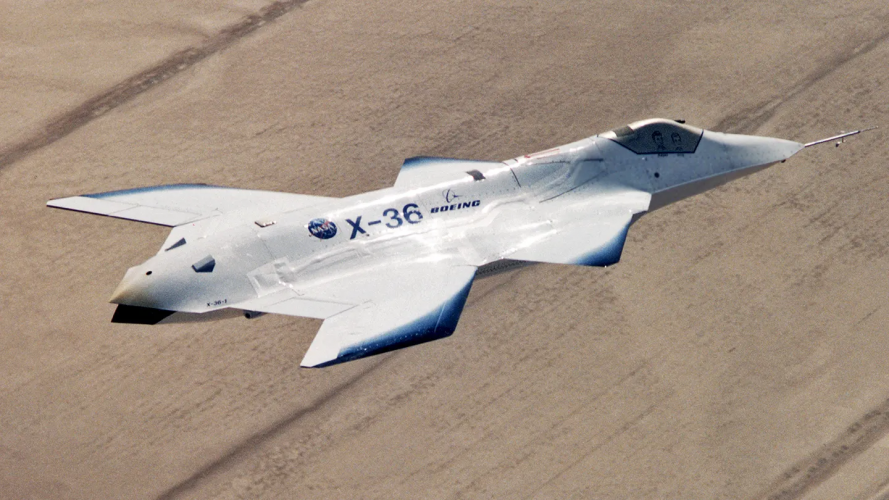
As long as people here do not consider aircraft are designed with compromises, the endless and fruitless discussions will continue.


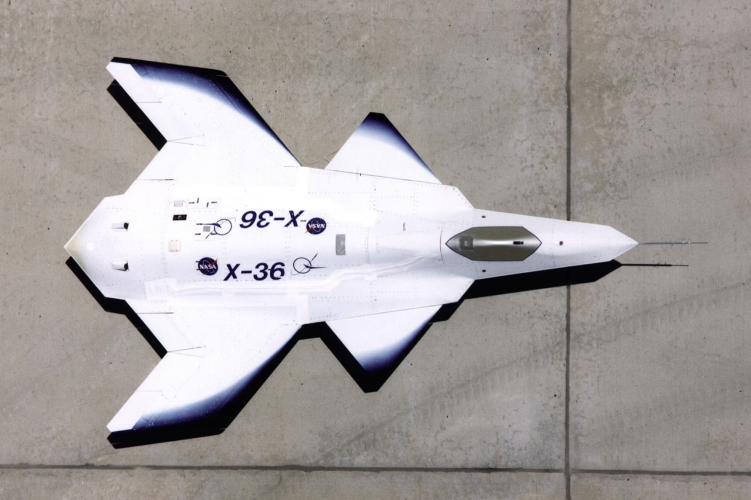
All aircraft compromise, all, J-20 is no exception, some of its features give more priority to aerodynamics than stealth, on X-36 both trailing edges and leading edges of both wings and canards are set at the same swept angle, that does not happen in J-20 plus X-36 does not have dihedral in the canards nor ventral fins and has a stealthier nozzle and lacks vertical tails basically a 6th generation concept.
1752099749894.png

1752100043466.png
The Solutions taken on J-20 are not inferior to X-36 in absolute terms, J-20 gave more importance to reduced R&D time and maneuverability, is not that they did not understand stealth in Chengdu but simply their design had other needs and priorities in few words they compromised, without understanding that this is a fruitless discussion to which I do not intend to continue, but I recommend you to see it as a real factor.

remember X-36 flew for the first time in 1997

1752105362849.png
If you want understand why J-20 is different to X-36 consider Eurofighter has high aspect ratio canards for lower drag and bigger area with respect the wing root that connects with the fuselage, and almost straight wing trailing edge for better elevon and flap effectiveness, J-20 combines both Eurofighter and X-36 with similar solutions to MiG-1.44 and himat
 
Last edited:
As long as people here do not consider aircraft are designed with compromises, the endless and fruitless discussions will continue.

So, I think there is a difference between agreeing that an aircraft (or indeed, any aircraft, or vehicle, or engineering solution overall) is a "compromise" from an engineering point of view (due to
inherent competing demands of various requirements versus available technology) -- versus suggesting that the designers did not have an adequate mastery of XYZ domain due to an aircraft being a compromise from an engineering pov.

Specifically, this part from Overscan imo strikes me as a little illogical (bolded):

It appears to me that the basic layout was selected for primarily aerodynamic reasons without full understanding of stealth shaping at an early stage of development, and then subsequently revised to substantially reduce the RCS without deviating too much from the original design. It may be that due to lack of engine thrust, more attention had to be paid to optimising the aerodynamics at some cost to RCS for example. I don't have any substantive evidence of this theory however. I think the J-36/J-50 will be substantial improvements.

Every aircraft is a compromise between different competing priorities. I'm sure the engineers at Chengdu are perfectly competent people who built a plane that met its requirements. We don't know what that was.

I am in full agreement with the final line that every aircraft is a compromise between different competing priorities -- however if the J-20 had a set of aerodynamic requirements that could only be met by having an aircraft with its specific overall planform and configuration -- twin engines, all moving tails, side intakes, ventral fins, dihedral canard + LERX + delta wing -- then I think one would have to make a rather detailed case to argue that J-20 exhibits any significant RCS reduction deficiencies that are reflective of poor understanding of stealth shaping.

Looking at the aircraft, it has about every stealth shaping measure one could expect for an aircraft that has its specific aerodynamic and planform configuration.

... I also take exception to the idea of "full understanding of stealth shaping" -- which unintentionally implies that it is ever possible to have "full understanding" for something like "stealth shaping" considering signature reduction shaping and design is constantly being iterated and advanced.
For example, US understanding of stealth shaping today is likely more capable than it was in the late 1980s when YF-22 was being developed/designed.


All aircraft compromise, all, J-20 is no exception, some of its features give more priority to aerodynamics than stealth, on X-36 both trailing edges and leading edges of both wings and canards are set at the same swept angle, that does not happen in J-20 plus X-36 does not have dihedral in the canards nor ventral fins and has a stealthier nozzle and lacks vertical tails basically a 6th generation concept.
View attachment 777524

View attachment 777525
The Solutions taken on J-20 are not inferior to X-36 in absolute terms, J-20 gave more importance to reduced R&D time and maneuverability, is not that they did not understand stealth in Chengdu but simply their design had other needs and priorities in few words they compromised, without understanding that this is a fruitless discussion to which I do not intend to continue, but I recommend you to see it as a real factor.

remember X-36 flew for the first time in 1997

I agree with these points you made in isolation, but imo if the question is "does J-20's configuration mean we can suggest that the designers did not have a competent grasp of stealth shaping" -- imo that question can only be answered by first laying the prerequisite that the shaping had to be done in confines of its aerodynamic configuration (as well as engine choice options, to an extent).

(For example, the comparison of J-20 and X-36 in terms of stealth shaping is moot, if we consider that X-36 probably did not have J-20's aerodynamic requirements and thus aerodynamic configuration in mind. We are thus not comparing "like with like")

That is to say, imo the best question to ask is:
"If one were to design a heavy twin engine aircraft that needed to have a planform/configuration inclusive of dihedral canards, LERX, delta wings, all moving tailfins, small ventral fins, and unable to adopt a 2D nozzle for its engines and adopt a LOAN style nozzle instead due to engine industry constraints, does the J-20 exhibit any design features that would make one suspect a significant deficiency in stealth shaping mastery that would be reasonably expected for its time period".

IMO, in that context, the J-20's stealth shaping measures are about as good as one could expect.


All of which is to say, tl;dr -- agree that every aircraft is an engineering compromise, however there is no persuasive basis for us to suggest J-20's design reflected any glaring lack of understanding of stealth shaping compared to international peers of the era when it was designed, when taken in context of its baseline aerodynamic configuration (and thus underlying aerodynamic performance requirements).
 
Last edited:
As long as people here do not consider aircraft are designed with compromises, the endless and fruitless discussions will continue.

I'm an engineering student and aviation enthusiast. I'm fully aware that compromises have to me made in order to find the right balance between certain properties and non-structural factors like cost or ease of maintenance.

But that's not what was implied, people genuine implied an inferior understanding of physics by people who hail from one of the academically most productive countries in the world which essentially gave said people a blank check to develop the first indigenous stealth fighter for their respective country. Something @Blitzo recognizes as well, so it's not like I'm making it up either. If it wasn't meant like that, it's then just a case of very, very poor wording.
 
Last edited:
So, I think there is a difference between agreeing that an aircraft (or indeed, any aircraft, or vehicle, or engineering solution overall) is a "compromise" from an engineering point of view (due to
inherent competing demands of various requirements versus available technology) -- versus suggesting that the designers did not have an adequate mastery of XYZ domain due to an aircraft being a compromise from an engineering pov.
There is no need to go 200 pages saying the same.

All aircraft compromise, in fact in air combat air forces develop tactics, and weapons to fix them.

It is a no brainer to see X-36 has better stealth than J-20 and same F-22 or YF-23, however air combat is not only stealth, it is probable J-20 could surpass F-35 in BVR or WVR combat depending in weapons, sensors and tactics.

in WWII smart P-51 pilots downed Me-262s, or less agile Hellcats could beat Zeros, in fact the MiG-29 was the most dangerous 1990s dogfighter but it was downed by F-16s and F-15s, so it is not only one factor but many what is important in air combat.

J-20 was designed upon compromises that the Chinese would fix upon weapons, sensors, UCAVs etc etc as well further upgrades in avionics.

The best fighter can be beaten with better tactics, P-40s could do that against the Zeros, and same F-16s could down MiG-29s with better radars and AIM-120s, so it is far more complex, but admit the reality, there are more stealthy fighters than J-20, and F-22 and F-35 have several advantages over J-20 in stealth, we like it or not.
 
Last edited:
There is no need to go 200 pages saying the same.

All aircraft compromise, in fact in air combat air forces develop tactics, and weapons to fix them.

It is no a brainer to see X-36 has better stealth than J-20 and same F-22 or YF-23, however air combat is not only stealth, it is probable J-20 could surpass F-35 in BVR or WVR combat depending in weapons sensors and tactics.

in WWII smart P-51 pilots downed Me-262s, or less agile Hellcats could beat Zeros, in fact the MiG-29 was the most dangerous 1990s dogfighter but it was downed by F-16s and F-15s, so it is not only one factor but many what is important in air combat.

J-20 was designed upon compromises that the Chinese would fix upon weapons sensors, UCAVs etc etc as well further upgrades in avionics.

The best fighter can be beaten with better tactics, P-40s could do that against the Zeros, and same F-16s could down MiG-29s with better radars and AIM-120, so it is far more complex, but admit the reality, there are more stealthy fighters than J-20 and F-22 and F-35 have several advantages over J-20 in stealth, we like them or not.

I was not debating the effectiveness of the respective aircraft as weapons systems here.

I am very specially addressing what is reasonable way of judging an aircraft's stealth shaping competency, and I am saying that it can only logically be done in context of the existing aerodynamic configuration/platform (and thus underlying aerodynamic requirements) behind them.

Comparing the X-36 or YF-23 with J-20 or with F-22 for that matter is nonsensical because those aircraft all have different aerodynamic requirements from each other.

If you agree with the above principle then I have no issue.
 
I was not debating the effectiveness of the respective aircraft as weapons systems here.

I am very specially addressing what is reasonable way of judging an aircraft's stealth shaping competency, and I am saying that it can only logically be done in context of the existing aerodynamic configuration/platform (and thus underlying aerodynamic requirements) behind them.

Comparing the X-36 or YF-23 with J-20 or with F-22 for that matter is nonsensical because those aircraft all have different aerodynamic requirements from each other.

If you agree with the above principle then I have no issue.
There is no point argue a lot at the end of the day, real war says who has the better equipment and the better tactics so most of this theoretical debate has to do more with nationalism rather than technical knowledge, people choose sides upon the aircraft they like, I love Rafale so I am bias too, so do not worry I think we can leave it here.

I will not debate it any more this, it will turn into a boring exercise.

regards
 
There is no point argue a lot at the end of the day, real war says who has the better equipment and the better tactics so most of this theoretical debate has to do more with nationalism rather than technical knowledge, people choose sides upon the aircraft they like, I love Rafale so I am bias too, so do not worry I think we can leave it here.

I will not debate it any more this, it will turn into a boring exercise.

regards

No, this is a discussion about the nature of observation and objectivity, this is not a debate about nationalism or war, it's not even a debate about the relative effectiveness of different aircraft.

Specifically, it is about pinning down what is an objective way to try and estimate stealth shaping competency, and I am saying that doing so without consideration of underlying aerodynamic requirements (and thus planform and aerodynamic geometry) is illogical and not objective, and this principle should be applied when observing every aircraft out there for purposes of consistency.


If you are uninterested in the best and most consistent way of determining stealth shaping competency, that's fine, but I would have thought you would have agreed with my position given how much you seem to understand that aircraft are a reflection of compromises.
 
The true RCS value of the F-22, F-35, Su-57, and J-20 are all classified information and it is likely it will remain that way for the foreseeable future.

Not trying to point fingers at anyone here, but there are many people that I find elsewhere that attempt to "find" problems with Chinese military equipment either through overblowing its perceived weaknesses or coming up with weaknesses of their own opinion and not having sufficient evidence to back it up. On the more extreme end, there are also people who come upon what they see and instantly assume the worst, often times without logical basis (e.g. the QBZ-191 "keyhole" debacle), simply because of bias against China.

With the J-20, we can only make deductions from what we see, either through referencing its physical shape, our knowledge of stealth shaping, as well as design considerations made by the designers. Well, everyone is going to have an different opinion because of different biases, knowledge base or depth, etc.

This is really a problem with all of the 5th generation fighters.
Depending on who you ask people will tell you the RCS of the Su-57 is not that horrible, or it's the worst thing ever. Because we don't have concrete numbers people can and will make up their own and attempt to justify it differently with which information they are familiar with, fuelled by their biases.

Because I don't think it is possibly to be 100% objective and non-biased, it's a part of human nature. But the best we can do is not to be blind when we see facts.
 
Well, I am judging two things here.

First we have the Song Wencong article from 2001 describing the layout of the future J-20.

Here I posted the original in Chinese: https://www.secretprojects.co.uk/th...nd-analysis-part-iii.28479/page-8#post-339547
English: https://defence.pk/threads/translation-of-j-20-article-by-dr-song-wencong.165231/

Obviously stealth shaping is considered at a gross feature level in this article, but it seems very much secondary to the aerodynamic features.

Mikoyan did something a little similar with MFI/1.44, assuming they could get the aerodynamics right first and 'stealth up' the basic aerodynamic design for production with adding RAM, internal bay etc.

I think Chengdu selected this basic configuration in 2001 (24 years ago!) first for primarily aerodynamic reasons under Song Wengcong's direction, and then his successor improved its stealth capabilities both during the detailed design phase and again after the prototype, within the limitations of a chosen basic layout.

That seems a better explanation for the mix of well-designed stealth features in some areas and more perplexing decisions elsewhere on the airframe than "China copied the stealth wrong". I may of course be wrong, it is my speculation.

More importantly, I am thinking of e.g. Dan Raymer's comments about Rockwell's ATF design. Rockwell thought they knew RCS and hence stealth as well as anyone. Their theoretical knowledge was pretty good, they'd reduced the B-1 RCS by a factor of 10, but they'd not designed a stealth aircraft before, and some of the hard lessons learned during the detail design of a real stealth aircraft weren't known to them. They just couldn't compete. Lockheed and Northrop were both on their third iteration of stealth aircraft when designing F-22/F-23.

It's a tall order to expect Chengdu to have got everything 100% right on their first try.

I am intrigued to see the J-36 in more closeup detail, as I expect after the experience with developing J-20 they can show their expertise on a clean sheet of paper design.
 
Well, I am judging two things here.

First we have the Song Wencong article from 2001 describing the layout of the future J-20.

Here I posted the original in Chinese: https://www.secretprojects.co.uk/th...nd-analysis-part-iii.28479/page-8#post-339547
English: https://defence.pk/threads/translation-of-j-20-article-by-dr-song-wencong.165231/

Obviously stealth shaping is considered at a gross feature level in this article, but it seems very much secondary to the aerodynamic features.

That article focuses on aerodynamics, so it is entirely reasonable that signature reduction would be secondary for the purposes of that specific paper (in the same way that say, weapons systems or avionics are also secondary).

For the totality of the J-20 overall, one of the earliest industry papers regarding the overall requirements of the next generation fighter in 2003 was actually quite clear about the importance of signature reduction/RF stealth, which I wrote about a few years ago.
In fact when describing the key characteristics of the next generation fighter (in section 4), the first point that they lead with (4.1) is to possess stealth capabilities.

See here:

And here for the full translated paper:


Mikoyan did something a little similar with MFI/1.44, assuming they could get the aerodynamics right first and 'stealth up' the basic aerodynamic design for production with adding RAM, internal bay etc.

I think Chengdu selected this basic configuration in 2001 (24 years ago!) first for primarily aerodynamic reasons under Song Wengcong's direction, and then his successor improved its stealth capabilities both during the detailed design phase and again after the prototype, within the limitations of a chosen basic layout.

That seems a better explanation for the mix of well-designed stealth features in some areas and more perplexing decisions elsewhere on the airframe than "China copied the stealth wrong". I may of course be wrong, it is my speculation.

I genuinely don't understand what perplexing decisions you are referring to.
If one accepts that the aircraft's aerodynamic configuration is a reflection of its aerodynamic requirements, then I really can't see what else they could have done any better to make the aerodynamic configuration more stealthy in context of the era they were in.

If we accept the following as immutable features that cannot be changed or removed from the design due to the need to meet aerodynamic requirements -- twin moving tail, twin engine, dihedral canard+LERX+delta wing configuration, dual fixed ventral fins -- I think they've basically nailed everything about as well as one could expect.

The edges all look appropriately aligned, they have DSI intakes with obvious care to signature management, with chines on the nose that continue to the aircraft's main leading edges, an internal weapons bay and key panels looking reasonably serrated where appropriate, and even an angled low signature chin EOIRST housing.
From the macro perspective, that's about as much as I think one could expect, with the only "omission" being that the engine nozzles are serrated LOAN style rather than 2D rectangular like F-22, but no one gives the F-35 that much grief these days for having a circular LOAN nozzle.

Also, the way that these downselect of airframes would work, is that aerodynamic and RF design progress would be happening simultaneously, and refinements for both aerodynamic and RF reasons (and other reasons like cost, range, size etc) would occur as designs get refined. Which is to say, there's no reason to think they started with a "non-stealthy" design to begin with that gradually and deliberately added stealth features onto -- but rather they likely started with a design that had aerodynamic and RF signature reduction already in place that could meet their aerodynamic needs as well as signature reduction needs, and then the specifics were further refined as detailed design progressed.


More importantly, I am thinking of e.g. Dan Raymer's comments about Rockwell's ATF design. Rockwell thought they knew RCS and hence stealth as well as anyone. Their theoretical knowledge was pretty good, they'd reduced the B-1 RCS by a factor of 10, but they'd not designed a stealth aircraft before, and some of the hard lessons learned during the detail design of a real stealth aircraft weren't known to them. They just couldn't compete. Lockheed and Northrop were both on their third iteration of stealth aircraft when designing F-22/F-23.

It's a tall order to expect Chengdu to have got everything 100% right on their first try.

The MFI/1.44 is so different to J-20 that it's a bit of a counterfactual to even consider whether it would be possible for them to "stealth up" the MFI.

That argument is also uncomfortably close to allowing others to suggest that the F-22 is just a stealthified F-15 with an internal weapons bay (when they're fundamentally different aircraft in every single way).
 
Last edited:
Well, didn't you just agreed with me really?

It's not bad if you assume canard+LERX+delta+ventral fins aero layout is set in stone. If they wanted it F-22 level stealth why would you start from there? Especially the ventral fins - sure you RAM treat them but not having them seems better.

a hopelessly lost tourist asks an old man by the side of the road "Can you tell me how to get to Dublin?". After a few minutes thinking, the man replies "Well, you don't want to start from here".

Moving canards are not ideal even if edge aligned at rest. Ventral fins are not ideal. The LERX section is curved, not aligned to anything. The entire rear section needed rework to be "comparable to F-22"- and some changes were made in this area. I doubt there was much emphasis on rear sector stealth in the requirement.

I'm not an expert, but I believe @quellish has some more detailed observations in the past.

I've never read the 2003 paper linked, so thanks for that.
"the forward aspect (+/-45 degrees) radar cross-sectional area is under 0.3m2, which is about 2 orders of magnitude smaller than fourth-generation fighters"

Two orders of magnitude is far from F-22 levels of RCS reduction, while the statement implies 4th gen fighter frontal RCS is 30 sq m. This is pretty high - maybe a fully loaded F-15 with tanks and missiles?

I think this is the last I'll say on the matter. I would still say its probably the most stealthy non-US fighter in service, which is nothing to be sniffed at.
 
Last edited:

Similar threads

Back
Top Bottom