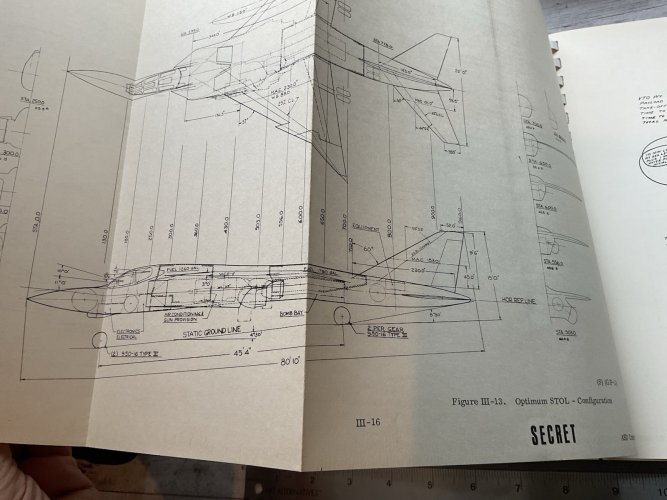
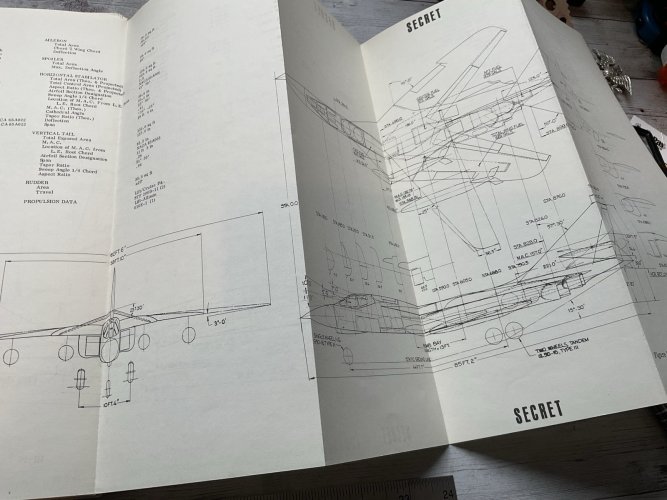
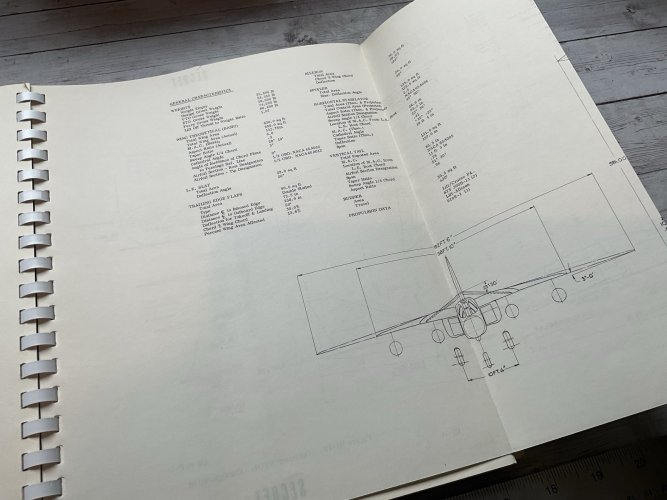
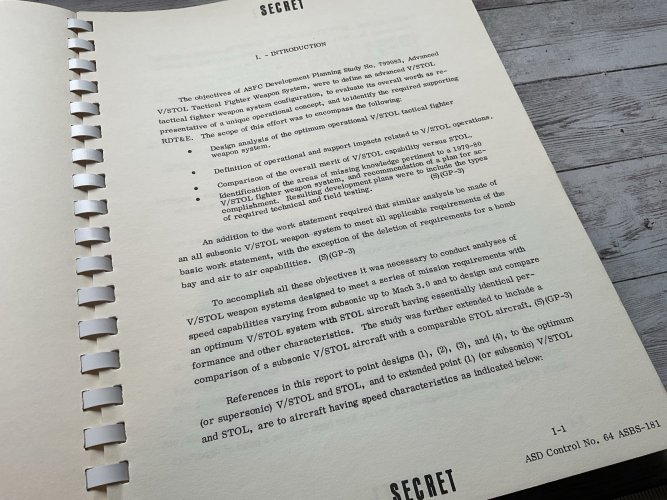
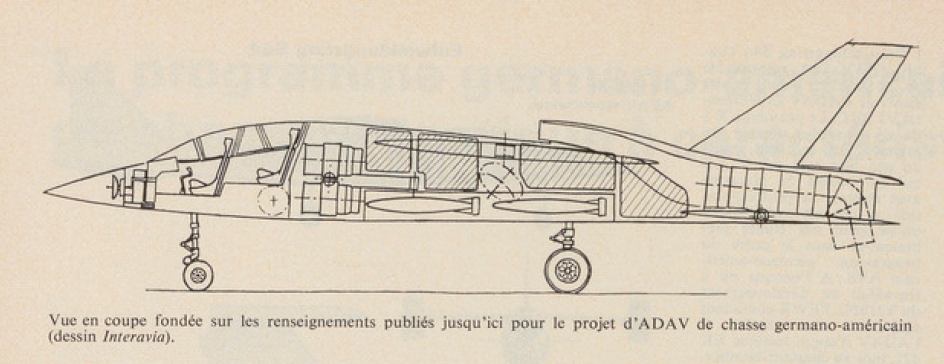
The US certainly devoted a lot of time and effort to VSTOL from the 50s on.
I think they came to the sensible conclusion and left it to the Marine Corps.
VSTOL is just really, really inefficient and doesn't make much sense with our current level of tech. Brits did it about as well as it could be done with the Harrier model of a central engine with rotating nozzles that doesn't penalize you with lots of extra weight. The Russian/US approach suffers from those extra vertical engines behind the cockpit that become useless weight in flight and takes up space that's needed for fuel. And even the Harrier/Pegasus model still suffers the range issue. Out in the fleet, US Navy pilots would joke that Marine Harrier drivers would be in Bingo Fuel as soon as they'd finished taking off.
 
In another thread (in the Designations section) boxkite mentioned a 2001 visit to the EADS archive. And it sounds as though the resident archivist is none to keen on visitors ... perhaps explaining why this archive has no website?

For those in the Munich area looking for an outing, maybe just bang on the door and demand to see Herr Mühlbauer? :p

...
Oh no, stop! Mr. Mühlbauer was a great help to us! It wasn't his fault that we weren't allowed to see or even copy everything. Our first (and only) visit was to gather material for presentations on vertical take-off projects from all over the world. If we had not limited ourselves to this, he would certainly have provided other documents in advance. It was around this time that his superiors decided that he should no longer be a permanently employed archivist at EADS, but should become self-employed in order to serve his previous employer in this way - EADS thus avoided insurance obligations and the like. Visitors from outside did not bring the company any money, it cost them money, because Mr. Mühlbauer would have had to look after us.
As I said, the decision-makers had other things in mind than pleasing a few 'project collectors' :confused:.
If he is reading this, I would like to thank Wolfgang M. once again for the help he gave us on this one day. Not forgetting the interesting articles he published in the magazine FLUGZEUG CLASSIC - I only have to mention the EK-33 ground attack aircraft project.
 
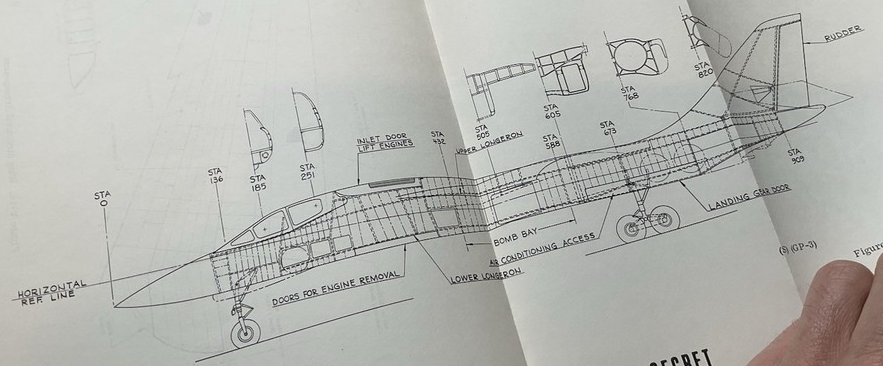
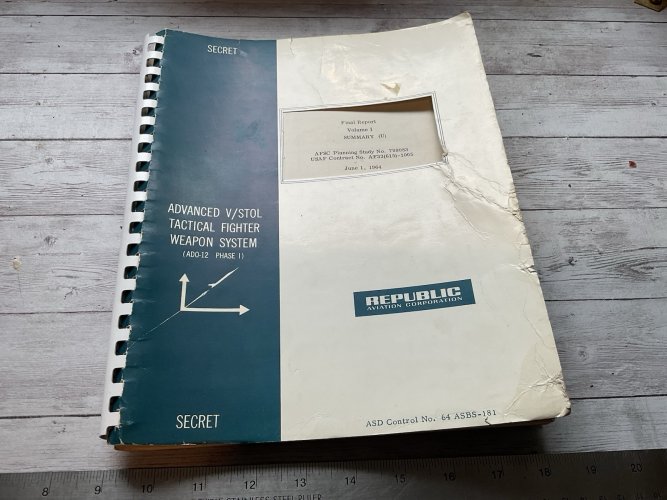
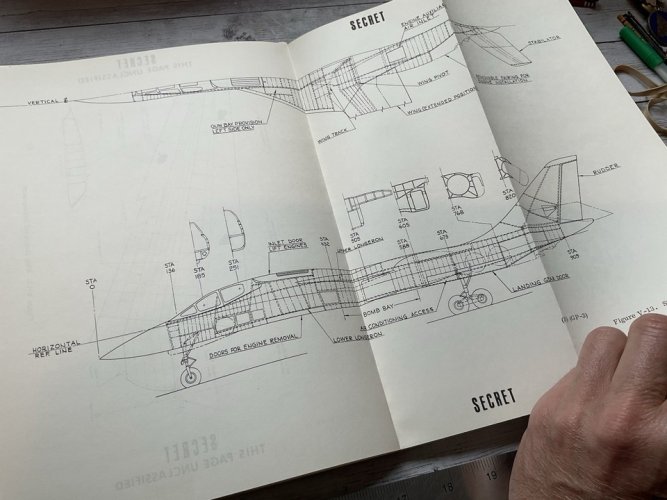
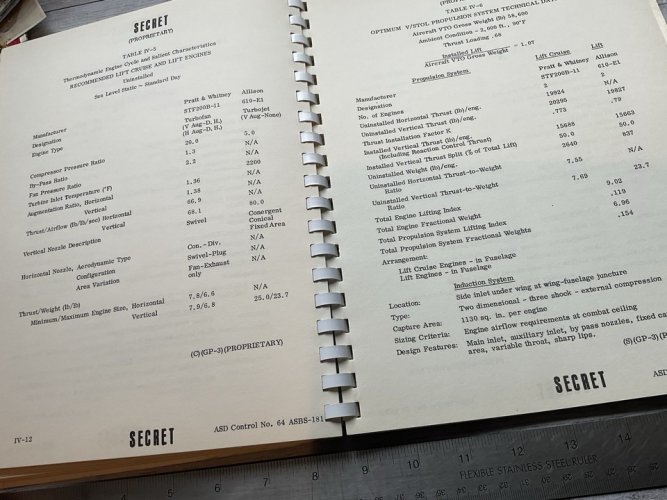
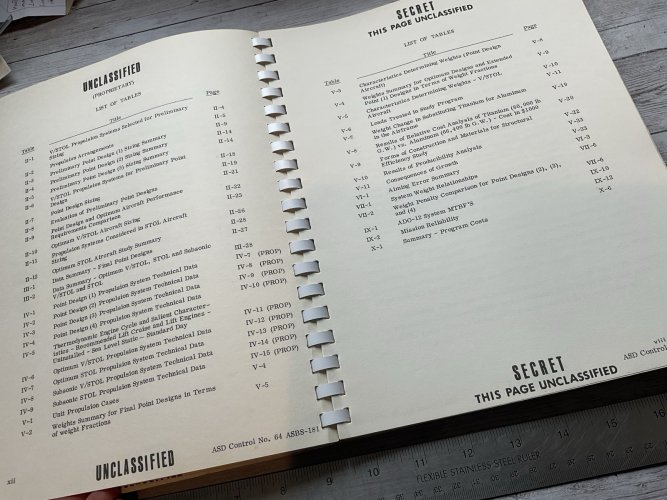
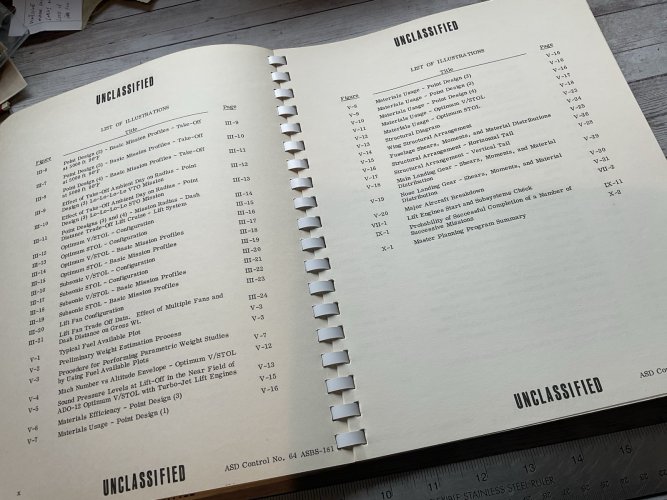
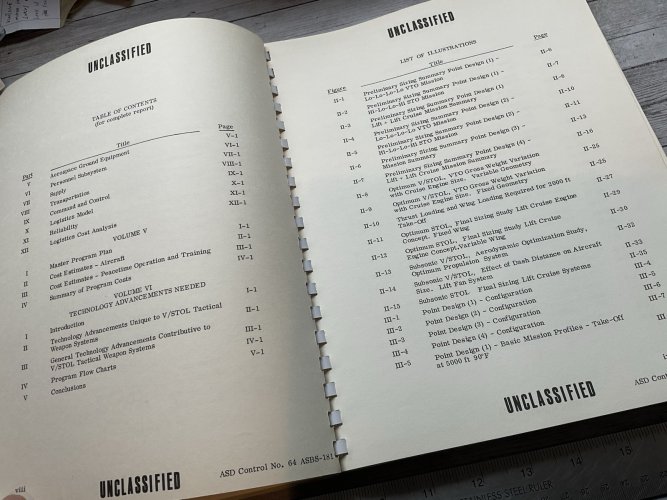
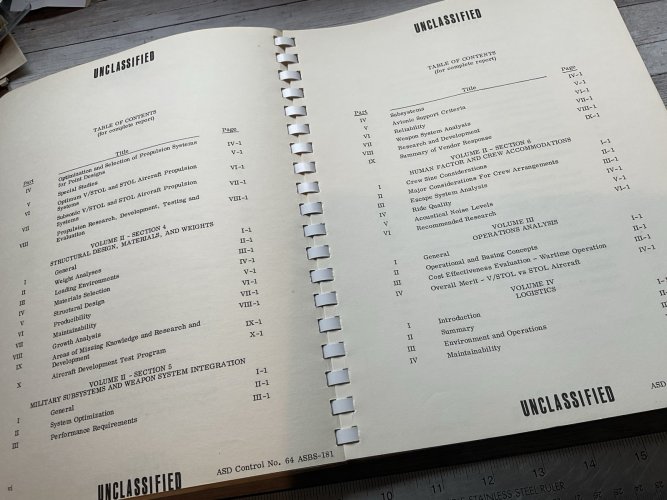
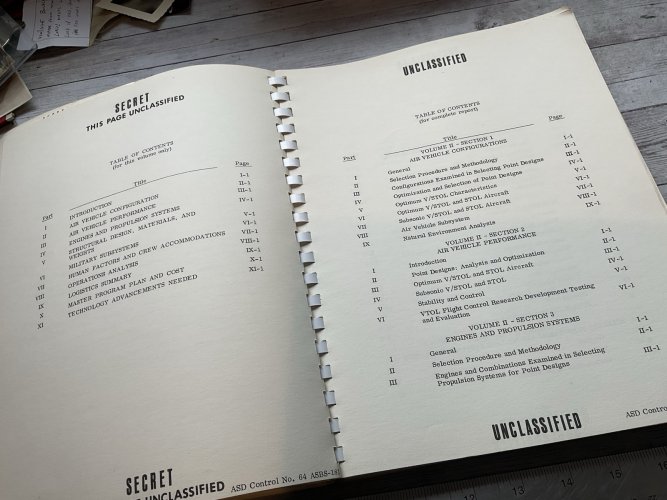
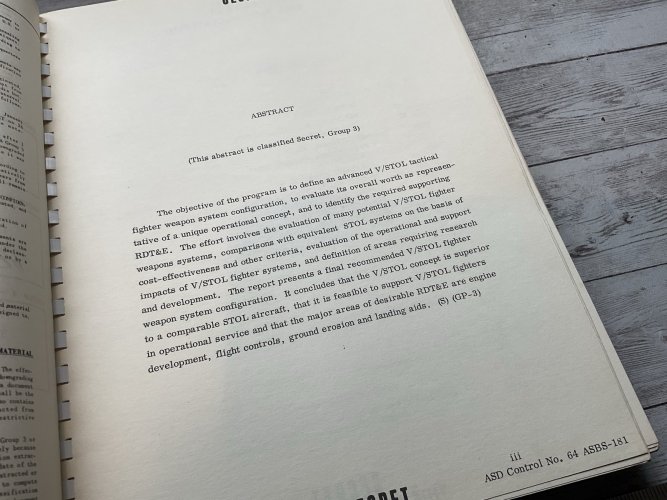
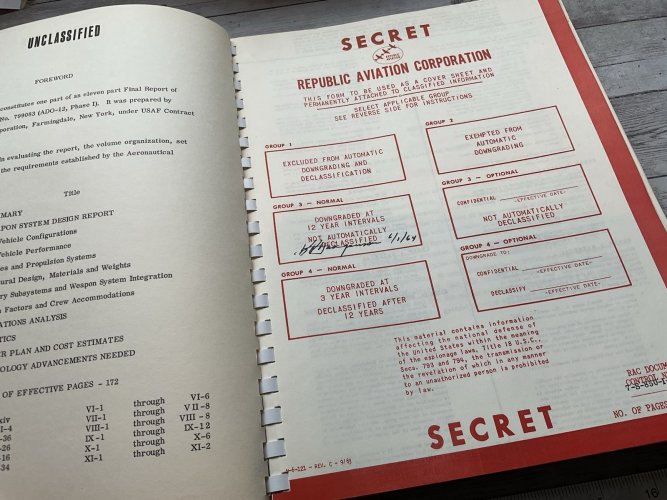
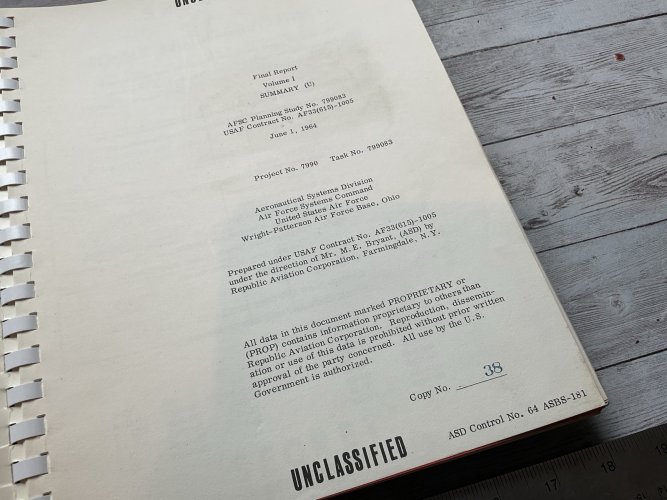
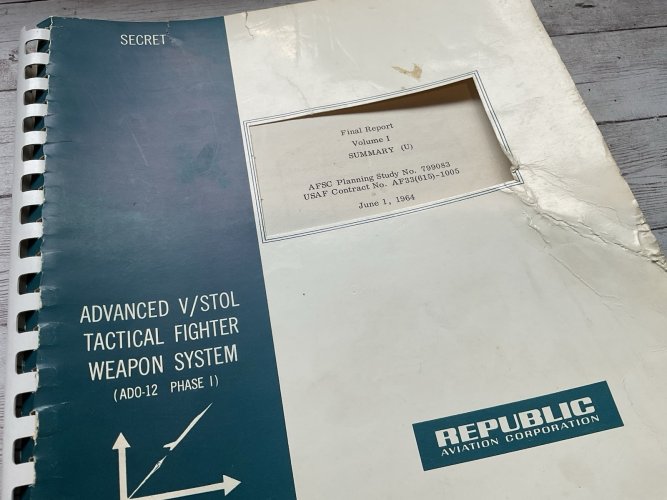
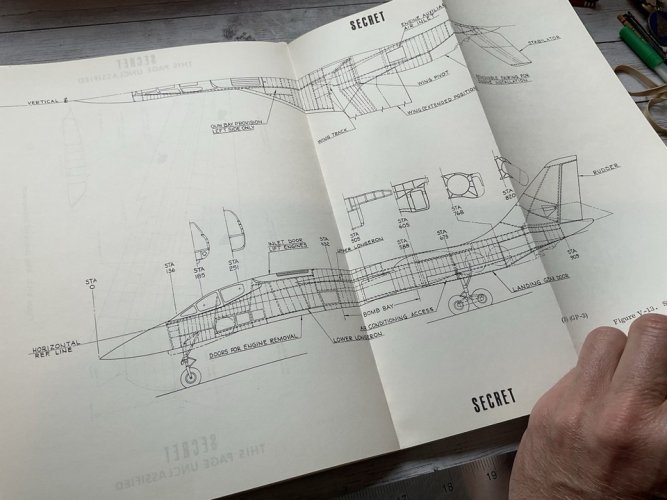
A guy is currently selling the once "Secret" Final Report Volume I on the ADO-12 Phase 1 program.
At $750 it is unlikely that any of us can afford it, but at least I've saved all 16 images in their largest version for the forum:

1749397983408.png
 

Attachments

  • 1.jpg
    1.jpg
    443.5 KB · Views: 132
  • 16.jpg
    16.jpg
    143.8 KB · Views: 70
  • 15.jpg
    15.jpg
    170.5 KB · Views: 71
  • 14.jpg
    14.jpg
    410.6 KB · Views: 69
  • 13.jpg
    13.jpg
    407.9 KB · Views: 67
  • 12.jpg
    12.jpg
    337.6 KB · Views: 58
  • 11.jpg
    11.jpg
    529 KB · Views: 55
  • 10.jpg
    10.jpg
    487.9 KB · Views: 49
  • 9.jpg
    9.jpg
    457.4 KB · Views: 46
  • 8.jpg
    8.jpg
    449.1 KB · Views: 59
  • 7.jpg
    7.jpg
    401.7 KB · Views: 42
  • 6.jpg
    6.jpg
    414.9 KB · Views: 40
  • 5.jpg
    5.jpg
    461.8 KB · Views: 46
  • 4.jpg
    4.jpg
    478.8 KB · Views: 45
  • 3.jpg
    3.jpg
    462.5 KB · Views: 41
  • 2.jpg
    2.jpg
    361.3 KB · Views: 56
A guy is currently selling the once "Secret" Final Report Volume I on the ADO-12 Phase 1 program.
At $750 it is unlikely that any of us can afford it, but at least I've saved all 16 images in their largest version for the forum:

View attachment 773085
$750 is in the ballpark of a group buy, potentially, if enough people are willing to chip in.
 
Thanks very much for sharing your find Stargazer

An attractive and sleek design, none the less.
Love the landing gear.

Is there an actual artist impression of this given drawing within this thread?

Regards
Pioneer
 

Attachments

  • 16.jpg
    16.jpg
    143.8 KB · Views: 431
Thanks very much for sharing your find Stargazer

An attractive and sleek design, none the less.
Love the landing gear.

Is there an actual artist impression of this given drawing within this thread?

Regards
Pioneer
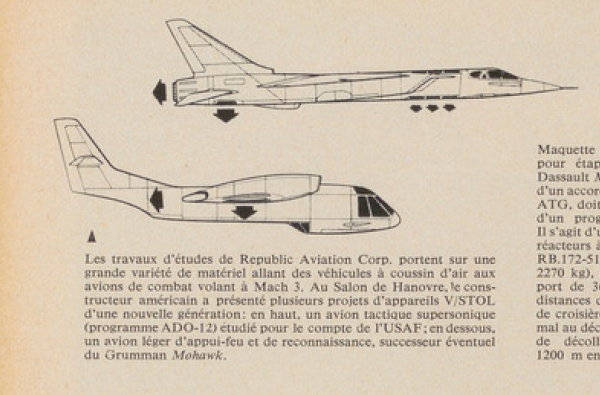
No. It has some family resemblance to other Republic VSTOL projects though.
16-jpg.773305


us-german-nkf-model-2-sm-jpg.611028


republic-ap100-a-jpg.205363
 
Last edited:
UNITED STATES INVOLVEMENT IN CODEVELOPMENT: AN ANALYSIS Of THE US/FRG V/STOL FIGHTER AIRCRAFT PROJECT AND NATO SEASPARROW PROJECT
Captain Melvin T. Baas
 

Attachments

  • AD0891385.pdf
    9.5 MB · Views: 70
Last edited:
Comment This design resembles the one referenced in the novel "Shadow 81" by the writer Lucien Nahum, where using a new fighter stolen by its pilot during a mission in Vietnam, he uses it with his accomplice to intercept and threaten to shoot down a passenger plane...!
 

Attachments

  • 3265009.jpg
    3265009.jpg
    102.2 KB · Views: 98
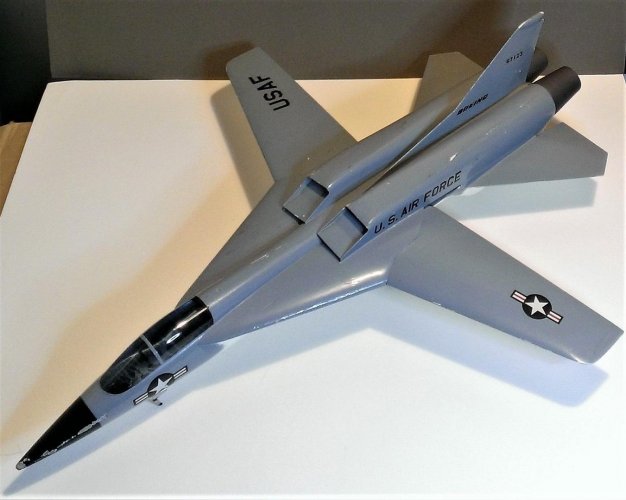
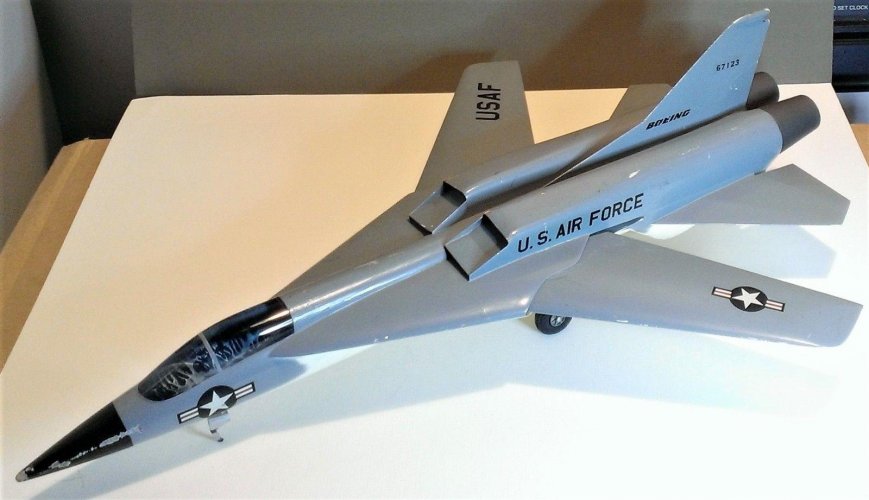
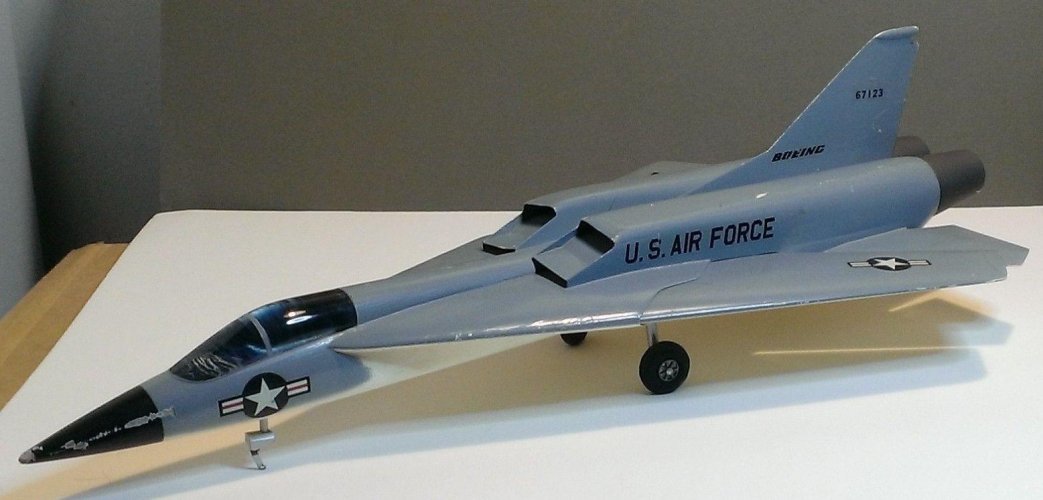
https://www.worthpoint.com/worthopedia/vintage-wooden-swing-wing-fighter-jet-1937589145
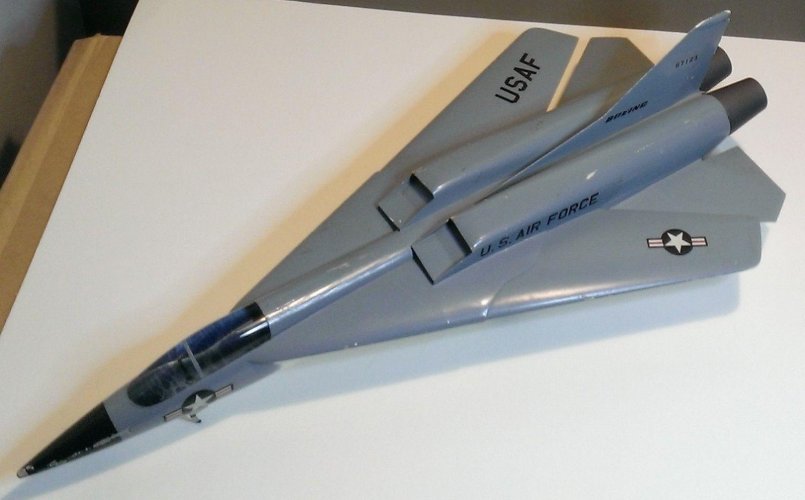
Vintage Wooden Swing Wing Fighter Jet ModelI have not been able to identify this model, but my best guess is that is a 1960s vintage V/STOL prototype, or a variant of the West German AVS described in the included link.The model has some condition issues, so please look at the photos carefully. The wings are geared internally and move together. The front landing gear is missing its wheel. The landing gear is easily removed for in-flight display. The cockpit looks to be cut from a solid piece of plastic. The model is about 19 inches long and the wingspan is about 15 inches when the wings are swung out.https:///news/articles/kings-of-the-swingers-top-13-swing-wing-aircraft-404176/Thanks! I've learned that this may be the Boeing Model 818, Boeing's proposal for the DOD's Tactical Fighter Experimental (TFX) program of the early 1960s.
[Admin - added other images and text description including size.]
 

Attachments

  • 1_6170990bdd2fff49dcfe11540075ca5b.jpg
    1_6170990bdd2fff49dcfe11540075ca5b.jpg
    120.5 KB · Views: 71
  • 1_6170990bdd2fff49dcfe11540075ca5b.jpg
    1_6170990bdd2fff49dcfe11540075ca5b.jpg
    139.9 KB · Views: 30
  • 1_6170990bdd2fff49dcfe11540075ca5b (1).jpg
    1_6170990bdd2fff49dcfe11540075ca5b (1).jpg
    112.3 KB · Views: 28
  • 1_6170990bdd2fff49dcfe11540075ca5b (4).jpg
    1_6170990bdd2fff49dcfe11540075ca5b (4).jpg
    116.3 KB · Views: 30
Last edited by a moderator:
US/FRG UNITED STATES/FEDERAL REPUBLIC OF GERMANY TACTICAL FIGHTER’ PROGRAMME

AIRFRAME PRIME CONTRACTORS:
Fairchild Hiller Corporation, Republic Aviation Division, Farmingdale, Long Island, New York 11735, USA Entwicklungsring Sid GmbH, 8 Miinchen 26, Museumsinsel 1, Germany

INDUSTRIAL MANAGEMENT: EWR / Fairchild International, Munich, Germany
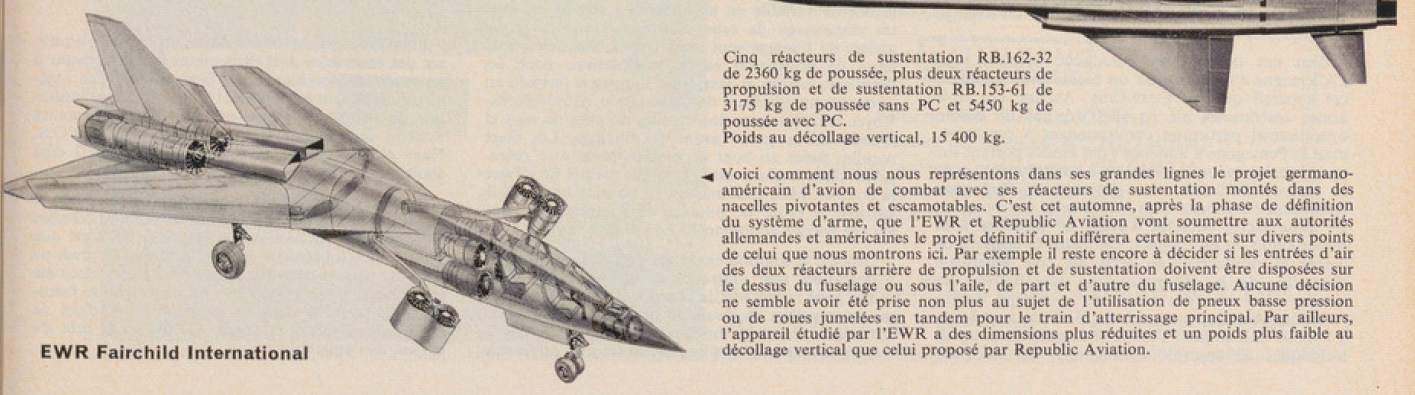
The aim of this bi-national programme is the study, development and construction of a highly-flexible advanced weapon system, embodying vertical and/or ultra-short take-off capability, to replace the Starfighter aircraft at present in service with the Luftwaffe and some types of current USAF tactical combat aircraft. The US/FRG project was initiated by a German American Memorandum of December 12, 1964, on the joint development of weapon systems, and the signing of the “Statement of Desired Work for a US/FRG Design Study”, of February 2, 1965. During 1965-66, eighteen US and two German companies put in proposals in answer to a government request. In November 1966, a US/FRG government committee designated EWR of Germany and Fairchild Hiller’s Republic Aviation Division as equal partners to perform initially the Project System Definition Phase (SDP). EWR and Fairchild Hiller have company EWR/Fairchild for industrial management of the during the seven-month SDP which began on April 24, 1967. After evaluation of the SDP study, the two governments will decide whether or not to proceed with the construction of prototypes. The inter-government agreement provides for the manufacture of twelve prototypes. Government management of the programme is the responsibility of a joint German American Programme Office at Wright-Patterson AFB, Ohio, USA.

US/FRG PROJECT
Detailed specifications of the US/FRG fighter are classified, but the adjacent illustration shows a model of one of the design studies that was exhibited at the 1967 Paris Air Show. It represents a medium-weight tactical fighter, eapable of operating conventionally, from short airstrips, or vertically. The fighter will have variable-geometry wings and will be powered by both lft and lift-cruise engines. The lift engines are being developed jointly by Allison in the USA and Rolls-Royce in the UK. Four of them will be fitted, in pairs, on arms which swing out from each side of the fuselage just forward of the wing leading-edges. They will be able to tilt in varying degrees from the horizontal, to provide vertical lift or short take-off capability. In an emergency, they could be used to give the aircraft a ‘“‘return-home”’ capability after failure of the main lift-cruis« engines. When not in use they will retract into the fuselage. The turbofan lift-cruise developed by the US government. The competition for their development and production is between Pratt & Whitney and General Electric. Two of the engines will be mounted side-by-side in the rear fuselage and will be fitted with tilting nozzles so that they can provide deflected thrust during take-off. A crew of two will be carried in tandem, the second man serving as back-up pilot or in any other role demanded by be flown.

From Jane's All the World's Aircraft 1967-68
 
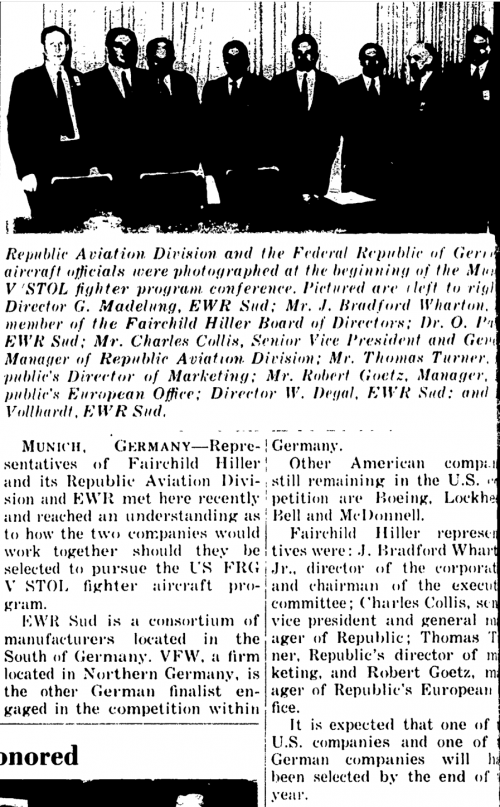
Republic Aviation Division and the Federal Republic of Germany
aircraft officials were photographed at the beginning of the Munich
V/STOL fighter program conference. Pictured are (left to right)
Director G. Madelung, EW R Sud; Mr. J. Bradford Wharton,
member of the Fairchild Hiller Board of Directors; Dr. O. P[illegible]
EWR Sud; M r. Charles Collis, Senior Vice President and General
Manager of Republic Aviation Division; Mr. Thomas Turner,
Republic’s Director of Marketing; Mr. Robert Goetz, Manager,
Republic's European Office; Director W.. Degal, E W R Sud: and [illegible]
Vollhardt, E W R Sud.
https://westislip.advantage-preserv...york_west_islip_19660501_english_4&df=1&dt=10
 

Attachments

  • Republic EWR.png
    Republic EWR.png
    456.9 KB · Views: 16
Back
Top Bottom