Italy was still under the limits of the international naval treaties, which forbid them from building capital ships for export. The best you can do is share a design with a power that wants to build them on their own, as was done with the Soviets. Which actually reminds me, I need to add to this post with some of the information about the designs beyond UP.41 now that we have a bit more information on them.
Erm, no. The Treaty system did not forbade building capital ships for export; it forbade requisitioning export-build ships for builder's own fleet. Selling ships from you fleet was also forbidden; but you could build ships for non-treaty customers provided that they would be in strict adherence to size & main guns limits.
 
Here are the specific WNT articles considering export:

Article XV​

edit
No vessel of war constructed within the jurisdiction of any of the Contracting Powers for a non-Contracting Power shall exceed the limitations as to displacement and armament prescribed by the present Treaty for vessels of a similar type which may be constructed by or for any of the Contracting Powers; provided, however, that the displacement for aircraft carriers constructed for a non-Contracting Power shall in no case exceed 27,000 tons (27,432 metric tons) standard displacement.

Article XVI​

edit
If the construction of any vessel of war for a non-Contracting Power is undertaken within the jurisdiction of any of the Contracting Powers, such Power shall promptly inform the other Contracting Powers of the date of the signing of the contract and the date on which the keel of the ship is laid; and shall also communicate to them the particulars relating to the ship prescribed in Chapter II, Part 3, Section I (b), (4) and (5).

Article XVII​

edit
In the event of a Contracting Power being engaged in war, such Power shall not use as a vessel of war any vessel of war which may be under construction within its jurisdiction for any other Power, or which may have been constructed within its jurisdiction for another Power and not delivered.
 
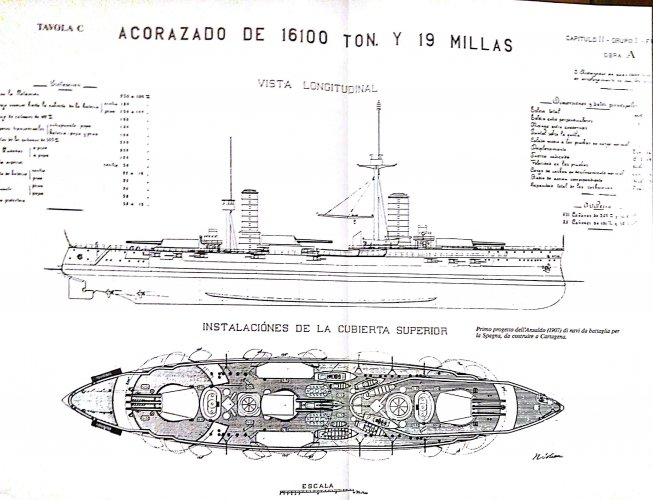
Does anyone know what the armor and other specifics are for this Battleship is? I can't quite read anything written on the sides. Any information would be greatly appreciated. :)
 

Attachments

  • h552br287mh4hbemr0ey67y3.jpg
    h552br287mh4hbemr0ey67y3.jpg
    397.1 KB · Views: 198
Three Ansaldo small battleship Project

View attachment 634751
Hi Everyone!!

I'm trying to track down information of the middle of these three ships. @ptdockyard identified it as the "1923 BB often called 'Livorno class'".

I've been trying to find some other reference to this ship but have come up empty. Does anyone have more information about it?

Thanks!!! :)
 
Hi Everyone!!

I'm trying to track down information of the middle of these three ships. @ptdockyard identified it as the "1923 BB often called 'Livorno class'".

I've been trying to find some other reference to this ship but have come up empty. Does anyone have more information about it?

Thanks!!! :)

The middle ship is the 23,000-ton battleship study from 1928.

It is possible that the study is a bit older than this, but it was presented for discussion by the Naval Staff in February 1929, so we know it was developed no later than 1928. This discussion centered on future battleship construction for the Regia Marina. At this time, Italy (along with France) was allowed to make use of 70,000 tons of 'free' capital ship tonnage under the Washington Naval Treaty that could be built prior to the expiration of the capital ship building holiday imposed by that treaty. Two solutions were formed from this - a 35,000-ton option, two of which could be built with the available tonnage, and a 23,000-ton option - which would allow a full division of three battleships. Either type were intended as fast battleships (not battlecruisers, as is sometimes stated).

The smaller option was a 190-meter battleship that would displace 23,000 tons at standard displacement and was intended to have top speed of 28/29 knots (29 knots at normal displacement, 28 knots at full load). The ship would be well protected, with a 330mm main armor belt, adequate deck protection (I've never seen a thickness published) and a torpedo defense system. The main armament was to compose of six 381mm guns in three twin turrets (A-B-Y) and would be backed by a secondary battery of eight (4x2) 152/53 M1929 and an anti-aircraft battery of twelve (6x2) 100/47 M1927. Two catapults were included for four floatplanes. The superstructure's layout still clearly reflects the 1920s style of the RM (pre-Pugliese tower), with the larger enclosed volume that characterizes the cruisers Bolzano and Pola.

The estimated cost for building three ships came out to 1.05 billion lire (350 million per ship), which was notably less than the 35,000-ton option, but the RM's Naval Staff remained firmly in favor of the larger battleships. Fundamentally, so long as the treaty allowed up to 35,000-ton ships, the RM had no reason to expect any powers would opt to build anything less than the maximum units possible, which would inherently devalue a 23,000-ton ship. The British had indeed already done this with the Nelson-class, and all treaty signatories had built their new generation of light cruisers to the maximum characteristics allowed by the treaty (8" guns and 10,000 tons).

In any case, regardless of the RM's own internal discussions on which ship type would be favorable, there was an understanding that in any case there would be no money for new battleships unless another power (namely, France) began building new capital ships - the Italian government did not want to be the first mover on renewed capital ship construction.
 
The middle ship is the 23,000-ton battleship study from 1928.

It is possible that the study is a bit older than this, but it was presented for discussion by the Naval Staff in February 1929, so we know it was developed no later than 1928. This discussion centered on future battleship construction for the Regia Marina. At this time, Italy (along with France) was allowed to make use of 70,000 tons of 'free' capital ship tonnage under the Washington Naval Treaty that could be built prior to the expiration of the capital ship building holiday imposed by that treaty. Two solutions were formed from this - a 35,000-ton option, two of which could be built with the available tonnage, and a 23,000-ton option - which would allow a full division of three battleships. Either type were intended as fast battleships (not battlecruisers, as is sometimes stated).

The smaller option was a 190-meter battleship that would displace 23,000 tons at standard displacement and was intended to have top speed of 28/29 knots (29 knots at normal displacement, 28 knots at full load). The ship would be well protected, with a 330mm main armor belt, adequate deck protection (I've never seen a thickness published) and a torpedo defense system. The main armament was to compose of six 381mm guns in three twin turrets (A-B-Y) and would be backed by a secondary battery of eight (4x2) 152/53 M1929 and an anti-aircraft battery of twelve (6x2) 100/47 M1927. Two catapults were included for four floatplanes. The superstructure's layout still clearly reflects the 1920s style of the RM (pre-Pugliese tower), with the larger enclosed volume that characterizes the cruisers Bolzano and Pola.

The estimated cost for building three ships came out to 1.05 billion lire (350 million per ship), which was notably less than the 35,000-ton option, but the RM's Naval Staff remained firmly in favor of the larger battleships. Fundamentally, so long as the treaty allowed up to 35,000-ton ships, the RM had no reason to expect any powers would opt to build anything less than the maximum units possible, which would inherently devalue a 23,000-ton ship. The British had indeed already done this with the Nelson-class, and all treaty signatories had built their new generation of light cruisers to the maximum characteristics allowed by the treaty (8" guns and 10,000 tons).

In any case, regardless of the RM's own internal discussions on which ship type would be favorable, there was an understanding that in any case there would be no money for new battleships unless another power (namely, France) began building new capital ships - the Italian government did not want to be the first mover on renewed capital ship construction.
Wow!!

Thank you so much!!! :)
 
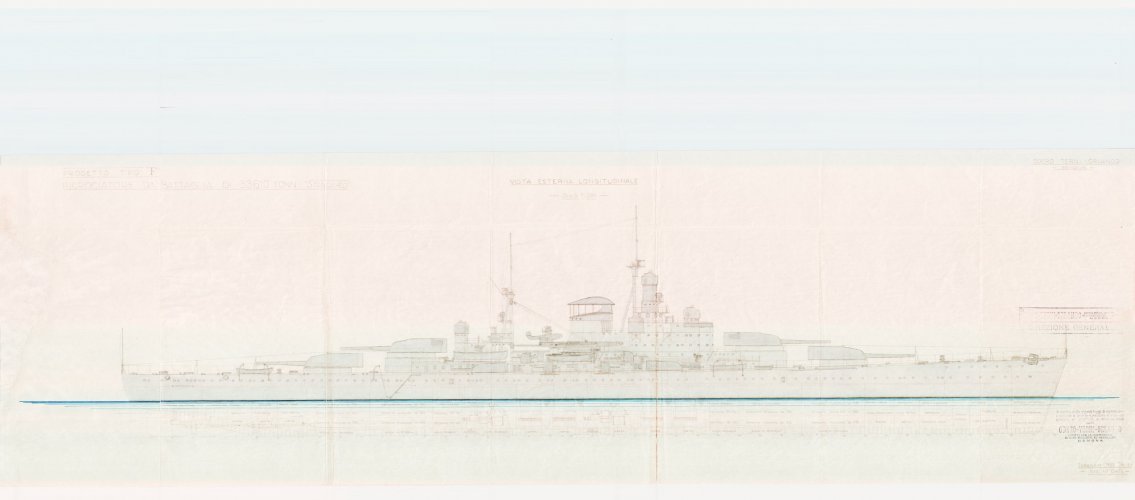
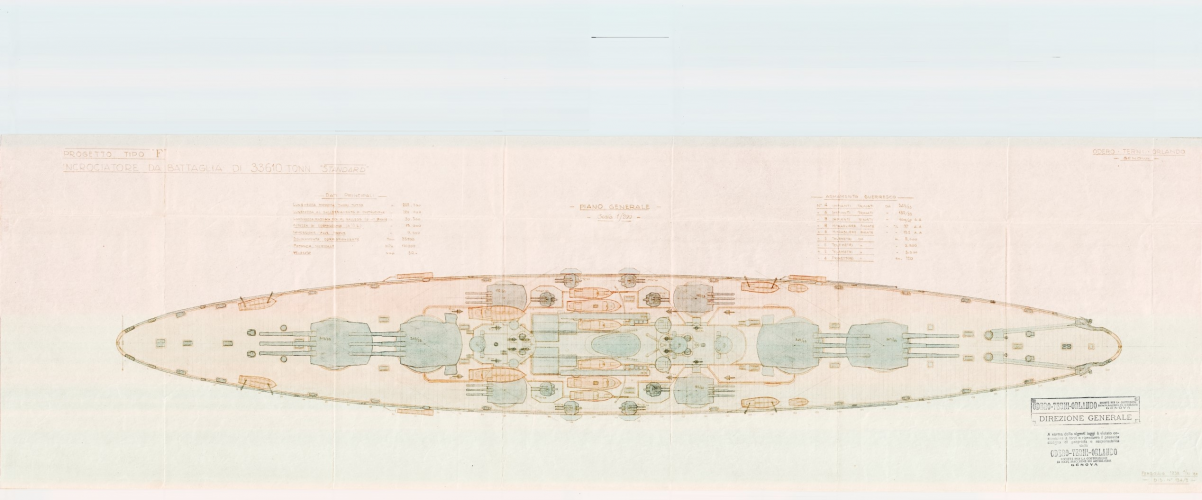
Hello @Phoenix_jz, do you happen to have any higher quality pictures of OTO battlecruiser "Type F" (Progetto Tipo F)?

The best I have are these:


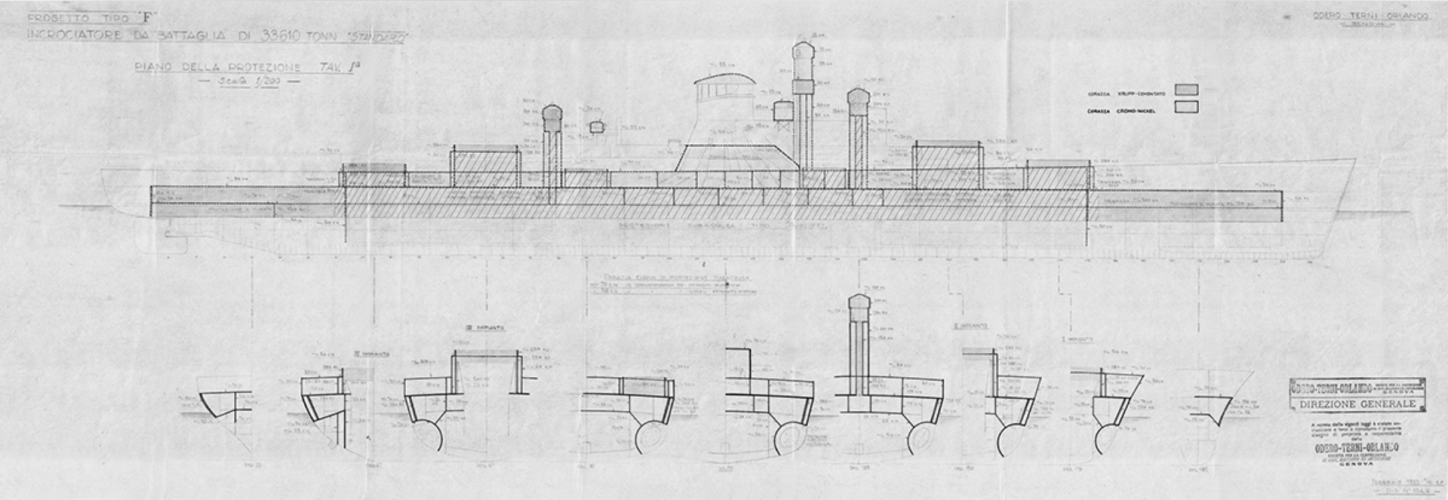
The last image shows the armor scheme but is too low resolution to be readable. Fortunately, we have a description of the scheme from RAdm Michele Cosentino's recent article on Italian monitor and battlecruiser designs in Warship 2025:

The protection scheme for ‘Type F’ was inspired by that developed by General Umberto Pugliese, Naval Engineering Corps, Italian Navy, in which a cylindrical structure inside a 50mm CN curved torpedo bulkhead was integrated into the lower part of the hull to absorb the force of a torpedo warhead explosion. Vertical protection called for an inclined main multilayered belt extended in length for 180 metres to include magazines and machinery spaces. There was a 70mm CN external plate and a KC 250mm internal plate with a 60mm wooden backing. The armoured citadel was closed by 200mm KC transverse bulkheads and was topped by an armoured deck of 110mm CN plating. There were 50mm CN steel plates on the upper part of the hull sides. Forward and aft of the citadel, the thickness of the belt was reduced to 150mm KC with a 50mm wooden backing, applied directly to the shell (ie without an external decapping plate). There were 150mm KC transverse bulkheads at the outer ends of these secondary armoured boxes, which were topped by a 50mm CN deck. The lower edge of the main multilayered armoured belt was secured to the curved torpedo bulkhead of the Pugliese system.

The upper decks had 30mm CN plating. The barbettes of the main gun turrets had 250mm KC plates with a 60mm CN decapping plate, increasing to 280mm (without the decapping plate) above decks and decreasing to 200mm + 25mm beneath the forecastle deck. The forward fire control post had KC plates whch varied in thickness from 120mm (roof) to 280mm (walls), while the communications tube was formed by 150mm hoops with an outer ring of 60mm CN plates. The after fire control post had a similar arrangement, but the walls were reduced to 150–200mm plates of KC, the roof to 30mm CN, and the communications tube to 120mm KC + 60mm CN. The highest of the three main control positions had relatively light protection, with only 25mm CN plates over the director but a lower cylinder (serving as a conning tower) with 90mm KC walls. The funnel had a 25mm CN cap and there was 50–100mm CN plating on the boiler uptakes.

Despite the design being called a battlecruiser, the design is actually quite substantially protected for a 33,610-ton (standard) vessel and is effectively just a fast battleship.
 
This is was am looking for, thank you so much and i happen to have John Jordan latest Warship 2025 edition but sadly a file form send by a friend of mine... still a colored and slightly better resolutions are enough for me (will use them for future warship model builds).
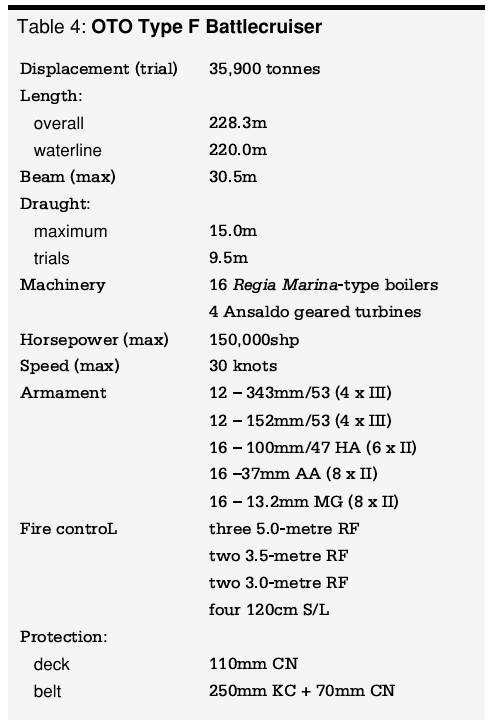
Here's the ship specifications for those who haven't get Warships 2025.
Type F specs.png
 
Last edited:
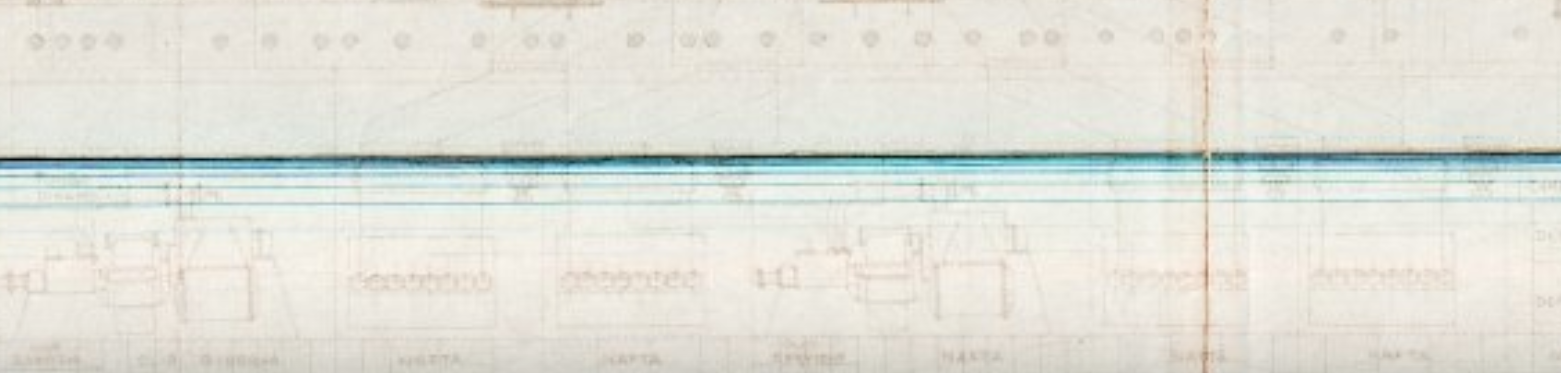
One note I would add on these statistics - RAdm Cosentino for some reason speculates about the presence of sixteen boilers, though why I am not clear on - the line literally reads: "As for machinery, the plans feature four shafts driven by geared turbines, with steam supplied by boilers (probably sixteen) housed in four separate rooms in a classic unit arrangement (BR1&2+ER1, BR3&4+ER2)."

I can think of no reason why the design would have so many boilers at this point in time, and given each boiler room only has one set of boilers across, that would imply four boilers across for each room - which certainly would not fit. The only reasonable number I can think of would be that there are eight larger boilers, effectively making this layout a somewhat more conventional version of the one that was used on the Littorio-class (which, FWIW, was initially designed with ten boilers, reduced to eight in June 1934).
 
Yes 10 is more likely based on the funnel uptakes and the longitudinal section view
 
Yes 10 is more likely based on the funnel uptakes and the longitudinal section view

Looking at the longitudinal view, I am only seeing four boiler rooms and four sets of trunks (plus the two engine rooms, each with two turbine groups), which would imply some multiple of four for the number of boilers present. Eight at a minimum, but twelve would theoretically be possible (though it seems extremely unlikely given how narrow the 'true' citadel of the ship is, and Italian design practice at this point in time).

1754497292253.png

Though it is worth noting that the output power, assuming that is meant to reflect full normal power, is consistent with what Littorio was supposed to achieve when she had ten boilers - 150,000 shp. It was reduced to 130,000 shp when the boilers were reduced to eight.

But then again it could also be reflected full maximum power (which for example on the Littorio-class, as completed, was 160,000 shp). Or OTO was simply more bullish about achieving a higher output with eight boilers.
 
I thought I've seen 5 uptakes..
But yeeah 8-12 is logical. The Yamatos had 12 boilers for 150K shp, the Lions and Vanguard had 8 for 130K (110K for KGV) the Bismarck class had 12 boilers for 148-160K shp.
 
Unless my eyes are deceiving, there seems to be a fifth but smaller trunk in the middle (on the 3rd pic) and it stop at the second deck.
 
Unless my eyes are deceiving, there seems to be a fifth but smaller trunk in the middle (on the 3rd pic) and it stop at the second deck.

That would likely be leading towards a pair of so-called 'donkey boilers', which were common on Italian ships of the era and used to handle some hotel steam loads when the boilers were not online, or to help the main boilers start up.
 
It was common on other navies as well, also likely the Diesel generators were connected to it as well
 
Judging by stern, superstructure, funnel and AA guns disposition it seems a fictional design. In mid '30 between the first and the second Littorio's pair, Italian navy had a great interest in small battleships but the picture you posted is very different from any proposal I know. Here are some official Italian small BB designs for a comparison
Hi guys. I'm trying to find more information on the Italian Battleship design that Wargaming used as the basis for Michaelangelo. Does anyone have more information on it?
 
Hi guys. I'm trying to find more information on the Italian Battleship design that Wargaming used as the basis for Michaelangelo. Does anyone have more information on it?

See this post:

Note, as ceccherini said, these aren't 'pre'-Littorio designs.

All barring the first attachment are from the 1935 Maricominav studies for 26,500-tonne battleship. I can give some background, though I don't have much in the way of detailed statistics;

In the run up to the London Conference (which resulted in the London Naval Treaty of 1936), initial proposals suggested displacement limits of 25-27,000 tons and 305mm to 330mm guns, which were either in agreement or not opposed between the British, French, and Italians. This ultimately failed, but while it existed as a potential option the Ship Design Committee (Comitato Progetti Navi/Maricominav) began exploring contingency options.

Starting in September 1935, these were feasibility for battleships of 26,500 tons standard displacement, with an armament of 305mm or 320mm guns. Presented to the Admiral's Committee in early 1936, the preference that resulted was for a ship of;

  • 27,000 tons standard
  • Armor Protection as that of the Littorio-class
  • Top speed of 30 knots
  • Range of 4,000 nm at 20 knots, with potential room for growth in the context of oceanic deployment
  • 9x320/44 (3x3)
  • 12-16x 120-140mm guns in Triples or Quads (4x3, 3x4, 4x4)
  • 12x 90mm guns + light AA calibers
In a meeting on 6 February 1936, Maricominav determined that such a design would require a tonnage increase to 30,000 tons - just as the initially 35,000-ton Littorio had already expanded to 38,500 tons by this point. If the design was to remain within 27,000 tons, it would be necessary to either reduce the top speed to 28 knots, or adopt the same quadruple arrangement of the Dunkerque-class (and thus only eight guns).

Ultimately, though, these efforts were largely ended after March 1936. The Ship Design Committee's initial conclusion on the matter of the 27,000-ton (or 30,000-ton) battleship was that Italy should not willingly choose to adopt battleships of 'medium' displacement unless this was enforced by international treaties, and that the preferable solution would be to continue the construction of battleships like the Littorio-class. At the conclusion of the 2nd London Naval Treaty, no reduction in battleship displacement had been introduced, and as such the effort was ended.

 

Similar threads

Back
Top Bottom