Part of Message 118.
Ark Royal as completed and declared under the Treaties - 22,500 tons
FWIW - 22,500 tons x 6 = 135,000 tons.

Another part of Message 118.
The USN had to convert the CV-1 Langley to a seaplane carrier AV-3 to obtain enough tonnage to build CV-7 Wasp, which was ordered in Sept 1935 and laid down in April 1936.
I've not checked (so I might be completely wrong) but IIRC the authorising Act of Congress for Wasp said that she was to replace Langley.
 
OTOH that likely triggers full mobilization whether we declare war or not, and all the OTL 1939 effects happen anyway.
In support of Message 119 by @EwenS, the following paragraphs come from the official history British War Production (Page 50) on the Hypwerwar website.
Preparations were equally advanced, while shortages proved less intractable, in the supply of armour and guns. In naval circles armour was always regarded a potential 'bottleneck', and the developments which followed the First World War boded ill for the future. At the end of 1918 armour was being produced at the rate of 44,000 tons per annum, and the five firms producing it were capable of turning out as much as 60,000 tons. As a result of the Washington Treaty, however, only three armour-making firms stayed in the business and the total capacity in the country fell to about 3,500 tons. This was just enough for such naval construction as went on between 1925 and 1931, but after 1931 a steep rise in requirements appeared probable (the official expectation was that under the new treaties new battleships might again come into the naval programme) and to meet it the Admiralty had to subsidise the erection of new armour-making plant in a number of steel-making plants for an additional 18,000 tons. Yet even this addition was insufficient to meet the needs and requirements of the 'D.R.C.' programme of 1935.65 Under that programme it was estimated that requirements would rise from some 22,000 tons in 1936 to about 42,000 tons in 1939. The Admiralty therefore instigated a number of further extensions in armour-making capacity in June 1936, and when these proved insufficient, still further additions in 1938. At the same time over 12,500 tons were purchased in Czechoslovakia.
All these schemes, needless to say, took a long time to mature. By the end of 1937 even the first of the additions, that of 18,000 tons, was not yet available in full; some of the capacity sanctioned in 1938 was not full in operation until well into the war; and of the Czechoslovak order only 10,000 tons had been delivered by the time war broke out. Yet by 1939 the supply position had greatly eased off. The shortages elsewhere, above all in gun mountings and fire control gear, were delaying construction to an extent which made it possible to scale down the demand for armour. In fact potential capacity was now much beyond the current need at its reduced level. The capacity available by mid-1938 could in wartime be worked up to about 62,000 tons per annum, and this was expected to cover the larger part of wartime demands as then envisaged.
https://www.ibiblio.org/hyperwar/UN/UK/UK-Civil-WarProduction/UK-Civil-WarProduction-2.html
 
Part of Message 118.

FWIW - 22,500 tons x 6 = 135,000 tons.
It goes back to 1920. Britain was looking for 5 carriers around 25,000 tons, for a total of 125,000 tons. It came out of the WNT Conference with an individual limit of 27,000 tons (a bit bigger than it thought it needed) with 135,000 tons delivering the 5 carriers it needed.

Prior to the WN Conference starting the RN had aleady decided to convert Furious and one of C & G to carriers. Furious had already been stripped down to the main deck in preparation for her reconstruction by the start of the Conference. After the Conference it was decided to convert both C & G.

Ark's final design showed a standard displacement of 22,000 tons
 
Part of Message 120.
Orders from Czechoslovakia totalled 12,500 tons of which about 10,000 tons was delivered, with the last arriving in Aug 1939. These were for thinner plates 1.5-4.5in thick. There was also a degree of secrecy about its eventual use that meant that the shipyards had to carry out some machining to get it to fit as intended.
For what it's worth this is from a Cabinet Paper that I recently downloaded from the National Archives website.
Armour Plate.
14. The Admiralty ask f o r authority to place an order in Czechoslovakia for 2,200 tons of armour plate. Admiralty orders for armour plate have already been placed in that country to the amount of some 15,000 tons.
We recommend the placing of the additional order, subject to approval being obtained in the ordinary way from the Treasury Inter-Services Committee.
It's CAB.024.079 (0020) "Defence Programme - Measures for Acceleration" dated 03.11.1938.
 
It goes back to 1920. Britain was looking for 5 carriers around 25,000 tons, for a total of 125,000 tons. It came out of the WNT Conference with an individual limit of 27,000 tons (a bit bigger than it thought it needed) with 135,000 tons delivering the 5 carriers it needed.

Prior to the WN Conference starting the RN had aleady decided to convert Furious and one of C & G to carriers. Furious had already been stripped down to the main deck in preparation for her reconstruction by the start of the Conference. After the Conference it was decided to convert both C & G.

Ark's final design showed a standard displacement of 22,000 tons
FWIW, I knew already.

And if I remember Freidman correctly, circa 1934, the Admiralty decided that the fleet needed 360 aircraft and the DNC said he could design an aircraft carrier that could carry 72 aircraft on 22,000 tons so five ships of what became the Ark Royal type could carry the required number of aircraft. Five x 22,000 tons = 110,000 tons, which the Admiralty wanted the British & American aircraft carrier tonnage quotas reduced to at the forthcoming Second London Naval Conference. I don't remember if he wrote it too, but if the Admiralty didn't get its reduction there's be enough tonnage left in the 135,000 ton quota for a sixth 22,000 ship to cover refits.

However (IIRC again) by the time of the Abyssinian Crisis it looked like more money would be available and that the next Treaty would abolish the tonnage quotas. Plus the introduction of TSR aircraft to replace the TB & SR types reduced the number of fleet aircraft required to hundred. The Admiralty hadn't been happy with having so many aircraft on one ships in the first place and this allowed them to carry a smaller number of aircraft and on a larger number of hulls. That is 7 of what became the Illustrious class (36 each) and the rest on Ark Royal (now rated at 48 aircraft) which is where the requirement for 8 aircraft carriers to work with the main fleets in the Cabinet Paper quoted earlier in the the thread came from. The expected increase in defence spending and abolition of the tonnage quotas also allowed the retention of one over-age ship for deck landing training and the Admiralty to make plans for 5 trade protection ships to help the cruisers find & destroy enemy surface raiders (like the panzerschiffen) on the trade routes. Which made a total of 14 ships and was the origin of the 14 aircraft carrier requirement in the other Cabinet Paper that I quoted.
 
Part of Message 120.
Orders from Czechoslovakia totalled 12,500 tons of which about 10,000 tons was delivered, with the last arriving in Aug 1939. These were for thinner plates 1.5-4.5in thick. There was also a degree of secrecy about its eventual use that meant that the shipyards had to carry out some machining to get it to fit as intended.
FWIW do you know when and why deliveries ceased. Was it due to the outbreak of World War II? Or did Germany stop deliveries when it occupied the rump of Czechoslovakia in March 1939?

That armour making capacity must have been a godsend for German AFV production and increasing the feasibility/reducing the unfeasibility of Plan Z, but exporting it would have earned some of the much needed foreign currency Germany needed to pay for imported raw materials.

Talking of Plan Z. Another AFAIK is that the guns and mountings for the Austro-Hungarian Navy were made by Skoda in what became Czechoslovakia. Does anyone know if the gun pits survived to 1939? I expect the answer to be no. However, in the unlikely event that they had survived intact or could have been repaired, it would have helped the Kriegsmarine realise Plan Z.
 
It was getting more and more difficult to get people to sign up to the arms limitation treaties as it became more and more obvious the Axis nations weren't playing ball. I think a third London treaty is extremely unlikely.
I don't disagree with you. FWIW if there was one ITTL my guess is that the only differences between it and the OTL Second London Naval Treaty (as amended in June 1938) would be to relax the displacement limits on aircraft carriers and cruisers (by putting them back to 27,000 tons and 10,000 tons respectively) and put the armament limit for cruisers back to 8in guns.
 
The RCN is perhaps the greater unknown, without it's 1939-41 Atlantic War involvement it is likely that its manpower will still be pretty small. I think they'd still be on board with the Tribals, but cruiser transfers are unlikely before the war begins I would think.
I think I did make a topic post regarding the India (may have been on the Battlecruisers forum) and what capacity they may have had.

RCN
On 3 Sept 1939 the RCN had 3,500 personnel including reservists and 13 vessels of which only the 6 destroyers were considered ocean going. Delivery of a seventh destroyer was being delayed by a couple of months to help out the RN at the start of the war.

In Nov 1936 the RCN goal was a force of 18 modern destroyers, but by Jan 1939 the Canadian Govt had only agreed to buy 6. With war imminent, that became 2 Tribals per year for 6 years all to be built in Canada.

The first major Canadian building Programme wasn't approved until 19 Sept 1939. And in Oct a 3 year plan called for completion of the first two years worth of ships in 18 months! That was to include 4 destroyers, with another pair in each of the following two years. Finally it dawned on them that Canada was, at that point, unable to build Tribals, so a barter deal was agreed with the RN. Canada built 10 Flower class corvettes for the RN while 2 Tribals were built at Vickers Armstrong (Tyne) for the RCN with the orders being placed on 11 April 1940. Orders for another pair came on 1 March 1941.

The decision to build another 2 and their machinery in Canada came in April 1941 followed by another pair in 1942. But the first of these, Micmac, took 40 months to build, not completing until 14 Sept 1945.


RAN
As for the RAN, they were augmenting their fleet by acquiring the 3 modified Leander class cruisers.

Sydney (ordered as Phaeton) was acquired before launch in 1934 and was a replacement for Brisbane, whose crew manned her initially.

Hobart (ex HMS Apollo) was acquired in 1938 with part payment in the shape of the seaplane carrier Albatross.

Finally Perth (ex HMS Amphion) was purchased in June 1939 and was en route to Australia when WW2 broke out.

In 1936 the RAN sought advice from the Admiralty about what to buy in light of the expectation that they would have to deal with raiders. The advice was to acquire Tribal class destroyers. The Australian Govt did nothing until Oct 1938 when they approved a programme of 3 Tribals (later reduced to 2) and 12 MTB. The orders for Arunta & Warramunga were placed on 24 Jan 1939 with both ships completing in 1942.

Then they cancelled the MTB and ordered another pair of Tribals, only one of which was ordered on 20 Dec 1939. Named Kurnai when laid down she was renamed Bataan before launch but wasn't completed until May 1945.

Design work on the Bathurst class corvette began in mid-1938. But with only a small design team it was Dec 1939 before the first order was placed.


RIN
In 1939 the largest warships in the RIN were 4 sloops built in Britain. It was early 1940 before the next batch were laid down, again in Britain. During WW2 a number of trawlers were built in India but the machinery and armament had to be sent from Britain which extended the build times. Quite a number of orders were cancelled in early 1945 before the ships were laid down.
 
Part of Message 120.

FWIW do you know when and why deliveries ceased. Was it due to the outbreak of World War II? Or did Germany stop deliveries when it occupied the rump of Czechoslovakia in March 1939?
That is the surprising thing. As I noted, the last delivery only arrived in Britain at the very end of Aug 1939, having travelled on the German railway system to a North Sea port (don't know which one)
 
That is the surprising thing. As I noted, the last delivery only arrived in Britain at the very end of Aug 1939, having travelled on the German railway system to a North Sea port (don't know which one)
In that case the undelivered balance was about 5,000 tons according to my source and 2,500 tons according to yours, which might be delivered ITTL.
 
Destroyers

At the POD the RNs had 192 destroyers completed and 30 under construction or on order. That is 180 RN, 5 RAN & 7 RCN completed and 24 RN & 6 RAN building or on order.

Under the First London Naval Treaty a destroyer laid down before 01.01.21 became over-age 12 years after its date of completion and a destroyer laid down after 31.12.20 became overage 16 years after its date of completion. Therefore:
  • 113 were under-age because they were laid down after 31.12.20 and completed 1927-39. They would become over-age 1943-55 at an average of 8 boats (or one flotilla) a year.
  • 79 were over-age because they were laid down before 01.01.21 and completed 1917-25 and became overage 1929-37.
Except that under the Second London Naval Treaty destroyers came under the category Light Surface Vessels (c) because they displaced less than 3,000 tons and were armed with guns not exceeding 6.1 inches in calibre. Ships of this category became overage 16 years after their date of completion regardless of when they were laid down. Therefore, under the extant Treaty the 79 oldest destroyers became overage 1933-41 instead of 1929-37. This included 5 that were under-age on 03.09.39 of which 4 would become over-age in 1940 and one that would become over-age on 15.04.41.

However, I'm sticking to the 1930 Treaty, because that's what Anthony Preston did in this book "Destroyers". The 79 old destroyers consisted of 9 flotilla leaders, 12 R&S class and 58 V&W class. The 113 new destroyers consisted of 81 of the A-to-I type (including 2 prototypes and 2 built for the RCN), 16 Javelin class and 16 Tribal class. The 30 destroyers under construction or on order were 8 Javelin class & 16 Lightning class for the RN and 6 Tribal class to be built in Australia for the RN. My information is different from @EwenS. That is my sources says Australia ordered 2 Tribals in January 1939 and 4 more in May 1939 for a total of 6.

There were enough destroyers to form the required 22 flotillas each consisting of 8 or 9 ships. However, the ratio of over-age to under-age flotillas was 13:9 instead of 16:6. Fortunately, when the 24 destroyers building or on order for the RN were completed there'd be enough ships to form 25 flotillas with a 16:9 ratio of under-age to over-age destroyers.

IOTL
  • The 8 L class were laid down October 1938 to March 1939. All before the POD.
  • The 8 M class were laid down October 1939 to September 1940. All after the POD. Furthermore, one had to be laid down a second time on 18.08.41 due to damage sustained in an air raid, which won't happen ITTL.
  • The 8 N class were laid down July 1939 to July 1940. That is 5 before the POD. One on 09.09.39 six days after the POD and 2 in 1940.
Therefore.
  • 13 out of 24 were laid down before the POD. So no change there ITTL;
  • One was laid down shortly after the POD. So unless @EwenS knows something to the contrary, no change there.
    • And.
  • 10 laid down after the POD. Of which 4 were laid down in the last quarter of 1939 and the rest were laid down in 1940. I have no idea how no European War affects that, but @EwenS might.
IOTL 13 out of 24 were completed before 07.12.41. That is 6 L class, 2 M class and 5 N class. My guess is that due to the factors explained by others all 24 would have been completed before the start of the Pacific War IOTL.

Except, at the POD, one old flotilla leader and 10 V&W had been converted or were being converted to AA & AS escorts. This involved removing the existing armament (including the torpedo tubes) and fitting two twin 4in AA gun mountings, 2pdr pompoms, 0.5in machine guns and a HACS. This was against a requirement for 4 flotillas. IOTL another 5 V&W class were taken in hand for the conversion when the European War started for a total of 16 including the Leader, which was enough for 2 flotillas, although one didn't have a leader. ITTL where there is no European War its very likely that a total of 4 old leaders and 32 V&W class would have been converted to form the 4 flotillas required.

These 4 flotillas weren't counted in the 22 flotillas. Therefore, the requirement was actually 26 flotillas of which 6 could be over-age with their original armaments and 4 over-age flotillas converted to AA & AS escorts. Therefore, the RN would be one flotilla short of requirements when the L to N classes were completed instead of having 3 that were surplus to requirements.

The K and L classes were built under the 1937-38 Estimates and the M & N classes were built under the 1939-40 Estimates, which in @EwenS-speak are the 1937 and 1939 (Building) Programmes respectively. My guess is that the plan was to build one flotilla a year in perpetuity from the 1940-41 Navy Estimates onwards as that was the rate required to maintain a force of 16 flotillas that were less than 16 years old. I've no idea what designs of destroyers would have been built under the 1940-41 & 1941-42 Estimates for completion in 1942 & 1943 respectively or what at 07.12.41 was planned to be built under the 1942-43 Estimates for completion in 1944. However, if it was up to me I'd build more Lightnings or Tribals and as they were completed pass the A-to-I class down to replace the older destroyers in the lower-threat areas.

However, ITTL the number of destroyer flotillas required may increase in the 27 months between September 1939 and December 1942 as the threat from the Kriegsmarine and Imperial Japanese Navy evolves. I'm not including the Regia Marina because countering that is what the Marine Nationale was for.

IOTL 10 destroyers of the A-to-I type were building in the UK for export at the POD and 8 of them were taken over by the RN. All 10 would have been completed and delivered by the outbreak of the Pacific War ITTL. IOTL the Argentine Navy had plans to order another 5 destroyers of this type and they might be under construction in UK yards in December 1941. But apart from that I haven't a clue about what other export orders might be in progress at that date.

What @EwenS wrote about the destroyers that might be ordered for the RCN between the POD and December 1942 ITTL. My information (which may not be the same as his) is that the 4 Vickers-built ships were ordered on 05.04.40 & completed in 1943; the first 2 Canadian-built ships were ordered in July 1941 & completed 1945-46 and the last 2 Canadian-built ships were ordered in April 1942 & completed 1947-48. That is 6 before the start of the Pacific War and 2 afterwards. My guess is if that was the TTL sequence of events all 8 ships would have taken less time to build for reasons already explained better than I can by others (mainly @EwenS).

Which brings us back to the 6 Australian Tribals. My guess is that all 6 would have been laid down before the start of the Pacific War and be built in a shorter length of time than the 3 that were eventually built ITTL. Arunta would have been completed before the Pacific War started and Warramunga might have been too. If the TTL Pacific War went on for as long as the OTL version it's likely that at least one follow-up order for more Tribals or a new fleet destroyer design would have been let.

I'm not doing the Hunt class in this points, because they were classed as (fast) escort vessels and if I write a message about how the construction of minor war vessels would have been altered between September 1939 and December 1942 they'll be included in that.

Summary added 08.05.25

I think the Royal Navies would have 216 destroyers on 07.12.41 ITTL, plus one or two of the Australian-built Tribal class. These were enough to form 25 flotillas (against an OTL requirement for 26) of which 16 were under-age (as per the requirement) and 9 were under-age (one short of the requirement).

137 destroyers completed 1927-41 formed the 16 under-age flotillas. They were 81 A-to-I type, 24 Javelin class, 16 Lightning class and 16 Tribal class. 79 destroyers completed 1917-25 formed the 9 under-age flotillas. They were 9 leaders, 12 R&S class and 58 V&W class. Four old leaders and 32 V&W class had been converted to AA & AS escorts.

At least 16 destroyers (2 flotillas) would have been under construction for the RN. One was in the 1940-41 Estimates (1940 Programme) and the other was in the 1941-42 Estimates (1941 Programme). They were laid down 1940-41 and were due to complete 1942-43. Another flotilla was planned for the 1942-43 Estimates (1942 Programme) to be laid down in 1942 and completed in 1944. I've no idea what type of destroyer they'd be.

If things had gone the same as OTL 4 Tribal class destroyers were under construction in the UK for the RCN and 2 more would be under construction in Canada for the RCN. Construction of all 6 destroyers was more advanced ITTL than it was IOTL.

In common with OTL 6 Tribal class were ordered from Australian yards in 1939. However, unlike OTL one or two had been completed and the other 4 or 5 were under construction.

 
Last edited:
How would another 27 months of peace affect the development of British radar? Would it be better by December 1941 or be worse? Plus, its not just the equipment, it's learning how to use it. Would the doctrine of how to use it be more or less advanced than OTL ITTL?
 
Part of Message 105.
Bombing the shipbuilding towns meant workers couldn't turn up for work while they sorted out their domestic circumstances. Clydebank, Greenock and Barrow were particularly badly hit, even if the John Brown yard itself at Clydebank escaped major damage. Unfortunately Scotts of Greenock in May 1941 was not so lucky. At the time it was building Scylla (already launched), Royalist (on the slips), Lookout (already launched), Loyal, Mahratta, Milne & Rocket (all on the slips but Mahratta was the worst affected), Chiddingfold (launched) & Cowdray (on the slips), submarines Satyr, Sceptre, Sirdar, Traveller & Trooper on the slips.

"The Cartsburn Dockyard [one one the Scotts yards at Greenock] was given over entirely to naval construction during WWII........ In May 1941 the Head Office was destroyed by bombing, losing all the valuable ship and engineering records [probably not entirely true according to some accounts]. The engine and boiler works suffered a direct hit and were out of action for six months."

Given the reputation the yard subsequently earned in WW2 one wonders if it ever fully recovered from this.
That explains the peculiarities I noticed while playing around with the filters on the British destroyers spreadsheet.
  • laid down 23.11.38 - completed 30.01.42 - 38 months - Lookout
  • laid down 23.11.38 - completed 31.10.42 - 47 months - Loyal
  • laid down 24.01.40 - completed 06.08.42 - 30 months - Milne
  • laid down 18.08.41 - completed 08.04.43 - 18 months - Mahratta (ex-Marksman)
    • though if you do it from the original laying down date of 21.01.40 its 39 months.
  • laid down 14.03.41 - completed 04.08.43 - 29 months - Rocket
For example it explains why Milne was completed 2 months before Loyal, despite being laid down 14 months after her.

Edit:

Milne's laying down date corrected from 24.01.41 to 24.01.40 and that she was laid down 14 months after Loyal instead of 26 months. See message 135.
 
Last edited:
Destroyers

At the POD the RNs had 192 destroyers completed and 30 under construction or on order. That is 180 RN, 5 RAN & 7 RCN completed and 24 RN & 6 RAN building or on order.

Under the First London Naval Treaty a destroyer laid down before 01.01.21 became over-age 12 years after its date of completion and a destroyer laid down after 31.12.20 became overage 16 years after its date of completion. Therefore:
  • 113 were under-age because they were laid down after 31.12.20 and completed 1927-39. They would become over-age 1943-55 at an average of 8 boats (or one flotilla) a year.
  • 79 were over-age because they were laid down before 01.01.21 and completed 1917-25 and became overage 1929-37.
Except that under the Second London Naval Treaty destroyers came under the category Light Surface Vessels (c) because they displaced less than 3,000 tons and were armed with guns not exceeding 6.1 inches in calibre. Ships of this category became overage 16 years after their date of completion regardless of when they were laid down. Therefore, under the extant Treaty the 79 oldest destroyers became overage 1933-41 instead of 1929-37. This included 5 that were under-age on 03.09.39 of which 4 would become over-age in 1940 and one that would become over-age on 15.04.41.

However, I'm sticking to the 1930 Treaty, because that's what Anthony Preston did in this book "Destroyers". The 79 old destroyers consisted of 9 flotilla leaders, 12 R&S class and 58 V&W class. The 113 new destroyers consisted of 81 of the A-to-I type (including 2 prototypes and 2 built for the RCN), 16 Javelin class and 16 Tribal class. The 30 destroyers under construction or on order were 8 Javelin class & 16 Lightning class for the RN and 6 Tribal class to be built in Australia for the RN. My information is different from @EwenS. That is my sources says Australia ordered 2 Tribals in January 1939 and 4 more in May 1939 for a total of 6.

There were enough destroyers to form the required 22 flotillas each consisting of 8 or 9 ships. However, the ratio of over-age to under-age flotillas was 13:9 instead of 16:6. Fortunately, when the 24 destroyers building or on order for the RN were completed there'd be enough ships to form 25 flotillas with a 16:9 ratio of under-age to over-age destroyers.

IOTL
  • The 8 L class were laid down October 1938 to March 1939. All before the POD.
  • The 8 M class were laid down October 1939 to September 1940. All after the POD. Furthermore, one had to be laid down a second time on 18.08.41 due to damage sustained in an air raid, which won't happen ITTL.
  • The 8 N class were laid down July 1939 to July 1940. That is 5 before the POD. One on 09.09.39 six days after the POD and 2 in 1940.
Therefore.
  • 13 out of 24 were laid down before the POD. So no change there ITTL;
  • One was laid down shortly after the POD. So unless @EwenS knows something to the contrary, no change there.
    • And.
  • 10 laid down after the POD. Of which 4 were laid down in the last quarter of 1939 and the rest were laid down in 1940. I have no idea how no European War affects that, but @EwenS might.
IOTL 13 out of 24 were completed before 07.12.41. That is 6 L class, 2 M class and 5 N class. My guess is that due to the factors explained by others all 24 would have been completed before the start of the Pacific War IOTL.

Except, at the POD, one old flotilla leader and 10 V&W had been converted or were being converted to AA & AS escorts. This involved removing the existing armament (including the torpedo tubes) and fitting two twin 4in AA gun mountings, 2pdr pompoms, 0.5in machine guns and a HACS. This was against a requirement for 4 flotillas. IOTL another 5 V&W class were taken in hand for the conversion when the European War started for a total of 16 including the Leader, which was enough for 2 flotillas, although one didn't have a leader. ITTL where there is no European War its very likely that a total of 4 old leaders and 32 V&W class would have been converted to form the 4 flotillas required.
The WAIR escort destroyer conversion programme had its origins back in 1936 in the wake of the Abyssinian Crisis when a general upgrade of the AA armament of RN ships was deemed necessary. Class I modernised the main fleet, while Class II provided trade protection AA ships. That came to include the C & D class cruiser conversions, the V & W class destroyer conversions and sloops. But Class I took priority

Plans in 1936 were for 36 old V & W class destroyers to be converted (out of 53 available after scrappings) starting with 2 ships in the 1937, 1938 & 1939 Programmes and then reviewing (Friedman). In the end only 15 + the Shakespeare class leader Wallace were converted. And IIRC conversion work on these got pushed back into 1938/39, there being greater priorities for the twin 4" gun mounts.

But with no war in Europe, is there a need for these conversions, especially with the Hunt class coming along?
These 4 flotillas weren't counted in the 22 flotillas. Therefore, the requirement was actually 26 flotillas of which 6 could be over-age with their original armaments and 4 over-age flotillas converted to AA & AS escorts. Therefore, the RN would be one flotilla short of requirements when the L to N classes were completed instead of having 3 that were surplus to requirements.

The K and L classes were built under the 1938-39 Estimates and the M & N classes were built under the 1939-40 Estimates, which in @EwenS-speak are the 1938 and 1939 (Building) Programmes respectively. My guess is that the plan was to build one flotilla a year in perpetuity from the 1940-41 Navy Estimates onwards as that was the rate required to maintain a force of 16 flotillas that were less than 16 years old. I've no idea what designs of destroyers would have been built under the 1940-41 & 1941-42 Estimates for completion in 1942 & 1943 respectively or what at 07.12.41 was planned to be built under the 1942-43 Estimates for completion in 1944. However, if it was up to me I'd build more Lightnings or Tribals and as they were completed pass the A-to-I class down to replace the older destroyers in the lower-threat areas.
You have the allocation of classes to the various Programmes a bit muddled.

1935 Programme (1935/36 to you) consisted of the I class and 7 Tribals (latter ordered 10 March 1936)
1936 Programme (1936/37) was another 9 Tribals (ordered 19 June 1936) plus the 8 J class
1937 Programme (1937/38) saw the K & L classes ordered
1938 Programme (1938/39) saw no fleet destroyers ordered.
1939 Programme (1939/40) saw the M class (ordered July 1939) and N class (ordered April 1939) class. 20 Hunt class, approved by the Cabinet in Nov 1938, were ordered in Mar/Apr 1939.

After the L class was approved for construction at the end of 1937 (the design itself wasn't finally signed off until 7 April 1938, a week after the orders were placed on 31 March), there was a period of reflection about what type of destroyer was needed in light of their ever increasin complexity and construction cost.

Back in late 1937 / early 1938 the then First Sea Lord had commented that probably no more than half the destroyers would serve with the battle fleet. The others would be used for anti submarine and other escort and patrol duties. With fleet destroyers being of ever increasing cost the way out seemed to be for a new smaller type to fill the latter role, there already being plenty already in service, in build or approved for construction to fulfill the former role. As Friedman notes "This comment seems to have been the origin of the 'Hunt' class". (British Destroyers and Frigates)

At that point the plan seems to have been for one destroyer flotilla in each of the 1939, 1940 & 1941 Programmes. But the discussion was about what to build. More Tribals? L class with its untested gun mount, which proved to be a delaying factor in the completion of these ships? A smaller type? Each had its proponents in the Admiralty and amongst the commanders of the various fleets. By the beginning of 1939 with war looming ever closer there was a need for numbers so it was then intended to order 2 flotillas.

But the original plans were for the 1939 Programme to consist of the M class (as a repeat of the existing L class design) and a new design for a second flotilla to follow in Jan 1940. In the end money played a part and in Jan 1939 the new design was replaced by a decision to order a repeat J/K class as the N class as a cheaper alternative saving at least £800k. That also meant that they could be obtained earlier with war looming.

IIRC this new design would have been even larger than the L/M class mounting 4 twin MK.XX mounts from the L/M class.

Dec 1938 also saw authorisation of design of a new Intermediate class of destroyer that emerged as orders for the O & P classes in Sept /Oct 1939.
However, ITTL the number of destroyer flotillas may increase in the 27 months between September 1939 and December 1942 as the threat from the Kriegsmarine and Imperial Japanese Navy evolves. I'm not including the Regia Marina because countering that is what the Marine Nationale was for.

IOTL 10 destroyers of the A-to-I type were building in the UK for export at the POD and 8 of them were taken over by the RN. All 10 would have been completed and delivered by the outbreak of the Pacific War ITTL. IOTL the Argentine Navy had plans to order another 5 destroyers of this type and they might be under construction in UK yards in December 1941. But apart from that I haven't a clue about what other export orders might be in progress at that date.

What @EwenS wrote about the destroyers that might be ordered for the RCN between the POD and December 1942 ITTL. My information (which may not be the same as his) is that the 4 Vickers-built ships were ordered on 05.04.40 & completed in 1943; the first 2 Canadian-built ships were ordered in July 1941 & completed 1945-46 and the last 2 Canadian-built ships were ordered in April 1942 & completed 1947-48. That is 6 before the start of the Pacific War and 2 afterwards. My guess is if that was the TTL sequence of events all 8 ships would have taken less time to build for reasons already explained better than I can by others (mainly @EwenS).
Vickers built 4 Tribals for the RN, more than any other builder, in 22 (Afridi, lead ship of the class), 24, 29, & 32 months. The 4 Canadian Tribals they built took 29, 27, 24 &24 months respectively. So I don't see them being completed any faster than historical. With the exception of Afridi, no other British shipbuilder built a Tribal in 24 months. All took longer.

Build times for the Canadian ships were 40, 52, 48 & 45 months in order of completion. The last pair took longer to build but they emerged with a totally different appearance. Gone were the twin 4.7in guns, to be replaced by more twin 4in (which were being built in Canada for RCN ships by mid-war). Gone was the relatively simple director on the bridge to be replaced by the Mk.VI from the Battle class which wasn't available until the end of 1944.

The Canadians were determined to build the Tribals in Canada but didn't have the industry to do it in 1940. The industry to build their turbine engines had to be built up from scratch AIUI.
Which brings us back to the 6 Australian Tribals. My guess is that all 6 would have been laid down before the start of the Pacific War and be built in a shorter length of time than the 3 that were eventually built ITTL. Arunta would have been completed before the Pacific War started and Warramunga might have been too. If the TTL Pacific War went on for as long as the OTL version it's likely that at least one follow-up order for more Tribals or a new fleet destroyer design would have been let.
Again I don't see the Australian ships being built much quicker than the first pair were historically, given the equipment that had to come from Britain. 29 and 33 months respectively. Compare that with the times of the ships built in Britain. The third vessel wasn't laid down until Nov 1940 and took 54 months. She was laid down the same day that the first, Arunta was launched. So it doesn't sound like the yard had the capacity to build more at the same time. All were built at Cockatoo Docks & Engineering at Sydney. The yard was a small one with only 5 slips in WW1, but I don't believe that all were long enough to build anything the size of a Tribal class. Maybe just the two.

The Australian shipbuilding industry was not that well developed at the start of WW2. This was exemplified when it came to construction of the Bathurst class. After Cockatoo the next most important yards were:-

Mort's Dock which emerged from recession to build a virtual monopoly on commercial shipbuilding and repair work at its yard in Sydney.
Williamstown dockyard in Victoria which built tugs, dredgers barges etc, and converted troopships at the start of WW2. Its total workforce at that point numbered 178. It had to clear its existing workload before it could even lay down its first Bathurst on 9 Sept 1940. Other yards brought into the Bathurst programme were also small and until then had not been building warships. The Australian War Cabinet was told around 1940

"In every district in which vessels are being built output is being limited by the amount of labour available, which is in no case equal to that which could be employed on the work".
I'm not doing the Hunt class in this points, because they were classed as (fast) escort vessels and if I write a message about how the construction of minor war vessels would have been altered between September 1939 and December 1942 they'll be included in that.
See my comments above about the split in destroyer requirements around 1938.
Summary added 08.05.25

I think the Royal Navies would have 216 destroyers on 07.12.41 ITTL, plus one or two of the Australian-built Tribal class. These were enough to form 25 flotillas (against an OTL requirement for 26) of which 16 were under-age (as per the requirement) and 9 were under-age (one short of the requirement).

137 destroyers completed 1927-41 formed the 16 under-age flotillas. They were 81 A-to-I type, 24 Javelin class, 16 Lightning class and 16 Tribal class. 79 destroyers completed 1917-25 formed the 9 under-age flotillas. They were 9 leaders, 12 R&S class and 58 V&W class. Four old leaders and 32 V&W class had been converted to AA & AS escorts.

At least 16 destroyers (2 flotillas) would have been under construction for the RN. One was in the 1940-41 Estimates (1940 Programme) and the other was in the 1941-42 Estimates (1941 Programme). They were laid down 1940-41 and were due to complete 1942-43. Another flotilla was planned for the 1942-43 Estimates (1942 Programme) to be laid down in 1942 and completed in 1944. I've no idea what type of destroyer they'd be.

If things had gone the same as OTL 4 Tribal class destroyers were under construction in the UK for the RN and 2 more would be under construction in Canada for the RN. Construction of all 6 destroyers was more advanced ITTL than it was IOTL.

In common with OTL 6 Tribal class were ordered from Australian yards in 1939. However, unlike OTL one or two had been completed and the other 4 or 5 were under construction.
 
Part of Message 105.

That explains the peculiarities I noticed while playing around with the filters on the British destroyers spreadsheet.
  • laid down 23.11.38 - completed 30.01.42 - 38 months - Lookout
  • laid down 23.11.38 - completed 31.10.42 - 47 months - Loyal
  • laid down 24.01.41 - completed 06.08.42 - 30 months - Milne
  • laid down 18.08.41 - completed 08.04.43 - 18 months - Mahratta (ex-Marksman)
    • though if you do it from the original laying down date of 21.01.40 its 39 months.
  • laid down 14.03.41 - completed 04.08.43 - 29 months - Rocket
For example it explains why Milne was completed 2 months before Loyal, despite being laid down 26 months after her.
Done a bit more digging about Scotts in 1941.

Milne was towed upriver from Greenock in March 1942, 3 months after launch, and completed by John Brown at Clydebank due to the damage at Scotts.

Edit - You have a typo. Milne was laid down 24/1/1940 not 1941. Only 14 months after Loyal. The overall build time is correct.
In Feb 1941, it was expected that the M class would complete between Dec 1941 & April 1942. In the end only 3 completed in that timescale.
 
Last edited:
Edit - You have a typo. Milne was laid down 24/1/1940 not 1941. Only 14 months after Loyal. The overall build time is correct.
In Feb 1941, it was expected that the M class would complete between Dec 1941 & April 1942. In the end only 3 completed in that timescale.
Yes it was. Sorry.
 
I've no idea what designs of destroyers would have been built under the 1940-41 & 1941-42 Estimates for completion in 1942 & 1943 respectively or what at 07.12.41 was planned to be built under the 1942-43 Estimates for completion in 1944. However, if it was up to me I'd build more Lightnings or Tribals and as they were completed pass the A-to-I class down to replace the older destroyers in the lower-threat areas.
Working from memory: there were multiple factions within the RN, some favoured the gun-heavy Tribals, but the impression I get is only as a proportion of the destroyer force to kick in the door for the torpedo-heavy types to close the enemy fleet. But there was a considerable faction (including Cunningham, who'd just been Rear Admiral (D) with the Med Fleet) for a smaller destroyer, because the theory was low silhouettes were better for night attacks. Of course this faction seems to have been completely oblivious to the size being driven by the weapons, and increasingly sensors, specified, and was still arguing that right up to the Darings.

If a big destroyer was specified in 1939 I suspect it probably wouldn't be based on the Tribal gun-heavy model (4x2x4.7", 1x4x21" TT), but on the L/M torpedo-heavy model (3x2x4.7"+2x4x21" TT). Given the delays in the 4.7"/50 62lb Mk.XX twins for the L/Ms, it might well revert to the 4.7"/45 50lb Mk.XII twins from the Tribal. Of course that's almost a J/K/N ....
 
The WAIR escort destroyer conversion programme had its origins back in 1936 in the wake of the Abyssinian Crisis when a general upgrade of the AA armament of RN ships was deemed necessary. Class I modernised the main fleet, while Class II provided trade protection AA ships. That came to include the C & D class cruiser conversions, the V & W class destroyer conversions and sloops. But Class I took priority

Plans in 1936 were for 36 old V & W class destroyers to be converted (out of 53 available after scrappings) starting with 2 ships in the 1937, 1938 & 1939 Programmes and then reviewing (Friedman). In the end only 15 + the Shakespeare class leader Wallace were converted. And IIRC conversion work on these got pushed back into 1938/39, there being greater priorities for the twin 4" gun mounts.

But with no war in Europe, is there a need for these conversions, especially with the Hunt class coming along?
Yes the European War doesn't break out in September 1939 ITTL and I think the British Government would still prepare for one. We know it doesn't break out at a later date. They don't.

I don't know whether all 36 old destroyers would have been converted as planned rather than the 16 that were carried out. All I did was take what I knew about the Admiralty's pre-war plans and made a guesstimate about how far they'd have got with them if there'd been another 27 months of peace.

One of those pre-war plans is the number of minor war vessels (which included the Hunts & WAIR conversions) that the RN wanted. As far as I know the number required increased from 226 in 1937 to 300 by September 1939. So there's a perceived need for a lot of convoy escorts despite Britain not being at war with Germany, which as far as I know had 136 U-boats completed, building & on order on 03.09.39.
You have the allocation of classes to the various Programmes a bit muddled.

1935 Programme (1935/36 to you) consisted of the I class and 7 Tribals (latter ordered 10 March 1936)
1936 Programme (1936/37) was another 9 Tribals (ordered 19 June 1936) plus the 8 J class
1937 Programme (1937/38) saw the K & L classes ordered
1938 Programme (1938/39) saw no fleet destroyers ordered.
1939 Programme (1939/40) saw the M class (ordered July 1939) and N class (ordered April 1939) class. 20 Hunt class, approved by the Cabinet in Nov 1938, were ordered in Mar/Apr 1939.

After the L class was approved for construction at the end of 1937 (the design itself wasn't finally signed off until 7 April 1938, a week after the orders were placed on 31 March), there was a period of reflection about what type of destroyer was needed in light of their ever increasing complexity and construction cost.

Back in late 1937 / early 1938 the then First Sea Lord had commented that probably no more than half the destroyers would serve with the battle fleet. The others would be used for anti submarine and other escort and patrol duties. With fleet destroyers being of ever increasing cost the way out seemed to be for a new smaller type to fill the latter role, there already being plenty already in service, in build or approved for construction to fulfil the former role. As Friedman notes "This comment seems to have been the origin of the 'Hunt' class". (British Destroyers and Frigates)

At that point the plan seems to have been for one destroyer flotilla in each of the 1939, 1940 & 1941 Programmes. But the discussion was about what to build. More Tribals? L class with its untested gun mount, which proved to be a delaying factor in the completion of these ships? A smaller type? Each had its proponents in the Admiralty and amongst the commanders of the various fleets. By the beginning of 1939 with war looming ever closer there was a need for numbers so it was then intended to order 2 flotillas.

But the original plans were for the 1939 Programme to consist of the M class (as a repeat of the existing L class design) and a new design for a second flotilla to follow in Jan 1940. In the end money played a part and in Jan 1939 the new design was replaced by a decision to order a repeat J/K class as the N class as a cheaper alternative saving at least £800k. That also meant that they could be obtained earlier with war looming.

IIRC this new design would have been even larger than the L/M class mounting 4 twin MK.XX mounts from the L/M class.

Dec 1938 also saw authorisation of design of a new Intermediate class of destroyer that emerged as orders for the O & P classes in Sept /Oct 1939.
No I didn't get them muddled. All I did was say that the K & L classes were in the 1938 Programme (1938-39 Estimates) instead of the 1937 Programme (1937-38 Estimates). It was a typo that you spotted before me. Fair enough about the rest.

As far as I know the plan circa 1936 was to build 2 flotillas in each of the 4 Building Programmes/Navy Estimates from 1936 to 1939, but the pair planned for the 1938 Programme/Navy Estimates weren't ordered. For a long time I thought that not building them was one of the biggest mistakes that the British Government made in the late 1930s as they'd have been completed in 1941 when the RN needed every fleet destroyer it could get.

But now I'm not so sure and reluctantly believe that they'd have taken longer to build and increased the overloading of the naval shipbuilding industry. That would have led to the 1939 Programme destroyers being completed even later. That may have had a knock-on effect on the Emergency Flotillas which in turn may have had a knock-on effect on the destroyers built after them.
Vickers built 4 Tribals for the RN, more than any other builder, in 22 (Afridi, lead ship of the class), 24, 29, & 32 months. The 4 Canadian Tribals they built took 29, 27, 24 &24 months respectively. So I don't see them being completed any faster than historical. With the exception of Afridi, no other British shipbuilder built a Tribal in 24 months. All took longer.

Build times for the Canadian ships were 40, 52, 48 & 45 months in order of completion. The last pair took longer to build but they emerged with a totally different appearance. Gone were the twin 4.7in guns, to be replaced by more twin 4in (which were being built in Canada for RCN ships by mid-war). Gone was the relatively simple director on the bridge to be replaced by the Mk.VI from the Battle class which wasn't available until the end of 1944.

The Canadians were determined to build the Tribals in Canada but didn't have the industry to do it in 1940. The industry to build their turbine engines had to be built up from scratch AIUI.

Again I don't see the Australian ships being built much quicker than the first pair were historically, given the equipment that had to come from Britain. 29 and 33 months respectively. Compare that with the times of the ships built in Britain. The third vessel wasn't laid down until Nov 1940 and took 54 months. She was laid down the same day that the first, Arunta was launched. So it doesn't sound like the yard had the capacity to build more at the same time. All were built at Cockatoo Docks & Engineering at Sydney. The yard was a small one with only 5 slips in WW1, but I don't believe that all were long enough to build anything the size of a Tribal class. Maybe just the two.

The Australian shipbuilding industry was not that well developed at the start of WW2. This was exemplified when it came to construction of the Bathurst class. After Cockatoo the next most important yards were:-

Mort's Dock which emerged from recession to build a virtual monopoly on commercial shipbuilding and repair work at its yard in Sydney.
Williamstown dockyard in Victoria which built tugs, dredgers barges etc, and converted troopships at the start of WW2. Its total workforce at that point numbered 178. It had to clear its existing workload before it could even lay down its first Bathurst on 9 Sept 1940. Other yards brought into the Bathurst programme were also small and until then had not been building warships. The Australian War Cabinet was told around 1940

"In every district in which vessels are being built output is being limited by the amount of labour available, which is in no case equal to that which could be employed on the work".

See my comments above about the split in destroyer requirements around 1938.
You yourself have described how ships built in the UK should have taken less time to build much better than I can.

In the case of the Australians & Canadians the former won't have the Bathurst class and the latter will be building smaller numbers of corvettes and minesweepers. Meanwhile, the British will be able to give more technical assistance because they've got a smaller convoy escort programme.

I think something else that hasn't been mentioned yet is that more raw materials are getting through due to not being sunk by the enemy due to no European War. Plus more merchant shipping may be available due to no war losses and fewer merchant ships being under repair because no war damage. Though IOTL that might have been offset by the British being able to use the large merchant marines of the nations Germany was occupying. Furthermore, the merchant shipping that was available would be used more efficiently. There'd be no convoy system, no evasive routing and the Mediterranean wouldn't be closed. Finally, the ports & railways aren't being bombed and road transport may be better due to no petrol rationing.

In addition to more raw materials getting through to Britain, it would be easier to send British-built parts of the Tribal class destroyers to Australia and Canada.

Was there any particular reason why the Canadian Tribals were built at Halifax? Canadian Vickers seemed more logical to me. All I could think of is that they would be too big for the St Lawrence River. Bigger ships, were built by Canadian Vickers, but I think that was after the St Lawrence Seaway was competed.
 
Last edited:
Yes the European War doesn't break out in September 1939 ITTL and I think the British Government would still prepare for one. We know it doesn't break out at a later date. They don't.

I don't know whether all 36 old destroyers would have been converted as planned rather than the 15 that were carried out. All I did was take what I knew about the Admiralty's pre-war plans and made a guesstimate about how far they'd have got with them if there'd been another 27 months of peace.

One of those pre-war plans is the number of minor war vessels (which included the Hunts & WAIR conversions) that the RN wanted. As far as I know the number required increased from 226 in 1937 to 300 by September 1939. So there's a perceived need for a lot of convoy escorts despite Britain not being at war with Germany, which as far as I know had 136 U-boats completed, building & on order on 03.09.39.

No I didn't get them muddled. All I did was say that the K & L classes were in the 1938 Programme (1938-39 Estimates) instead of the 1937 Programme (1937-38 Programme). It was a typo that you spotted before me. Fair enough about the rest.

As far as I know the plan circa 1936 was to build 2 flotillas in each of the 4 Building Programmes/Navy Estimates from 1936 to 1939, but the pair planned for the 1938 Programme/Navy Estimates weren't ordered. For a long time I thought that not building them was one of the biggest mistakes that the British Government made in the late 1930s as they'd have been completed in 1941 when the RN needed every fleet destroyer it could get.

But now I'm not so sure and reluctantly believe that they'd have taken longer to build and increased the overloading of the naval shipbuilding industry. That would have led to the 1939 Programme destroyers being completed even later. That may have had a knock-on effect on the Emergency Flotillas which in turn may have had a knock-on effect on the destroyers built after them.

You yourself have described how ships built in the UK should have taken less time to build much better than I can.

And where were the bottlenecks in the warship building programmes of the late 1930s? Armour, guns & gun mounts.

Until you look at the overall rearmament programme for all the services in the run up to war it is impossible to tell whether resources could be freed up to build more guns and mounts for Tribal class programmes in Australia & Canada.

What I would say is that the Tribals were laid down between June 1936 and Jan 1937 and completed between April 1938 & March 1939. The CP XIX twin gun mount was tested on the Hereward Jan-Mar 1937 some 5-6 months before any Tribal was launched, and just as the big expansion of the warship building programmes were getting underway.

So I believe that the peacetime rates of construction for the RN Tribals of 24-30 months (with the exception of the lead ship Afridi at 22) was not going to be bettered in overseas yards that did not have the experience of building such complex ships.
In the case of the Australians & Canadians the former won't have the Bathurst class and the latter will be building smaller numbers of corvettes and minesweepers. Meanwhile, the British will be able to give more technical assistance because they've got a smaller convoy escort programme.
Australia
I don't understand why you believe that Australia wouldn't build the Bathurst class. See the Warship 2022 article "The Australian Bathurst Class Minesweeper Corvette" by Mark Briggs.

At the beginning of 1938 the RAN had just 2 sloops and 0 minesweepers in service. Its communication links relied heavily on coastal traffic. It didn't have a large fishing industry from which to requisition trawlers in the event of war. Admiralty plans in the 1920s were based around requisitioning 200 trawlers for use between Aden & Hong Kong with just 25 going to the RAN. With even the threat of war in Europe, the ACNB in 1938 doubted that these would be available, or available in sufficient time, to protect Australian waters.

The RN began purchasing a few civilian trawlers in 1935 and then more in the summer of 1939. It started requisitioning more from Aug 1939. Until that point they were happily plying their trade and feeding the nation. With no war in Europe that function remains as it reduces the need for food imports, and more purchases / requisitions are not going to happen until mid/late 1941. Then allow for fit out time, transfer to Australia (2 months ? at trawler speeds)

Add the fact that no one knew that the IJN would not run a massive anti-shipping campaign in Australian waters. They did however deploy their submarines in that role from time to time. For example, minelaying in northern waters around Darwin in early 1942 & midget sub attacks on Sydney in May/June 1942. So the threat proved to be real.

So Bathursts would, in my opinion have been built, but just not in the numbers eventually constructed. Remember that of the 60 built, 20 were for the RN, being an offer from Australia to Britain in 1940 to build and man them, but they remained RN property. Another 4 were built for the RIN. The initial order was for 7, initially increased to 24 with a final 12 ordered in 1942.

I think you overestimate the capabilities of the pre-war shipbuilding industries in Australia & Canada to build complex warships.

Only Cockatoo Dockyard had the experience in Australia, building two Grimsby class sloops one at a time in the period May 1934 to Dec 1936. Another pair were ordered 6 months apart in 1938 and completed in 1940. The rest of the warship building industry was built up on the back of the Bathurst programme before moving on the much more complex River class frigates. Given what happened historically it doesn't seem that Cockatoo could build more than two sloops / destroyers at a time.

Canada
As for Canada see this article attached (third item on my Google search!) about the history of building the Tribals in Canada and the problems that had to be overcome in the course of the programme. Note that Canada couldn't even produce the necessary quality steel until it spent money on reopening an old plant in 1942!!! Steel for the first pair built in Canada came from the USA and required the plans to be altered to accomodate its use. Maybe the delays in roducing the engines might have been overcome sooner if Inglis hadn't been involved in so many other wartime projects. But how many of these might have happened anyway as Canada geared up for war.

To get a better idea of what Canada was building in the 1930s before it embarked on the Flower and Bangor programmes in 1939/40 see these links:-
http://shipbuildinghistory.com/canada.htmhttp://shipbuildinghistory.com/canadianships.htm
Nothing remotely as complex as a Tribal

I think something else that hasn't been mentioned yet is that more raw materials are getting through due to not being sunk by the enemy due to no European War. Plus more merchant shipping may be available due to no war losses and fewer merchant ships being under repair because no war damage. Though IOTL that might have been offset by the British being able to use the large merchant marines of the nations Germany was occupying. Furthermore, the merchant shipping that was available would be used more efficiently. There'd be no convoy system, no evasive routing and the Mediterranean wouldn't be closed. Finally, the ports & railways aren't being bombed and road transport may be better due to no petrol rationing.

In addition to more raw materials getting through to Britain, it would be easier to send British-built parts of the Tribal class destroyers to Australia and Canada.
While the above is true it doesn't change anything about the skills available particularly in Canada. And I'm not sure that delaying the programmes frees up any more resources from British yards to lend, particularly to Canada. See the article about Canada's skill shortages.
Was there any particular reason why the Canadian Tribals were built at Halifax? Canadian Vickers seemed more logical to me. All I could think of is that they would be too big for the St Lawrence River. Bigger ships, were built by Canadian Vickers, but I think that was after the St Lawrence Seaway was competed.
See the article. It's not the size that was the problem. One issue was the St Lawrence freezing over in winter. Even if the contract were given to Canadian Vickers there were a lot of other problems to be overcome before Canada could successfully produce Tribals at the same speed as UK yards. If you have to import the steel then you may as well order the ships from a British yard. Then you get them faster and cheaper than historical, IF they can be accomodated in British yards in the first place.


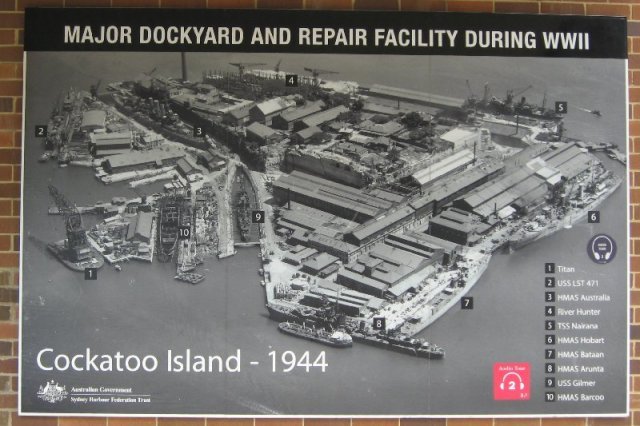
Edit:- Some further digging about Cockatoo. It has been changed significantly over its life but as far as I can see in the WW2 era there was

Slip No.1 - constructed 1912. Used to build the cruiser Brisbane, seaplane carrier Albatross, and still In use in the 1950s.

Slip No.2 - built in 1938 as part of an expansion of the facilities. The sloop Warrego (laid down May 1939), and the Tribals Warramunga (laid down same day Warrego was launched 10 Feb 1940) & Bataan were constructed there according to this source.
https://navyhistory.au/naval-heritage-sites/cockatoo-island/shipbuilding/
(?? Given the construction dates Bataan must have followed Arunta not Warramunga onto the slip. I've found some significant errors on that site in the past. See below its first Bathurst was laid down 10 Feb 1940)

Other areas were used for building smaller vessels at various times but it is not clear where. The whole facility, which included 2 dry docks and a floating dry dock really was not very big.

1746898351864.jpeg

Over the period from 1938 Cockatoo built
2 Grimsby class sloops
3 Bar class BDV
1 Net class ADV
3 Tribals

Its first Bathurst class was laid down on 10 Feb 1940, being the first of 7 built there. Its first River class frigate was laid down in Oct 1942.

Edit 2:- Cockatoo also built 2 Standard A class merchantmen in WW2, which were given 'River' names
http://www.geocities.ws/dinmurnel/clarence.htmhttp://www.geocities.ws/dinmurnel/hunter.htm
Just 13 of these Standard A class ships were laid down in Australian yards during WW2 but only 8 completed before the end of the war. Yards began to build smaller standard merchant types late in WW2 but none of these were completed until post-war.
 

Attachments

  • nm_5_1_1-17 Tribals in Canada.pdf
    727.1 KB · Views: 10
Last edited:
Back
Top Bottom