
You are using an out of date browser. It may not display this or other websites correctly.
You should upgrade or use an alternative browser.
You should upgrade or use an alternative browser.
Vickers type designations
- Thread starter Jos Heyman
- Start date

- Joined
- 26 May 2006
- Messages
- 38,288
- Reaction score
- 20,425
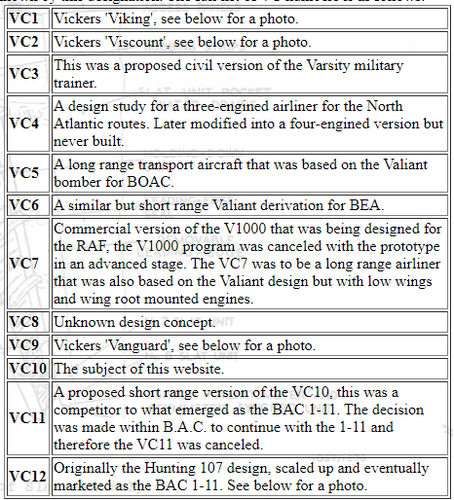
The letter combination VC (for Vickers Commercial) was only used for marketing purposes and was used as follows:
VC-1 Viking
VC-2 Viscount
VC-3 Proposed civilian development of the Varsity
VC-4 A three engined airliner for the North Atlantic route
VC-5 A long range transport based on the Valiant
VC-6 A short range transport based on the Valiant
VC-7 The 1000 design
VC-8 Viscount 800 series (?)
VC-9 Vanguard
VC-10 The VC-10
VC-11 A short range version of the VC-10
VC-12 Short range transport
In details,
http://www.vc10.net/History/vc10_origins.html
Attachments

Maveric
Fight for yor Right!
- Joined
- 14 January 2007
- Messages
- 2,291
- Reaction score
- 1,024
I would very much like to doubt this numbering. The Vickers Vernon dates from 1921. As early as 1913, Vickers assigned the designation Type 18 to the EFB.1. Here is the Type 18, the Vickers Viking III dates from 1920. The Viking IV is called Type 54 (1921). The jump would be too big.

- Joined
- 19 October 2012
- Messages
- 2,072
- Reaction score
- 2,209
I agree, Lumsden's numbering makes little sense.
- Joined
- 19 October 2012
- Messages
- 2,072
- Reaction score
- 2,209
A clearer version


- Joined
- 25 June 2009
- Messages
- 15,515
- Reaction score
- 9,447
Coming back to this topic after several years...
I would very much like to doubt this numbering. The Vickers Vernon dates from 1921. As early as 1913, Vickers assigned the designation Type 18 to the EFB.1. Here is the Type 18, the Vickers Viking III dates from 1920. The Viking IV is called Type 54 (1921). The jump would be too big.
I agree, too. That being said, I still have my doubts as to whether the early numbering system is connected to the one used from Type 50 onwards... Considering the E.F.B.3 of 1914 is said to have been Type 30, it means there would have been only 19 slots remaining for all the types created between then and 1920!I agree, Lumsden's numbering makes little sense.
- Joined
- 25 June 2009
- Messages
- 15,515
- Reaction score
- 9,447
we are now left with the following ‘unknown’ Types for the 1920s
53 | 65 | 90 | 101 | 109 | 126 | 136 | 152 | 154
In Morgan and Meerkom’s book of Air Ministry specifications there is this sketch drawing of a Vickers project to spec. 9/23 which would therefore date to late 1923. That makes it a possible contender to be Type 90. It is an odd design, parts are typical Vickers while others are unusual. It would be useful to see the original company drawings so before I start hunting has anyone more information.
- Regarding Type 90, I personally considered the Day Bombing Landplane (Drawing N°9047) designed to Spec. 10/23 to be a likely candidate.
- As for Type 126, I have it as the Vixen VI, [G-EBEC], a former type 105 re-engined and converted as a general purpose biplane. I can't say where I got that from. Note that there is also a Type 124 Vixen VI.
- Joined
- 25 June 2009
- Messages
- 15,515
- Reaction score
- 9,447
Source?the FB-5 = Type-32
- Joined
- 26 May 2006
- Messages
- 38,288
- Reaction score
- 20,425
Kites, Birds & Stuff - Vickers Aircraft - BY P. D. StempSource?
- Joined
- 25 June 2009
- Messages
- 15,515
- Reaction score
- 9,447
Awesome work, Bazinga, for which I thank you!And here is the source file.
Comparing your list with mine, I find more Viscount variants that don't appear in your list:
- 652: a projected version with four Hercules engines
- 653: a projected stretched version with four Dart engines
- 700D: a version with 1,576 hp (1,175 kW) engines instead of the 1,381 hp (1,030 kW) of the 700 version
- 701C: no data
- 784B: a lease to Trans Australian Airlines
- 860: no data
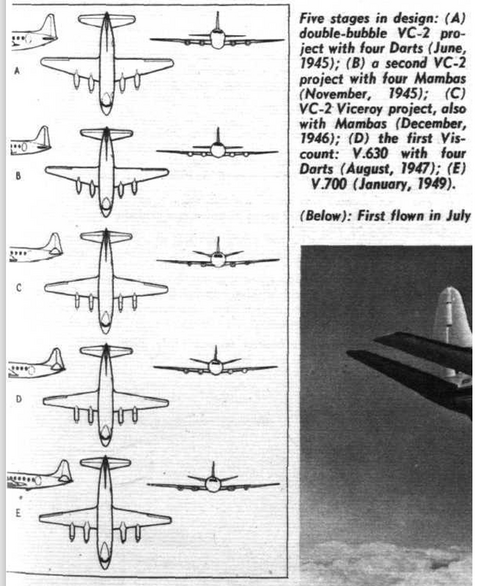
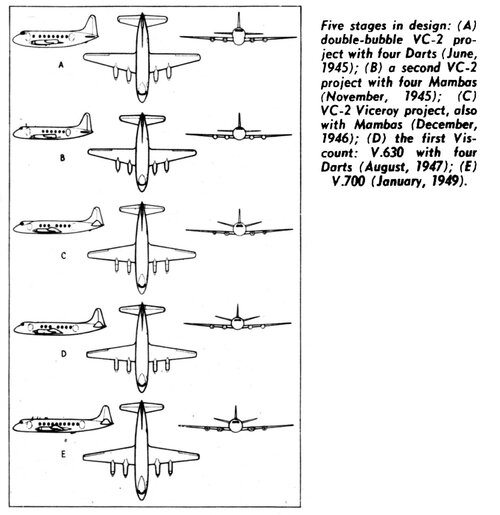
- Type 609 was initially known as the VC-2 Viceroy
- Type 630 was known as the VC-2 Viscount (I believe the "VC-2" designation was dropped after that)
- Types 663 and 700 were delivered to the Ministry of Supply
- Type 728 was also planned for Aden Airways
- Type 809 was for Greece
- "Air Lingus" should read Aer Lingus
- Likewise, "Capitol Airways" should read Capital Airways
- Type 811 was meant for Capital
Again, congrats on your work and thanks again!

Bazinga
I really should change my personal text
- Joined
- 14 December 2012
- Messages
- 377
- Reaction score
- 545
OK, thx @Stargazer . I will wait for more comments. Amend the list and repost a new source. Note that the source file also contains a way to manage digital assets via a unique folder format. For those that store files in windows folders, it may be useful to apply. If needed I can create a zip of empty windows folders.Awesome work, Bazinga, for which I thank you!
Comparing your list with mine, I find more Viscount variants that don't appear in your list:
A few remarks:
- 652: a projected version with four Hercules engines
- 653: a projected stretched version with four Dart engines
- 700D: a version with 1,576 hp (1,175 kW) engines instead of the 1,381 hp (1,030 kW) of the 700 version
- 701C: no data
- 784B: a lease to Trans Australian Airlines
- 860: no data
A question: would you say that Type 630 (first use) was designed to meet Specification 8/46, while the other two were for C.16/46?
- Type 609 was initially known as the VC-2 Viceroy
- Type 630 was known as the VC-2 Viscount (I believe the "VC-2" designation was dropped after that)
- Types 663 and 700 were delivered to the Ministry of Supply
- Type 728 was also planned for Aden Airways
- Type 809 was for Greece
- "Air Lingus" should read Aer Lingus
- Likewise, "Capitol Airways" should read Capital Airways
- Type 811 was meant for Capital
Again, congrats on your work and thanks again!
On 630: Indeed they had different specs. Let me see if I can find them and add them to the source file as well
Bazinga
I really should change my personal text
- Joined
- 14 December 2012
- Messages
- 377
- Reaction score
- 545
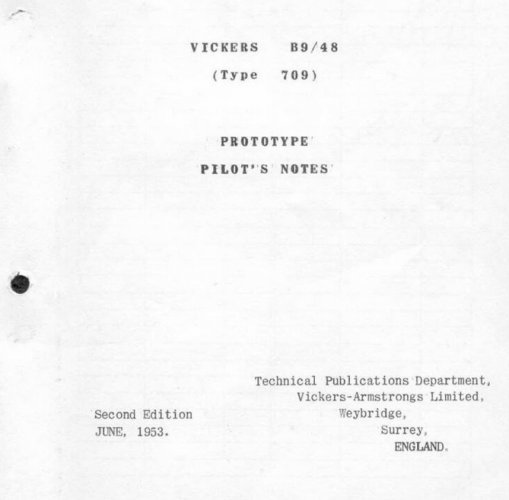
https://www.flight-manuals-online.com/product/vickers-valiant/
The Valiant 709 is marked here as a prototype. This must be in using the B.1 prototype with uprated engines?

The Valiant 709 is marked here as a prototype. This must be in using the B.1 prototype with uprated engines?
Bazinga
I really should change my personal text
- Joined
- 14 December 2012
- Messages
- 377
- Reaction score
- 545
So, I've processed you remarks.OK, thx @Stargazer . I will wait for more comments. Amend the list and repost a new source. Note that the source file also contains a way to manage digital assets via a unique folder format. For those that store files in windows folders, it may be useful to apply. If needed I can create a zip of empty windows folders.
On 630: Indeed they had different specs. Let me see if I can find them and add them to the source file as well
700D: Is a contradiction in terminus. The 700 was a prototype/pre-production. I guess it was uprated at some point but only for 754 onwards the D appears.
There is a reference in Wikipedia

The 1381hp Dart version is RDa.2 Mk.504 and appears for the first time in the Viscount series in 1948 (630)
The 1576hp Dart version is RDa.3 Mk.506 and appears for the first time in the Viscount series in 1952 (701)
The 1750hp Dart version is RDa.6 Mk.510 and appears for the first time in the Viscount series in 1955 (754) The D suffix is associated with the Mk.510 .
The 700 is from 1950. Do you know the first flight date of the 700D? GPT says it was for Air France in 1953 but still this data is not consistent with a 510. Besides. GPT is not to be trusted.
The 700 flight record can be read in detail here: https://www.vickersviscount.net/Index/VickersViscount003History.aspx
In 1953 a Dart engine was used with 10% more power for the Oct 53 Air Race. That could be the jump from 504 to 506.

In 1955, there is evidence that the 510 was installed:
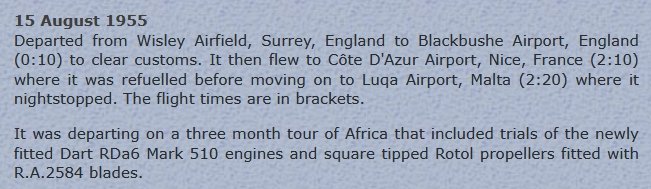
There is another temporary test in 1957 with just one Mk.525. 1960, she was disbanded. No mention of the 700D. So, technically the 700 DID carry a 510 engine from Aug 1955 onwards so technically you could retrofit the D suffix: So 700D is from 1955.
Last edited:
Bazinga
I really should change my personal text
- Joined
- 14 December 2012
- Messages
- 377
- Reaction score
- 545
Looks like this was a 2x2625hp Bristol Centaurus 661 Radial (not Turboprop)652: a projected version with four Hercules engines

- Joined
- 25 June 2009
- Messages
- 15,515
- Reaction score
- 9,447
Neat. It's cool to share it as an image instead of a text chart and/or an Excel file (I've started to do that myself) because the content has almost zero chance of winding up in Google or other search engine results. Consequently there is no risk of mistakes being spread on the web if anything turns out to be inaccurate or incomplete!I have deleted thread 93 and 94. It only leads to confusion. I've processed Stephane's comment.
Bazinga
I really should change my personal text
- Joined
- 14 December 2012
- Messages
- 377
- Reaction score
- 545
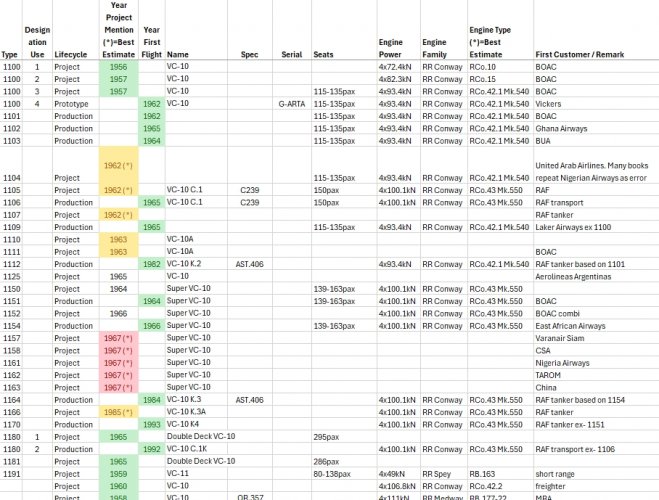
So, after the Viscount, I started working on the VC-10. This is actually more difficult because of What-If modellers and persistent error copying in later publications. I'm not claiming to be done here but this is as far as I got. Especially about timing I have green as evidence, yellow as fairly sure and red as educated guess. I've used vc10.net as close to the source but also this site is not complete. I've dismissed speculative Skybolt and Bomber variants. If Vickers did not allocate a number or if there is no evidence of a project, I'm dismissing it.

- Joined
- 25 June 2009
- Messages
- 15,515
- Reaction score
- 9,447
Thanks, Bazinga. I had most of those except fot the "pink" ones, but you provided more details regarding engines. I have three designations that are not in your list:
- Type 1153 as also a VC-10 project but with no data.
- Type 1199 as "a developed version of Super VC-10 seating 284 passengers in widebody fuselage".
- Type 1400, which turns out to be exactly what you described as Type 1191. Do you think it was a mistake? Or was it a commercial monicker?
- My entry on Type 1125 says "projected VC-10 hybrid for Aerolineas Argentinas". Do you know what that means?
- Since Specification AST.406 extended as far as Type 1164, could it also have concerned Types 1166 and 1170?
- I have Types 1180 (1) and 1181 as for 249 and 273 passengers respectively, not 295 and 286 as you mentioned.
- My entry for Type 1181 has "DB265 / Superb" in the "name" column. Does that mean anything to you?
Bazinga
I really should change my personal text
- Joined
- 14 December 2012
- Messages
- 377
- Reaction score
- 545
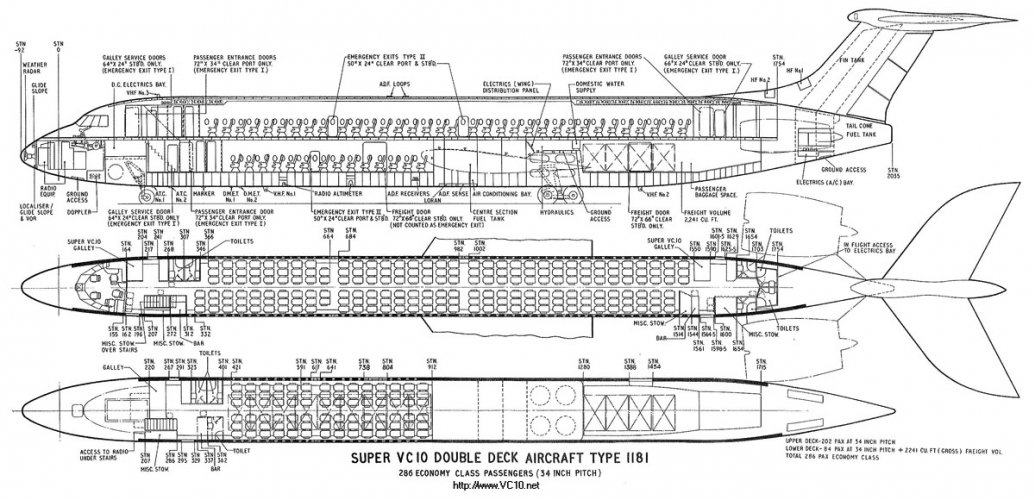
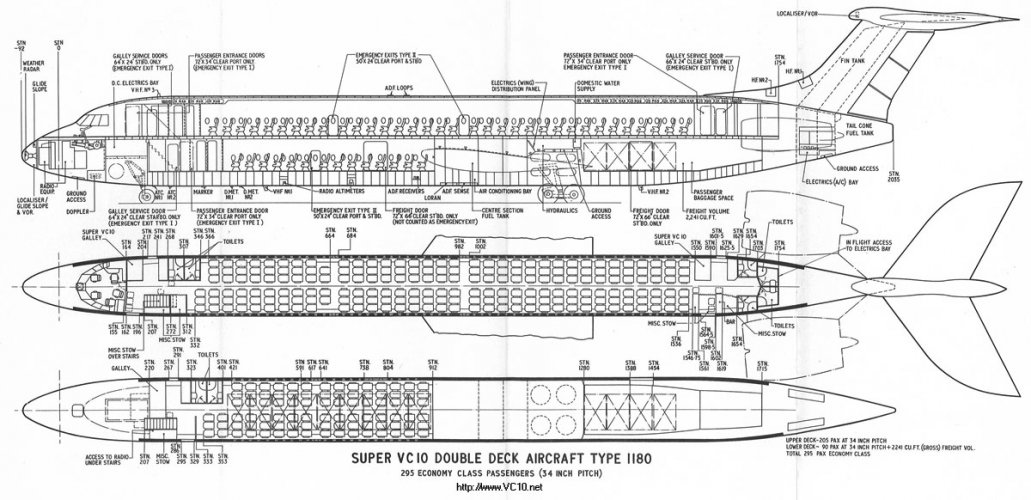
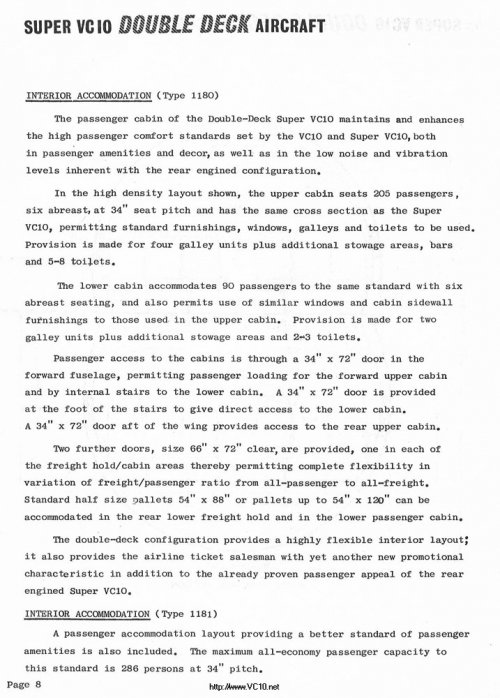
I'll answer them one by one. Your questions sometimes make me have to reread the articles I have. First up, 1180/1181. The site https://www.vc10.net/History/DDVC10_page8.html shows the Vickers Brochure for the Double Deck Super VC-10 with the 1180 in 295 and 1181 with a 286 arrangement. Seating is always tricky. It is completely up to the carrier to specify the seats. I find the evidence convincing. Jelle Hieminga, the author of vc10.net has worked at Brooklands. In the meantime I have found 2 alternative configurations to the 1180. I will amend the list and post the evidence later.Thanks, Bazinga. I had most of those except fot the "pink" ones, but you provided more details regarding engines. I have three designations that are not in your list:
A few questions/remarks/differences:
- Type 1153 as also a VC-10 project but with no data.
- Type 1199 as "a developed version of Super VC-10 seating 284 passengers in widebody fuselage".
- Type 1400, which turns out to be exactly what you described as Type 1191. Do you think it was a mistake? Or was it a commercial monicker?
- My entry on Type 1125 says "projected VC-10 hybrid for Aerolineas Argentinas". Do you know what that means?
- Since Specification AST.406 extended as far as Type 1164, could it also have concerned Types 1166 and 1170?
- I have Types 1180 (1) and 1181 as for 249 and 273 passengers respectively, not 295 and 286 as you mentioned.
- My entry for Type 1181 has "DB265 / Superb" in the "name" column. Does that mean anything to you?
Attachments
Last edited:
Bazinga
I really should change my personal text
- Joined
- 14 December 2012
- Messages
- 377
- Reaction score
- 545
Hybrid: https://www.vc10.net/Data/vickers_vc10_type_designations.html reveals just a little more context: Standard (could be a hybrid Standard/Super design) VC10 for Aerolineas Argentinas, none built
The way I read it, Aerolineas Argentinas probably wanted a Standard VC-10 with some of the Super VC-10 features. This tells me that this project was at the tail end of the Standard VC-10 series. Vickers probably sneak-previewed their Super VC-10, and AA started working up a shopping list for their standard VC-10 plan because they probably didn't need the additional seats. Because of that, I am placing 1125 end 1965, early 1966. The 1152 Super VC-10 was mentioned in 1966.
The way I read it, Aerolineas Argentinas probably wanted a Standard VC-10 with some of the Super VC-10 features. This tells me that this project was at the tail end of the Standard VC-10 series. Vickers probably sneak-previewed their Super VC-10, and AA started working up a shopping list for their standard VC-10 plan because they probably didn't need the additional seats. Because of that, I am placing 1125 end 1965, early 1966. The 1152 Super VC-10 was mentioned in 1966.
Last edited:
Bazinga
I really should change my personal text
- Joined
- 14 December 2012
- Messages
- 377
- Reaction score
- 545
DB265/Superb: 2 Jul 1965: BAC announces details of the Super VC10-DB265 Double-Deck aircraft; accommodating up to 265 passengers on two levels and demonstrating a 20% reduction in seat-mile costs compared to current long-range jetliners, the new variant is to meet a BOAC requirement for six such aircraft - and is also dubbed the ‘Super Super’ or ‘Superb’ VC10.
The following year (11 May 1966), the Government declines to provide launch funding for the Super VC10-DB265 and BOAC buy the Boeing 747 instead.
https://vc10.net/History/Timeline.html
The following year (11 May 1966), the Government declines to provide launch funding for the Super VC10-DB265 and BOAC buy the Boeing 747 instead.
https://vc10.net/History/Timeline.html
Bazinga
I really should change my personal text
- Joined
- 14 December 2012
- Messages
- 377
- Reaction score
- 545
AST-406/ASR-406: I cannot find a lot about this RAF Air Staff Requirement 406 other than again https://vc10.net/History/Timeline.html

So it was issued to support Tornado operations.
Returning to your question: Since Specification AST.406 extended as far as Type 1164, could it also have concerned Types 1166 and 1170?
1166: 1985 first mention. The K3A. They ended up with a "phase 2" wishlist and called it K3A. So, YES very likely.
1170: 1993 first flight. The K4. This is 14 years after AST/ASR-406 was issued. So, NO, not very likely. Specs change more frequently than that, so this will have been a new spec. Probably an analog to digital jump. This is the drawback on relying on sequencing of numbers which suggest a certain project proximity while in reality in the VC-10 case, the numbers are all over the place, so a date is needed to make a deeper judgement on other data.

So it was issued to support Tornado operations.
Returning to your question: Since Specification AST.406 extended as far as Type 1164, could it also have concerned Types 1166 and 1170?
1166: 1985 first mention. The K3A. They ended up with a "phase 2" wishlist and called it K3A. So, YES very likely.
1170: 1993 first flight. The K4. This is 14 years after AST/ASR-406 was issued. So, NO, not very likely. Specs change more frequently than that, so this will have been a new spec. Probably an analog to digital jump. This is the drawback on relying on sequencing of numbers which suggest a certain project proximity while in reality in the VC-10 case, the numbers are all over the place, so a date is needed to make a deeper judgement on other data.
Bazinga
I really should change my personal text
- Joined
- 14 December 2012
- Messages
- 377
- Reaction score
- 545
Type 1400: https://www.aeroflight.co.uk/tag/vickers-vc10 mentions the Type 1400 as the VC-11. Also, Putnam Andrews' book (first edition page 487, not mentioned in 2nd edition!) mentions the 1400. Now, I have decreased trust in that book while cross-referencing other sources. But, 1191 is also not convincing yet, as it mentions a "short haul BEA version". But, like I said Jelle Hieminga, works at Brooklands and has access to the archives.
VC-11 had two customers in mind: BEA and TCA. Both were different configurations. BEA bailed out first.
I sent the vc10.net author an email and asked him for more intel. 1191 is not mentioned anywhere else.
So, for now not confirmed either way. "I'll be back"
VC-11 had two customers in mind: BEA and TCA. Both were different configurations. BEA bailed out first.
I sent the vc10.net author an email and asked him for more intel. 1191 is not mentioned anywhere else.
So, for now not confirmed either way. "I'll be back"
Last edited:
Bazinga
I really should change my personal text
- Joined
- 14 December 2012
- Messages
- 377
- Reaction score
- 545
I'll process the other info you shared. I also found some more exotic VC-10 variants in the second edition of Putnam Andrew's book. I will update the list with what we know now and repost it here.
Bazinga
I really should change my personal text
- Joined
- 14 December 2012
- Messages
- 377
- Reaction score
- 545
On 1153: Probably 1966 as the 1154+Super VC-10 is a 139-163pax with 4x100.1kN RR RCo.43 Mk.550 for East African Airways. The 1152 is a BOAC combi freight/pax project. vc10.net mentions the 1153, but even he is vague. Kinda strange. If you sit on an archive, why would you not tell what the purpose was, except denying what it wasn't?


Bazinga
I really should change my personal text
- Joined
- 14 December 2012
- Messages
- 377
- Reaction score
- 545
On 1199: I am going to make a jump that I have not read before here. I am suggesting that the 1199 turned into the BAC 311.
Logic:
1965-1966: Multi fuselage and multi deck planes do not attracts customers.
1966: Vickers name disappears. It is now BAC.
1966: The high bypass turbofan RB.211 becomes available for Tristar
Post 1966: The 1199 suggests a very late Vickers project. At least post 1966.
1968: BAC-311 is launched. It is a Vickers Weybridge project.
Logic:
1965-1966: Multi fuselage and multi deck planes do not attracts customers.
1966: Vickers name disappears. It is now BAC.
1966: The high bypass turbofan RB.211 becomes available for Tristar
Post 1966: The 1199 suggests a very late Vickers project. At least post 1966.
1968: BAC-311 is launched. It is a Vickers Weybridge project.
Bazinga
I really should change my personal text
- Joined
- 14 December 2012
- Messages
- 377
- Reaction score
- 545
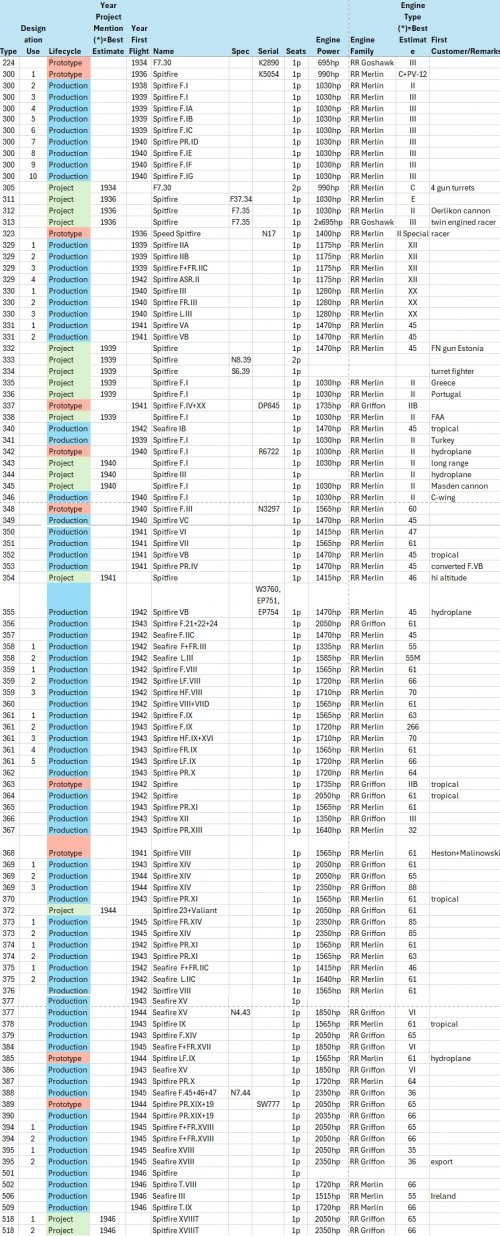
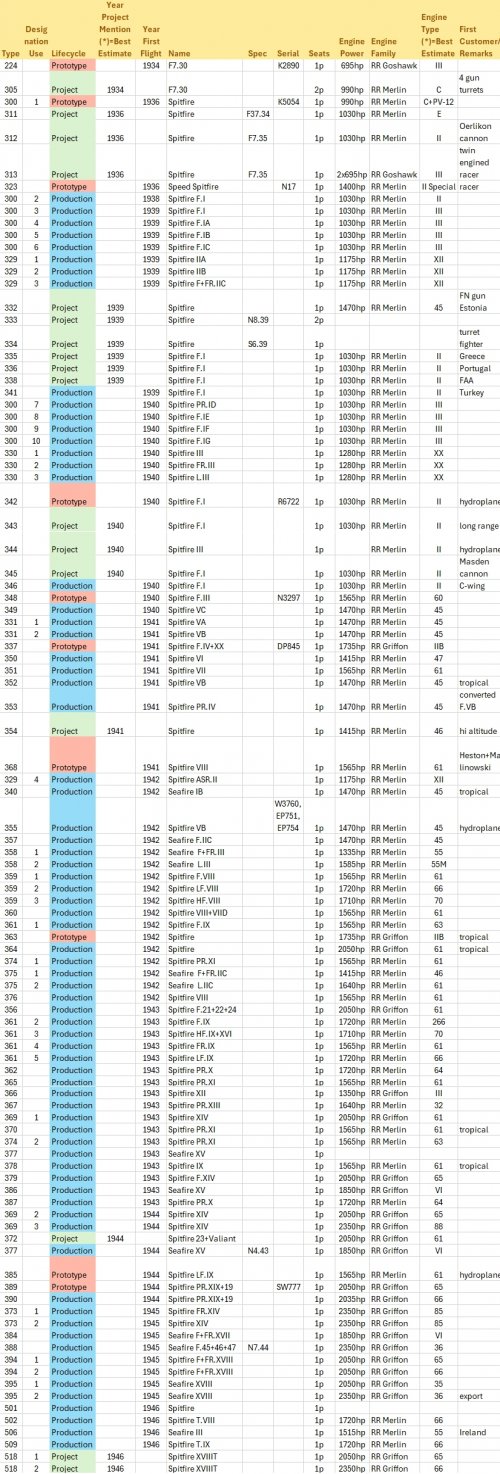
I guess @Stargazer was right. Unearthing Spitfire history with all its versions is daunting. As promised, I have deleted the table to prevent bots from stealing the work. I have created two images. Both tell the same story differently. One is sorted by type, the most useful way to sort but a simple re-sort by year, gives a more chronological glimpse. Enjoy. Those that need the xlsx, just DM me.
Attachments
Bazinga
I really should change my personal text
- Joined
- 14 December 2012
- Messages
- 377
- Reaction score
- 545
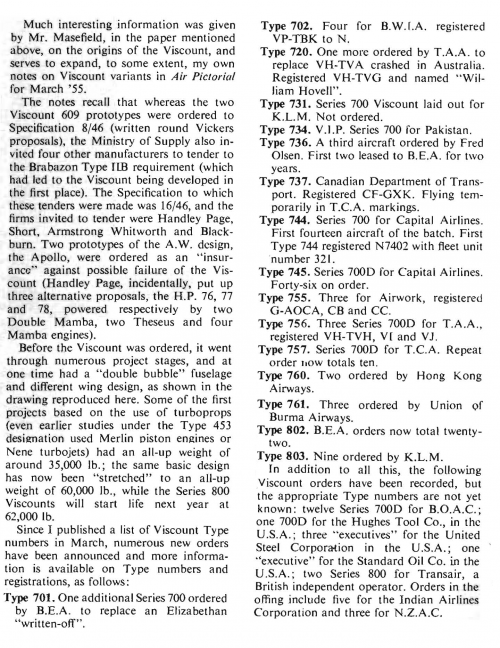
Do we consider this the start of the Viscount family?Vickers Type 453 44 Four Engined Empire Passenger Transport
4 x Rolls Royce Griffon 14SM
40 day passengers or 20 sleeping berths
Pressurised
Span 122' 7"
Length 88' 7"
Weight loaded 72000 lbs
Speed Max cruising 267mph
Speed mean cruising @10,000ft 248mph
Range 2200 miles
The wing style and size, and the four-unit main undercarriage suggests that the wing is based on that of the Vickers Windsor
Bazinga
I really should change my personal text
- Joined
- 14 December 2012
- Messages
- 377
- Reaction score
- 545

Bazinga
I really should change my personal text
- Joined
- 14 December 2012
- Messages
- 377
- Reaction score
- 545
I told you I would be back. Jelle Hieminga, webmaster of the VC10 site, replied back and cleared some mystery here:Type 1400: https://www.aeroflight.co.uk/tag/vickers-vc10 mentions the Type 1400 as the VC-11. Also, Putnam Andrews' book (first edition page 487, not mentioned in 2nd edition!) mentions the 1400. Now, I have decreased trust in that book while cross-referencing other sources. But, 1191 is also not convincing yet, as it mentions a "short haul BEA version". But, like I said Jelle Hieminga, works at Brooklands and has access to the archives.
VC-11 had two customers in mind: BEA and TCA. Both were different configurations. BEA bailed out first.
I sent the vc10.net author an email and asked him for more intel. 1191 is not mentioned anywhere else.
So, for now not confirmed either way. "I'll be back"
The VC11 (no hyphen in Vickers markings!) naturally remained a project, and therefore, not all information is entirely clear, but we're actually confusing two things here:
- The Type 1191 mentioned on my website is a proposed variant of the VC10 (not VC11!) for BEA, with the VC10 design being 7.5m longer with a 5m shorter wingspan, optimized for BEA's short routes within Europe. This development phase was also referred to as the 'Type 230', and a Type 1190 was later proposed. This occurred around 1966.
- The VC11 was to be a completely separate design, using only the proportions and configuration of the VC10, but scaled down: 42m length, 32.5m wingspan, and four RR Spey engines. This type was given the indicative type number 1400, but because it didn't leave the drawing board in 1959, that number never saw the light of day. The Hunting/BAC 107 was considered a better candidate, and this design later became the BAC 1-11.
For a good overview, John McCrickard's recently published Air-Britain book also contains a considerable amount of information about these projects. See here: https://www.air-britain.co.uk/actbooks/acatalog/VickersVC10--199.html#SID=13
So,
1966: 1190 and 1191 were stretched VC10s for BEA, also referred to as Type 230. 1191 is therefore NOT a VC11
1959: 1400 is indeed a name for the VC11 and can be seen as a marketing number, which @Stargazer already alluded to.
Kudos go to Jelle Hieminga of https://vc10.net/
Last edited:

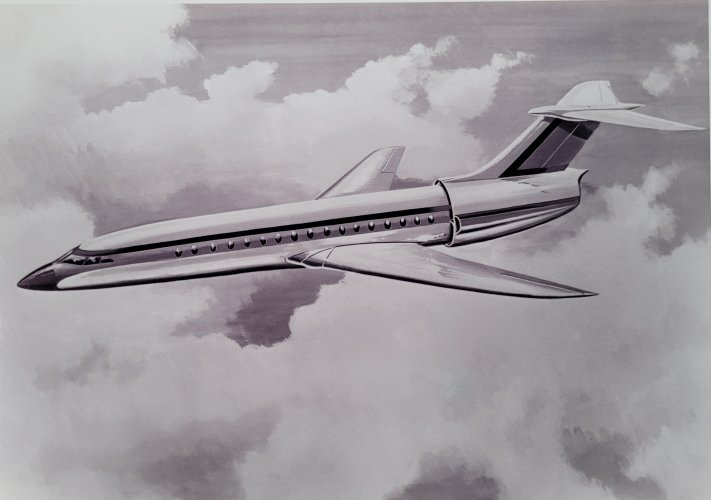
Iv nothing further information wise other than the other negatives in the set showing ga. drawings and sections of the design call it a 'supersonic transport' (the Vickers Aviation stamp and 1964 dating are on the brown paper negative folder, from the period where they were technically 'BAC.' but still retaining some identity within, as can also be seen in some TSR.2 related paperwork)
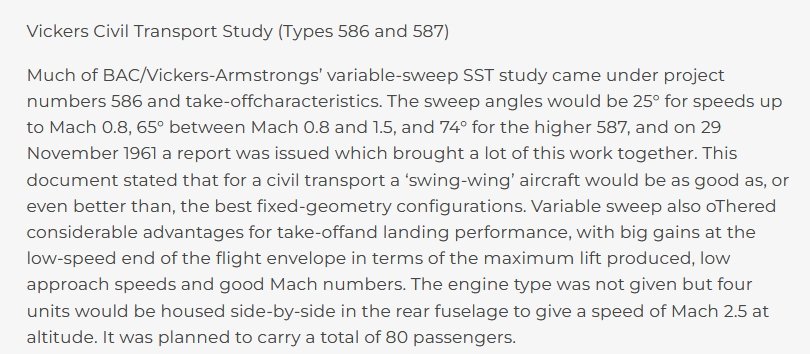
I'm thinking it might be a precursor design to the reasonably well documented Type 586 ? VG. SST. with rear mounted ramp intakes
I'm thinking it might be a precursor design to the reasonably well documented Type 586 ? VG. SST. with rear mounted ramp intakes
Last edited:
Bazinga
I really should change my personal text
- Joined
- 14 December 2012
- Messages
- 377
- Reaction score
- 545
I think you are right. The 586 was a series of design studies. Here is a snap I got from the web https://www.key.aero/article/concordeIv nothing further other than the negatives are all marked as Vickers Aviation, and the other images in the set calling it a 'supersonic transport' (dating from the period where they were technically 'BAC.' but still retaining identity within, as can also be seen in some TSR.2 related paperwork)
I'm thinking it might be a precursor design to the reasonably well documented Type 586 ? VG. SST. with rear mounted ramp intakes
- Joined
- 26 May 2006
- Messages
- 38,288
- Reaction score
- 20,425
Vickers (Weybridge) VG. SST., 1964
(I'm thinking possibly Type 586 related ?)
It looks like this aircraft in reply # 10,
https://www.secretprojects.co.uk/threads/uk-sst-projects.2435/#post-53265
Similar threads
-

-

-
 Renard Aircraft Designations (Belgium - including R.S.V. & Stampe et Renard)
- Started by Cy-27
- Replies: 19
-

-
