Triton

Donald McKelvy
Senior Member
Joined
14 August 2009
Messages
9,704
Reaction score
3,624
Website
deeptowild.blogspot.com
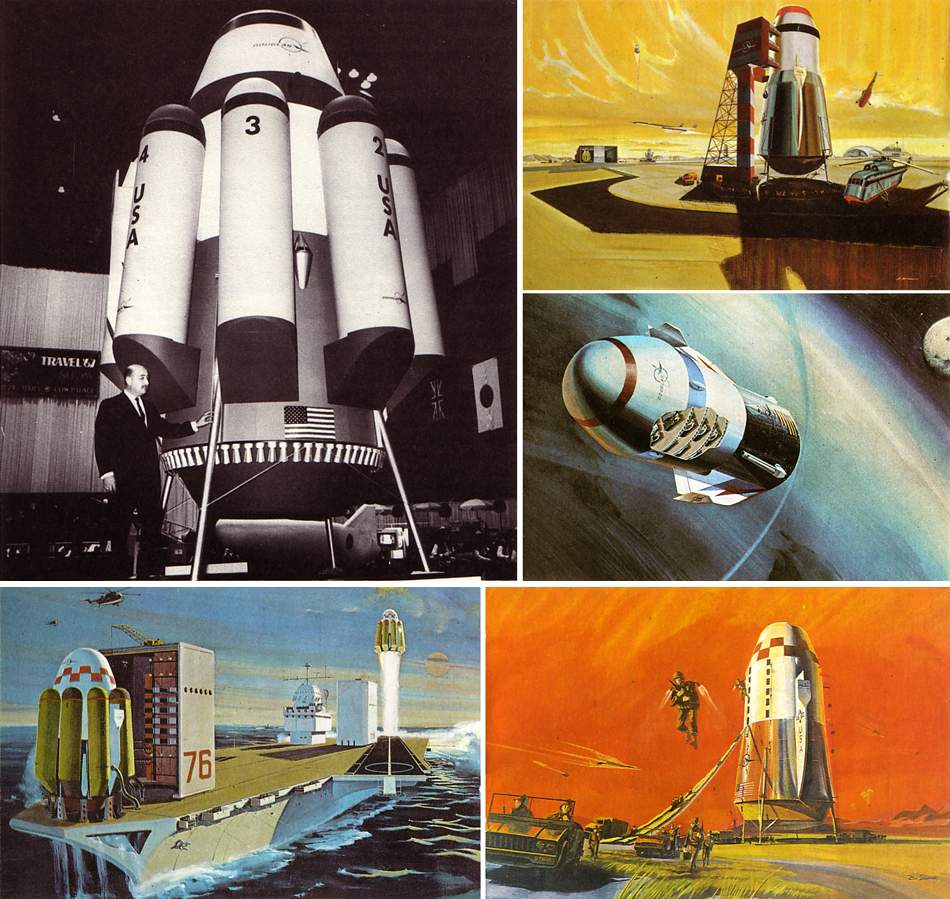
Does anyone have a picture of Philip Bono the creator of ROMBUS, Pegasus, ICARUS, Ithacus, Selene, Deimos etc. who was employed at McDonnell-Douglas? My image searches seem to hit Salvatore Philip Bono aka "Sonny" Bono the late Congressman and former husband of Cher and the television program "Sonny & Cher." :mad:

Does anyone have some decent biographical information on Philip Bono?
 
Triton said:
Does anyone have a picture of Philip Bono the creator of ROMBUS,


One of the few I've seen...
pegasusithacus.jpg
 
Thank you Orionblamblam, I didn't realize Philip Bono is pictured next to the model. I just thought it was some exec at McDonnell-Douglas.
 
When he died in '93, I was in the Iowa State (University) Space Society; we got some sort of notice from *somebody* about his death with some bio and photos (probably one of the glossy space magazines that was published at the time), that being one of them. I've seen a few others, including a standard headshot, but it's been about 15 years. That's about all I have.
 
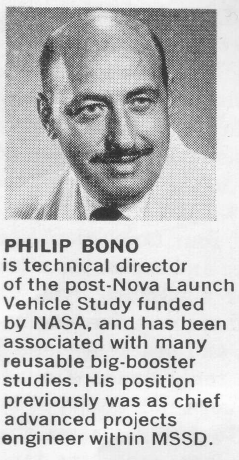
I found another picture of Philip Bono

source:
The Rombus Concept by Philip Bono
Astronautics & Aeronautica, Januar 1964
 

Attachments

  • Philip_Bono.png
    Philip_Bono.png
    92.9 KB · Views: 360
Around end 1960's Douglas proposed
several projects for reuse of S-IVB Stage

the final Idea was a reusable S-IVB with Aerospike engine
to use as upperstage on Saturn launcher or as SSTO

got some one more info (like payload) on that proposal ?
thanks in advance
 
XP67_Moonbat said:
Try Philip Bono and Kenneth Gatland's book FRONTIERS OF SPACE.

Moonbat

I have the German edition but there only picture, no information about preforms
 
Michel, in my edition there is full chapter on SASSTO and SARRA (fourth, n my edition) with data. Moreover, there is a color comparison chart between SASSTO and two two-stage reusable winged launchers. SASSTo is given at a launc weight of 97,887 Kg, max thrust of 125,647 Kg, empty weight (w/o payload) 3995 Kg and a low-orbit payload of 2812-3617 Kg.
 
yes SASSTO had to be final version of this SSTO study

but i looking for S-IVB version of that
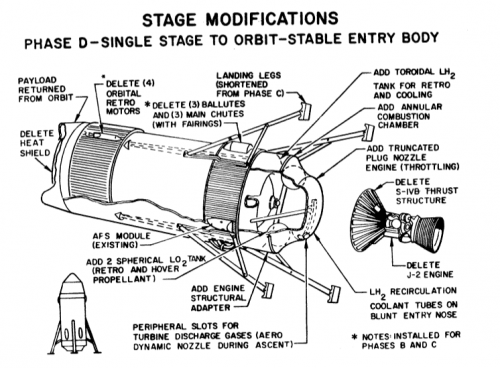
challed "Phase D - Singel Stage to Orbit - Stabel Entry Body"

see the picture
simply the Tanks of S-IVB with Aerospike engine and landinggear
 

Attachments

  • Phase-D.png
    Phase-D.png
    61.2 KB · Views: 295
Yes that is indeed in Frontiers of Space, but it is the later edition (there were at least two). I had both before hurricane Isabel :mad: (stoopid Isabel)
There was IIRC not much more info than that on the craft itself, however it was presented as part of a multi step program that was intended to start with Apollo hardware and incrementally develop via trial and error a VTOVL launch capability of the sort that Bono advocated ultimately building up to the ROMBUS design he had proposed some years earlier. I think SASSTO was the last in the line that used direct developments of more or less existent hardware, later ones like Hyperion (a mountainside-sled launched vertilanding craft) Peagasus, Ithacus and ultimately ROMBUS itself would have relied heavily on lessons learned during the program and so their designs would have been somewhat fluid. ISTR an offhanded mention in the book that there was interest in using Salked's tripropellant scheme in some of the later designs.

Note that the crazy ass concept of build...test...learn...build better...test...learn...build even better...is the way technology generally develops successfully.
 
Michel Van said:
yes SASSTO had to be final version of this SSTO study

but i looking for S-IVB version of that
challed "Phase D - Singel Stage to Orbit - Stabel Entry Body"

You've seen this, yes?
http://www.up-ship.com/drawndoc/drawndocspacesaturn.htm#spacedoc63
Advanced Saturn/Apollo Missions
http://www.up-ship.com/drawndoc/sdoc53ani.jpg
 
Orionblamblam said:
You've seen this, yes?
http://www.up-ship.com/drawndoc/drawndocspacesaturn.htm#spacedoc63
Advanced Saturn/Apollo Missions
http://www.up-ship.com/drawndoc/sdoc53ani.jpg

i have buy them !
"Advanced Saturn/Apollo Missions" and "Saturn Mission Payload Versatility"
last one is Boeing study how to transform the S-IC in S-ID SSTO
sadly, both do not have a detail Information about this S-IVB SSTO :mad:
 
While the search is on, let me advance a suggestion. SASSTO and SARRA were just two of the ideas explored at Douglas for advanced uses of derivatives of S-IVB. The one that more strictly adheres to the configuration you are searching is in my opinion the LASS concept (direct mode cargo lunar carrier). It used a normal or uprated bell exhaust J-2, but for the rest it was very similar. Look for LASS (Scott has a presentation by Donald Douglas on LASS on his site).
 
LASS is show in "Advanced Saturn/Apollo Missions"
a direct landing S-IVB for AAP or Lunar Base build.
S-IVB with multy restart J-2S and 2x RL-10 engines for landing
nice idea: use S-IVB empty tanks as "Wet" moon Base

not close to phase D S-IVB SSTO :(
but i will take the STASSO data for Aerospike engine and return fuel
an made crude calculation payload in 100 n.m. orbit
 
I made my (very crude) calculation

payload 3500 kg in 200 km orbit
with replace J-2 (1588 kg) by a Aerospike Engine (3176 kg)
(Scott Lowther say once something about they heaver as normal engine)
Plus
7483 kg on return system
(heatshield on S-IVB tanks, parachutes, Landing gear, and Fuel - about 37% empty mass)
2155 kg Instrument unit (Saturn IB-V)
105 kg payload faring
525 kg Payload holder

makes in total:
138268.45 kg lift off mass
but it got only a delta V of 7440 meter/sec
need in to 200 km orbit are 8036 meter/sec

but in some literature and Wiki claim that Aerospike engine
use 30% less fuel as a bell engine in lower atmosphere

recalculated that makes
a delta V of 9088 meter/sec

so in theory it works.
 
:eek: B)
Philip Bono Collection Images at San Diego Air and Space Museum Archives
Link:
https://www.flickr.com/photos/sdasmarchives/albums/72157666706198030
 
fightingirish said:
:eek: B)
Philip Bono Collection Images at San Diego Air and Space Museum Archives
Link:
https://www.flickr.com/photos/sdasmarchives/albums/72157666706198030

Lot's of goodness!!
 
Update!!! :eek: B)
Philip Bono Collection Images at San Diego Air and Space Museum Archives
Link:
https://www.flickr.com/photos/sdasmarchives/sets/72157669057850210
 
Philip Bono papers listing.

https://oac.cdlib.org/findaid/ark:/13030/c88s4vjz/entire_text/
Series IV: Papers and Reports by Philip Bono

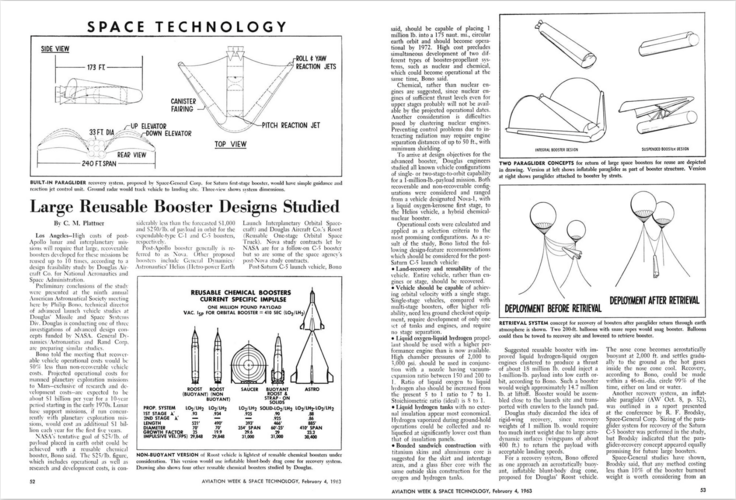
Folder 1 -- ROOST (2 reports): Integrated Systems Study for a One-Stage Orbital Space Truck, December 1962; Economic Potential of a One-Stage Orbital Space Truck, August 1962.

Folder 2 -- Saturn (2 reports): Saturn SIVB Stage as a Test Bed for Booster Recovery, May 1966; Recent Trends in Post-Saturn Propulsion -- Expendable Solid or Reusable Liquid Systems?, September 1967.

Folder 3 -- Two reports: Enigma of Booster Recovery -- Ballistic or Winged?, May 1967; Implications of Booster Recovery on Unconventional Propulsion Systems, May 1964.

Folder 4 -- Two reports: Variable-Payload Booster -- Next Generation of Large Launch Vehicle?, April 1967; Rocket-Sled Launching Technique and its Implications on Performance of Reusable Ballistic (Orbital Global) Transport Systems, October 1967.

Folder 5 -- Three reports: On the Application of Space Techniques to Terrestrial Transportation, October 1964; A New Dimension in Terrestrial Transportation -- Byproduct of the Space Age, undated; Reusable Rocket Booster as a Military Terrestrial Transport, October 1967.

Folder 6 -- Two reports: A Near-Term Technique for Land-Recovery of an Earth Orbital Stage, October 1966; The Influence of Unconventional Structures and Materials on Booster Reusability, April 1964.

Folder 7 -- Three reports: The Rombus Concept, January 1964; Rombus -- An Integrated Systems Concept for Reusable Orbital Module (Booster and Utility) Shuttle, June 1963; Reusable Booster for Lunar Logistics and Planetary Exploration, 1964.

Folder 8 -- Four reports: Beyond the Supersonic Airlines, November 1964; Advanced Launch Vehicle Concepts, March 1963; Advanced Rocket Concepts, January 1964; Reusable Booster for Lunar Logistics and Planetary Exploration, September 1964.

Folder 9 -- Two Journal of British Interplanetary Society articles: Rocket-Sled Launching for Reusable Ballistic Transport Systems, 1970; Expendable Solid and Reusable Liquid Systems in Post-Saturn Propulsion, 1970.

Folder 10 -- Magazine articles: Rocket Troop Transport, Ordnance Magazine, July-August 1968; Global Rocket Transport Offers Instant Thrill-a-Minute Travel, Society of Automotive Engineers Journal, 1965; Advanced Rocket Concepts, Mechanical Engineering Magazine, January 1964.

Folder 11 -- Magazine articles: Five articles on Rombus, rocket transport, Pegasus, and Reusable Spacecraft.

Folder 12 -- Magazines articles: Three articles on Military Transport, and ROOST.

 
Quick recap of Bono papers, 1962-1967-1970

ROOST (2 reports):

- Integrated Systems Study for a One-Stage Orbital Space Truck, December 1962

- Economic Potential of a One-Stage Orbital Space Truck, August 1962.

Advanced Launch Vehicle Concepts, March 1963

Rombus -- An Integrated Systems Concept for Reusable Orbital Module (Booster and Utility) Shuttle, June 1963;

The Influence of Unconventional Structures and Materials on Booster Reusability, April 1964.

The Rombus Concept, January 1964;

Reusable Booster for Lunar Logistics and Planetary Exploration, 1964.

Implications of Booster Recovery on Unconventional Propulsion Systems, May 1964.

On the Application of Space Techniques to Terrestrial Transportation, October 1964

Beyond the Supersonic Airlines, November 1964

Advanced Rocket Concepts, January 1964

Reusable Booster for Lunar Logistics and Planetary Exploration, September 1964.

---

Saturn SIVB Stage as a Test Bed for Booster Recovery, May 1966

A Near-Term Technique for Land-Recovery of an Earth Orbital Stage, October 1966

Recent Trends in Post-Saturn Propulsion -- Expendable Solid or Reusable Liquid Systems ? - September 1967.

Enigma of Booster Recovery -- Ballistic or Winged? May 1967

Variable-Payload Booster -- Next Generation of Large Launch Vehicle? April 1967

Rocket-Sled Launching Technique and its Implications on Performance of Reusable Ballistic (Orbital Global) Transport Systems, October 1967.

A New Dimension in Terrestrial Transportation -- Byproduct of the Space Age, undated; Reusable Rocket Booster as a Military Terrestrial Transport, October 1967.

---

Rocket-Sled Launching for Reusable Ballistic Transport Systems, 1970

Expendable Solid and Reusable Liquid Systems in Post-Saturn Propulsion, 1970
 
Found some Hazegrayart SASSTO goodness on youtube so I thought I'd post it up.

Just reading Michael's post above, I think from memory that the heat shielding was to be provided by boiling off/running LH2 back through the plug nozzle on reentry. This would have provided a considerable weight saving over the standard, at the time, ablative shielding.

As I say, from memory.

Edit: Nope. My memory is apparently rubbish.
View: https://youtu.be/YfvG0v1LX6k?si=xskF5GvzKnvcp3mL
 
Last edited:
Actually depends on the how, what, and why. Saturns were a pretty solid launch system. The main issue was that any idea of keeping Saturn going was an issue of economics and support and NASA wasn't going to have much of either after Apollo.

Randy
Titans were cheaper and Saturn IB were unaffordable using LC-39
 
Vietnam spending usurped everything

That was an excuse really, the main issue was that Congress (and the public behind them) were tired of Apollo spending levels and in Congress' case they were still pissed about NASA's failure with Apollo 1. Since then it's Congress that has not been interested in getting back to the Moon until recently.

Randy
 
Titans were cheaper and Saturn IB were unaffordable using LC-39

Titan's were cheaper as long as you didn't look too closely at how the Air Force figured "costs" :)

While the Air Force would have prefered the use of Titan, NASA would likely supported Saturn 1B using a much cheaper S-IVB stage (the major cost factor) and upgraded S-1 stages. The argument could be made and frankly the Titan would have reached its limitations sooner than the Saturn 1B.

Of course the 800lb "issue" in the room was that what NASA REALLY wanted was to keep the Saturn V production going as they assumed they could fit in a Lunar mission or two at some point which was totally out of the question for Congress. Hence why NASA wasn't really interested in keeping Saturn 1 if they couldn't have the Saturn V.

Randy
 
Titan's were cheaper as long as you didn't look too closely at how the Air Force figured "costs" :)
That would be wrong. It was cheaper. The Titan had an existing production line. From 1969 to 1974, Titan IIIB flew 25 times and Titan IIIC/D 16 times using 4 pads. Saturn IB only flew 3 times (Saturn V 6 times). During the Titan IIIE of 6 launches (1977-1977), Titan IIIB flew 12 times and Titan IIIC/D 14 times using 3 pads, Saturn only flew once.

Only one Titan pad and 2 launch platforms needed Centaur mods. Another Milkstool would be needed and the two Saturn IB Mobile Launchers would require Centaur mods and possibly another firing room would need Saturn IB mods.

While the Air Force would have prefered the use of Titan, NASA would likely supported Saturn 1B using a much cheaper S-IVB stage (the major cost factor) and upgraded S-1 stages. The argument could be made and frankly the Titan would have reached its limitations sooner than the Saturn 1B.
The USAF didn't care if NASA used Titan.
NASA would likely supported Saturn 1B using a much cheaper S-IVB stage (the major cost factor) and upgraded S-1 stages. The argument could be made and frankly the Titan would have reached its limitations sooner than the Saturn 1B.
Again, not true. S-IVB was not cheaper than anything on the Titan (or any two things for than matter). And just in case, there is no misunderstanding, it was not Saturn IB vs Titan IIIE (Centaur). It was Saturn IB Centaur vs Titan IIIE (Centaur)
The argument could be made and frankly the Titan would have reached its limitations sooner than the Saturn 1B.
No, there was no west coast pad for Saturn IB. And upgraded Saturn IB Centaur would have been more expensive than Titan IV, still with no west coast capability.
 
That would be wrong. It was cheaper. The Titan had an existing production line. From 1969 to 1974, Titan IIIB flew 25 times and Titan IIIC/D 16 times using 4 pads. Saturn IB only flew 3 times (Saturn V 6 times). During the Titan IIIE of 6 launches (1977-1977), Titan IIIB flew 12 times and Titan IIIC/D 14 times using 3 pads, Saturn only flew once.

Eh that's exactly what I mean, so thanks for that :)
The Titan 'launch vehicles' were not standard Titans and had to be made on specifically designed (and rebuilt) lines and that was before costs went up when they stopped being operational missiles but that costs was still being 'hidden' by being "operational production models' which they weren't. Yes the Air Force used a lot of "accounting methods" to keep Titan "cheap" until they couldn't anymore and the price skyrocketed.
Saturn, especially Saturn 1 was from the start aimed at being as cheap as possible while being the most powerful booster possible for the US during the period. And that carried through even though they made a decisions to use a very expensive upper stage which is what cost the most. (And understanding this they were planning on making cheaper S-IV stages which would have been pretty simple to do)

Only one Titan pad and 2 launch platforms needed Centaur mods. Another Milkstool would be needed and the two Saturn IB Mobile Launchers would require Centaur mods and possibly another firing room would need Saturn IB mods.

So? You say Titan needed only a few pads and mods but to fly the proposed Apollo missions and would quickly have reached limits to both the existing pads and infrastructure. Part of the price of doing business. Titan would have required lots of changes to the Apollo systems and vehicles which would have significantly impact the prices as well.
The USAF didn't care if NASA used Titan.

Yes they did, they were VERY interested in NASA using Titan because they could continue to hide the actual prices by charging things to NASA instead. They also hoped to get into flying their own manned missions and into a higher place on the Space Launch food chain. They pretty much made no bones about it. They were aiming to have NASA pay for most of the changes and upgrades to the Titan infrastructure, (which NASA did end up helping with because of using Titan as a launcher themselves) NASA paid for all the upgrades to make the Titan LV's used for Gemini which were thing that the Air Force knew could be problems but were unwilling to pay for out of their budget so the precedent was already in place.
Again, not true. S-IVB was not cheaper than anything on the Titan (or any two things for than matter). And just in case, there is no misunderstanding, it was not Saturn IB vs Titan IIIE (Centaur). It was Saturn IB Centaur vs Titan IIIE (Centaur)

Actually no, the Centaur was supposed to be used on future unmanned Saturn missions, the S-IVB in the form of a "cheap Chinese copy" for manned flights. The Titan IIIE was go be an issue even with the Centaur added. Adding SRBs to the Titan required raised the prices of Titan even more (and was a lot harder to hide) because the SRB Titans no longer shared production "commonality" with the historic existing production lines. Meanwhile adding them to the Saturn 1 was essentially going to be some equipment changes and system re-routing because the basic structure to handle them was already built in to the booster.
You seem fixated on the S-IVB which we've already established was known to be expensive and fixes for the problem already in work if things had gone forward with things.
No, there was no west coast pad for Saturn IB. And upgraded Saturn IB Centaur would have been more expensive than Titan IV, still with no west coast capability.

Uh never said there was, I said the Air Force was against using Saturn 1 and used the cost and difficulty of having to put one there to defend using the Titan which had existing pads. It was just another argument aimed at making Titan "look" better as a deal. (There was some real worry about the USAF and NASA being forced due to budget cutting of having to go with one or the other. The Air Force wanted all the arguments they could get to NOT have to use Saturn. The Air Force remembered quite well being forced to go with the Titan rather than the new system of the Space Launching System they had really wanted for the space launch mission)

In the end it was pretty clear that the standard Air Force and NASA "missions" were not going to be able to be handled by a single launch vehicle and the pressure to consolidate eased off. NASA went with the Shuttle which the Air Force (again) didn't really want but went along in the hopes of getting either their own Shuttles (not going to happen) or included on missions but didn't really start preparing to use the Shuttle until they actually read the fine print on the NASA Shuttle program paperwork where NASA had proposed and Congress had accepted that in the end ALL government payloads would end up flying on the Shuttle and that would include anything that could be flown on Titan. :)

Randy
 
Eh that's exactly what I mean, so thanks for that :)
The Titan 'launch vehicles' were not standard Titans and had to be made on specifically designed (and rebuilt) lines and that was before costs went up when they stopped being operational missiles but that costs was still being 'hidden' by being "operational production models' which they weren't. Yes the Air Force used a lot of "accounting methods" to keep Titan "cheap" until they couldn't anymore and the price skyrocketed.
Saturn, especially Saturn 1 was from the start aimed at being as cheap as possible while being the most powerful booster possible for the US during the period. And that carried through even though they made a decisions to use a very expensive upper stage which is what cost the most. (And understanding this they were planning on making cheaper S-IV stages which would have been pretty simple to do)
Wrong. The production line I was referring to was one for the launch vehicles (1969-1974). ICBM production was complete by 1965 or so (the 54 missiles on alert was achieved by December 1963). There was no hiding the fact these were space launch and not same as the weapon systems vehicles and had increased costs for structure mods and mission success. . The cores for IIID/E were modified to take SRM loads and heavier payloads. That even applied to the IIIB because of heavier payload. Prices didn't skyrocket and they were still cheaper than Saturn IB.

And Saturn I wasn't "cheap" as possible. It was done quick as possible aided by using Redstone and Jupiter tank tooling and 8 engines. But it made assembling the stage more expensive due to labor costs

And no where did I mention using Titan for Apollo missions. I was just limiting my points to the NASA Titan IIIE payloads..

And you are wrong about Centaur. It was to be used on Saturn IB as a 3rd stage, not as a S-IVB replacement (that was never a plan). Saturn IB couldn't do the IIIE payloads without it or any non LEO mission. Saturn IB was S-IB stage and S-IVB stage . Saturn IB does not equate to S-IB (designation for a stage).. That is why I specifically stated Saturn IB Centaur (which means Centaur was a 3rd stage). Never a plan to replace S-IVB with Centaur. Anyways, S-IB and Centaur could not do Titan missions (any of them, not just the planetary).

there was no "raising" price because of the SRMs. The Titan III wasn't sold using the "benefit" of Titan II production because it was long complete before Titan IIIC flew in 1965 and 1966 for the IIIB.

And the USAF was basically going to get a Shuttle (Discovery) for Vandenberg and its own MCC.
 
Last edited:

Similar threads

Back
Top Bottom