
Main problem with the Javelin as a Missileer + Red Dean / Red Hebe: drag, drag, and more drag. The missiles were enormous (and draggy) and so was the Javelin.
A pity, because the combination might have been an intriguing alternative to F.155T: starting from Thin Wing Javelin last iterations: such as the P.376 with Olympus.

What is really fascinating is to compare Thin Wing Javelin with Arrow and Fairey F.155T winner. Also by 1956 the RAF hesitated between the three, drawing comparisons between them.
The Arrow was not good enough for F.155T but still buried any TW Javelin, even P.376. Main issue was that Red Dean / Red Hebe would not fit inside the weapon bay.
Another interesting aspect was that the Arrow's Sparrow II were ARH - active radar homing... just like Red Dean and Red Hebe. This amounted to building an AMRAAM with 1950's technology - and that was hopeless.

The Hawker Siddley Group (HSG) found themselves in a difficult position in 1956 as two of their contracted full scale development projects (TWJ and Arrow) were rejected by their U.K. customer, who launched a new full scale development contract for what they thought they wanted with another Vendor I.e Fairy 155T . HSG responded by proposing P376, and indeed privately funding to full size mock up. P376 really was HSG take on what the customer wanted as a suggestion to salvage something out of what they had already paid for with the TWJ (P354). P376 didn’t exist when F155T was in the bid stage, I wonder why? About the same time Gloster P376 emerged, Hawker Kingston P1103 went to 1116 to 1121 and became the companies preferred private venture funded project.

To me the real opportunity missed here was a single ambitious offering that could have satisfied both Canadian and U.K. requirements in airframe, systems and missiles.
 
Last edited:
To me the real opportunity missed here was a single ambitious offering that could have satisfied both Canadian and U.K. requirements in airframe, systems and missiles.
Sadly Blackburn pursued Canada with a Buccaneer evolution. Not good enough.

Arguably P.1103-like aircraft with a new twin engined fusilage more like P.1129 or Avro's take on OR.339 might have met this.

Though it was DH's DH.117 that had the most logical solution that could be shaped to requirements.
 
No it could have been done, based on Thunderbird mkII or Bloodhound technologies.

No that doesn't mean trying to mount Thunderbird from a pylon, rather it means trying to squeeze the guidance package into a large AAM.

Or just buying in the Eagle AAM, which looks like the strongest case. Until Sea Dart.....though earlier A5 seeker technology is a possibility.

But.....this probably favours the larger V-Bomber or converted Civilian Airliner concept better than the Javelin.
An air to air version of the Thunderbird mounted below the wings of an HP Victor (two per wing) as a flying battleship was actually considered.
 
The Hawker Siddley Group (HSG) found themselves in a difficult position in 1956 as two of their contracted full scale development projects (TWJ and Arrow) were rejected by their U.K. customer, who launched a new full scale development contract for what they thought they wanted with another Vendor I.e Fairy 155T . HSG responded by proposing P376, and indeed privately funding to full size mock up. P376 really was HSG take on what the customer wanted as a suggestion to salvage something out of what they had already paid for with the TWJ (P354). P376 didn’t exist when F155T was in the bid stage, I wonder why? About the same time Gloster P376 emerged, Hawker Kingston P1103 went to 1116 to 1121 and became the companies preferred private venture funded project.

To me the real opportunity missed here was a single ambitious offering that could have satisfied both Canadian and U.K. requirements in airframe, systems and missiles.
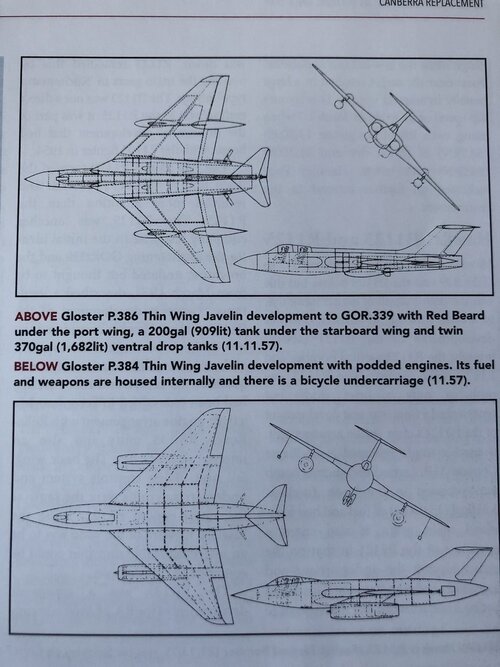
The P.376 was not the final edition of the Javelin; these were the P.384 and P.386. While still not in the same speed class as the CF-105, they would definitely have been supersonic (mach 1.4 - 1.6) with its afterburning Olympus engines and would have had a rather large combat radius.
 
The P.376 was not the final edition of the Javelin; these were the P.384 and P.386. While still not in the same speed class as the CF-105, they would definitely have been supersonic (mach 1.4 - 1.6) with its afterburning Olympus engines and would have had a rather large combat radius.
If a designer needs two afterburning Olympus engines on a fighter in order to go Mach 1.4-1.6, the design office of that company needs to be shut down post haste.
Great fuel consumption + great drag = short combat radius, not a rather large one.
 
Early Sidewinders, Falcons and Genies might be better than Firestreaks but not much.
Sorry I know you want those paper British missiles but they were never going to happen.
Really? In an alternative universe, why not? It does require a systems-integration decision for a common radar for both Javelin and Sea Vixen to provide illuminator capability, accepting at a fairly early stage that the best - active radar homing - is the enemy of good enough. BSP4 mentions a last-minute redesign of Red Dean that brought the weight way, way down and went for semi-active, but details on this final form are lacking, even in Forbat's in-depth account. This happened in 1956, and a conversion to SARH at this stage (if continued as a test bed) could have driven illuminator integration for at least the two subsonic interceptors.
You could do worse than put Red Top on it, and Blue Dolphin isn't that much of a pipe dream. But neither is anything to get excited about.

Fundamentally, I think the best thing you can do for the Javelin is to get it replaced with a supersonic all-weather fighter a bit earlier. Could be worse, the Sea Vixen was bid to the same spec, and soldiered on until 1972!
I'm surprised Red Top wasn't considered for the Javelin as soon as it was in service, for the same reason it was given to Sea Vixen.
Because we ended up using US missiles not French or Soviet ones.
Sidewinders should have been evolved in partnership with the US. Sparrow became the RAF bomber killer.
A UK platform with US missiles might have worked. Javelins with Genies and Falcons like US Daggers and Darts.
Sparrow isn't actually that much bigger than Firestreak, although it is 150lb heavier, and IIRC some of the AI radars used by Javelins were actually American. I don't see it being that much of a problem to make a decision for a radar to integrate Sparrow with the Javelin, which would give it a far better punch at longer range than Falcon.
 
If a designer needs two afterburning Olympus engines on a fighter in order to go Mach 1.4-1.6, the design office of that company needs to be shut down post haste.
Great fuel consumption + great drag = short combat radius, not a rather large one.
Well, 1000 nm combat radius isn't bad at all and they were quite impressive area ruled designs. See Tony Buttler's book "British Jet Bombers since 1949".
 

Attachments

  • IMG_0041.jpeg
    IMG_0041.jpeg
    361.8 KB · Views: 105
BSP4 mentions a last-minute redesign of Red Dean that brought the weight way, way down and went for semi-active, but details on this final form are lacking, even in Forbat's in-depth account. This happened in 1956, and a conversion to SARH at this stage (if continued as a test bed) could have driven illuminator integration for at least the two subsonic interceptors
Post and then edited due to quoting issues....

Had the axe fallen on F.155 in '56, and the 'interim' order for Sea Vixen, Scimitar and Lightning gone through at this point. It is arguable that Red Dean should continue and enter service on Sea Vixen and Javelin.
As this would be the 400lb revised SARH design. Such a weapon would give greater flexibility to the two aircraft and allowed the development of further improvements.
We could envision changes to materials to increase speed/temperature, changes to seeker to monopulse, changes to rocket motor and warhead. Even changes in aspects of external design.

Arguably in a more supersonic aircraft compatible form, this could arm a Lightning development.

It also potentially form the basis of a means to develop Orange Nell.
Even perhaps a limited ARM version.
 
Last edited:
No it could have been done, based on Thunderbird mkII or Bloodhound technologies.

No that doesn't mean trying to mount Thunderbird from a pylon, rather it means trying to squeeze the guidance package into a large AAM.

Or just buying in the Eagle AAM, which looks like the strongest case. Until Sea Dart.....though earlier A5 seeker technology is a possibility.

But.....this probably favours the larger V-Bomber or converted Civilian Airliner concept better than the Javelin.
For the BARCAP/Missileer flight mission, you really need something big. The F6D was roughly Intruder sized (and performance), so you'd really want something like the Buccaneer or one of the V-bombers. When you're talking about 1000-1500lb long range missiles, you need all the lifting capacity you can get!

And honestly, my recommendation at that point would be buying Eagle AAMs (1500lbs each!), and probably using something like Bucc S2s with the Spey turbofans for low fuel consumption in cruise at altitude. We can argue over whether to use British radar or the American APQ-81 and whichever AWG firecontrol applies (-10 or -11 later on in phantoms, obviously -9 with the F111B and Tomcat).
 
For the BARCAP/Missileer flight mission, you really need something big. The F6D was roughly Intruder sized (and performance), so you'd really want something like the Buccaneer or one of the V-bombers. When you're talking about 1000-1500lb long range missiles, you need all the lifting capacity you can get!

And honestly, my recommendation at that point would be buying Eagle AAMs (1500lbs each!), and probably using something like Bucc S2s with the Spey turbofans for low fuel consumption in cruise at altitude. We can argue over whether to use British radar or the American APQ-81 and whichever AWG firecontrol applies (-10 or -11 later on in phantoms, obviously -9 with the F111B and Tomcat).
I think getting the V-Bomber....maybe Vulcan is the strongest BARCAP case for the period.

Later on HSA seems to have information on the big AIM-47 AAM developed for F108 and F12.
 
I think getting the V-Bomber....maybe Vulcan is the strongest BARCAP case for the period.

Later on HSA seems to have information on the big AIM-47 AAM developed for F108 and F12.
Will admit that the Bucc S2 was more for RN BARCAP than RAF. I'd fully expect the RAF to use one of the V-bombers instead of Bucc.
 
Well, 1000 nm combat radius isn't bad at all and they were quite impressive area ruled designs. See Tony Buttler's book "British Jet Bombers since 1949".
1000 nm combat radius is indeed great. Provided that it was not a sales pitch, of course, but something the actual aircraft were actually doing.
'Quite impressive designs' - they never existed, so pitching them as such is kinda ... odd.
 
1000 nm combat radius is indeed great. Provided that it was not a sales pitch, of course, but something the actual aircraft were actually doing.
'Quite impressive designs' - they never existed, so pitching them as such is kinda ... odd.
Designs = concepts ... and there is no obligation to like these various Javelin concepts ;)
 
A useful defence of the Javelin- a Tornado ADV sort of fighter.
Unlike the Sea Vixen FAW2 it never got 4 Red Tops.
All were obsolescent when they entered service compared with US types.
More like obsolete. The F-102 operating with the SAGE ground control system was generations ahead of the Javelin. The 102 was supersonic, could be automatically steered to an intercept, had an advanced fire control system that allowed all-angle attack patterns on a target, and was all-weather. Yes, the 102 didn't have a gun, but it was supposed to be a bomber killer, not an attack aircraft / fighter killer.

I get the British had a far smaller budget. I also get that British bureaucracy at the time was beyond pedantic when it came to aircraft procurement. It takes a special kind of stupid in bureaucracy to destroy an entire industrial sector that was relatively successful prior to its involvement.
 
Drag comes in many flavors. Javelin looks like it was not optimized for transonic flight but should have been very favorable for distance in a subsonic role relying upon purely dry thrust. It had pretty exceptionally low wing loading which is good for subsonic flight characteristics. Give the pilot a high altitude suit and let it loft missiles from a high perch. Its hard to believe its nose diameter was so similar to much larger aircraft that came long after it. That should have given it a nice situational awareness of high flying targets in its day.
 
Drag comes in many flavors. Javelin looks like it was not optimized for transonic flight but should have been very favorable for distance in a subsonic role relying upon purely dry thrust. It had pretty exceptionally low wing loading which is good for subsonic flight characteristics. Give the pilot a high altitude suit and let it loft missiles from a high perch. Its hard to believe its nose diameter was so similar to much larger aircraft that came long after it. That should have given it a nice situational awareness of high flying targets in its day.

I'd also think with that huge delta wing that while you'd get a good initial turn rate, the drag would cripple the plane in a sustained turn or trying to do any sort of energy maneuvering.
 
Lack of turn rate is okay for an interceptor. And the heavy wings would make it a dog in rolls. Javelin's tail was not very well placed to try its hand in fighter roles. But for interceptions, that is not really any hinderance. And certainly as a missileer its not an issue as you pretty much need a stable platform to illuminate from.
 
Oh, some contemporaries that could climb with a Lightning:

The F4D Skyray... It could make just shy of 50,000 feet from a standing start in two-and-a-half minutes climbing at a 70 degree angle, and that's doing it subsonic!

The F-104, particularly if you accelerated to above Mach before starting your climb. The climb rate was somewhere between about 50,000 fpm to 25,000 fpm depending on speed and altitude when entering the climb.
And the F-104 held the climb records, not the Lightning.
 
I'd also think with that huge delta wing that while you'd get a good initial turn rate, the drag would cripple the plane in a sustained turn or trying to do any sort of energy maneuvering.
Actually the big wing a low wing loading gave good sustained turn rate performance at high altitude.

It's really in the turn cases above sustained where you suffer as you decelerate (or lose altitude) quickly as Drag > Thrust. And it hurts for climb/acceleration too as you have both more drag and more weight
 
Lack of turn rate is okay for an interceptor. And the heavy wings would make it a dog in rolls. Javelin's tail was not very well placed to try its hand in fighter roles. But for interceptions, that is not really any hinderance. And certainly as a missileer its not an issue as you pretty much need a stable platform to illuminate from.
The T-tail was also a big detriment in pitch up maneuvers as it could easily be blanked off by the wing and fuselage of the aircraft. The F-101 had this issue big time. It was so bad, that the plane was fitted with a spin recovery drag chute to be used if the pilot pitched up too steeply and caused the plane to enter an unrecoverable spin.

 
All were obsolescent when they entered service compared with US types.
I have a vision of you being reincarnated as a parrot, and you will sit on your perch screeching "Buy American! Buy American! Buy American!" :p

The saddest thing about this thread is that the "better Javelin" was (IIRC) cancelled with early examples actually on the production line. Given how long the Javelin actually served, I would be half-inclined to switch to the faster version and call it good.
 
The saddest thing about this thread is that the "better Javelin" was (IIRC) cancelled with early examples actually on the production line. Given how long the Javelin actually served, I would be half-inclined to switch to the faster version and call it good.

“better Javelin” I assume you mean Thin Wing Javelin?

As for “on the production line”

No on both counts;-

What Gloster’s was building at their prototype facility at Benham was the P371(Thin wing Javelin), which was not much better than the production Javelin, which indeed not much better than the Meteor NF.

Please open this link the find drawings and photos of it (well chunks of XG338)
on the Benham shop floor.

https://www.secretprojects.co.uk/threads/gloster-javelin-projects.3938/#post-328189
 
It would have been interesting if Javelin evolved like McDonnell did with F-101 and F-4. Elongate the fuselage. Move the horizontal stabs down as they move back. Thin out the wing. Add slats and trimmable flaps. Probably ends up more a Buccaneer shape with recessed missiles to cut drag.
 
In my opinion, the Javelin's main defect was the excessive thickness of its wings, which had originally been designed to accommodate heavy guns.

Some of the lessons learned about the structural damage of compressibility buffeting had not been incorporated into the design, which is especially noticeable in the archaic tailplane design. A concept that had already been discarded in the Gloster E.5/42 in favor of the E.1/44 but again resurrected in the tormented aerodynamics of the Gloster Meteor.


The aircraft was designed as a long-range interceptor to shoot down slow Soviet copies of the B-29, but I should add that any aerodynamic refinement would have greatly increased its range in CAP missions.

In my time as a modeler, Javelin disappointed me.

Unlike the Sea Vixen.
 
Last edited:
In my opinion, the Javelin's main defect was the excessive thickness of its wings, which had originally been designed to accommodate heavy guns.
Hence my desire for a thin(ner)-winged Javelin, whichever version we might be talking about.

If you're going to cancel it because you're swooning over the CF-105, fine. But then just buy the damn CF-105 and get it over with.
 
Hence my desire for a thin(ner)-winged Javelin, whichever version we might be talking about.

If you're going to cancel it because you're swooning over the CF-105, fine. But then just buy the damn CF-105 and get it over with.
Well, I don't think it would have been enough to design thinner wings, the engine air intakes and the T-tailplane also generated a lot of drag.
 
the engine air intakes and the T-tailplane also generated a lot of drag.
Looking at the various forms of "thin wing Javelin" in British Secret Projects 1 (Second Edition): jet fighters since 1950, an engine change was in the offing anyway (Sapphire to Olympus), and that brings new intakes as a matter of course.
 
The problem is that noone had decent fighters until the 70s. All early missile systems were pretty useless.
I’ll assume you mean missile armed fighters.

F-4? Crap?

Early missile systems probably would have done pretty well against their intended targets, high flying, non maneuvering bombers.
 
I think the 'problem' of early AAMs is one of expectations exceeding reality. When they worked they were obviously a significant improvement over guns and unguided rockets that were in use in the 50s, however nobody expected every round of cannon ammo or rocket to work, yet that seems to be the expectation for AAMs.

AAMs had a 'life on the wing' of about 50-100 hours, presumably navy carrier aircraft were at the lower end, and I expect this had to be discovered during combat. The Ault Report which famously led to Top Gun was mostly about missile and weapons system maintenance and the Top Gun syllabus was focused on teaching pilots the limitations of AAMs and therefore how to get their fighters to within the AAM's parameters. Again this likely needed combat to be discovered.
 
Could it have been possible to produce a better Javelin?
Certainly seems technically achievable, albeit with some major re-design work. The broad history of transonic area rule has it being independently discovered in the US in 1951 and it being pushed out to domestic industry in 1952, when did the UK learn about it does anyone know? That potentially limits the timeline on some of the changes you can do.
 
So coming back to this the main changes seem to be moving the engines inwards next to the body – ideally semi-circular to allow the addition of shock cones, incorporate splitter plates, area rule the fuselage and use the 'thinner' wings. After all that I'm not sure how much of the original Javelin you'd have left.

With such a large list of changes the question becomes when did these developments originally see introduction? A quick search has side intakes and splitter plates being introduced shortly after WWII. Area rule in America was confidentially released to domestic industry in 1952 – it would make sense that they also released it to foreign companies where the US was funding the design and production of aircraft, but that's no guarantee. Gloster were already tinkering with things during the original development of the Javelin so that's easy enough to play with, which leaves when shock cones first came on the scene – any examples before the mid-1950s?
 
So coming back to this the main changes seem to be moving the engines inwards next to the body – ideally semi-circular to allow the addition of shock cones, incorporate splitter plates, area rule the fuselage and use the 'thinner' wings. After all that I'm not sure how much of the original Javelin you'd have left.

Therein lies the problem.

Turning a sluggish 40s radar carrying aircraft into a supersonic fighter for the 60s is a big and expensive job to produce an aircraft that would not be much chop compared to its Contemporaries. Dropping the thin wing javelin was a good move overall.
 
Can javelin be reinvented as a strike fighter ?
Perhaps better load carrying capacity than a hunter
Like a land based sea vixen
Is there a market for it in smaller countries that don’t have to deal with Mach 2 threats ?
 
Can javelin be reinvented as a strike fighter ?
Perhaps better load carrying capacity than a hunter
Like a land based sea vixen
Is there a market for it in smaller countries that don’t have to deal with Mach 2 threats ?
I don't think so. Load is only 4x Firestreak, so call it 4x500lb bombs.

When the US is willing to sell A-4 Skyhawks.
 
I don't think so. Load is only 4x Firestreak, so call it 4x500lb bombs.

When the US is willing to sell A-4 Skyhawks.

And the RAF had more Canberras than it can poke a stick at. For the most part from the mid 50s the RAF moved from fighter-bombers to interdictors, using nuclear armed Canberras.
 
Back
Top Bottom