Training plane Project. Poland,

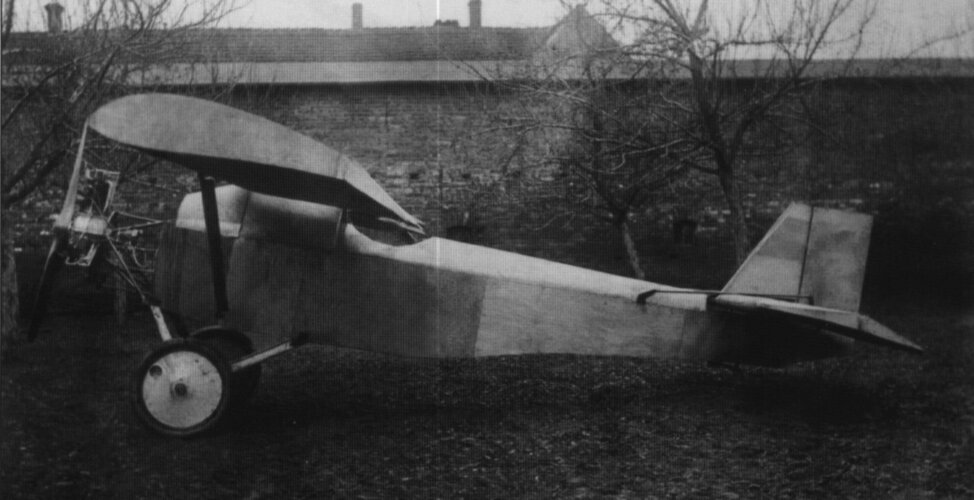
The design of the ST-4 training aircraft was developed for a competition announced by IBTL in June 1926 for a training aircraft capable of performing full acrobatics. The plane took second place in the competition, the project Bartel BM-3 won, and PWS-2 took third place.

The constructors were Eng. Piotr Tułacz and August Zdaniewski from WWS "Airplane". In the opinion of IBTL, it was noted that the project requires major modifications, including displacement of the longitudinal mass distribution in the hull and increase of the hull length. The project sent for correction was not implemented.

http://www.samolotypolskie.pl/samoloty/3010/126/ST-42
 
The designers, of course, came from WWS Samolot S.A. In 1926, one of those designers' names was inż. August Bobek - he didn't change his name to Zdaniewski until 1932.

BTW, the IBTL in question was the Polish Army's Instytut Badań Technicznych Lotnictwa (Aviation Technical Research Institute) of Warsaw
 
School plane Project. Poland,

The project of the "Orle" school plane was developed by Eng.
Maurycy Sztygold for a competition announced in October 1924
by the IV Department of Air Navigation for the design of the airframe.
The results were announced on November 16, 1925. He took second
place in the general classification and second prize. It was intended f
or initial pilot training.

The design and calculations are carefully and clearly made, and the
construction is not very complicated. Despite the high rating (second
place after WZ-IX) and the announcement of building a prototype,
the project was not implemented.

http://www.samolotypolskie.pl/samoloty/2911/126/Sztygold-Orle2
 
BTW, Orlę means 'Eaglet'. The rest of the samolotypolskie.pl text reads:

Construction :
Two-seater monoplane with wooden structure.
Side-by-side seating in cockpit for instructor and student

Engine - 26 kW (35 hp) Anzani
 
Reconnaissance plane Project. Poland,

The design of the Wentzel-I plane was created in 1919 by Włodzimierz
Wentzl. The constructors were Włodzimierz Wentzel and Emil Kurzeja.
In November 1919, Wentzel made an offer to SŻN, proposing to launch
the production of aircraft. A committee was delegated to the manufacturer
to familiarize themselves with the design of the aircraft and the production capabilities. The company declared the delivery of the first aircraft five
months after signing the contract, 450 airframes in the first year and 1,200
per year in the following years.

After getting to know the label, the commission was skeptical about the
offer. The feasibility of producing aircraft was not recognized. The offer
was rejected.

http://www.samolotypolskie.pl/samoloty/3144/126/Wentzel-I2
 
A question: does any Polish engineer in 1920-1930s experimented with remote controlled planes/bombs? I'm working on a series of articles about guided weapon experiments in minor WW2 participants (like Hungary and Romania), and neutral countries (like Sweden) and would be grateful for any data.
If you look at answer#5 it mentions the Paul Schweda unmanned design.
 
Fighter plane Project. Poland,

The design of the "Wujot" fighter plane was prepared for a
competition announced in October 1924 by the IV Department
of Air Navigation for the design of the airframe. The results were
announced on November 16, 1925. The project was prepared by
Jerzy Wojciechowski from the Polish Aviation Youth Association.
The project got 2nd place in the group of single-seat fighters, 6th
place in the general classification and 4th prize.

The project was not implemented.

http://www.samolotypolskie.pl/samoloty/3174/126/Wojciechowski-Wujot
 
Experimental plane Project. Poland,Strange concept

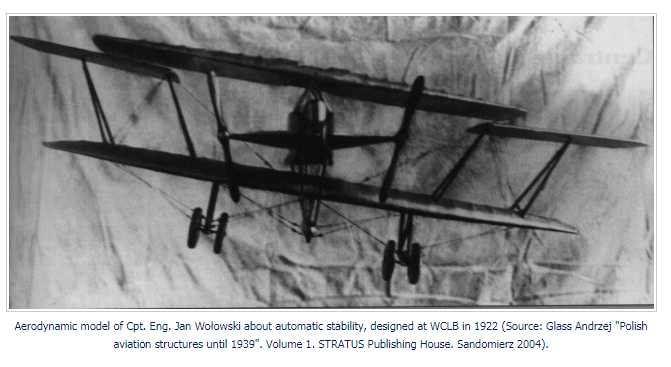
Capt. Eng. Jan Wołowski developed in 1922 at the Military Central Aviation Research Center a project of an automatically stabilized aircraft . He applied for a patent for an automatic airframe ballast in the Polish Patent Office . In September of the same year, in the workshop of the Central Aviation Works in Mokotów, he completed a 1:10 scale model, which he tested in the wind tunnel of the Warsaw University of Technology . The construction of the aircraft was started in 1923, but already in 1924 it was definitely abandoned. The plane was never completed A reminiscence of the inventor's interest in the automatic stabilizer was his participation in the Exhibition of Aircraft Models and Aerofoto, which was organized in April 1924 by the State Air Defense League in Warsaw. Wołowski exhibited an experimental model of an airplane with an articulated airfoil above the fuselage. In the case of tilting of the aircraft, the upper wing moved towards the fuselage, which was to ensure automatic lateral stability of the apparatus in flight. Perhaps he continued his experiences and works related to the construction of an aircraft of his own design in RBWZ, abandoned in 1911 (see Wołowski-Piotrowski reflex plane ). Wołowski's model aroused keen interest in both the public and the press. The inventor argued that he would soon perform a series of experiments on the stand prepared on the roof of a freight car included in the fast train, and his method of ensuring automatic lateral stability of airframes may be of great importance for heavy transport and bomber aircraft.

http://www.samolotypolskie.pl/samoloty/3185/126/Wolowski-samolot-stateczny
 

Attachments

  • 1.png
    1.png
    198.5 KB · Views: 135
Experimental helicopter project. Poland.

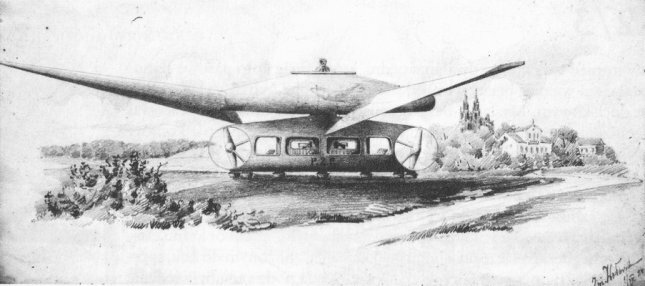
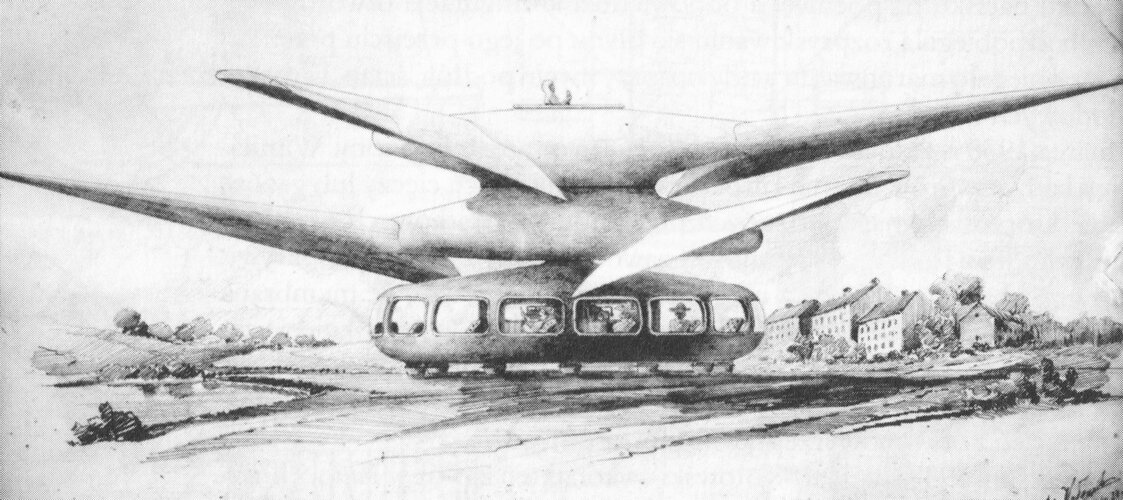
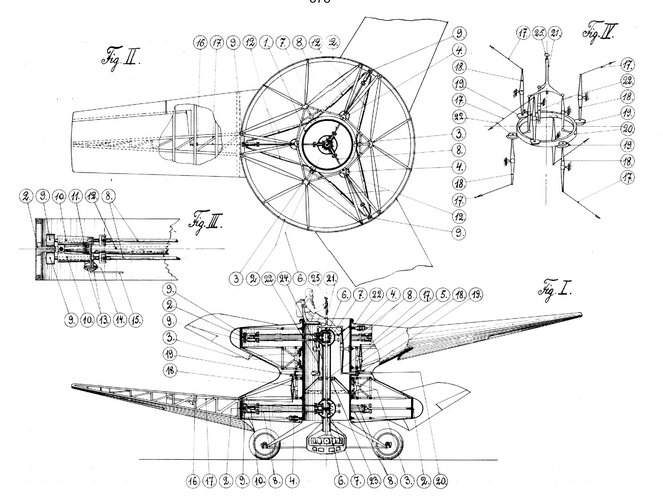
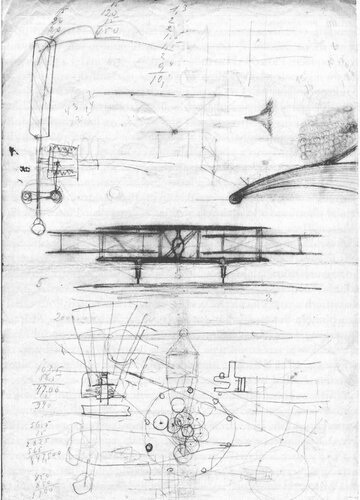
On July 5, 1924, Jan Wołowski applied for a patent for a "friction drive helicopter". Wołowski pointed out that the use of a complex system of gears in the helicopter between the engine and a low-speed rotor with a large span carries a heavy load on the machine and is difficult to implement. Belt transmissions also did not win recognition, due to the fact that the belts working in the horizontal plane cannot protect themselves from damage and sliding, as well as from jumping off the rim of the drive pulley.
He proposed the use in a two-rotor helicopter with concave profile rotors, mounted coaxially, of an appropriate friction gear configuration with the rotor, suspended in a place as close as possible to the center of gravity of the system, which, in his opinion, should provide a sufficient degree of efficiency of the power transmission, the large pulley would also constitute a crown rotor hubs, while the small ones would be connected to the thrust mechanism.

http://www.samolotypolskie.pl/samoloty/15754/126/Wolowski-smiglowiec
 

Attachments

  • 1.jpg
    1.jpg
    37.1 KB · Views: 110
  • 2.jpg
    2.jpg
    393.3 KB · Views: 105
  • 3.jpg
    3.jpg
    180.4 KB · Views: 119
Bomber. Poland / France,

W-6 & W-7;

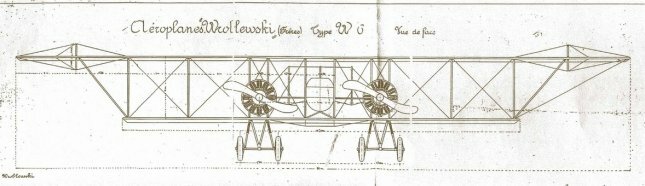
Edward Wróblewski, after abandoning the construction of a twin-prop aircraft (see Wróblewski (Edward) two-propeller aircraft), fundamentally changed the assumptions and layout of the aircraft that he intended to dedicate to the army. He abandoned the concept of a monoplane in favor of a biplane, twin engine, with engines mounted on the wing.

The W-6, which was to be a medium bomber, was built in the workshop of Louis Joannard in Lyon from mid-1915. In order to obtain two Hispano Suiza engines for this construction, he sought interest in the project by the military authorities. After many different interventions, also from the politicians he reached, he received steel pipes rationed during the war, thanks to which in February 1916 the W-6 type A military plane was already fully assembled. The designer asked Edouard Nieuport to allow him to purchase Hispano-Suiza V8 engines with 147 kW (200 HP), produced at his factory in Issy-les-Moulineaux. However, on March 9, 1916, he refused. During the war, the priority was given to production for military aviation, studies and design experiments lagged far behind the needs of the front. In this case, the issue concerned engines, the production of which did not fully meet the needs of building new aircraft and operating those used in the first line. There was even talk of motor hunger. No wonder that this barrier could not be broken.

This plane was to be equipped with a bomb launcher and a bomb sight, which was necessary to attract any interest of the military authorities, which clearly defined the technical guidelines for a bomber plane, which had to have instruments enabling a precise raid over the target. To meet this condition, Edward developed his own type of bomb sight, which he referred to as a teleperiscope or optical apparatus for airplanes. On 4 April 1916 he applied for a patent, but we do not know this patent, it was not published due to its military value. He also sent a description of his invention to the Ministry of War. Here, Pierre-Étienne Flandin, aeronautics rapporteur on the Armed Forces Control Commission of the National Assembly of France opted for its implementation and appropriate experiments. The case of Edward Wróblewski's sight to the French Ministry of War was also recommended above by Alain Leret d'Aubigny, a politician. Their interventions made the military authorities finally become interested in the proposal and ordered that on July 10, 1916, tests with the completed specimen were carried out in Ambérieu, led by Lieutenant Colonel Jean Doran.

At that time, as a result of a recommendation from Louis Janin, Wróblewski's works became interested in the aviation pioneer and industrialist Robert Esnault-Pelterie, who in 1915 moved his aviation factory to Lyon. The advocate of Edward's design work was Michel Pierre Molla, director of the Lyon airline company REP.

On March 16, 1916, he offered Edward all the help and services of a factory pilot who would carry out a flight test of the machine. Robert Esnault Pelterie finally made Nieuporta provide the engines necessary for test flights. On April 18 in Issy-les-Moulineaux, at the Nieuporta airport, where the final assembly of the plane transported here from Ambérieu was carried out. With the participation of officers of the Aeronautics Department of the Ministry of War, military tests of the plane were undertaken in flight, up to a ceiling of 4,000 m. Unfortunately, in the first flight there was a failure and the plane fell into the Seine. The pilot and accompanying Edward, the wounded were taken out of the river. The idea of rebuilding the W-6 was abandoned.

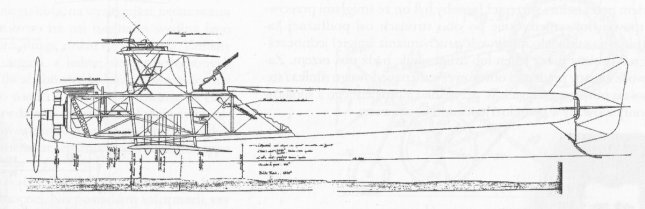
After the crash of the Wróblewski W-6 bomber, during a long recovery, Edward Wróblewski developed a project to build a heavy, D-type biplane W-7 bomber with strong on-board armament, according to the guidelines of the Ministry of War regarding technical requirements for strategic military aircraft.

http://www.samolotypolskie.pl/samoloty/15769/126/Wroblewski-W-6http://www.samolotypolskie.pl/samoloty/15770/126/Wroblewski-W-7

 

Attachments

  • W-6.jpg
    W-6.jpg
    30.4 KB · Views: 102
  • W-7.jpg
    W-7.jpg
    27.1 KB · Views: 105
Experimental helicopter project. Poland.

On July 5, 1924, Jan Wołowski applied for a patent for a "friction drive helicopter". Wołowski pointed out that the use of a complex system of gears in the helicopter between the engine and a low-speed rotor with a large span carries a heavy load on the machine and is difficult to implement. Belt transmissions also did not win recognition, due to the fact that the belts working in the horizontal plane cannot protect themselves from damage and sliding, as well as from jumping off the rim of the drive pulley.
He proposed the use in a two-rotor helicopter with concave profile rotors, mounted coaxially, of an appropriate friction gear configuration with the rotor, suspended in a place as close as possible to the center of gravity of the system, which, in his opinion, should provide a sufficient degree of efficiency of the power transmission, the large pulley would also constitute a crown rotor hubs, while the small ones would be connected to the thrust mechanism.

http://www.samolotypolskie.pl/samoloty/15754/126/Wolowski-smiglowiec

Hah!
Hah!
That reminds us of R. Buckminster Fuller's 1930 Dymaxion House.
 

Attachments

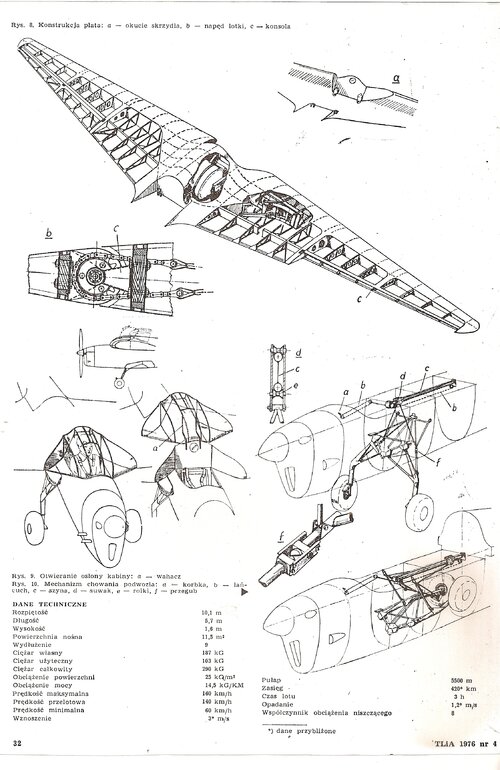
  • mip-1.jpg
    mip-1.jpg
    73.6 KB · Views: 98
  • mip-1.gif
    mip-1.gif
    102 KB · Views: 88
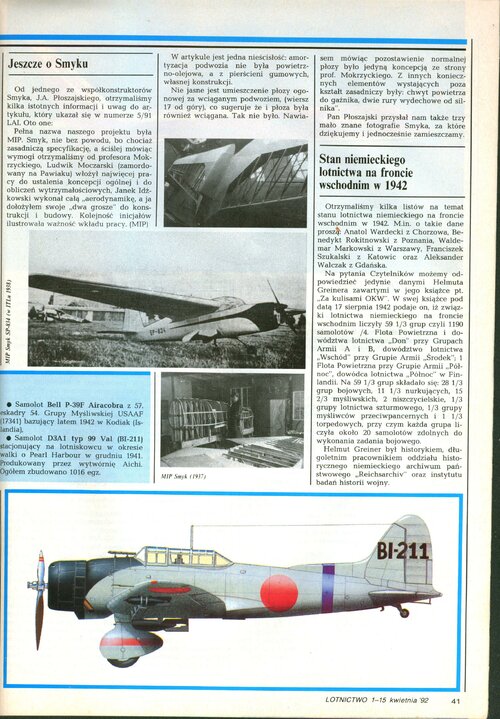
  • MIP_Smyk_02.jpg
    MIP_Smyk_02.jpg
    549.7 KB · Views: 88
  • Modelarz 5 1957_0016.jpg
    Modelarz 5 1957_0016.jpg
    681.8 KB · Views: 85
  • Modelarz 5 1957_0008.jpg
    Modelarz 5 1957_0008.jpg
    468.8 KB · Views: 90
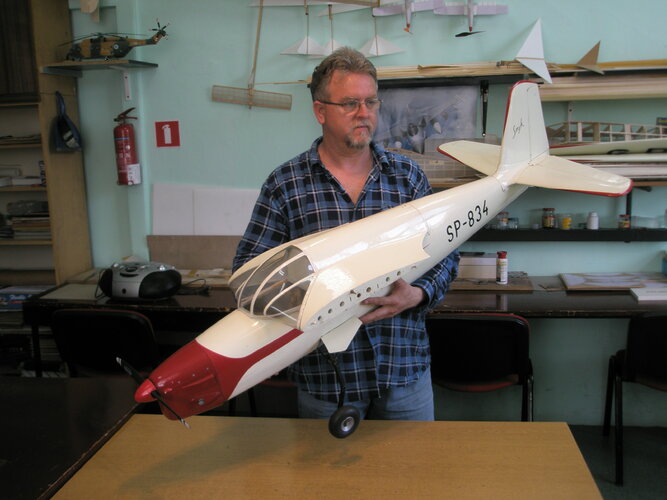
  • 1.JPG
    1.JPG
    1.5 MB · Views: 86
Experimental plane Project. Poland,Strange concept

Capt. Eng. Jan Wołowski developed in 1922 at the Military Central Aviation Research Center a project of an automatically stabilized aircraft . He applied for a patent for an automatic airframe ballast in the Polish Patent Office . In September of the same year, in the workshop of the Central Aviation Works in Mokotów, he completed a 1:10 scale model, which he tested in the wind tunnel of the Warsaw University of Technology . The construction of the aircraft was started in 1923, but already in 1924 it was definitely abandoned. The plane was never completed A reminiscence of the inventor's interest in the automatic stabilizer was his participation in the Exhibition of Aircraft Models and Aerofoto, which was organized in April 1924 by the State Air Defense League in Warsaw. Wołowski exhibited an experimental model of an airplane with an articulated airfoil above the fuselage. In the case of tilting of the aircraft, the upper wing moved towards the fuselage, which was to ensure automatic lateral stability of the apparatus in flight. Perhaps he continued his experiences and works related to the construction of an aircraft of his own design in RBWZ, abandoned in 1911 (see Wołowski-Piotrowski reflex plane ). Wołowski's model aroused keen interest in both the public and the press. The inventor argued that he would soon perform a series of experiments on the stand prepared on the roof of a freight car included in the fast train, and his method of ensuring automatic lateral stability of airframes may be of great importance for heavy transport and bomber aircraft.

http://www.samolotypolskie.pl/samoloty/3185/126/Wolowski-samolot-stateczny

Also from the same source.
 

Attachments

  • 1.jpg
    1.jpg
    128.9 KB · Views: 108

Attachments

  • SWScan01337.JPG
    SWScan01337.JPG
    970.9 KB · Views: 95
  • 74275858_2841568509209318_4833322604532072448_n.jpg
    74275858_2841568509209318_4833322604532072448_n.jpg
    80.3 KB · Views: 84
  • 06_copy42.jpg
    06_copy42.jpg
    79.3 KB · Views: 69
  • 20293166_1408875572500518_6861249342272251376_n.jpg
    20293166_1408875572500518_6861249342272251376_n.jpg
    36.2 KB · Views: 60
  • 3_copy1004.jpg
    3_copy1004.jpg
    121.2 KB · Views: 65
Hi,

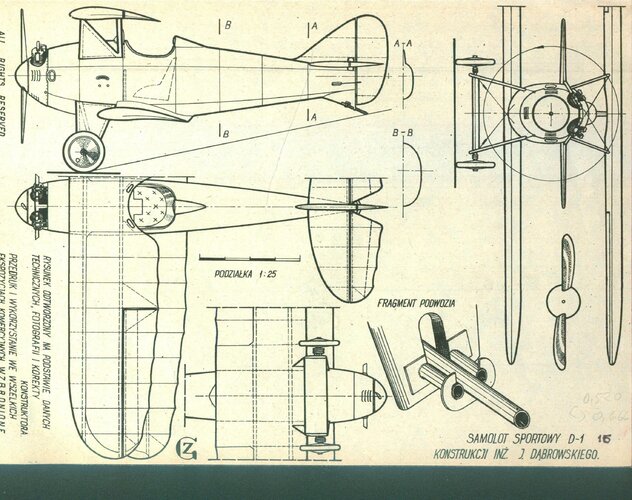
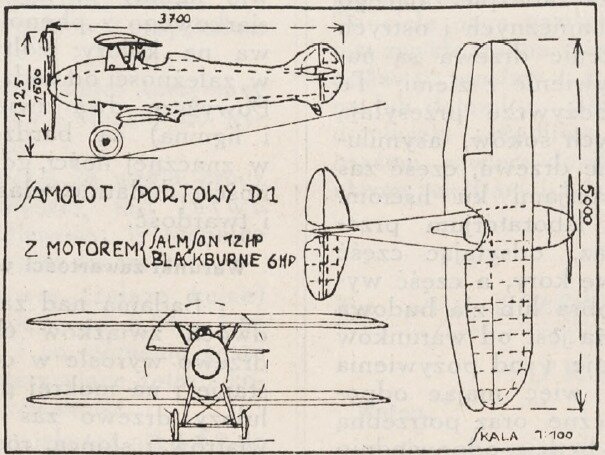
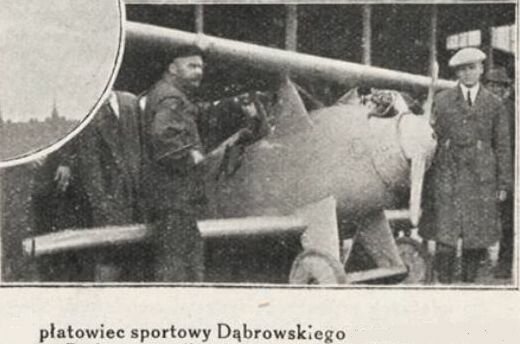
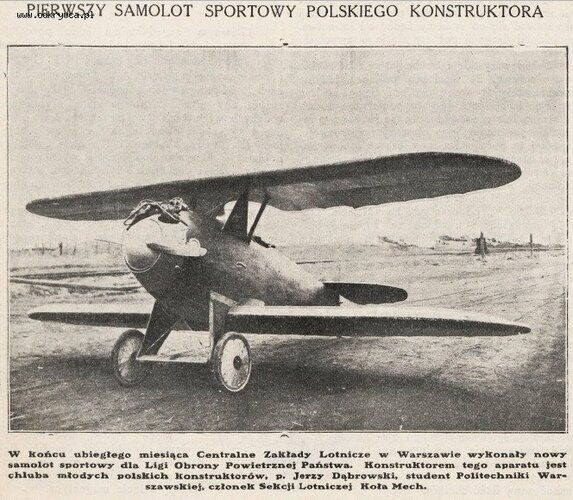
Mr. Jerzy Dabrowski designed the D-1 Cykacz,it was single seat cantilever sporting biplane,built
in 1925 and powered by one 16 hp Blackburn Tomtit engine,followed by D-2,it was a single seat
high-wing monoplane Project of 1926,but never materialized.

http://www.samolotypolskie.pl/samoloty/754/74/D-1http://www.samolotypolskie.pl/samoloty/755/74/D-22

Cute little biplane.
Those flat wings would have neutral roll stability: great for aerobatics, but tiresome in cruise.
 
Hi,

Marian Mazur developed an original "Design of a new type of airframe", which he sent to the Military Aviation Research Center in March 1923. The silhouette represented a traditional aircraft, in which the change of track was achieved, however, not by deflecting the rudders, but by changing the direction of the thrust vector of the power unit. The inventor intended to achieve the effect by articulated suspension of the engine bed. The desired change in the position of the propeller-engine unit was made by the pilot by pressing the lever. The idea was original, but the design had the characteristics of an amateur construction and was technically underdeveloped. The Military Aviation Research Center issued a negative opinion.

http://www.samolotypolskie.pl/samoloty/1814/126/Mazur-samolot2
 
Last edited:
Hi,

In 1912, Jan Kazimierz Michalewski developed a glider design, which took 3rd place at the ZASPL Competition in February 1913. The first prize in the competition was won by ZASPL members, brothers Tadeusz and Eng. Władysław Florjański.
The completed model of the glider was presented at the 2nd Aviation Exhibition in Lviv in 1913. The glider was a monoplane, but its design was never implemented.

http://www.samolotypolskie.pl/samoloty/15506/126/Michalewski-szybowiec2
 
Last edited:
Hi,

Marian Mazur developed an original "Design of a new type of airframe", which he sent to the Military Aviation Research Center in March 1923. The silhouette represented a traditional aircraft, in which the change of track was achieved, however, not by deflecting the rudders, but by changing the direction of the thrust vector of the power unit. The inventor intended to achieve the effect by articulated suspension of the engine bed. The desired change in the position of the propeller-engine unit was made by the pilot by pressing the lever. The idea was original, but the design had the characteristics of an amateur construction and was technically underdeveloped. The Military Aviation Research Center issued a negative opinion.

http://www.samolotypolskie.pl/samoloty/1814/126/Mazur-samolot2
Did he consider gyroscopic precession?
 
Pioneer aircraft design. Poland / USA.

The Polish press reported in 1911 that the inventor Józef Pinas, together with Stanisław Wojtan (mechanic), developed an airplane design in Waukegan (Illinois).

According to the creators, it was supposed to be safe to use. They formed a company and intended to build airplanes of their own design, intending to provide themselves with a living this way. However, these plans were not implemented.

http://www.samolotypolskie.pl/samoloty/15577/126/Pinas-Wojtan-samolot2
 
Pioneer glider design. Poland / Austria-Hungary.

Eng. Pokiziak worked on a glider design for a glider model competition announced in 1912 by the Aviation Association of Students of the Polytechnic School in Lviv, and resolved on February 25, 1913.

The project was not implemented, the completed model was exhibited at the 2nd Lviv Aviation Exhibition in February-March 1913.

http://www.samolotypolskie.pl/samoloty/15596/126/Pokiziak-szybowiec2
 
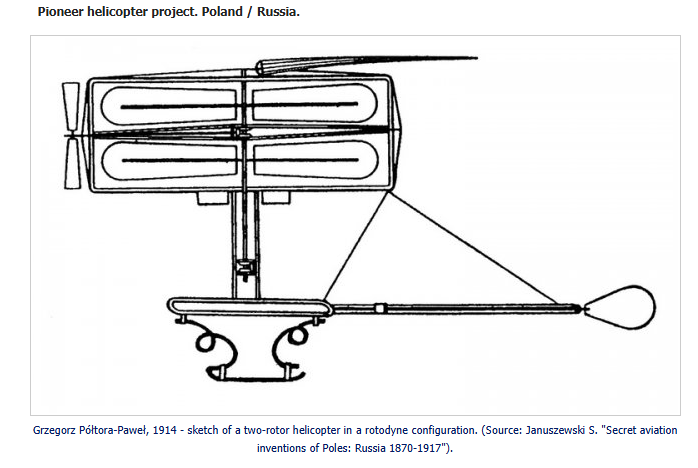
Poltora-Pawel helicopter, 1915,

In August 1914, Grzegorz Połtora-Paweł presented his superiors with a helicopter project , the implementation of which would provide a new tool for aerial reconnaissance and would - in his opinion - replace the role of the tethered balloon in this respect.

The command of the Warsaw Aeronautical Park delegated him to St. Petersburg. There, contacting the specialist community, he refined the project and in 1915 presented it to the Main Military-Technical Directorate.

It was to be a twin-rotor helicopter, with rotors mounted coaxially, in a rotodyne system . Its rotors were characterized by the ability to control the speed of rotation. The fuselage was equipped with a tail at the end. A characteristic feature of the helicopter was the system of maintaining balance using an automatic device moving the ballast in the fuselage. Above the rotor, Poltora-Paweł introduced a foldable parachute, if necessary bringing the aircraft to the ground. The drive was realized from a mechanical engine located in the fuselage. Elements of its construction also played the role of a radiator for the water-cooled mechanical engine. The crew of this helicopter was to consist of two people - a pilot and a mechanic.

http://www.samolotypolskie.pl/samoloty/15806/126/Poltora-Pawel-smiglowiec
 

Attachments

  • 20.png
    20.png
    115.8 KB · Views: 30
Hi,

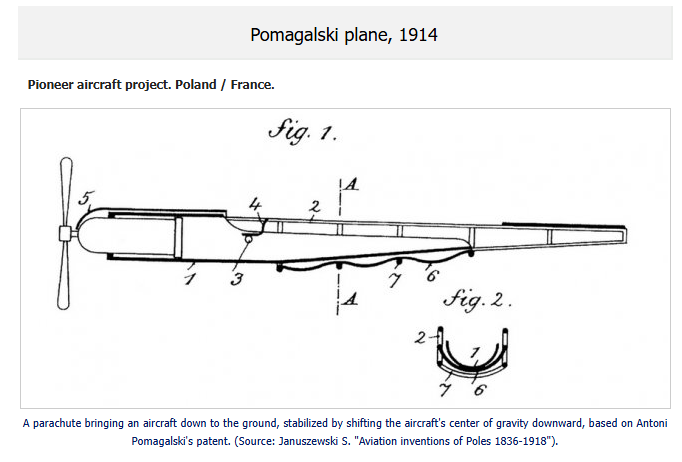
On January 6, 1914, Antoni Pomagalski filed a patent application in Belgium for a safety device for aircraft . He was granted patent no. 263,577.
In his patent memorandum, he described an aircraft fuselage composed of two or more telescopic sections, carrying a propulsion and propeller assembly in its forward section. The two tubular fuselage covers (a rigid front cover and a fabric-covered rear cover) are pivotally mounted on an axis near the center of gravity. They can be tilted 90 degrees, creating parachute surfaces that bring the entire aircraft to the ground. This parachute deploys automatically when the aircraft enters a dive. This is accomplished by a pendulum that activates levers that release the parachute surface locks, which adhere tightly to the fuselage in normal flight (the pilot can also manually activate them). As the aircraft begins to dive, the parachute surfaces begin to deploy, and the fuselage is folded by telescopically extending the section carrying the engine and propeller. This downward shift of the system's center of gravity stabilizes the parachute surface.

The patent claims cover a parachute closely linked to the aircraft's structure and designed to bring it down in the event of a malfunction. Shifting the aircraft's center of gravity downward, as a result of extending the forward section of the fuselage, which carries the engine and propeller, stabilizes the parachute surfaces.

http://www.samolotypolskie.pl/samoloty/15599/126/Pomagalski-samolot
 

Attachments

  • 2.png
    2.png
    77.7 KB · Views: 28
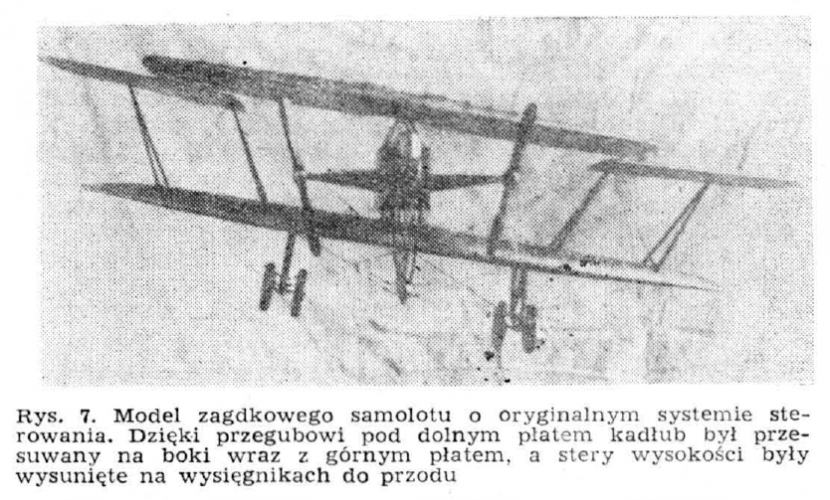
What was this ?,from Tehnika Lotnicza 1985,

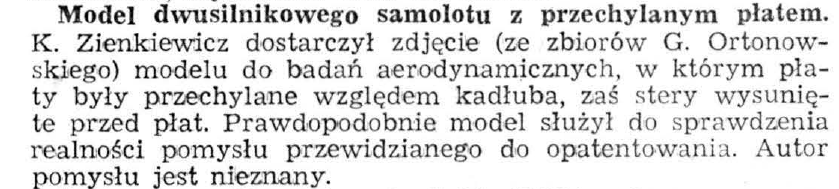
Fig. 7. A model of a puzzle aircraft with an original control system. Thanks to a hinge under the lower wing, the fuselage moved sideways along with the upper wing, and the elevators were extended forward on outriggers.

A model of a twin-engine aircraft with a tilting wing.
K. Zienkiewicz provided a photo (from the G. Ortonowski collection) of a model for aerodynamic testing, in which the winglets were tilted relative to the fuselage, and the elevators extended forward. The model likely served to test the feasibility of an idea proposed for patenting. The author of the idea is unknown.
 

Attachments

  • 1.png
    1.png
    456.9 KB · Views: 12
  • 2.png
    2.png
    143.9 KB · Views: 13
From Technika Lotnicza 1993 and this site,

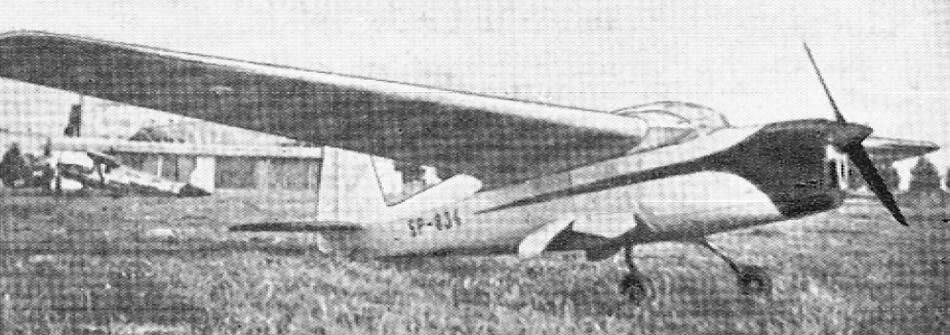
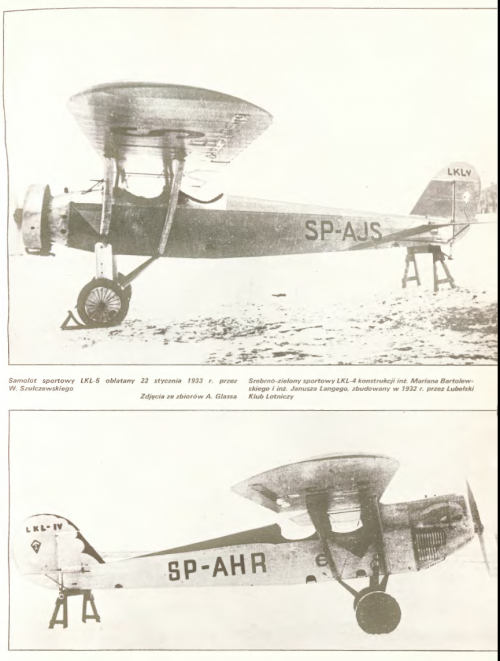
At the same time, the LKL-5 was built , an improved variant with a slimmer fuselage and different landing gear. It first flew on January 22, 1933, and received the registration SP-AJS. These aircraft participated in the 3rd Lublin-Podlasie Aviation Competition from February 3-5, 1933. The LKL-4 had to make three forced landings during the competition due to engine failures, while the LKL-5 withdrew from the competition early in the rally. In May 1933, at the 2nd International Air Meeting in Warsaw, Z. Martyniak took 2nd place in the LKL-4. In the 5th National Tourist Aviation Competition (September 3-10, 1933), the LKL-5 took 9th place, while the LKL-4 did not finish the competition.

http://www.samolotypolskie.pl/samoloty/1642/81/LKL-4-LKL-52
 

Attachments

  • 5.png
    5.png
    1 MB · Views: 8

Similar threads

Back
Top Bottom