peterjayy

ACCESS: Restricted
Joined
15 April 2025
Messages
5
Reaction score
9
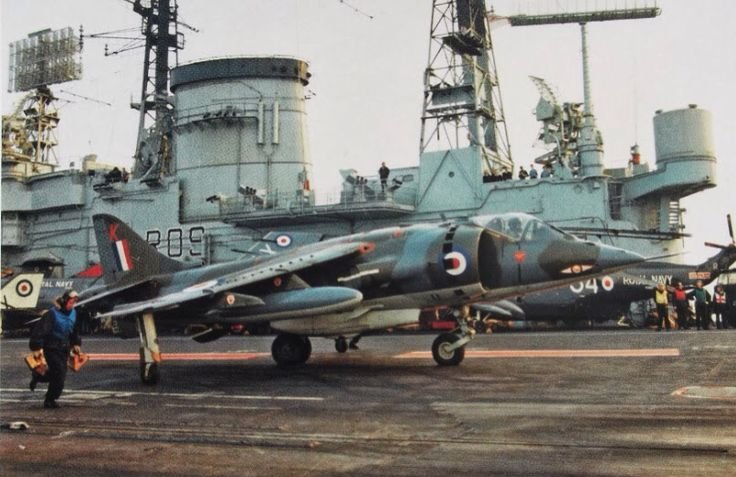
Hello to you all, i am a new member to this forum & i like a lot of what i see & read here & fulmars !(Feeble naval pun/typo intended!) full marks to you all, however, its only fair that i chip in as well. So here goes it. If you cast your mind back to the air shows of the late 70s & early 1980s. There would often be the chance to see a Hawker Harrier Jump Jet on display. It was often perceived as a novelty aircraft, VTOL, reverse thrust manoeuvring, jumping through a ring of fire !;) . All very impressive, but it`s not a real combat aircraft was often how it would be received. Fast forward to 1982 & the Falklands conflict and the Sea Harrier armed with Sidewinder AAMs proved to be very effective. Post conflict, i often wonder why the aircraft never really seemed to peak interest with other nations to operate it? The USA would go on to sell the MD- A/V8 to other nations & as far as i can recall and only the Indian Navy opted for the Sea Harrier. Maybe it was the lack of a suitable, `Invincible light` class of carrier design being available? Had Australia purchased HMS Hermes in 1985 & operated the Harrier, would the pilots be known as `Sailoroos`:D Would the RCN or the Netherlands navies have returned to fixed wing operations at sea? From a modelling perspective, the `WHAT-If` potential is always unlimited. Some of what i have mentioned maybe already covered in earlier posts, but who knows. In the meantime, please enjoy this photo on HMS Ark Royal showing the way forward as it was then. f2ffde7bbb8b61fb5b6e4f16664e81fc--navy-carriers-harrier.jpg
 
. Fast forward to 1982 & the Falklands conflict and the Sea Harrier armed with Sidewinder AAMs proved to be very effective. Post conflict, i often wonder why the aircraft never really seemed to peak interest with other nations to operate it?
To put it simply, because it wasn't VERY effective. It was a subsonic, relatively short-legged attack jet with only very moderate anti-air capabilities. In contended airspace, Harrier's chances were pretty low. The Falkland sucsess was caused mainly by the geographical factor - mainly the distance from Argentinean airfield, that significantly reduced the capabilities of Argentinean supersonic jets.

So essentially, Harrier was useful in pretty limited set of potential combat situations. And operating Harriers was rather costly.
 
Hello to you all, i am a new member to this forum & i like a lot of what i see & read here & fulmars !(Feeble naval pun/typo intended!) full marks to you all, however, its only fair that i chip in as well. So here goes it. If you cast your mind back to the air shows of the late 70s & early 1980s. There would often be the chance to see a Hawker Harrier Jump Jet on display. It was often perceived as a novelty aircraft, VTOL, reverse thrust manoeuvring, jumping through a ring of fire !;) . All very impressive, but it`s not a real combat aircraft was often how it would be received. Fast forward to 1982 & the Falklands conflict and the Sea Harrier armed with Sidewinder AAMs proved to be very effective. Post conflict, i often wonder why the aircraft never really seemed to peak interest with other nations to operate it? The USA would go on to sell the MD- A/V8 to other nations & as far as i can recall and only the Indian Navy opted for the Sea Harrier. Maybe it was the lack of a suitable, `Invincible light` class of carrier design being available? Had Australia purchased HMS Hermes in 1985 & operated the Harrier, would the pilots be known as `Sailoroos`:D Would the RCN or the Netherlands navies have returned to fixed wing operations at sea? From a modelling perspective, the `WHAT-If` potential is always unlimited. Some of what i have mentioned maybe already covered in earlier posts, but who knows. In the meantime, please enjoy this photo on HMS Ark Royal showing the way forward as it was then.

Sea Harrier was a byproduct of the RAF Harrier Mk.1 & Mk.3, unfortunately post 1976, AV-16 and Big Wing Harrier cancellations the UK lost - abandonned, really - control of Harrier sales in favor of the USA and AV-8B. It really didn't helped when the RAF itself bought AV-8B !
At the end of the day, Sea Harrier only sold to India, AV-8B swept all the other naval customers : Spain, Italy, as for Thailand they bought second-hand AV-8As from Spain (not USMC).

I think an interesting turning point might be Big Wing Harrier, circa 1977. That one was to literally unify the RAF and RN Harrier fleets around, well, a big modern wing : vastly improving performance. In the end it was the US AV-8B, flown in 1978, that used that idea.
 
Last edited:
Not really a missed opportunity if we're being honest. The RN got very, very lucky with the Falklands. It was just far enough away from mainland Argentina that the vast majority of the Argentine fighters either couldn't reach it, or could just barely reach it with less than 5 minutes of combat time available to them if they wanted to get back home. On top of that, the airfield on it island at that time wasn't suitable for basing high performance aircraft at. This let the FAA pick and choose where to employ the Sea Harrier. And because of that, they were able to use it in a way that maximized it's advantages while minimizing its weaknesses. Had this battle taken place in almost any other theater of operations in the world, the Sea Harrier would likely have a very different reputation.

And personally, I think that most nations realized that. They saw that, employed in the right rolls, in the right theaters, the Harrier could be effective. But outside of those rolls, it would suffer badly going up against actual fighters.
 
Would any of the light carrier navies have ordered Sea Harrier if it had been available a decade earlier, in the late 1960s?

i.e. Could Hawker Siddeley have offered a radar-equipped Harrier from the start, when it was just starting to produce the first RAF GR1s? Would Australia / Canada / Argentina / Brazil have been interested, especially as an alternative to radar-less Skyhawks?
 
Think there are very few top tier navies that require local air support (from a carrier) because they're operating too far from their own Air Force yet close enough to the enemy that SAMs aren't enough. Australia is certainly one, and the RAN had arranged to buy the HMS Invincible in 1981 but this fell through because of the Falklands. Perhaps Canada if it had followed a different strategic path, the Dutch are not a contender once West Papua was invaded by Indonesia in 1962.
 
Harrier and Sea Harrier are niche aircraft. The Harrier offered a runway independent attack aircraft for NORTHAG/BAOR and the USMC; Sea Harrier offered the UK as a Harrier user a cheap way to turn an escort cruiser/helicopter carrier into a continuation of fixed wing carrier aviation.

If you're facing WWIII and continuous air and IRBM attacks on your fixed runways, or you're planning to deploy into the territory seized by an amphibious forced entry force, whether there are runways there or not, then Harrier may be the aircraft for you. OTOH other aircraft (A-10, Jaguar, Alpha Jet) offered different versions of runway independence with the ability to operate from roads and autobahns, while other nations may decide that the threat to runways is not so great as to make runway independence a capability they need.

If you're already a Harrier user, and CVA.01 just got cancelled, but its escort cruiser/helicopter carrier counterpart hasn't yet faced the axe and might just have room to squeeze in a Harrier airgroup, then sticking a basic fighter radar on Harrier to let it hack down recce Bears in the GIUK Gap makes a very narrow piece of sense for the RN and for no-one else.
 
Think there are very few top tier navies that require local air support (from a carrier) because they're operating too far from their own Air Force yet close enough to the enemy that SAMs aren't enough. Australia is certainly one, and the RAN had arranged to buy the HMS Invincible in 1981 but this fell through because of the Falklands. Perhaps Canada if it had followed a different strategic path, the Dutch are not a contender once West Papua was invaded by Indonesia in 1962.
There is a use case for Harrier for nations like The Netherlands and Canada. It would involve the NATO navies committing to the anti-submarine carrier longer for use as a close escort to CVBGs and north Atlantic convoys. IOTL, that role was pretty much usurped by the P-3 Orion for the convoys, and by swapping out an A-7 squadron for an S-3 squadron on the attack carriers.

ITTL, you'd have to convince the NATO navies that the P-3 wasn't enough on its own to provide anti submarine protection for the convoys, and that a single S-3 (or S-2 depending on time frame) squadron isn't enough to provide 24hr coverage for a carrier battle group. The second option is pretty straightforward. Have enough Admirals get a puckered ass over the thought of losing their multi billion dollar carrier because a decades old piece of shit Foxtrot got lucky and found a blind spot in their screen, and presto! ASW carriers get a reprieve.

It's the convoy escort roll that i want to focus on. Any NATO carriers assigned to the mission will need either Trackers or Vikings for their primary roll. Because if all they're going to operate is helicopters, you might as well just stick them on a few destroyers and call it a day. And since you already have a big deck, you might as well ship a few fighters to provide organic air defense to hunt down Bear recon planes and have a shot at breaking up the odd Badger or Backfire raid by Soviet Naval Aviation.

While this does make the case for the Harrier, it's also where the case breaks down. Because Trackers and Vikings need cats and traps. And because you'll already have a CATOBAR carrier, buying the Harrier doesn't make much sense. Not when you can buy an actual fighter like the Tiger, Crusader, or (unlikely) the Phantom. I'm honestly not sure how you can reconcile those two things.

Because the way I see it the only way to justify first line NATO navies buying the Harrier, is by keeping their light fleets. But keeping the light fleets also means you don't need the Harrier because you have cats and traps.
 
I'd envisage more utility in the Pacific than the Atlantic due to the greater distances involved. As mentioned the NATO P3 forces can cover the North Atlantic due to numerous bases, and there would be a lot of tactical aircraft on the periphery and on USN carriers. In the Pacific this isn't the case, leaving a lot more room for a light carrier with Sea Harriers to operate effectively.
 
I'd envisage more utility in the Pacific than the Atlantic due to the greater distances involved. As mentioned the NATO P3 forces can cover the North Atlantic due to numerous bases, and there would be a lot of tactical aircraft on the periphery and on USN carriers. In the Pacific this isn't the case, leaving a lot more room for a light carrier with Sea Harriers to operate effectively.
Yeah, that's a good point. But then you still run into the same issue. In that you've now kept your CATOBAR equipped carrier, and don't really need Harriers when you just buy a dedicated naval fighter instead (or even the extremely numerous and cheap as dirt A-4 as an anti-snooper fighter). So we're really back at the same problem. How do you justify Harrier when you're retaining your conventional carriers?
 
Yeah, that's a good point. But then you still run into the same issue. In that you've now kept your CATOBAR equipped carrier, and don't really need Harriers when you just buy a dedicated naval fighter instead (or even the extremely numerous and cheap as dirt A-4 as an anti-snooper fighter). So we're really back at the same problem. How do you justify Harrier when you're retaining your conventional carriers?
In the North Atlantic? Because they can operate in sea states that would prevent CATOBAR operations. That was one of the findings of the Falklands War.
 
Yeah, that's a good point. But then you still run into the same issue. In that you've now kept your CATOBAR equipped carrier, and don't really need Harriers when you just buy a dedicated naval fighter instead (or even the extremely numerous and cheap as dirt A-4 as an anti-snooper fighter). So we're really back at the same problem. How do you justify Harrier when you're retaining your conventional carriers?

The Melbourne was a total rustbucket by 1980 and the RAN only expected to keep her until about 1984. 24-28 years life for a carrier designed and laid down in WW2 is fantastic, but top tier navies don't keep ship like that forever and its replacement from the late 70s onwards won't be CATOBAR.
 
The Melbourne was a total rustbucket by 1980 and the RAN only expected to keep her until about 1984. 24-28 years life for a carrier designed and laid down in WW2 is fantastic, but top tier navies don't keep ship like that forever and its replacement from the late 70s onwards won't be CATOBAR.
At that point, if you're not going CATOBAR for a carrier who's primary mission is supposed to be ASW, you shouldn't even build a carrier. Just put your choppers on your destroyers and frigates for a much lower cost (plus you can build and man multiple ships vs just one carrier). Because the only way to justify retraining carriers in the ASW role is if they operate fixed wing aircraft. And that means cats and traps. That's why i brought it up.
 
I think an interesting turning point might be Big Wing Harrier, circa 1977. That one was to literally unify the RAF and RN Harrier fleets around, well, a big modern wing : vastly improving performance. In the end it was the US AV-8B, flown in 1978, that used that idea.
The problem was that the USMC had something like 2/3 to 3/4 of all Harrier sales, so the USMC want of a better bomb truck was going to win through sheer economics unless the UK Big Wing also made them a better bomb truck.
 
Because Trackers and Vikings need cats and traps.
Or just screw the S-3 and replace the S-2 by Canadair CL-84. Hop, no need for catapults, back to the SCS square one.

It all boils down to the NATO ASW mission and how to achieve it best:

1-CATOBAR S-2 / S-3 carriers ?
vs
2-SCS with ASW Canadair CL-84 ?
vs
3-land-based P-3s with ultra-long endurance
vs
4-ASW Helicopters on frigates ?

A typical case then is The Netherlands navy. Karel Doorman's Tracker are 1- and they were replaced by a mix of 3- and 4- ; 2- was never an option.
The Spanish military however begs to differ.
 
Last edited:
It's the convoy escort roll that i want to focus on. Any NATO carriers assigned to the mission will need either Trackers or Vikings for their primary roll. Because if all they're going to operate is helicopters, you might as well just stick them on a few destroyers and call it a day. And since you already have a big deck, you might as well ship a few fighters to provide organic air defense to hunt down Bear recon planes and have a shot at breaking up the odd Badger or Backfire raid by Soviet Naval Aviation.
If i recall correctly, USN worked on STOL anti-submarine plane in 1970s, but the project got canned...
 
It all boils down to the NATO ASW mission and how to achieve it best:
Basically, a Tartar was a missile that killed the anti-submarine carriers. Before Tartar, an ASW carrier was viewed as more or less irreplaceable, since convoys needed air defense too, and it was clearly impractical to use big (and costly) missile cruisers for such role. But Tartar changed the equation; a small, cheap missile-armed escort became possible. And thus half of ASW carrier functions in convoy defense could now be relegated to escorts... and the development of anti-submarine helicopters allowed to relegate the other one, too. A fleet of helicopter-carrying, SAM equipped frigates was much cheaper to operate, and tactically more useful than single small carrier.
 
Interesting. This explains why France converted four of its T47 destroyers to it in the early 1960's.
Yep. Essentilally the "Tartar & helicopter escort" became ubiquitous concept for Western (and other US-aligned) navies in 1960s. They were much cheaper than light anti-submarine carriers, and have similar functionality. Not as capable, of course, but much more numerous and multi-functional. The governments loved the "cheap" part, the admirals loved "numerous and multi-functional" parts.

The realization, that short-range SAM and single (at most two) helicopter is not enough only came later. The resurgence of "small carrier" concept in 1970s was mostly based on the experience of operating helicopter cruisers of 1960s.
 
the Dutch are not a contender once West Papua was invaded by Indonesia in 1962.
Indonesian military actions in what was then Dutch New Guinea had already been going on for years in 1962, culminating in the Battle of Vlakke Hoek. Cue more Soviet and US involvement. In August 1962, under US pressure, the Netherlands signed the New York Agreement with Indonesia. Control of the territory was then passed to the United Nations, with Indonesia getting full control in May 1963.

Not much of an invasion. An extensive Indonesian operation was planned for later in 1962, but the New York Agreement intervened.
 
Last edited:
If i recall correctly, USN worked on STOL anti-submarine plane in 1970s, but the project got canned...
Yes, the Sea Control Ship (SCS) concept, under Chief of Naval Operations, Elmo Zumwalt.
Unfortunately, a combination of dumb arse selection of the Rockwell XFV-12 and the shit canning of the whole concept by Super Carrier Mafia within the USN ensured that this common-sense Hi-Lo plan never gained traction.
Sadly, I think it's safe to say that the USN is no exception to the other two services - the US Army and USAF, in over complicating a good and once simple concept. I think the USN would have been far more sensible to have pursued the Canadair CL-84 (in the ASW and AEW roles), rather than the other over complicated, expensive and risky V/STOL harebraine designs it toyed with.


Regards
Pioneer
 
Last edited:
Would any of the light carrier navies have ordered Sea Harrier if it had been available a decade earlier, in the late 1960s?

i.e. Could Hawker Siddeley have offered a radar-equipped Harrier from the start, when it was just starting to produce the first RAF GR1s? Would Australia / Canada / Argentina / Brazil have been interested, especially as an alternative to radar-less Skyhawks?
H_K, if I may, I think this issue with the Harrier, from the get go, was its small size and proportionately large diameter engine, which left little room for the then 1960's technology - especially 1960's radars. In some way's, I guess until the advent of the Douglas A-4F with it's avionics hump on the fuselage spine, it's small and compact design made it difficult to fit an effective radar. I'd suggest an avionics hump on the spine of the Harrier, except the portly Pegasus engine has already necessitated a humpish-like arrangement to the Harrier design. I'm also guessing that the horrible arrangement of having to remove the entire wing to access/remove the Pegasus engine would also hamper such a dorsal avionics hump arrangement.
No, sadly, Im thinking Hawker Siddeley should have scaled up the size of the original GR.1 Harrier ever so slightly. But then again, for the time, every kilogram of weight impacted the performance of the Pegasus, equating to the effect on fuel and weapon carriage......

Regards
Pioneer
 
H_K, if I may, I think this issue with the Harrier, from the get go, was its small size and proportionately large diameter engine, which left little room for the then 1960's technology - especially 1960's radars. In some way's, I guess until the advent of the Douglas A-4F with it's avionics hump on the fuselage spine, it's small and compact design made it difficult to fit an effective radar. I'd suggest an avionics hump on the spine of the Harrier, except the portly Pegasus engine has already necessitated a humpish-like arrangement to the Harrier design. I'm also guessing that the horrible arrangement of having to remove the entire wing to access/remove the Pegasus engine would also hamper such a dorsal avionics hump arrangement.
No, sadly, Im thinking Hawker Siddeley should have scaled up the size of the original GR.1 Harrier ever so slightly. But then again, for the time, every kilogram of weight impacted the performance of the Pegasus, equating to the effect on fuel and weapon carriage......

Regards
Pioneer
Harrier probably should have been flying on BS100, even if that was without PCB.

If you design the wiring harness correctly, an avionics hump would be an easy thing to implement. However many bigass cannon plugs to make a disconnect at the right spot in the harness. remove the front of the hump (screws or 1/4 turn fasteners), undo the cannon plugs, remove wing as per old harrier process.
 
The post-harrier designs tend to prefer the P.1150 style remove engine downwards.
Rather than remove wing, and lift engine out.
 
Although being next the efflux from the noise, heat and vibration of the aft nozzles didn't do the avionics much good in that position.

The Harrier was always a limited aircraft, basically the most airframe that could be hung around a Pegasus and lifted by it. All said and done, the P.1127 was an experimental aircraft and fate resulted in it being beefed up for an operational role.
 
The FA.2 got a redesigned nose and a 14in fuselage plug behind the wing to accommodate the extra avionics.

Yes, to fit the sort of radar-missile package that could only be dreamed about in the mid 70s when the Sea Harrier was conceived, akin to the 70s F15 or 80s F18. This relied on another decade of advances in electronics as well as a serious reduction in missile weight.
 
Back to the question of whether an opportunity was missed with the Sea Harrier I would say that the FA2 should have been based on the AV-8B Harrier II +

The Sea Harrier is my favourite aircraft and I would have loved to see a big wing version with slipper tanks and 8 missiles but the FA2 as built was a short sighted decision in my opinion.

Another missed opportunity was building HMS Ocean as an LPH rather than a first of class 30 knot, multi-purpose Invincible class replacement.

I’m sure a Harrier II based FA2 would have been more desirable than the FRS1 update.
 
Back to the question of whether an opportunity was missed with the Sea Harrier I would say that the FA2 should have been based on the AV-8B Harrier II +
Agreed.

Huh. Didn't realize that the US Harrier IIplus was developed at basically the same time as the FA2 (~1992 IOC)


The Sea Harrier is my favourite aircraft and I would have loved to see a big wing version with slipper tanks and 8 missiles but the FA2 as built was a short sighted decision in my opinion.
There was definitely a missed opportunity on the wings. The AV-8B and GR5/7/9 wings were different already, UK doing the "big wing" wouldn't have been a big deal in terms of production. The UK would have had to pay for all the R&D for it alone, however.
 
IIUC BAE signed over development rights for the Harrier II to MacDonald Douglas, whereas the Sea Harrier remained under British-BAE control. This gave Britain the design control they needed to get the design changes they needed, rather than going cap in hand to McD in the US asking for changes.
 
Back to the question of whether an opportunity was missed with the Sea Harrier I would say that the FA2 should have been based on the AV-8B Harrier II +
There were other studies of even bigger Harrier wings for a Sea Harrier 3 and further fuselage stretches to improve the airflow from the intakes. There were even thoughts of swapping out the rear fuselage for a Harrier II item.
The main problem that was later found with the Harrier II wing was that the full-size LERX caused too much lift when used in conjunction with a ski-jump.
I would agree though, that the Sea Harrier's full potential was not entirely realised, but it must be remembered that by the time of the FA.2, it was hoped that by 2010 we'd have supersonic ASTOVLs to replace it, so it didn't seem worth the cost.

I'd say that the FA.2 was fine, but what it needed was a laser-rangefinder or podded FLIR system to really give it a multirole capability to stop it being retired early because by 2003 doing interceptions seemed old school stuff compared with dropping JDAMs on Toyota Hiluxes.
 
Back to the question of whether an opportunity was missed with the Sea Harrier I would say that the FA2 should have been based on the AV-8B Harrier II +

The Sea Harrier is my favourite aircraft and I would have loved to see a big wing version with slipper tanks and 8 missiles but the FA2 as built was a short sighted decision in my opinion.
The FA.2 had the same basic wing as the FRS.1 and AV-8A (with a few modifications) because that wing gave it a higher roll & turn rate... important things for a FIGHTER lacking supersonic capability... if you can't outrun your opponent you had better be able to out-maneuver him. For the RN the Sea Harrier was a fighter first, and a strike aircraft second (almost exclusively anti-ship strike with AShMs rather than bombs).

The AV-8B was a ground attack aircraft with limited self-defense capability that later got BVR missile capability - air combat maneuvering was less important than heavy payloads and longer mission distances.


The BAe proposed "big wing/tin wing' was designed to preserve that maneuverability while helping payload & range - but cost too much for the RAF/RN to develop on their own, and the USMC were unimpressed with the "slight when compared to the proposed AV-8B" gains in payload & range.
 
Back
Top Bottom