Tailspin Turtle said:
Only the Conway is specifically mentioned with respect to hardware. Somebody's else's guess will be better than mine with respect to the customer. What Brit requirement was there for a low-level fighter bomber in 1957?

As fighter bomber a replacement for the Scimitar in a new larger carrier. Or in air to air as an alternative to the transonic Sea Vixen?

Does the Conway Crusader (IV?) information have anything about endurance? The lower SFC of the turbofan should provide a bit of a boost.
 
How odd.....?

Is this a way of getting a low to medium level fighter after the death in '54 of the Scimitar FAW?

Then again even by 1957 the SeaVixen is hardly a sparkling performer. Knowing this where they already looking to replace it even as it was about to enter service?

The odd thing is the idea of fitting British avionics here, as we know there is no radar/missile combination bar the AI.23/Red Top in this periode. Though there are paper options for the missile.

In theory it has a lot of attractions bar the single engine. It could certainly replace the Scimitar if it can carry the bombload and that high wing could in theory easy the restrictions for carridge of British nuclear weapons (Scimitar essentialy having to land on land rather than the carrier, if returning with Red Beard).

If anything it smacks of the DLI mission, but the Conway suggests they where looking to expand it into the CAP role.
 
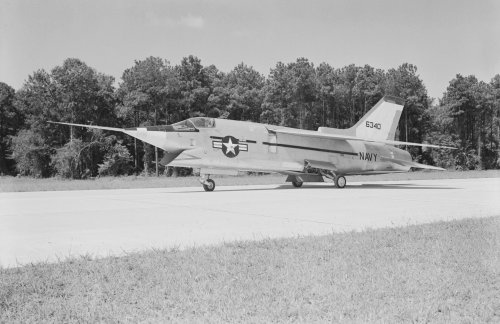
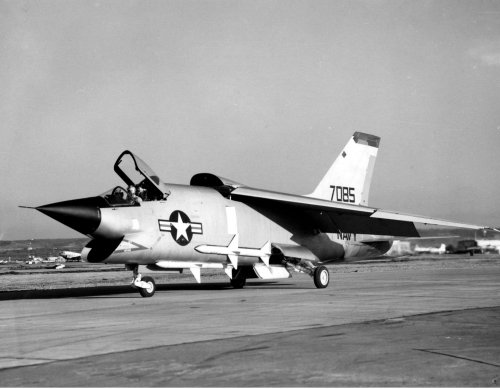
XF8U-3 No. 1 in NASA hands - dated 10 September 1959.
 

Attachments

  • XF8U-3 No. 1 09-10-1959.jpg
    XF8U-3 No. 1 09-10-1959.jpg
    744.3 KB · Views: 639
Abraham Gubler said:
Tailspin Turtle said:
Only the Conway is specifically mentioned with respect to hardware. Somebody's else's guess will be better than mine with respect to the customer. What Brit requirement was there for a low-level fighter bomber in 1957?

As fighter bomber a replacement for the Scimitar in a new larger carrier. Or in air to air as an alternative to the transonic Sea Vixen?

Does the Conway Crusader (IV?) information have anything about endurance? The lower SFC of the turbofan should provide a bit of a boost.

There was no performance information in the document I found other than the Mach number vs. altitude chart that I posted or any mention of the better sfc presumably provided by the Conway. I suppose that it wasn't the only one provided to the MoD at the time but there's no reference to any others. As usual, I had to put two and two together to get something to say:

In early 1957, Chance Vought and Rolls-Royce teamed up for a “Preliminary Investigation of Possible Manufacture in U.K. of F8U-3 Airframe Incorporating Rolls-Royce Conway Engine,” to present to the British Ministry of Defence (MoD). The license-built F8U-3 was also to incorporate British armament, radar, hydraulic and electrical components, etc. The stated mission was low-level fighter-bomber. It’s possible that the study was being accomplished in anticipation of the British government’s 4 April Defence White Paper, which announced cancellation of most of its advanced manned airplane programs for the Royal Air Force, including the Avro 730 supersonic bomber and the Saunders-Roe SR.177 interceptor. In addition, the Royal Navy did not have a supersonic fighter in development. However, the Scimitar was being introduced and the first production Sea Vixen had just flown in March; neither was affected by the Defense White Paper.

The Conway was an early version of the turbofan engine—and the first to enter service—which incorporated a bigger compressor than required for combustion. The additional air flowed around, or bypassed, the basic engine. This use of additional mass flow provided lower specific fuel consumption than the conventional axial flow jet engine. The Conway engine proposed was R.Co.11, an uprated 17,000-lb thrust version for the improved Victor bomber. With an afterburner added, it would provide thrust equivalent to that of the J75 but with lower fuel consumption.

The document was not, strictly speaking, a proposal. It contained no specific content from the British aerospace industry other than Conway installation details. For example, it states that “A comparable armament system utilizing the present structural attach points for missile pylons, etc. is anticipated for the airplane. This armament system will probably consist in entirety of British items. Installation of such a system is not considered to be particularly difficult.” One interesting omission was any mention of the Martin-Baker ejection seat, which would have one of the most obvious substitutions.

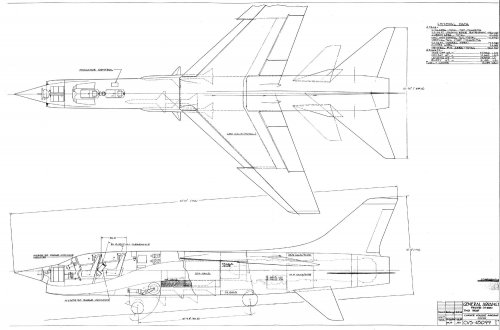
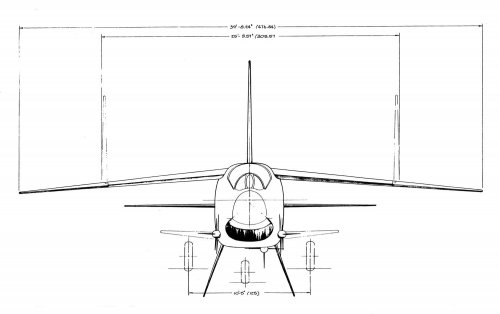
It summarized the F8U-3 design and the changes required to accommodate the Conway engine along with providing structural design and performance data, a raw material list, and high level engineering drawings. The only change besides the Conway was the incorporation of a large recess between the main landing gear for semi-submerged carriage of a 2,000-lb store need for a fighter-bomber mission. The catapult and tail hook were retained. Very little performance data was provided other than level flight speeds. It was projected to have a top speed of Mach 2.2 at 35,000 feet. No mention was made of the presumably lower fuel consumption or any range/endurance benefit.

As it happened, the English Electric Lightning program had been allowed to continue by the MoD as the last manned fighter. The production prototype flew the same day that the White Paper was released. It proved to be an excellent point interceptor, with a terrific rate of climb and Mach 2 speed. While the F8U-3 would have had better range and endurance, its adoption would have involved the budget and schedule penalty of a program startup.

There was no home for it in the Royal Navy either. At the time, the Royal Navy had new, albeit subsonic, airplane programs in progress for all its requirements, with its strike mission to be accomplished by the Blackburn Buccaneer. It also planned to buy the supersonic SR.177, which had been allowed to continue in hopes of a sale to Germany in addition to the small RN purchase. However, at the end of 1957, when the German Defence Ministry announced its short list, the SR.177 was not on it and the program was cancelled.

The British MoD was eventually forced to admit that there was still a need for manned and supersonic strike fighters. Since the development pipeline had been shut off in 1957, it had few alternatives but to order a variation of the eventual winner of the U.S. Navy’s 1958 fighter competition, the F-4 Phantom. Like the F8U-3 Conway proposal, it was powered by a Rolls-Royce turbofan engine, an afterburning variant of its Spey. British airframe and avionics content, however, were limited to the aft fuselage and a radar altimeter.
 
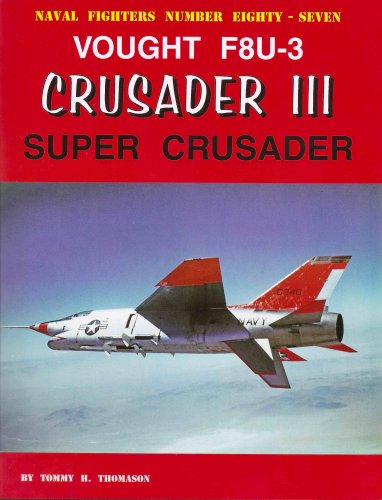
At long last, my F8U-3 monograph has been published by Steve Ginter. It includes details that you probably haven't seen on the F8U-3 and the Grumman Design 118 (both twin and single-engine versions), as well as information on the competition between the F8U-3 and the F4H.
 

Attachments

  • F8U-3 Cover.jpg
    F8U-3 Cover.jpg
    668 KB · Views: 625
Congrats Tommy - looking forward to seeing and getting a copy at the local hobby shop.

Enjoy the Day! Mark
 
Huh. Doesn't appear to be listed on the Ginter website. ???
 
sferrin said:
Huh. Doesn't appear to be listed on the Ginter website. ???

I've sent Steve an email about that. Some of his other monographs are no longer listed as well although I know they're available. The F8U-3 monographs came off the press about 10 days ago (I have a box of them) so be assured that they are being distributed.
 
WTG Tommy, I've added it to my list of must have books. :)
 
Thanks for the book, Mr. Thomason I'm ready to order it;)
 
sferrin said:
From Ed Rasimus on rec.aviation.military (F-105 pilot and author of "When Thunder Rolled")

"The F-105 had 36 gallons of de-ionized water in a "saddle" tank that
rode over the AB section of the engine. The J-75 was rated at 24,500
pounds in max. power and 26,500 in max with water injection. The water
was only used for take-offs and was only introduced after burner
light-off. Let there be no doubt in your mind, the 2000 pounds of
thrust was very real and readily apparent to the pilot.

I was stationed at Hill AFB when they flew out the last two F-105's from the reserve squadron here. As an 'aside' let me state that it wasn't "apparent" to JUST the pilots when they put their "foot-into-it" for take off! I was at the opposite end of the runway when they spooled up for take off, the thunder kind of sent a thrill up you spine but when they lit off the burner and kicked in the injection system there was this deep, penatrating "THUD!" that rocked me back on my heels.

I'd never really appreciated the "Thud" all the much before that evening, but I damn well won't ever forget them :eek:)

Randy
 
Greetings All!

I've received my copy of Tommy's book and it is one that you'll want to get. Well done with coverage of the other competing designs (besides the F4H-1 Phantom II) that'll appeal to us Secret Projects types. The Grumman designs were particularly interesting to me. I give the book 6 stars on a scale of 1 to 5 with 5 being excellent!

Well done Tommy, well done!

Enjoy the Day! Mark
 
RanulfC said:
sferrin said:
From Ed Rasimus on rec.aviation.military (F-105 pilot and author of "When Thunder Rolled")

"The F-105 had 36 gallons of de-ionized water in a "saddle" tank that
rode over the AB section of the engine. The J-75 was rated at 24,500
pounds in max. power and 26,500 in max with water injection. The water
was only used for take-offs and was only introduced after burner
light-off. Let there be no doubt in your mind, the 2000 pounds of
thrust was very real and readily apparent to the pilot.

I was stationed at Hill AFB when they flew out the last two F-105's from the reserve squadron here. As an 'aside' let me state that it wasn't "apparent" to JUST the pilots when they put their "foot-into-it" for take off! I was at the opposite end of the runway when they spooled up for take off, the thunder kind of sent a thrill up you spine but when they lit off the burner and kicked in the injection system there was this deep, penatrating "THUD!" that rocked me back on my heels.

I'd never really appreciated the "Thud" all the much before that evening, but I damn well won't ever forget them :eek:)

Randy

I grew up in Sunset and our house was right under the pattern. F-105s were always my favorite growing up.
 
On the subject of the J58, according to the TFX contract investigation the Navy spent upwards of $120 million on the J58 including a full 150 hour test program.
 
Higher res copy of previously posting pic


Source: Posted by Pedro De Figueiredo‎ on Facebook
 

Attachments

  • 10333747_788212354535706_899864900559633390_o.jpg
    10333747_788212354535706_899864900559633390_o.jpg
    192.8 KB · Views: 1,221
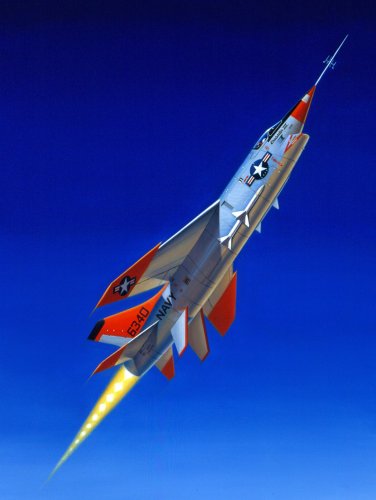
I am absolutely no fan of the Crusader III, have never been, never will be, but I must admit Mike Machat's painting is just stunningly beautiful! :)
 
It's definitely a keeper! Nice find, and most generous of Mr. Machat to share.
 
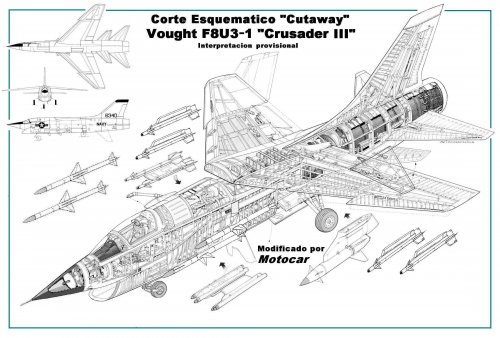
Schematic Court XF8 Vought Crusader III, the proposed single-engined fighter with a stunning performance, cutaway speculative based on the F-8 but with the J-75 engine and tweaks to recreate this advanced game, author Aviagraphica and modified byMotocar

Success
 

Attachments

  • Cutaway Vought XF-8U3-1  Crusader III.JPG
    Cutaway Vought XF-8U3-1 Crusader III.JPG
    523.9 KB · Views: 575
Definitely speculative. The inflight refueling probe was on the left side of the fuselage, not the right side. Unlike the F8U-1/2, there were to be two pylons on each side of the fuselage, not one with an adapter, to carry four Sidewinders. At the time the F8U-3 was cancelled, there were no wing pylons planned, but in that case I'm sure they would have been adopted as they were on the F8U-2.
 
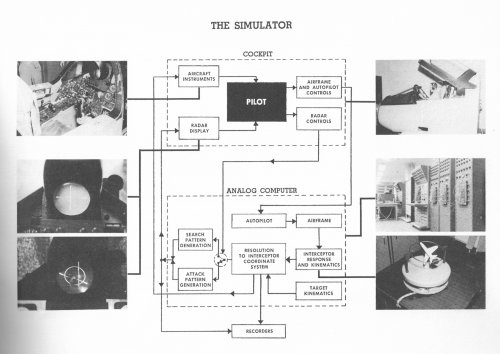
This was part of Vought's marketing campaign to convince the Navy that a second crewman (i.e. in the F4H) was unnecessary for the fleet air defense mission. Another was a very advanced fixed-base cockpit simulator that could be "flown" to demonstrate all the features shown.
 

Attachments

  • Mission Simulator0001.jpg
    Mission Simulator0001.jpg
    942.8 KB · Views: 1,609
Hi!
https://www.youtube.com/watch?v=9x4Wv8G4URk
 
Enough stuff here for an even better monography perhaps?

http://libtreasures.utdallas.edu/xm...o the Vought Aircraft Company Collection.html
F8U-3 (V-401) two-place study. 1955 October 7 Report No. 9887. Original VAHF identification number: 129-4.

F8U-3 (V-401) armament control and electronic systems. 1955 October 7 Report No. 9883. Original VAHF identification number: 129-5.

F8U-3 (V-401) study of dayfighter configuration. 1956 February 9 Report No. 10092. Original VAHF identification number: 129-6.

Description of the air conditioning system for the model F8U-3 airplane. 1958 June 4 Report No. E8R-10439. Original VAHF identification number: 129-7.

F8U-3 engine removal mock-up photographs. 1957 July 29 Original VAHF identification number: 129-8.

Service training manual F8U-3 utility systems. 1958 May 1 Original VAHF identification number: 129-9.

F8U-3 weapon system operational analysis studies. 1958 February 1 Report No. 10429. Original VAHF identification number: 129-10.

F8U-3 weapon system brochure. 1958 June Original VAHF identification number: 129-11.

Guide to F8U-3/-3F all weather airplane mockup. 1956 November 29 Original VAHF identification number: 129-14.

F8U-3 all weather missile only fighter. 1955 October 7 Original VAHF identification number: 129-14.

F8U-3 inboard profile. Undated Report No. E8R-11543. Original VAHF identification number: 129-15.

F8U-3 weapon system brochure. 1958 June Original VAHF identification number: 129-16.

F8U-3 weapon system development program. 1957 July Original VAHF identification number: 129-17.

Comparison of F8U-3, F4H, and A3J. 1958 May Original VAHF identification number: 129-18.

F8U-3 estimated asymmetrical pressures on the exhaust. 1958 September Original VAHF identification number: 129-19.

F8U-3 automatic compressor bleed valve stall fix. 1958 October Original VAHF identification number: 129-20.

F8U-3 print engine mounts. 1957 Original VAHF identification number: 129-22.

F8U-3 aircraft hydrogen peroxide leak and residual design problems. 1958 October Original VAHF identification number: 129-25.

F8U-3F visit of Aerojet representatives to Chance Vought. 1958 August Original VAHF identification number: 129-27.

F8U-3 J75-P-6 engine installation and removal of mockup. 1958 March Original VAHF identification number: 129-28.

Status of J75 engines. 1958 December Original VAHF identification number: 129-29.

F8U-3 auxiliary air inlets. 1958 August Original VAHF identification number: 129-30.

F8U-3 information. 1958 Original VAHF identification number: 129-31.

F8U-3 Crusader articles. 1977 Original VAHF identification number: 129-34.

Airpower, "Was Vought's F8U-3 Crusader III crucified by an unworkable fighter/bomber concept?" 1977 July Original VAHF identification number: 129-35.

The structural capabilities of the F8U-3 airplane for flights beyond the present flight boundaries. 1959 January 21 Report No. E9R-11913. Original VAHF identification number: 129-36.

Wind tunnel test of F8U-3 model. 1958 September Original VAHF identification number: 129-52.

F8U-3 program information. 1957-1967 Original VAHF identification number: 129-56.

F8U-3 program history. 1957 Original VAHF identification number: 129-56.

F8U-3 (V-401) design summary for day fighter configuration. 1956 February 9 Report No. 10093. Original VAHF identification number: 129-57.

The J75 powered F8U-3 Crusader. 1956 March Original VAHF identification number: 129-58.

F8U-3 weapon system brochure about operational analysis summary. 1958 June Original VAHF identification number: 129-60.

All weather interceptor weapon system cost analysis. 1958 September Original VAHF identification number: 129-60.

F8U-3 performance improvement study. 1957 Original VAHF identification number: 129-62.

F8U-3 weapons loading versatility study. 1958 Original VAHF identification number: 129-63.

All weather missile fighter F8U-3 system capability. 1958 January Original VAHF identification number: 129-64.

F8U-3 qualification tests; oxygen pressure; and bailout bottle. 1959 Original VAHF identification number: 129-65.

Loads and stress analysis for Chance Vought escape system sled F8U-3. 1958 July Original VAHF identification number: 129-66.

F8U-3 escape system test report. 1959 April Original VAHF identification number: 129-66.

F8U-3 ejection system tests data report. 1959 September 18 Original VAHF identification number: 129-66.

F8U-3 electrical handbook. 1958 Original VAHF identification number: 129-68.

F8U-3 (V-401) performance data. 1955 October 7 Report No. 9876. Original VAHF identification number: 129-72.

F8U-3 performance studies at high altitude. 1955 Original VAHF identification number: 129-73.

F8U-3 drawing for modelers. Undated Original VAHF identification number: 129-75.

Guide to F8U-3 (F8U-3F) all weather airplane mockup brochure. 1956 November 29

F8U-3 weapons system brochure and articles. 1958-1976

F8U-3 log of flights and basic information. 1982

F8U-3 program history. Undated

F8U-1 - F8U-3 brochures, photographs, and articles. 1971-1975

PCI-24. 1957 Engineering release forms for F8U-3.

PCI-25. 1957 Engineering release forms for F8U-3.

PCI-26. 1957-1958 Engineering release forms for F8U-3.

PCI-33. 1957-1958 Engineering release forms for F8U-3.

ECP-1. 1958 F8U-3 electronic equipment.

ECP-2. 1958 F8U-3 electric radar equipment.

EI-91. 1959 Engineering information for F8U-3, V-401, and F8U-1.

EI-92. 1959 Engineering information for F8U-3.

EI-93. Undated Engineering information for F8U-3.

EI-94. 1959 Engineering information for F8U-3.

 
And an excellent monograph it is. Definitely something any fan of the XF8U-3 would want in their collection. :)
 
Seconded. Definitely the go-to source on the F8U-3.

Tommy's F-111B book is also a must-read.
 
Nextly repair the cutaway drawing post...!
 
Yes...! Cutaway drawing Vough XF8U-3 Crusader III next
 

Similar threads

Back
Top Bottom