SHD 2ème RM, Brest...Regarding BS.5 (From the section on Clemenceau and Foch (p.219))
- Built by Brown Bros.
- Can launch a 20-tonne aircraft at 90 kn with 2.8 g acceleration
- Interval between launch: 35 s (theoretical), 45 s (practical)
- The remainder are information about the installation itself such as the cylinders counts and connection + location of things such steam accumulator + blast deflector + bridle catchers
Nothing on the BS.4 unfortunately (I didn't seem to see it mentioned at all)
There were? Hmm... I didn't seemed to see it mention at all in book. Could you point me to a source?

You are using an out of date browser. It may not display this or other websites correctly.
You should upgrade or use an alternative browser.
You should upgrade or use an alternative browser.
Verdun French Aircraft Carrier (images)
- Thread starter Jackryan
- Start date
orlovsky
I really should change my personal text
- Joined
- 28 May 2016
- Messages
- 431
- Reaction score
- 851
Put it here: https://www.secretprojects.co.uk/th...ssex-class-catapults-arrestor-gear-etc.51523/Typical government thing...
Guess I should write it up as a topic, the issue is all over the place now. Just not sure where, naval projects? Alternate history?


JJMM
ACCESS: Restricted
- Joined
- 26 February 2025
- Messages
- 31
- Reaction score
- 138
From Jean Moulin's book page 174 :
The two steam catapults are British BS 5 type catapults built by Brown Brothers. A slight confusion arose regarding the catapult type on the two aircraft carriers. Originally, the British used the term BS 4 interchangeably for both the "cantilever track" catapult (with a carriage running on rails attached to the pit covers) and the "centre rail track" catapult (with a carriage sliding in a central track rail attached to the pit).
On April 7, 1961, the Admiralty decided to differentiate between the two types of catapults, retaining the designation BS 4 for the former and adopting BS 5 for the latter. To avoid any confusion, French Navy aligned itself with the British, and the catapults of the Clemenceau and Foch became BS 5 simply by applying a note.
Ultimately, Brown Bros never built any 75m catapults...
The two steam catapults are British BS 5 type catapults built by Brown Brothers. A slight confusion arose regarding the catapult type on the two aircraft carriers. Originally, the British used the term BS 4 interchangeably for both the "cantilever track" catapult (with a carriage running on rails attached to the pit covers) and the "centre rail track" catapult (with a carriage sliding in a central track rail attached to the pit).
On April 7, 1961, the Admiralty decided to differentiate between the two types of catapults, retaining the designation BS 4 for the former and adopting BS 5 for the latter. To avoid any confusion, French Navy aligned itself with the British, and the catapults of the Clemenceau and Foch became BS 5 simply by applying a note.
Ultimately, Brown Bros never built any 75m catapults...
JJMM
ACCESS: Restricted
- Joined
- 26 February 2025
- Messages
- 31
- Reaction score
- 138
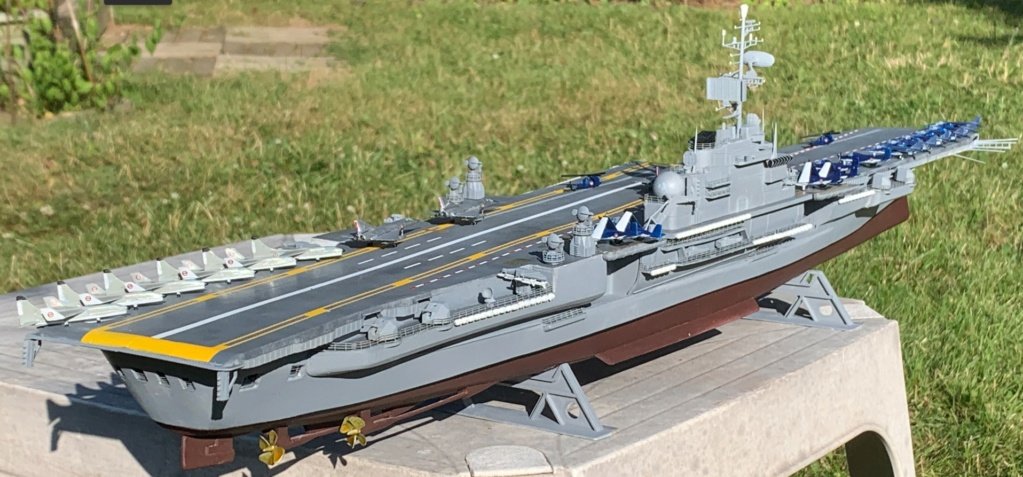
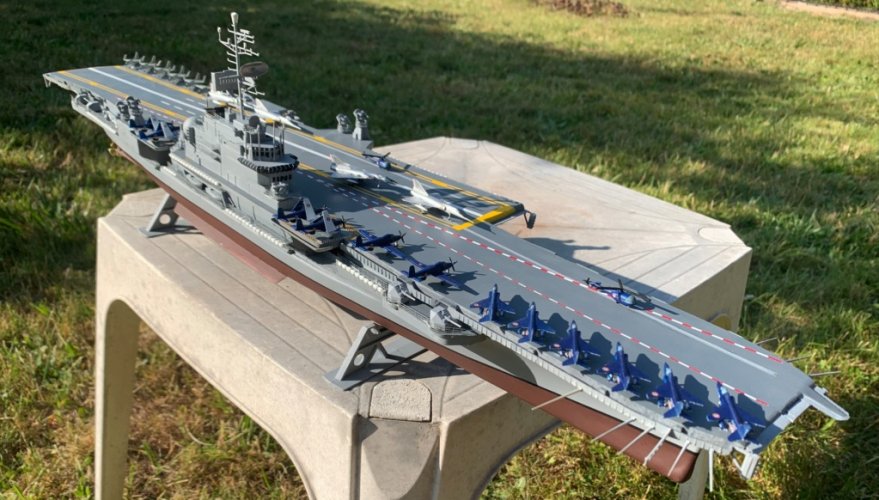
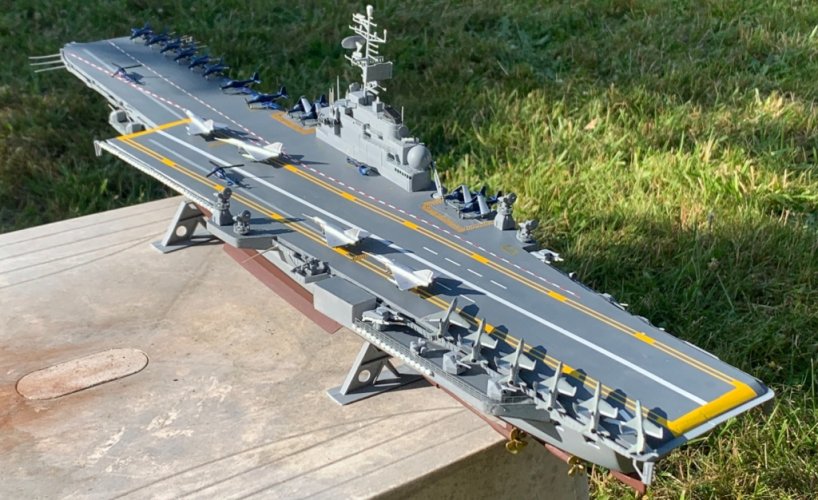
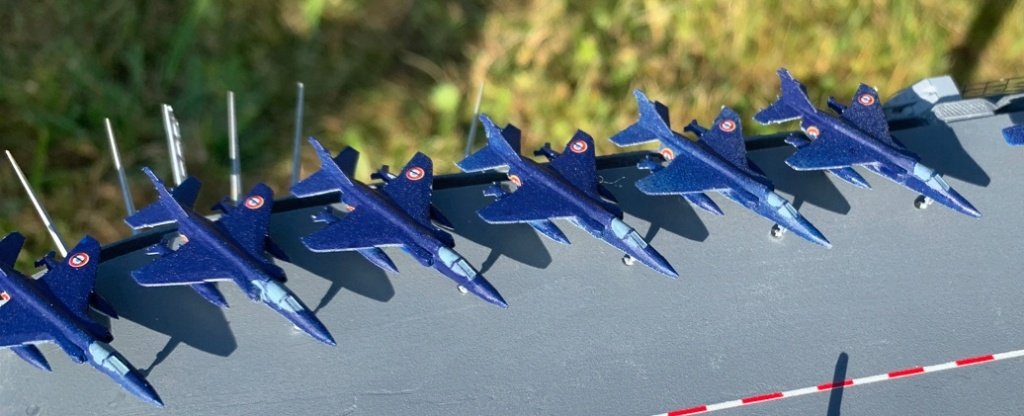
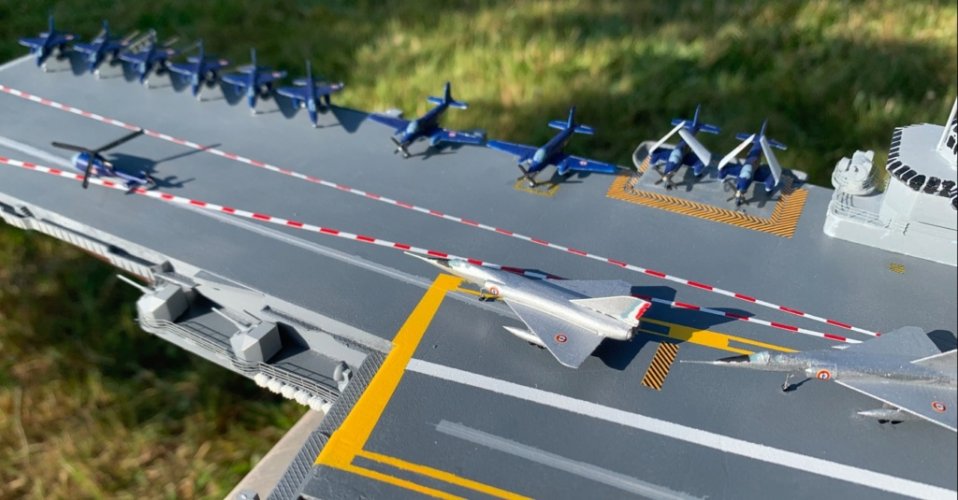
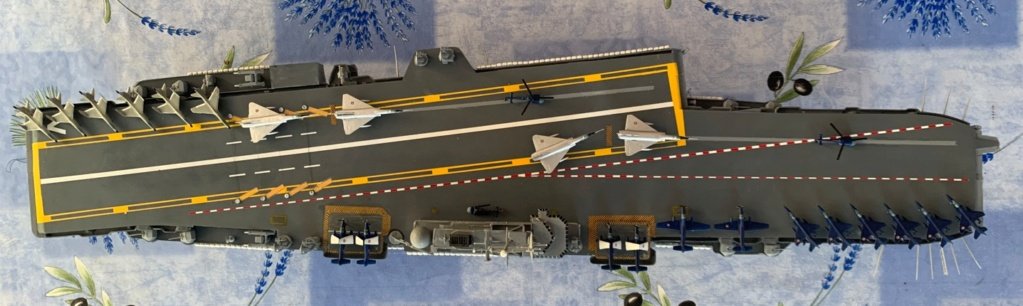
I was pleasantly surprised to see on a model-making website that "my" Verdun PA-58, designed in 2015 (see #105 above), had been built using a modified Clemenceau model, which shows the project's stage of development with 8 x 100mm guns and two Masurca double launchers. The aircraft are SEPECAT Jaguar M, Vought F-8E (FN), GAMD Mirage IV M, and Breguet Alizé, giving a good idea of the very ambitious nature of the projec t!
Attachments
orlovsky
I really should change my personal text
- Joined
- 28 May 2016
- Messages
- 431
- Reaction score
- 851
Summarized from French Aircraft Carrier 1910-2000 (John Jordan & Jean Moulin) *It's was mentioned briefly from p.265-p.266 in four short paragraphs (unfortunately no graphics)
PA 58 (Verdun)
....
- Two 75 m Catapult (one port forward and one on angle deck)
.....
- 3 x Nuclear-capable Bomber (CB 62)
- 3 x Refueling Aircraft (CB 62)
- 8 x All-weather Interceptor (CB 62)
CB 62 should act as a 15t interceptor, also from the Clems, and a 20t bomber only from the large PA58.
There is a little extra information about the CB 62 in Moulin, Clem+Foch (2006) p 224: "les bombardiers devant être catapultés à 165 noeuds à la masse de 20 tonnes", causing catapult problems.
165 kts catapult end speed (or total end speed including WOD? In that case, about 140 kts from the catapult)... US C-7 catapult would make about 140 kts, the 199 ft BS5 and the 169 ft on the Clems (later version) just ~110 kts, initially just ~95 kts. (The F-4B with BLC got the total end speed down to 140-145 kts @ 20 tons.)
This would be marginal even with the large PA58, which it seems was mostly designed for the large fighter/bomber. After CB 62 was ended in 1959, the smaller PA59 emerged, but too late....
Very interesting. That was my understanding: PA58 for Force de Frappe with some kind of naval, mini Mirage IV. The bomber being the very reason why it grew to 45 000 tons. All in all it was influenced by the A-5 Vigilante. But future belonged to SLBM...
Last edited:
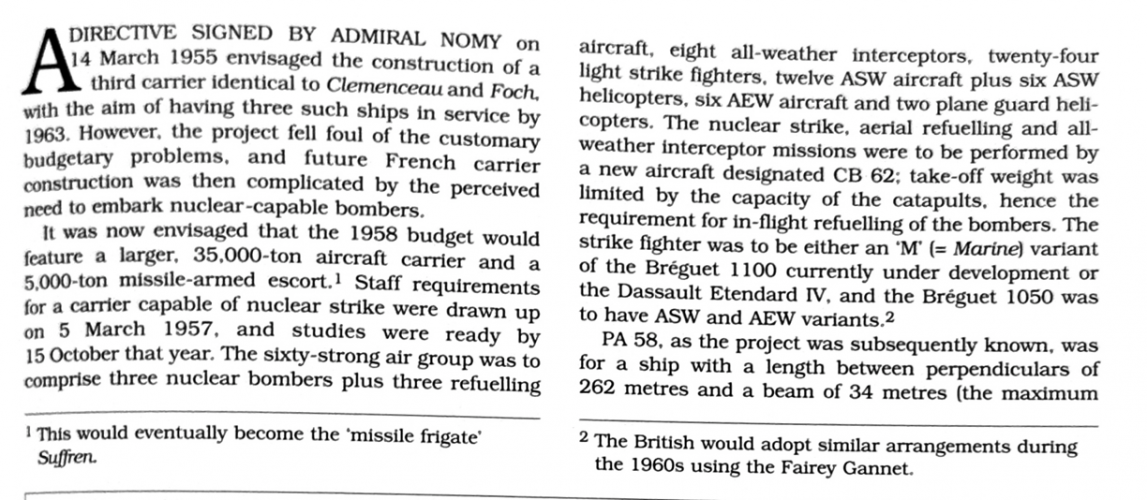
I also received Moulin's new book, but the CB 62 carrier-based aircraft mentioned in the PA 58 project introduction has me confused. What exactly is this thing? Is it the SO 4060?
He says Dassault's was the Étendard IV rather than the Mirage VI-M, what is this?

He says Dassault's was the Étendard IV rather than the Mirage VI-M, what is this?
Last edited:
https://lefauteuildecolbert.blogspot.com/2016/09/avant-projet-dembarquement-de-regulus.html
Based on the information in this article, the PA 58 may have had a proposal using a combination of 100m and 50m catapults. Moreover, the subsequent PA 59 would be a nuclear retaliation carrier based on the SSM-N-9 Regulus II.
Also, could someone explain what this "bâtiment base atomique." means? A sea replenishment base?
Based on the information in this article, the PA 58 may have had a proposal using a combination of 100m and 50m catapults. Moreover, the subsequent PA 59 would be a nuclear retaliation carrier based on the SSM-N-9 Regulus II.
À la suite des mises sur cale des Clemenceau (22 novembre 1961 - 1er octobre 1997) et Foch (15 juillet 1963 - 15 novembre 2000), l’état-major de la Marine souhaitait la mise sur cale d'une troisième unité, dérivée des Clemenceau (2), dans le cadre de la tranche navale de 1958. Baptisé officieusement Verdun dans les coursives, son déplacement aurait atteint 35 000 tW : contre seulement 22 000 tW pour les Clemenceau (2). S’inspirant, manifestement, assez largement du concept de « porte-avions stratégique » identifié dans le Statut naval de 1955, révisé en 1956, et même du CVA-58 USS United States (1948 - 1949) , ce PA 58 Verdun devait être capable de mettre en œuvre un bombardier stratégique, et pour ce rôle était en concurrence les Générale aéronautique Marcel Dassault Mirage IVM ou bien le SNCASO SO-4060 Super Vautour, devant être capable d'emporter une bombe atomique grâce, notamment, à l’intégration au pont d’envol d’une catapulte axiale de 100 mètres, aux côtés d’une autre de 50 mètres.
En parallèle, une nouvelle proposition était avancée, dans le cadre du PA 59, pour substituer aux bombardiers stratégiques, un engin. Le missile de croisière Chance Vought SSM-N-8A Regulus (1955 -1964) de 500 nautiques de portée était employé aux États-Unis d’Amérique comme l’une des armes stratégiques. Cet armement fut déployé sur 4 croiseurs, 10 porte-avions (occasionnellement, en réalité) et 5 sous-marins. Afin de crédibiliser la force nucléaire américaine, le Chance Vought SSM-N-9 Regulus II était mis à l’étude dans l’optique d’en doubler la portée :1000 nautiques. La production débutait dès l'année 1958. Le missile entrait en service en septembre 1958 mais il était abandonné la même année, le 18 décembre 1958, au profit de l’UGM-27 Polaris A1 (Lockheed Corporation) : le premier Submarine Launched Ballistic Missile (SLBM), dénommé en France Mers-Sol Balistique Stratégique (MSBS).
Also, could someone explain what this "bâtiment base atomique." means? A sea replenishment base?
Le format de chacune des deux périodes triennales devait aboutir à la mise sur cale des bâtiments suivants :
- un porte-avions ou croiseur lance-engins,
- trois croiseurs escorteurs,
- deux sous-marins atomiques,
- un bâtiment base atomique.
orlovsky
I really should change my personal text
- Joined
- 28 May 2016
- Messages
- 431
- Reaction score
- 851
I also received Moulin's new book, but the CB 62 carrier-based aircraft mentioned in the PA 58 project introduction has me confused. What exactly is this thing? Is it the SO 4060?
He says Dassault's was the Étendard IV rather than the Mirage VI-M, what is this?
View attachment 814893
If I understand that correctly, CB62 was a study, maybe not even a full specification. Mirage IVM and SO 4060 or 4062 would fit as projects developed in that context.
The Breguet 1100M or Etendard IVM would be for the 24 light strike fighters.
It seems the MN lacked financial realism. 14 CB62 on the PA58, so maybe 30-40 aircraft overall. [edit: even with the fighter version on Clem/Foch maybe only 50-60] The small run of the 90 Etendard was expensive, but most development work had been done before.
Last edited:
orlovsky
I really should change my personal text
- Joined
- 28 May 2016
- Messages
- 431
- Reaction score
- 851
https://lefauteuildecolbert.blogspot.com/2016/09/avant-projet-dembarquement-de-regulus.html
Based on the information in this article, the PA 58 may have had a proposal using a combination of 100m and 50m catapults. Moreover, the subsequent PA 59 would be a nuclear retaliation carrier based on the SSM-N-9 Regulus II.
The PA58 and PA59 designs were fluid. The 100m catapult would have been necessary for a CB62 at full weight. Unclear whether that ever made it into a seriously considered design.
Moulin mentions the Regulus as an option studied "for the two carriers", ie Clemenceau and Foch.
Also, could someone explain what this "bâtiment base atomique." means? A sea replenishment base?
Nuclear powered logistics support ship. Could be anything from replenishment (more probable) to housing/transport (like the Moselle https://www.postenavalemilitaire.com/t335-moselle-1968-1978 )
Last edited:
Naval nuclear deterrent was in flux: between Vigilante, Regulus I & II and Polaris.
With the coming Force de frappe (FDF) and its impact on conventional weapons procurement budget (it was brutal), the French Navy was positioning itself to get a slice of the FDF fat budget cake.
And to do that it was closely watching the USN varied nuclear deterrent concepts that were fighting each others. Eventually the Polaris won so the French Navy settled on boomers too. There would be no naval nuclear bomber, just like Vigilante was shifted to reconnaissance.
Had Regulus II or Vigilante prevailed over Polaris, the French navy would have noted that and followed the USN example. This is probably why "Regulus on Richelieu battleships" and "Regulus on carriers" was considered. Same for Mirage IVM and SO-4060M.
Thinking about it, would have been fun to put Regulus II on Arromanches.
With the coming Force de frappe (FDF) and its impact on conventional weapons procurement budget (it was brutal), the French Navy was positioning itself to get a slice of the FDF fat budget cake.
And to do that it was closely watching the USN varied nuclear deterrent concepts that were fighting each others. Eventually the Polaris won so the French Navy settled on boomers too. There would be no naval nuclear bomber, just like Vigilante was shifted to reconnaissance.
Had Regulus II or Vigilante prevailed over Polaris, the French navy would have noted that and followed the USN example. This is probably why "Regulus on Richelieu battleships" and "Regulus on carriers" was considered. Same for Mirage IVM and SO-4060M.
Thinking about it, would have been fun to put Regulus II on Arromanches.
Last edited:
Similar threads
-
French Aircraft Carrier Never-Were Designs and Proposals
- Started by Fr05ty
- Replies: 94
-

-
 French nuclear-powered amphibious assault ship (PH 75/PA 75)
- Started by Triton
- Replies: 33
-
-
 French and other proposals for Canadian nuclear icebreaker (Polar 10) project, late 1970s / early 1980s
- Started by Grey Havoc
- Replies: 5