Sentinel Chicken
American 71 Heavy, contact departure 126.47
Link to original story: http://www.wingsoverkansas.com/features/article.asp?id=461
The Cessnas that got away
By DARYL MURPHY ©2005
At least part of Cessna's success is the fact that their aircraft are engineered for production. Reigning for years as the No. 1 manufacturer of General Aviation aircraft, their designs have always been pragmatic and market-driven, and most importantly, accessible to the masses.
In the boom years since World War II, Cessna has designed, manufactured and marketed scores of airframe designations. But there was also an equal number of ideas that seemed awfully good at the time, but which for one reason or another you may not have ever seen at your local airport.
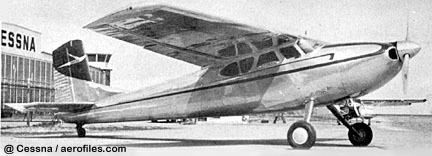
Model X-210-Cessna's first 210 had no direct relationship to the later model of the same name, but was proposed in the late Forties as a possible replacement for the popular Model 195. The X-210 employed a 195 airframe and its cantilever wings, but in place of the 300 hp Jacobs radial was a horizontally opposed Continental O-470 of 240 horsepower. The reasoning was that the flat cowl presented much fewer square feet of frontal area. Wing tips and vertical and horizontal stabilizer had square tips instead of the rounded ones used on production 195s, the wings featured high-lift flaps, and the main gear was an innovative tapered tubular steel design.
The X-210 first flew in January 1950, but the gain from the lower cowl profile was no trade for sixty less horsepower, and the prototype proved to be disproportionately slower than the 195. The lukewarm feeling was further heightened when the Korean War began, demanding more and more production materials and space from Cessna for its L-19 Bird Dog, so the project was dropped.
However, several of the design features would show up on later Cessna models.
Model 308-This design could be characterized as a four-place Model 305-the airplane which had become the U.S. Army's "Bird Dog" in 1950. The 308 was in answer to a military proposal which called for a new, larger aircraft category that was eventually filled by the de Havilland Beaver. Built on the general lines of the 170, the Model 308 had a much larger 47-ft wing span and 4,200 lb gross weight. Powered by a whopping 375 hp Lycoming GSO-580, it could operate smartly off unimproved strips and carry a 1,000-lb payload for 800 statute miles. Only one example was built, and it first flew in July 1951.
Model 309/319--Cessna participated in Boundary Layer Control (BLC) research from 1951 to 1955 with the U.S. Navy and Wichita University using a stock 170A modified to house a small gas turbine in the fuselage which blew air over the wing (1951). The 309A, first flown in February 1952, used an engine-driven electric generator to operate large fans in the wings to generate the air; the 309B of 1953 and 309C in 1954 used dry chemicals that generated airflow across the wings and flaps.
Another follow-on, the 319-A of 1953, had larger, more powerful flaps. With 225 hp Continental engine and BLC, the airplane had a stall speed of 32 mph. It could take off in 190 ft, land in 160 ft and make it in over a 50-ft obstacle in just 450 ft. As a research vehicle, the 309/319 was a success, but its commercial application was questionable--or as a Cessna test pilot wrote on a report after his first flight, "All in all, a rather nasty little monster!"
Model 620-Despite Beech's lack of success in finding a market for a four-engine transport nine years earlier, Cessna announced its Model 620 in 1956. It was an eight to ten-place pressurized aircraft powered by four 320 hp Continental GSO-526-As. Priced in the $300,000-$400,000 range, it would cost more than new twin-engine Martin and Convair airliners.
Planned for introduction as a 1958 model, design began in September 1953. Even though work on the Model 310 twin was underway, very little structure could be found to share with the larger airframe; virtually every piece on the four-engine airplane was new. It took nearly three years of prototype construction before the first flight was made.
Its stand-up cabin was six feet high and air conditioned, and the 620 had an on-board APU. Fuel capacity was over 400 gallons (part of which was carried in the distinctive tip tanks which would be a Cessna trademark for decades), gross weight was 13,650 lbs, it had a 55-ft wing span, maximum speed of 282 mph and 27,500 ft service ceiling--22,500 ft on three engines.
It apparently wasn't until after flight testing began that the company started its market research, and it was then that they discovered much the same which Beech had found earlier--that most potential customers had a ready supply of larger, pressurized airliners available for far less than the proposed model. With a total of fifty hours on the only prototype, it was sold to a Wichita scrap metal dealer. Some of the 620's design lessons, however, would be used in later twin-engine models.
Model 160-Cessna was selling most of the single-engine aircraft produced in the world in 1962. With models ranging from the $7,495 two-place 150B trainer to the $23,975 Model 210B, the company had eight models filling the niches. What it needed now, the reasoning went, was a design that would offer more airplane for less money, and the answer could possibly lie in changing labor-intensive production procedures. The four-place Model 160 was to be priced at $8,450, between the 150 and the 172. Its unfashionably square-cut conventionality was more a concession to the economies of manufacturing than to aesthetics of its market.
Fuselage and wing skins relied on heavy beading for strength and low weight, and the strut-braced constant-chord wings and free-caster nose gear provided simplicity of manufacture. The prototype was powered by a 125 hp Franklin engine, and it took the airplane to 134 mph. The 145 hp O-300 Continental engine then in use in the 172 was specified for the production Model 160, and would provide a top speed of 143 mph. In a proposed military version--the 160M--a Continental IO-360 of 210 hp would push it to a theoretical 174 mph top speed.
Flight tests in 1962-63 showed the model had promise, but not enough to make the necessary production and tooling adjustments, so the project was eventually abandoned and the company went back to doing things the way they had always been done. The sole prototype hung around until 1974, when it was reportedly scrapped.
However, the salvage yard kept putting off the job, and a mechanic from Northeast Kansas bought the remains of the prototype a few years ago and has offered it for sale.
Model 327-After modest successes with the Center Line Thrust (CLT) concept that Cessna pioneered in civil aircraft with the 1964 introduction of the six-place, fixed-gear 336 and subsequent retractable-gear 337 Skymasters, the Model 327, the "Baby Skymaster," was proposed in 1965.
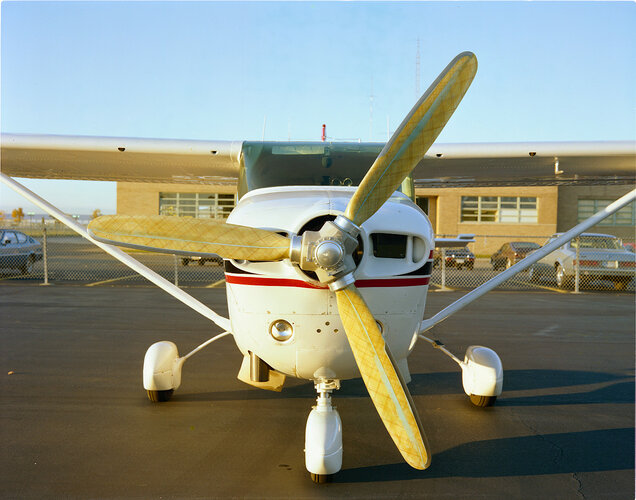
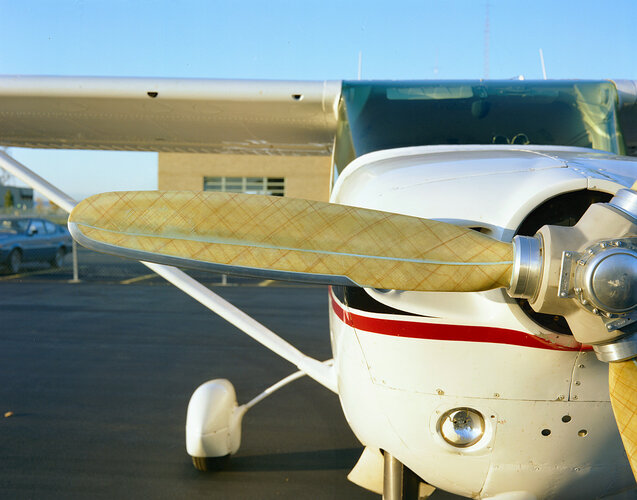
The four-seat twin had cantilever wings and was powered by two 160 hp IO-320 engines. It first flew in December 1967, and 39 hours of flight testing was completed before the project was canceled from lack of interest in 1968. The prototype continued to fly, however, working in a joint Langley Research Center/Cessna Aircraft Company project on noise reduction and being used as a test bed for wind tunnel evaluation of ducted and free propellers.
Model 187-The 187 was developed as a natural numeric follow-on to the 177, and was intended to expand the new Cardinal design motif-cantilever wing, flying tail, wide doors and spacious cabin-to all of Cessna's singles. The project started life in 1965 as the Model 343, with 240 hp GO-336 engine, T-tail and balanced stabilator, but was redesignated the Model 187 in 1968 with the old standby O-470 engine which had been in use since 1956 in the Model 182. First flown in April 1968, the 187 looked good, sleek and speedy, but there were no significant performance or handling improvements over the model it intended to replace. By the time some of its shortcomings were being discovered, the seminal Cardinal design was foundering in market acceptance, so the Model 187 project was canceled.
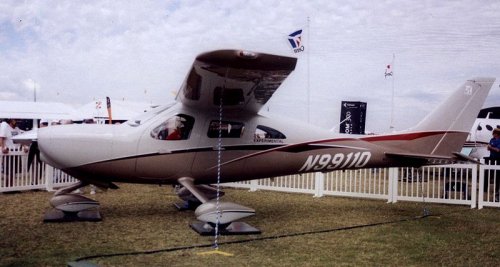
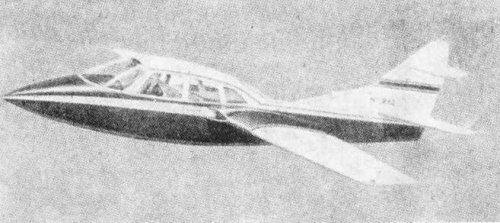
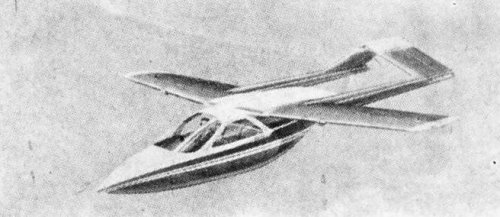
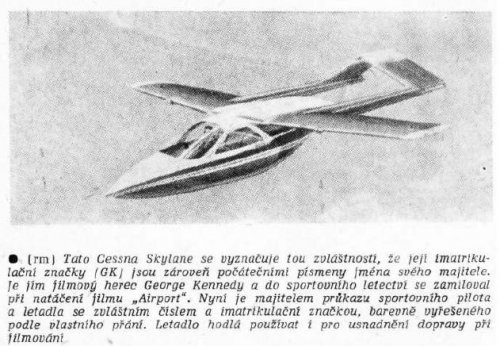
Model 1014/1034 XMC-One truly innovative Cessna design was the XMC, a public relations acronym for Experimental Magic Carpet. Probably never intended for production, the single development airplane was built in the early Seventies to test (and publicize) advanced aerodynamics and materials concepts.
A100 hp O-200 Continental engine was mounted behind the two-place cabin with pusher prop. That rearward weight bias necessitated that the pilot and passenger be placed ahead of the slightly swept cantilever wing. It was first flown in January 1971 as the Model 1014, and was reconfigured with a shrouded propeller, spatted nose gear and increased vertical stabilizer area in 1972, when the designation was changed to the Model 1034.
Other experiments with CG effects, control surface location/response, cabin noise levels and relationship of wing to engine and propeller were tested over the next two years before the program ended.
These are some of the designs which never saw the showroom floor; there were dozens of others that developed into production models, including the Cessna CH-1 helicopter, but that's another whole strange story.
The Cessnas that got away
By DARYL MURPHY ©2005
At least part of Cessna's success is the fact that their aircraft are engineered for production. Reigning for years as the No. 1 manufacturer of General Aviation aircraft, their designs have always been pragmatic and market-driven, and most importantly, accessible to the masses.
In the boom years since World War II, Cessna has designed, manufactured and marketed scores of airframe designations. But there was also an equal number of ideas that seemed awfully good at the time, but which for one reason or another you may not have ever seen at your local airport.
Model X-210-Cessna's first 210 had no direct relationship to the later model of the same name, but was proposed in the late Forties as a possible replacement for the popular Model 195. The X-210 employed a 195 airframe and its cantilever wings, but in place of the 300 hp Jacobs radial was a horizontally opposed Continental O-470 of 240 horsepower. The reasoning was that the flat cowl presented much fewer square feet of frontal area. Wing tips and vertical and horizontal stabilizer had square tips instead of the rounded ones used on production 195s, the wings featured high-lift flaps, and the main gear was an innovative tapered tubular steel design.
The X-210 first flew in January 1950, but the gain from the lower cowl profile was no trade for sixty less horsepower, and the prototype proved to be disproportionately slower than the 195. The lukewarm feeling was further heightened when the Korean War began, demanding more and more production materials and space from Cessna for its L-19 Bird Dog, so the project was dropped.
However, several of the design features would show up on later Cessna models.
Model 308-This design could be characterized as a four-place Model 305-the airplane which had become the U.S. Army's "Bird Dog" in 1950. The 308 was in answer to a military proposal which called for a new, larger aircraft category that was eventually filled by the de Havilland Beaver. Built on the general lines of the 170, the Model 308 had a much larger 47-ft wing span and 4,200 lb gross weight. Powered by a whopping 375 hp Lycoming GSO-580, it could operate smartly off unimproved strips and carry a 1,000-lb payload for 800 statute miles. Only one example was built, and it first flew in July 1951.
Model 309/319--Cessna participated in Boundary Layer Control (BLC) research from 1951 to 1955 with the U.S. Navy and Wichita University using a stock 170A modified to house a small gas turbine in the fuselage which blew air over the wing (1951). The 309A, first flown in February 1952, used an engine-driven electric generator to operate large fans in the wings to generate the air; the 309B of 1953 and 309C in 1954 used dry chemicals that generated airflow across the wings and flaps.
Another follow-on, the 319-A of 1953, had larger, more powerful flaps. With 225 hp Continental engine and BLC, the airplane had a stall speed of 32 mph. It could take off in 190 ft, land in 160 ft and make it in over a 50-ft obstacle in just 450 ft. As a research vehicle, the 309/319 was a success, but its commercial application was questionable--or as a Cessna test pilot wrote on a report after his first flight, "All in all, a rather nasty little monster!"
Model 620-Despite Beech's lack of success in finding a market for a four-engine transport nine years earlier, Cessna announced its Model 620 in 1956. It was an eight to ten-place pressurized aircraft powered by four 320 hp Continental GSO-526-As. Priced in the $300,000-$400,000 range, it would cost more than new twin-engine Martin and Convair airliners.
Planned for introduction as a 1958 model, design began in September 1953. Even though work on the Model 310 twin was underway, very little structure could be found to share with the larger airframe; virtually every piece on the four-engine airplane was new. It took nearly three years of prototype construction before the first flight was made.
Its stand-up cabin was six feet high and air conditioned, and the 620 had an on-board APU. Fuel capacity was over 400 gallons (part of which was carried in the distinctive tip tanks which would be a Cessna trademark for decades), gross weight was 13,650 lbs, it had a 55-ft wing span, maximum speed of 282 mph and 27,500 ft service ceiling--22,500 ft on three engines.
It apparently wasn't until after flight testing began that the company started its market research, and it was then that they discovered much the same which Beech had found earlier--that most potential customers had a ready supply of larger, pressurized airliners available for far less than the proposed model. With a total of fifty hours on the only prototype, it was sold to a Wichita scrap metal dealer. Some of the 620's design lessons, however, would be used in later twin-engine models.
Model 160-Cessna was selling most of the single-engine aircraft produced in the world in 1962. With models ranging from the $7,495 two-place 150B trainer to the $23,975 Model 210B, the company had eight models filling the niches. What it needed now, the reasoning went, was a design that would offer more airplane for less money, and the answer could possibly lie in changing labor-intensive production procedures. The four-place Model 160 was to be priced at $8,450, between the 150 and the 172. Its unfashionably square-cut conventionality was more a concession to the economies of manufacturing than to aesthetics of its market.
Fuselage and wing skins relied on heavy beading for strength and low weight, and the strut-braced constant-chord wings and free-caster nose gear provided simplicity of manufacture. The prototype was powered by a 125 hp Franklin engine, and it took the airplane to 134 mph. The 145 hp O-300 Continental engine then in use in the 172 was specified for the production Model 160, and would provide a top speed of 143 mph. In a proposed military version--the 160M--a Continental IO-360 of 210 hp would push it to a theoretical 174 mph top speed.
Flight tests in 1962-63 showed the model had promise, but not enough to make the necessary production and tooling adjustments, so the project was eventually abandoned and the company went back to doing things the way they had always been done. The sole prototype hung around until 1974, when it was reportedly scrapped.
However, the salvage yard kept putting off the job, and a mechanic from Northeast Kansas bought the remains of the prototype a few years ago and has offered it for sale.
Model 327-After modest successes with the Center Line Thrust (CLT) concept that Cessna pioneered in civil aircraft with the 1964 introduction of the six-place, fixed-gear 336 and subsequent retractable-gear 337 Skymasters, the Model 327, the "Baby Skymaster," was proposed in 1965.
The four-seat twin had cantilever wings and was powered by two 160 hp IO-320 engines. It first flew in December 1967, and 39 hours of flight testing was completed before the project was canceled from lack of interest in 1968. The prototype continued to fly, however, working in a joint Langley Research Center/Cessna Aircraft Company project on noise reduction and being used as a test bed for wind tunnel evaluation of ducted and free propellers.
Model 187-The 187 was developed as a natural numeric follow-on to the 177, and was intended to expand the new Cardinal design motif-cantilever wing, flying tail, wide doors and spacious cabin-to all of Cessna's singles. The project started life in 1965 as the Model 343, with 240 hp GO-336 engine, T-tail and balanced stabilator, but was redesignated the Model 187 in 1968 with the old standby O-470 engine which had been in use since 1956 in the Model 182. First flown in April 1968, the 187 looked good, sleek and speedy, but there were no significant performance or handling improvements over the model it intended to replace. By the time some of its shortcomings were being discovered, the seminal Cardinal design was foundering in market acceptance, so the Model 187 project was canceled.
Model 1014/1034 XMC-One truly innovative Cessna design was the XMC, a public relations acronym for Experimental Magic Carpet. Probably never intended for production, the single development airplane was built in the early Seventies to test (and publicize) advanced aerodynamics and materials concepts.
A100 hp O-200 Continental engine was mounted behind the two-place cabin with pusher prop. That rearward weight bias necessitated that the pilot and passenger be placed ahead of the slightly swept cantilever wing. It was first flown in January 1971 as the Model 1014, and was reconfigured with a shrouded propeller, spatted nose gear and increased vertical stabilizer area in 1972, when the designation was changed to the Model 1034.
Other experiments with CG effects, control surface location/response, cabin noise levels and relationship of wing to engine and propeller were tested over the next two years before the program ended.
These are some of the designs which never saw the showroom floor; there were dozens of others that developed into production models, including the Cessna CH-1 helicopter, but that's another whole strange story.