Status
Not open for further replies.

Attachments

  • RL_3_5123_0016.jpg
    RL_3_5123_0016.jpg
    1.4 MB · Views: 216
  • RL_3_5123_0020.jpg
    RL_3_5123_0020.jpg
    1.5 MB · Views: 155
  • RL_3_5123_0022.jpg
    RL_3_5123_0022.jpg
    1.7 MB · Views: 143
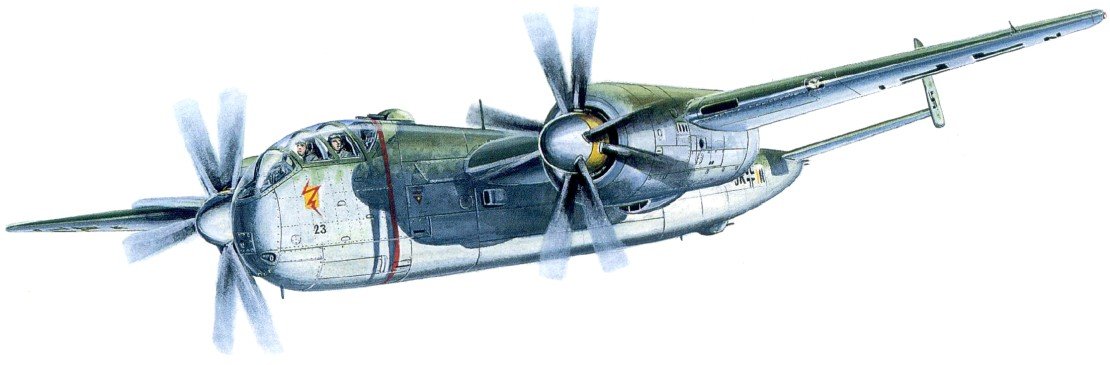
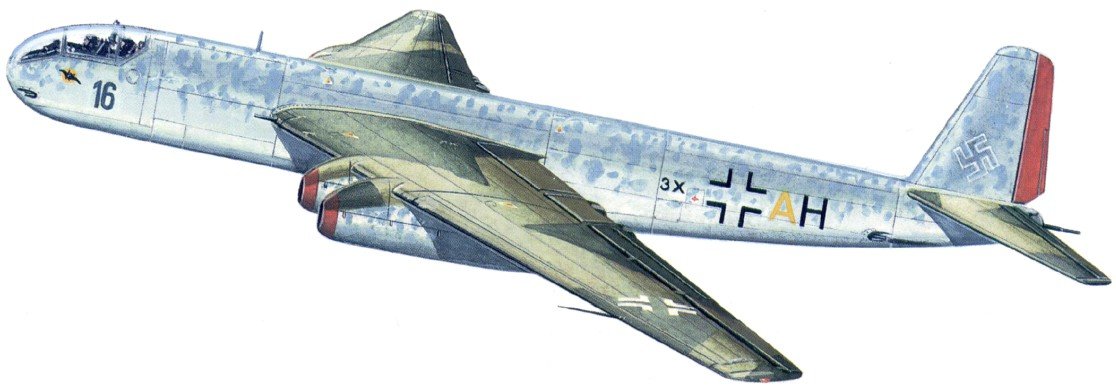
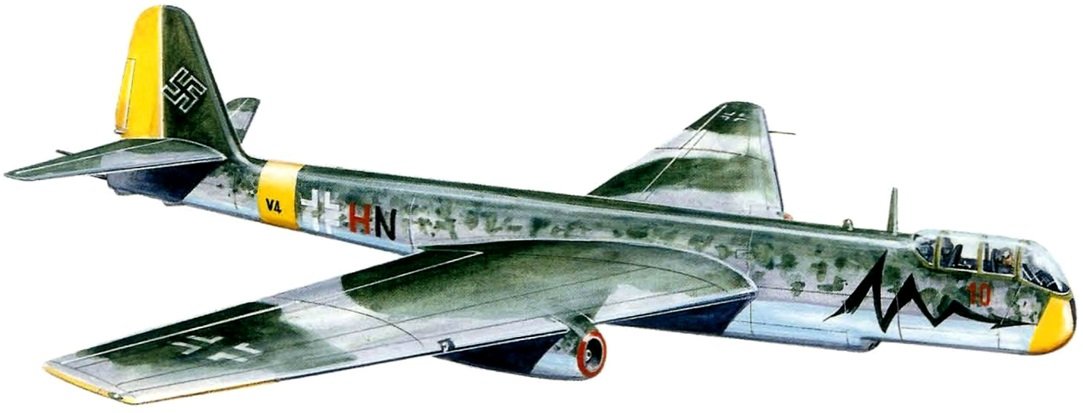
Ar E. 560/2
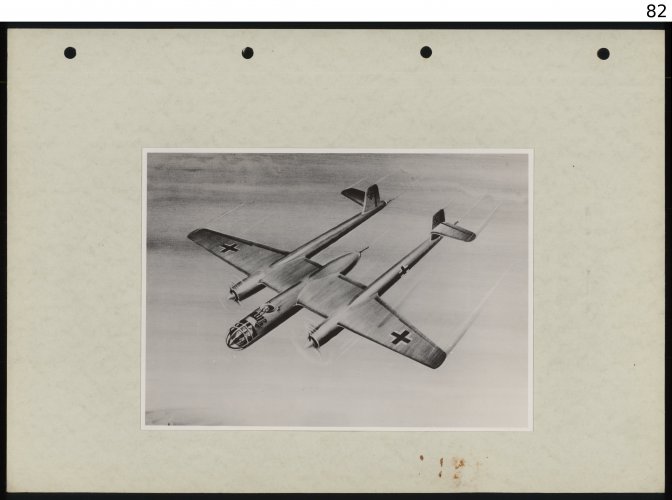
Equipped with two BMW 803 series twin radial piston engines, each producing approximately 4,000 hp. Each engine will drive two counter-rotating blades for a top speed of over 500 mph. The first model was designed with a T-tail and a basic two-person cockpit.
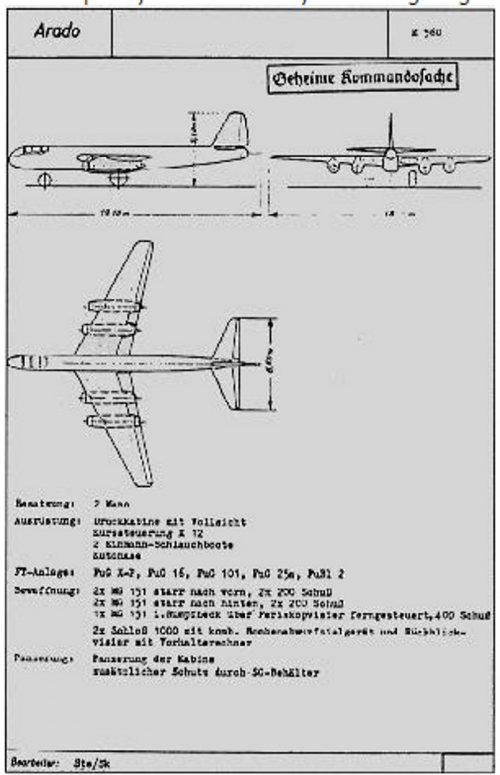
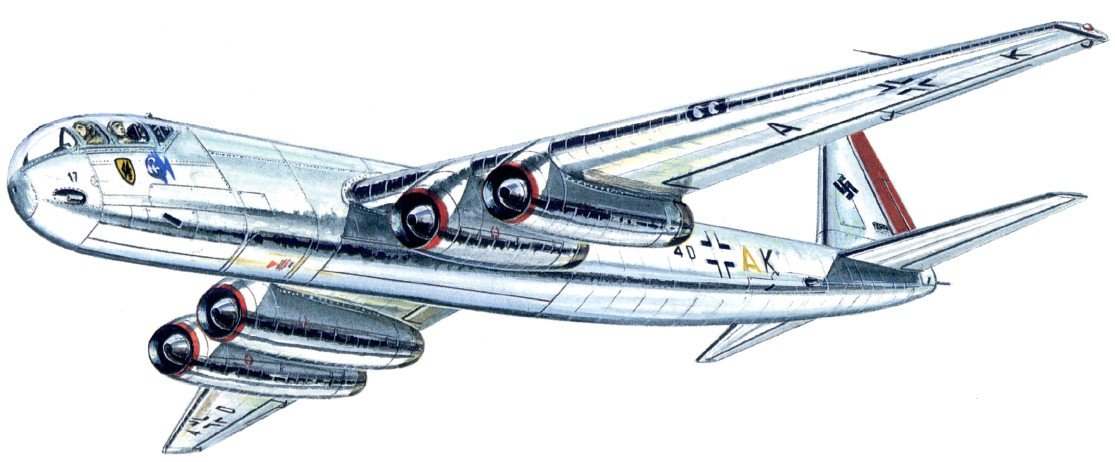
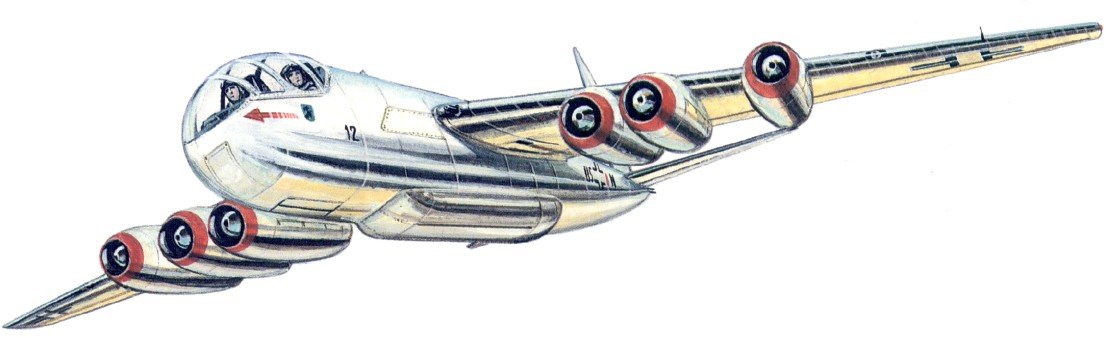
Ar E.560/4
Four-engined bomber project powered by turbojet engines.
Crew: two, Length: 19.1 m (62 ft 8 in), Wingspan: 18 m (59 ft 1 in),
Height: 5.4 m (17 ft 9 in), Wing area: 48 m2 (520 sq ft)
Gross weight: 17,000 kg (37,479 lb)
Powerplant: 4 × BMW 003E Turbojet engines
Maximum speed: 900 km/h (560 mph, 490 kn), Range: 2,300 km (1,400 mi, 1,200 nmi)
Guns: 2 fixed 30 mm MK 103 guns at the cockpit end and 2 periscope operated 30 mm MK 103 guns at the tail end, Bombs: 3,000 kg
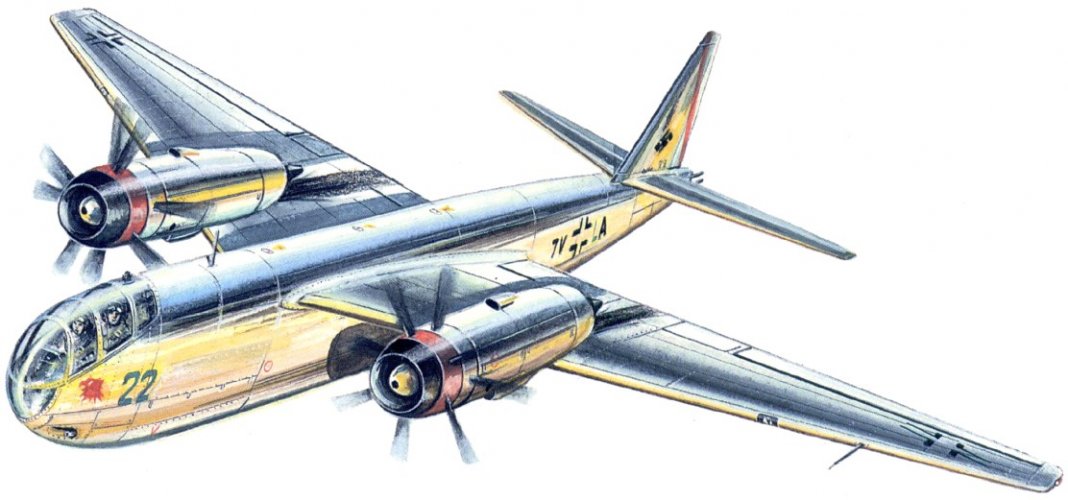
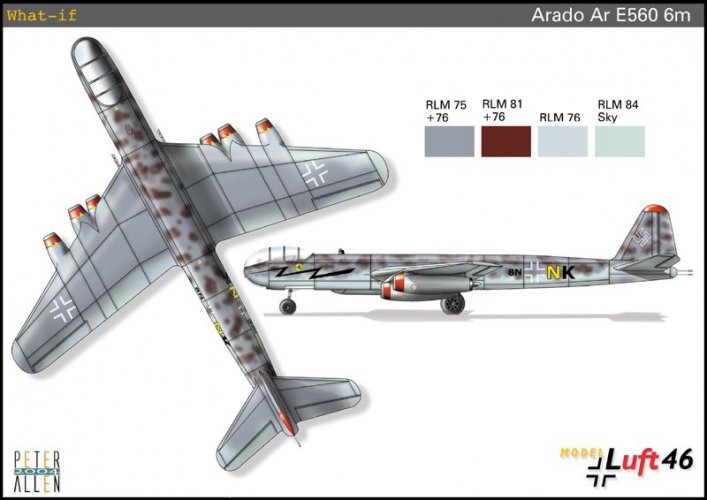
Ar E.560/7
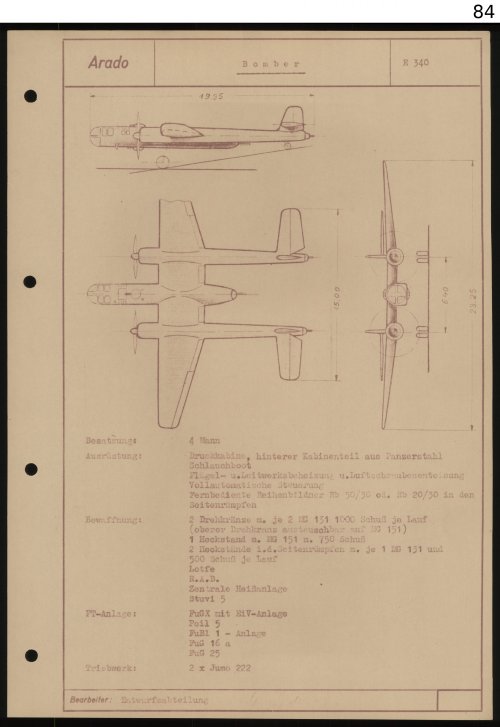
Smaller two-engined bomber project powered by turboprop engines..
Crew: two, Wingspan: 23.5 m (77 ft 1 in), Height: 3.95 m (13 ft 0 in)
Gross weight: 18,800 kg (41,447 lb)
Powerplant: 2 × BMW 028 Turboprop engines
Maximum speed: 920 km/h (570 mph, 500 kn)
Combat range: 3,400 km (2,100 mi, 1,800 nmi)
Bombs: 4,000 kg
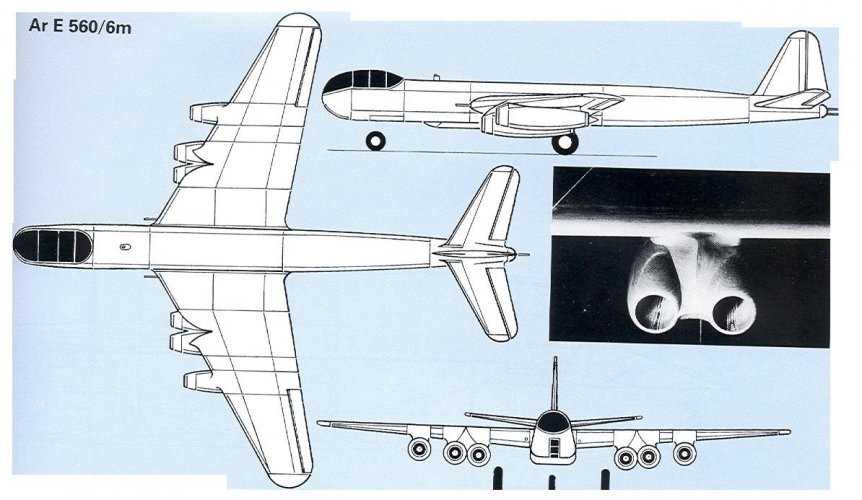
Ar E.560/8
Six-engined bomber project powered by turbojet engines.
Crew: two, Length: 18 m (59 ft 1 in), Wingspan: 23.2 m (76 ft 1 in)
Height: 3.95 m (13 ft 0 in),
Powerplant: 6 × BMW 003 Turbojet engines
Maximum speed: 920 km/h (570 mph, 500 kn)
Combat range: 3,400 km (2,100 mi, 1,800 nmi)
Bombs: 3,000 kg
Ar E.560/11
Four-engined bomber project powered by turbojet engines. .
Crew: two, Length: 19.1 m (62 ft 8 in), Wingspan: 24 m (78 ft 9 in)
Height: 5.1 m (16 ft 9 in), Gross weight: 28,600 kg (63,052 lb)
Powerplant: 4 × BMW 018 Turbojet engines
Guns: 2 fixed 20 mm MG 151 cannons at the cockpit end and 2 fixed 20 mm MG 151 cannons, as well as a periscope-controlled MG 151 rear-firing cannon with 400 rounds, at the tail end, Bombs: 4,000 kg (Wikipedia)
https://live.warthunder.com/post/590953/en/
https://war-book.ru/arado-ar-e-560-bombardirovshhik/
 

Attachments

  • E560-2.jpg
    E560-2.jpg
    66.4 KB · Views: 71
  • Ar E560-4.jpg
    Ar E560-4.jpg
    244 KB · Views: 65
  • E560-4.jpg
    E560-4.jpg
    104.5 KB · Views: 61
  • E560-7.jpg
    E560-7.jpg
    119.3 KB · Views: 55
  • E560-8.jpg
    E560-8.jpg
    62.2 KB · Views: 56
  • Ar_E_560-8.jpg
    Ar_E_560-8.jpg
    49.8 KB · Views: 56
  • E560-11.jpg
    E560-11.jpg
    77.1 KB · Views: 62
  • E560-8.jpg
    E560-8.jpg
    159.5 KB · Views: 42
Last edited:
Justo-san must be knows the name of this type.
 

Attachments

  • some E560 type.jpg
    some E560 type.jpg
    102.7 KB · Views: 62

Attachments

  • arado-e-381-parasite-fighter (3).jpg
    arado-e-381-parasite-fighter (3).jpg
    17.6 KB · Views: 38
  • arado-e-381-parasite-fighter.jpg
    arado-e-381-parasite-fighter.jpg
    30.1 KB · Views: 38
  • e 381.jpg
    e 381.jpg
    33.6 KB · Views: 45
Last edited:
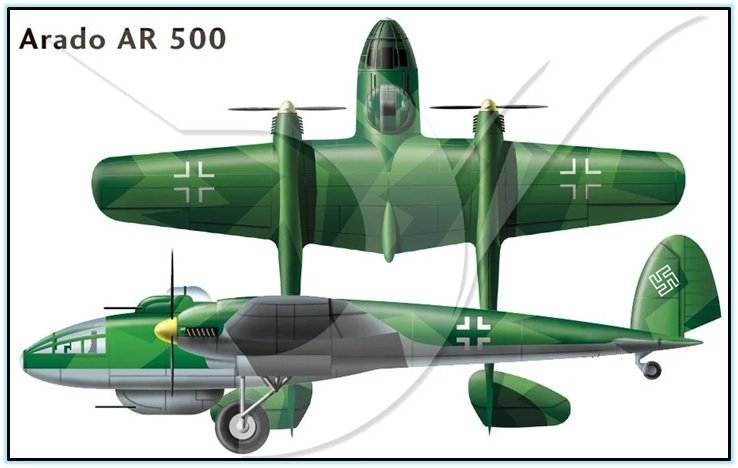
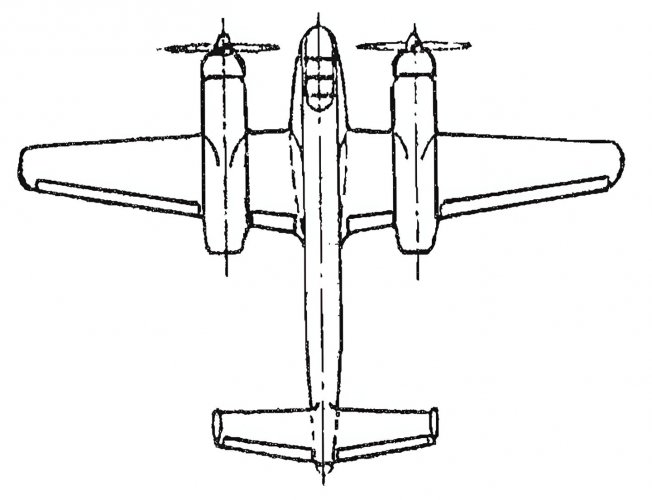
Hi! Arado Ar E.500.
https://ww2aircraft.net/forum/threads/arado-ar-500-zerstorer-project.51285/https://www.facebook.com/Bruyneel.P...35-1936larado-e500-était-un/3069258446625302/

"Arado E.500​

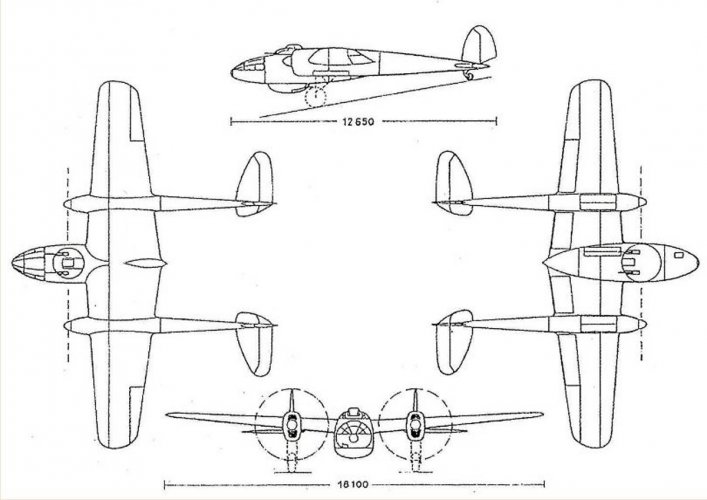
A 1936 Arado Aircraft development program for a twin-engine heavy fighter aircraft.
This four-seat heavy fighter is characterized by its short fuselage, twin booms, and horizontal stabilizers that appear to have had their central section removed.
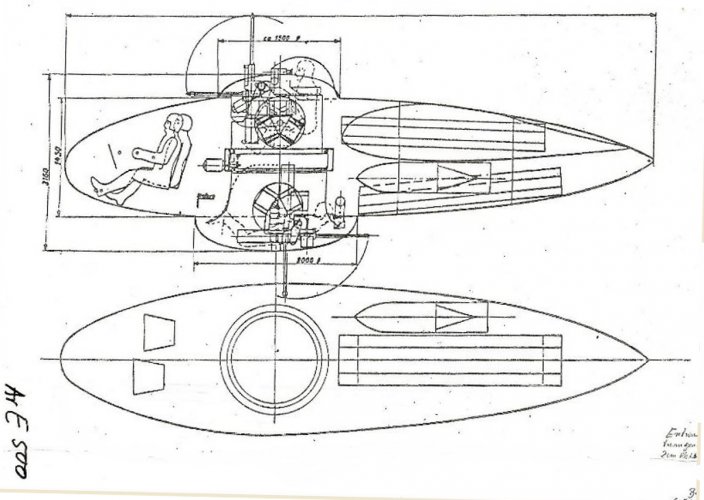
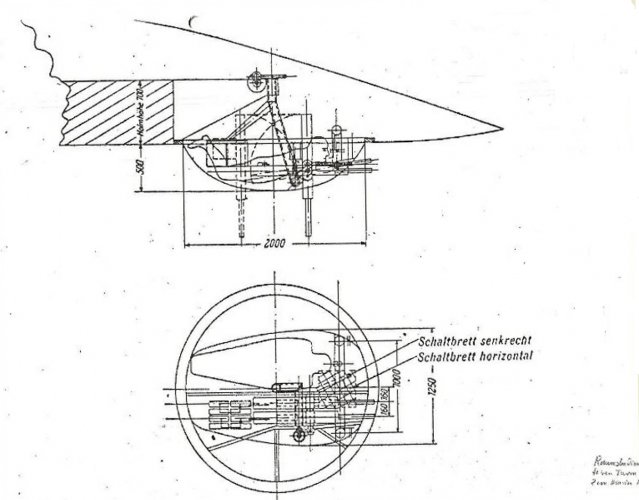
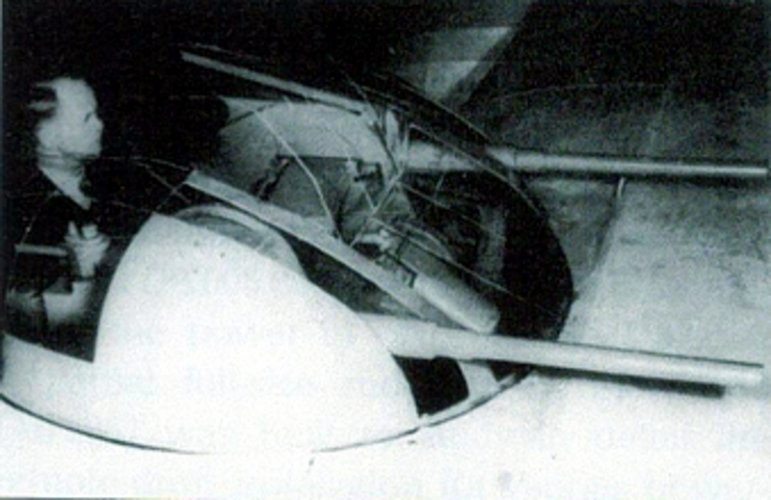
Its most distinctive feature is its armament, which relies solely on turrets equipped with twin 20mm cannons on the upper and lower surfaces, making it a Defiant-like turret fighter.
The upper turret is manned and manually rotated, while the lower turret is operated by another gunner via a periscope.
The distinctive shape of the horizontal stabilizers is thought to be designed not to obstruct the turrets' field of fire.
The English Wikipedia mentions that it also had fixed armament in the nose, but other sources do not mention this.
The crew is most likely to consist of four people: pilot, co-pilot, upper gunner, and lower gunner.
The engine was planned to be two Daimler-Benz DB603s (Note: Production of the DB603 began in 1939.
The 20mm cannon to be mounted was the Rheinmetall Lb-202 series, which used 20×105mmB "Short Solotharn" ammunition and was experimentally produced and operated in the 1930s.
Incidentally, the "Lb" is a manufacturing code meaning swivel gun, so the official name is MG204, taken from the improved LB-204...or so it seems (this is information from an overseas forum...so...).
Upper turret mounted on the mockup
Although a full-scale mock-up was completed, the project did not progress further and was canceled.
Therefore, detailed dimensions and specifications could not be found."
 

Attachments

  • 00095955.jpg
    00095955.jpg
    78.3 KB · Views: 50
  • AADO E500.JPG
    AADO E500.JPG
    255.8 KB · Views: 53
  • ARADO E500 SIDE.JPG
    ARADO E500 SIDE.JPG
    390.4 KB · Views: 49
  • E500 UNDER TURRET.JPG
    E500 UNDER TURRET.JPG
    301.5 KB · Views: 45
  • E500 UPPER TURRET.jpg
    E500 UPPER TURRET.jpg
    300.3 KB · Views: 46
  • 481038314_3729607640590376_1995270258644578082_n.jpg
    481038314_3729607640590376_1995270258644578082_n.jpg
    46.3 KB · Views: 51
Last edited:
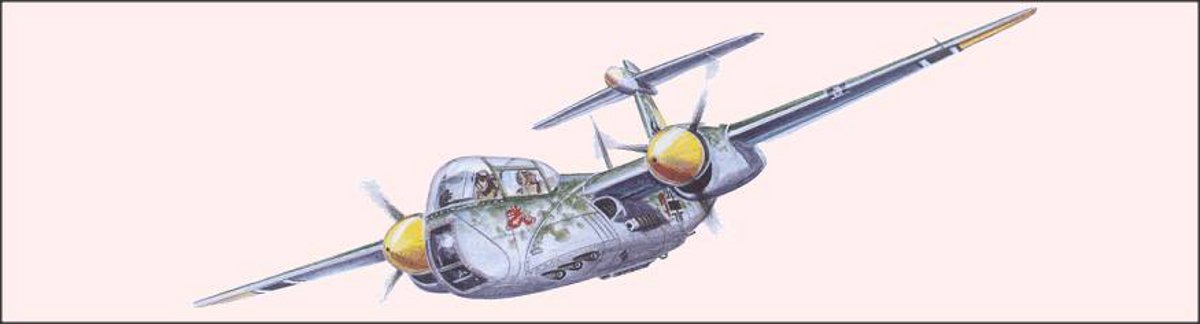
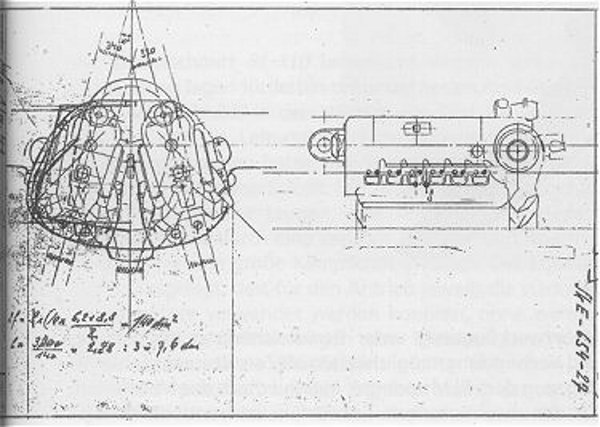
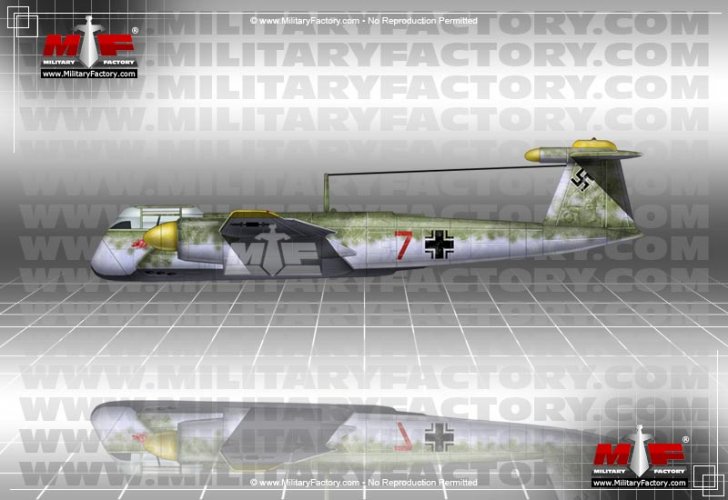
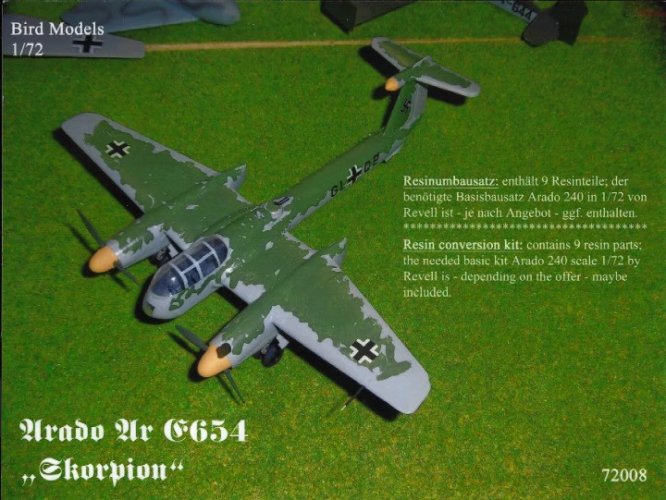
https://www.facebook.com/groups/luft46/posts/3192416867452183/https://en.namu.wiki/w/Ar E.654https://www.militaryfactory.com/aircraft/detail.php?aircraft_id=671https://www.scalemates.com/zh/kits/bird-models-72008-arado-ar-e654-skorpion--1578013
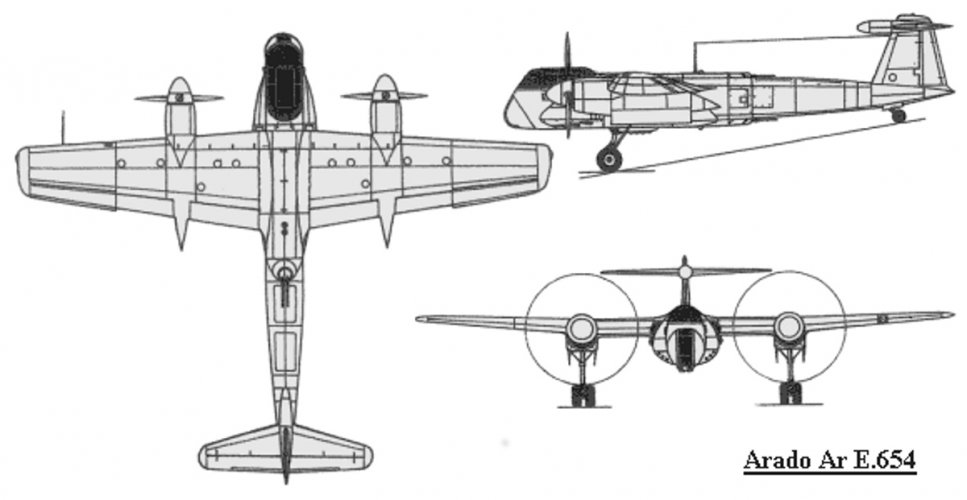
The Arado Ar E.654"Kampfzerstörer"(destroyer, or heavy fighter) project was conceived by Arado's Chief Designer Walter Blume. The fuselage was similar to the Ar 240, except it was widened to facilitate the 2 Daimler Benz DB 614 or 627 engines which were mounted side-by-side and inclined 15 degrees. The engines drove the propellers via complicated method of right angle gear boxes and drive shafts. The advantages of this system was to minimize drag caused by larger engine nacelles and kept the engines in a more protected position. Offensive armament consisted of six fixed MK 103 cannons installed under the engines. Defensive armament was similar to the Ar 240's: 2 turrets mounted above and below the fuselage. The Arado document show the engines position
 

Attachments

  • Ar E 654.jpg
    Ar E 654.jpg
    132.1 KB · Views: 42
  • E 654.jpg
    E 654.jpg
    123.1 KB · Views: 46
  • E 654 engine.jpg
    E 654 engine.jpg
    130.4 KB · Views: 42
  • arado-e654.jpg
    arado-e654.jpg
    64.5 KB · Views: 42
  • 1578013-146093-54-720.jpg
    1578013-146093-54-720.jpg
    128.1 KB · Views: 39
Last edited:
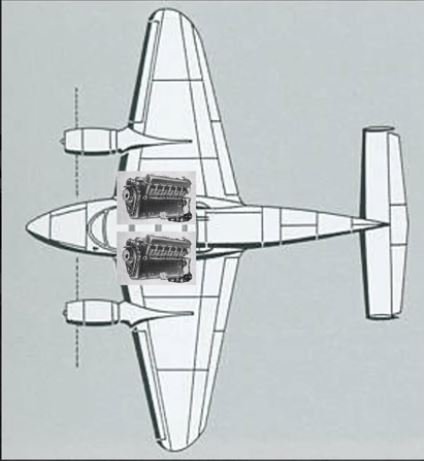
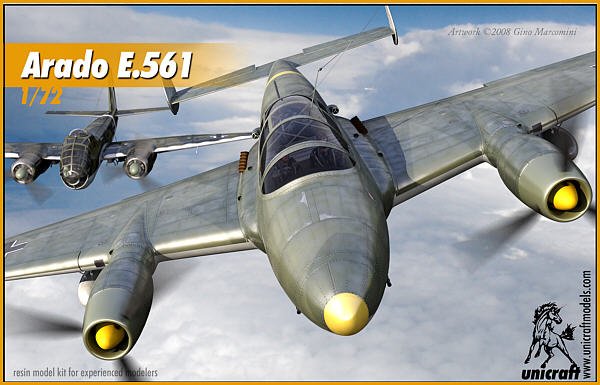
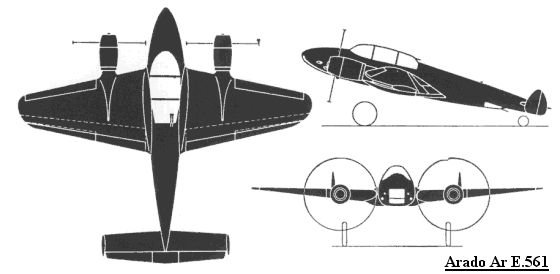
Ar E.654's side by side engine installation is same as E.561 heavy fighter.
Radiator is located near propeller.
 

Attachments

  • E 561 ENGINE.JPG
    E 561 ENGINE.JPG
    28.8 KB · Views: 40
  • arado-ar-e-561_3.jpg
    arado-ar-e-561_3.jpg
    49.5 KB · Views: 41
  • arado-ar-e-561_6.jpg
    arado-ar-e-561_6.jpg
    18 KB · Views: 38
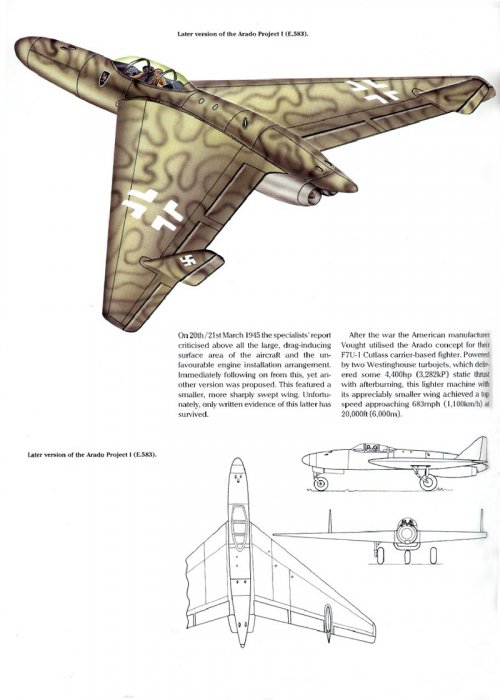
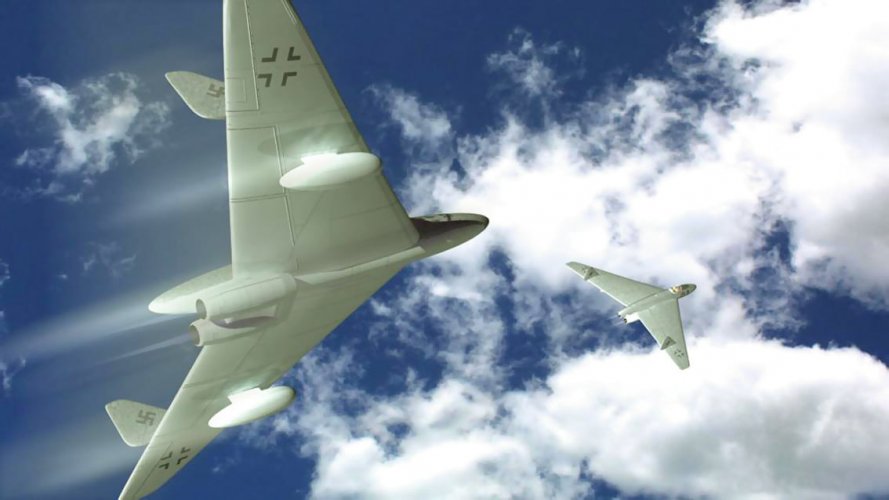
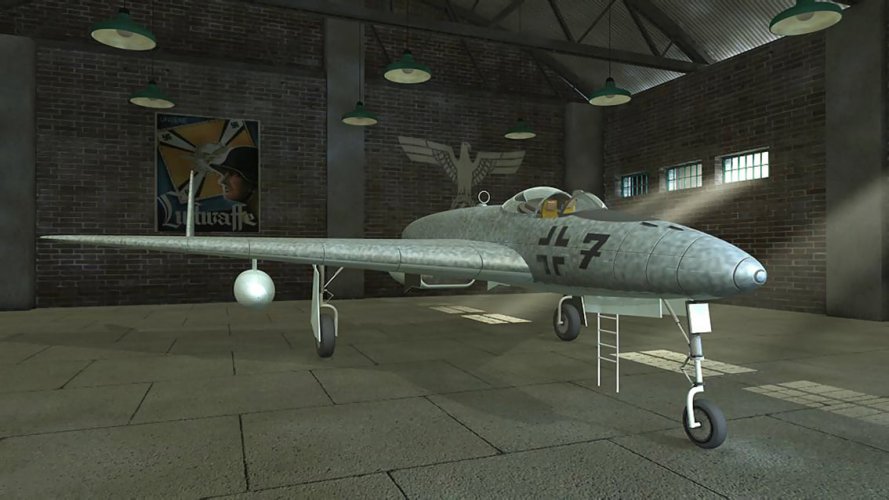
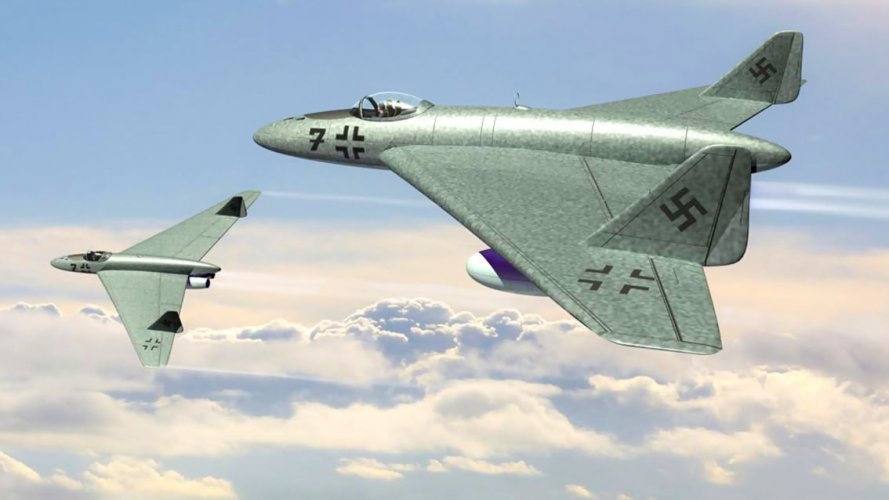
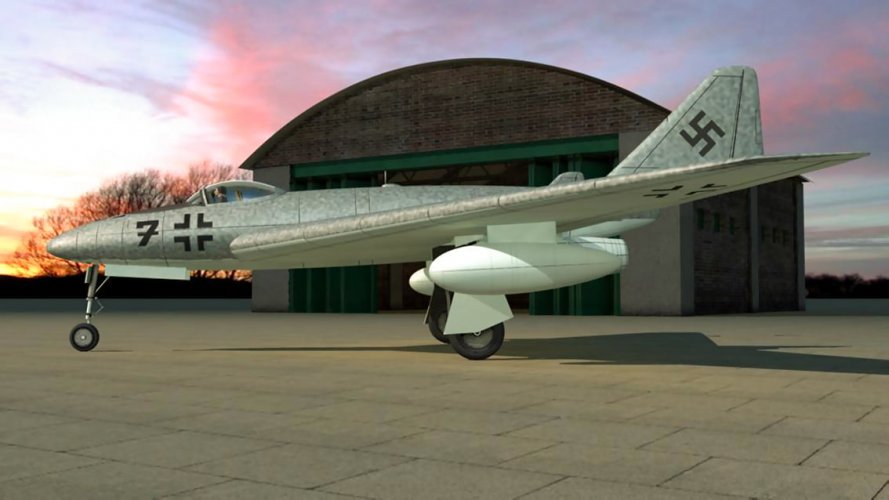
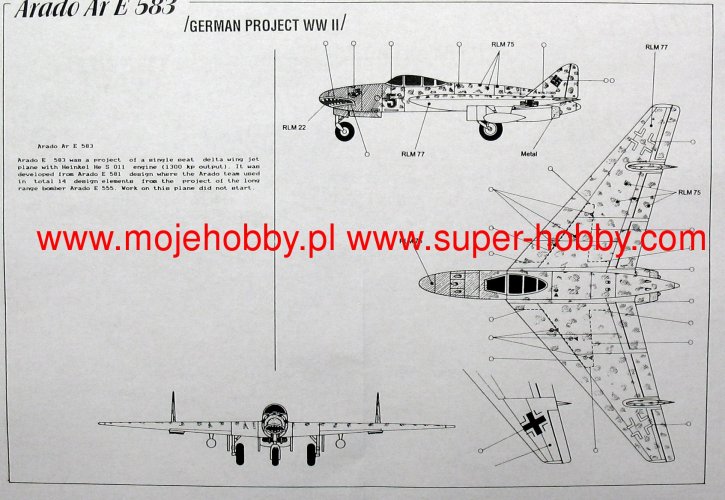
Hi! Ar E 583 project1. 
https://www.facebook.com/photo?fbid=10209148553908264&set=pcb.5622444021116110https://jp.super-hobby.com/products/Arado-Ar-E-583.html
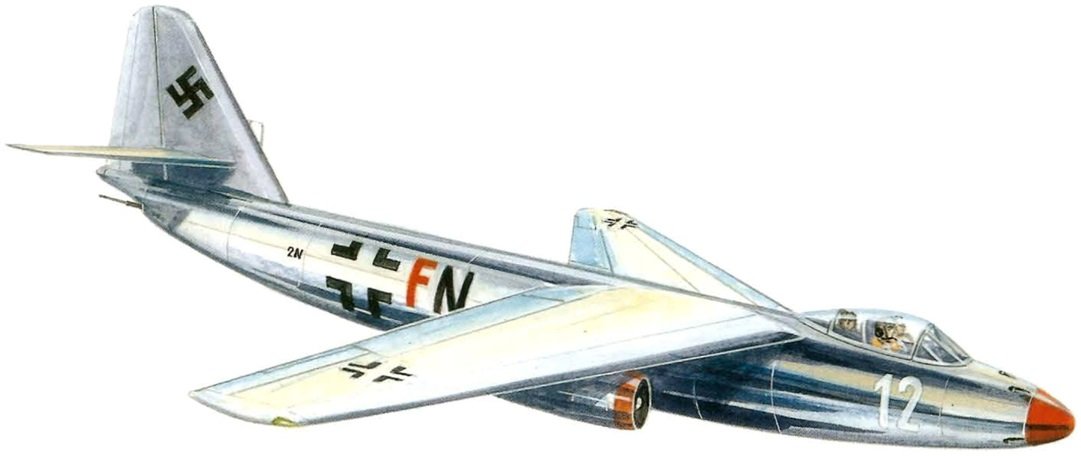
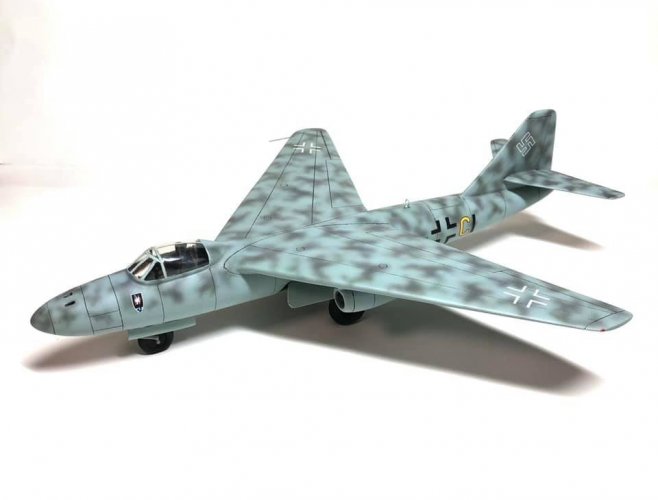
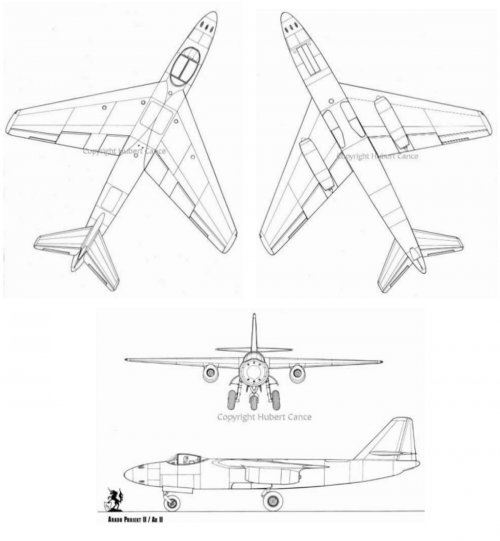
"The Arado Ar E.583 was a project of a German WWII night fighter jet. It was assumed that the propulsion would be provided by two He-S011 jet engines, and the on-board armament would consist of two machine guns and two 30 mm cannons. The maximum speed was to reach approx. 800 km / h. The Ar E.583 project was developed at the Arado Flugzeugwerke aviation plant in early 1945. The new design was based largely on the assumptions of the E.581 project and, interestingly, was to use some elements of the E.555 bomber design. The E.583 project involved the creation of a relatively large aircraft, with long-span oblique wings, in an aerodynamic arrangement that closely resembled the delta arrangement. The machine also did not have vertical fins in the tail part, but on the wings. The approaching end of World War II and the enormous problems with obtaining the raw materials needed to build the Arado Ar E.583 meant that the machine never left the design phase."
 

Attachments

  • 482342922_10212699537200627_5217369731137584217_n.jpg
    482342922_10212699537200627_5217369731137584217_n.jpg
    294.3 KB · Views: 29
  • 482227340_10212699535960596_2668019125796832034_n.jpg
    482227340_10212699535960596_2668019125796832034_n.jpg
    77.9 KB · Views: 26
  • 482320235_10212699532320505_6681441168856430303_n.jpg
    482320235_10212699532320505_6681441168856430303_n.jpg
    104.9 KB · Views: 24
  • 482343854_10212699535520585_3962696623688037297_n.jpg
    482343854_10212699535520585_3962696623688037297_n.jpg
    74.6 KB · Views: 28
  • 482348197_10212699536000597_2611028017643406973_n.jpg
    482348197_10212699536000597_2611028017643406973_n.jpg
    84.2 KB · Views: 37
  • 9354_2_PLT032_2.jpg
    9354_2_PLT032_2.jpg
    381.2 KB · Views: 17
Last edited:

Attachments

  • 00066043.jpg
    00066043.jpg
    55.3 KB · Views: 21
  • 00095988.jpg
    00095988.jpg
    80.4 KB · Views: 23
  • 1857-entry-1-1645479089.jpg
    1857-entry-1-1645479089.jpg
    43.4 KB · Views: 25
  • E 583 projectⅡ.jpg
    E 583 projectⅡ.jpg
    242.7 KB · Views: 35
Last edited:
https://airpages.ru/eng/lw/ar240.shtml

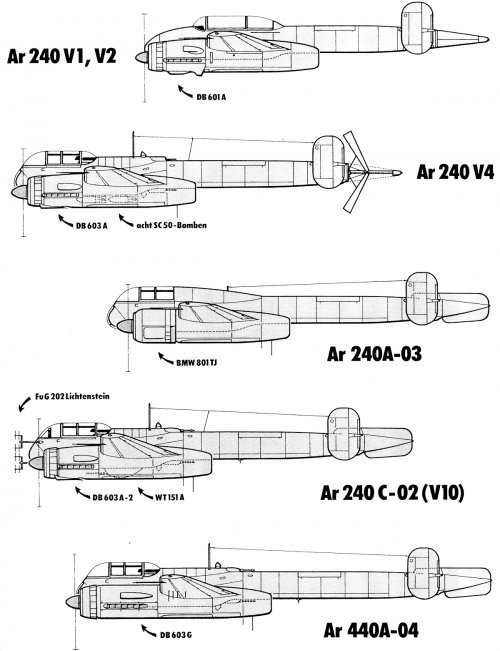
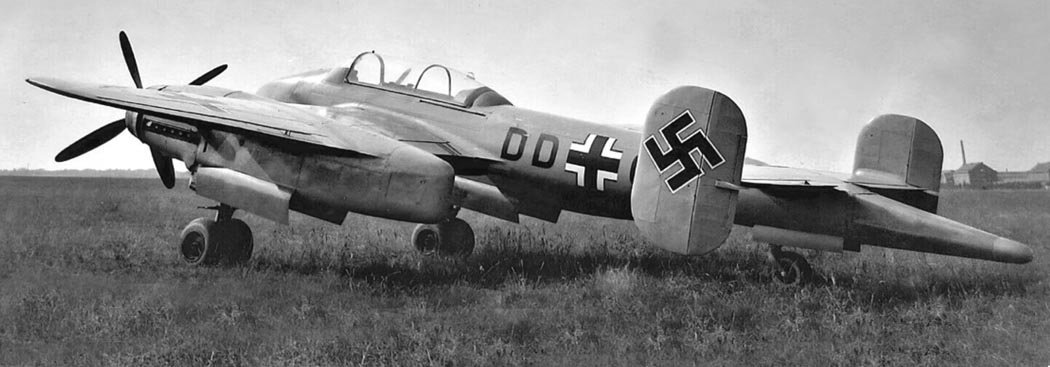
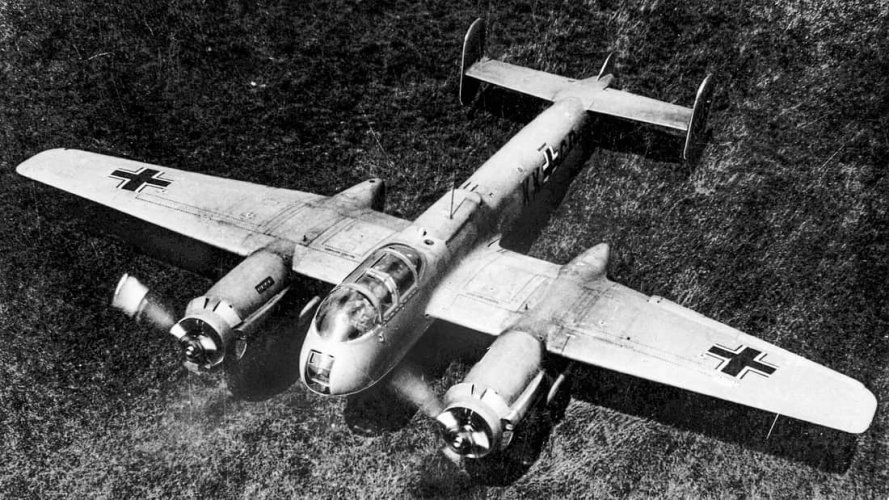
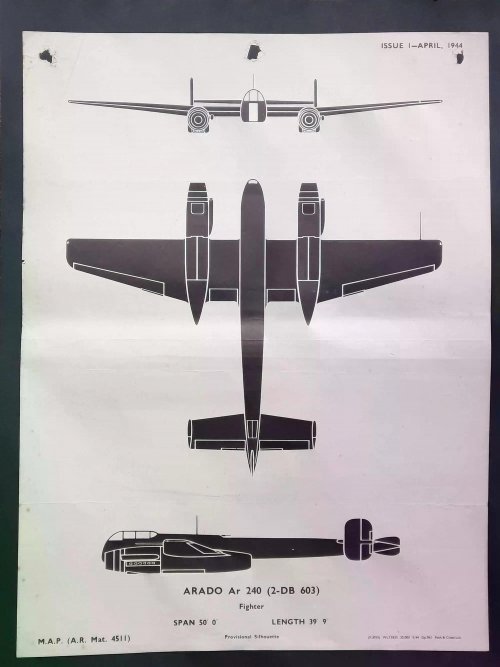
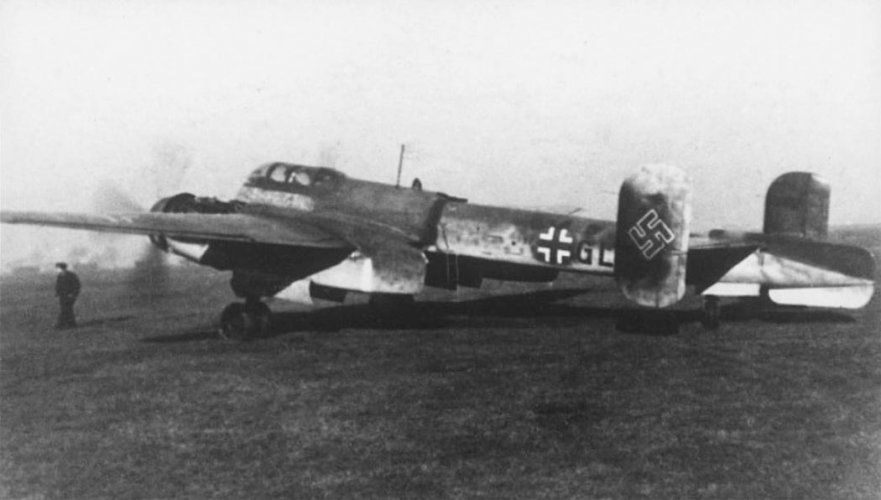
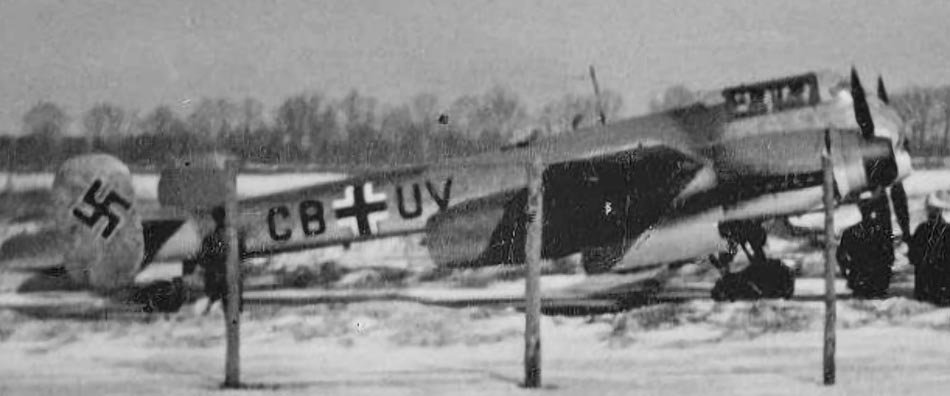
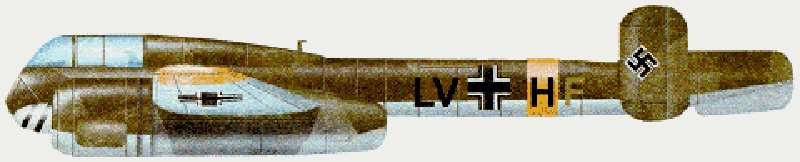
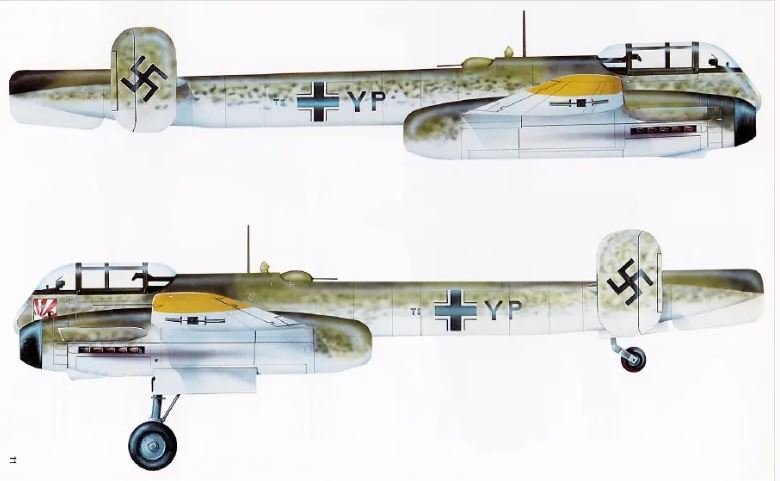
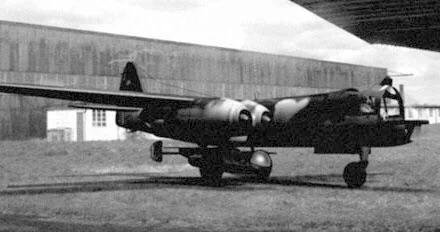
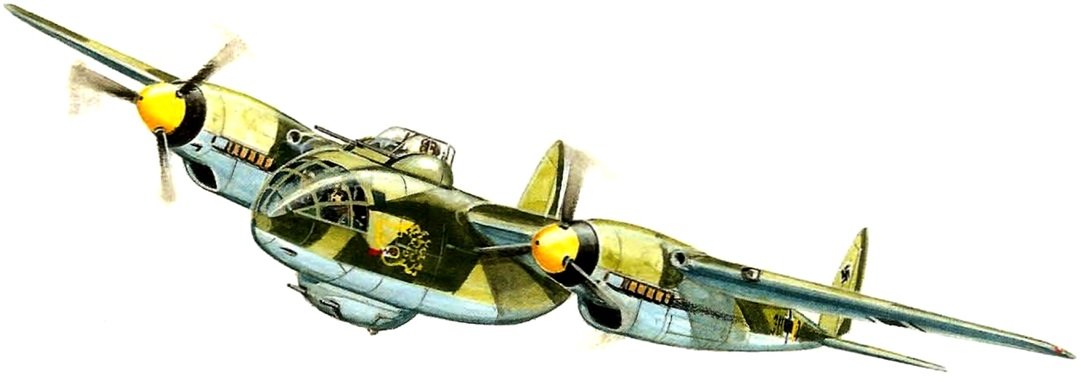
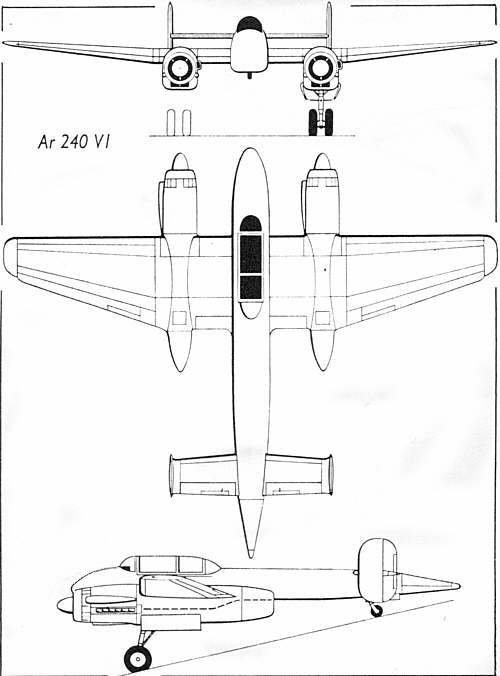
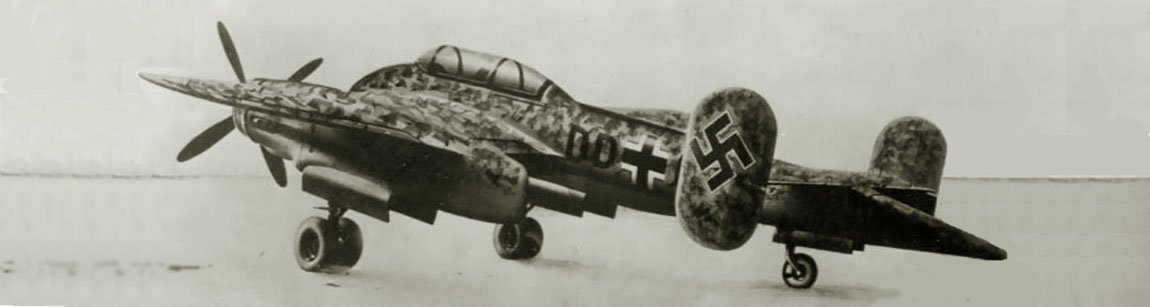
"The Ar 240 heavy fighter was born, like the Me 210/410, in the fall of 1938 as a potential replacement for the Bf 110 that had just entered service. Moreover, the Third Reich Aviation Ministry gave the company complete freedom in the use of advanced technical solutions and technologies.

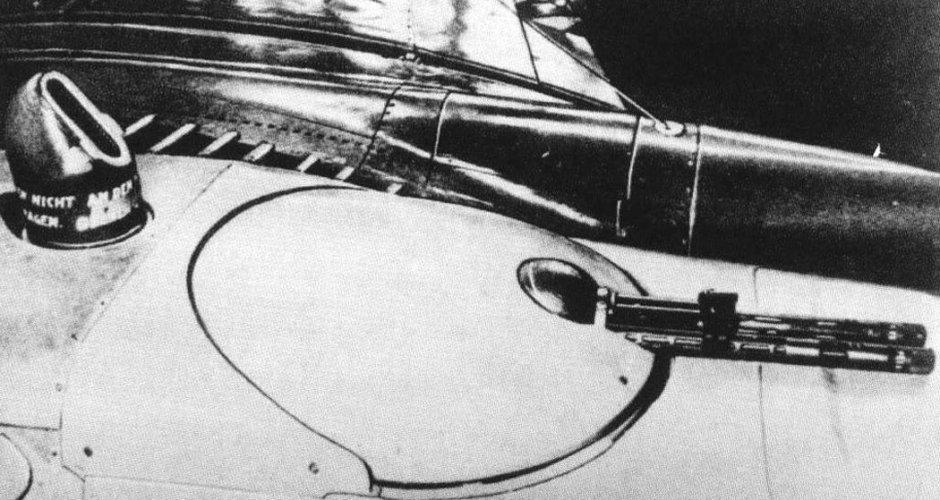
The concept of the heavy fighter has been worked on for a long time by the technical director of Arado Flyugzeugwerke, Walter Blum. The main highlight of the project developed under his leadership was the use of new ideas in relation to the defensive weapons of the "hunter". In collaboration with Rheinmetall-Borzig, Blum designed the advanced weapon system at that time - a remotely controlled machine-gun mount. This decision made it possible to get rid of the main disadvantage of the defensive armament of the Bf 110 - the lack of cover for the lower-rear hemisphere.

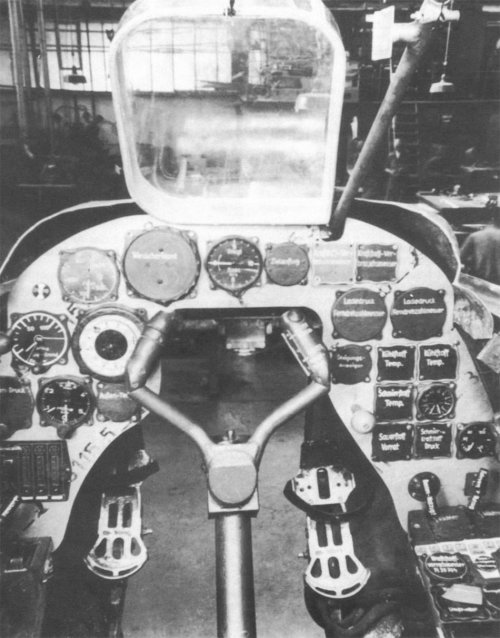
The following year, the company presented a project that takes into account the latest achievements in aerodynamics. The aircraft was a two-seater all-metal monoplane with a high wing loading, a pressurized cockpit, a remotely controlled machine gun mount, a highly mechanized wing with automatic slats and double-slotted flaps. The shape of an air brake in the form of a parachute folding into a tail cone was unusual.

To meet another important requirement for the new heavy fighter - the maximum possible speed - the dimensions and cross-sections of the aircraft were chosen to be minimal. To eliminate the reactive torque of the propellers when using powerful motors, it was planned to use coaxial propellers. At the same time, the cocks were supposed to be tunnel - with an air intake for water radiators. This made it possible to simultaneously cool the gearboxes of the coaxial propellers, but wartime conditions did not allow them to be created ...

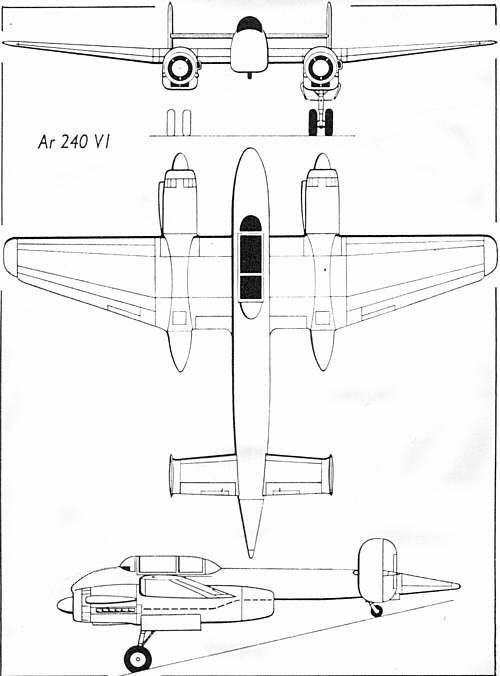
With the beginning of the war - September 1 - it was decided to stop work on all aircraft that did not have time to start flight tests, including the Ar 240. Work resumed only at the end of 1939. The first flight of the Ar 240 VI took place on April 30, 1940, and after the second Ar 240 V2 followed for three months. From the very first flight, it became clear that the new "hunter" is unstable in all three axes! Considering that the creator of the aircraft Kozin was considered the main specialist in aircraft control in the "Third Reich", the embarrassment was complete ... The rejection of coaxial propellers immediately made the Ar 240 unstable, and the seemingly successful solution with tunnel cocks played an important role here , since such coca had a greater mass and further increased the reactive moment of the screws. The large rotating mass far in front of the aircraft's center of mass made it unstable in longitudinal and lateral control. In addition, long, narrow ailerons proved to be ineffective. The blows in the wind tunnel showed that the thin wing profile was also to blame. The leading edge had to be thickened with special trims. Unlike the problems with the Me 210, the Ar 240 did not even have to rework the plumage. By the fall of 1940, the modified prototypes were sent to the Luftwaffe test center in Rechlin.

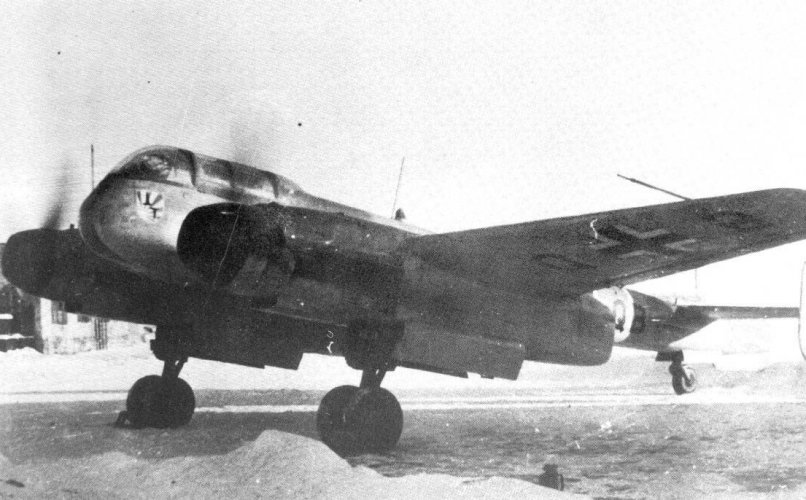
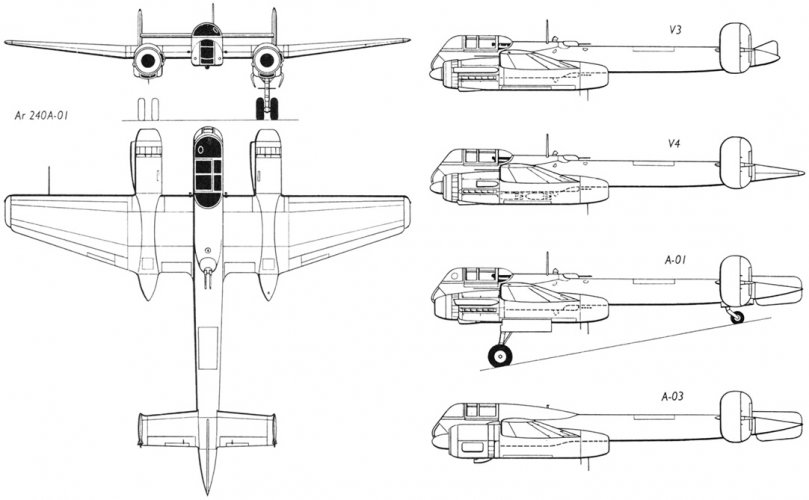
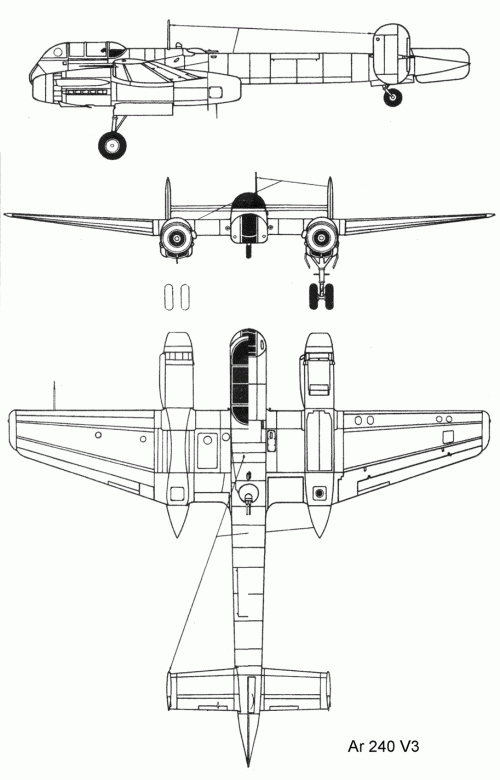
By that time, as a result of the air "battle for England", the Bf 110's inconsistency as a "hunter" had already become obvious. The new machines were urgently required to improve the pilot's view, especially forward and downward, to install pressurized cabins and more powerful defensive weapons. As a result, on the next prototype Ar 240 V3 (KK + CD), design changes were made. The aircraft was designed as a dive bomber and reconnaissance aircraft. The pressurized cockpit was moved forward to the very nose, and to maintain alignment, the tail of the new aircraft was lengthened by 1.2 m by inserting a fuselage section. The wingspan also had to be increased by more than 2 meters. The tail air brake was removed. An additional keel was installed. The slats were also removed (mainly to avoid icing). Like its predecessors, the Ar 240 V3 propulsion system consisted of a pair of DB 601A with a capacity of 1075 hp. with. on takeoff. The aircraft was finally equipped with an FA-13 hydraulic fire control system. In the upper and lower installations, a pair of 7.9 mm machine guns were installed. The bow armament is modeled on the Ar 240 V2. All of these improvements delayed the V3's readiness until late spring 1941, when flight tests revealed some, but insufficient, improvement in handling. Again, alterations were required, the installation of new ailerons. At the end of the summer, Ar 240 V3 entered the long-range reconnaissance group for military trials. The FA-13 system, which performed well on tests, performed poorly in the field and was removed along with the offensive weapons. Instead, a pair of Rb 50/30 cameras was installed, as well as a GM-1 nitrous oxide boost system. Colonel Knemeyer of the reconnaissance group carried out several reconnaissance flights over Britain with this aircraft. High speed and high flight altitude made it possible to avoid countermeasures from fighters.

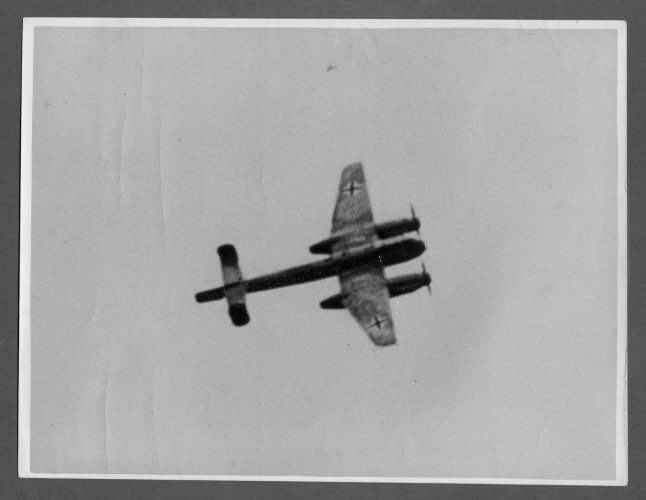
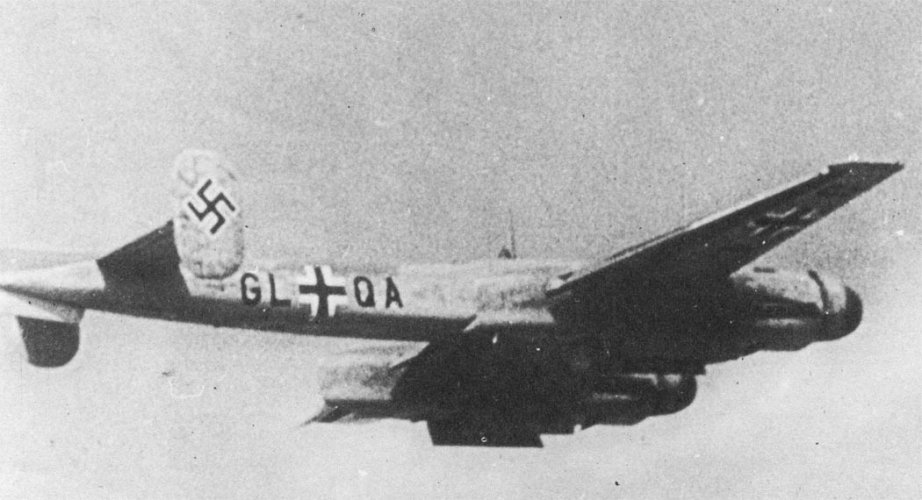
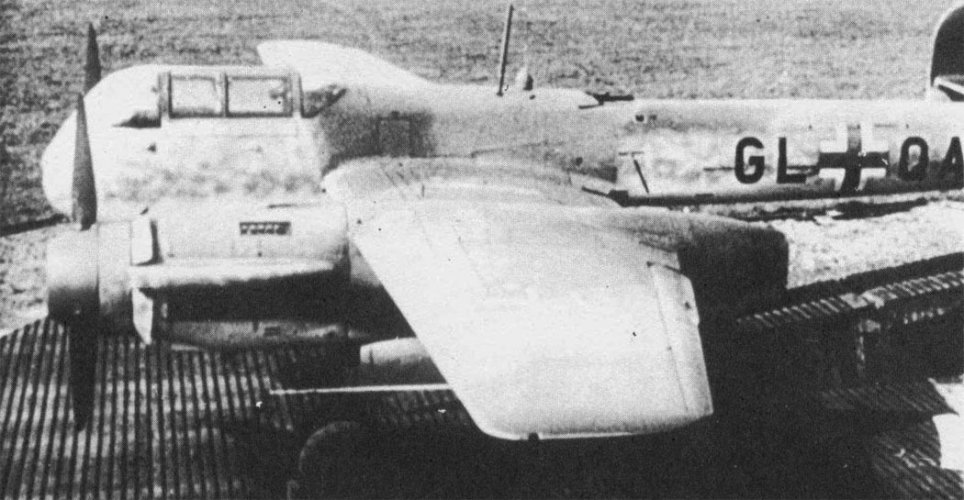
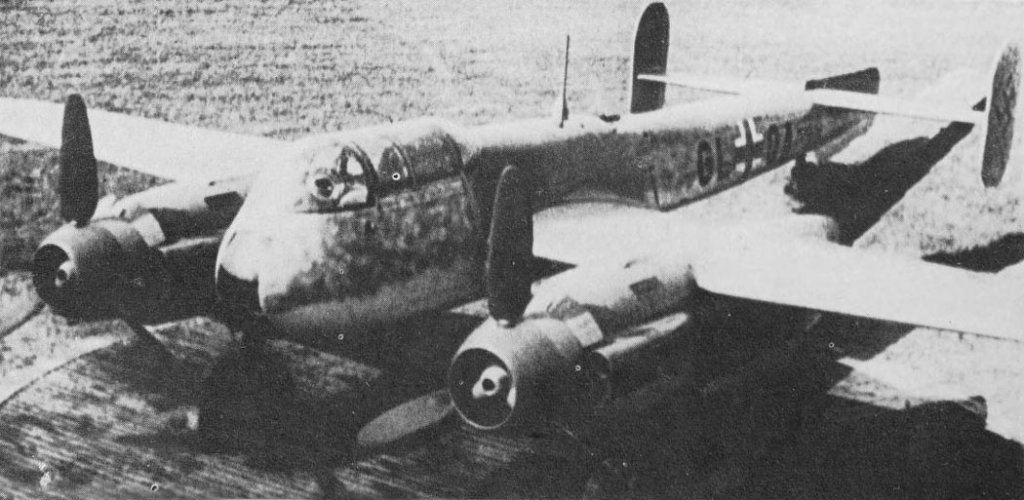
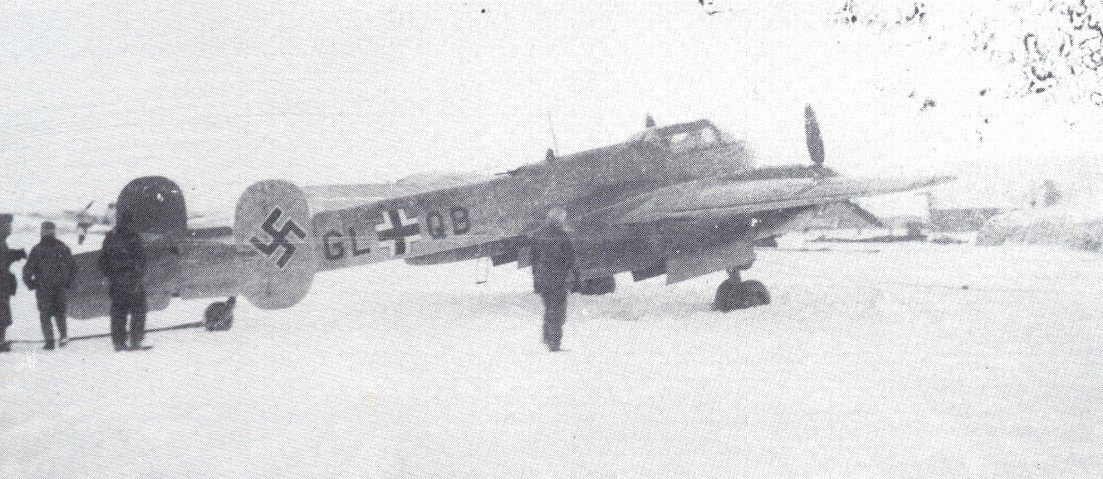
Meanwhile "Arado" finished the fourth Ar 240 V4 . The Ar-0 flugzeugwerke company in Oschersleben was chosen for the production of the Ar 240A-0 installation series. Metal procurement began. Ar 240 V4 was intended for the role of a dive bomber and reconnaissance aircraft. The armament of the previous version was retained, and suspensions for eight 50-kg bombs were installed under the fuselage. The air brake was again installed, increasing the length of the aircraft from 12.4 to 13 m. The engines were installed DB 603A with a take-off capacity of 1750 hp. Before the completion of the dive bombing tests, it was decided that the reconnaissance was now more needed than the dive bomber. As a result, the first pre-production Ar 240A-01 and -02 (GL + QA and QB), which also had the designation V5 and V6, were completed in the reconnaissance version.

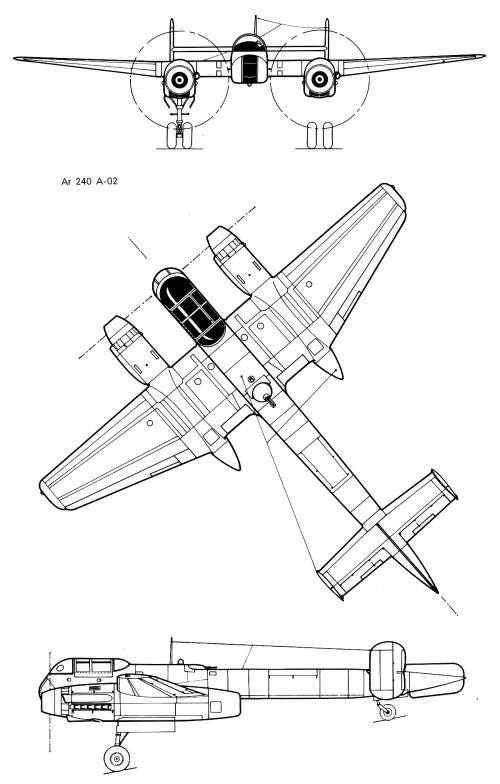
Ar240 A-01 and -02 flew in October 1942. Their aerodynamics were also improved, which improved handling, which is still far from ideal. Although the wingspan and shape of the wing did not change, it was actually redesigned. The wing profile has become close to laminar. As a result, the aircraft's performance has improved immeasurably. The air brake was finally abandoned. Engines of steel DB 601E with a capacity of 1175 hp on takeoff. The offensive armament was reduced to a pair of 7.9 mm machine guns. But the FA-13 armament system with coaxial MG81Z machine guns was retained. The two crew members sat back to back in a pressurized, double-glazed cockpit sealed with inflatable rubber hoses. Eight fuel tanks held 2,300 liters of fuel and could be supplemented with a 600 liter outboard tank. Rb50 / 30 automatic cameras were mounted at the rear of the propulsion nacelles. By this time, the takeoff weight had increased to 9460 kg, and the wing load was at least 300 kg / m² with a wing area of 30 m².

Three more Ar 234-A-O were completed and flown to ArO by October 1942. The first of them, the A-03, was originally equipped with DB601E engines, but was later re-equipped with BMW801TJ - 14-cylinder, radial, air-cooled, turbo-charged, takeoff power 1880 hp with. and 1520 liters. with. at an altitude of 10800 m. Ar 240A-04 and -05 (or A-0 / U1 and U2), made without weapons, had DB603A engines. And by December 1942, she had already prepared 80% of the units and parts at the plant in Oschersleben for the first 40 serial Ar 240A, but Erhard Milch suspended the program.

Ar.240 A-1Ar.240 B-0Ar.440 A-0
Dimensions
Powerplant
Weight, kg:
Performance
Armament
Specification
Crew222
Wing span, m13,313,316,3
Wing area, m²30,930,934
Length, m12,812,814,3
Height, m3,953,954,0
2×PE, power hptypeDB601EDB605AMDB603G
at sea level2×11752×14752×1900
at altitude, 7380 m--1560
Empty weight620062009200
Loaded weight94601030512210
Speed, km/hCruise at altitude 6000m552575696*
Maximum at altitude 6000m615630747**
Time to 6000m, min1110,6-
Service range, km1990***1900***2700****
Bombs, kg--1000
* - max speed at altitude 8300 m

** - max speed at altitude 11200 m with GM1.

*** - with 600-l fuel tank at cruise speed

**** - with two 670-l fuel tanks"
 

Attachments

  • ar240  v1.jpg
    ar240 v1.jpg
    46.5 KB · Views: 19
  • Ar240V1.jpg
    Ar240V1.jpg
    31.2 KB · Views: 23
  • ar240 v3.gif
    ar240 v3.gif
    57.6 KB · Views: 21
  • ar240a01.jpg
    ar240a01.jpg
    122.7 KB · Views: 25
Last edited:
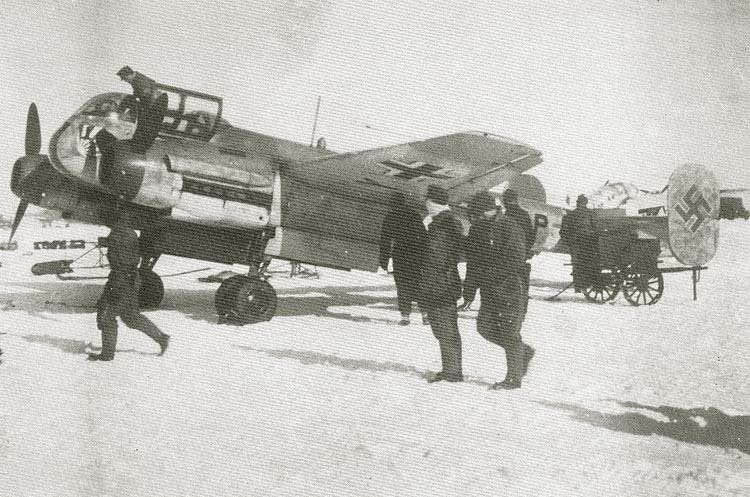
"Despite the cessation of production, the produced aircraft were quickly transferred to combat units. Thus, in December 1942, two Ar 240s conducted reconnaissance of the "Stalingrad cauldron" into which Pauls' 6th Army fell. Ar 240A-01 and -02 were delivered to the 5th Fighter Squadron, which was located in the north of Finland near Petsamo. Aircraft "Arado" conducted reconnaissance of the Murmansk railway. Another Ar 240 from February 1943 operated together with the Ju88 from 3. (F) / 100 as part of the Ostland air command, and from July 1943 as part of the Don air command. In June 1943 I. (F) / 100 also used the Ar 240 in the 6th Air Fleet. In the summer of 1943, Ar 240A-02 was transferred from JG-5 to 2. (F) / 122 at Frazinone, southeast of Rome. After several test flights, the aircraft made its first reconnaissance flight. Soon this part received from I. (F) / 123 in Pergia Ar 240A-04 (A-0 / U1), but it was not used due to problems with the DB 603A engines. After their repair, the plane was returned to Germany. This aircraft, together with Ar240A-05 (A-0 / U2) and Ar 240A-03, was used in the southern sector of the Eastern Front in the 10th Long Range Reconnaissance Regiment and as part of the 1st Aufkl Squadron. Gr.Ob.d.L. Ar240 V7 and V8, which were completed before Milch's verdict in October and December 1942, were prototypes of the Ar 240В-1 reconnaissance aircraft. They are also known under the designations Ar 240B-01 and B-02. The aircraft had the same design as the Ar 240A-0. The engines were DB-605AM with a capacity of 1475 hp. on takeoff. Using the injection of a water-alcohol mixture, the power increased to 1800 hp. Both V7 and V8 had a pair of MG17 machine guns forward and barbets with MG81Z. The latter had another 20 mm MG151 cannon in front.

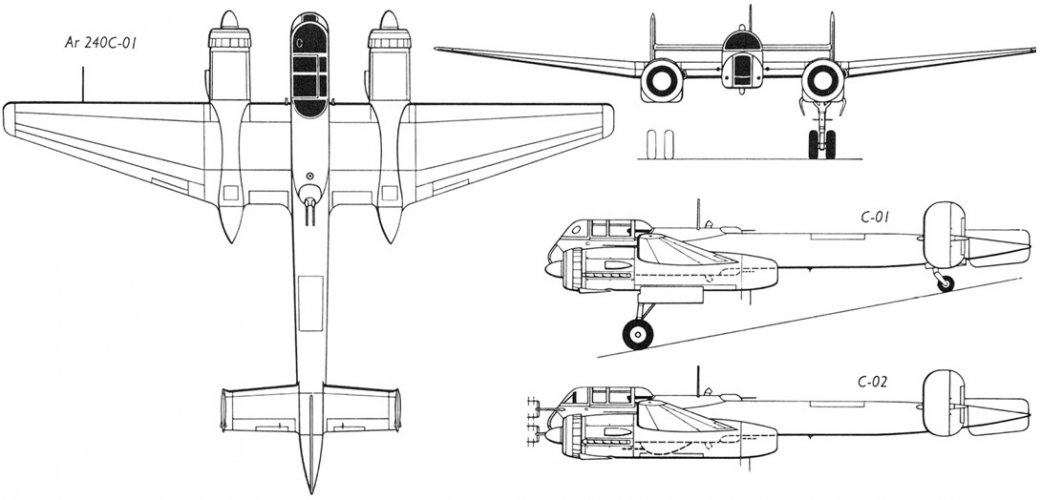
The creation of the Ar 240 reconnaissance variant took priority over other variants of this multipurpose aircraft. As a result, the first "hunter" - Ar 240 V9 (or Ar 240C) did not start flight tests until March 1943, that is, three months after the official completion of the program. The engines on it were DB603A-2 with a capacity of 1750 hp.; and 1850 hp. at an altitude of 2100 m. Ar 240 V9 had practically the same design as the A- and B-series, but the wingspan was increased to 16.6 m. The lengthening of the propulsion nacelles led to an overall increase in the length of the aircraft to 13.3 m. armament consisted of four 20-mm MG 151 cannons. Remote-controlled installations were equipped with twin sets of 13-mm MG 131 machine guns. The empty and take-off weight increased markedly to 8487 kg and 10560 kg, respectively. Despite the increase in wing area by 3.6 m², the load on the wing remained the same. Tests have shown that the flight characteristics have not changed.

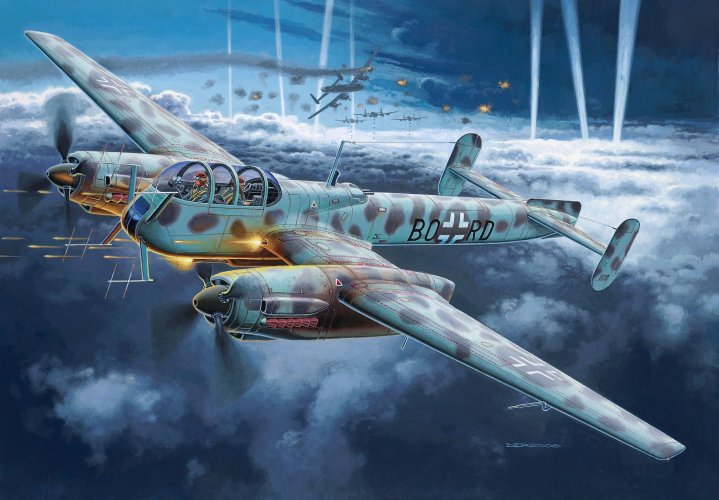
Three more experimental aircraft of the C-series were built in parallel: V10 (Ar 240C-02) as a night fighter with another 20-mm MG151 in a WT-151A outboard fairing, FuG202 Liechtenstein locator, and VII and VI2 (Ar 240C-03 and -04) were capable of carrying 1800 kg of bombs and were equipped with a GM1 nitrous oxide injection system, which gave an increase in speed at altitude up to 56 km / h. Other variants were designed, including the Ar 240C-1 with DB603G, the Ar 240C-2 night fighter, the C-3 and C-4 high-speed bomber and reconnaissance aircraft; multipurpose Ar240D with DB614 engines (DB603 with three-speed supercharger); enlarged Ar 240E - bomber with DB603G engines and an equivalent variant of the Ar240F fighter. However, the technical department refused to continue the Ar 240 program. The decision was largely motivated by unsatisfactory controllability and some other problems, which at the time of the program's termination in late 1942 were still unresolved.

Ar.440​

Heavy Fighter Bomber​

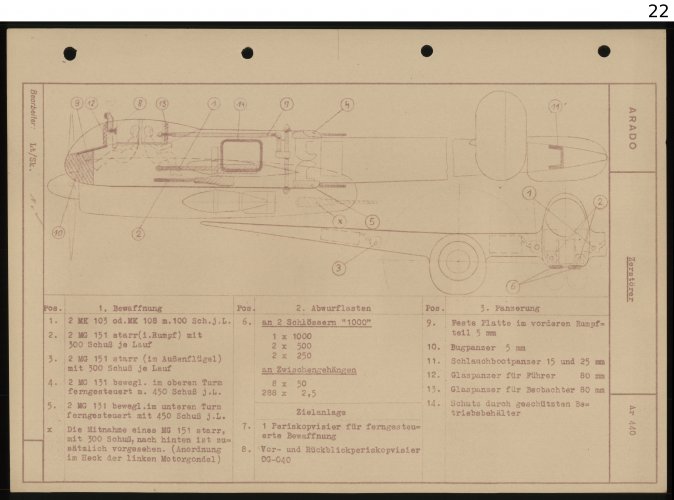
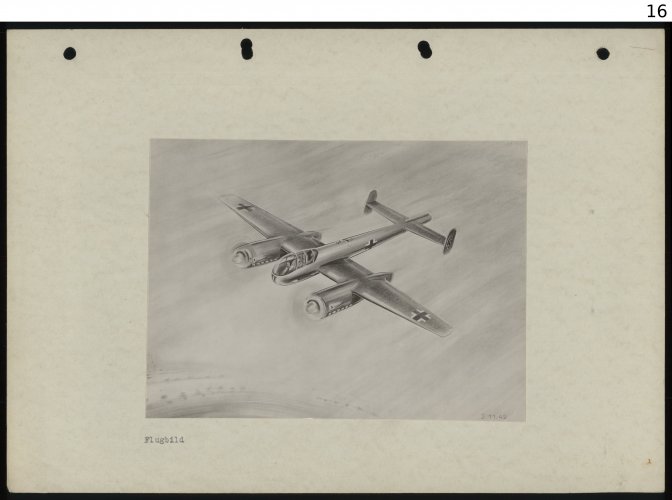
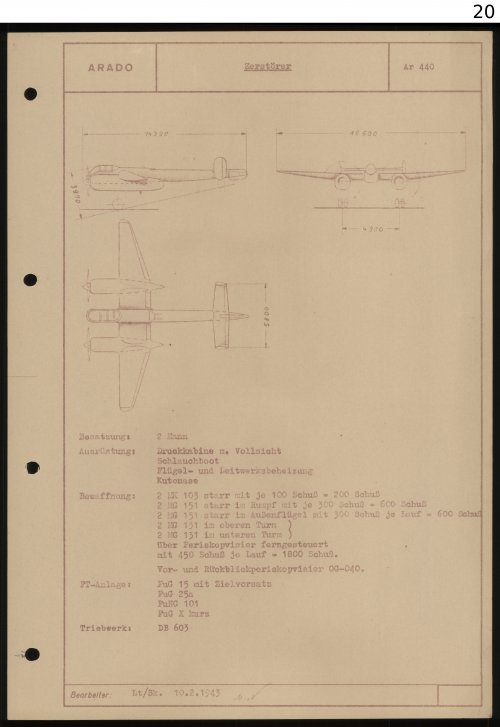
Arado Аr.440 - two-seat heavy fighter-bomber. The creation of the Ar 440 was considered a completely separate project, although modified units from the Ar 240 were used. The engines were DB 603G, which differed from the DB 603A with a faster supercharger and increased compression ratio, and gave up to 1900 hp on takeoff. with. Structurally, the Ar 440 differed from the Ar 240 by the addition of an additional section just behind the cockpit and a new aft fuselage. The center section was expanded so that the propulsion nacelles were further from the fuselage. The span of the consoles, the stabilizer was also increased, and the propulsion nacelles were lengthened. The engines were fitted with the GM1 system. It was assumed that the DB 627 engines would be installed in the series, which differed from the DB 603G in a two-speed supercharger and a subsequent cooler, developing power up to 2000 hp. on takeoff.

It was understood that the main task of the aircraft would be the role of a fighter-bomber. Armament Ar 440 consisted of two 30mm MK 108 cannons at the root of the wings, two 20mm MG 151 cannons at the nose of the fuselage. The defensive armament consisted of a pair of 13 mm MG 131 machine guns in the upper and lower remote-controlled mounts and one 20 mm MG 151 cannon mounted stationary back. The bomb load was 1000 kg.

The first prototype aircraft was designated Ar 440A-01. Flights began in the summer of 1942. Initial factory tests were encouraging - none of the defects still fought on the Ar 240 showed up on the Ar 440. Three more Ar 440A-0s joined the test program by the end of November, in December and January 1943. Ar 440A-04 was tested by one of the most famous "hunters" - Ober-Lieutenant Thirfelder, who was absolutely delighted with the new aircraft. Despite positive reports from Rechlin, where the new aircraft was being tested, the Technical Department refused to launch the Ar 440 into production. The possibility of releasing the aircraft was considered again 18 months later, after the start of the so-called "urgent fighter program", but by this time the Dornier -335, which promised great prospects, was already approaching, and the Arado fighter finally became history."
 

Attachments

  • ar240-2.jpg
    ar240-2.jpg
    540.7 KB · Views: 30
  • ar240A-02.jpg
    ar240A-02.jpg
    427.7 KB · Views: 25
  • v1.jpg
    v1.jpg
    71 KB · Views: 20
  • V3.jpg
    V3.jpg
    118.8 KB · Views: 15
  • UPPER TURRET.jpg
    UPPER TURRET.jpg
    146.5 KB · Views: 14
  • COCKPIT.jpg
    COCKPIT.jpg
    157.7 KB · Views: 16
  • DIVE BRAKE.jpg
    DIVE BRAKE.jpg
    35.6 KB · Views: 14
  • Ar240 flight.jpeg
    Ar240 flight.jpeg
    186.2 KB · Views: 10
  • arado-ar-240-recognition-poster_88121_pic1_size4.jpg
    arado-ar-240-recognition-poster_88121_pic1_size4.jpg
    228.9 KB · Views: 7
  • GL+QA.jpg
    GL+QA.jpg
    98.1 KB · Views: 4
  • GL+QA (2).jpg
    GL+QA (2).jpg
    126.4 KB · Views: 4
  • GL+QA (3).jpg
    GL+QA (3).jpg
    113.3 KB · Views: 4
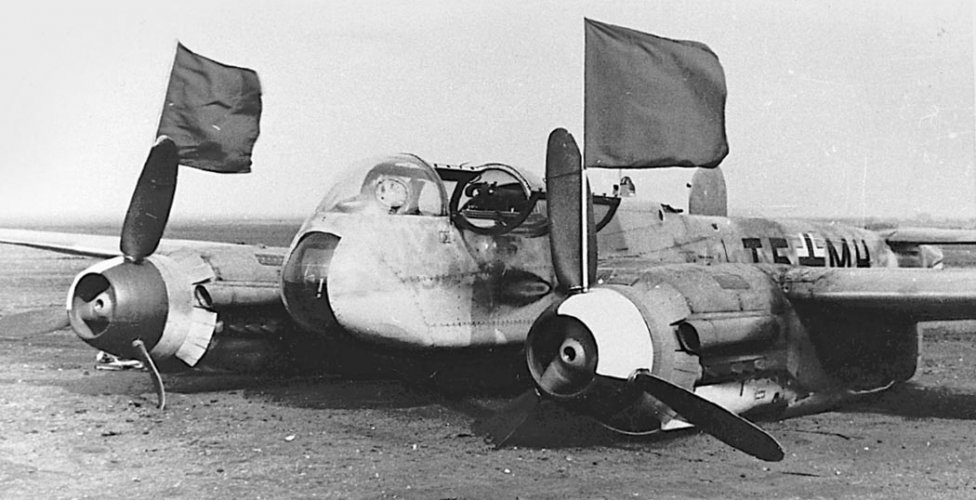
  • T5+MH.jpg
    T5+MH.jpg
    102.3 KB · Views: 4
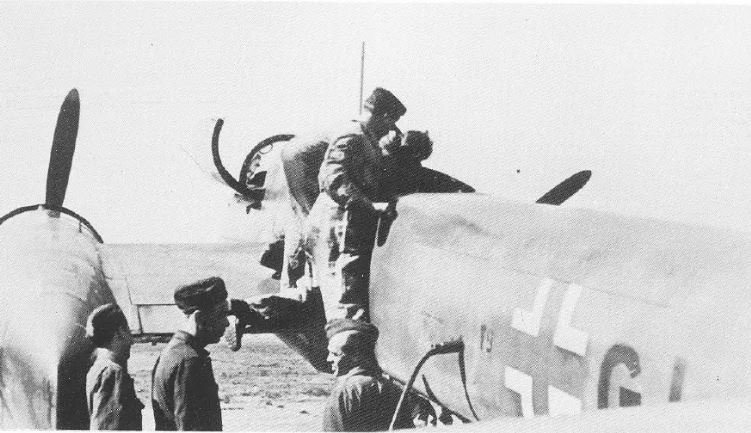
  • T9+GL.JPG
    T9+GL.JPG
    68.6 KB · Views: 4
  • T9+GL (2).jpg
    T9+GL (2).jpg
    62.2 KB · Views: 4
  • CB+UV.jpg
    CB+UV.jpg
    54.3 KB · Views: 5
  • LV+HF.jpg
    LV+HF.jpg
    156.4 KB · Views: 5
  • T5+YP.JPG
    T5+YP.JPG
    46.8 KB · Views: 5
  • GL+QB.jpg
    GL+QB.jpg
    188.1 KB · Views: 4
  • GL+QB (2).jpg
    GL+QB (2).jpg
    166.3 KB · Views: 7
  • 00097040.jpg
    00097040.jpg
    125.8 KB · Views: 6
  • 00097043.jpg
    00097043.jpg
    104.4 KB · Views: 9
Last edited:
Lastly to everyone - these grab bag Various topics are a terrible idea. You end up with lots of information on dozens of projects randomly distributed over multiple pages. Better to have one topic per project so all the information is adjacent and this reduces the chance of duplication.
 
Status
Not open for further replies.

Similar threads

Back
Top Bottom