carsinamerica
ACCESS: Confidential
- Joined
- 18 February 2010
- Messages
- 122
- Reaction score
- 87
From Internet.
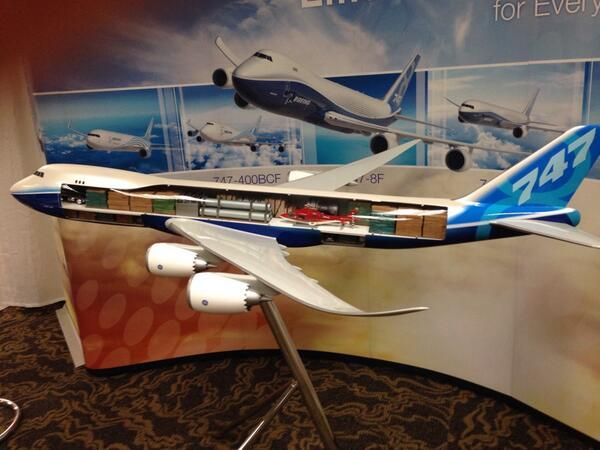
Interesting model, hesham. That one is an SP, which is an interesting platform choice.

From Internet.


From Internet.

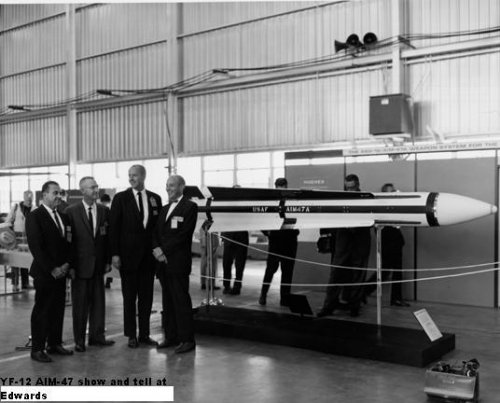
Sure looks like it. Or an extended booster version of Eagle, which amounts to almost the same thing.Was this missile some sort of extended range phoenix?
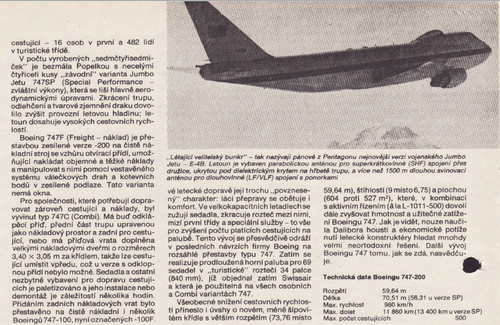
Any information on the 747 derivative depicted here? This image was recently sold on eBay without any identifying details.
 )
)It shows an aircraft based on a 747-100 or 200 with the following features:
- a rotodome that looks like it might be similar in size to that used on the E-3 but on taller struts
- a dorsal fairing behind the upper deck fairing, probably for a satellite antenna
- some sort of fairing on the aft end of the fuselage, perhaps with a dielectric tailcone
- something being streamed from a tube under the rear fuselage, perhaps a wire antenna
- a missile being launched from doors under the forward fuselage. The missile looks like a long range air-to-air type, perhaps a Phoenix or Eagle with a booster. It looks like there are a set of doors right and left of centerline under the forward and aft fuselage
) we discovered that there was a (now) blank panel on the flight engineers station that was labeled in the T.O. as "Missile System Control Panel" that lead to a wiring run that lead... Nowhere... It terminated dirctly below the cockpit in the forward lower lobe with a capped off run that went aft and branched off to the Engine Ferry hardpoint. (The E3 can attach an 'extra' engine to the right side of the aircraft to carry to a TDY destination, though it was clear it had other uses as it was plumbed for fuel/fluid and electrical connections but none of them went beyond the inner wall of the airframe) ) I'm pretty sure we could have handled a very long range heavy missile like the Phoenix. Especially if it had it's own terminal guidance system.- what could be optical sensors below the nosecone and above the tailcone
- a break for the nose cargo door
I have trouble imagining what sort of mission would require this set of features other than some sort of all-purpose AWACS/Command Post/Missileer battleplane.
 )
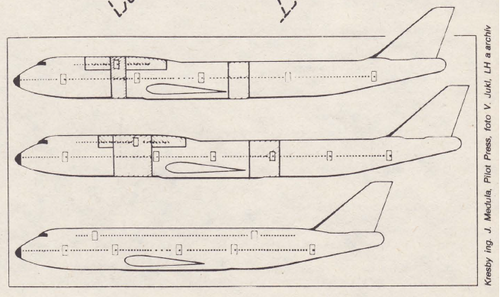
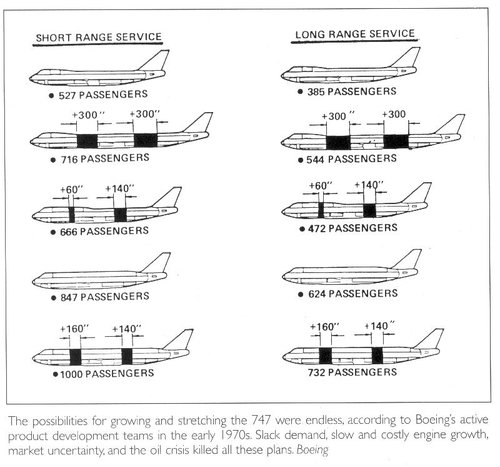
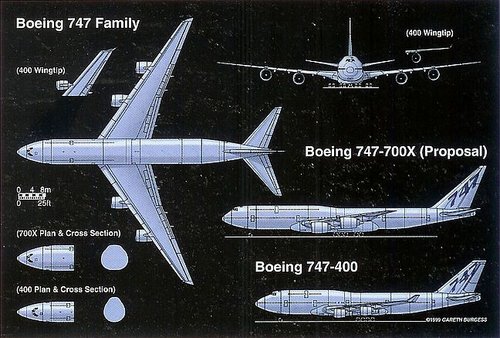
)The one 747 stretch proposal in the middle appears to be the same length as or perhaps slightly longer than the Boeing 747-600X later in 1996, which was around 279 feet in length.From L+K 14/1981.
The one 747 stretch proposal in the middle appears to be the same length as or perhaps slightly longer than the Boeing 747-600X later in 1996, which was around 279 feet in length.From L+K 14/1981.
Well that means I was pretty close. And on to those 747 stretch proposals you mentioned, these proposals are surely crazy huge. I estimate that the 50-70 foot 747 stretch from 1975 would have carried at least 510 passengers to as much as 730. And as for the 100 foot stretch from 1989, that plane would have carried at least 750 passengers, to as many as 1150. And I think you are right. It probably would be the largest jetliner of all time if it was built. Now if that particular plane also had a full length upper deck, it would probably have an exit limit of a whopping 1500+ passengers. Now wouldn't that be crazy or what?The one 747 stretch proposal in the middle appears to be the same length as or perhaps slightly longer than the Boeing 747-600X later in 1996, which was around 279 feet in length.From L+K 14/1981.
Close, but it's hard to pin down. When you count window frames and try to equi-space them, it looks like about 22 frames (the 747-600X was 27.5 frames). However, if you just compare base length, it comes out to about 277 feet. It's hard to say how precise this is. I've seen several proposals from 1979 centered around a 6-frame forward, 8-frame aft stretch, plus the SUD.
What's interesting, though, is that this is the only proposed 747 variant I've ever seen with 6 main-deck entry doors. Even the 747-600X didn't have that.
There were some earlier proposals (circulated in the 24 July 1975 issue of Flight International, that talked about a stretch of 50 to 70 feet to meet the anticipated needs of British Airways. I've never seen any sketchwork or schematics to accompany the latter proposal. That surely would have need six, and perhaps seven, main entry doors.
The most outlandish proposal I've ever hear was this gem, from Flight International on 24 June 1989: "Boeing is working on a 747-400 freighter, and a possible stretched or reconfigured development that could take up to 650 passengers. The 747-400F will probably be launched this summer, to be available in late 1992/early 1993. Further ahead is a 747-500, which would have either a fuselage stretch or a double deck running the aircraft's length. Sutter says that a stretched -400 is 'a natural.' Fuselage plugs fore and aft would add 50-100ft [emphasis added], and the aircraft would require a new 230-240ft-span wing." That would make the 747 more than 332 feet long plus however much extra length would be incurred by larger horizontal and vertical stabilizers. I think that would make it the largest jetliner ever seriously contemplated (possibly even slightly longer than MDD's HSCT, the other contender). I've never seen any illustrations of this, either.
Hesham: Do you have any text that went along with this image? It'd be helpful to see what they were saying.
I believe you have a point.You get to some practical limits in terms of terminal capability and capacity. A 300-footer would be a challenge to manage on the apron at a cramped place like JFK, for example. You'd also have a huge catering requirement. Getting several flights' worth of passengers through the same FIS at the same time is kind of a nightmare now, let alone a scenario of dumping 1500 people at once into customs and baggage processing.
There's also the economic issue of whether 1500 people want to go to the same place at the same time. The 747 was retired by several airlines in its early days because there were just too many seats to fill. I'm sure there are a handful of very high-capacity routes where a 1500-seat aircraft and carefully designed compatible infrastructure would work, but it's questionable whether there are enough to support a new aircraft development program.
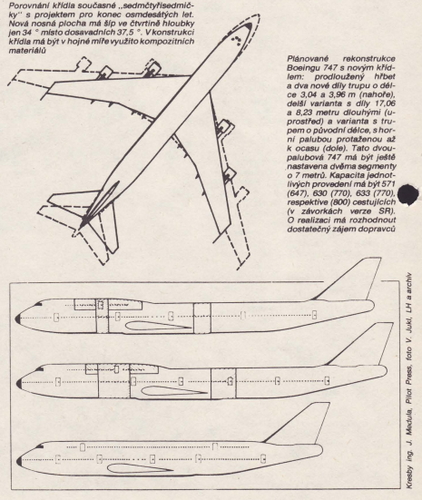
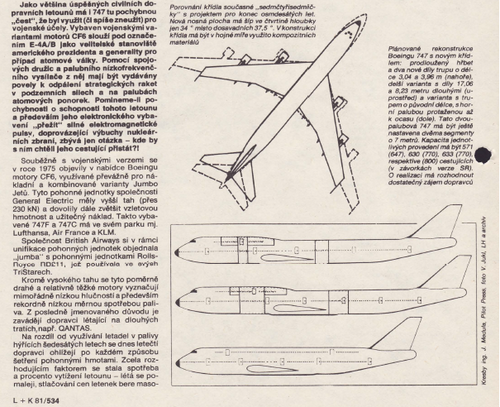
A comparison of the wing at the same time, seventy-seven, with a projection for the late 1980s. The new "bearing area has a sip in a quarter of depth" [wing angle at quarter-chord?] only 34 degrees instead of the current 37.5 degrees. Composite materials are widely used in wing construction.
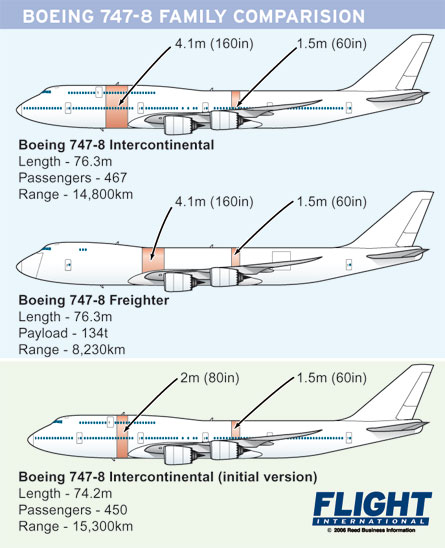
Planned reconstruction of the Boeing 747 with a new wing: extended spine [upper deck?] and two new fuselage sections of 3.04 [120 in] and 3.96 meters [155, perh. 160 in] (top) longer variant with 17.06 [670 in] and 8.23 meters [325 in] (middle) and a fuselage with original length, top flank cut to tail (down). This two-deck 747 m is still set up [stretched?] by two segments of 7 meters [~280 in]. The capacity of the individual versions should be 571 (647), 630 (770), 633 (770) and (800) passengers (in short-range versions). Sufficient interest of the carrier should decide on the implementation.



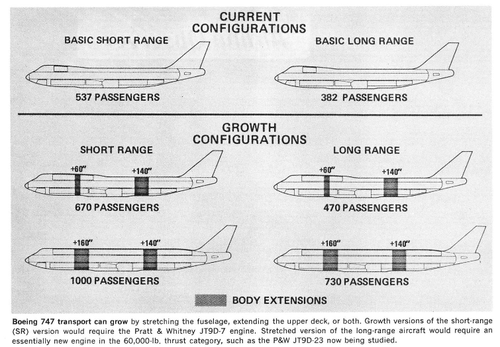
"Stretched versions of the long-range aircraft would require an essentially new engine in the 60,000-lb. thrust category, such as the P&W JT9D-23 now being studied."
https://archive.aviationweek.com/image/spread/19710712/15/2
That exact picture was from the Civil Jet Aircraft Design book back from 1999. All three of the designs had 3 class seating for 1,500 passengers, which could mean that the exit limit could have exceeded 2,000 passengers, compared to the A380, the largest passenger aircraft today which has an exit limit of only 860 passengers. The single fuselage design had 26 abreast seating, the twin fuselage had 21 abreast, and the triple fuselage had 16 abreast.Hi,
when I was searching in my old staff,I found this drawings to Boeing 747,with single,twin and triple fuselage,
and I don't remember from where file,may be NASA report.