RadicalDisconnect
Tony F.
- Joined
- 28 April 2014
- Messages
- 240
- Reaction score
- 202
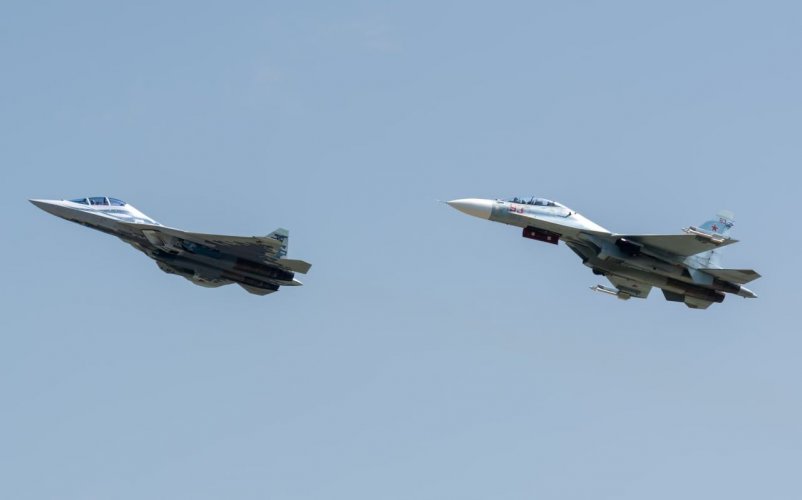
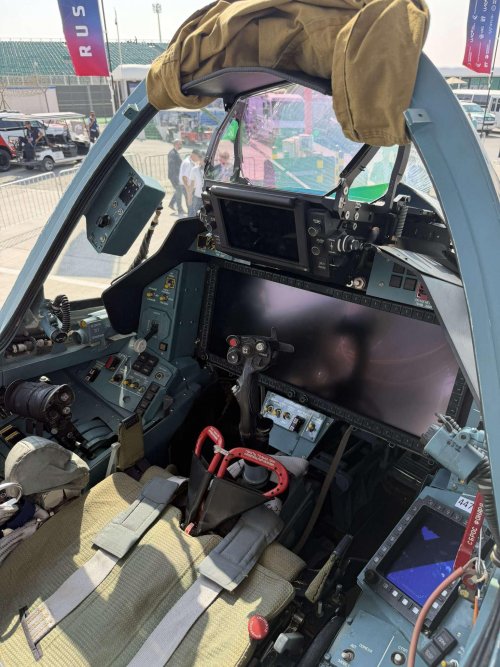
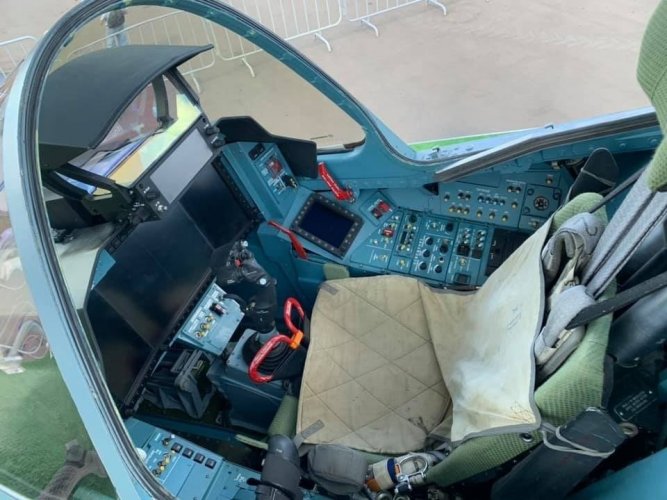
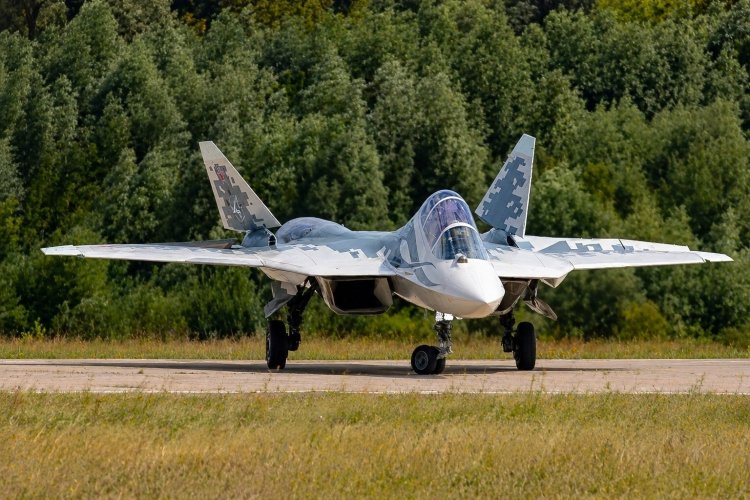
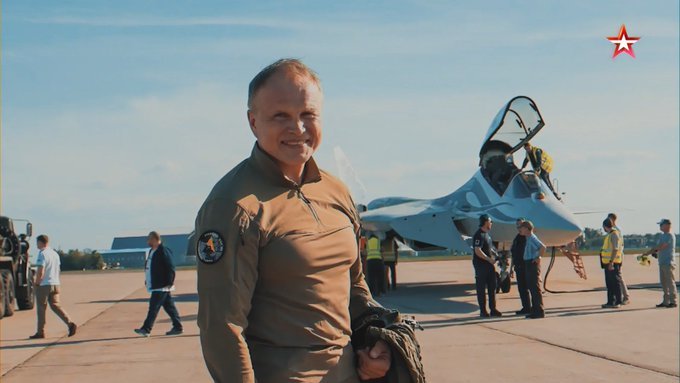
So is it T-50 prototype or serial Su-57? Official language of “combat trainer” which is vague.

So is it T-50 prototype or serial Su-57? Official language of “combat trainer” which is vague.


Source: my dreambecause the economy of scale will not exist.
The Su-57 won't replace the Su-34. UCAVs of various sizes, cost factors and capabilities will. The Su-57 will just operate in the same framework as these systems and provide guidance and control in some cases.For replacing Su34s I think I'd expect the two-seat Su57, with further upgraded stealth.

Moreover, they still have a long way to go before they even begin replacing the Su-34, as it has performed well in the war and they continue to procure it. Within the VKS, the Su-34 broadly fills the same role as the F-15E/EX, hauling outsized payloads. It will continue to perform that role well into the 2050s... I'd honestly even expect a life-extension program down the line, as I suspect such bomb trucks will remain highly valuable well into the 2070s...The Su-57 won't replace the Su-34. UCAVs of various sizes, cost factors and capabilities will. The Su-57 will just operate in the same framework as these systems and provide guidance and control in some cases.

I still think there will be a few Su-57s will be there to act as controllers. And it probably won't be a 1-for-1 replacement of Su34s.The Su-57 won't replace the Su-34. UCAVs of various sizes, cost factors and capabilities will. The Su-57 will just operate in the same framework as these systems and provide guidance and control in some cases.

So is it T-50 prototype or serial Su-57?

Didn’t they tell you that it was one of the prototypes?
Why MoD would care of prototype on the UAC balance sheets crash and make statements?
Sixth-generation aircraft technologies will be tested on the two-seat Su-57D
https://topwar.ru/288076-dvuhmestny...-tehnologij-samoleta-shestogo-pokolenija.html
That is a topic for discussion in other threads, but mentions of a Russian 6th-generation aircraft are becoming increasingly frequent—even from figures like Badekha or Strelets.6th gen? Maybe but let us remind what they achieved with the Su-57M prototype ( 511 blue, called "The President" ,first prototype of the OKR 'Megapolis'- project ) several years ago.As Sergey Bogdan told ,he flew in several test flights and as he mentioned, he did almost nothing at all during those test flights.So they achieved completely autonomous ''pilotless'' flights.
No and there won't be. Conceptually close doesn't mean joint development. It simply alludes to the notion that what Russia wants out of a notional next generation fighter is more in line with what China prioritized, rather than what the US prioritized in the NGAD program.Interesting. Is there any rumor of a joint Sino-Russian 6th Gen program?
PAK DP will remain an active program unless another solution to replace the MiG-31 has been found (and no, as has been established at length, neither Su-35 nor Su-57 are sufficient in that role). As for next generation developments, talks first emerged basically as T-50 first took flight, or shortly afterwards. However something that also goes just as far back is military and industrial figures emphasizing that before any serious work could take place, the necessary technologies would have to be brought to maturity first. You'd imagine that over 10 years later a great deal of resources and money would have been spend to mature several of these major technologies. So the discussion is now becoming more seriously as to how to go about that new development, getting government funding, subcontractors on board, the facilities set up.It remains an open question whether the PAK DP program is even still active, but all indications suggest that the new generation will be conceptually closer to the J-36 than to NGAD. However, the full picture likely won't emerge until the coming decade.

Interesting. Is there any rumor of a joint Sino-Russian 6th Gen program?

Source (Russian):In this episode of Military Acceptance, viewers will see trials of next‑generation fighters at test ranges, demonstration flights at major international airshows, and the program’s exclusive feature — a conversation with Hero of Russia Sergei Bogdan.
Silly question: could an avionics change make the Su57 sufficient?PAK DP will remain an active program unless another solution to replace the MiG-31 has been found (and no, as has been established at length, neither Su-35 nor Su-57 are sufficient in that role).
Avionics are a major difference between the two types, but also one that's constantly changing. Both aircraft have received several avionics upgrades over their service life. Especially the MiG-31 had made leaps from it's initial avionics suite to what you find today in the newly modernized airframes.Silly question: could an avionics change make the Su57 sufficient?
New radars etc?
Okay, thank you!But generally speaking a clean sheet design is necessary to deliver an aircraft that can function as a genuine successor for the MiG-31 and not just as a substitute.
Mind you, that's simply down to the perceived need of having an aircraft in that specific role. Other countries simply use their air superiority fighters in that role or don't fill that role at all. So it's valid asking why the Su-57 doesn't replace the aging MiG-31 despite comparable performance metrics in some areas and newer avionics. But the Russian case is, as it is often, a very unique one and the Russian military views an aircraft in that role as a necessity. Thus something like PAK DP is required, and from what we know, still being pursued.Okay, thank you!
A responsibly written post.Mind you, that's simply down to the perceived need of having an aircraft in that specific role. Other countries simply use their air superiority fighters in that role or don't fill that role at all. So it's valid asking why the Su-57 doesn't replace the aging MiG-31 despite comparable performance metrics in some areas and newer avionics. But the Russian case is, as it is often, a very unique one and the Russian military views an aircraft in that role as a necessity. Thus something like PAK DP is required, and from what we know, still being pursued.
If anything, a potential Su-57 successor, in the manner we have talked about in recent replies here, may be able to finally reconcile both roles. Perhaps just differing from it's multirole version just by the systems it's deployed with (more heavily integrated into the medium and long range IADS, dedicated high speed, high end sensor suite equipped drones).
But it's beyond early to make even uneducated guesses on that front. The Russian next generation effort is currently about to enter the preliminary conceptual phase if people familiar with the matter are to be believed. After a rigorous campaign to push domestic subsystem development, manufacturing and material science to the point it becomes mature enough to get seriously to work and inform potential proposals with what's actually available or soon available.
Consequently the Su-57 is continuously upgraded to deliver some of the desired capabilities with regards to networking, unmanned teaming and sensor suite performance and coverage in the meantime. It's continuously being iterated upon, to squeeze more and more performance out of the entire system.
No. Higher and faster, yes, though value of that is rather limited in this day and age.The genuine hardware is the hurdle the Su-57 can't overcome, as of now. The MiG-31 flies higher, faster, longer. It's a persistent long range interceptor.
Thing is that Su-57s main advantage aside from avionics is stealth over other aircraft in Russia. Drop tanks and aerial refueling negate that benefit, MiG-31 never relied on it. While the AL-41s are definitely more efficient and the MiG-31s airframe is optimized for high speed and high altitude operations, at subsonic cruise it has more staying power than most give it credit for. However part of why I put the future AL-51 into the foreground a bit in my previous post is that this engine will be significantly more efficient than either AL-41 or D-30, which should give the Su-57 better fuel economy throughout all flight regimes. But as I also said, that's just one aspect of the whole picture.No. Higher and faster, yes, though value of that is rather limited in this day and age.
Mig-31 is not a persistent(loitering) interceptor (though obviously an improvement over mig-25), rather it's an alert one.
Su-57 endurance is higher, substantially so.
Mig-31 listed ferry range is given with drop tanks. I.e. it's relatively mediocre as for heavy 4th generation jets, with and without them.While the AL-41s are definitely more efficient and the MiG-31s airframe is optimized for high speed and high altitude operations, at subsonic cruise it has more staying power than most give it credit for.
Lots of fuel, but it's a heavy steel brick, optimized for mach 3.I thought the MiG-31 had a lot of internal fuel? What is its cruise range and flight profiles? Does it have more reach because it can fly higher than most fighters? It can punch from longer distances to no? It must have some performance advantages that merit a replacement. I imagine the MiG flight profile is climb to the most efficient cruise altitude and if needed accelerate to launch its weapons. This flight profile could be higher than regular fighters and faster.