TSARb
ACCESS: Confidential
- Joined
- 8 March 2011
- Messages
- 122
- Reaction score
- 325
Let’s try to model the interception scenario.
The MiG-31’s flight profile consists of a supersonic dash over a distance of 720 km, followed by an attack on the target with missiles having a range of 180 km (different sources give figures from 160 to 200 km, so let’s get the average). This gives us an interception range of 900 km = 720 + 180. We can estimate the time required to intercept a target at 20.25 minutes: 17.34 minutes for the carrier aircraft’s flight plus 2.91 minutes for the missile’s flight at an average speed of Mach 3.5.
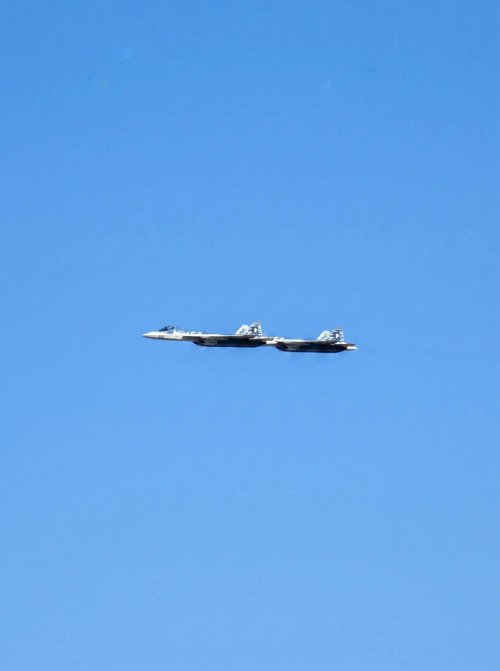
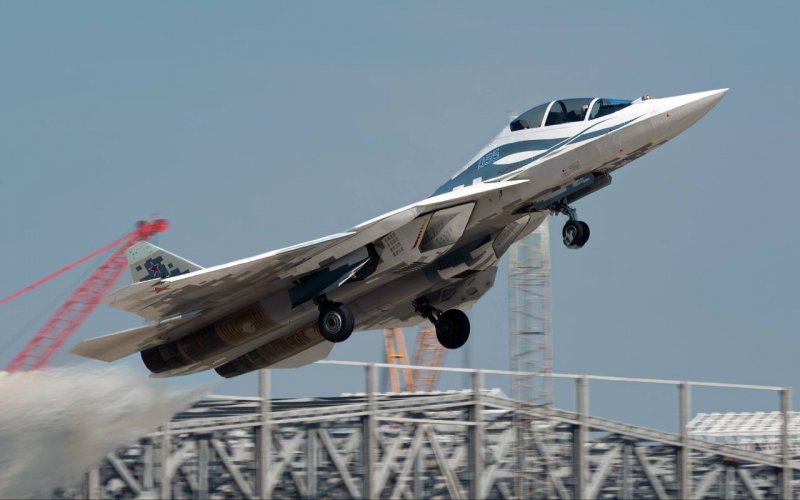
Now let’s check the Su-57. Let’s assume a hypothetical air-breathing missile with an average speed of Mach 4.5 and a range of 400 km (this is a conservative estimate based on Waverider data). The missile would cover 400 km in 5.03 minutes = 400 / (4.5 × 1060/60). The Su-57 is capable of a long flight at Mach 2.0, but let’s limit its speed to Mach 1.8 plus a 5 minute dash at Mach 2.35. Since the missile takes 5.03 minutes and the total time limit is 20.25 minutes, the jet has 15.22 minutes remaining. This allows it to cover 532.6 km = 325 km + 207.6 km. Here, 325 km is the distance covered at Mach 1.8 over 10.22 minutes, and 207.6 km is the distance covered at Mach 2.35 over 5 minutes.
The resulting profile is as follows: ~10 minutes of flight at Mach 1.8, a 5 minute dash at Mach 2.35, and then another 5 minutes of missile flight at Mach 4.5. This would make it possible to engage a target 932.6 km away = 532.6 + 400.
So, being limited to 20 minutes, the MiG‑31 could reach a target at 900 km, while the Su‑57 with a new missile could reach one at ~930 km
Does the Russian Ministry of Defense have an air-to-air missile with these characteristics? Certainly not.
Which would be easier to develop: a replacement for the MiG-31, or a new missile with these characteristics? The answer is obvious.
P.S. I fully understand simplifications are very significant — but that allowed me to keep the post somewhat compact.
The MiG-31’s flight profile consists of a supersonic dash over a distance of 720 km, followed by an attack on the target with missiles having a range of 180 km (different sources give figures from 160 to 200 km, so let’s get the average). This gives us an interception range of 900 km = 720 + 180. We can estimate the time required to intercept a target at 20.25 minutes: 17.34 minutes for the carrier aircraft’s flight plus 2.91 minutes for the missile’s flight at an average speed of Mach 3.5.
Now let’s check the Su-57. Let’s assume a hypothetical air-breathing missile with an average speed of Mach 4.5 and a range of 400 km (this is a conservative estimate based on Waverider data). The missile would cover 400 km in 5.03 minutes = 400 / (4.5 × 1060/60). The Su-57 is capable of a long flight at Mach 2.0, but let’s limit its speed to Mach 1.8 plus a 5 minute dash at Mach 2.35. Since the missile takes 5.03 minutes and the total time limit is 20.25 minutes, the jet has 15.22 minutes remaining. This allows it to cover 532.6 km = 325 km + 207.6 km. Here, 325 km is the distance covered at Mach 1.8 over 10.22 minutes, and 207.6 km is the distance covered at Mach 2.35 over 5 minutes.
The resulting profile is as follows: ~10 minutes of flight at Mach 1.8, a 5 minute dash at Mach 2.35, and then another 5 minutes of missile flight at Mach 4.5. This would make it possible to engage a target 932.6 km away = 532.6 + 400.
So, being limited to 20 minutes, the MiG‑31 could reach a target at 900 km, while the Su‑57 with a new missile could reach one at ~930 km
Does the Russian Ministry of Defense have an air-to-air missile with these characteristics? Certainly not.
Which would be easier to develop: a replacement for the MiG-31, or a new missile with these characteristics? The answer is obvious.
P.S. I fully understand simplifications are very significant — but that allowed me to keep the post somewhat compact.
Last edited: