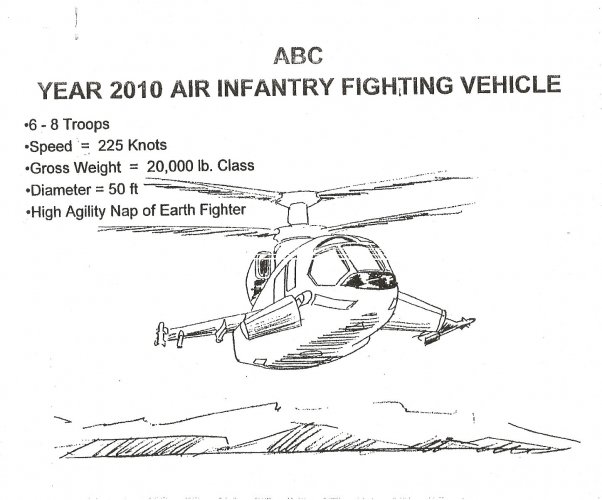
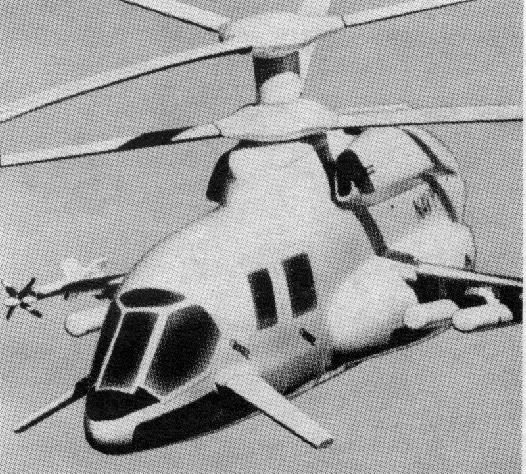
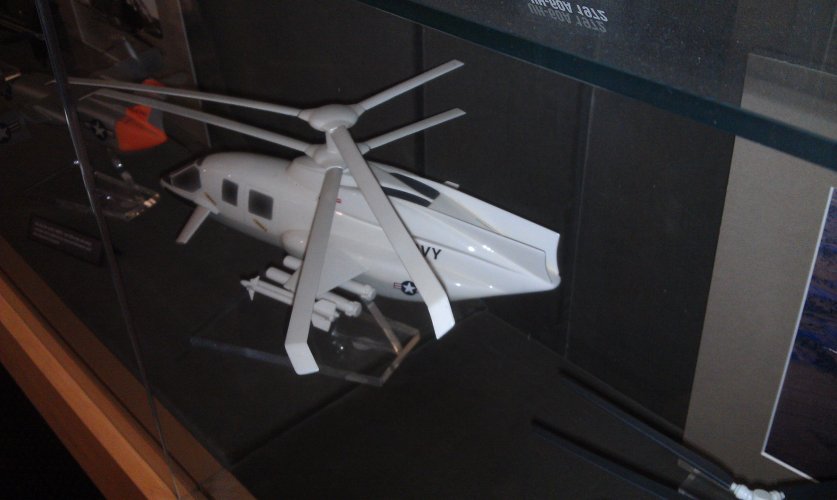
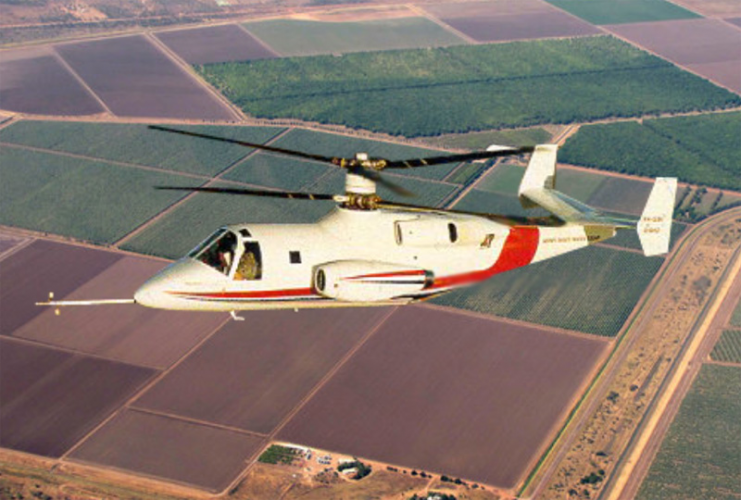
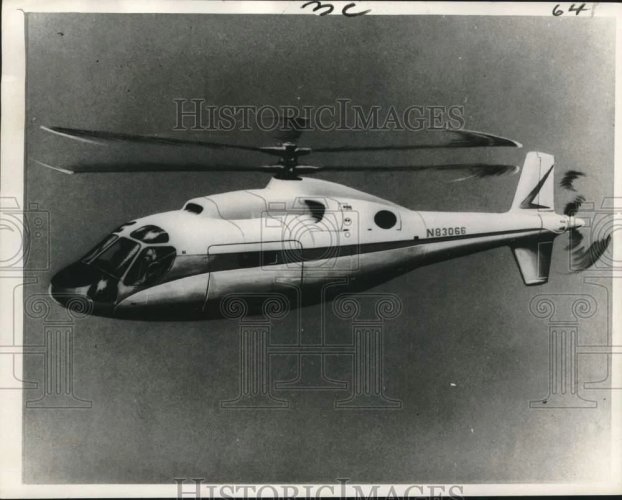
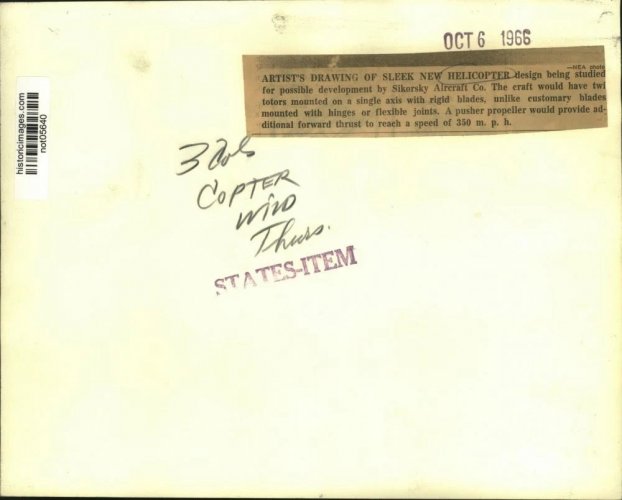
Originally offered as a high speed ASW platform, I think. Somewhere in our Indiana Jones Warehouse of aviation information I posted pictures of the model that resides at the Sikorsky HQ. The picture posted by @Grey Havoc is from a U.S. Army briefing during the early days of the Army After Next effort. It was one of several concepts Sikorsky provided toward the idea of a larger vertical maneuver force.
Found them!
A little history: there were two S-69 XH-59A ABCs built. First flight occurred in June, 1973. One month later the first XH-59A aircraft experienced a low speed accident on the Sikorsky helipad. The design team had never dealt with a rotor system as stiff as this before. There was much concern about the extremely high control power that the rotor could develop. As a result, the control system gain was limited to prevent the controls from being too sensitive. This seemed to work out fine in the initial hover tests. However, when the pilots moved out of hover to transition to forward flight, the aircraft started to nose up. The pilot input more and more forward cyclic to counter this, until the stick was on the forward stop and the aircraft was still nosing up. The pilot reduced the collective to get it back on the ground. The tail contacted the ground first, a gear leg collapsed and the aircraft rolled over until the blades struck the ground. The rotor system was destroyed. Two pilots, Byron Graham and Lou Bajorenus were uninjured. Legend has it that Byron Graham climbed out and started walking slowly away, through the spilt fuel. Half way to safety, he turned around and went back and kicked the aircraft.
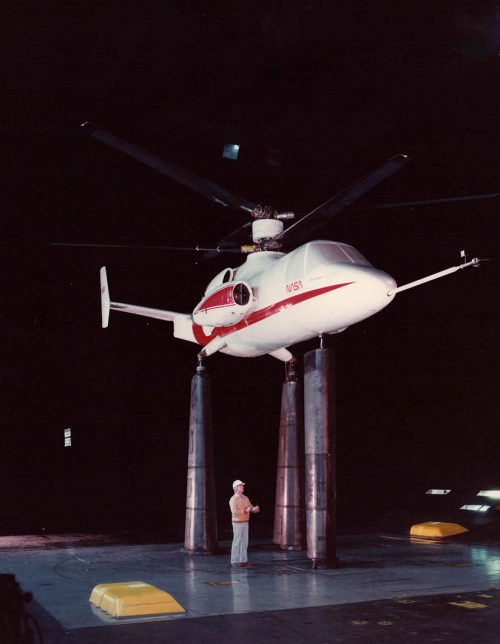
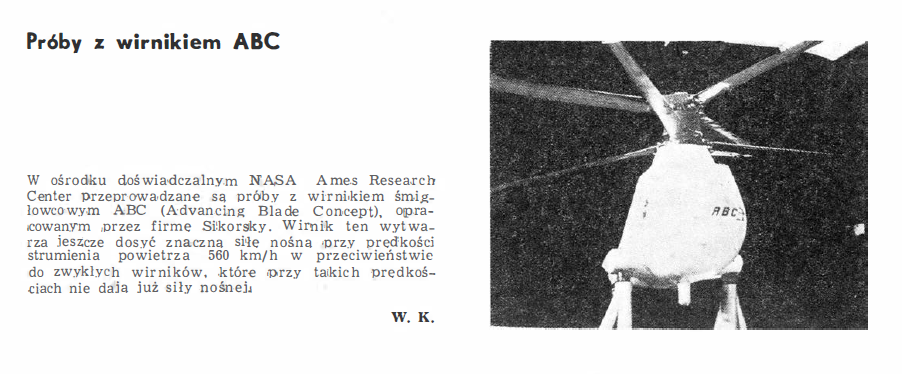
The first airframe was converted to a wind tunnel test airframe that was tested in the NASA Ames 40X80 wind tunnel.
Flight testing with the second aircraft resumed in November, 1974. An extensive flight test program of about 170 flight hours was accomplished through 1981. From July 1975 to March 1977 the helicopter configuration was tested. The test envelope was expanded to level flight at 156 knots, dive speeds to 186 knots, and altitudes to 14,000 feet. Auxiliary propulsion flights were conducted from April 1978 to January 1981. The aircraft accomplished virtually all of its technical objectives. A maximum level flight speed of 240 knots was achieved, making this the first rotary wing aircraft to achieve this speed without the use of an auxiliary wing, thus proving the basic advancing blade concept. Stability and control proved to be excellent. The entire flight envelope was flown without any artificial stabilization equipment.
Ironic though that history repeats itself with ABC in that the first S-97 also had control law issues and ended up also unflyable. I don't think Bill Fell kicked the aircraft though.
Ironic though that history repeats itself with ABC in that the first S-97 also had control law issues and ended up also unflyable. I don't think Bill Fell kicked the aircraft though.
My theory? What happens in many a corporate environment happened here: new people either don't know or don't take into account, even discard, what was done before them. "If you do not learn from history, you're condemned to repeat it," as a wise man once said. If only all the knowledge from past programs could be built upon each time a new program comes in, I'm sure costs and durations would be considerably reduced. A case in point is the Moon thing: the original teams managed to send people 380,000 kms away and get them back with very basic (to our modern standards) technology and costs that were but a fraction of what just R&D would cost now... If all that knowledge had been duly processed and integrated, it wouldn't take two decades to (maybe) do what others achieved in just one.
This site uses cookies to help personalise content, tailor your experience and to keep you logged in if you register.
By continuing to use this site, you are consenting to our use of cookies.