In light of recent world events, it'll be interesting to see whether China chooses to flex its manufacturing might in the coming years.

I believe they've been somewhat modest with regards to current production rates.
Chengdu is said to be mostly maxed out with J-20s at ~120 aircraft per year, Shenyang's new facility is apparently similar in size to LM's Fort Worth plant and should theoretically have the max output given similar floor area, but they'll likely be dedicating part of that capacity to J-15s, J-XDS, J-16s and J-35AEs same with Chengdu with J-36 LRIP and prototyping.

I would expect ~800-900 J-20s of all type at the end of this 5YP (2030) with ~400 J-20s and 400-500 J-20As to be produced in the next 5 years which is reasonably likely given previous production rate while Shenyang might be pushing out J-35s at ~100 aircraft per year once production line is fully matured for maybe ~300-400 J-35/35A for the PLA and a few dozen of J-35AE by 2030. I estimate a total of 1100-1300 5th generation aircraft total by 2030 which should be roughly at parity with the US.

J-35As would probably replace all of J-10A/Bs and J-20As replace the remaining heavy 4th generation air superiority fleet which consists of J-11s/Su-27s/Su-35s while J-16 replace all the Su-30MKK/MK2 and JH-7As by 2030. So roughly the 2030 combat fleet would consist of ~200 J-10Cs in second line duty with a frontline fleet of mostly J-20s for air superiority and J-35As, J-16s for multirole and strike. 5th generation production would likely start winding down post 2030 when J-36 and J-XDS starts coming online.
 
Chengdu is said to be mostly maxed out with J-20s at ~120 aircraft per year, Shenyang's new facility is apparently similar in size to LM's Fort Worth plant and should theoretically have the max output given similar floor area, but they'll likely be dedicating part of that capacity to J-15s, J-XDS, J-16s and J-35AEs same with Chengdu with J-36 LRIP and prototyping.

I would expect ~800-900 J-20s of all type at the end of this 5YP (2030) with ~400 J-20s and 400-500 J-20As to be produced in the next 5 years which is reasonably likely given previous production rate while Shenyang might be pushing out J-35s at ~100 aircraft per year once production line is fully matured for maybe ~300-400 J-35/35A for the PLA and a few dozen of J-35AE by 2030. I estimate a total of 1100-1300 5th generation aircraft total by 2030 which should be roughly at parity with the US.

J-35As would probably replace all of J-10A/Bs and J-20As replace the remaining heavy 4th generation air superiority fleet which consists of J-11s/Su-27s/Su-35s while J-16 replace all the Su-30MKK/MK2 and JH-7As by 2030. So roughly the 2030 combat fleet would consist of ~200 J-10Cs in second line duty with a frontline fleet of mostly J-20s for air superiority and J-35As, J-16s for multirole and strike. 5th generation production would likely start winding down post 2030 when J-36 and J-XDS starts coming online.
How big is Chengdu's facility, is it smaller or bigger than Forth Worth? And what would be a rough yearly production number for SAC's new facility that is equal to FW floor wise, would it be something like 150 a year or closer to 200?
 
How big is Chengdu's facility, is itsmaller than Forth Worth? And what would be a rough yearly production number for SAC's new facility that is equal to FW floor wise, would it be something like 150 a year or closer to 200?
It's hard to tell, Chengdu's facility is older and unlike the new Shenyang and Fort Worth facilities, are not a single large building but instead has many smaller buildings around the airport. IIRC it should be smaller in terms of total floor area compared to Fort Worth.
 
How big is Chengdu's facility, is it smaller or bigger than Forth Worth? And what would be a rough yearly production number for SAC's new facility that is equal to FW floor wise, would it be something like 150 a year or closer to 200?
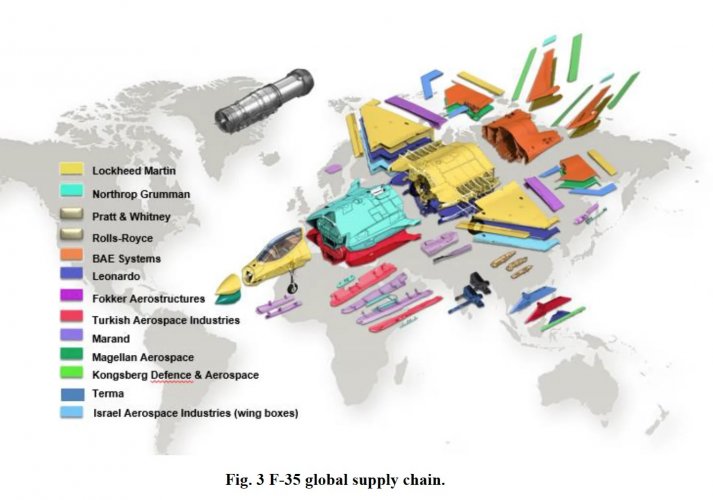
Keep in mind, Ft Worth is just where final assembly occurs. A lot of sub-assembly / part work occurs in other locations. Even a lot of the parts that go into sub-assemblies built by "Lockheed" (and others) might be built at still other companies.

Screen-Shot-2018-11-19-at-7.54.27-AM.jpg
 
I think as long as we have almost no useful data, all we can do is to speculate and if this is useful, is another question ... otherwise I nowadays often remember Bill Sweetman's "perfect" conclusion in one of his early analysis: "The J-35 is almost everything the F-35 could have been ..." (or similar)!
Cool....so is J-35 capable to super cruise and is Mach 2+ mover ?
 
I'm pretty J-35 is atleast still able to supercruise with WS-19, it's still a more air superiority centric aircraft than F-35.
Is the WS-19 designed for it? Supercruising at Mach 1.1 clean isn't much more than a bullet point on the marketing sheet, with an asterisk at the bottom, for example. Are we talking something useful, like the F-22, or even Eurofighter, or something more like a YF-17?
 
Is the WS-19 designed for it? Supercruising at Mach 1.1 clean isn't much more than a bullet point on the marketing sheet, with an asterisk at the bottom, for example. Are we talking something useful, like the F-22, or even Eurofighter, or something more like a YF-17?
It's a brand-new engine for a 5th gen fighter, the original specs have it designed to have a similar specific thrust as the F-119. Aerodynamics of supercruise hasn't been a challenge for a while, it's just the engine. We'll probably find out more in a few months as they'll likely put up more info about it in the upcoming airshow.
 
Pardon, aren‘t you confusing the WS-15 with the WS-19? I never heard that the WS-19‘s „original specs have it designed to have a similar specific thrust as the F-119“; that was always the WS-15.
 
Is the WS-19 designed for it? Supercruising at Mach 1.1 clean isn't much more than a bullet point on the marketing sheet, with an asterisk at the bottom, for example. Are we talking something useful, like the F-22, or even Eurofighter, or something more like a YF-17?
Usually by supercruise we understand tactically significant supercruise. "we can just about maintain M=1.01" fever is long gone.
We have papers on j-35 being specifically optimized for supersonic drag. I.e. unless they failed in their intent, it isn't an asterisk - it's a design goal.
I wouldn't expect much over M1.8, to be honest. Maybe the Chinese will surprise me and it'll reach M2, but I doubt it.
Maybe yes, maybe no, but tbh this is so inconsequential i franky doubt why it's even raised. We aren't in mid-1950s.
 
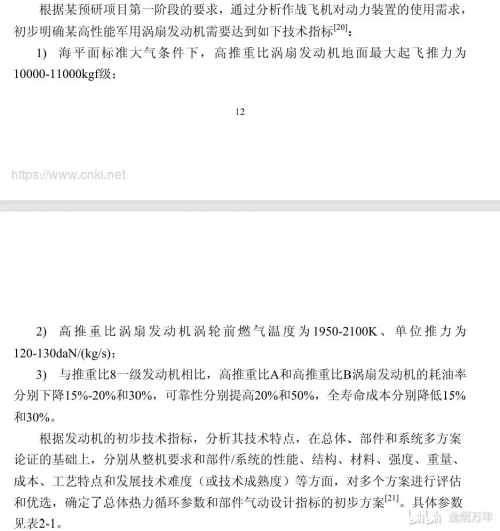
Translation:

"According to the requirements of Phase I of a certain pre-research project, by analyzing the operational demands of a combat aircraft on its propulsion system, the required technical performance targets for a high-performance military turbofan engine are preliminarily defined as follows [20]:
Under sea-level standard atmospheric conditions, the maximum takeoff thrust on the ground of the high thrust-to-weight ratio turbofan engine shall be in the range of 10,000–11,000 kgf.
The turbine inlet gas temperature of the high thrust-to-weight ratio turbofan engine shall be 1950–2100 K, and the specific thrust shall be 120–130 daN/(kg/s).
Compared with a thrust-to-weight ratio level-8 engine, the specific fuel consumption of high thrust-to-weight ratio turbofan engines A and B shall be reduced by 15%–20% and 30%, respectively; their reliability shall be improved by 20% and 50%, respectively; and their life-cycle cost shall be reduced by 15% and 30%, respectively.
Based on the preliminary technical indicators of the engine, its technical characteristics are analyzed. On the basis of multi-scheme demonstrations at the overall, component, and system levels, multiple design options are evaluated and optimized from the perspectives of overall engine requirements and component/system performance, structure, materials, strength, weight, cost, manufacturing characteristics, and development difficulty (or technology maturity). This process determines a preliminary scheme for the overall thermodynamic cycle parameters and component aerodynamic design targets [21]. The specific parameters are shown in Table 2-1."
 
Don’t confuse specific weight (thrust / weight I.e. thrust to weight ratio) with specific thrust (thrust / airflow).

High specific thrust means high exhaust velocity, which is necessary for supercruise but not good for specific fuel consumption. High specific thrust by itself may be sufficient for low supercruise in the M1.2-1.4 range, but rotor speed and turbine temperature have to continue to increase to maintain those thrust levels at M1.5+ conditions as the inlet temperatures increase above the standard day 15C. Rotor speed and temperature capability at hot inlet conditions is the secret sauce for supercruise, and one of the hardest things to achieve.
 
The turbine inlet gas temperature of the high thrust-to-weight ratio turbofan engine shall be 1950–2100 K, and the specific thrust shall be 120–130 daN/(kg/s).
I know it says sea level thrust shall be in the range of 10,000-11,000kgf. But if I'm reading this right, is this the reason why some Chinese sources were saying the WS-19 thrust could be possibly up to 127kN? As a 1200-1300N/(kg/s) specific thrust with a max airflow of 100kg/s airflow could indicate 120-130kN wet thrust.
 
Aside from not much need for it?
Why is speed not needed?

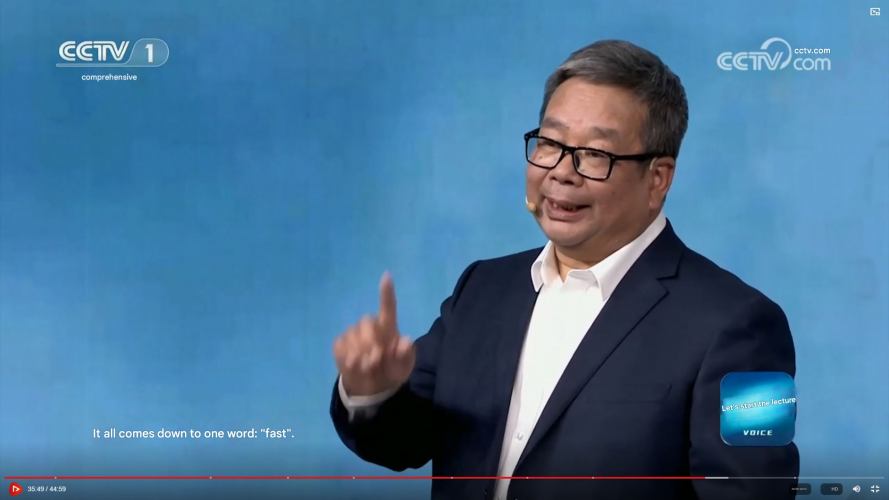
From the horses mouth, in a CCTV1 interview with the SAC's Chief Designer Wang Yongqing, he effectively described 'speed' to be the most important requirement, with stealth being the standard for all fighters moving forward. It'd be quite strange if the J-35's designer emphasized speed as such an important requirement, while making the J-35 unable to super cruise, and being noticeably slower than the J-20.
https://tv.cctv.com/2025/02/22/VIDE...50222.shtml?spm=C52056131267.PosekSpq74e8.0.0
 

Attachments

  • translated_image_en.png
    translated_image_en.png
    914.8 KB · Views: 34
Why is speed not needed?

From the horses mouth, in a CCTV1 interview with the SAC's Chief Designer Wang Yongqing, he effectively described 'speed' to be the most important requirement, with stealth being the standard for all fighters moving forward. It'd be quite strange if the J-35's designer emphasized speed as such an important requirement, while making the J-35 unable to super cruise, and being noticeably slower than the J-20.
https://tv.cctv.com/2025/02/22/VIDE...50222.shtml?spm=C52056131267.PosekSpq74e8.0.0
Again, I'm saying M1.8ish top end. Like F-16, F-18, and F-35. Because there's little reason to have the faster speeds when it's been shown to not be needed in combat, or means you need adjustable inlets (heavy, complicated, and not stealthy).

Still able to supercruise at M1.4ish (guessing), comparable to/same as the F-35.
 
Again, I'm saying M1.8ish top end. Like F-16, F-18, and F-35. Because there's little reason to have the faster speeds when it's been shown to not be needed in combat, or means you need adjustable inlets (heavy, complicated, and not stealthy).

Still able to supercruise at M1.4ish (guessing), comparable to/same as the F-35.
When has it been shown to be not needed in combat? Just because America and the west doesn't see any use for speed, doesn't exactly indicate the same train of thought for the Chinese, again the J-35 Chief designer explicitly stated that speed is important. So why wouldn't what he believes in, translate to the J-35?

I know it isn't dynamic thrust at altitude.. But using the 70kN dry thrust figure of the "nerfed" WS-19 and some relatively conservative calculations for the gross weight based on the stated MTOW of 29,000kg. The T/W at standard is similar to that of the Su-57 Stage II equipped with AL-51.

If limited super cruise was the goal why the insane excess thrust? The J-35A is a multirole fighter, with a primary lean towards air superiority, it's design goals are far apart from the F-35.
 
So the J-35, with this new unveilling, is now a Kaan instead of a KF-21. Interesting that they would field two classes of plane with not too much discrepancies between their performance (2x F119 and 2x F135) with a presumably VCE down the pipeline and the old daddy WS-10.
 
When has it been shown to be not needed in combat? Just because America and the west doesn't see any use for speed, doesn't exactly indicate the same train of thought for the Chinese, again the J-35 Chief designer explicitly stated that speed is important. So why wouldn't what he believes in, translate to the J-35?

I know it isn't dynamic thrust at altitude.. But using the 70kN dry thrust figure of the "nerfed" WS-19 and some relatively conservative calculations for the gross weight based on the stated MTOW of 29,000kg. The T/W at standard is similar to that of the Su-57 Stage II equipped with AL-51.

If limited super cruise was the goal why the insane excess thrust? The J-35A is a multirole fighter, with a primary lean towards air superiority, it's design goals are far apart from the F-35.
We don’t know what the performance of the Su-57 is with the AL-51, or whether it has the supercruise performance claimed by Russia. Overall thrust to weight is not the determining factor for supercruise performance.
 
So the J-35, with this new unveilling, is now a Kaan instead of a KF-21. Interesting that they would field two classes of plane with not too much discrepancies between their performance (2x F119 and 2x F135) with a presumably VCE down the pipeline and the old daddy WS-10.
What? No. It's still a mid-sized fighter like the F-18E/35/KF-21. The WS-19 is still a EJ200/RD-33-sized thing.

We don’t know what the performance of the Su-57 is with the AL-51, or whether it has the supercruise performance claimed by Russia. Overall thrust to weight is not the determining factor for supercruise performance.
Afaik the AL-51F went the F135 route, that is raising the BPR and running a lower theta-break for left hand side thrust curves?
 
Last edited:
Overall thrust to weight is not the determining factor for supercruise performance.
I know. It's a demonstration of the differing requirements between the J-35 and the F-35. The J-35's role has more in common with the Su-57 than the F-35. Comparisons with the F-35 are superficial through namesake.

The criteria for supercruise is like you said, high specific thrust and low wave drag. Firstly the J-35 is visibly a very slender aircraft, this is important as that would minimize the wave drag during the transonic transition. It's engines, as discussed above have been reportedly designed for a high specific thrust requirement. Lastly, the J-35 designer himself spoke of the importance of speed, whether or not you guys think it's an important requirement or not. All these factors point towards the J-35 being an aircraft designed for supersonic performance. All the arguments I'm hearing against this conclusion are basically just 'vibes'.
 
Last edited:
When has it been shown to be not needed in combat? Just because America and the west doesn't see any use for speed, doesn't exactly indicate the same train of thought for the Chinese, again the J-35 Chief designer explicitly stated that speed is important. So why wouldn't what he believes in, translate to the J-35?

When has it been shown to be important?

The generic statement of a Chief Designer proves nothing!

There has been an info sheet from aan airshow on the FC-31 that stated M 1.8. That's the best we have thus far, albeit it's not stringently the truth.
 
When has it been shown to be not needed in combat? Just because America and the west doesn't see any use for speed, doesn't exactly indicate the same train of thought for the Chinese,
You mean aside from Vietnam, Israel-Syria, Lybia, Iran-Iraq, Iraq 1991, former Yugoslavia, Iraq 2003, Georgia 2008...


again the J-35 Chief designer explicitly stated that speed is important. So why wouldn't what he believes in, translate to the J-35?
But is speed greater than M1.8 more important than good acceleration?


If limited super cruise was the goal why the insane excess thrust? The J-35A is a multirole fighter, with a primary lean towards air superiority, it's design goals are far apart from the F-35.
Because massive acceleration is the key to E-M Theory. Boyd would be proud.

Specific Excess Power is good. Raw Top Speed doesn't necessarily help you if it takes 20+ minutes of acceleration to get from M1 to M3 (Blackbird)
 
Afaik the AL-51F went the F135 route, that is raising the BPR and running lower a theta-break for left hand side thrust curves?
Love the reference to theta-break !!

If the displayed AL-51F cross sections are accurate, my eyeball engineering says it is a 3 stage fan with 4:1 pressure ratio, and a 5 stage HPC with a 5:1 pressure ratio giving an OPR of 20:1, with bypass ratio in the 0.4 range. The lower OPR lowers HPC discharge temperature, allowing for a greater temperature rise in the combustor (I.e. more fuel). This could allow for sufficient TIT margin for a higher theta-break, if there is enough rotor speed margin. They might be able to sacrifice those margins at lower inlet temps to support their “special mode” in the left and center part of the envelope. But the lower OPR doesn’t support their world class SFC claims.

Off subject - back to the J-35 and its propulsion challenges.
 
You mean aside from Vietnam, Israel-Syria, Lybia, Iran-Iraq, Iraq 1991, former Yugoslavia, Iraq 2003, Georgia 2008...
To be fair, the only a2a loss of Iraq 1991 was the slowest fighter(hornet), and the only fighter western airpower struggled to deal with was the fastest one(mig-25), despite it being largely in museum stage of its lifecycle.
Not the far more advanced mig-29.

Either way, J-35 was adapted for supersonic performance, and wasn't adapted for more volumous bays. This isn't unique - if we remember LTS design evolution scheme, exact same thing happened. This isn't about Vmax, but combat speed.
Especially combat speed over twin seater flankers, which are ... often overestimated, let's put it politely.
 
Last edited:

That's a slop engagement account on twitter, I wouldn't pay much attention/credibility to what they write (sometimes they happen to write things which are true, but most of the time they don't have the ability to differentiate credible from non-credible from "how did they even come to this conclusion")
 
Love the reference to theta-break !!

If the displayed AL-51F cross sections are accurate, my eyeball engineering says it is a 3 stage fan with 4:1 pressure ratio, and a 5 stage HPC with a 5:1 pressure ratio giving an OPR of 20:1, with bypass ratio in the 0.4 range. The lower OPR lowers HPC discharge temperature, allowing for a greater temperature rise in the combustor (I.e. more fuel). This could allow for sufficient TIT margin for a higher theta-break, if there is enough rotor speed margin. They might be able to sacrifice those margins at lower inlet temps to support their “special mode” in the left and center part of the envelope. But the lower OPR doesn’t support their world class SFC claims.

Off subject - back to the J-35 and its propulsion challenges.
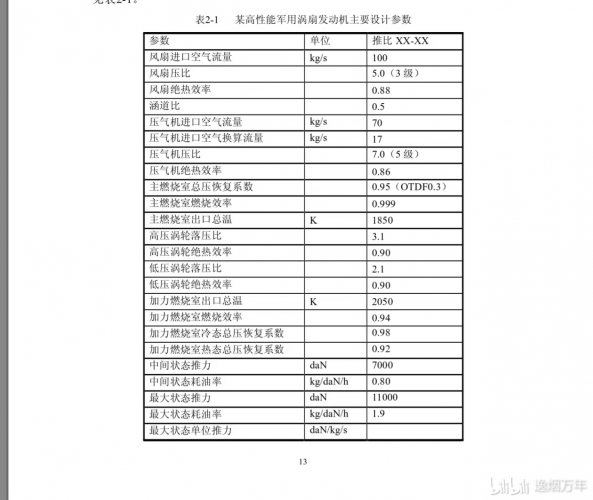
Speaking of which, we do have some preliminary specs of the WS-19 outlined in a paper (dated 2011!), which are as follows:
20260113_061135.png

Translated:
ParameterUnitValue
Fan inlet mass flowkg/s100
Fan pressure ratio-5.0 (3 stages)
Fan isentropic efficiency-0.88
Bypass ratio-0.5
Core mass flowkg/s70
Core inlet corrected mass flowkg/s (corrected)17
Core pressure ratio-7.0 (5 stages)
Core isentropic efficiency-0.86
Combustor total pressure recovery coefficient-0.95 (OTDF of 0.3)
Combustor combustion efficiency-0.999
Total temperature at combustor outlet (Tt)K1850
HP turbine total pressure drop ratio (∆P)-3.1
HP turbine isentropic efficiency-0.90
LP turbine ∆P-2.1
LP turbine isentropic efficiency-0.90
Afterburner outlet total temperatureK2050
Afterburner combustion efficiency-0.94
Afterburner total pressure recovery (unlit)-0.98
Afterburner total pressure recovery (lit)-0.92
Mil power thrustdaN7000
Mil power TSFCkg/daN/h0.80
Max AB thrustdaN11000
Max AB TSFCkg/daN/h1.9
Max AB specific thrust (thrust per unit inlet mass flow)daN/(kg/s)(unspecified*)
*specified prior as 120-130 daN/(kg/s)

They're quite interesting, to say the least. In fact, it's very reminiscent of the EJ270 proposal:
1768303391556.jpeg

But again, while definitely connected with the WS-19, these are in no way its actual numbers. Its a preliminary design proposal from almost 15 years after all.

I would say though, the OPR seems to be in the 35:1 range, which, at first glance, seems awfully high for a supercruising engine (same goes for the 0.5 BPR). But I've heard that they've got methods to have a high OPR and higher BPR while still being supercruising (and maintain good supersonic performance). Something related to the concepts explored in the WS-6 project apparently.
 

Similar threads

Back
Top Bottom