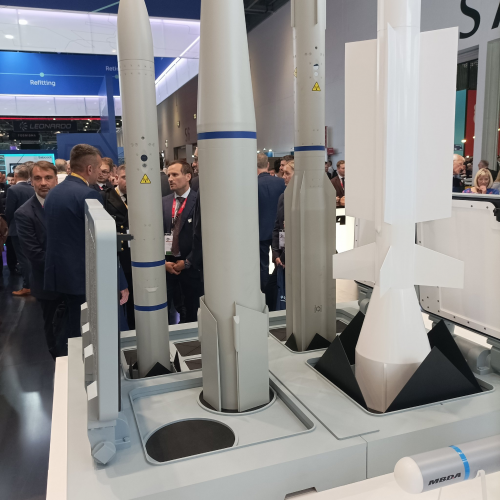
The cells look like proper circles in perspective. Trust an old illustrator.

If the box is in exterior 25.12" then internally it's likely 24" or less.
That means the diagonal is 34" or less therefore half is 17" or less.

Since those circles don't touch obviously, they're less than 17".
Lack of quad packing means they cannot be as low a diameter as 12"

So it's likely between 13" to 16".
 
From a geometric consideration, in a 21-inch square, you can fit
  • One 21-inch missile
  • Two 12.3-inch missiles, or
  • Four 10.5-inch missiles
That doesn't fully take allowance of separation, wall thickness, etc.,
Shouldn't that be two 14.8" missiles? (Sqrt(21^2+21^2)/2 = Sqrt(882)/2 = 14.85)
 
Shouldn't that be two 14.8" missiles? (Sqrt(21^2+21^2)/2 = Sqrt(882)/2 = 14.85)
No because the missile, being rounded, can't go all of the way to the corner and so they are pushed towards the centre, limiting size further. Each small missile is 2 - sqrt2 times the diameter of the square, so 12.3in for a 21in square.
Incidentally, is there a rough relationship between missile range and diameter? Does it go up proportionally to the diameter, the cross-sectional area (square), or maybe even the volume (cube)?
 
Shouldn't that be two 14.8" missiles? (Sqrt(21^2+21^2)/2 = Sqrt(882)/2 = 14.85)
That doesn't quite fit if you draw it out. You need to find the diameter of the incircle of a triangle with two 21-inch sides and one 21√2-inch side – which comes out to about 12.3 inches
 
So it's likely between 13" to 16".
You'll get slightly different numbers depending on precisely which measurement is being compared. I've used missile diameter as that's readily available. Canister size will be larger, but then an allowance has to be made for wall thickness, clearance, etc.
 
That doesn't quite fit if you draw it out. You need to find the diameter of the incircle of a triangle with two 21-inch sides and one 21√2-inch side – which comes out to about 12.3 inches
Yeah, I calculated the diagonal of the box the missile has to fit in, not the diameter of the missile, d'oh!
 
Hartpunkt

(Article in German)

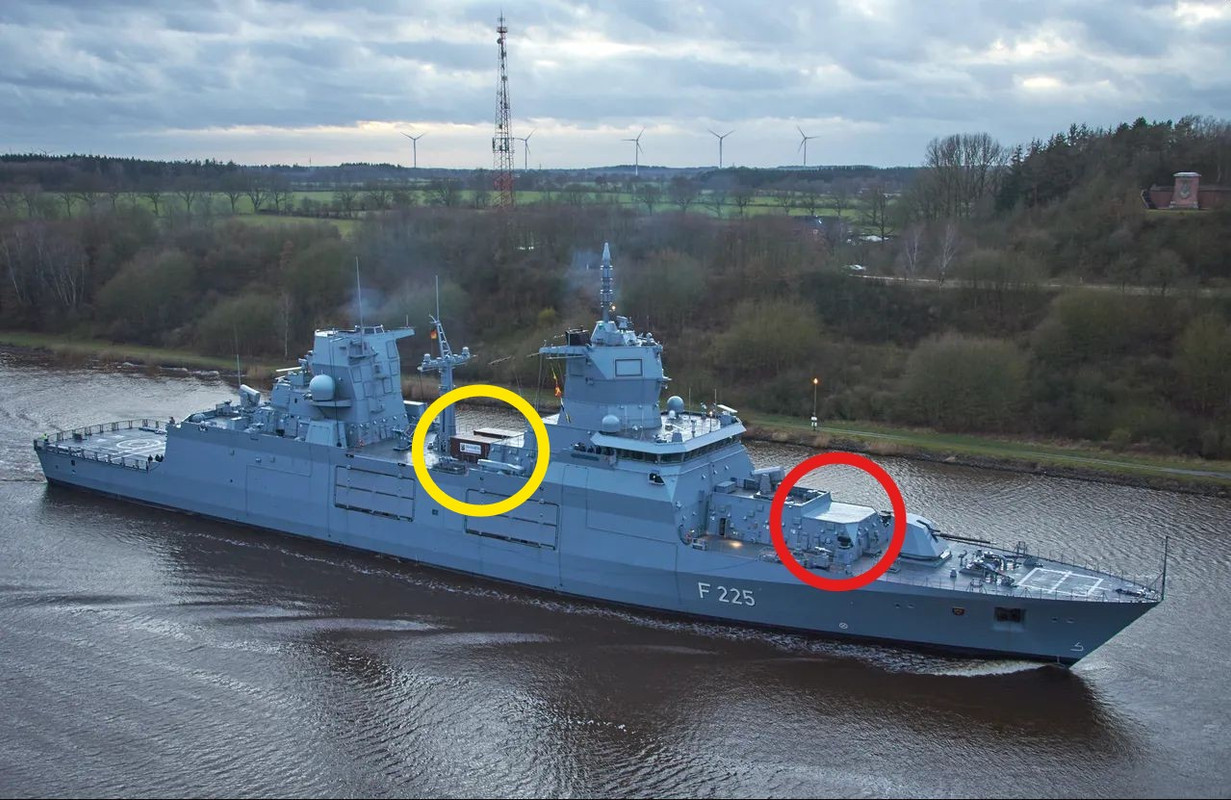
CAMM and the 6-cell MLS are being discussed as a potential upgrade for the German navy's F125 type frigates. One of those frigates recently carried out a firing exercise with a (normally land-based) IRIS-T SLM SAM launcher.

The MLS could be installed in the space which is currently used to house the ship's gym room (red circle):

F125.jpg


Another alternative launcher system (according to MBDA) could be integrated into a 10 foot ISO container and placed between the ship's masts (yellow cicle). This is also the location where the IRIS-T SLM launcher was placed.
 
Interesting. I think it'd be odd if the German chose not to pursue their IRIS-T SLM, but if the CAMM can steal that role it'd be a welcome surprise. They'd need the data-link antennas as well, right?
My understand both is on the table as around 6 to 12 maybe 18 fit in the front of the RAM while the place between the super structures, where the space for containers is, would be used for SLM and SLX later on. Probaly some 12-16 shot magazine size in the end but building a dedicated VLS in the front would be to expensive while NZ is supposedly already working on CAMM integration into CMS-330
 
An ASRAAM costs roughly £200,000, so a CAMM would probably be more than that. An Aster-30 costs £1.5 million, so a CAMM is probably less than that.

Narrowing it down further is going to be trickier, but I'd guess about £500,000 to £800,000 per missile.
Yeah my guess was also around 400.000£ but a friend wanted to make me belice thats somewhere at 3-4 mil with a source that said CAMM-ER is around 420.000€...
But even after my own research i tought its better to ask
 
Hartpunkt

(Article in German)

CAMM and the 6-cell MLS are being discussed as a potential upgrade for the German navy's F125 type frigates. One of those frigates recently carried out a firing exercise with a (normally land-based) IRIS-T SLM SAM launcher.

The MLS could be installed in the space which is currently used to house the ship's gym room (red circle):

F125.jpg


Another alternative launcher system (according to MBDA) could be integrated into a 10 foot ISO container and placed between the ship's masts (yellow cicle). This is also the location where the IRIS-T SLM launcher was placed.
It would be ironic considering CAMM is a development from ASRAAM that the Germans left to develop IRS-T.
But to be pragmatic, Italy, Poland, Sweden, now Norway and the UK use or will use CAMM.
Which means navalisation, integration and the training-replacement logistics is already in place to NATO members.
Whereas IRS-T in it's VLS form has very few users.

And of course CAMM cells obviate the need for hot launch VLS systems.
Plus the sensor agnostic architecture makes integration fairly easy.
 
Hartpunkt

(Article in German)

CAMM and the 6-cell MLS are being discussed as a potential upgrade for the German navy's F125 type frigates. One of those frigates recently carried out a firing exercise with a (normally land-based) IRIS-T SLM SAM launcher.

The MLS could be installed in the space which is currently used to house the ship's gym room (red circle):

F125.jpg


Another alternative launcher system (according to MBDA) could be integrated into a 10 foot ISO container and placed between the ship's masts (yellow cicle). This is also the location where the IRIS-T SLM launcher was placed.
From what I remember the F125-class already has some weight-related issues, so CAMM might indeed be seriously considered there as the CAMM in the mushroom farm VLS is probably the lightest option available, and even when using the iLauncher it doesn't need an exhaust deflector. Though I think CAMM-ER would be a much better option as CAMM is closer in performance to the RAM Block II than to the IRIS-T SLM or the ESSM. However, as far as I know the other significant issue with trying to fit VLS into the F125-class is the lack of space below the deck. And if that's the case, the best option for a VLS is the Mk56 which needs just under 2 meters below the deck, and which enables hot launch, so could (and should tbh) be integrated with the IRIS-T SLM.
So I think that the best choices for the F125-class are either CAMM-ER in the iLauncher or IRIS-T SLM in the Mk56. From the technical standpoint of course, so excluding IRIS-T's massive advantage of being a domestic solution.

 
From what I remember the F125-class already has some weight-related issues, so CAMM might indeed be seriously considered there as the CAMM in the mushroom farm VLS is probably the lightest option available, and even when using the iLauncher it doesn't need an exhaust deflector. Though I think CAMM-ER would be a much better option as CAMM is closer in performance to the RAM Block II than to the IRIS-T SLM or the ESSM. However, as far as I know the other significant issue with trying to fit VLS into the F125-class is the lack of space below the deck. And if that's the case, the best option for a VLS is the Mk56 which needs just under 2 meters below the deck, and which enables hot launch, so could (and should tbh) be integrated with the IRIS-T SLM.
So I think that the best choices for the F125-class are either CAMM-ER in the iLauncher or IRIS-T SLM in the Mk56. From the technical standpoint of course, so excluding IRIS-T's massive advantage of being a domestic solution.
Mk.56 doesn't seem to be an tought of solution. Right now the IRIS-T launcher is a proof of concept. While weight is a serious problem as far as i heard any speed or range reduction is seen as acceptable given that the ship can't really do anything without it. Same for the Work into the direction of ASW. Most reasonable choice probaly will be an USV with the Sonar how TKMS has already shown.
That said i think any further discussions should be done in a different Channel dedicated too F-125
 
So here's an interesting tweet from Przemysław Kowalczuk, an ex vice president of Mesko, a PGZ subsidiary specializing in missile technology (so the one that will be the most involved in the CAMM-ER production and CAMM-MR development): View: https://x.com/pkowalczuk_opl/status/1981045510568898979

Supposedly there were (as of 2024, so maybe still are?) two concepts when it comes to what the CAMM-MR could look like - one with a single-stage missile and a triple pulse motor (or at least that's how I understood it, could also be triple thrust), cold launched, and the other one with a more conventional motor and a booster stage, I assume hot launched.
 
So here's an interesting tweet from Przemysław Kowalczuk, an ex vice president of Mesko, a PGZ subsidiary specializing in missile technology (so the one that will be the most involved in the CAMM-ER production and CAMM-MR development): View: https://x.com/pkowalczuk_opl/status/1981045510568898979

Supposedly there were (as of 2024, so maybe still are?) two concepts when it comes to what the CAMM-MR could look like - one with a single-stage missile and a triple pulse motor (or at least that's how I understood it, could also be triple thrust), cold launched, and the other one with a more conventional motor and a booster stage, I assume hot launched.
Interesting that he mentions MBDA Italy, I didn't know they were involved with the development of the CAMM-MR. TBF, it would make sense to let them develop the triple-pulse rocket motor given that the CAMM-ER used a dual-pulse rocket motor.

Given the lack of booster, I assume the mock-ups we've seen already are closer to this triple-pulse design.

How would a booster square with dual-packing?
 
Given the lack of booster, I assume the mock-ups we've seen already are closer to this triple-pulse design.

I assume that the first pulse is to launch the missile out of its' cell and pointing in the direction of the target with the second pulse to boost it past transonic speeds and the third pulse is the sustain pulse?
 
Interesting that he mentions MBDA Italy, I didn't know they were involved with the development of the CAMM-MR. TBF, it would make sense to let them develop the triple-pulse rocket motor given that the CAMM-ER used a dual-pulse rocket motor.
Yea, I find that a bit weird too. Could be that it will be a co-development between MBDA UK, MBDA IT and PGZ. Though it's not certain yet as there still is no financing for the project from the Polish side.
And as for the booster, dual packing was always considered as a certainty, so I'm pretty sure it would dual pack with the booster too.
 
CAMM MR has not the range and even less the pk against supersonic missile of ASTER 30.

If you know the full specs of CAMM-MR perhaps you should post them on the related thread...because everyone over there has the same small amount of information that has been released to date and made public...
 
If you know the full specs of CAMM-MR perhaps you should post them on the related thread...because everyone over there has the same small amount of information that has been released to date and made public...
CAMM-MR is studied to have a 100km range. the MR weight is not released, but CAMM is 99kg, CAMM ER is 166kg. CAMM-MR... 250kg?
10kg warhead. Classical aerodynamic control surfaces, ie less pk at max range and max altitude.

ASTER 30 is a 120km range missile. New model, B1NT is 150km range. All with a high pk at max range thanks to PIF PAF high agility vectoring. It is a 450kg missile, with a 20kg warhead. Another beast, and another price also....
 
The point to make about CAMM-MR is it's intentionally beng designed to compliment Patriot and provide a lower cost interceptor for more conventional targets.
The sort Patriot was originally designed to intercept. But has increasingly been developed to engage ever more difficult targets.

In this it's a reasonable capability to provide an affordable modern alternative of non-US supply, to the lower tier of Standard or ESSM variants in the naval context.

We should view it as complimentary to Aster-30 and it's developments and an extension in range compared to CAMM and CAMM-ER.

There is a case to make for firing multiple CAMM-MR against single fixings of Aster-30 or Standard or PAC-3 against a set of possible targets.
 
You forgot the excess before the 100km
???
With such a "tiny" 2nd stage, I think unlikely to try to reach more than 100km. A lot of others medium range SAM are on the table, and Poland as the lauch customer of this variant already has Patriot.
 
Thats what they said and thats likely the goal. If they can or can't isn't up to debate because where not there yet. So until know +100km IS the range ...
With such a "tiny" 2nd stage, I think unlikely to try to reach more than 100km. A lot of others medium range SAM are on the table, and Poland as the lauch customer of this variant already has Patriot.
Did i miss something because i don't remember the final design being finnished.
 
The point to make about CAMM-MR is it's intentionally beng designed to compliment Patriot and provide a lower cost interceptor for more conventional targets.
The sort Patriot was originally designed to intercept. But has increasingly been developed to engage ever more difficult targets.

We should view it as complimentary to Aster-30 and it's developments and an extension in range compared to CAMM and CAMM-ER.
Exactly this. Another indicator is that Aster 30 (SAMP/T) has been intercepting Russian missiles in Ukraine that Patriot is unable to intercept (per French Senate hearings this week), so if anything Aster 30 should offer an even wider performance gap making Aster 30 and CAMM-MR even more complementary than Patriot and CAMM-MR (but are the Patriots in Ukraine up to the latest standards?).
 
As posted on the FDI thread, Naval Group is developping a cold-launch launcher for CAMM family missiles.

It's sized to take as much space as a 8 cell Sylver laucher, but fits 24 CAMM-ER missiles

This new launcher will be operational before 2030
 
Last edited:
Denmark orders CAMM-ER?

For now Denmark has ordered Iris-T SLM, NASAMS and VL MICA for short/medium range and they will order SAMP/T NG for medium/long range.
For wathever reason MBDA proposed VL MICA and not CAMM to Denmark... i personally prefer CAMM.

But they could still order CAMM-ER since the missile will be integrated in the SAMP/T NG system (probably for Italy) alonside the VL MICA NG (for France)
 
CAMM-MR is studied to have a 100km range. the MR weight is not released, but CAMM is 99kg, CAMM ER is 166kg. CAMM-MR... 250kg?
10kg warhead. Classical aerodynamic control surfaces, ie less pk at max range and max altitude.
Technically speaking, the maximum possible range of the CAMM-MR should be around 150 km, the same as that of the SM-2MR. At least that's what the currently known info about it allows for - the dual pack requirement allows for the maximum diameter of around 340 mm and a need to be launched either from the iLauncher of (less likely) from the M903 allows for the max length of around 5 meters (5,3-5,5 for the launch container length).
For wathever reason MBDA proposed VL MICA and not CAMM to Denmark... i personally prefer CAMM.
Everybody in their right mind prefers the CAMM over the VL MICA. Danish SAM procurement is really, really weird IMO.
 
Denmark is spreading the risk by purchasing almost every type of SAM.
It's also a means to buy into other European states missile systems future and support NATO.

Some of these may end up gifted to Ukraine or less well off NATO states.
 
Denmark is spreading the risk by purchasing almost every type of SAM.
It's also a means to buy into other European states missile systems future and support NATO.

Some of these may end up gifted to Ukraine or less well off NATO states.
I know, I kinda get that point. Though I really don't think they're in such a hurry to buy the VL MICA, even if they're gonna give it to Ukraine in a couple of years (because there is no way they'll choose the VL MICA as their main SHORAD system).
 

Similar threads

Back
Top Bottom