
You are using an out of date browser. It may not display this or other websites correctly.
You should upgrade or use an alternative browser.
You should upgrade or use an alternative browser.
SDI Brilliant Pebbles
- Thread starter mz
- Start date


- Joined
- 1 April 2006
- Messages
- 12,276
- Reaction score
- 15,084
Google for 'Brilliant Pebbles'
http://www.heritage.org/Research/NationalSecurity/bg748.cfm
http://www.globalsecurity.org/space/systems/bp.htm
http://www.answers.com/topic/strategic-defense-initiative
http://www.defensetech.org/archives/001693.html
http://www.thespacereview.com/article/368/1
BP ressurected as MKV - Multiple Kill Vehicle, ex-Miniature Kill Vehicle, http://www.gizmag.com/go/7888/), there was also good publication on these at AWST and Ares blog with videos.
http://www.aviationweek.com/aw/generic/story_generic.jsp?channel=awst&id=news/aw060208p1.xml&headline=Lockheed%20and%20Raytheon%20Vie%20for%20MKV
http://www.aviationweek.com/aw/blogs/defense/index.jsp?plckController=Blog&plckScript=blogScript&plckElementId=blogDest&plckBlogPage=BlogViewPost&plckPostId=Blog%3A27ec4a53-dcc8-42d0-bd3a-01329aef79a7Post%3A5dcd9c0a-026b-485c-a864-fbfbcb037f53
http://www.aviationweek.com/aw/blogs/defense/index.jsp?plckController=Blog&plckScript=blogScript&plckElementId=blogDest&plckBlogPage=BlogViewPost&plckPostId=Blog%3a27ec4a53-dcc8-42d0-bd3a-01329aef79a7Post%3a450705eb-b9ef-4dcc-8424-d65a33fb635a
http://www.aviationweek.com/media/video/MKV_R_v4_FINAL.wmv
Lockheed Martin won MDA MKV development and demonstration contract.
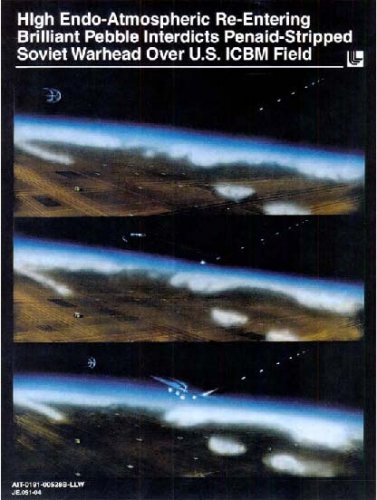
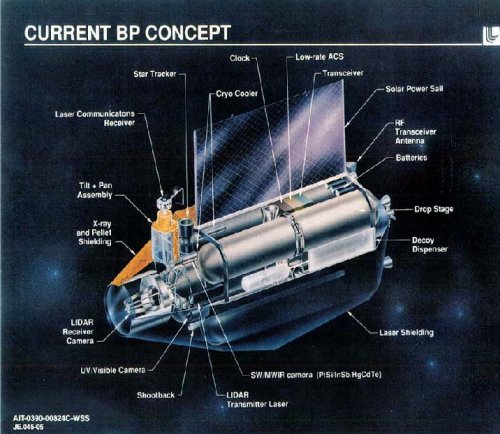
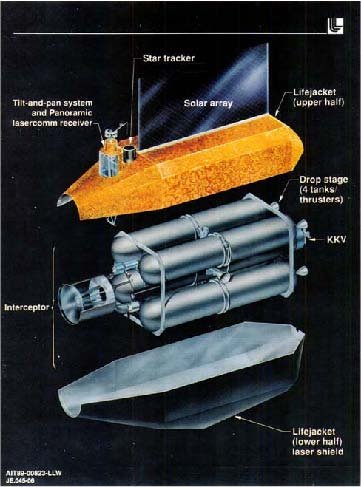
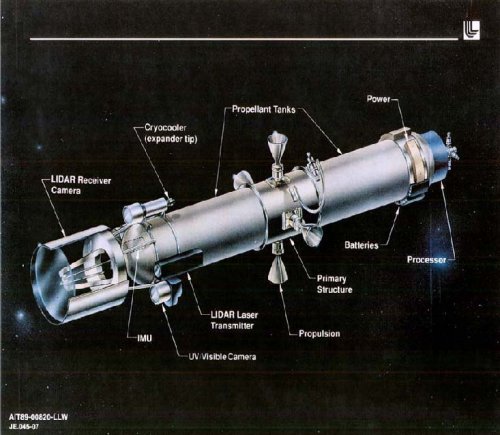
Brilliant Pebbles was a non-nuclear system of satellite-based, watermelon-sized,[21] mini-missiles designed to use a high-velocity kinetic warhead.[22] It was designed to operate in conjunction with the Brilliant Eyes sensor system and would have detected and destroyed missiles without any external guidance. The project was conceived in November 1986.[23]
John H. Nuckolls, director of Lawrence Livermore National Laboratory from 1988 to 1994, described the system as “The crowning achievement of the Strategic Defense Initiative”. The technologies developed for SDI were used in numerous later projects. For example, the sensors and cameras that were developed for Brilliant Pebbles became components of the Clementine mission and SDI technologies may also have a role in future missile defense efforts.[24]
http://www.heritage.org/Research/NationalSecurity/bg748.cfm
http://www.globalsecurity.org/space/systems/bp.htm
http://www.answers.com/topic/strategic-defense-initiative
http://www.defensetech.org/archives/001693.html
http://www.thespacereview.com/article/368/1
Though regarded as one of the most capable SDI systems, the Brilliant Pebbles program was canceled in 1994 by the BMDO.[25] However, it is being reevaluated for possible future use by the MDA.
BP ressurected as MKV - Multiple Kill Vehicle, ex-Miniature Kill Vehicle, http://www.gizmag.com/go/7888/), there was also good publication on these at AWST and Ares blog with videos.
http://www.aviationweek.com/aw/generic/story_generic.jsp?channel=awst&id=news/aw060208p1.xml&headline=Lockheed%20and%20Raytheon%20Vie%20for%20MKV
http://www.aviationweek.com/aw/blogs/defense/index.jsp?plckController=Blog&plckScript=blogScript&plckElementId=blogDest&plckBlogPage=BlogViewPost&plckPostId=Blog%3A27ec4a53-dcc8-42d0-bd3a-01329aef79a7Post%3A5dcd9c0a-026b-485c-a864-fbfbcb037f53
http://www.aviationweek.com/aw/blogs/defense/index.jsp?plckController=Blog&plckScript=blogScript&plckElementId=blogDest&plckBlogPage=BlogViewPost&plckPostId=Blog%3a27ec4a53-dcc8-42d0-bd3a-01329aef79a7Post%3a450705eb-b9ef-4dcc-8424-d65a33fb635a
http://www.aviationweek.com/media/video/MKV_R_v4_FINAL.wmv
Lockheed Martin won MDA MKV development and demonstration contract.
A
avatar
Guest
when I saw the name of the thread , i thought it was some sort of a pun on Brilliant Pebbles, but it isn't. would have been more interesting though...
- Joined
- 1 April 2006
- Messages
- 12,276
- Reaction score
- 15,084
KJ_Lesnick
ACCESS: Top Secret
- Joined
- 13 February 2008
- Messages
- 1,042
- Reaction score
- 125
That's one hefty laser-shield


Grey Havoc
ACCESS: USAP
- Joined
- 9 October 2009
- Messages
- 24,500
- Reaction score
- 18,170
Grey Havoc
ACCESS: USAP
- Joined
- 9 October 2009
- Messages
- 24,500
- Reaction score
- 18,170
Some details on SBI testing plans from 1987: http://www.dtic.mil/dtic/tr/fulltext/u2/a214020.pdf
Grey Havoc
ACCESS: USAP
- Joined
- 9 October 2009
- Messages
- 24,500
- Reaction score
- 18,170
Crosslink to GPALS thread.
Grey Havoc
ACCESS: USAP
- Joined
- 9 October 2009
- Messages
- 24,500
- Reaction score
- 18,170
Link to Orbital Hyper Velocity Gun (HVG) - Rail Gun thread.
- Joined
- 1 April 2006
- Messages
- 12,276
- Reaction score
- 15,084
The Rise and Fall of Brilliant Pebbles
Donald R. Baucom
Missile Defense Agency
Paper presented at “They Taught the World to Fly:The Wright Brothers and the Age of
Flight,” an International Flight Symposium Sponsored by the North Carolina First Flight
Centennial Commission, 23 October 2001
Donald R. Baucom
Missile Defense Agency
Paper presented at “They Taught the World to Fly:The Wright Brothers and the Age of
Flight,” an International Flight Symposium Sponsored by the North Carolina First Flight
Centennial Commission, 23 October 2001

donnage99
ACCESS: Top Secret
- Joined
- 16 June 2008
- Messages
- 1,584
- Reaction score
- 1,629
There's another similar space based interceptor project that is launched by submarines during time of conflict, the vehicle carrier would hover above the adversary nation, waiting for potential strike. does anyone knows what it is called?
I’m surprised there is so little interest in Brilliant Pebbles and push to resurrect the program.
It always seemed to me like an 80’s ideas that belongs in the 2020s: clouds of small, smart cheap components, machine learning, automation, high level of decentralization. If SpaceX, Blue Origin and the crowd of other new/old space fulfill expectations to bring down launch costs dramatically, it’ll be much more affordable, and imaginable to put up the thousands of interceptor satellites needed. Miniaturization and A.I. has vastly improved, hugely so since the 80s when Brilliant Pebbles was conceived. Surely we can build much smaller, cheaper and thus populous interceptors? This has been a fashionable trend in satellite technology: SmallSats, CubeSats, Elon Musks’s humungous internet satellite constellation.
It always seemed to me like an 80’s ideas that belongs in the 2020s: clouds of small, smart cheap components, machine learning, automation, high level of decentralization. If SpaceX, Blue Origin and the crowd of other new/old space fulfill expectations to bring down launch costs dramatically, it’ll be much more affordable, and imaginable to put up the thousands of interceptor satellites needed. Miniaturization and A.I. has vastly improved, hugely so since the 80s when Brilliant Pebbles was conceived. Surely we can build much smaller, cheaper and thus populous interceptors? This has been a fashionable trend in satellite technology: SmallSats, CubeSats, Elon Musks’s humungous internet satellite constellation.
- Joined
- 26 September 2008
- Messages
- 2,216
- Reaction score
- 1,541
skyblue said:I’m surprised there is so little interest in Brilliant Pebbles and push to resurrect the program.
It always seemed to me like an 80’s ideas that belongs in the 2020s: clouds of small, smart cheap components, machine learning, automation, high level of decentralization. If SpaceX, Blue Origin and the crowd of other new/old space fulfill expectations to bring down launch costs dramatically, it’ll be much more affordable, and imaginable to put up the thousands of interceptor satellites needed. Miniaturization and A.I. has vastly improved, hugely so since the 80s when Brilliant Pebbles was conceived. Surely we can build much smaller, cheaper and thus populous interceptors? This has been a fashionable trend in satellite technology: SmallSats, CubeSats, Elon Musks’s humungous internet satellite constellation.
I noticed the strategic use of "if" in your scenario...
Yeah, things might be a lot cheaper in this theoretical future. But it's never going to be really cheap. Take lots of relatively cheap components and now try to integrate them all. The integration requires a lot of software effort and a lot of people looking over all of that. It's not easy. And it won't be cheap.
Plus, we don't even know if this would work. It requires a lot of spacecraft covering a lot of territory and all connected into a warning and tracking system that might not behave as advertised.

Temistocle
ACCESS: Secret
- Joined
- 9 December 2009
- Messages
- 309
- Reaction score
- 726
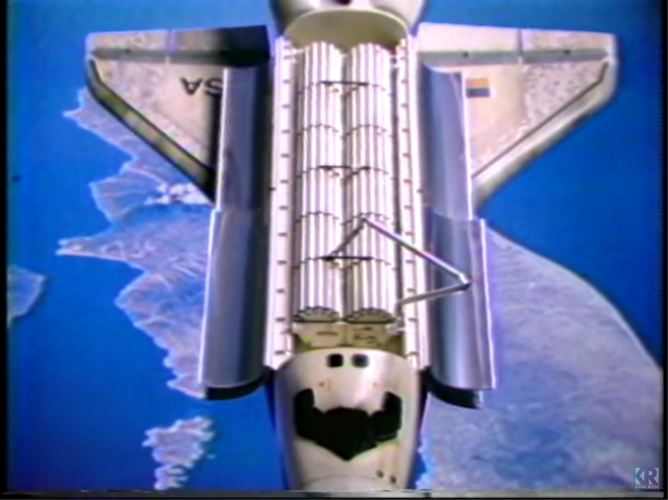
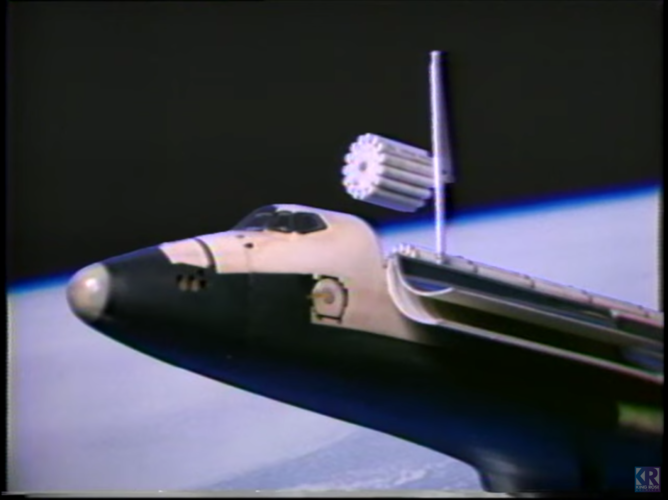
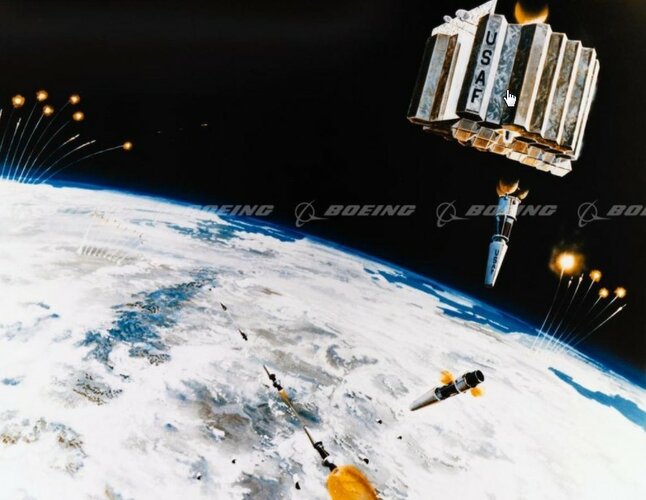
During the early phases of SDI, the armed satellites were big, "garage" satellite with a plenty of missiles onboard. Later they were replaced by the well known Brilliant Pebbles.
I tried to find a drawing of the "garage" satellites and of the missiles they were armed, but without success.
Anyone can help?
I tried to find a drawing of the "garage" satellites and of the missiles they were armed, but without success.
Anyone can help?
Did you tried "smart rocks" and "Daniel O. Graham" ? That's how the BP were called before Teller and Woods shamelessly stole the idea from Graham in 1986. When Excalibur proved unworkable. And lasers, more generally.
Temistocle
ACCESS: Secret
- Joined
- 9 December 2009
- Messages
- 309
- Reaction score
- 726
Hi Archibald, thank you for your reply, and sorry for the delay of mine.
Thank you also for your input, I have know some other new things, but still I did not find an image of the "garage satellite". Maybe they are buried inside a redacted document...
Thank you also for your input, I have know some other new things, but still I did not find an image of the "garage satellite". Maybe they are buried inside a redacted document...
- Joined
- 26 September 2008
- Messages
- 2,216
- Reaction score
- 1,541

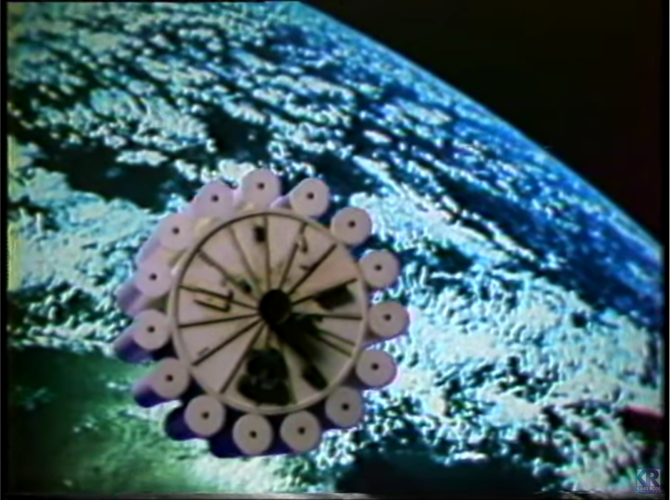



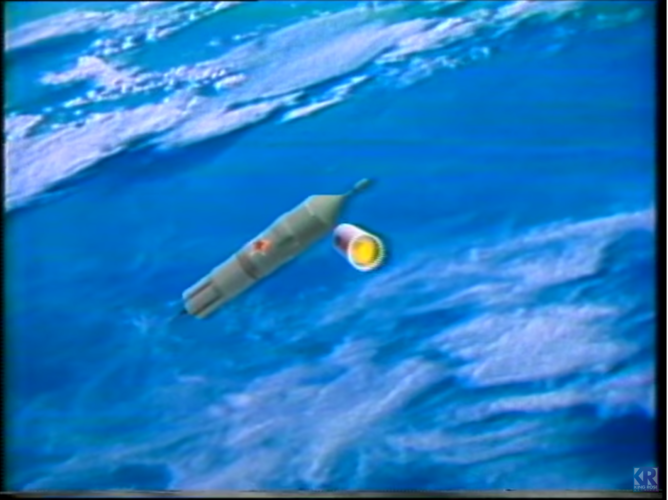

Grey Havoc
ACCESS: USAP
- Joined
- 9 October 2009
- Messages
- 24,500
- Reaction score
- 18,170
On a related note: http://up-ship.com/blog/?p=45193
Temistocle
ACCESS: Secret
- Joined
- 9 December 2009
- Messages
- 309
- Reaction score
- 726
Thank you Blackstar, very interesting!
When I watched your video, at first I had some doubts that the SBI interceptors had that "simple" form (i.e. no solar cells, no antennas), but a couple of days later I found this image in a 1988 document:
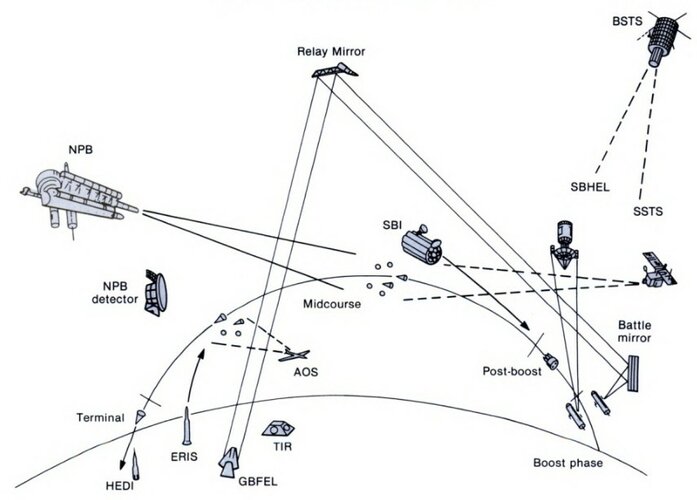
The SBI is almost at the center of the image; it is a "barrel" with some cylinders around, with the missiles inside them, plus a couple of antennas. So it seems that the SBI in the video is a simplified sketch of the "real" SBI.
The image is taken from the 1988 document "SDI : technology, survivability, and software", page 74, easily available online in pdf format, but some pages were ruined during OCR-ing (I think). A good version is here
SDI: technology, survivability, and software
BTW1, there are three versions of that document in the Hathi Trust Library, in my opnion this is the better scanned.
BTW2, I downloaded that (OCR-ed) version, it is 89 MB. If someone is interested, PM me.
- Joined
- 26 September 2008
- Messages
- 2,216
- Reaction score
- 1,541
Thank you Blackstar, very interesting!
When I watched your video, at first I had some doubts that the SBI interceptors had that "simple" form (i.e. no solar cells, no antennas), but a couple of days later I found this image in a 1988 document:
The SBI is almost at the center of the image; it is a "barrel" with some cylinders around, with the missiles inside them, plus a couple of antennas. So it seems that the SBI in the video is a simplified sketch of the "real" SBI.
The image is taken from the 1988 document "SDI : technology, survivability, and software", page 74, easily available online in pdf format, but some pages were ruined during OCR-ing (I think). A good version is here
Keep in mind this was only notional. It's like drawing a stick figure to represent a person. Any actual vehicle would have looked different.
Temistocle
ACCESS: Secret
- Joined
- 9 December 2009
- Messages
- 309
- Reaction score
- 726
Thank you for your warning, Blackstar.
I already took the images in that with a grain of salt; this is why I put "real" within quotation marks.
I already took the images in that with a grain of salt; this is why I put "real" within quotation marks.

bearnard97
ACCESS: Confidential
- Joined
- 5 January 2021
- Messages
- 109
- Reaction score
- 109
Now we have a more advanced kind of satellites that is called microsatellites. These satellites are so capable as ordinary satellites, but some of the microsatellites are only 45 kg and less than a meter in length. In some time this kind of satellite will replace completely ordinary sats in all spheres.During the early phases of SDI, the armed satellites were big, "garage" satellite with a plenty of missiles onboard. Later they were replaced by the well known Brilliant Pebbles.
I tried to find a drawing of the "garage" satellites and of the missiles they were armed, but without success.
Anyone can help?
bearnard97
ACCESS: Confidential
- Joined
- 5 January 2021
- Messages
- 109
- Reaction score
- 109
I found the website of the company that manufactures that kind of satellites I had mentioned before.During the early phases of SDI, the armed satellites were big, "garage" satellite with a plenty of missiles onboard. Later they were replaced by the well known Brilliant Pebbles.
I tried to find a drawing of the "garage" satellites and of the missiles they were armed, but without success.
Anyone can help?
https://dragonflyaerospace.com/
Those microsats are going to substitute ordinary sats in some time. It`s just a question of time.

Temistocle
ACCESS: Secret
- Joined
- 9 December 2009
- Messages
- 309
- Reaction score
- 726
I just found this satellite concept on the Boeing website, a box instead of a cylinder:
Boeing SDI concept

Boeing SDI concept

Forest Green
ACCESS: USAP
- Joined
- 11 June 2019
- Messages
- 14,501
- Reaction score
- 31,534
That wouldn't be true. C&C would be highly centralized.high level of decentralization.
Those KKV deals astounded me how rock steady they were in hovering over those nets—making the craft of Armadillo and friends look like wobbly drunks:
I have no doubt that the KKV tech can be made even cheaper with additive manufacturing. Clementine used that tech…and I would not be surprised to find it behind the tech that allowed Delta II Mars probes that also had to be small.
The old hover articles are now museum pieces:
Imagination is the only limit
https://www.trekbbs.com/threads/what-dream-tech-would-you-like-to-see.297875/page-2
Last edited:

