Mk22 was the small version of Mk13, for the FFG.
Not exactly, there were significant differences between almost all elements of Mk-13 and Mk-22. The Mk-13 used rotating magazine with two concentric drums and two-position reloading launcher (one position for inner drum, the other for outer), placed on the side of the magazine.

The Mk-22 used a single stationary drum and rotating magazine top with launcher set in the center. Essentially, the magazine cover rotated with launcher toward the selected missile.

Both systems were different enough to be considered incompatible with each other by such elements as launcher design, magazine construction, ect.
 
Not exactly, there were significant differences between almost all elements of Mk-13 and Mk-22. The Mk-13 used rotating magazine with two concentric drums and two-position reloading launcher (one position for inner drum, the other for outer), placed on the side of the magazine.

The Mk-22 used a single stationary drum and rotating magazine top with launcher set in the center. Essentially, the magazine cover rotated with launcher toward the selected missile.

Both systems were different enough to be considered incompatible with each other by such elements as launcher design, magazine construction, ect.
Dilandu
Thank for the clarification.
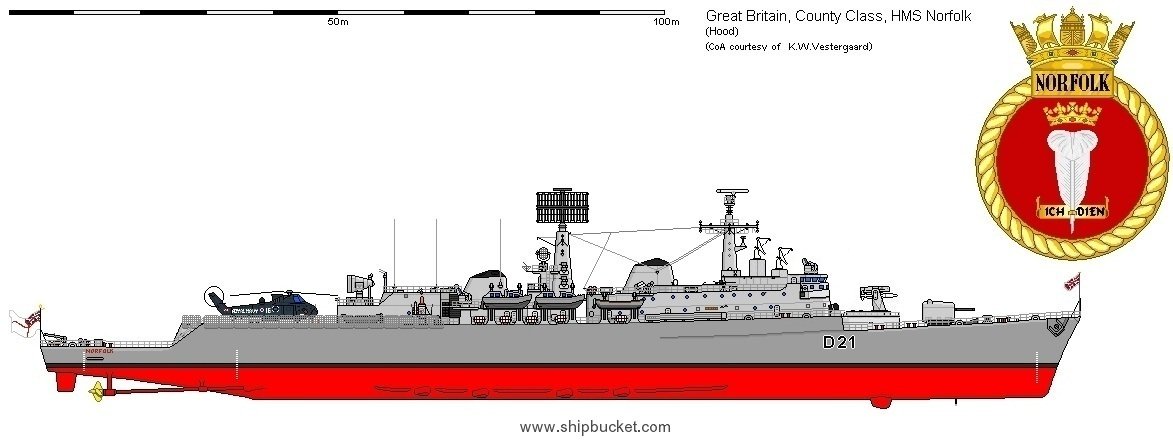
If, its possible to fit the Mk-13 on place of 4.5 inch upper gun.
You have 8 AGM-84 and 32 SM-1, with possibility to upgrade to SM-2.
An with a nomral hungar for 2 helos.
like the drw that put BlackBat242
Here is the new County class with Mk13 D21-HMS-Norfolk-003.jpg
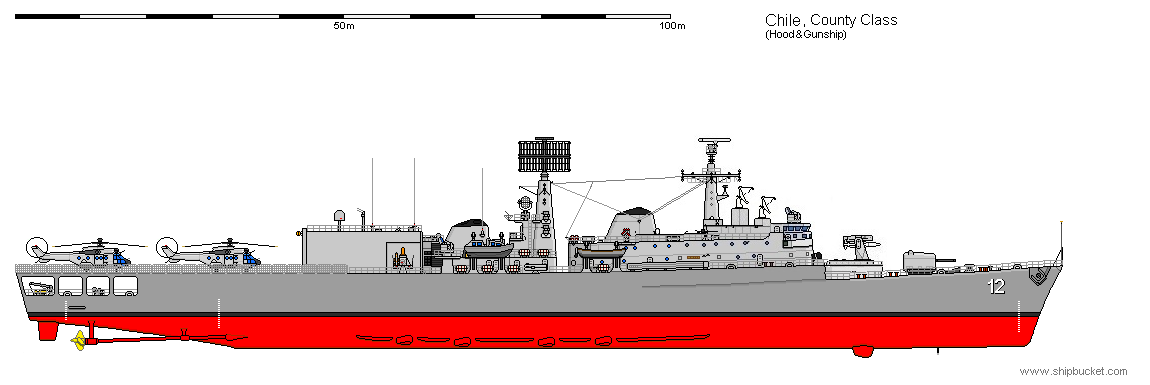
I like what the Chilean Navy do to them
1131_DD-12AlmiranteCochrane_20230518182234.png
Sorry the poor quality of the modificacion.
Even I was thinking to change thre 965 for 1022 radar
 
These ships aren't going to last forever, at the time of their design the British were looking to replace a steam-powered ship after the ship after the 2nd or 3rd boiler re-lining, 22-26 years. Rearming a ship with only 5 or so years of economic life left isn't a good idea despite its technical interest.
 
These ships aren't going to last forever, at the time of their design the British were looking to replace a steam-powered ship after the ship after the 2nd or 3rd boiler re-lining, 22-26 years. Rearming a ship with only 5 or so years of economic life left isn't a good idea despite its technical interest.
With Devonshire commissioned late-62, that gives her until 1984-88, Antrim commisioned mid-70, giving until 1992-96.
 
With Devonshire commissioned late-62, that gives her until 1984-88, Antrim commisioned mid-70, giving until 1992-96.

Yes, but the difficulty lies with timing a major change to weapons fit in with a boiler (firebox) re-lining, which generally first occurs after ~12 years, then 6-4-3-3.... years. Of course these are not firm numbers, you might get 13 years out of the first set of bricks/tiles but barely 5 out if the 2nd or any combination of those approximate times.

If you time it right you might re-arm at year 18 and get a decade out of the rebuild. But then again a ship might have gotten 20 years out of its first 2 sets of tiles and the RN thinks 4 or 5 years out of the 3rd set is enough for the ship and a re-arm isn't worthwhile. Ships are sadly victims of circumstance all the time, IIRC the newest USN CGN was first to be decommissioned after the Cold War because it was next in line for a refuelling after The Wall fell.

This is why gas turbines are so awesome, you can just cheaply swap them out until the hull rusts through.
 
Terrier
Weight 3,000lb
Length 27ft
Diameter 13.5"
Span 62.4"

Seaslug
Weight 4,576lb
Length 19ft
Diameter 16.5"
Span 55"

Seaslug was stored as an all-up round ready to go in the ready magazine and a number broken down and crated that had to be assembled.
Relevent website for seaslug.

https://www.littlewars.org.uk/Seaslug/seaslug03.html
H
Assuming we're working with OTL Seaslug, the system has scope for considerable improvement.
 
What ideas do you have?
I've pretty much gone into what I think could be done with a mkIII missile. Namely polyrod interferometer guidance.

But within the scope of a 9ft long torpedo of a diameter of 18" or 16", there ought to be enough scope in the Seaslug launcher and magazine system limitations, to handle a rocket driven glider able to deliver such a torpedo to a reasonable range.
That would need additional guidance systems onboard the ship.

The big problem is actually getting a working Anti-ship missile....

And it's quite plausible that a smaller SAM could be fired out of the same launcher.....Orange Nell in some variant for example. Again with additional guidance systems onboard the ship.
 
To throw something in out of left field, what about designing it around a Wee Gwen warhead? Might free up a fair bit of the overall mass budget.
 
I've pretty much gone into what I think could be done with a mkIII missile. Namely polyrod interferometer guidance.
Yes, that's quite possible (I thought along the same lines). It would not only increase long-range accuracy, but also would solve the flame blocking the beam problem. So a new, long-burning motor could be installed to increase range.

But within the scope of a 9ft long torpedo of a diameter of 18" or 16", there ought to be enough scope in the Seaslug launcher and magazine system limitations, to handle a rocket driven glider able to deliver such a torpedo to a reasonable range.
That would need additional guidance systems onboard the shi
An ASROC analogue?
 
Hm, good idea! Maybe you could just use Seaslug own wrap-around booster setup, to boost the torpedo?
Might be overkill considering the acceleration that delivers and I'd rather keep the volume for the torpedo 'carrier' system where I can.

Might allow a development of the carrier system as a subsonic target for training as well.
 
Terrier
Weight 3,000lb
Length 27ft
Diameter 13.5"
Span 62.4"

Seaslug
Weight 4,576lb
Length 19ft
Diameter 16.5"
Span 55"

Seaslug was stored as an all-up round ready to go in the ready magazine and a number broken down and crated that had to be assembled.
Relevent website for seaslug.

https://www.littlewars.org.uk/Seaslug/seaslug03.html
H
Assuming we're working with OTL Seaslug, the system has scope for considerable improvement.
Actually the Mk 2 ships (and, to a lesser extent, HMS London) had a crated stowage; only the wings and control surfaces were removed. This allowed a greater packing density.

SRJ
 
But wouldn't the system be otherwise incompatible with existing launcher rails?
I think it's quite reasonable to design something that interfaces with them on which the combination of carrier and torpedo ride. Even if they're jettisoned after launch.
 
Actually the Mk 2 ships (and, to a lesser extent, HMS London) had a crated stowage; only the wings and control surfaces were removed. This allowed a greater packing density.

SRJ

I have a question, if you don't mind: could you please explain how exactly Seaslug launcher operated? The whole thing is so complicated, that I can't figure out some details. For example, I still can't understood (at least reliably) - was missile hanging under overhead guide rail, or it was lying on side rails?
 
Most Leanders were given extensive updates: Ikara, Sea Wolf or Exocet. I think the Counties could be candidates for 2 or even 3 of these weapon systems as powerful ASW ships. They'd need smaller crews of course, the command staff wouldn't be required for starters.
 
Old thread, I know, but read through it and decide to post.

http://www.navweaps.com/Weapons/WNBR_45-45_mk5.php
The Mk6 mount weighs about 45 tons.

https://www.secretprojects.co.uk/threads/weight-of-tartar-missile-systems.45924/
According to the table in this link, the Mk22 GMLS weighs about 92,000 lb (~42t), missiles weigh 10 to 11t (Tartar or SM-1 MR) plus the hydraulic fluid, probably total weight of a Mk22 ready for battle would be under 60t definitely. Perhaps could replace the Mk6 gun, the GMLS is heavier, but nearly all the weight is below the deck, opposite compared to a naval gun.
 
Most Leanders were given extensive updates: Ikara, Sea Wolf or Exocet. I think the Counties could be candidates for 2 or even 3 of these weapon systems as powerful ASW ships. They'd need smaller crews of course, the command staff wouldn't be required for starters.
The Australian Type 12 were built with Ikara at stern. Perhaps a RAN County could have this system as well at stern. So she would have combined AAW and ASW capabilities as well.
 
The Royal Navy still saw itself as having something of a worldwide role when these ships were designed, and as such, giving them all their own air capability was seen as a vital aspect of the design. US air-defence cruisers and destroyers (for example) had the benefit of operating in a fleet with a VERY large organic aviation component, both at sea and shore-based. The British simply couldn't afford to specialize to that degree.
And quite frankly, the idea of "every ship gets a helo" has proven so vital that even USCG cutters have a helo deck with beartrap, and most have hangars.


It is worth comparing the service life of the US Coontz class single ended Terrier ships with the County class. The US got much more use of them because their weapons systems were easier to upgrade. France got a similarly long life out of its two Suffren class.
The RN seems to build ships which become obsolete faster than those in other navies.
Which is honestly better for their shipbuilding industry. Building 8-10 ships of a type (say, AAW) over a decade, shift to a different type (ASW) for a decade while designing the replacement for the first class, repeat for the second class.

At best, you could stretch that to a 3 type rotation.
 
even USCG cutters have a helo deck with beartrap, and most have hangars.
Especially considering what the Coast Guard does.

Mind you, the Coast Guard doesn't have to devote quite as much space and weight to weapon fits, although I know there were a few classes that were quite spicy back in the Cold War.
 
I have a question, if you don't mind: could you please explain how exactly Seaslug launcher operated? The whole thing is so complicated, that I can't figure out some details. For example, I still can't understood (at least reliably) - was missile hanging under overhead guide rail, or it was lying on side rails?
I’m sorry for not replying earlier; Seaslug missiles were ‘held’ in the launcher rather than hanging from a single rail. Shoes on the four boost motors engaged in channels in the ‘scaffolder’s nightmare’ to stop the missile from moving in a heavy sea.
Would you like me to post some images?

SRJ
 
I’m sorry for not replying earlier; Seaslug missiles were ‘held’ in the launcher rather than hanging from a single rail. Shoes on the four boost motors engaged in channels in the ‘scaffolder’s nightmare’ to stop the missile from moving in a heavy sea.
Would you like me to post some images?
Very much, thank you!
 
I know it’s going off on a bit of a tangent, but I have copied an article by Jon Wise from ‘Warship 2007’ which gives quite a lot of background about the conversion of the Landing Craft Maintenance Ship Girdle Ness into the Sea Slug trials ship and also gives some detail about, especially, the early tests…
 
I’ll have to try and resize it or break it into several parts.
Even as a pdf it’s being rejected s too large for posting!
 
Thanks. I'll try uploading as a group of smaller pdf's first....
Here goes....
Apologies for the quality of (some) images. I copied the article from an open-source website which had uploaded the 2007 edition of Warship and some parts of things on there can be 'fuzzy' to say the least.
 

Attachments

  • Pt1 HMS GIRDLE NESS- Sea Slug Missile Trials Ship.pdf
    2 MB · Views: 30
  • Pt2 HMS GIRDLE NESS- Sea Slug Missile Trials Ship.pdf
    835.2 KB · Views: 23
  • Pt3 HMS GIRDLE NESS- Sea Slug Missile Trials Ship.pdf
    5.9 MB · Views: 14
  • Pt4 HMS GIRDLE NESS- Sea Slug Missile Trials Ship.pdf
    4 MB · Views: 17
  • Pt5 HMS GIRDLE NESS- Sea Slug Missile Trials Ship.pdf
    6.1 MB · Views: 13
  • Pt6 HMS GIRDLE NESS- Sea Slug Missile Trials Ship.pdf
    115.8 KB · Views: 15
Hi,
Thanks for posting. These are interesting files.

Pat
 
The fascinating part of this is that the magazine system was funded to a prototype aboard Girdle Ness.

And then abandoned for the tube system implemented on the County Class.

The chief visual difference being the stacked magazine is length limited.
Whilst the tube system isn't.

So if one was thinking ahead and contemplating missiles longer thsn Seaslug. You wouldn't want to hamper the upgrade process by needing to rip out the magazine system.......
 
Something has occurred to me. The Seaslug had the same body diameter as the Martel/Sea Eagle, a wingspan slightly greater and is about 2 metres longer. In theory Martel could readily fit in the Seaslug magazines and seaslug style boosters could be used to get these missiles to flying speed. This would avoid for huge structural work that dooms things like Sea Dart conversion in practice.
 
Something has occurred to me. The Seaslug had the same body diameter as the Martel/Sea Eagle, a wingspan slightly greater and is about 2 metres longer. In theory Martel could readily fit in the Seaslug magazines and seaslug style boosters could be used to get these missiles to flying speed. This would avoid for huge structural work that dooms things like Sea Dart conversion in practice.
I'd make a stretched Martel/Sea Eagle for that. More fuel, more boom.
 
By design. Tartar evolved as a point-defence version of Terrier without the requirement for manual fitting of fins, and Standard was, if you like, a semi-clean sheet of paper design intended to retain compatibility with the same ships and launchers while improving performance and reliability. Terrier started out as a beam rider, while Tartar was SARH from the start and then Terrier followed not long before both were replaced by a common missile either with (ER) or without (MR) the booster.


The two missiles are completely different in shape, so I'd say you're almost certainly right here.

The problem isn't building a better Seaslug; the problem is making it compatible with both the Counties (and their existing launchers) and with smaller platforms. Does anyone have pictures of the two missiles next to each other/to the same scale, preferably with Seaslug devoid of its boosters?
The thought comes to mind that you could fit the Standard guidance package to SeaSlug, or even package a standard missile with SeaSlug boosters and use the existing SeaSlug launcher and magazine.

For it to be worth doing, there would have to been a decision to retain all eight Counties into the 80s and 90s.
 
The fascinating part of this is that the magazine system was funded to a prototype aboard Girdle Ness.

And then abandoned for the tube system implemented on the County Class.
IRRC the Girdle Ness magazine was a prototype for cruiser-based system; but after cruisers were cancelled, the Navy required something that would fit on much narrower destroyer hull.
 
IRRC the Girdle Ness magazine was a prototype for cruiser-based system; but after cruisers were cancelled, the Navy required something that would fit on much narrower destroyer hull.
Weirdly not. The 'tube' magazine was preferred for a cruiser, for reasons that aren't entirely clear to me, and had to be shoehorned into a smaller hull. The deep magazine was preferred for a destroyer or 'convoy escort' arrangement - the GIRDLE NESS arrangement was theoretically the latter.
 
Weirdly not. The 'tube' magazine was preferred for a cruiser, for reasons that aren't entirely clear to me, and had to be shoehorned into a smaller hull. The deep magazine was preferred for a destroyer or 'convoy escort' arrangement - the GIRDLE NESS arrangement was theoretically the latter.
Whoa. Thanks for clarification - I didn't know that. I thought that "lane" magazine was specifically designed to fit into narrow hulls of destroyers.
 
Back
Top Bottom