R-33, R-37 and R-72/KS-172S-1 ALRAAM missiles

I hope we can all agree now all sources are clear initial versions of R-33 and R-27 do not use lofted profiles. This limits their maximum range, and 120km is a typical launch range for R-33 against a bomber target.

Yes, it seems like that . In fact, launch itself is very similar to those one of the new R-37M.After ejecting from AKU-410/-1, R-33 declines like R-37M downward and then begins to climb but not to go lofting as you mentioned/described.

Comparisons :

View: https://www.youtube.com/watch?v=VKFbg02Dp3E


From 22:00

View: https://www.youtube.com/watch?v=IgIUqglU3rM&t=34s


Sequences from 22:30

View: https://www.youtube.com/watch?v=OphPLCjGYbk


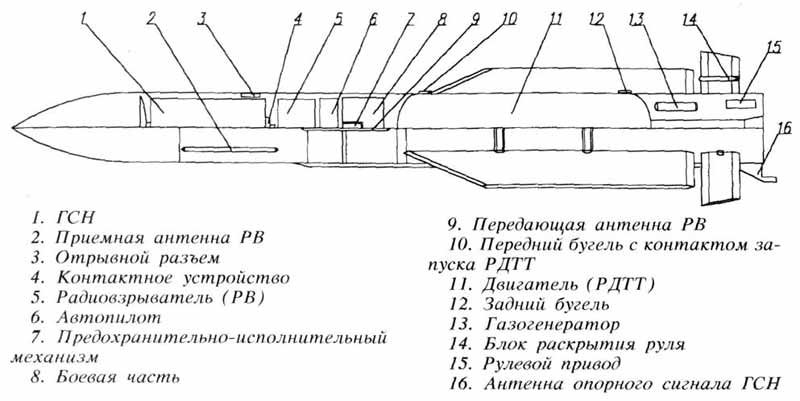
Now as we can see ,old R-33 certainly has auto pilot (6) .

R-33 SKICA.jpg

Hm, that was limiting factor for the old R-33. In the doc movie ,in the moment when the first aircraft appeared on the screen ,RIO got DLZ for the R-33's. We can see that old N007 could detect/track aircraft from several hundreds of kms : for the 3sqm fighter ( RC MiG-21) it was about 120km, for the 19 sqm bomber Tu-16/RC M-16 it was almost 200km. Target that appeared on the screen in previous doc. movie ( almost 400km in PPS) was something very big ,maybe what Russians call ''ракетa мишень'' with e.g. Luneberg lenses for RCS increasing.

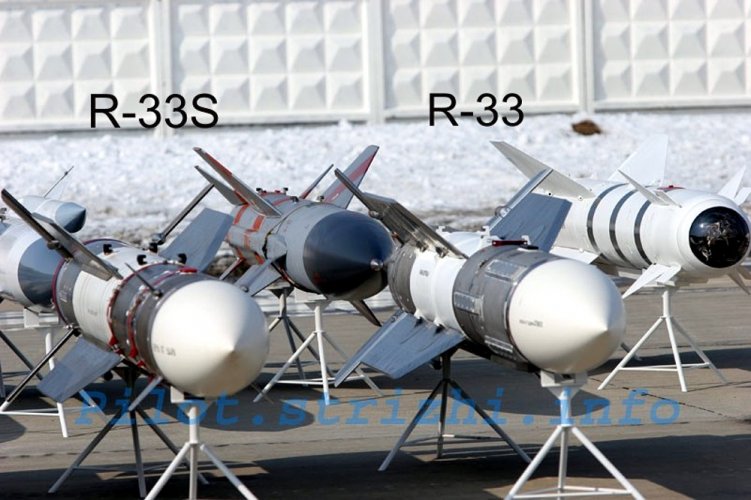
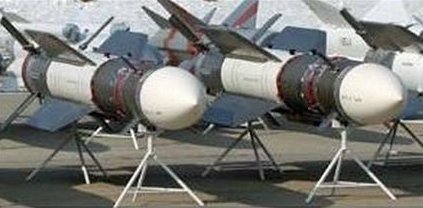
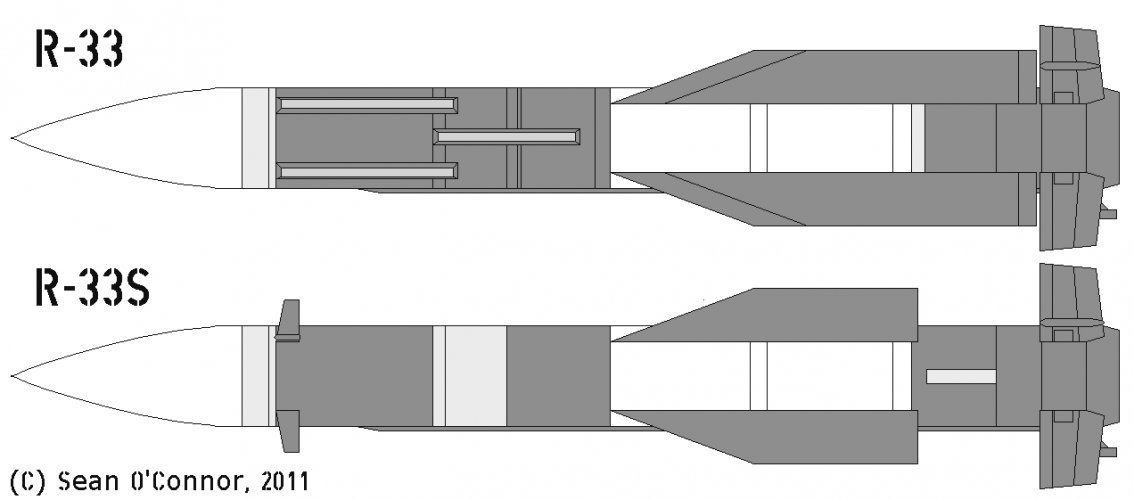
When we look both R-33S and R-33 on the pics,we can see that they have the same wings but wings on the R-33S are moved forward from the stabilizers.


R-33S  R-33 u prvom redu.jpg

So with R-33S they got the heavy long range AAM with lofting possibilities.Maybe those forward stabilizers/canards have task to increase stability and controllability during loft ?

What is intriguing and surprising, there is no photo of the MiG-31B/BS with R-33S on the ground or even during flight.I could not find one at least.
 
Those screenshots I took more than 20 years ago and posted on my Russian Avionics page. They were taken from a tiny AVI copy of the Wings of the Red Star video. There's much better quality videos of that archive footage available now.View attachment 792557

Tnx again .

What we can see is R-33's DLZ as mentioned and 6 aircraft with numbers 1-6 from the left side. This is the R-37M DLZ in MiG-31BM from the famous video ( for comparison ) .

View: https://www.youtube.com/watch?v=ZxAGVMTtQb0
 
I don’t think r-33e is energy variant of r-33, it must be just export version of r-33 as it has same 120km max range of normal r-33
 
From 9:38 details about R-33 in the famous video about 70th anniversary of the GosMKB Vympel .

Missile has digital connections with the interceptor. R-33 itself was developed for the MiG-31 and vice versa. Product was aviation intercept complex MiG-31-33.

ФИЛЬМ ОБ АО ГОСМКБ «ВЫМПЕЛ» ИМЕНИ И. И. ТОРОПОВА​


View: https://www.youtube.com/watch?v=WA2pewYPA8s
 
Last edited:
It seems that R-33S has also only inertial +SARH ( not ARH ) .

''Еще не закончились ГСИ комплекса перехвата, как началась разработка РГС МФБУ-520 (модернизация РГС МФБУ-410) для более эффективной ракеты большой дальности. Она проводилась в НИО-3 НИИП с участием отраслевых подразделений соразработчиков.В 1991-м ГосНИИАС выдал положительное заключение по результатам моделирования и испытаний и ракету приняли к серийному производству, не дожидаясь окончания ГСИ модернизированного комплекса, которые успешно завершились в 1992 году.''

''Before the interceptor system's state-of-the-art testing was completed, development of the MFBU-520 radar seeker (a modernization of the MFBU-410 radar seeker) for a more effective long-range missile began. This work was carried out at NIO-3 NIIP, with the participation of industry divisions from co-developers.
In 1991, GosNIIAS issued a positive conclusion based on the results of modeling and testing, and the missile was accepted for serial production without waiting for the completion of the State Testing and Design (GTS) of the modernized complex, which was successfully completed in 1992.''


''В основу системы управления ракеты (МФБУ-410/520) положена полуактивная радиолокационная головка самонаведения (РГС), обеспечивающая многоканальное наведение с борта истребителя, оснащенного РЛС с ФАР. При этом подсвет цели осуществляется в дискретном режиме. В РГС используется индикаторная гиростабилизационная система с максимальной отработкой угловой скорости линии визирования до 20 град/с и большой точностью ее оценивания (до 0,01-0,03 град/с).''

''The missile's (MFBU-410/520) guidance system is based on a semi-active radar homing head (SHR), providing multi-channel guidance from a fighter equipped with a phased array radar. Target illumination is achieved in discrete mode.The radar seeker uses an indicator gyrostabilization system with a maximum angular velocity of the line of sight of up to 20 degrees/s and high accuracy of its estimation (up to 0.01-0.03 degrees/s). ''

Source: https://www.aviationunion.ru/media/news/2550/

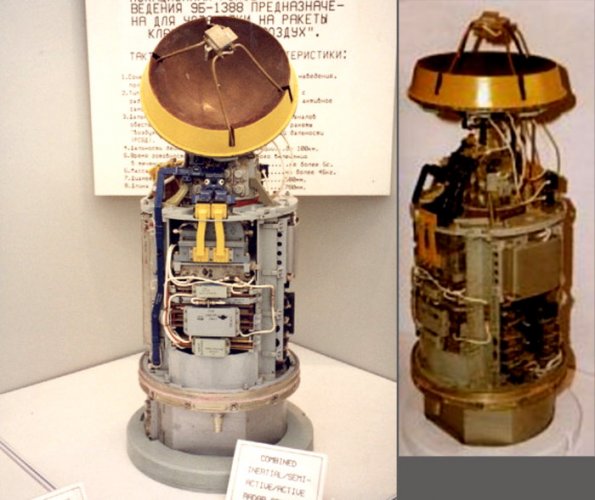
9B1388/MFBU-610 was the first with the use of combined ARH/SARH .


9B1388.jpg

http://militaryrussia.ru/blog/topic-106.html
P.S.

They used RC version of the Tu-16 to simulate SR-71's RCS ?

''Требуемая дальность обнаружения целей с эффективной поверхностью рассеивания (ЭПР) 19 квадратных метров (что соответствовало высотному разведчику SR-71 — наиболее сложной цели для ПВО) — 180-200 километров — оказалась в несколько раз больше, чем у любого другого отечественного истребителя-перехватчика того времени.''

''The required detection range for targets with an RCS of 19 square meters (which corresponded to the SR-71 high-altitude reconnaissance aircraft, the most difficult target for air defense) was 180-200 kilometers, which turned out to be several times greater than that of any other domestic interceptor fighter of the time.''
 
Y

When we look both R-33S and R-33 on the pics,we can see that they have the same wings but wings on the R-33S are moved forward from the stabilizers.

So with R-33S they got the heavy long range AAM with lofting possibilities. Maybe those forward stabilizers/canards have task to increase stability and controllability during loft ?

What is intriguing and surprising, there is no photo of the MiG-31B/BS with R-33S on the ground or even during flight.I could not find one at least.
Somewhere I've seen a drawing of the R-33S, the wings moved and there were small destabilising canards to adjust centre of lift. I believe the primary reason was to improve agility, as R-33 is not good in this respect.
 
It seems that R-33S has also only inertial +SARH ( not ARH ) .

''Еще не закончились ГСИ комплекса перехвата, как началась разработка РГС МФБУ-520 (модернизация РГС МФБУ-410) для более эффективной ракеты большой дальности. Она проводилась в НИО-3 НИИП с участием отраслевых подразделений соразработчиков.В 1991-м ГосНИИАС выдал положительное заключение по результатам моделирования и испытаний и ракету приняли к серийному производству, не дожидаясь окончания ГСИ модернизированного комплекса, которые успешно завершились в 1992 году.''

''Before the interceptor system's state-of-the-art testing was completed, development of the MFBU-520 radar seeker (a modernization of the MFBU-410 radar seeker) for a more effective long-range missile began. This work was carried out at NIO-3 NIIP, with the participation of industry divisions from co-developers.
In 1991, GosNIIAS issued a positive conclusion based on the results of modeling and testing, and the missile was accepted for serial production without waiting for the completion of the State Testing and Design (GTS) of the modernized complex, which was successfully completed in 1992.''


''В основу системы управления ракеты (МФБУ-410/520) положена полуактивная радиолокационная головка самонаведения (РГС), обеспечивающая многоканальное наведение с борта истребителя, оснащенного РЛС с ФАР. При этом подсвет цели осуществляется в дискретном режиме. В РГС используется индикаторная гиростабилизационная система с максимальной отработкой угловой скорости линии визирования до 20 град/с и большой точностью ее оценивания (до 0,01-0,03 град/с).''

''The missile's (MFBU-410/520) guidance system is based on a semi-active radar homing head (SHR), providing multi-channel guidance from a fighter equipped with a phased array radar. Target illumination is achieved in discrete mode.The radar seeker uses an indicator gyrostabilization system with a maximum angular velocity of the line of sight of up to 20 degrees/s and high accuracy of its estimation (up to 0.01-0.03 degrees/s). ''

Source: https://www.aviationunion.ru/media/news/2550/

9B1388/MFBU-610 was the first with the use of combined ARH/SARH .
Yes absolutely.

The big problem with Western reporting in the 1990s / 2000s was Russia was showing various upgraded components and describing various planned improvements, many of which never came to fruition, and journalists would make suppositions. For example, Zhuk radar was shown at an airshow before Western media had seen the N019 radar. Several journalists assumed the radar displayed was the standard MiG-29 radar.

SImilarly, someone presumably knew there was an improved R-33 missile being developed, saw the 9B1388 being shown, and assumed it was for the R-33 upgrade.
 
Somewhere I've seen a drawing of the R-33S, the wings moved and there were small destabilising canards to adjust centre of lift. I believe the primary reason was to improve agility, as R-33 is not good in this respect.

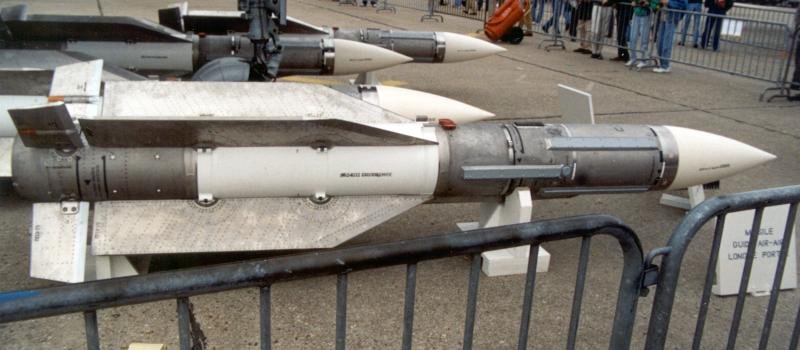
I also thought that but in fact,wings of the R-33S are shorter.Wings of the R-33 are longer and they are positioned over the white and the grey engine section plating.

R-33 Izd 410.jpg

As we can see ,wings of the R-33S are positioned only over white plating.

R-33S.jpg

Just as it was shown on the first page of this topic

R-33 R-33S.jpg
 
Last edited by a moderator:
Is there maybe original Russian article ?
Oh, you say you’re interested in what a Russian publication posts now? How about how all my Russian sources are wrong :)
Yes so what ? I mentioned that there is so many sources with that wrong data.
But I provided 5 sources with the same number. Logic dictates if 5 sources say this and we have 0 counter to them, maybe they are correct or atleast best information we have!

What is so strange to use AAM that was operatioanl from 1980?
Yes let’s “test” a missile we tested 10 years ago for induction and have been firing ever since then and already know everything about. Without the article saying so we can’t assume it was the same missile. This experimental family of missiles, the road to R-37M, was filled with many variants and types of R-33 that saw testing and were developed. It is not strange at all for Russia to test improved versions of the R-33 that are not like the old one in the 90s.

No, PoD is in fact % value for the first scan cycle of the given scan zone. So how can one PESA N007 be in the same cathegory with N001/N019 which have mechanical scanning...
Any different to what I said? It detects it 9/10 for 90%, 5/10 for 50%.

At roughly 150km both N001 or N019 can detect some very big incoming air target ( e.x. B-52H ) and engaged him with R-27R from 90km.
You are lucky that 100m squared RCS of B-52 is so big:) Against 16m squared Tu-16, against all BUT a B-52, it wouldn’t not experience 150 km of detection.
Regardless it couldn’t make a R-27R shot of 90 km range in such a case, as the 90 km range shot is only for conditions of Mach 2+ launch, 15-17 km, and enemy at Mach 2+ as well. There is no way to make up that shot distance against a subsonic plane. We still have 60 seconds only to contend with.
 
I also thought that but in fact,wings of the R-33S are shorter.Wings of the R-33 are longer and they are positioned over the white and the grey engine section plating.

View attachment 792781

As we can see ,wings of the R-33S are positioned only over white plating.

View attachment 792782

Just as it was shown on the first page of this topic

View attachment 792783

Yes the R-33S is half way to the R-37 in config.

Photos of the R-33S seems very elusive - it certainly didn't replace R-33.
 
Last edited:
They must’ve realized R-33 was far too stable and that drag losses made it profitable to have destabilizing surfaces and wing area moved reduced and moved forward while still having a good enough control system, in addition to possible maneuverability enhancing if a factor.
 
Oh, you say you’re interested in what a Russian publication posts now? How about how all my Russian sources are wrong :)

Publications from the manufacturers ,interviews with the constructors,designers etc are more valuable than any 'book',magazine ,ordinary article.

In the meantime I 've found one of overscan's article about Izd 520 in this forum, of course on Russian.

https://forums.airbase.ru/2011/09/t26877_5--proizvodstvo-urvv-na-territorii-rf.html
But I provided 5 sources with the same number. Logic dictates if 5 sources say this and we have 0 counter to them, maybe they are correct or atleast best information we have!
Yes and as I wrote, I have many of them. Right now, I think that doc movie about MiG-25/31 is maybe the most valuable for us here . That is because we can see how things work in practice,in the real situation.

Any different to what I said? It detects it 9/10 for 90%, 5/10 for 50%.

I later realized what I wrote. Ronny gave the real explanation like you of course.


Photos of the R-33S seems very elusive - it certainly didn't replace R-33.

No of course ,that 's why I mentioned that I never saw any R-33S in operational unit.

Does anyone know where and when the R-33S photos were taken?

I tried to find it via ''http://pilot.strizhi.info'' ....

Nothing so far .
 
Does anyone know where and when the R-33S photos were taken?
The photo may be on page 37 of this edition of Aviation Week. It is the "Defense (2)" entry in the table of contents. I don't have access.

https://archive.aviationweek.com/issue/20090413/#!&pid=36

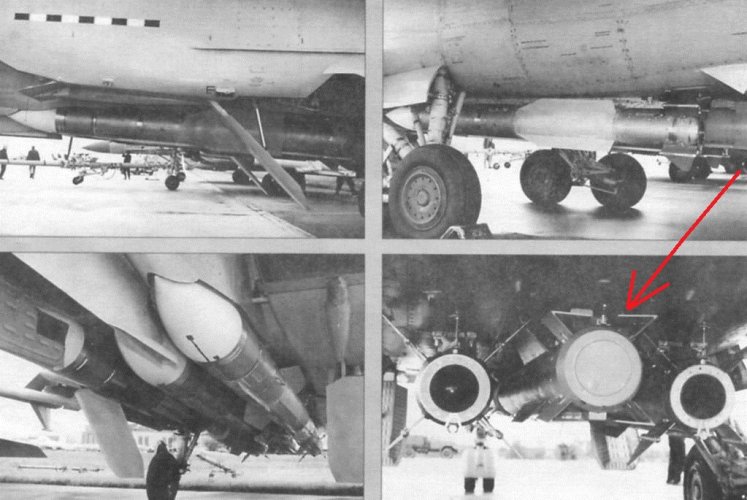
I also remember reading that when the MiG-31M was shown at an airshow with 6 missiles under its fuselage, the 4 outer ones were R-37's and the 2 middle ones were R-33S's with the main fins removed. The 13th photo below the article at the link below may show that.

http://авиару.рф/aviamuseum/aviatsiya/sssr/istrebiteli-2/istrebiteli-1960-g-1991-g/istrebiteli-okb-mikoyana-i-gurevicha/istrebitel-perehvatchik-mig-31/istrebitel-perehvatchik-mig-31m/
 
Last edited:
The photo may be on page 37 of this edition of Aviation Week. It is the "Defense (2)" entry in the table of contents. I don't have access.

https://archive.aviationweek.com/issue/20090413/#!&pid=36

I also remember reading that when the MiG-31M was shown at an airshow with 6 missiles under its fuselage, the 4 outer ones were R-37's and the 2 middle ones were R-33S's with the main fins removed. The 13th photo below the article at the link below may show that.

http://авиару.рф/aviamuseum/aviatsiya/sssr/istrebiteli-2/istrebiteli-1960-g-1991-g/istrebiteli-okb-mikoyana-i-gurevicha/istrebitel-perehvatchik-mig-31/istrebitel-perehvatchik-mig-31m/

Yes ,we commented that photo once. In fact ,wings were not attached. One of the forward stabilizers is clearly visible. About source for the mentioned photo ,this will be reserve variant:

https://aviationweek.com/share-aviation-daily-without-violating-copyright-law-133
 
Even this famous site gave wrong data :

Р-33С / "изделие 420" ? (1990 г.) - модернизированный серийный вариант ракеты для комплекса вооружения МиГ-31Б, ракета оснащена активной РЛ ГСН с БЦВМ

http://militaryrussia.ru/blog/topic-102.html
We know now that R-33S has inertial+SARH only.

Additional data/info :

Very interesting detail about R-33 ,during R&D work they first planned to integrate canards which were later used on R-33S.

''Первоначально для ракеты приняли схему "утка" и размещение на пилонах под крылом по типу реализованного на МиГ-25 для К-40. Однако в дальнейшем разработчики перешли на "нормальную" аэродинамическую схему, обеспечивающую более высокое аэродинамическое качество, что особенно важно для ракеты большой дальности.''

''Initially, the missile adopted a canard configuration and was mounted on underwing pylons, similar to the K-40 on the MiG-25. However, the developers later switched to a "normal" aerodynamic configuration, which provides higher lift-to-drag ratio, which is especially important for a long-range missile.''

Source: https://sovetarmy.forum2x2.ru/t17-topic
 
So, reading a bit more, the 100km mid-course correction datalink is associated with the R-37 not R-33. So it is incorrect to associate it with the basic R-33. The question is whether the R-33S had this capability or not.

AWST 13 March 2009

Russian Icon
Moscow reveals AAM inventory for Foxhound upgrade, unveils revised Amos
DOUGLAS BARRlE/lONDON

The Russian air force is—for the first time—detailing the air-to-air weapons capability of the MiG-31BM variant of the Foxhound, and showing the actual configuration of the R-33S long-range missile.

A MiG-31BM was on display at Kubinka air base for the visit of President Dmitry Medvedev at the end of March,, as was an array of weaponry for the aircraft. Medvedev was shown the latest additions to the air force inventory and upgraded aircraft types; he also was given a flight in a Sukhoi Su-34 Fullback.

The appearance of the MiG-31BM, and its weaponry, underscores the aircraft’s continuing importance—and prestige— to the air force. The Foxhound remains the service’s primary long—range air defense platform, designed from the outset to engage strike aircraft as well as cruise missiles. The MiG-31BM is an upgrade to inservice aircraft, but draws on systems and weapons originally intended for the canceled MiG-31M mid-life upgrade. The
aircraft’s passive phased array radar is believed to be boosted to the Zaslon-AM standard.

Displayed at Kubinka alongside two Vympel (now part of Tactical Missile Corp.) R—33 (AA-9 Amos) missiles were two R—33Ss (AA—9B5). The latter variant has only been partially seen in photographs taken in 1994 at the air force flight test center at Ahktubinsk.

The R-33Ss in the 1994 photos were mounted in the two center semi-recessed stations of the MiG-31M. That aircraft was designed to carry up to six long-range air-to-air missiles semirecessed under the fuselage, while earlier versions of the Foxhound could only carry four. The R—33S displayed did have the four fixed destabilizers to the rear of the radome; it did not have its main wing surfaces fitted.

The two R—33Ss at Kubinka indicate an alteration to the wing configuration; the trailing edge now ends considerably short of the four rear-control surfaces. Development of the R—33S stretches back to the 1980s, and its service status has long remained in question publicly, though test rounds, at least, may have been produced as far back as the early 1990s. The development of an improved variant of the basic Amos reputedly stemmed in part from some specifications being compromised by Adolf Tolkachev, a lead engineer at a major design bureau, who passed classified information to the US, including on the Foxhound and its weapons. This is believed to have spurred development of the MiG-31B/BS, with the modified Amos s part of the effort.

Aerodynamically, the R—33S offers improved maneuverability over the basic weapon. The R—33 was not designed to engage a maneuvering target;
however, the introduction of destabilizers along with the redesigned wing offers some increase in performance in this area. The Amos has a published maximum engagement range of about 120 km. (64 naut. mi.) against a non-maneuvering target at high altitude; the range is reduced for low—altitude engagements to around 35 km. Semi-active radar-guidance is used for the terminal phase of the engagement.

Vympel officials have also suggested that the design included changes to the solid-rocket motor. The basic R—33 weighs 490 kg. (1,080 lb.) and is carried on the MiG-31 by the AKU-410 pylon. A pylon variant, the AKU -410-1, however, was described by Vympel as capable of carrying a 530-kg. weapon. The weight increase could indicate the weapon has a greater overall kinematic capability
than the original R-33.

A display board at Kubinka indicated that the aircraft would be capable of carrying K-77-1s and K—37Ms—designations for further developments of the R—77 (AA-12 Adder) and K—37 (AA-X—13), respectively, both designed by Vympel.

The K—77—1 is the first element in a staged upgrade program of the basic R—77, which has not entered Russian air force inventory in significant numbers. Flight testing of the K—77—1 may well have been underway by 2007. A more extensive upgrade of the R—77 (known as RVV-AE for export) is the K—77M.

The K—37M is a further development of the K—37 program intended for the MiG—31M. Test firings of the K—37 were carried out in the mid-1990s, well in excess of the maximum engagement of the R—33. A firing in 1994 included hitting a large target at a range of 260 km. The original K—37 may have employed a dual-mode semi-active/active-radar seeker combination, though the K—37M might use only the active-radar guidance.
Photo is a wider shot of that already posted, credited to Sergei Kuznetsov.

Article in Air Forces Monthly May 2018 apparently connects the general R-33S secrecy with its use of a nuclear warhead? I don't have a copy.
 
Last edited:
Yes, it seems like that . In fact, launch itself is very similar to those one of the new R-37M.After ejecting from AKU-410/-1, R-33 declines like R-37M downward and then begins to climb but not to go lofting as you mentioned/described.
Not to derail but probably the best example of lofting I've seen starts right here:

 
Last edited:
So, reading a bit more, the 100km mid-course correction datalink is associated with the R-37 not R-33. So it is incorrect to associate it with the basic R-33. The question is whether the R-33S had this capability or not.

It seems like that. 100km range for the RC -channel is for the N007M ( so for the both R-33S and old K/R-37 ) For the R-33, we have data that 10%-20% of the trajectory belongs to the inertial guidance with possible use of that RC -channel, so 80%-90% is SARH .

Another detail ,this is from citation :

''Aerodynamically, the R—33S offers improved maneuverability over the basic weapon. The R—33 was not designed to engage a maneuvering target.''


This is from the Vladimir Ilyin's article which is obviously copy of the A.Fedothencko's one ?

''Perhaps, the experiment, carried out on 21 April by 1994 became the most effective flying experiment, which entirely demonstrated the possibility of aviation complex, on the simultaneous fire of four aerial targets. As the latter were begun to operate the specially equipped fighters MiG-21 (guided from the surface control centers), that had relatively low RCS and high maneuverability.

The first target flew at the altitude of 7100 m, the second - 1720 m, the third - 2470 m, the fourth - 6230 m. the sequence of the fire of targets was determined by the program of computing system MiG-31: 4-2-3-1. All targets, which maneuvered on the course, were annihilated in several ten kilometers from the fighter-interceptor.''

R-33 could/can engage targets which can maneuver only with max 4G load ( so non maneuverable targets like bombers,SR-71 stratetig recce ,low flying CM's etc ) .That parameter was increased to 8G with R-33S .So the test from 21 April 1994 was accomplished with MiG-31B armed with four R-33S engaging four RC- MiG-21 or M-21 / М-21 (М-21М) (1967) — высокоманёвренный радиоуправляемый самолёт-мишень./


Article in Air Forces Monthly May 2018 apparently connects the general R-33S secrecy with its use of a nuclear warhead? I don't have a copy.

That's questionable and even Russian sources mentioned that in many cases...

''...модификация Р-33С ("изделие 520") оснащена ядерной боевой частью.''

''R-33S modification ("item 520") equipped with a nuclear warhead.''

https://www.aviationunion.ru/media/news/13190/
https://bmpd.livejournal.com/3206861.html
Russian sources mentioned that this letter S means ''специальная'' or special ,hm Don't think that R-33S has nuclear warhead.In that case, missile itself would be under control of many limitations and agreements between Russia and USA.

One more detail :

''Р-33С с активной РГСН. Р-33С - первая советская ракета, оснащенная встроенной цифровой БЦВМ.''

https://missilery.info/missile/r33
It seems that even older R-33 has digital comp. onboard.
 
Well, it seems like R-33S was built in series to some extent, but it never seems to be photographed in use.
 
Thirty-eight years ago, on August 28, 1978, the world's first flight experiment involving the simultaneous engagement of four radio-controlled targets with R-33 missiles was conducted by a MiG-31 interceptor equipped with the Zaslon weapon control system (WCS), equipped with a phased array radar (PAR).
This 38-year-old event is recalled by one of the R-33 missile development managers and its lead designer, Lenin Prize Laureate, Russian Federation Government Prize Laureate, USSR Higher School Prize Laureate, Honored Designer of the Russian Federation, Advisor to the Deputy General Director for R&D, Yu.K. Zakharov, who, upon graduating from the GSLI, was appointed Deputy Chief Designer of the Vympel Plant by order of the USSR Minister of Aviation Industry V.A. Kazakov on November 19, 1980. At that time, the MiG-31 interceptor with R-33 missiles was in the final stages of the State Joint Flight Tests (SJFT), during which this highly complex and organizationally important experiment was conducted. The objective was to confirm the ability of the new-generation air-launched missile system to effectively engage four air targets simultaneously with long-range missiles, flying in different modes.

On that day, August 28, the entire test range in Akhtubinsk, Astrakhan Region, had been busy since 5:00 a.m. preparing for the main task—ensuring the effective combat performance of the air-launched system. The weather was favorable. All the range's services worked efficiently and harmoniously. Three MiG-31 interceptors awaited orders at the airfield to load their missiles and depart for the mission. Twelve experimental missiles manufactured by Vympel were stacked on transport trolleys. La-17 and MiG-21 radio-controlled targets, escort aircraft, and MiG-31 aircraft—the experiment's backups—were positioned nearby on spare runways. All ground systems were also ready for critical missions. The experiment was supervised by the Chairman of the State Commission for the General Defense of the Soviet Union, Marshal of Aviation Yevgeny Yakovlevich Savitsky, twice Hero of the Soviet Union.
The experiment began on his command. About 20 aircraft were launched. The aircraft, the radio-controlled targets, and the escort aircraft took off.
For the first time in the world, all participants froze in trepidation. And it was worth it.

The long-range airborne interception system (AKDP) based on the MiG-31 interceptor with R-33 missiles demonstrated its effectiveness. Four experimental R-33 missiles, fired from a single fighter, hit all four targets on the first try. This experiment culminated 12 years of intense work by our company's team to create the first domestic long-range missile for the MiG-31 interceptor.

Many of our company's employees, who are still working there today, actively participated in these unforgettable events at the Akhtubinsk test site. These include V.G. Bogatsky, M.N. Pravidlo, A.V. Andryushin, Yu.M. Volkov, O.L. Gribanov, A.A. Medvedkin, A.G. Lebedev, A.V. Egorshin, V.I. Fedin, A.A. Korsakov, L.B. Gaidai, L.V. Ocheretny, and others.

Pride in the timely fulfillment of the USSR government's assignment and the high achievements in their work filled the hearts of the employees of the design bureau, production, test site, and related enterprises. Over these years, many fundamentally new technical and technological challenges were solved, which subsequently allowed the Vympel team to move forward, developing more advanced long- and ultra-long-range products to support the advanced air-launched missile systems of next-generation fighters.

Assistant General Director
S.S. Radinsky
https://web.archive.org/web/2019032...ds/2016/11/Gazeta-2016-10-Oktyabr-na-sajt.pdf
 
Last edited:
Some details about serial production of the 'Titanium made R-33' which was in produced from 1981 until 1993 :

''Приказом МАП от 04.02.81 г., одновременно с серийным выпуском изделии 9М38 , заводу было поручено производство ракеты Р-33 (изделие «410») класса «воздух-воздух» разработки МКБ «Вымпел» (главный конструктор Г.А. Соколовский) для вооружения самолета-перехватчика МиГ-31 комплекса "Заслон" ПВО страны.
Система наведения ракеты — инерциально-полуактивная радиолокационная — позволяет поражать одиночные и групповые цели (до 4-х одновременно), летящие на высотах от 50 м до 25 км в любых метеоусловиях, в любое время года и суток. Тип целей: крупноразмерные (бомбардировщики и транспортные самолеты); среднеразмерные (истребители, штурмовики, разведчики); малоразмерные (крылатые ракеты), летящие в свободном пространстве и на фоне земной поверхности (земля, горы, вода).

Изделие «410» было принято на завод после неудачной попытки его изготовления на других заводах нашего министерства. ДМЗ принял изделие с завода «Стрела» (г. Калининград, ныне Королев). Ответственным за освоение производства этой ракеты был назначен зам. главного инженера А.П. Булашевич.
Отличительной технологической особенностью изделия «410» являлось то, что весь корпус был выполнен из титанового сплава ВТ20. Отсеки корпуса изготавливались в основном на станках с ЧПУ и обрабатывающих центрах. Для изготовления профилей крыла была изготовлена и внедрена установка для гибки профилей с радиационным нагревом. Авторы: А.З. Бессарабов (отдел 240), СВ. Конкин (отдел 216).

В ходе производства ракеты Р-33 было освоено изготовление титановых деталей холодной штамповки, сварка титановых узлов в камере с контролируемой средой, автоматическая точечная сварка титановых поверхностей на сварочной машине с программным управлением. Был создан участок для изготовления элементов теплозащиты ATM, освоено литье корпусов рулевых приводов из алюминиевого сплава ВАЛ-10. Было организовано производство двигателя 9Ж-1036, разработчик Казанское КБ «Союз».

Обечайки двигателя и газогенератор рулевых приводов изготавливались методом раскатки на стенках СРГ-1200 и СРГ-300. Была освоена и доведена до практического применения установка комплексного контроля «Трубеж». Ракета была успешно освоена и производилась до 1993 года.''

''By order of the Ministry of Aviation Industry of 04.02.81, simultaneously with the serial production of the 9M38 product, the plant was tasked with the production of the R-33 (product "410") air-to-air missile developed by the Vympel Design Bureau (chief designer G.A. Sokolovsky) for arming the MiG-31 interceptor aircraft of the Zaslon air defense system of the country.
The missile's guidance system, an inertial-semi-active radar, allows it to engage single and group targets (up to four simultaneously) flying at altitudes from 50 m to 25 km in any weather conditions, at any time of year or day.Target type: large-sized (bombers and transport aircraft); medium-sized (fighters, attack aircraft, reconnaissance aircraft); small-sized (cruise missiles), flying in free space and against the background of the earth's surface (land, mountains, water).

The "410" missile was accepted at the plant after unsuccessful attempts to manufacture it at other plants within our ministry. DMZ accepted the missile from the Strela plant (Kaliningrad, now Korolev). Deputy Chief Engineer A.P. Bulashevich was appointed responsible for developing production of this missile.

A distinctive technological feature of the "410" was that the entire hull was made of VT20 titanium alloy. The hull sections were manufactured primarily on CNC machines and machining centers.A radiant-heated bending system was developed and implemented for the production of wing profiles. Authors: A.Z. Bessarabov (Department 240), S.V. Konkin (Department 216).

During the production of the R-33 missile, the production of cold-stamped titanium parts, welding of titanium components in a chamber with a controlled environment, and automatic spot welding of titanium surfaces on a CNC welding machine were mastered.A facility for manufacturing ATM thermal protection components was established, and the casting of steering gear housings from VAL-10 aluminum alloy was mastered. Production of the 9Zh-1036 engine, developed by the Kazan Soyuz Design Bureau, was established.

The engine shells and steering gear gas generators were manufactured using the SRG-1200 and SRG-300 wall-forming method. The Trubezh integrated testing system was developed and brought to practical use. The missile was successfully tested and remained in production until 1993.''


Source: https://dolgoprud.org/doc/?book=29&page=628


As we know ,newer R-37M /Izd 610M is also produced in Strela plant from 2015.
 
Very interesting,with old R-33 they engaged targets like maneuverable RC La-17 and M-21 even in 1978.
Erm.... No. La-17 was not very manouverable at all. The Chinese clone of it was stressed to max 4g, which puts it in Foxbat territory. It was a simple target aircraft. Interesting to note:

La-17MM or izdeliye 202M. The specification called for an operational altitude envelope of 500-18,000 m (1,640-59,055 ft) and an RCS in the 3-cm
waveband equal to that of the Tu-16 and IL-28 bombers
and the FKR-1 cruise missile.
Yefim Gordon, Red Star 20 - Soviet UAVs

I'd say the 16 sqm / 19 sq m RCS "standard bomber target" was probably La-17MM, and the M-21 the 3 sq m RCS "standard fighter target"

However, if you think even M-21 targets were doing high g turns during radar and missile testing, I highly doubt it.
 
Last edited:
Erm.... No. La-17 was not very manouverable at all. The Chinese clone of it was stressed to max 4g, which puts it in Foxbat territory. It was a simple target aircraft. Interesting to note:


Yefim Gordon, Red Star 20 - Soviet UAVs

I'd say the 16 sqm / 19 sq m RCS "standard bomber target" was probably La-17MM, and the M-21 the 3 sq m RCS Fighter target"

However, if you think even M-21 targets were doing high g turns during radar and missile testing, I highly doubt it.

Of course,we know that for the R-33 that limitation was 4G as the max G -load for the engaged target .

Now as we can see, targets for the R-33 were : RC- La-17MM, M-16 and M-21 .
 
Comment from the OKB Mikoyan test pilot Vladimir Kondaurov :

''Вот как вспоминает в книге "Взлетная полоса длиною в жизнь" о своем участии в отработке МиГ-31 заслуженный летчик-испытатель СССР Герой Советского Союза полковник Владимир Николаевич Кандауров:

Каким же образом выглядел один из полетов на испытание вооружения с реальным уничтожением четырех самолетов-мишеней?

- Я сидел в кабине и откровенно зевал, совершенно, не зная чем бы себя занять. Мы уже с полчаса летели с курсом 90 градусов на самом удобном для нас режиме по скорости и высоте. Где-то впереди на малых высотах навстречу нам должны были лететь мишени, разбросанные по фронту на 50 км. Эфир был пуст. Ощущение, что ты один в бескрайнем небе". "Не беспокойся, ты не один, - усмехнулся я сам себе, - сзади штурман работает. Уж ему-то не до "дураков" сейчас". Все же не выдерживаю и нажимаю кнопку внутренней связи:

- Коля, мне надоело спать, скажи как у тебя дела? Что делаешь?

- Сплю, - услышал тихий голос штурмана Н.Волкогонова

- Хорошее дело! - воскликнул я в удивлении, - Оба спим, а кто же работает?

- "Заслон" работает, в автомате. Пока сидим и ждем.
- Осматриваю еще раз пульт вооружения. Все включено, Ракеты готовы к пуску. Еще пять минут общего молчания. Вдруг на стекле (индикатор на фоне лобового стекла) появилась метка цели, сигнал "Атака" и шкала дальности.

Первая - наиболее опасная - слева под 30, работай, командир, - слышу голос своего штурмана.

Доворачиваю самолет, "накладываю" прицельное кольцо на метку цели и туту же вхожу в зону пусков. Пошла, родная!
Сразу после схода ракеты появляется метка второй цели справа. Энергичный разворот. Чтобы удержать кольцо на цели, перехожу в пикирование. До цели 40 км. Начало зоны пусков с 30 км. В запасе семь-восемь секунд, можно проконтролировать двигатель. "Значит следующие две еще менее опасные, значит, у меня будет время на маневры", - спокойно рассуждаю я, и пускаю вторую. Через двадцать секунд все было кончено.

- Командир, все четыре сбиты, поворачиваем домой, здесь нам делать больше нечего, - слышится в наушниках довольный голос Николая.

- Да, - отвечаю, - все так просто, что даже противно.''
''Here's how Honored Test Pilot of the USSR, Hero of the Soviet Union, Colonel Vladimir Nikolaevich Kandaurov, recalls his participation in the development of the MiG-31 in his book "A Runway as Long as Life":
- What did one of the weapons testing flights with the actual destruction of four target aircraft look like?

I sat in the cockpit, openly yawning, completely at a loss for what to do. We'd been flying for about half an hour at a 90-degree heading, at our most comfortable speed and altitude. Somewhere ahead, at low altitude, targets should be flying toward us, scattered across a 50-kilometer front. The airwaves were empty.

It feels like you're alone in the endless sky." "Don't worry, you're not alone," I chuckled to myself, "the navigator's working in the back. He certainly has no time for 'fools' right now." Still, I can't resist and press the intercom button:

Kolya, I'm tired of sleeping. Tell me, how are you? What are you doing?

"Sleeping," I heard the quiet voice of navigator N. Volkogonov.

"Good thing!" I exclaimed in surprise. "We're both asleep, but who's working?"

"The Zaslon is working, on automatic. For now, we're just sitting and waiting."

I examine the weapons control panel again. Everything is on, the missiles are ready to launch. Another five minutes of general silence. Suddenly, a target marker, an "Attack" signal, and a range scale appear on the windshield (the indicator against the background of the windshield).

The first one—the most dangerous one—is on the left, at 30. "Get going, commander," I hear my navigator say.I turn the plane, align the aiming ring with the target mark, and immediately enter the launch zone. "Go, my dear!"
Immediately after the missile launches, the second target's blip appears on the right. A vigorous turn. To keep the ring on the target, I go into a dive. The target is 40 km away. The launch zone begins at 30 km. I have seven to eight seconds to spare; I can check the engine.
"That means the next two are even less dangerous, which means I'll have time to maneuver," I reason calmly, and launch the second one. Twenty seconds later, it was all over.

"Commander, all four have been shot down. We're turning back for home. There's nothing more for us to do here," Nikolay's satisfied voice comes through the headphones.
"Yes," I reply, "it's all so simple it's almost disgusting."


Source: https://www.airwar.ru/enc/fighter/mig31.html

Question is ,was it that test from Aug. 1978 ?

 
Even this famous site gave wrong data :

Р-33С / "изделие 420" ? (1990 г.) - модернизированный серийный вариант ракеты для комплекса вооружения МиГ-31Б, ракета оснащена активной РЛ ГСН с БЦВМ

http://militaryrussia.ru/blog/topic-102.htmlWe know now that R-33S has inertial+SARH only.

Additional data/info :
What part of “upgraded serial version (1990) “ did you not see? Lots of R-33 versions tested in 90s, this is not hard to understand when R-37M clearly took a lot of effort to get there from original R-33.
 
What part of “upgraded serial version (1990) “ did you not see? Lots of R-33 versions tested in 90s, this is not hard to understand when R-37M clearly took a lot of effort to get there from original R-33.

Do not understand in fact . Only one ,modified version was tested ,it was R-33S.

Interesting details :

''Главный инженер проекта Ю.К. Захаров: «Начнем с того, что эта ракета создавалась как составная часть истребителя-перехватчика. Чтобы уменьшить общее лобовое сопротивление, четверку Р-33 решили «врезать» в его фюзеляж. Это обеспечило удобное расположение ракет, получивших защиту от кинетического нагрева и испытывавших меньшие нагрузки при скорости носителя, соответствующей М3». По той же причине часть деталей Р-33 изготовили из стойких к высоким температурам титановых сплавов, внедрили тепловую защиту корпуса и внутренних агрегатов и узлов. Поскольку ракеты находятся не на открытых подкрыльевых пилонах-держателях, а полуутоплены в фюзеляж и запускаются катапультными устройствами, их снабдили крылом малого удлинения и двумя складывающимися рулями.Разработку Р-33 завершили в 1980 г, через два года приняли на вооружение, а спустя некоторое время появилась модификация с увеличенной дальностью пуска и экспортная Р-ЗЗЭ.''

''Chief Engineer of the project, Yu.K. Zakharov: "Let's start with the fact that this missile was designed as an integral part of a fighter-interceptor. To reduce overall drag, it was decided to 'cut' four R-33s into its fuselage.
This ensured a convenient placement of the missiles, which were protected from kinetic heating and experienced lower loads at a carrier speed corresponding to M3." For the same reason, some R-33 components were made from high-temperature-resistant titanium alloys, and thermal protection was introduced for the hull and internal units and components.Since the missiles are not carried on open underwing pylons, but are semi-recessed into the fuselage and launched by ejection devices, they were equipped with a low aspect ratio wing and two folding rudders.
The development of the R-33 was completed in 1980, and two years later it was accepted into service. Some time later, a modification with an increased launch range and the export R-33E appeared.''

Source: https://epizodsspace.airbase.ru/bibl/tehnika_-_molodyoji/2000/9/30-35.html

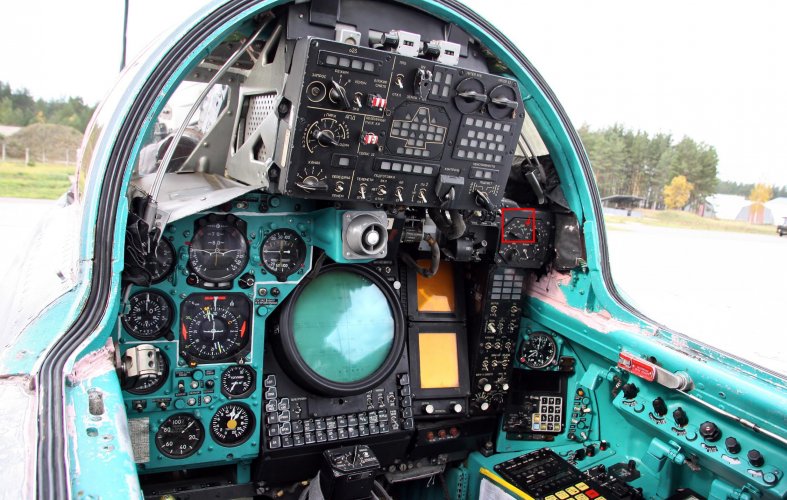
R-33's can be in fact launched even when MiG-31 flies with true air speed of Mach 2.8 .


Cockpit_of_Mikoyan-Gurevich_MiG-31_(7) (1)mod.JPG
 
Control system of armament (SUV) “Zaslon”, worked out for the fighter-interceptor MiG-31 - unique article, whose many characteristicss, until now, are not exceeded on the foreign analogs.
Characteristicss of complex maximally high for their time were to a considerable extent achieved due to the carrying out of multiple, now and then completely large-scale (as it is organizational, so also materially) flight tests and experiments. Some of these experiments, until now, are unique.
Should be noted the the fact that similar experiments, directed toward a increase in the possibilities of aviation complex, they were conducted also after reception MiG-31 for the armament. Let us pause only at the individual, most significant development stages of complex, carried out BY NIIP im. V.V Tikhomirov and OKB A. I. Mikoyan in the course of flight tests MiG-31.

On 15 February of 1978 in Akhtubinske took place not [povtorjonnyj], until now, not by some foreign aviation complex flying experiment on the simultaneous detection, the capture and the accompaniment of 10 aerial targets, which fly by wide front (on the order of 150 km) at different heights.

Interceptor MiG-31 executed flight at height 5000 m. of target were distributed to two groups. The first group flew at the altitude of from 8400 m to 9600 m, the second - from 1400 m to 2600 m. thus, in one experiment was evaluated the work SUV “Zaslon” both according to the targets, which fly against the background free space (sky), and along the targets, which fly (relative to interceptor) the against the background underlying (terrestrial) surface. The maximum detectable range of targets (had EPR on the order of 16 m2) was 210 kilometers.

Target Number-Distance of detection/automatic target tracking-Target Altitude, m
1 141,3 1400
2 162,2 9000
3 136,5 2000
4 124,8 1700
5 131,5 2600
6 137,8 9300
7 144,3 8700
8 121,5 9600
9 112,2 2300
10 115,4 8400

The total time of detection and tracking was 153,5 s. in this case the first seven targets were detected and tracked for 69,5 s. the time, spent directly on the procedure of the target of seven lock-ons, it composed 24,3 s , and 10 targets -49,05 s.

For the exclusion of the repeated target of one and the same lock-on and, as a result, “recycling” of the work of system was introduced the comparison of the coordinates newly locked on and inhibit to their repeated capture.

It must be noted, that the possibility of repeated lock on and tracking one and the same target in one flying experiment made it possible to estimate the load of calculating processes and to gather statistics according to the observation of the signals of target (mode for the experimental works) without the organization subsequently of the expensive flights of 10 of targets.

The creation of the phased antenna array (FAR) for SUV “Zaslon” made it possible not only to realize the multipurpose work of radar complex, but also to work out the application of mode of the so-called “consecutive feeler” for a increase in the range. In this case the analysis is conducted during two-four elementary temporary time (position of the ray FAR [ostajotsja] invariable). Lower and upper thresholds in each time are different. With the excess of the upper limit in each of 180 sectors of Doppler frequencies is developed the signal “target”. Consecutive feeler made it possible to obtain the gain in the range of detection of aerial targets, component approximately 20-25%. In this case entire procedure of consecutive detection is realized in special analog-digital processor.

The realization of this mode in the up-to-date digital signal processors is problematic because of the insufficient speed and the need organizing the special calculating process.

On 28 August of 1978 MiG-31 it successfully destroyed by four simultaneously released rockets R-33 of four radio-controlled airborne target.

On 18 August of 1993 was carried out a series of flying experiments on the interception of target at maximum range. In the course of the first of them the radio-controlled target, which flies at the height of 10.300 m with a velocity of 189 meters per second, was locked on by interceptor MiG-31 (flight altitude 8480 m, velocity - 669,3 meters per second) at the range if 319,5 kilometers the launch of rocket R-33 (successfully destroyed target) was carried out at the distance 228 kilometers.

Perhaps, the experiment, carried out on 21 April by 1994 became the most effective flying experiment, which entirely demonstrated the possibility of aviation complex, on the simultaneous fire of four aerial targets. As the latter were begun to operate the specially equipped fighters MiG-21 (guided from the surface control centers), that had relatively low RCS and high maneuverability.

The first target flew at the altitude of 7100 m, the second - 1720 m, the third - 2470 m, the fourth - 6230 m. the sequence of the fire of targets was determined by the program of computing system MiG-31: 4-2-3-1. All targets, which maneuvered on the course, were annihilated in several ten kilometers from the fighter-interceptor.

Thus, SUV “Zaslon” under the conditions, maximally approximating real, confirmed its unique characteristicss. It should be noted that and today aviation complex MiG-31, created still in 1968-1981 years, did not drain its evolutionary possibilities. Its modernization will make it possible to substantially increase combat potential and will attach to it the characteristicss, which correspond to requirements for the fighter-interceptors XXI of century.

For the creation SUV “Zaslon” and its modifications of 196 coworkers of NIIP they were rewarded with orders and medals of USSR.

But was begun development SUV “Zaslon” in 1968 at first it it advanced complicatedly and difficultly. All technical decisions were new: FAR, quasi-continuous emission, multipurpose work, group activities and other this now, 37 years later, they are steels customary, clear and as by itself understanding, necessary in each new development. In this case it is important to note that the fundamental technical decisions were immediately selected correctly, but their practical realization was extremely difficult task.

In the process of the work on SUV “Zaslon” was added the creative strategic formation of the specialists of different organizations. Implication to the solution of priority problem, scale of works and highest level of scientific and technological tasks drew together the specialists of the firm of the developer of – NII instrument manufacture, series plant “Leninist” and the set of enterprises and services of science, industry and client.

But by the meaningful result of development SUV “Zaslon” was creation in NIIP of scientific technical school for the development of antenna systems and radar with electronic control of ray, capable of today conducting the most complex and foremost developments both for the aviation and for the antiaircraft missile systems.
Flight tests of SUV “Zaslon”
Vladimir Ilin
“Aerospace review”, №5, 2005, pages 42-43


So according to the translation from Key publishing, it appear that SUV Zaslon is referring to upgrade version of basic Zaslon, so it seem to be the Zaslon-A. Which mean the test on 18 Aug 1993 was done by Mig-31B using R-33S
 
The Zaslon weapon control system (WCS), developed for the MiG-31 interceptor, is a unique product, many of whose characteristics remain unsurpassed by foreign counterparts. The system's exceptionally high performance for its time was largely achieved through numerous, sometimes very large-scale (both organizationally and logistically), flight tests and experiments. Some of these experiments remain unique.

It should be noted that similar experiments aimed at enhancing the capabilities of the aircraft system were conducted even after the MiG-31 entered service. We will focus on only a few of the most significant stages of the system's development, conducted by the V.V. Tikhomirov Research Institute of Instrument Engineering and the A.I. Mikoyan Design Bureau during the MiG-31's flight tests. On February 15, 1978, a flight experiment involving the simultaneous detection, acquisition, and tracking of 10 aerial targets flying over a wide front (approximately 150 km) at various altitudes took place in Akhtubinsk.

A flight experiment, never before repeated by any foreign aviation complex, involved the simultaneous detection, acquisition, and tracking of 10 aerial targets flying over a wide front (approximately 150 km).

A MiG-31 interceptor flew at an altitude of 5,000 m. The targets were divided into two groups. The first group flew at altitudes from 8,400 m to 9,600 m, the second from 1,400 m to 2,600 m. Thus, in a single experiment, the performance of the Zaslon combat control system was evaluated against both targets flying against a background of open space (the sky) and targets flying (relative to the interceptor) against the underlying (earthly) surface. The maximum target detection range (with an RCS of approximately 16 m) was 210 km.

The total detection and acquisition time was 153.5 s. The first seven targets were detected and acquired in 69.5 s.

The time spent directly on the acquisition procedure for seven targets was 24.3 s, and for 10 targets, 49.05 s.

To prevent multiple acquisitions of the same target and the resulting "looping" of the system, a comparison of the coordinates of newly acquired targets and a ban on their repeated acquisition were introduced.

It should be noted that the ability to multiple acquire and track the same target in a single flight experiment made it possible to evaluate the computational load and collect target signal observation statistics (experimental mode) without the need for costly subsequent flights for 10 targets. The development of a phased array antenna (PA) for the Zaslon radar system allowed not only the implementation of multi-purpose operation of the radar system, but also the development of the so-called "sequential detector" mode to increase the operational range.

In this case, the analysis is carried out over two to four elementary time cycles (the position of the PA beam remains constant).

The Zaslon weapon control system (WCS), developed for the MiG-31 interceptor, is a unique product, many of whose characteristics remain unsurpassed by foreign counterparts. The system's exceptionally high performance for its time was largely achieved through numerous, sometimes very large-scale (both organizationally and logistically), flight tests and experiments. Some of these experiments remain unique.

It should be noted that similar experiments aimed at enhancing the capabilities of the aircraft system were conducted even after the MiG-31 entered service. We will focus on only a few of the most significant stages of the system's development, conducted by the V.V. Tikhomirov Research Institute of Instrument Engineering and the A.I. Mikoyan Design Bureau during the MiG-31's flight tests. On February 15, 1978, a flight experiment involving the simultaneous detection, acquisition, and tracking of 10 aerial targets flying over a wide front (approximately 150 km) at various altitudes took place in Akhtubinsk. This experiment, never before repeated by any foreign aviation complex, involved the simultaneous detection, acquisition, and tracking of 10 aerial targets flying over a wide front (approximately 150 km) at various altitudes.

A MiG-31 interceptor flew at an altitude of 5,000 m. The targets were divided into two groups. The first group flew at altitudes from 8,400 m to 9,600 m, and the second from 1,400 m to 2,600 m. Thus, the performance of the "Zaslon" control system was evaluated in a single experiment. The lower and upper thresholds in each cycle are different. When the upper threshold is exceeded, a "target" signal is generated in each of the 180 Doppler frequency segments. The sequential detector allowed for an increase in aerial target detection range of approximately 20-25%. The entire sequential detection procedure was implemented in a dedicated analog-to-digital processor. Implementing this mode in modern digital signal processors is problematic due to insufficient performance and the need to organize a dedicated computing process.

On August 28, 1978, a MiG-31 successfully engaged four radio-controlled aerial targets with four R-33 missiles fired simultaneously.

On August 18, 1993, a series of flight experiments to intercept targets at maximum range were conducted. During the first of these, a radio-controlled target, flying at an altitude of 10,300 m and a speed of 189 m/s, was captured by a MiG-31 interceptor (flying at an altitude of 8,480 m and a speed of 669.3 m/s) at a distance of 319.5 km. The R-33 missile (which successfully hit the target) was launched at a range of 228 km.


MOSCOW 73/23028 67 15/10 1827
PRESIDENT
of the Rassinsky FEDERATION - MOSCOW 17} ZENIT LENINGRADSKOE HIGHWAY 6
TO GENERAL DESIGNER RA BELYAKOV.
I CONGRATULATE YOU AND THE WORK TEAMS OF THE COMPANIES PARTICIPATING IN THE CREATION OF OBJECTS 05 AND PRODUCTS 610 ON THE UNIQUE RESULTS ACHIEVED DURING THEIR TESTING.
THE PRESIDENT AND THE GOVERNMENT WILL ALWAYS SUPPORT EFFORTS AIMED AT THE CREATION OF NEW TECHNOLOGY, INCREASING ITS EFFICIENCY, RELIABILITY, AND COMPETITIVENESS IN THE GLOBAL MARKET.
WE WISH YOU FURTHER CREATI SUCCESS.
NR-PR-1593 B, YELTSIN
1838. 15U 0046
Perhaps the most spectacular flight experiment, which fully demonstrated the capabilities of the aviation complex, was the experiment conducted on April 21, 1994, involving the simultaneous firing of four aerial targets. The latter were specially equipped MiG-21 fighters (controlled from ground command posts), which had a relatively low radar cross-section and high maneuverability.

The first target flew at an altitude of 7,100 m, the second at 1,720 m, the third at 2,470 m, and the fourth at 6,230 m. The target engagement sequence was determined by the MIIG-31 computer system program: 4-2-3-1. All targets maneuvering on course were destroyed within a few dozen kilometers of the interceptor.

Thus, the Zaslon combat control system, under conditions as close to real-life as possible, confirmed its unique characteristics. It should be noted that Even today, the MiG-31 aircraft system, developed back in 1968-1981, has not exhausted its evolutionary potential. Its modernization will significantly increase its combat potential and give it characteristics that meet the requirements of 20th-century fighter-interceptors.

For the creation of the Zaslon fighter-interceptor system and its modifications, 196 NIIP employees were awarded USSR orders and medals.

Development of the Zaslon fighter-interceptor system began in 1968. Initially, it progressed with difficulty and complexity. All the technical solutions were new: phased array (PAR) quasi-continuous emission, multi-purpose operation, group operations, etc. Now, 37 years later, they have become familiar, understandable, and, as a matter of course, mandatory in every new development. At the same time, it is important It should be noted that the main technical solutions were chosen correctly from the start, but their practical implementation was an extremely difficult task.

During the work on the Zaslon SUV, a creative collaboration of specialists from various organizations was formed. The involvement in solving a priority problem, the scale of the work, and the highest level of scientific and technological challenges brought together specialists from the developer company—the Institute of Instrument-Making, the Leninetz serial plant, and numerous scientific, industrial, and customer enterprises and services. But the most important result of the development of the Zaslon SUV was the creation at NIIP of a scientific and technical school for the development of antenna systems and radars with electronic beam steering, which is now capable of carrying out the most complex and advanced developments for both aircraft and anti-aircraft missile systems.
Aerospace Review, 2005 05 (better translation)
 
So according to the translation from Key publishing, it appear that SUV Zaslon is referring to upgrade version of basic Zaslon, so it seem to be the Zaslon-A. Which mean the test on 18 Aug 1993 was done by Mig-31B using R-33S

Definitely ,yes.

Citation :


''Для проведения испытаний компонентов комплекса перехвата были созданы самолеты-лаборатории - для испытаний ГСН ракет К-33 - ЛЛ-21 на базе МиГ-21 (зав.№76211524), для испытания РЛС "Заслон" и ракет - самолет-лаборатория ЛЛ-2 / ЛЛ-104-518 на базе Ту-104 (зав. №42324). Переоборудование Ту-104 осуществлялось НТК "Взлет" начиная с 1970 г. На Ту-104 начиная с 1972 г. отрабатывалась работа РЛС "Заслон" и ГСН МФБУ-410, установленных в массо-габаритные макеты ракет ГВМ-410. Для проведения испытаний в течение 1972 г. изготовлены 8 пусковых экземпляров ракет (для неуправляемых пусков), 1 бросковую ракету и 5 программных ракет (без ГСН, но с автопилотом).''

''To test the interceptor system components, aircraft-laboratories were created: the LL-21, based on the MiG-21 (plant number 76211524), for testing the K-33 missile seeker, and the LL-2/LL-104-518 aircraft-laboratory, based on the Tu-104 (plant number 42324), for testing the Zaslon radar and missiles. Tu-104 conversion was carried out by the Vzlet Scientific and Technical Complex beginning in 1970.
Beginning in 1972, the Tu-104 was used to test the Zaslon radar and MFBU-410 seeker, installed in full-scale mockups of the GVM-410 missiles. Eight launch prototypes of the missiles (for unguided launches), one throwing missile, and five program missiles (without a seeker, but with an autopilot) were manufactured for testing during 1972.''

http://militaryrussia.ru/blog/topic-102.html
Photos of the LL-2/ Tu-104LL are here :

The Tu-104LL-2 (reg CCCP-42454), the second of two LM-104-518 avionics testbeds converted from Tu-104 type airliners by NPO Vzlyot to evaluate the MiG-31’s weapon systems, primarily its Zaslon PESA radar but also the R-33 long range air to air missile.​


View: https://www.reddit.com/r/WeirdWings/comments/wcqrga/the_tu104ll2_reg_cccp42454_the_second_of_two/
 
Now we are sure about some testing data:

15 Feb 1978, MiG-31 detected /tracked two groups of M-16 ( RC version of the Tu-16).

28 Aug 1978, MiG-31 engaged four differ targets ( La-17MM and M-21) with four R-33.

18 Aug 1993, MiG-31B engaged one target ( M-16 ?) with R-33S.

21 April 1994, MiG-31B engaged four M-21 with four R-33S ???


''MOSCOW 73/23028 67 15/10 1827
PRESIDENT
of the Rassinsky FEDERATION - MOSCOW 17} ZENIT LENINGRADSKOE HIGHWAY 6
TO GENERAL DESIGNER RA BELYAKOV.
I CONGRATULATE YOU AND THE WORK TEAMS OF THE COMPANIES PARTICIPATING IN THE CREATION OF OBJECTS 05 AND PRODUCTS 610 ON THE UNIQUE RESULTS ACHIEVED DURING THEIR TESTING.
THE PRESIDENT AND THE GOVERNMENT WILL ALWAYS SUPPORT EFFORTS AIMED AT THE CREATION OF NEW TECHNOLOGY, INCREASING ITS EFFICIENCY, RELIABILITY, AND COMPETITIVENESS IN THE GLOBAL MARKET.
WE WISH YOU FURTHER CREATI SUCCESS.
NR-PR-1593 B, YELTSIN
1838. 15U 0046''

This is certainly in connecton with the test from April 1994 when prototype MiG-31M engaged one target with R-37 from the record-breaking launch distance of 304km.

Some citations :

''В апреле 1994 г. Президент России Б.Н.Ельцин поздравил создателей ракеты с успешным поражением воздушной цели на рекордной дальности 304 км. Испытания ракеты продолжались по 1997 г.''

''In April 1994, Russian President Boris Yeltsin congratulated the missile's creators on their successful destruction of an aerial target at a record-breaking range of 304 km. Testing of the missile continued through 1997.''

''Государственные испытания МиГ-31М завершились в апреле 1994 г. успешным поражением учебной воздушной цели на удалении 300 км. Поздравления с окончанием госиспытаний МиГ-31М и успешным поражением ракеты-мишени коллективу ОКБ МиГ направил Президент России Борис Николаевич Ельцин.''

''State testing of the MiG-31M concluded in April 1994 with the successful destruction of a training aerial target at a range of 300 km. Russian President Boris Yeltsin congratulated the MiG Design Bureau on the completion of state testing of the MiG-31M and the successful destruction of the target missile.''

''Весной 1994 года ГСИ завершились успешным пуском дальней ракеты «воздух-воздух», поразившей мишень на дальности 300 км. «В испытаниях был пройден рубеж соответствия самолета требованиям Технического Задания, однако из-за отсутствия финансирования работы во второй половине 90-х годов были приостановлены и самолет в серию так и не пошел», — отмечается в материалах РСК «МиГ».''

''In the spring of 1994, the state tests culminated in the successful launch of a long-range air-to-air missile, which hit a target at a range of 300 km."The tests reached the point of the aircraft's compliance with the Technical Assignment requirements, but due to a lack of funding, work was suspended in the second half of the 1990s and the aircraft never entered production," the RAC MiG materials note. ''

Maybe that 'target missile' was this one ?

'Strizh' (swift)

https://www.rusarmy.com/pvo/pvo_vvs/mk_lisa-m.html
http://www.buran.ru/htm/rm.htm
Now ,why missile and not airplane like in the cases with MiG-31/R-33 and MiG-31B/R-33S. It seems or maybe, that MiG-31M with its K-/R-37 was developed to counter US Army MRBM 'Pershing-II' and other ballistic missiles not only low flying cruise missiles and high flying subsonic and supersonic aircraft?

The Pershing II was a United States Army medium-range, mobile ballistic missile that was deployed in West Germany starting in 1983 and targeted the western Soviet Union.
 
Last edited:
Well spotted, could you point to those forward stabilizers? Also, am i mistaken or there are colour versions of the above pics as well?
 
Well spotted, could you point to those forward stabilizers? Also, am i mistaken or there are colour versions of the above pics as well?

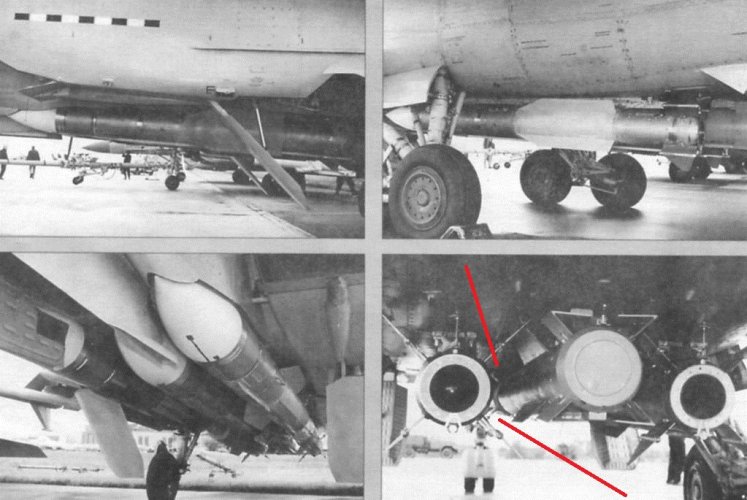
Take a look on what two red lines show to us .I think we can see them.

22-3 mod1.jpg
 
Last edited:
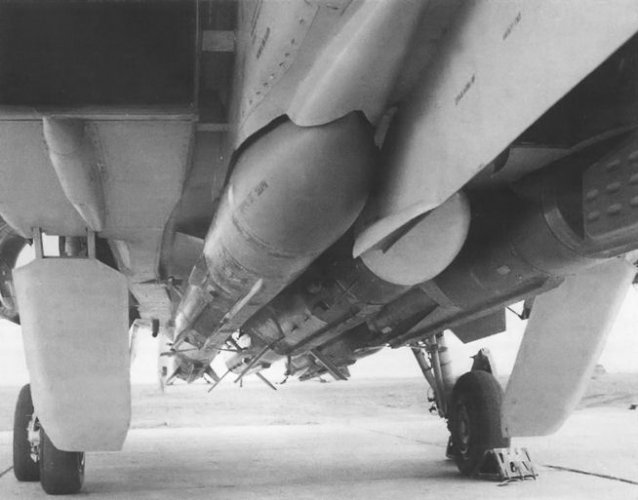
Yes, i think i see it. It looks to me only the rear mid AAM is the R-33S, the other 5 are all R-37s. A bit odd for a loadout, unless the R-33S is the atomic warhead version i recall reading about before, though i haven't yet read the last few posts here.
 
Yes, i think i see it. It looks to me only the rear mid AAM is the R-33S, the other 5 are all R-37s. A bit odd for a loadout, unless the R-33S is the atomic warhead version i recall reading about before, though i haven't yet read the last few posts here.

In that case R-37's had white radomes but in this case they had grey ones .I think the missile in the middle with the white radome is R-33S but w/o wings attached.I don't think that R-33S had/has atomic warhead.

From the article Russian Icon which 'overscan' has posted earlier :

''The R-33Ss in the 1994 photos were mounted in the two center semi-recessed stations of the MiG-31M. That aircraft was designed to carry up to six long-range air-to-air missiles semirecessed under the fuselage, while earlier versions of the Foxhound could only carry four. The R—33S displayed did have the four fixed destabilizers to the rear of the radome; it did not have its main wing surfaces fitted.''

13-2 (1).jpg
 
Last edited:
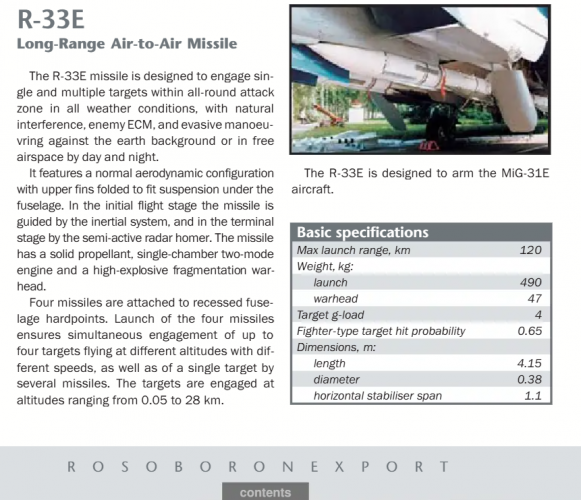
r-33e from export catalog. advertises up to 4 launches at once at 4 different targets and its semi-active radar homing
 

Attachments

  • 1764724903835.png
    1764724903835.png
    377.5 KB · Views: 44

Similar threads

Back
Top Bottom