where do you got this from? could you provide the source for it?40 years ago on one exercise ,two MiG-31 simulated intercept of the two Tu-95MS-6 ( simulated USAF B-52H), where detect distance was almost 600km in PPS and 'uslovny pusk' or simulated launch was executed from about 300km.

You are using an out of date browser. It may not display this or other websites correctly.
You should upgrade or use an alternative browser.
You should upgrade or use an alternative browser.
R-33, R-37 and R-72/KS-172S-1 ALRAAM missiles
- Thread starter Pit
- Start date

Aeria Gloria
ACCESS: Secret
- Joined
- 8 February 2024
- Messages
- 413
- Reaction score
- 479
R-40 is nearly 500 kg, does it go over 120 km? No. R-4 Anab is also nearly 500 kg, does it go 120 km? It went 25 km at best! This is a fallacy that somehow because it’s a “half ton monster” it must be capable of extreme ranges, as if this 300 km shot is the same version as the in service missile! If you agree these books and brochures and magazines are correct about 120 km range being for a small target, then they must also be correct about its 60 second powered flight time, which definitly needed modification before doing 300 km! What’s the difference in ballistics between a small target going as fast as a large one? The 130 km range for 27ER only has Target go in straight line, all max ranges are reported based off a straight line best condition shot. I understand if the missile is “limited by the radar,” but again, we have no source for this and it seems Soviet Union was very good about designing a missile to match its expected carrier’s radar range and not exceed it.
You don’t seem to have any sources that this 120 km is “RCS based,” so I can’t take it seriously. Sorry. You decry that using books as sources is a mistake, but those are much better then no source at all and always will be.
You don’t seem to have any sources that this 120 km is “RCS based,” so I can’t take it seriously. Sorry. You decry that using books as sources is a mistake, but those are much better then no source at all and always will be.
In 1985?
So why bother with inventing the even bigger R-37 and giant 1.4 m antenna Zaslon-M for the MiG-31M and then being super-proud in 1994 of a test where it achieved 280km launch range when Zaslon and R-33 can do it all already? Source? Or is it your usual "trust me bro".
R-27R typical launch range is 50km. R-27ER, 75km. R-33, 120km. Seems legit.
We have information from radar developers, GosNIIAS experts, Mikoyan, that Zaslon could detect a Tu-16 at 180-200km. Even assuming Tu-16 RCS is 16 sq m (I've seen 16 sq m and 19 sq m quoted) and taking 200km not 180km, that means that the Tu-95 has an RCS of about 1,296 m². I don't think the radar display can even show a target that far away - I'm pretty sure max instrumented range is 300km.
Yes but N007M Zaslon-M was already developed. First flight of the MiG-31M'sfirst prototype with the N007M was achieved on Dec. 1985.
What does 'typical launch range' mean anyway ? There is no word 'typical'. Launch distances/ranges can only be calculated and authorised .Calculated by the radar's computer which calculates three main angular coordinates: distance ,elevation and the azimuth, closer rate etc. Pilot will then get 'PR' command( Launch Authorised).As I described earlier ,there is also calibrated launch distances as max authorised launch distances against the small,medium and big air target ( all depends on target'RCS ). Every radar has that calibrated launch distances and also has calibrated( instrumental) distance to aircraft/target scales. If you don't mind I will show you how exactly look all three scales for the three combat modes of the N007 Zaslon.
This is the scale for the PPS mode,front hemisphere ,HPRF working mode of the main TWT with max calibrated detection distance of 600km as we can see.
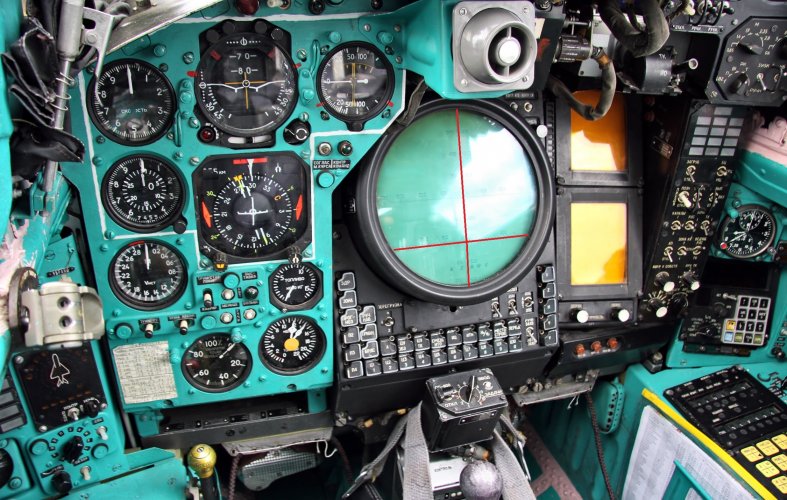
Scale for the AVT 'Avtomat' combat mode ( front/rear hemi... together) with HPRF/MPRF combo,max detection distance is 400km.
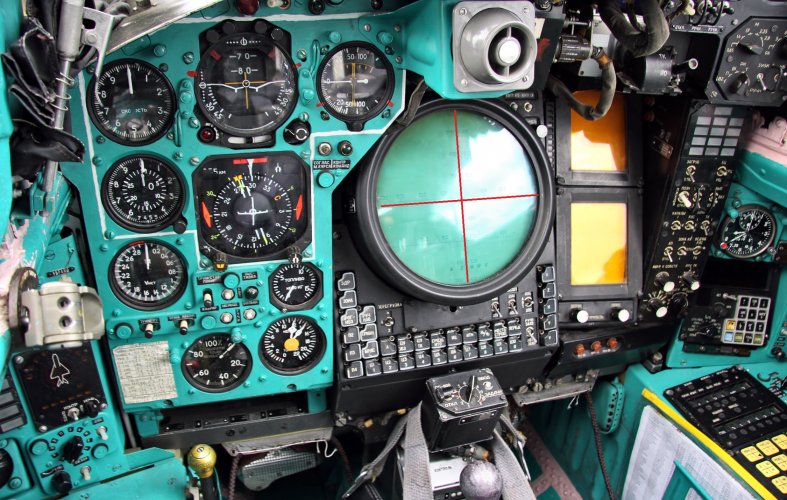
Scale for the ZPS combat mode,rear hemisphere with MPRF working mode,max detection distance is 200km.
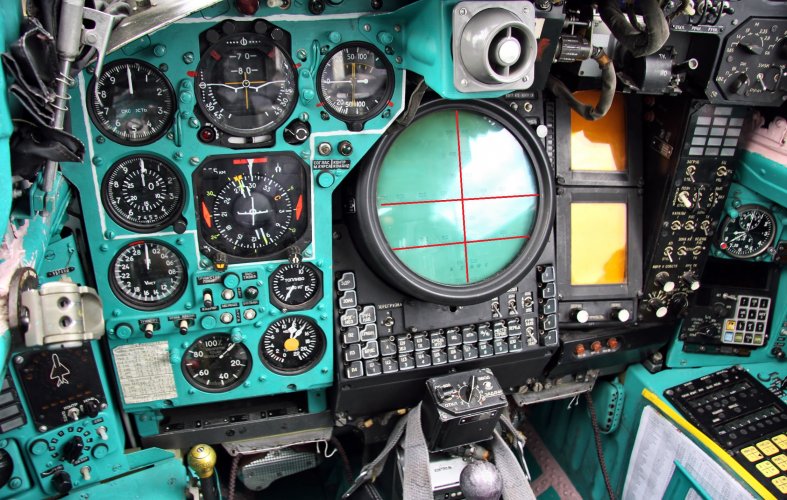
R-33 as we all know was never used in any real combat. That heavy long range AAM was only used in many tests ( version K-33) and the R-33 ( as serial/operational) ,even in one case when four R-33's were launched against four incoming RC- MiG-21's.
R-33 was used many times during excercises. I will repeat the case from May 2013 when two MiG-31's engaged two incoming low flying subsonic cruise missiles type Kh-55 ( of course w/o the real nuclear warhead) .Lock-on/launch distance was 90km. Yes, 90 km for one such small air target with frontal RCS no more then 0.5sqm .What will happen in the case of engaging high-flying or stratospheric-supersonic incoming air target with much bigger RCS? No matter if MiG-31 flies in the subsonic cruise mode ( alt about 10km) or in supersonic cruise mode ( alt 15-22km).
where do you got this from? could you provide the source for it?
'Aviatsiya i Kosmonautyka' journal , uf, maybe 30 years ago but even today I remember those data from one article. Even remember that two MiG-31's took of from the Monchegorsk AB.
R-40 is nearly 500 kg, does it go over 120 km? No. R-4 Anab is also nearly 500 kg, does it go 120 km? It went 25 km at best! This is a fallacy that somehow because it’s a “half ton monster” it must be capable of extreme ranges, as if this 300 km shot is the same version as the in service missile! If you agree these books and brochures and magazines are correct about 120 km range being for a small target, then they must also be correct about its 60 second powered flight time, which definitly needed modification before doing 300 km! What’s the difference in ballistics between a small target going as fast as a large one? The 130 km range for 27ER only has Target go in straight line, all max ranges are reported based off a straight line best condition shot. I understand if the missile is “limited by the radar,” but again, we have no source for this and it seems Soviet Union was very good about designing a missile to match its expected carrier’s radar range and not exceed it.
You don’t seem to have any sources that this 120 km is “RCS based,” so I can’t take it seriously. Sorry. You decry that using books as sources is a mistake, but those are much better then no source at all and always will be.
Do you even know what was the max detection distance of the only LPRF radar RP-25 Smerch e.g. ? 120km. And yes, there was launch distances limitation by the radars ,that's why I mentioned radars like N011M and N035 in the relationship with R-27ER. There is no 60sec 'powered' flight time limitation for the R-33 because its single chamber dual-phase rocket engine works if I remember well less then 30sec.Maybe you meant on aerodynamically controllable flight time and it is much greater then that 60sec.
When you find real Manual then you will understand. You mentioned that you have 80 docs about MiG-29 so how you don't know about max calibrated launch distances of the N019 for R-27R based on the target's RCS : 30km for the small incoming air target,70km for the medium one and the 90km for the bigger air target.Try to find that ,I hope you will.
Now this is very interesting ... from the R-23,24,27 thread
@Tasnif
'' Пермская авиагруппа - Реал/ракеты В-В
Check this about R-33''
Citation :
''Дальность захвата головкой цели типа Ту-16 составляет около 90 км, что с учетом инерциального наведения до захвата обеспечивает возможность пуска с дальности порядка 120...130 км.''
“The target acquisition/lock on range of the Tu-16 type by the radar seeker is approximately 90 km, which, taking into account inertial guidance before acquisition/lock on , makes it possible to launch from a range of approximately 120...130 km.”
So R-33's radar seeker with SARH mode only can lock-on ( of course not the real one but practically to receive illumination signals sent from the N007) ,from 90km in the case of Tu-16. We already know that RC channel ( it can be used only during the first inertal phase of guidance) with its coded signals has max range from the radar of 100kms. 100km of the inertial phase + 90 km of the SARH phase ( in the case of e.g. Tu-16).
Btw ,Tu-16 in its RC -version was also used for the calibration of those radar's detection/track distances and of course for the R-33's launch distances . B-52H has about 100sqm of the frontal RCS ( open sources mentioned that ). What about max launch distance against one incoming strategic bomber/missile carrier like B-52H ? 100 km of the inertial phase with possible use of RC-channel and how many kms of the SARH mode in the case of engaging such a huge target like B-52H....
@Tasnif
'' Пермская авиагруппа - Реал/ракеты В-В
Check this about R-33''
Citation :
''Дальность захвата головкой цели типа Ту-16 составляет около 90 км, что с учетом инерциального наведения до захвата обеспечивает возможность пуска с дальности порядка 120...130 км.''
“The target acquisition/lock on range of the Tu-16 type by the radar seeker is approximately 90 km, which, taking into account inertial guidance before acquisition/lock on , makes it possible to launch from a range of approximately 120...130 km.”
So R-33's radar seeker with SARH mode only can lock-on ( of course not the real one but practically to receive illumination signals sent from the N007) ,from 90km in the case of Tu-16. We already know that RC channel ( it can be used only during the first inertal phase of guidance) with its coded signals has max range from the radar of 100kms. 100km of the inertial phase + 90 km of the SARH phase ( in the case of e.g. Tu-16).
Btw ,Tu-16 in its RC -version was also used for the calibration of those radar's detection/track distances and of course for the R-33's launch distances . B-52H has about 100sqm of the frontal RCS ( open sources mentioned that ). What about max launch distance against one incoming strategic bomber/missile carrier like B-52H ? 100 km of the inertial phase with possible use of RC-channel and how many kms of the SARH mode in the case of engaging such a huge target like B-52H....
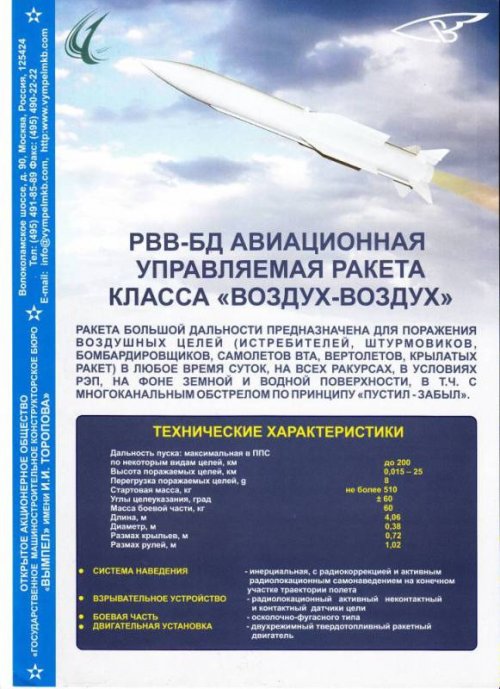
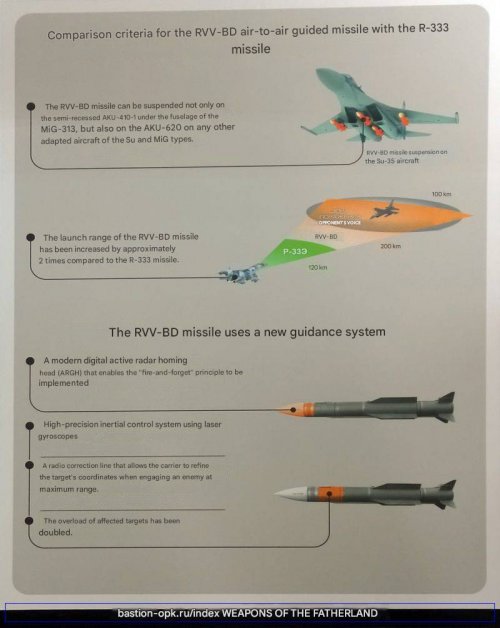
Rvv bd brochure dump
Note: MiG-31BM and Su-35S with R-37M already shot down several UkrAF combat aircraft ,even fighters with the launched distances over 200km. R-37M is Russian modified version of the old Soviet K-/R-37 with which one MiG-31M prototype achieved record-breaking launch range of 304km on April 1994.

kizvy
Local su-30mkm enjoyer
- Joined
- 14 October 2025
- Messages
- 101
- Reaction score
- 103
I think rvv bd is more like old r37 than new r37mNote: MiG-31BM and Su-35S with R-37M already shot down several UkrAF combat aircraft ,even fighters with the launched distances over 200km. R-37M is Russian modified version of the old Soviet K-/R-37 with which one MiG-31M prototype achieved record-breaking launch range of 304km on April 1994.
I think rvv bd is more like old r37 than new r37m
RVV-BD is in fact the designation for the long range AAM. It can be even old R-33/S . In the case of that brochure ,it is possible ( maybe) export version of the new R-37M . Izdeliye 610M. They made some comparisons with 'R-33E' which in fact never existed in practise ( operational use).
Aeria Gloria
ACCESS: Secret
- Joined
- 8 February 2024
- Messages
- 413
- Reaction score
- 479
Yes but N007M Zaslon-M was already developed. First flight of the MiG-31M'sfirst prototype with the N007M was achieved on Dec. 1985.
What does 'typical launch range' mean anyway ? There is no word 'typical'. Launch distances/ranges can only be calculated and authorised .Calculated by the radar's computer which calculates three main angular coordinates: distance ,elevation and the azimuth, closer rate etc. Pilot will then get 'PR' command( Launch Authorised).As I described earlier ,there is also calibrated launch distances as max authorised launch distances against the small,medium and big air target ( all depends on target'RCS ). Every radar has that calibrated launch distances and also has calibrated( instrumental) distance to aircraft/target scales. If you don't mind I will show you how exactly look all three scales for the three combat modes of the N007 Zaslon.
This is the scale for the PPS mode,front hemisphere ,HPRF working mode of the main TWT with max calibrated detection distance of 600km as we can see.
View attachment 792112
Scale for the AVT 'Avtomat' combat mode ( front/rear hemi... together) with HPRF/MPRF combo,max detection distance is 400km.
View attachment 792113
Scale for the ZPS combat mode,rear hemisphere with MPRF working mode,max detection distance is 200km.
View attachment 792114
R-33 as we all know was never used in any real combat. That heavy long range AAM was only used in many tests ( version K-33) and the R-33 ( as serial/operational) ,even in one case when four R-33's were launched against four incoming RC- MiG-21's.
R-33 was used many times during excercises. I will repeat the case from May 2013 when two MiG-31's engaged two incoming low flying subsonic cruise missiles type Kh-55 ( of course w/o the real nuclear warhead) .Lock-on/launch distance was 90km. Yes, 90 km for one such small air target with frontal RCS no more then 0.5sqm .What will happen in the case of engaging high-flying or stratospheric-supersonic incoming air target with much bigger RCS? No matter if MiG-31 flies in the subsonic cruise mode ( alt about 10km) or in supersonic cruise mode ( alt 15-22km).
'Aviatsiya i Kosmonautyka' journal , uf, maybe 30 years ago but even today I remember those data from one article. Even remember that two MiG-31's took of from the Monchegorsk AB.
Do you even know what was the max detection distance of the only LPRF radar RP-25 Smerch e.g. ? 120km. And yes, there was launch distances limitation by the radars ,that's why I mentioned radars like N011M and N035 in the relationship with R-27ER. There is no 60sec 'powered' flight time limitation for the R-33 because its single chamber dual-phase rocket engine works if I remember well less then 30sec.Maybe you meant on aerodynamically controllable flight time and it is much greater then that 60sec.
When you find real Manual then you will understand. You mentioned that you have 80 docs about MiG-29 so how you don't know about max calibrated launch distances of the N019 for R-27R based on the target's RCS : 30km for the small incoming air target,70km for the medium one and the 90km for the bigger air target.Try to find that ,I hope you will.
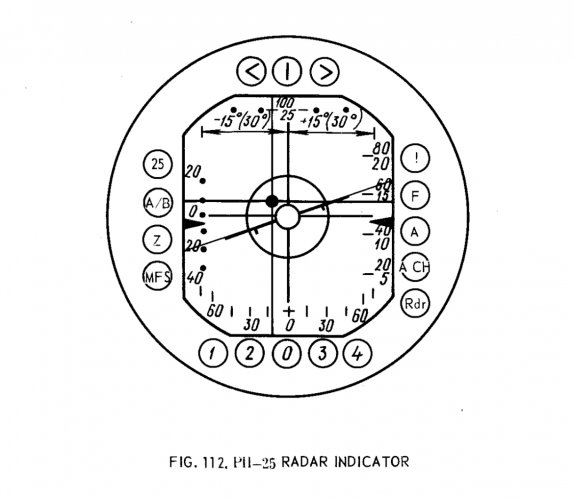
Manuals for MiG-25P state maximum detection range of 100 km, and here is an image of the semi mechanical Smerch radar display in MiG-25P, do you see 120 km anywhere or space for it? If you’re trying to disprove what I said about “Soviets being good at designing missile range to match and not exceed radar range of the carrier,” nowhere in that sentence is it implied that this was done for EVERY SINGLE aircraft/missile pair ever developed by SU

The sources we have given you in the other thread state 60 second powered flight time, yes I mean the time the actuators are powered and the missile guided, which correlates very nearly with its speed with 120 km range when we also look at R-27ER 130 km range and 60 second powered flight time. Until another source says differently it can only be 60 seconds if you are trying to be objective. We cannot take sources that we imagine or would like, and especially with Soviet equipment we often have to understand that things often are different then we imagine, and the truth very unexpected and often strange!
Why do you not think I know max calibrated distance for R-27R? We talked about R-27ER already, and there are a magnitude more sources for R-27R! When we calculate with CFD the 90 km range for R-27R also correlates perfectly with a 60 second flight time at the speeds it would fly when launched above Mach 2 at 15-17 km
Then talking about the R-33 source above, Squirrel, you have to see this
Now this is very interesting ... from the R-23,24,27
“……., makes it possible to launch from a range of approximately 120...130 km.”
……100km of the inertial phase + 90 km of the SARH phase ( in the case of e.g. Tu-16).
The source literally says “it is possible to launch from 120-130 km,” yet you take the 90 km seeker range figure and go “so if we add the max datalink range we get the max range of the missile!” You are choosing to see what you want in the seeker range figure and choosing to disregard the possible launch range figure in the same source! Do you think “possible to launch from” means it can launch farther or something? The seeker range is made to be good in case it needs to be fired at small targets such as cruise missiles, where that datalink range can be put to good use. You can’t just pick and choose what you want to believe
Semi Mechanical Smerch in 25P display limited to 100 km \/\/\/
Attachments
Last edited:
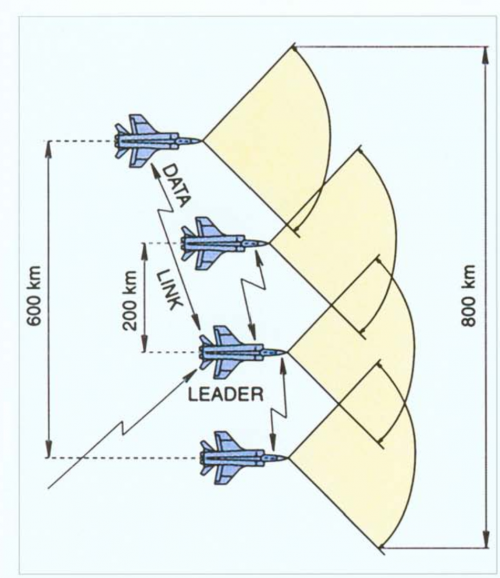
I checked, but there doesn’t seem to be any information confirming a 600 km detection range. You may be remembering the maximum datalink range between four MiG-31s instead.'Aviatsiya i Kosmonautyka' journal , uf, maybe 30 years ago but even today I remember those data from one article. Even remember that two MiG-31's took of from the Monchegorsk AB.
Attachments
Last edited by a moderator:
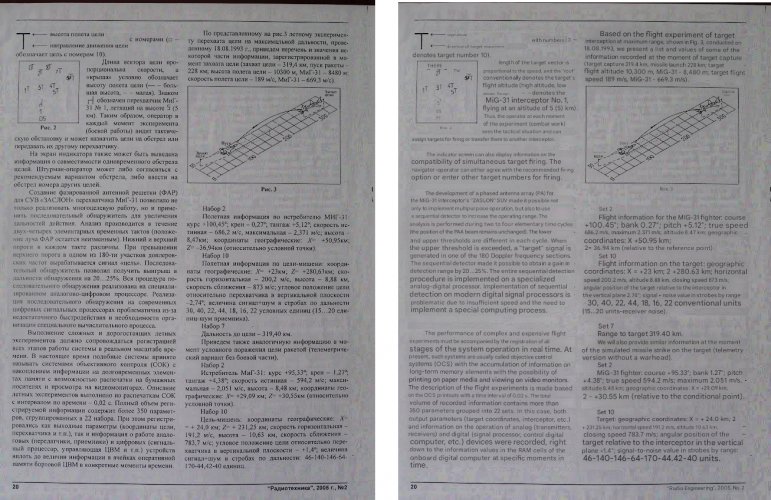
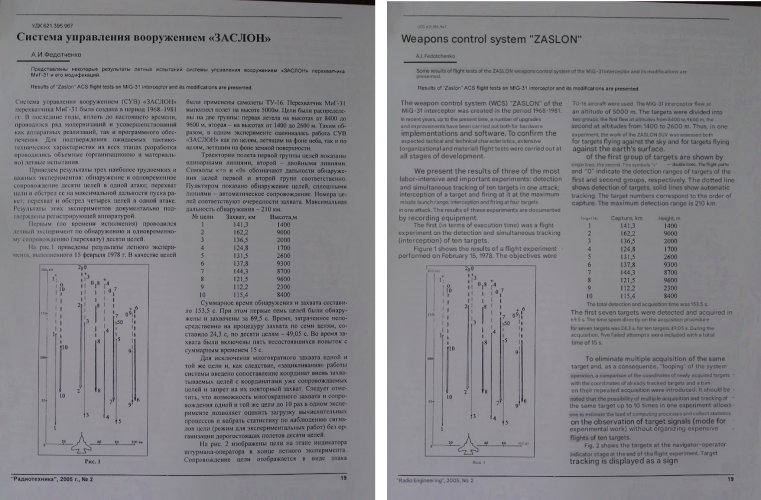
Maximum detection range of basic Zaslon against Tu-16 is 210 km, capture (lock) distance is 141 kmSo 120 km is max launch distance against some small air target , again, it is not max possible launch distance. For the 500kg heavy AAM and the interceptor which can launch four of them under 10 sec with max true air speed 2.8M at alt almost 22km ,it would be funny and silly to have only ''120km range AAM'' .Especially when it is known that max detect/track distance in HPRF mode is staggering 600 km ( of course for some big incoming aircraft).Launch distances against medium and bigger incoming air targets are of course much greater.
40 years ago on one exercise ,two MiG-31 simulated intercept of the two Tu-95MS-6 ( simulated USAF B-52H), where detect distance was almost 600km in PPS and 'uslovny pusk' or simulated launch was executed from about 300km.
Capture distance of Zaslon-M against Tu-16 is roughly 319 km
Attachments
Last edited by a moderator:
Aeria Gloria
ACCESS: Secret
- Joined
- 8 February 2024
- Messages
- 413
- Reaction score
- 479
Awesome stuff!

- Joined
- 27 December 2005
- Messages
- 19,225
- Reaction score
- 35,635
Yes, maximum detection range in these tests was 210km. So, the 180-200km figure is going to be probably something like 90% probability rather than absolute maximum. Note that tracking range varied from 112km to 162km in these tests against the same target, which will hopefully reinforce how radar ranges are not fixed numbers.
Aeria Gloria
ACCESS: Secret
- Joined
- 8 February 2024
- Messages
- 413
- Reaction score
- 479
I would think PoD actually lower, in Su-27 and MiG-29 detection occurs at 50% PoD and lock can occur at 90% PoD. I would imagine MiG-31 not too different despite the PESA
- Joined
- 27 December 2005
- Messages
- 19,225
- Reaction score
- 35,635
Yeah you are probably right.
Manuals for MiG-25P state maximum detection range of 100 km
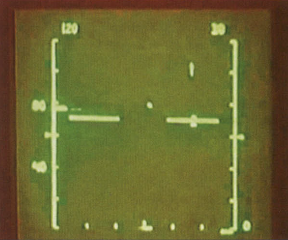
The sources we have given you in the other thread state 60 second powered flight time, yes I mean the time the actuators are powered and the missile guided, which correlates very nearly with its speed with 120 km range when we also look at R-27ER 130 km range and 60 second powered flight time.
Which sources again ? Do you know that the'' time of aerodynamic stability and controlability'' / время управляемого полета/ or controlable flight time of the R-37M is 300sec ( 5 min) . So R-33 has 60sec and R-37M has 300sec ?! R-33 is about 500kg heavy and the new R-37M like older K/R-37 is about 600kg heavy. Where is the logic there?
The source literally says “it is possible to launch from 120-130 km,” yet you take the 90 km seeker range figure and go “so if we add the max datalink range we get the max range of the missile!” You are choosing to see what you want in the seeker range figure and choosing to disregard the possible launch range figure in the same source! Do you think “possible to launch from” means it can launch farther or something? The seeker range is made to be good in case it needs to be fired at small targets such as cruise missiles, where that datalink range can be put to good use. You can’t just pick and choose what you want to believe
You didn't understand my answer/comment. The essence of my answer was to point out that Russian sources are also very wrong (civilian sources).That source mentioned that radar seeker in the R-33 can 'lock-on' ( receive illumination signals sent from the radar N007) from 90km .Yes but that is only SARH mode. Where is the inital inertial guidance with possible use of the RC-channel which coded signals have 100km range from the onboard radar ? Something like that, author did not calculate...
I checked, but there doesn’t seem to be any information confirming a 600 km detection range. You may be remembering the maximum datalink range between four MiG-31s instead.
View attachment 792209
Magic number marked with the red arrow is ?
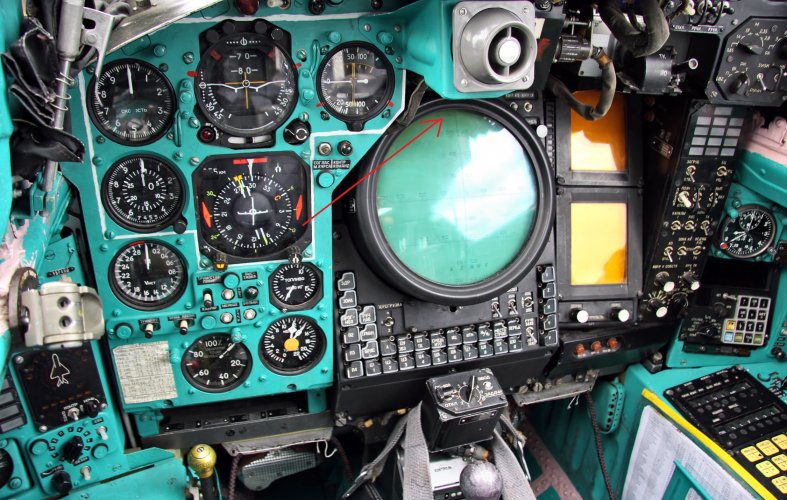
Now, these 600 km means something ,yes ? Number 600 is not there without any reason of course. It is value of the calibrated /instrumented distance ,what for? For the detection and tracking of the incoming aircraft of course.
Maximum detection range of basic Zaslon against Tu-16 is 210 km, capture (lock) distance is 141 km
View attachment 792210
Capture distance of Zaslon-M against Tu-16 is roughly 319 km
View attachment 792211
If I remember well ,we already discussed all of that.I already mentioned to you that A.I. Fedotchenko as a chief constructor of the N007 Zaslon gave tests data and info only for the main N007 Zaslon ,not for the N007M Zaslon-M. Btw ,in those scans ,where do you see designations like MiG-31M or N007 Zaslon-M anyway ? A.Fedotchenko definitely knew what is N007 and what is N007A or N007M also about MiG-31,MiG-31B and MiG-31M.
P.S.
Even you mentioned that it was MiG-31 ,not MiG-31M on this topic:
https://www.secretprojects.co.uk/threads/mikoyan-mig-31-foxhound.38380/page-6
Btw, that article from 'Radio Engineering' ,2005 was 'copied' by famous Soviet/Russian military officer and historian Vladimir Ilyin that same year ( once had both of the articles).
https://knigamaniya.com/books/61966-vladimir-ilin-ilin-vladimir--kratkaya-biografiya/toread
Test from the 15 Feb 1978 was the real flight test of the N007 against two groups of RC-bombers type Tu-16 or ''Ту-16М — Радиоуправляемая мишень, переоборудованная из выработавшего ресурс Ту-16.'' Tranls: Tu-16M - Radio-controlled target aircraft, converted from a retired Tu-16. They have in fact next designations M-16-1/-2/-3 and they even have jamming stations /ECM systems. OK , max detection distance was 210km but max lock on range was in fact 162km for the second target, is it ? Then on 28 Aug 1978 for the first time, MiG-31 with its N007 Zaslon and four R-33's engaged four differ targets within 10 sec. Some details were described by the OKB Mikoyan test pilot Vladimir Kondaurov once.
Then on 18 Aug 1993 ,MiG-31 ( not MiG-31M) was use in the test with R-33 against a single RC-target ( not mentioned which ), with the task to achive max (possible) detection-track and lock on distance and where max detection distance was 319.4 km and launch distance was 228km but that was ''uslovniy pusk'' so simulated launch only,not the real one. On 21 April 1994, MiG-31 with N007 Zaslon and R-33's was tested again four RC-MiG-21's. They were hit and destroyed severel tens of kms from the MiG-31. As we know ,also on April 1994 ,prototype of the MiG-31M number 057 blue with its N007M Zaslon-M and its six R-37 ( Izdeliye 610) was tested against six incoming targets where one of them was engeaged from record breaking 304km in the live firing test.I have info that the target was in fact one missile ( ракета мишень). That was the only case in which MiG-31M was mentioned in relationship with the real flight/firing tests.
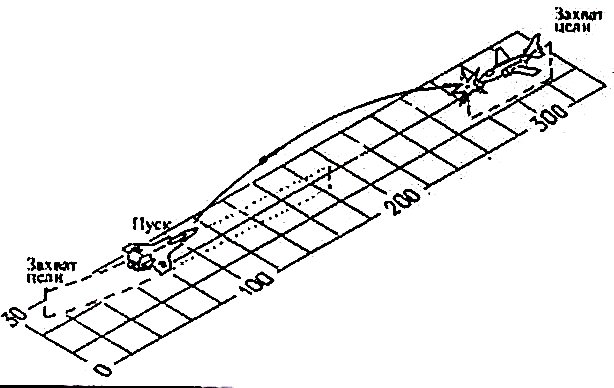
This is also interesting because it is from A. Fedotchenko himself. What we can see is the ballistic/parabolic (loft) trajectory of the R-33.
Have any images of the R-33S ever turned up?
Even after almost twenty years but it is never too late,haha.Already posted this photo but...
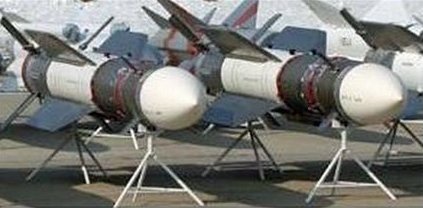
R-33S or Izdeliye 520. It was modernised version for the MiG-31B/BS and today for the MiG-31BM.Heavier than basic R-33,it has as we can see ,forward stabilizers for the better controllability when flying very low. In fact , R-33S was developed for countering then new USAF strategic low flying subsonic stealth cruise missile type AGM-129A ACM. R-33S has combined radar-laser proximity fuse and inertial +combined ARH/SARH in the terminal phase.
That 600 km is the instrumented range not the physical radar detection range, you need to remember that Mig-31 were designed to work in group, multiple Mig-31 can share target dataMagic number marked with the red arrow is ?
View attachment 792304
Now, these 600 km means something ,yes ? Number 600 is not there without any reason of course. It is value of the calibrated /instrumented distance ,what for? For the detection and tracking of the incoming aircraft of course.
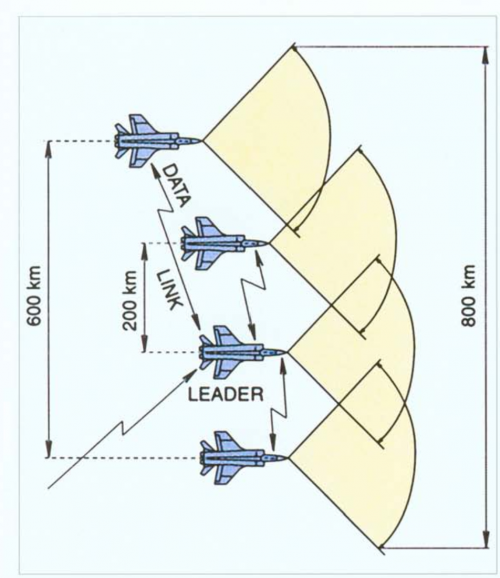
Beside, Mig-31 is not the only aircraft with instrumented range greater than detection range, even the ancient and tiny mechanical steered APG-68 on F-16 has instrumented range of 160 nm (295 km), and its detection range is no where near that long
We did discussed the detection range of Zaslon and Irbis-E in this thread:If I remember well ,we already discussed all of that.I already mentioned to you that A.I. Fedotchenko as a chief constructor of the N007 Zaslon gave tests data and info only for the main N007 Zaslon ,not for the N007M Zaslon-M. Btw ,in those scans ,where do you see designations like MiG-31M or N007 Zaslon-M anyway ? A.Fedotchenko definitely knew what is N007 and what is N007A or N007M also about MiG-31,MiG-31B and MiG-31M.
https://www.secretprojects.co.uk/th...atform-between-mig-31-and-su-35s.39723/page-2don’t recall you ever making the argument that "A.I. Fedotchenko, as the chief designer of the N007 Zaslon, could therefore provide test data only for the basic N007 variant". And frankly, that line of reasoning doesn’t seem very strong anyway. Consider that he also led the modernization Zaslon-AM and Zaslon-A, it just seem strange if he have no information about Zaslon-M
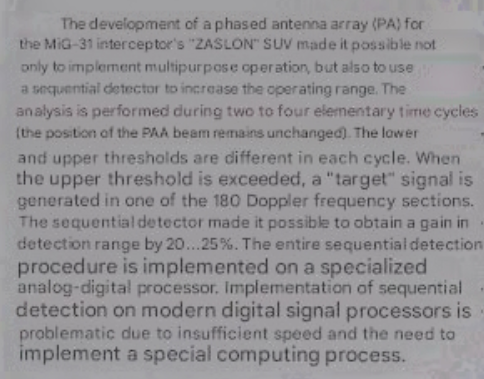
Another reason that lead me to believe that the article were talking about Zaslon-M is due to the fact that they were talking about development of a new Phased antenna array which lead me to think it either Zaslon-AM or Zaslon-M rather than basic Zaslon. But because Zaslon-AM first tested in 2007 so this leave only Zaslon-M
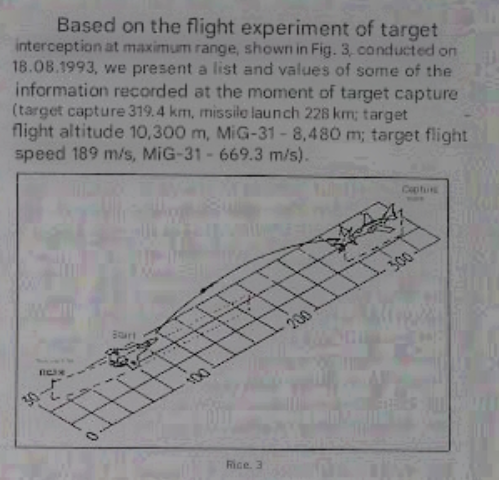
Moreover, in the article, they mentioned the test took place in 1993 and Mig-31 shoot down the Tu-16 from 228 km
In Yefim Gordon’s book MiG-31: Famous Russian Aircraft. He mentioned that in 1994, President Boris sent a telegram to congratulate the creator of Mig-31M and its weapon system because they are the first in the world to achieve a kill from 228 km.
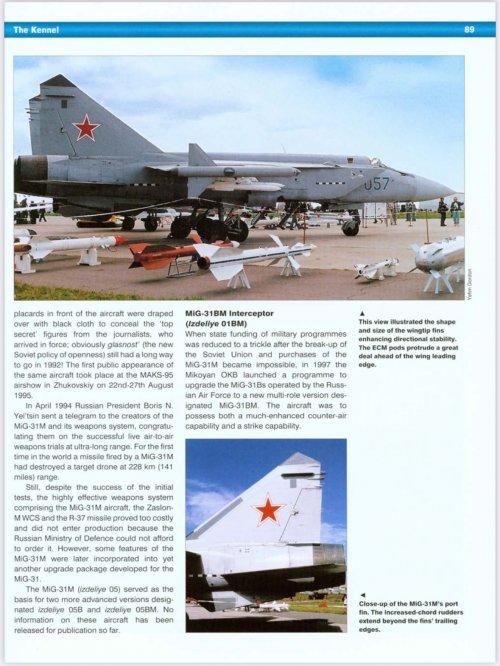
Another source given by yourself in the previous thread also say the same thing
''18 августа 1993 г МиГ-31М стал первым истребителем вмире, сбившим (ракетой К-37) воздушную цель на дальности200 - 228 км.''
Page 87 ,pdf source : http://www.kr-magazine.ru/upload/iblock/45d/KR_3_4_2018_.pdf
All these data from various source seem to fit nicely together I think
Last edited:
Aeria Gloria
ACCESS: Secret
- Joined
- 8 February 2024
- Messages
- 413
- Reaction score
- 479
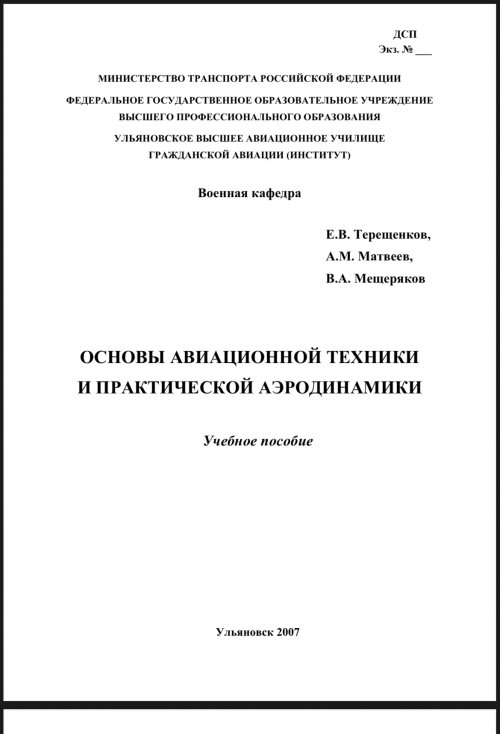
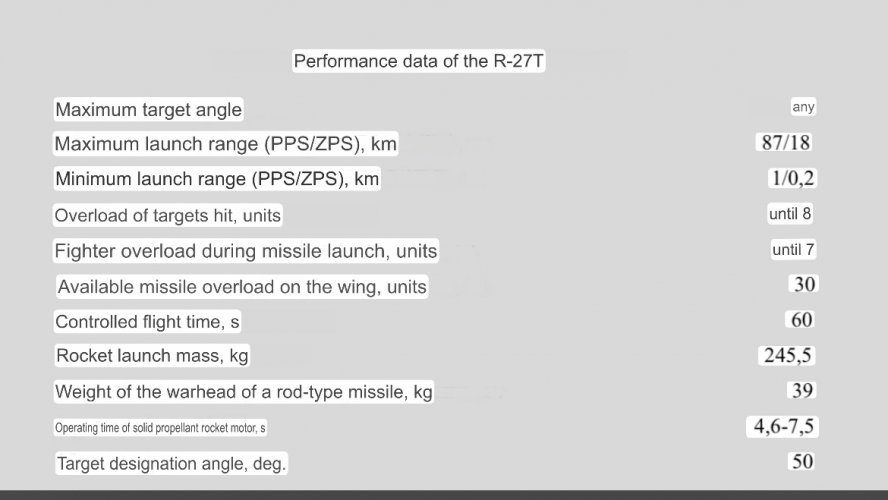
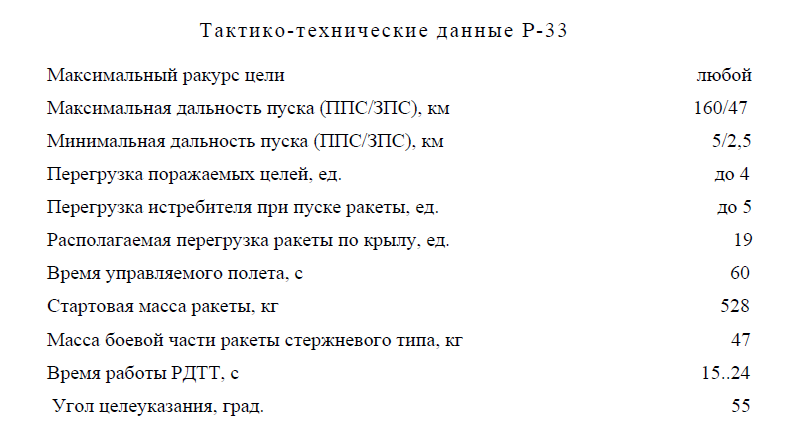
Squirrel, the picture you post is from MiG-25PD/PDS. Not P model with Smerch. Different and longer ranged radar using MiG-23MLA avionics! I thought you knew about MiG-25P……..the 25PD picture you post doesn’t even show 120 km like you originally argued……
Just becuase R-37M has a long flight time does not mean R-33 does, logic? Do you think engineering in Soviet Union was always obvious or logical? Like said, sources are better than no sources and conjecture. Same with MiG-31 display having a 600 km marker as if it doesn’t also have a long range HF datalink…….. You really telling me you haven’t seen weird things in Soviet Union engineering before or this your first time?
Which source? This one. Sources are the law of debating about reality. Colleges will teach you that without sources you have no credibility.
And as multiple people have told you, the R-37M is proven to be capable of loft like AIM-54 along with a likely much better motor, loft is likely primarily where it gets its long range and need of a long flight time. Non lofted flight is shorter, and thus need for not more then 60 seconds to reach 120-160 km
Missile up high launched at Mach 2 go very very fast!
Attachments
Last edited by a moderator:
That 600 km is the instrumented range not the physical radar detection range, you need to remember that Mig-31 were designed to work in group, multiple Mig-31 can share target data
View attachment 792321
Beside, Mig-31 is not the only aircraft with instrumented range greater than detection range, even the ancient and tiny mechanical steered APG-68 on F-16 has instrumented range of 160 nm (295 km), and its detection range is no where near that long
We did discussed the detection range of Zaslon and Irbis-E in this thread:
https://www.secretprojects.co.uk/th...atform-between-mig-31-and-su-35s.39723/page-2don’t recall you ever making the argument that A.I. Fedotchenko, as the chief designer of the N007 Zaslon, could therefore provide test data only for the basic N007 variant. And frankly, that line of reasoning doesn’t seem very strong anyway. Consider that he also led the modernization Zaslon-AM and Zaslon-A, it just seem strange if he have no information about Zaslon-M
Another reason that lead me to believe that the article were talking about Zaslon-M is due to the fact that they were talking about development of a new Phased antenna array which lead me to think it either Zaslon-AM or Zaslon-M
View attachment 792330
Another detail is that in the article, they mentioned the test took place in 1993 and Mig-31 shoot down the Tu-16 from 228 km
View attachment 792331
In Yefim Gordon’s book MiG-31: Famous Russian Aircraft. He mentioned that in 1994, President Boris sent a telegram to congratulate the creator of Mig-31M and its weapon system because they are the first in the world to achieve a kill from 228 km. All these data from various source seem to fit nicely together I think
View attachment 792332
If number 600km means nothing then what for is on the distance to target scale ?You can then have number 1000 e.g. If I remember well, both radars AN/APG-63 (70) and AN/APG-68 have max detection range in the TWS 80nmi but in the VSR/LRS modes have 160nmi detection range . In that modes, only one target can be detected and tracked( e.g. strategic bomber/missile carrier).There is some catch about HPRF/MPRF working mode ,do not remember right now,sorry.
Yes we commented some details on that thread ,even myself thought that in some cases were MiG-31B but ...Now as I can see,Fedotchenko mentioned only MiG-31. Where is that info that the target was Tu-16? I mean RC-Tu-16 of course ...
Y.Gordon was not right. B.Yeltsin sent a telegram on April 1994 when MiG-31M shot down one 'missile target' with launch distance of 304km.
@Aeria Gloria
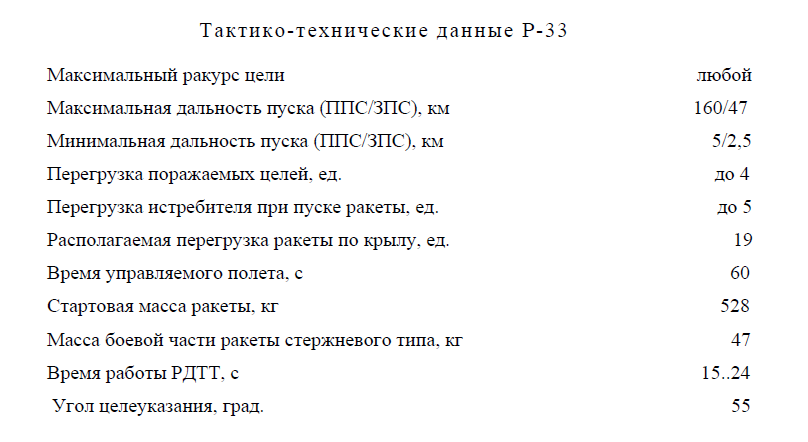
What's this ? Now R-33 has max launch range for the incoming target of 160km ? 120km or 160km ???
What's this ? Now R-33 has max launch range for the incoming target of 160km ? 120km or 160km ???
Attachments
Last edited by a moderator:
- Joined
- 27 December 2005
- Messages
- 19,225
- Reaction score
- 35,635
Okay, we are - FINALLY - getting somewhere.This is also interesting because it is from A. Fedotchenko himself. What we can see is the ballistic/parabolic (loft) trajectory of the R-33.
View attachment 792313
The R-33 (1981 service entry) was not capable of lofting. This is a diagram of a lofting test done in the 1990s, more than 10 years after the R-33 entered service.
The tests done used modified missiles with new autopilot / inertial units which made the missile capable of executing a lofting profile. In certain circumstances, this can allow significantly longer range missile launches.
AIM-54 was always capable of lofting, which is the primary reason for the disparity in maximum range.
This is why I made it clear we were discussing the original R-33. Its possible that the R-33 missiles in Russian service today have been upgraded and have longer maximum range along the lines of the test above. Maybe 160km.
I would think PoD actually lower, in Su-27 and MiG-29 detection occurs at 50% PoD and lock can occur at 90% PoD. I would imagine MiG-31 not too different despite the PESA
I forgot to ask this. Sorry but can you explain what is in fact that ''PoD'' ( probability of detection, of course), nevermind ,50%, 90%. What does it mean anyway ? Tnx ...
Squirrel, the picture you post is from MiG-25PD/PDS. Not P model with Smerch. Different and longer ranged radar using MiG-23MLA avionics! I thought you knew about MiG-25P……..the 25PD picture you post doesn’t even show 120 km like you originally argued……
Hm,maybe wrong pic or something.In any case nevermind if it is pulse only RP-25 Smerch-A(serial A2,A3) in P or pulse-Doppler N005 Sapfir-25 in PD/PDS with their 100/120km max detection range.That was limitation factor for R-40R/RD ( same as N001 was for the R-27ER).
In the R-23,24 and R-27 thread ,you asked me this:
''We have literally provided over 5 sources in this thread giving 120 km, no where does it say this 120 km is for a small target.
The R-27 case is not just about the size of the target, its launch ranges you see for different RCS is also limited by the maximum length of the datalink phase since smaller targets need more datalink, radar acquisition rates, clutter of the seeker, etc. Yes target RCS CAN effect launch distance, but in this area we have NO sources that 120 km is for a specific size, but all sources do point to 120 km as a “maximum” range. There is no other reason to put it under “maximum range” in the 5 sources we have listed. And yes, there is an improved variant with 160 km range that is also listed, but this like the 120 km appears to be a maximum range, not a “small targets only!”
Believe me friend I have additional 5 or more sources ( even Russian) where it states that R-33 has max launch range/distance of 120km and you gave us source where it states even 160km.
Take a look on this one e.g.
''Была обеспечена способность поражать цели на дальности до 120 км.''
''The ability to hit targets at a range of up to 120 km was ensured.''
From the e book :
Онлайн книга «МиГ-31. Страж российского неба»
https://loveread.ec/read_book.php?id=74406&p=2
Now what about this data ( from the same book)
''Дальность обнаружения целей – до 300 км., цель с ЭПР порядка 5 м2 обнаруживается на удалении 189 км (дальность автоматического сопровождения – 120 км).''
''Target detection range is up to 300 km, a target with an RCS of about 5 m2 is detected at a distance of 189 km (automatic tracking range is 120 km).''
What's this ? 5sqm from abut 190km ???
Next source, aha 150-200km for the 19 sqm ?
Дальность обнаружения воздушных целей
- в передней полусфере 200-320 км
- на встречных курсах 150-200 км (ЭПР 19 кв.м)
- самолетов с ЭПР 5 кв.м - 180 км
- в задней полусфере - 90-150 км
- в задней полусфере - 60 км (ЭПР 19 кв.м)
- цели типа F-16 - 120 км
- цели типа B-1B - 200 км
Дальность сопровождения целей в передней полусфере:
- бомбардировщиков - 150-200 км
- истребителей (ЭПР ок. 2 кв.м) - 90 км
Дальность сопровождения целей в задней полусфере:
- бомбардировщиков - 120 км
- истребителей - 70 км
http://militaryrussia.ru/blog/topic-407.html
Then this one ,180-200km for 19 sqm target etc
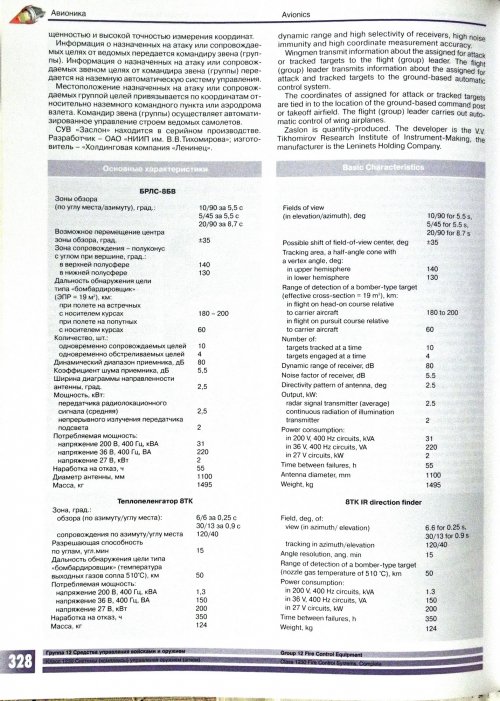
More sources,more data...What is the point of all of this ? It is not the statement like 'R-33 has max launch range of 120km',but the question for what parameters,factors etc. 120km but what for ? For low or high flying target? Small,medium or bigger one ? As incoming or receding ? Slow or very fast ? Etc etc.. That's why I gave the data from the 'MiG-29 FM ' where we could see that R-27R in relationship with N019 has max (calibrated and authorised) launch distances : 30km against small,70km against medium and max 90km against big air target ,of course as incoming.R-33 must have also those launch distances in connection with N007.
PS
I already mentioned so many times that exercise from May 2013 where MiG-31DZ/BM launched two R-33 ( not R-33S or R-37M which btw was even not operational then) ,from 90km against such a small incoming target like cruise missile type Kh-55.Target with the frontal RCS no more than 0.5 sqm. With R-33 it is possible to engage such a low flying and such a small target from almost 100km. What about engaging very fast high flying target like e.g. SR-71 ???Possible launch distance for the R-33 ?
Okay, we are - FINALLY - getting somewhere.
The R-33 (1981 service entry) was not capable of lofting. This is a diagram of a lofting test done in the 1990s, more than 10 years after the R-33 entered service.
The tests done used modified missiles with new autopilot / inertial units which made the missile capable of executing a lofting profile. In certain circumstances, this can allow significantly longer range missile launches.
AIM-54 was always capable of lofting, which is the primary reason for the disparity in maximum range.
This is why I made it clear we were discussing the original R-33. Its possible that the R-33 missiles in Russian service today have been upgraded and have longer maximum range along the lines of the test above. Maybe 160km.
Yes it was test launch from 18.08. 1993 and what Vladimir Ilyin ( military officer and historian) stated about that:
''On 18 August of 1993 was carried out a series of flying experiments on the interception of target at maximum range. In the course of the first of them the radio-controlled target, which flies at the height of 10.300 m with a velocity of 189 meters per second, was locked on by interceptor MiG-31 (flight altitude 8480 m, velocity - 669,3 meters per second) at the range if 319,5 kilometers the launch of rocket R-33 (successfully destroyed target) was carried out at the distance 228 kilometers.''
He wrote R-33 not R-33S or R-37. As a military officer and historian ,he certainly knew what were differences between R-33,R-33S and K/R-37.
P.S.
I also supposed for a while that it was MiG-31B with R-33S in the test from Aug 1993 but it seems it was not.
Some comments from KP forum as source for the citation :
''No, K-37 "famous" test was made in 1994 and the article is pretty concise in what it talks about, furthermore the ranges involved are different.
First sucessful launch of a K-37 missile from MiG-31M prototype was made in October 1993...two months after this test.
The two main target sizes used by Russian radar designers were 3 sq m and 16 sq m for MiG-21 and Tu-16 respectively.
Radars designed to engage fighters are generally quoted vs 3 sq m targets. In Zaslon's case, the primary target was bombers, hence the 16 sq m target. Zaslon-M range was quoted vs 19 sq m - perhaps this is Tu-22M?''
https://www.key.aero/forum/modern-m...nce-zaslon-hyped-to-compete-with-awg-9?page=0
Aeria Gloria
ACCESS: Secret
- Joined
- 8 February 2024
- Messages
- 413
- Reaction score
- 479
It is talking about R-33S when you read the whole article@Aeria Gloria
What's this ? Now R-33 has max launch range for the incoming target of 160km ? 120km or 160km ???
View attachment 792337
Aeria Gloria
ACCESS: Secret
- Joined
- 8 February 2024
- Messages
- 413
- Reaction score
- 479
Squirrel, the post you link says R-33 range is “up to” 120 km!I forgot to ask this. Sorry but can you explain what is in fact that ''PoD'' ( probability of detection, of course), nevermind ,50%, 90%. What does it mean anyway ? Tnx ...
The other page you attach says nothing about R-33, so with you linking it adding nothing about R-33, how can we be sure that this 190 km range you talk about is about the original variant or when 33S? And yes. Sometimes people still call a modification R-33, not every modification has a suffix!
In one of the quotes you attach, it says “in experiment in 1993,” do you not wonder why they would do an experiment in 1993 with a missile that has been in service and already tested thoroughly by MOD in 1981-82? It is becuase it is modified on the long journey to R-37
Probability of detection is about sensor detection. 90% means it detects it 9 out of 10 scans. 50% 1 out of 2 scans. Therefore, you might be able to detect someone beyond your max range of continuous detection or tracking.
It is a fallacy to think instrumented range equals detection range. Both MiG-29 and Su-27 show 150 km range on scale in PPS, do they have equal range? No. Is there anything a MiG-29 N-019 can detect from 150 km? Maybe a flying aircraft carrier.
Last edited by a moderator:
No one said the number mean nothing, as I said before, it is instrumental range, Mig-31 can be linked with several different aircraft.If number 600km means nothing then what for is on the distance to target scale ?You can then have number 1000 e.g. If I remember well, both radars AN/APG-63 (70) and AN/APG-68 have max detection range in the TWS 80nmi but in the VSR/LRS modes have 160nmi detection range .
As for APG-68 and APG-63, you remember wrong. The only thing that APG-68 can realistically detect from 160 nm is a SHIELD Helicarrier
I don’t think that’s an important point to hang on to. It’s very common for people to mention only the base name of a weapon system without including the full suffix. For example, people often say "F-16" instead of specifying the block, "MiG-31" instead of MiG-31BM or MiG-31K, or "AIM-120" instead of AIM-120C-7 or AIM-120C-5Yes we commented some details on that thread ,even myself thought that in some cases were MiG-31B but ...Now as I can see, Fedotchenko mentioned only MiG-31.
It just a guess because the target is pretty slow, barely 189 m/s at 10 km heightWhere is that info that the target was Tu-16? I mean RC-Tu-16 of course ...
Yefim Gordon is a well known aviation historian, so it would take more than your opinion to convince others that he is mistaken. Konstantin Alexandrovich Kuznetsov, another respected historian, also noted that the tests on 18 August 1993 were conducted using the MiG‑31M.Y.Gordon was not right. B.Yeltsin sent a telegram on April 1994 when MiG-31M shot down one 'missile target' with launch distance of 304km.
Beside, in the test MiG-31 was flying at an altitude of 8,480 meters (27,827 feet), the target was flying at altitude of 10,300 meters (33,792 ft). Which is not very high at all, and should be ways outside the envelop of basic R-33
Last edited:
Squirrel, the post you link says R-33 range is “up to” 120 km!
Yes so what ? I mentioned that there is so many sources with that wrong data.
In one of the quotes you attach, it says “in experiment in 1993,” do you not wonder why they would do an experiment in 1993 with a missile that has been in service and already tested thoroughly by MOD in 1981-82? It is becuase it is modified on the long journey to R-37
It was experiment for max intercept range for one specific target in fact. What is so strange to use AAM that was operatioanl from 1980?
Probability of detection is about sensor detection. 90% means it detects it 9 out of 10 scans. 50% 1 out of 2 scans. Therefore, you might be able to detect someone beyond your max range of continuous detection or tracking.
No, PoD is in fact % value for the first scan cycle of the given scan zone. So how can one PESA N007 be in the same cathegory with N001/N019 which have mechanical scanning...
It is a fallacy to think instrumented range equals detection range. Both MiG-29 and Su-27 show 150 km range on scale in PPS, do they have equal range? No. Is there anything a MiG-29 N-019 can detect from 150 km? Maybe a flying aircraft carrier.
At roughly 150km both N001 or N019 can detect some very big incoming air target ( e.x. B-52H ) and engaged him with R-27R from 90km.
Yefim Gordon is a well known aviation historian, so it would take more than your opinion to convince others that he is mistaken. Konstantin Alexandrovich Kuznetsov, another respected historian, also noted that the tests on 18 August 1993 were conducted using the MiG‑31M.
Yes it is but with so many mistakes in his books ,even in books where co-author was Dmitry Komisarov.
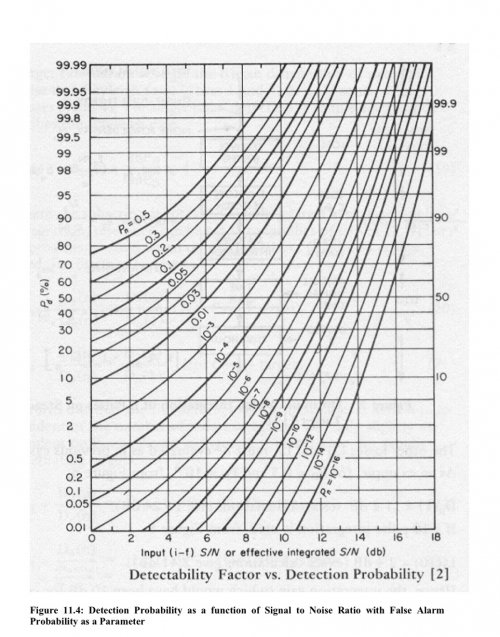
I think I have explained what is PD in previous thread but in case you haven't read it, let me re post againNo, PoD is in fact % value for the first scan cycle of the given scan zone. So how can one PESA N007 be in the same cathegory with N001/N019 which have mechanical scanning...
Radar detection range in the real world doesn't work like in video games, where a target with a given RCS is always detected at a fixed distance. In reality, detection is probabilistic and depends heavily on the signal-to-noise ratio (SNR).
For example, you might achieve a 50% probability of detection with a 50% false alarm rate at an SNR of 0 dB. However, if you require a 99.9% detection probability and a false alarm rate as low as 10⁻¹⁶, the necessary SNR increases to around 18 dB. This difference in SNR requirement translates to a significant change in detection range.
In short, is it possible for a radar to detect a target at a greater distance than the manufacturer's stated range under a certain real world conditions? Yes absolutely. However, the advertised detection range typically reflects the distance at which the signal to noise ratio (SNR) is sufficient to ensure reliable chance of detection with a low probability of false alarm.
Attachments
Last edited by a moderator:
- Joined
- 27 December 2005
- Messages
- 19,225
- Reaction score
- 35,635
It was an experimental R-33 missile modified to test lofting. That was the entire purpose of the test, to see the range increases possible using a lofted profile. No, it wasn't R-33S because that didn't exist in 1993, it was a prototype. It wasn't a stock R-33 because the stock R-33 did not have a suitable autopilot/INS to fly a lofted profile. Neither did R-27ER. Work was done on a modified R-27EM with lofted flight profile at the same time, though I don't know if it was flight tested. These may have been enabled by the availability of more compact and accurate INS devices and computing devices from the West.''On 18 August of 1993 was carried out a series of flying experiments on the interception of target at maximum range. In the course of the first of them the radio-controlled target, which flies at the height of 10.300 m with a velocity of 189 meters per second, was locked on by interceptor MiG-31 (flight altitude 8480 m, velocity - 669,3 meters per second) at the range if 319,5 kilometers the launch of rocket R-33 (successfully destroyed target) was carried out at the distance 228 kilometers.''
He wrote R-33 not R-33S or R-37. As a military officer and historian ,he certainly knew what were differences between R-33,R-33S and K/R-37.
P.S.
I also supposed for a while that it was MiG-31B with R-33S in the test from Aug 1993 but it seems it was not.
Remember these tests were done in the dark times of the 1990s. There was no money to build new R-33s. The reason Vympel was at Western airshows was trying to get funding.
Once can assume that when MiG-31 upgrades were finally carried out once there was some money, upgrades were potentially done to the R-33. I don't really have any data on that though.
Last edited:
- Joined
- 27 December 2005
- Messages
- 19,225
- Reaction score
- 35,635
Okay, found something interesting in this book.
JSC State Design Bureau "Vympel" named after I.I. Toropov
70 years in service to the Motherland
International United Biographical Center
Moscow
2019
JSC State Design Bureau "Vympel" named after I.I. Toropov
70 years in service to the Motherland
International United Biographical Center
Moscow
2019
середине 1980-х годов на «Вымпеле»
приступили к выполнению модер-
низации ракеты Р-33. По требова-
нию заказчиков она должна была
значительно отличаться от базового ва-
рианта увеличенной дальностью пуска,
большей массой боевой части, более со-
вершенной системой управления, уве-
личенным полетным временем и новой
двигательной установкой. При этом, не-
смотря на увеличенную массу и моменты
инерции, она должна была размещаться
на тех же местах, что и Р-33, и катапуль-
тироваться с АКУ-410, которое требова-
лось модифицировать таким образом,
чтобы оно позволяло обеспечивать старт
обеих ракет.
Новая разработка была выполнена в
чрезвычайно высоком темпе: на нее по-
требовалось вдвое меньше времени, чем
на создание Р-33, — всего шесть лет вме-
сто двенадцати.
Из воспоминаний Юрия Константино-
вича Захарова:
«В течение всех шести лет работа над
модернизацией Р-33 шла по «зеленой ули-
це». Правда, подобный приоритет ракете
был предоставлен после того, как во 2-м
ГУ МАП одобрили компоновку ракеты с
новым двигателем.
Первое время главный инженер главка
Б.Н. Глазырин жестко настаивал на уни-
фикации двигательных установок ракет,
мотивируя тем, что в ТТЗ работы по
созданию новой ракеты были прописаны в
виде создания варианта ракеты Р-33.
Не желая вникать в то, что новая раке-
та должна была иметь более высокие бал-
листические характеристики при несколь-
ко увеличенной массе и иной аэродинамике,
что однозначно требовало использования
для нее двигателя с увеличенной энерге-
тикой, он стремился сохранить прежнюю
производственную базу в возглавляемом
главным конструктором П.Ф. Зубцом ка-
занском МКБ «Союз».
Нам пришлось организовать несколь-
ко совещаний у начальника 2-го ГУ МАП
С.М. Большакова, который одобрил пред-
ложенную нами компоновку ракеты. На
последнем из совещаний было принято
решение о разработке специального двига-
теля московским КБ «Искра» главного кон-
структора И.И. Картукова.
Вскоре была разработана техническая
документация, изготовлено необходимое
количество опытных образцов, проведены
летные испытания. Еще до их завершения
было принято решение о передаче докумен-
тации на серийный завод для подготовки
производства».
Серийное производство модернизи-
рованной ракеты Р-33 было поручено Ту-
шинскому машиностроительному заводу.
Подготовка к этому началась в 1988 году,
и в течение ряда лет ракеты изготавлива-
лись серийно.
В 1999 году за модернизацию ракеты
Р-33, ее освоение в серийном производстве
и эксплуатации 15 сотрудников ГосМКБ
«Вымпел» и смежных предприятий были
удостоены Премии Правительства РФ
So it seems like there was some production of an improved R-33 missile in the early 1990s before production was halted, though the book doesn't mention the designation.In the mid-1980s, Vympel began modernizing the R-33 missile. According to customer requirements, it was to differ significantly from the baseline version by having an increased launch range, a heavier warhead, a more sophisticated control system, increased flight time, and a new propulsion system. Despite its increased mass and moments of inertia, it was to be mounted in the same positions as the R-33 and ejected from the AKU-410, which had to be modified to support the launch of both missiles. The new development was completed at an extremely high pace: it took half the time to develop the R-33—only six years instead of twelve. From the memoirs of Yuri Konstantinovich Zakharov:
"For the entire six years, work on modernizing the R-33 proceeded along the 'green light.'" True, such priority was given to the missile after the 2nd Main Directorate of the Ministry of Aviation Industry approved the missile's configuration with a new engine.
At first, the main directorate's chief engineer, B.N. Glazyrin, strongly insisted on the unification of the missile's propulsion systems, citing the fact that the design specifications for the new missile were described as a variant of the R-33. Unwilling to delve into the fact that the new missile was supposed to have superior ballistic performance with a slightly increased weight and different aerodynamics, which clearly required the use of an engine with increased energy, he sought to maintain the previous production base, headed by chief designer P.F. The Kazan Zubtsov Design Bureau "Soyuz."
We had to organize several meetings with the head of the 2nd Main Directorate of the Ministry of Aviation Industry S.M. Bolshakov, who approved our proposed missile configuration.
At the last meeting, a decision was made to develop a special engine at the Moscow Iskra Design Bureau, headed by Chief Designer I.I. Kartukov.
Soon, technical documentation was developed, the required number of prototypes were manufactured, and flight tests were conducted. Even before their completion, a decision was made to transfer the documentation to a production plant for preparation for production."
Serial production of the modernized R-33 missile was entrusted to the Tushino Machine-Building Plant. Preparations for this began in 1988,
and for several years, the missiles were mass-produced. In 1999, 15 employees of the Vympel State Design Bureau and related enterprises were awarded the Russian Federation Government Prize for the modernization of the R-33 missile, its introduction into serial production, and its operation.
Last edited:
No, it wasn't R-33S because that didn't exist in 1993, it was a prototype.
Hm, first thanks for the additional, and very surprising info.It is very confusing now to see that modernised version was not R-33S ? If I remember well, first serial MiG-31B came to Monchegorsk AB in 1990.Question is ,did they get new R-33S then.Obviously not.
It wasn't a stock R-33 because the stock R-33 did not have a suitable autopilot/INS to fly a lofted profile. Neither did R-27ER. Work was done on a modified R-27EM with lofted flight profile at the same time, though I don't know if it was flight teste
Hm again... Something about that lofting. First must mention those old R-40 on MiG-25P/PD/PDS.For the R-40, there was no need for the loft trajectory 'cause MiG-25 interceptor can fly with them and launched them even from height 22-24km ( with two or all four AAM's).After launch from the launch rail, they flew straight which we can see on many doc-videos etc .
When it comes to R-27/E they don't have loft trajectory but pilot get special command 'Gorka' or climb during lock on mode in situation when target fly higher then own fighter.
Now we come to the MiG-31 and its R-33. As we know, R-33 can be launched from AKU-410/-1 so with ejecting and with decline. How its flight path can be straightened and the missile itself pointed up if it needs?
''JSC State Design Bureau "Vympel" named after I.I. Toropov
70 years in service to the Motherland
International United Biographical Center
Moscow
2019''
Is there maybe original Russian article ?
In the meantime, one interesting detail. It seems that R-33 has HOJ mode? Now we know that M-16 as RC- version of the Tu-16 had active jammer stations.
''Первые пуски по низколетящим целям в переднюю полусферу выявили необходимость внесения доработок в автомат захвата цели и в автомат захвата помехи.''
''The first launches at low-flying targets in the forward hemisphere revealed the need for modifications to the target acquisition/lock-on equipment and the jammer acquisition equipment.''
http://militaryrussia.ru/blog/topic-102.html
''Первые пуски по низколетящим целям в переднюю полусферу выявили необходимость внесения доработок в автомат захвата цели и в автомат захвата помехи.''
''The first launches at low-flying targets in the forward hemisphere revealed the need for modifications to the target acquisition/lock-on equipment and the jammer acquisition equipment.''
http://militaryrussia.ru/blog/topic-102.html
- Joined
- 27 December 2005
- Messages
- 19,225
- Reaction score
- 35,635
Its a book. I can paste the original text of the paragraphs above, but I can't post the whole book.Hm again... Something about that lofting. First must mention those old R-40 on MiG-25P/PD/PDS.For the R-40, there was no need for the loft trajectory 'cause MiG-25 interceptor can fly with them and launched them even from height 22-24km ( with two or all four AAM's).After launch from the launch rail, they flew straight which we can see on many doc-videos etc .
When it comes to R-27/E they don't have loft trajectory but pilot get special command 'Gorka' or climb during lock on mode in situation when target fly higher then own fighter.
Now we come to the MiG-31 and its R-33. As we know, R-33 can be launched from AKU-410/-1 so with ejecting and with decline. How its flight path can be straightened and the missile itself pointed up if it needs?
''JSC State Design Bureau "Vympel" named after I.I. Toropov
70 years in service to the Motherland
International United Biographical Center
Moscow
2019''
Is there maybe original Russian article ?
I notice you really don't seem to understand what lofting means.
Any missile can lock onto a target above itself within the limits of the seeker field of view. However, a traditional AAM using proportional navigation will steer towards the target in a non-optimal flight path from a kinetic point of view; its using a simple guidance law that essentially uses the error angle of the seeker to generate steering commands directly. For a long range shot, the more optimal path is to start with a climb aiming significantly higher than the target and then dive down towards it at the end of the trajectory - "lofting". However, this requires a much more complex guidance system and accurate INS in the missile to achieve.
Last edited:
Its a book. I can paste the original text of the paragraphs above, but I can't post the whole book.
I notice you really don't seem to understand what lofting means.
Any missile can lock onto a target above itself within the limits of the seeker field of view. However, a traditional AAM using proportional navigation will steer towards the target in a non-optimal flight path from a kinetic point of view; its using a simple guidance law that essentially uses the error angle of the seeker to generate steering commands directly. For a long range shot, the more optimal path is to start with a climb aiming significantly higher than the target and then dive down towards it at the end of the trajectory - "lofting". However, this requires a much more complex guidance system and accurate INS in the missile to achieve.
In contrary ,I do understand especially what is 'proportional approach' with the mathematically modeled trajectory/flypath. Now what is questionable ,that AAM's like old R-33 and R-27/E use old INS but newer R-77-1 and R-37M use so called BINS or strapped-down INS.
@overscan
''In the mid-1980s, Vympel began modernizing the R-33 missile. According to customer requirements, it was to differ significantly from the baseline version by having an increased launch range, a heavier warhead, a more sophisticated control system, increased flight time, and a new propulsion system. ''
Now this :
''In October 1991, the state design bureau of a new long-range missile, product 520, the successor to the R-33 missile, was completed. After the R-33 missile was transferred to serial production, the Vympel team actively took up the development of product 520, specified by the Resolution of the Central Committee of the CPSU and the Council of Ministers of the USSR as a variant of the R-33 missile back in 1968. Product 520 was to differ significantly from the basic R-33 missile in its increased launch range, greater warhead weight, a more advanced control system, increased flight time and a new propulsion system. In essence, this was the development of a new long-range missile.''
Source is GS : https://www.globalsecurity.org/military/world/russia/r-33s.htm
Hm, practically the same article as yours. On the given photos is definitely R-33,not R-33S.
But in the mid 1980's ?! Was the reason for that famous Adolf Tolkachev 'case'???
This forced the designers to accelerate the introduction of a new weapons system on the MiG-31. The result was the MiG-31B ("Product 01B"), with an improved radar, upgraded R-33S missiles, and D-30F6 engines.''
http://www.airwar.ru/enc/fighter/mig31b.html
It is really intriguing that it was modernised version of the R-33 but it is not the R-33S ?
''In the mid-1980s, Vympel began modernizing the R-33 missile. According to customer requirements, it was to differ significantly from the baseline version by having an increased launch range, a heavier warhead, a more sophisticated control system, increased flight time, and a new propulsion system. ''
Now this :
''In October 1991, the state design bureau of a new long-range missile, product 520, the successor to the R-33 missile, was completed. After the R-33 missile was transferred to serial production, the Vympel team actively took up the development of product 520, specified by the Resolution of the Central Committee of the CPSU and the Council of Ministers of the USSR as a variant of the R-33 missile back in 1968. Product 520 was to differ significantly from the basic R-33 missile in its increased launch range, greater warhead weight, a more advanced control system, increased flight time and a new propulsion system. In essence, this was the development of a new long-range missile.''
Source is GS : https://www.globalsecurity.org/military/world/russia/r-33s.htm
Hm, practically the same article as yours. On the given photos is definitely R-33,not R-33S.
But in the mid 1980's ?! Was the reason for that famous Adolf Tolkachev 'case'???
''В 1985 г. в Москве органами КГБ был задержан некий гражданин Адольф Толкачев. Выяснилось, что он, будучи агентом западных спецслужб, передавал хозяевам секретные данные по системам вооружения МиГ-29 и МиГ-31. Шпиона признали виновным, но секрет был уже разглашен. Причем, ущерб от действий Толкачева был значительно серьезней, чем от Беленко, в свое время перегнавшего МиГ-25 во вражеский стан.
Это вынудило конструкторов ускорить введение на МиГ-31 новой системы вооружения. В результате появился МиГ-31Б ("изделие 01Б") с улучшенной радиолокационной станцией и доработанными ракетами Р-33С и двигателями Д-30Ф6.''
''In 1985, a certain Adolf Tolkachev was arrested in Moscow by the KGB. It was discovered that, as an agent for Western intelligence agencies, he had been passing classified data on the MiG-29 and MiG-31 weapons systems to his masters. The spy was found guilty, but the secret had already been revealed.Moreover, the damage from Tolkachev’s actions was significantly more serious than that from Belenko, who at one time flew a MiG-25 into the enemy camp.Это вынудило конструкторов ускорить введение на МиГ-31 новой системы вооружения. В результате появился МиГ-31Б ("изделие 01Б") с улучшенной радиолокационной станцией и доработанными ракетами Р-33С и двигателями Д-30Ф6.''
This forced the designers to accelerate the introduction of a new weapons system on the MiG-31. The result was the MiG-31B ("Product 01B"), with an improved radar, upgraded R-33S missiles, and D-30F6 engines.''
http://www.airwar.ru/enc/fighter/mig31b.html
It is really intriguing that it was modernised version of the R-33 but it is not the R-33S ?
- Joined
- 27 December 2005
- Messages
- 19,225
- Reaction score
- 35,635
I hope we can all agree now all sources are clear initial versions of R-33 and R-27 do not use lofted profiles. This limits their maximum range, and 120km is a typical launch range for R-33 against a bomber target.In contrary ,I do understand especially what is 'proportional approach' with the mathematically modeled trajectory/flypath. Now what is questionable ,that AAM's like old R-33 and R-27/E use old INS but newer R-77-1 and R-37M use so called BINS or strapped-down INS.
From the Vympel book it seems clear an improved R-33 with lofting potential made it to at least low rate initial production before the fall of the USSR disrupted production. It should be a fairly reliable source, as it was produced for Vympel and quotes the memoirs of a specific engineer.
R-27EM with lofted flight profile doesn't seem to have proceeded past project stage.
- Joined
- 27 December 2005
- Messages
- 19,225
- Reaction score
- 35,635
Done some digging, this *is* Izdeliyie 520 R-33S.
Газета «Вымпел» №9—(41) сентябрь 2010
Газета «Вымпел» №9—(41) сентябрь 2010
Back in October 1991, the GSP of a new long-range missile, the 520 product, following the R-33 missile, ended.
After the transfer of the R-33 missile to mass production, the team «Vympel» actively took up the development of product 520, specified by the Resolution of the CPSU Central Committee and the USSR Council of Ministers as a variant of the R-33 missile, back in 1968. Product 520 was supposed to differ significantly from the base R-33 missile in its increased launch range and larger warhead weight. more advanced control system, increased flight time and new propulsion system. Essentially, this was the development of a new long-range missile.
At the Customer's request, it must be placed in the same places as the R-33 missile (in the niches of the MiG-31 aircraft) and. despite the increased mass and other moment of inertia compared to the R-33 missile, eject from the AKU-410, for which this ejection device must be modified for the use of both the R-33 missile and ed. 520.
A team of designers, technologists, production workers and testers «Vympel» carried out this complex development at a high pace, spending half as much time as on the development of the R-33 rocket. If the development of the first domestic long-range missile R-33 took about 12 years, then the development of the publication. 520 was completed in 6 years (from 1982 to 1988)!
The work took place under the strict control of the Customer and the Ministry and proceeded, as they say, along «green street» without serious delays. But, however, after 2 GU MAP approved the layout of the 520 product with the new solid propellant rocket engine.
The fact is that the chief engineer of the Main Directorate Glazyrin B.N. insisted on unifying the engine from the R-33 missile, citing the fact that in the technical specifications for the R-33 missile, product 520 was registered as a variant of the R-33 missile.
Not wanting to understand that the product 520 should have higher ballistic characteristics with slightly increased weight and different aerodynamics, which requires the use of an rocket engine with increased weight compared to the R-33 rocket, energy, but in an effort to maintain the same production base in the Kazan MKB «Soyuz» of chief designer P.F. Zubets. Glaucus had great difficulty accepting our reports on the appearance of the 520 product with the new engine.
Several nervous meetings were held with the head of the 2nd State Administration of the MAP, S.M. Bolshakov, who, in the end, approved our layout of the 520 product. and a decision was made to develop a special RDTT for product 520, which was entrusted to the Moscow Design Bureau «Iskra» of chief designer I.I. Kartukov.
Soon, technical documentation was developed, prototypes were manufactured in the required quantity, ground tests were carried out and flight tests began, even before the completion of which it was decided to transfer the technical documentation to a serial plant for production preparation.
«Vympel» was firmly committed to further cooperation with the Dolgoprudninsky Machine-Building Plant (DMZ), which successfully carried out serial production of the R-33 missile, especially since the missiles of the same class, approximately the same dimensions, are both made of titanium alloys, the development of which took a lot of effort and time.
However, by order of MAP № 325 dated June 25, 1986, to prepare for mass production of the publication. 520, an unknown machine-building plant, unit Yu-9765, located in the city of Komsomolsk-on-Amur, was connected.
How can this be, because entrusting DMZ with a new job would seem to be the most rational decision. Contacting MAP with our proposal to connect DMZ to mass production of the publication. 520 instead of item Yu-9765 did not produce results. And on June 10, 1986, technical documentation for the publication. 520 was sent to item Yu-9765. And after January 1, 1987, a group of representatives «Vympel», consisting of the author of these lines, Yu.K. Zakharov, the head of the design department, Yu.I. Petrov, and the chief technologist, A.A. Ivanov, visited the machine-building plant in Komsomolsk-on-Amur in order to familiarize and resolve issues that arose among specialists when familiarizing themselves with our technical documentation. And only after meeting the director of the plant, A.M. Petrov, chief technologist F.I. Fedorov. and the management of the enterprise, it became clear why the mechanical plant was in distant Komsomolsk-on-Amurrather than DMZ, I received preference.
The reason turned out to be circumstances that were not openly discussed with our participation, but which raised the prestige of our enterprise. It turns out that for mass production of product 520, it was decided to build a specialized plant with a closed manufacturing cycle. According to the explanation of plant director Petrov AM, the task was to provide each MiG-31 fighter with a maximum ammunition load of 520 products. And, given that after the completion of the first stage of the GSI complex MiG-31-33 with products 520, there was a decision to modify the entire MiG-31 fleet and produce new fighters for use on them, published in 520 (the fighter received the index MiG-31 B (BS)), a very large number of products were required, for the manufacture of which a unique plant was built part of the famous aircraft plant named after. YU.A.Gagarin in Komsomolsk-on-Amur.
Arriving at the plant, which was still being completed, we saw a huge area fenced with a high fence, inside of which on powerful reinforced concrete piles, about 10 meters high, there was a huge roof with several slips and glazing. Under it there were production areas, fenced with partitions, from procurement and metalworking to plumbing, assembly and testing
In our presence, large metal-cutting machines and welding equipment were imported and installed. And originally from this hulk there was a multi-story hotel building, which housed units of the serial design department (SKO), the department of the chief technologist, plant management, various technical services and warehouses.
Factory director AM. Petrov enthusiastically talked about how decisions were made to build such a unique plant, about how it was laid, like the Minister of Aviation Industry I.S. Silaev outlined the prospects for creating a united industrial zone in this region with the organization of the production of components to ensure mass production of the 520 product. The focus was on the potential of the workforce in the region.
The director's office was original and unusual. On the huge wall of the office there was an electronic screen, as the director said, similar to the screen in the control center in the city of Korolev. The movements of manufactured parts and assemblies, as well as the status of important organizational issues, must be monitored on the screen. All this information is similar to a moving network schedule, allowing you to quickly resolve important production issues.
After working with specialists for several days, answering a number of their questions, even making some technical decisions on the proposals of designers and technologists, inspired by what we saw and the prospect of mass production of the 520 product, we returned home.
However, in reality this project did not come true. At the beginning of the Perestroika period, the doctrine of development of the aviation industry and weapons of the army was revised, and the needs of the Air Force were sharply reduced. The construction of a plant in Komsomolsk-on-Amur specifically for the serial production of product 520 lost its meaning and was stopped.
However, State flight tests of the MiG-31B (BS) complex were being completed, and it was still necessary to organize mass production of the 520 product, but in a much smaller volume.
DMZ, under the pretext of reorienting the enterprise to civilian products, abandoned the manufacture of this rocket, and the then still functioning MAP decided to load the Tushinsky Machine-Building Plant (TMZ), freed from the manufacture of the ISS «Buran», with serial production of product 520. Director of TMZ Arutyunov S.G. accepted with satisfaction the offer, which allowed him to keep his specialist staff afloat and support the plant’s activities «afloat». Since 1988, TMZ began preparing the production of product 520 and mass-produced it for 8 years on orders from the Ministry of Defense.
Thus ended the epic with the serial production of product 520 that fell during the perestroika period in the country. True, for the creation of product 520, mastery in mass production and operation, 15 employees «Vympel» and related enterprises and organizations of industry and the Ministry of Defense were awarded the «Prize of the Government of the Russian Federation» in 1999.
Y.K. Zakharov,
deputy chief designer
Last edited:
@overscan
What can I say/write ? You are excellent digger hehe,tnx .I think and hope that this will be very quality research and commenting .Hope other members ( especially Ronny ,Aeria Gloria etc) will join to continue.
Take a look ,this is from your first article/source:
''it took half the time to develop the R-33—only six years instead of twelve. From the memoirs of Yuri Konstantinovich Zakharov: "For the entire six years, work on modernizing the R-33 proceeded along the 'green light.''
This is from your second source:
''If the development of the first domestic long-range missile R-33 took about 12 years, then the development of the publication. 520 was completed in 6 years (from 1982 to 1988)!''
We can now be sure that 'modified version' we are writing about is in fact R-33S or Izdeliye 520 ???
What is your opinion about this statement ?
But but, there is one moment,detail also ,here the author mentioned R-33E ( on Russian it is Р-ЗЗЭ) ,citation:
''В варианте Р-ЗЗЭ («энергетическом») ракеты получилидвигатель с увеличенным временем работы,обеспечившим большую дальность.''
"In the R-33E ("energy") variant, the missiles received an engine with an increased operating time, providing a greater range."
Source: https://ukr.bulletpicker.com/pdf/советские авиационные ракеты воздух-воздух.pdf
As far as I know, version R-33E was in fact export variant of the basic R-33. It was btw presented together with the MiG-31E demonstrator in Tehran ,1992.As we know ,there was no real MiG-31E neither R-33E in oper. use anywhere.
Now ,we can suppose that mentioned 'experiment' from the 18.08 .1993 was that MiG-31B in fact launched R-33S against incoming target with launch range of 228km. Target was maybe Tu-16 ( as Ronny supposed also) or in fact its RC -version M-16.
OK, if we assume or even claim that with old/basic R-33 it is possible to achive max launch distance of 120km against bigger incoming air target as we can see for R-33S there is data from the open sources that max launch distance is 160km. But we know now that with R-33S they achieved max launch distance of almost 230km.
Now this is some very interesting material to discuss.It is famous documentary about MiG-25 and 31 from the 'Wings of the Red star'. From the sequence on 37:20, I carefully watched what RIO and the pilot did and what happened especially on that large circle CRT display.
From which period exactly it was ,I don't know but it is obvious that it was some kind of flying test ,maybe some exercise where we can see basic MiG-31 with N007 and its basic R-33. Now take a look one the moment at 37:50 ,when pilot looked on the panel with AAM 's 'designations'. In that moment all four R-33's were designated for combat use/launch .So LITER codes/programs were in fact activated ( that four triangles got green light) .
Next sequence in the rear cockpit with RIO shows us that radar and IRST were working ( combat mode known as Cooperation').Now this is very interesting. Moment on exactly 38:40 ,we can see launch zone/DLZ for the R-33's and this is how it looks on the pic : As we can see R-33's DLZ is limited to 120km-150km max in the distance from the lower scale to the middle one ( as the widest on the screen).

Pics btw as sequencies from the doc movie are from this source: https://www.ausairpower.net/TE-Foxbat-Foxhound-92.html
In the meantime eariler sequence at 38:11 is very important ,what we can see there ?
In the lower right corner we can see one switch with next designations on the Russian Cyrillic : БЦ,СРЦ,МЦ. First is for the big target,second for the medium one and the third is for the small air target of course.
This is that switch :

As I can see on 38:28 that switch stayed in position for the 'medium target'.
Now this is crucial ,pls take a look on the next sequence , 38:41 where we can see the first incoming aircraft appeared .My assessment is that the detection/track distance was very close to 400km ,of course in the PPS combat mode.He appeared somewhere in this 'area' :
Next sequences show us that there was 6 differ aircraft as incoming ,so flying to the R-33's DLZ. From the 39:30 pilot got PR command to launch first R-33 etc...
At 40:04 we can see direct hit of one of launched R-33 and if I see well target was smaller one ?! Am I right or wrong?
View: https://www.youtube.com/watch?v=wxb-ZDb0emg
To be cont....
What can I say/write ? You are excellent digger hehe,tnx .I think and hope that this will be very quality research and commenting .Hope other members ( especially Ronny ,Aeria Gloria etc) will join to continue.
Take a look ,this is from your first article/source:
''it took half the time to develop the R-33—only six years instead of twelve. From the memoirs of Yuri Konstantinovich Zakharov: "For the entire six years, work on modernizing the R-33 proceeded along the 'green light.''
This is from your second source:
''If the development of the first domestic long-range missile R-33 took about 12 years, then the development of the publication. 520 was completed in 6 years (from 1982 to 1988)!''
We can now be sure that 'modified version' we are writing about is in fact R-33S or Izdeliye 520 ???
What is your opinion about this statement ?
But but, there is one moment,detail also ,here the author mentioned R-33E ( on Russian it is Р-ЗЗЭ) ,citation:
''В варианте Р-ЗЗЭ («энергетическом») ракеты получилидвигатель с увеличенным временем работы,обеспечившим большую дальность.''
"In the R-33E ("energy") variant, the missiles received an engine with an increased operating time, providing a greater range."
Source: https://ukr.bulletpicker.com/pdf/советские авиационные ракеты воздух-воздух.pdf
As far as I know, version R-33E was in fact export variant of the basic R-33. It was btw presented together with the MiG-31E demonstrator in Tehran ,1992.As we know ,there was no real MiG-31E neither R-33E in oper. use anywhere.
Now ,we can suppose that mentioned 'experiment' from the 18.08 .1993 was that MiG-31B in fact launched R-33S against incoming target with launch range of 228km. Target was maybe Tu-16 ( as Ronny supposed also) or in fact its RC -version M-16.
OK, if we assume or even claim that with old/basic R-33 it is possible to achive max launch distance of 120km against bigger incoming air target as we can see for R-33S there is data from the open sources that max launch distance is 160km. But we know now that with R-33S they achieved max launch distance of almost 230km.
Now this is some very interesting material to discuss.It is famous documentary about MiG-25 and 31 from the 'Wings of the Red star'. From the sequence on 37:20, I carefully watched what RIO and the pilot did and what happened especially on that large circle CRT display.
From which period exactly it was ,I don't know but it is obvious that it was some kind of flying test ,maybe some exercise where we can see basic MiG-31 with N007 and its basic R-33. Now take a look one the moment at 37:50 ,when pilot looked on the panel with AAM 's 'designations'. In that moment all four R-33's were designated for combat use/launch .So LITER codes/programs were in fact activated ( that four triangles got green light) .
Next sequence in the rear cockpit with RIO shows us that radar and IRST were working ( combat mode known as Cooperation').Now this is very interesting. Moment on exactly 38:40 ,we can see launch zone/DLZ for the R-33's and this is how it looks on the pic : As we can see R-33's DLZ is limited to 120km-150km max in the distance from the lower scale to the middle one ( as the widest on the screen).
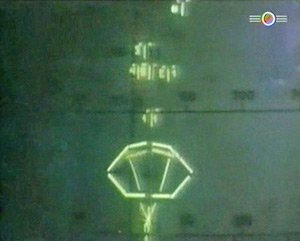
Pics btw as sequencies from the doc movie are from this source: https://www.ausairpower.net/TE-Foxbat-Foxhound-92.html
In the meantime eariler sequence at 38:11 is very important ,what we can see there ?
In the lower right corner we can see one switch with next designations on the Russian Cyrillic : БЦ,СРЦ,МЦ. First is for the big target,second for the medium one and the third is for the small air target of course.
This is that switch :
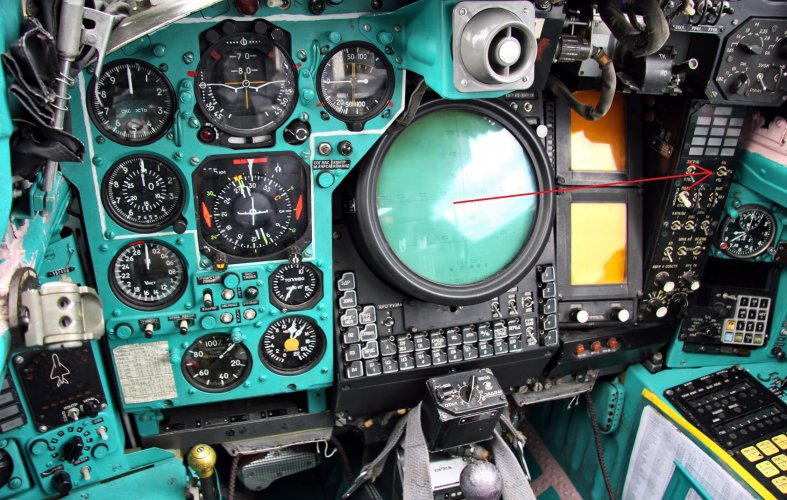
As I can see on 38:28 that switch stayed in position for the 'medium target'.
Now this is crucial ,pls take a look on the next sequence , 38:41 where we can see the first incoming aircraft appeared .My assessment is that the detection/track distance was very close to 400km ,of course in the PPS combat mode.He appeared somewhere in this 'area' :
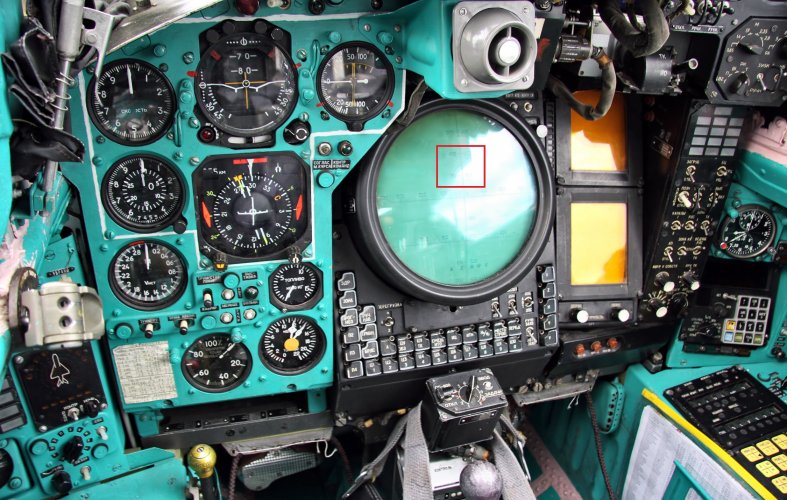
Next sequences show us that there was 6 differ aircraft as incoming ,so flying to the R-33's DLZ. From the 39:30 pilot got PR command to launch first R-33 etc...
At 40:04 we can see direct hit of one of launched R-33 and if I see well target was smaller one ?! Am I right or wrong?
Wings of the Red Star - MiG-25 Foxbat & MiG-31 Foxhound
To be cont....
Last edited:
- Joined
- 27 December 2005
- Messages
- 19,225
- Reaction score
- 35,635
Those screenshots I took more than 20 years ago and posted on my Russian Avionics page. They were taken from a tiny AVI copy of the Wings of the Red Star video. There's much better quality videos of that archive footage available now.

The black range scales are anything but obvious to me. if that's the missile launch envelope. its not centred for starters.
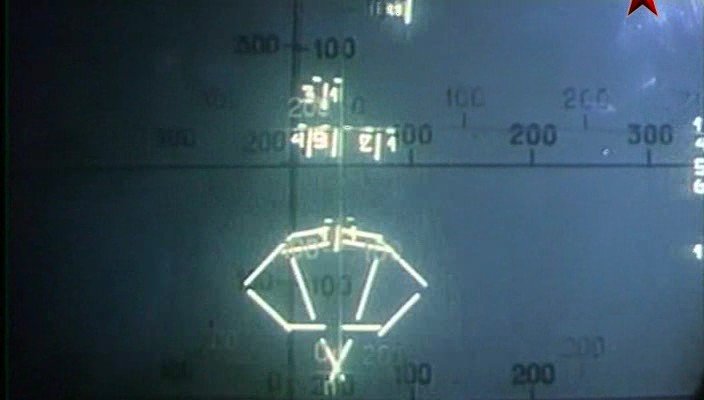
The black range scales are anything but obvious to me. if that's the missile launch envelope. its not centred for starters.
Last edited:
Similar threads
-

-

-
-
-
Mig-31 and Su-27 speed limit when loaded with missiles.
- Started by Ronny
- Replies: 11