Postwar Payen Projects

Last edited:
Thank you my dear Deltafan,

and please can you give us a direct link to all available issues of this (Pilote privé).
 
Thanks Hesham,

But I Don't understand your question.

There is no link of the web of available issues of these old magazines. I discovered this link only today.

I can only give you my own list of issues of Pilote Privé with known articles on Payen :

-Pilote privé
n° 11 10/1974 (Payen divers)
n° 45 (coupe Deutsch 5)
n° 54 06/1978 (Pa.100)
n° 60 12/1978 (Pa.100)
n° 83 12/1980 (YA-11 + RAP.40)
n° 84 01/1981 (SP.230 + 250)
n° 85 02/1981 (Pa.100-101)
n° 86 03/1981 (Coupe Deutsch / Pa.22)
n° 87 04/1981 (AP.10 + Pa.110)
n° 88 05/1981 (Pa.22 série)
n° 89 06/1981 (Pa.400 and others)
n° 120 01/1984 (Pa.49/1)
n° 121 02/1984 (Pa.49/2)
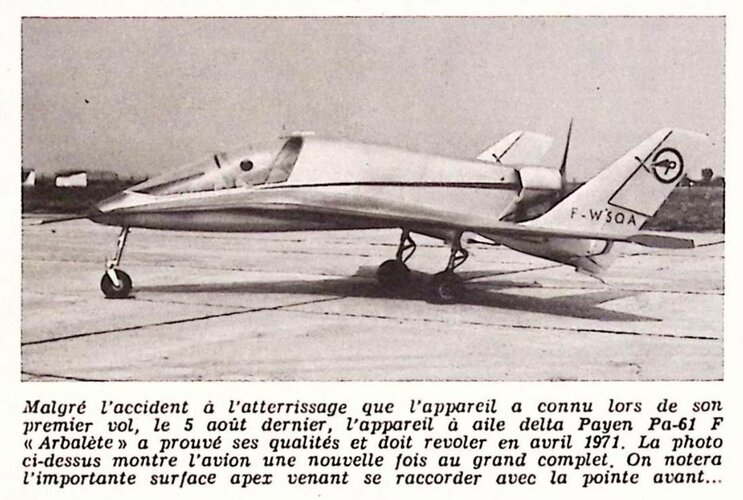
n° 123 04/1984 (Pa.61/1)
n° 124 05/1984 (Pa.61/2)
n° 131 12/1984 (Pa.61/3)

Today, Pilote privé is named Aviation et pilote, but AFAIK, they never wrote on Payen since 1984 (and if old issues are available from now to 1982, all the issues of 1984 are no more available).
 
Last edited:
Thank you my dear Deltafan,

but I don't spoke about Payen,I meant if this site has all this magazine issues,can you give us a direct link to all issues to
can upload them ?.
 
Sorry,

visibly the link come from an old site of the Aero-Club of Versailles, and the author wanted only to give these articles on Payen (9 Pilote Privé + 1 of Aviasport) on his link. I did not found other available Pilote Privé articles or magazines on it.
I found the link as direct link on Google Images. I could not found it after that on the two websites (the old one and the new) of the Aero-Club de Versailles.

http://acversailles.free.fr/https://www.aeroclub-versailles.com/
 
I don't remember the source,

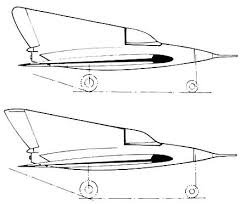
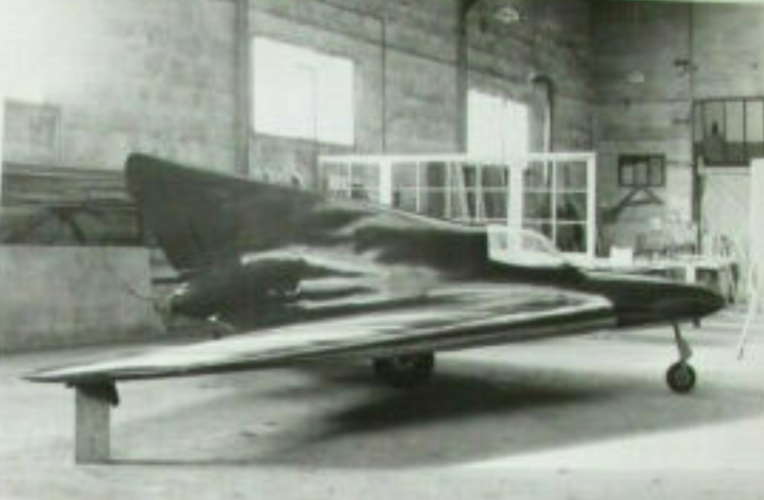
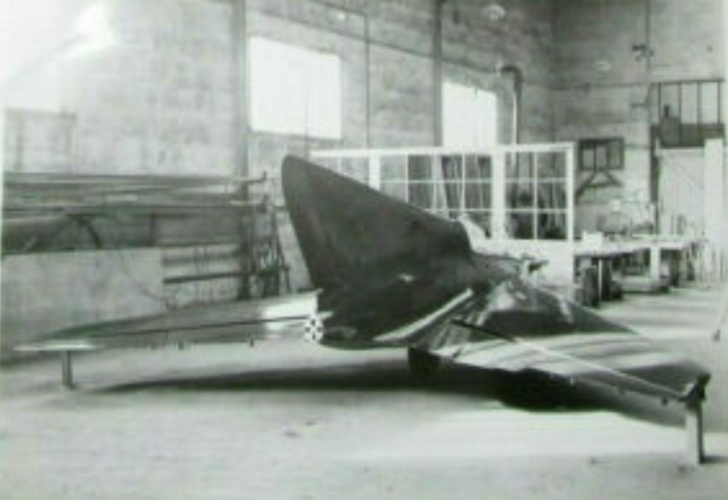
the Payen Pa.49 in early shape and building shape as I think ?.
 

Attachments

  • images.jpg
    images.jpg
    6.5 KB · Views: 108
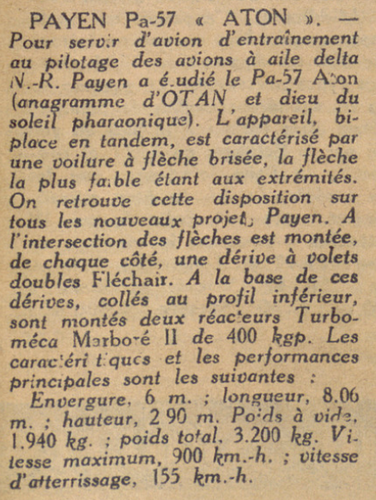
From Aviation magazine 1955,

a more Info about Payen Pa.57.
 

Attachments

  • 57.png
    57.png
    583.9 KB · Views: 87
Thanks Hesham.


Is there texts with the two drawings ?


The Pa.149 drawing is the source for the drawing of the Minijets website. There is a text (in french) about this plane (this webpage is improved since a few time).

https://minijets.org/fr/150-a-300-kg/turbomeca-palas/projets/payen-pa-149/

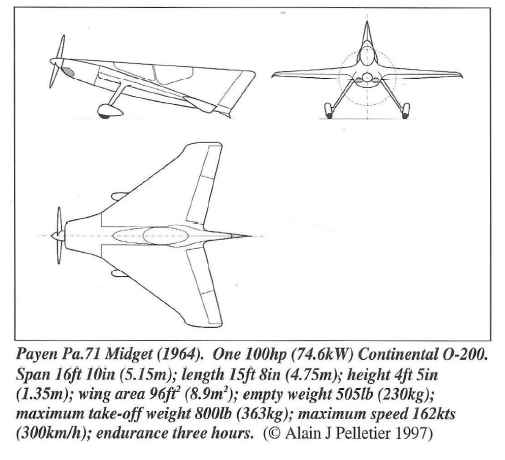
For the Pa.71, this 3D drawing from JAWA is new, even if we know a drawing from Jemiba (see my avatar) ;)
The exact url is: https://minijets.org/fr/150-300/turbomeca-palas/projets/payen-pa-149
 
Thanks Hesham.


Is there texts with the two drawings ?


The Pa.149 drawing is the source for the drawing of the Minijets website. There is a text (in french) about this plane (this webpage is improved since a few time).

https://minijets.org/fr/150-a-300-kg/turbomeca-palas/projets/payen-pa-149/

For the Pa.71, this 3D drawing from JAWA is new, even if we know a drawing from Jemiba (see my avatar) ;)
The exact url is: https://minijets.org/fr/150-300/turbomeca-palas/projets/payen-pa-149
Thanks and welcome on SPF First_philou :)
 

Attachments

  • Payen Pa.49 ebay 4.png
    Payen Pa.49 ebay 4.png
    699.2 KB · Views: 56
  • Payen Pa.49 ebay 5.png
    Payen Pa.49 ebay 5.png
    809.7 KB · Views: 69
Last edited:
Hi all,

Jemiba believes this is the Payen Pa.562!


Servus Maveric
I could see that cockpit lower a tad—with its fuselage join being the intake…with gill like slats to either side for taxiing.

It would have a two stage ejection—cockpit up and tail sever to eject while protecting the occupants.
 
Do we know what prompted later designs' belated migration of cockpits from tail to nose ??

( Being whacked with proverbial 'Clue by Four' by screaming test-pilot seems far-fetched, even for Payen... )
 
I can't ID this aircraft ?.
 

Attachments

  • 20.png
    20.png
    485.2 KB · Views: 136
Old post but in what year was the Payen Pa/P1 cruise missile (K48) designed (and tested if it ever got that far?)

Thanks

Larry
 
I'm trying to figure out what style of wing the Pa.49 had.

An issue of Aero France 1955 describes it as follows;
L'aile a un allongement de 2,7 et une flèche au bord d'attaque de 72°. Le calage des profils, de 10% d'épaisseur relative à la nervure moyenne, est évolutif de 4° selonune génération à partir de la nervure n°4. Le profil moyen est un NACA de la série 23000 modifié, à Cmo nul. Le calaxe axial est de +2°.
All the translators I've tried produce somewhat confusing results. DeepL does the following;
The airfoil camber, which is 10% of the relative thickness at the centerline, varies by 4° per generation starting from rib No. 4.
While google translate outputs;
The wedging of the profiles, 10% thick relative to the average rib, is progressive by 4° according to one generation from rib no. 4.
Which doesn't help much.

Le Fana 274 says;
La voilure, de forme triangulaire, présente une flèche de bord d'attaque de 72°; son bord de fuite fait un angle de 63° avec l'axe de l'avion. L'aile a un allongement de 2,7, et une surface en projection de 11,25 m2 pour une envergure de 5,16 m. Elle n'a pas de dièdre et le calage des profils est évolutif (environ 4°). Le profil moyen est un NACA 23000, modifié (12% d'épaisseur à l'emplan-ture, 8% aux extrémités, et bord de fuite relevé). Le bord de fuite comprend près du fuselage, les volets de profondeur, avec com-pensateurs réglables en vol, et, aux extrémi-tés, des ailerons conjugués avec la gouverne de profondeur.
Once again translators don't exactly help.

Can any French speakers with familiarity with aircraft terminology explain just what is meant by the camber/wedge being 4 degrees? Geometric twist?
 
I'm trying to figure out what style of wing the Pa.49 had.

An issue of Aero France 1955 describes it as follows;

All the translators I've tried produce somewhat confusing results. DeepL does the following;

While google translate outputs;

Which doesn't help much.

Le Fana 274 says;

Once again translators don't exactly help.

Can any French speakers with familiarity with aircraft terminology explain just what is meant by the camber/wedge being 4 degrees? Geometric twist?
Hi sienar,

I’m only just seeing your message today (real-life commitments mean I spend much less time on SPF than I used to, and I have a huge amount of reading to catch up on in the forum).

I have to admit too that even in French, I would struggle to explain the passage in question to you. And unfortunately, I never quite filled the many gaps in my English (I usually use Google Translate to express myself on SPF).

So, I asked Gemini—Google's AI—and here is what it told me.

First of all, I asked it for a "very explicit" translation of the passage, and this is what it replied:

"The airfoil incidence, featuring a 10% thickness-to-chord ratio at the mid-span rib, twists by 4° along a ruling line originating from rib No. 4."

Then, it added this:

  • Calage des profils : Angle of incidence or setting angle (the angle of inclination of the airfoil relative to the aircraft's reference axis).
  • Épaisseur relative : Relative thickness or thickness-to-chord ratio (the ratio between the maximum thickness of the airfoil and its chord length).
  • Nervure moyenne : Mean rib or mid-span rib (the rib located at the midpoint of the wingspan).
  • Évolutif : Varies or twists (which changes value progressively, related to the wing twist).
  • Génération : Generator line or ruling line (the geometric straight line used to plot/generate the 3D surface of the wing from one rib to another).

I hope this helps. Unfortunately, I can't do any better than that.
 
Last edited:

Similar threads

Back
Top Bottom