Payen Pa.112 C.1

maccountrypilot

ACCESS: Restricted
Joined
29 June 2010
Messages
12
Reaction score
1
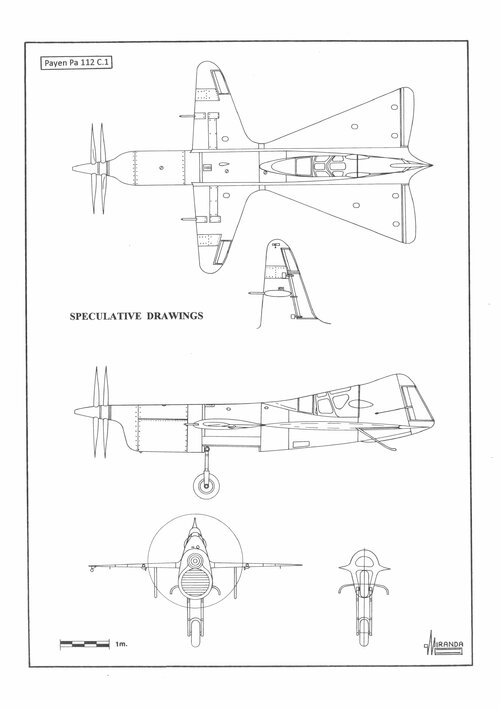
HI all .... I hope you guys have your "thinking caps" on. I ran across this France's Mystery Fighter called the PA-112-C.I. "Flechair". I found s few assorted drawings and renderings. Some show it as a contra-rotating prop while others show it as a conventional single prop. The plane is very odd (to be sure)I am giving consideration to building this as a contra-rotating r/c electric model. Does anyone have some detailed plans of this plane as an r/c model? I have the 3-views and other static model pics along with artist renderings. However with a plane this unusual, it presents many design questions. Any help would be most appreciated!!
 
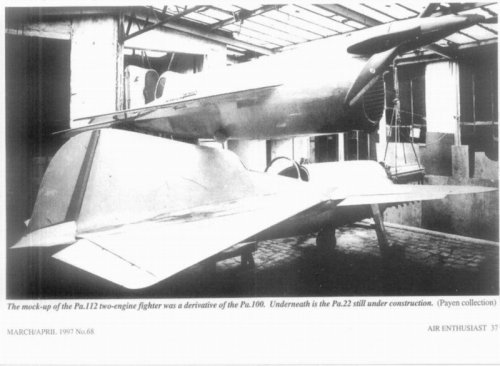
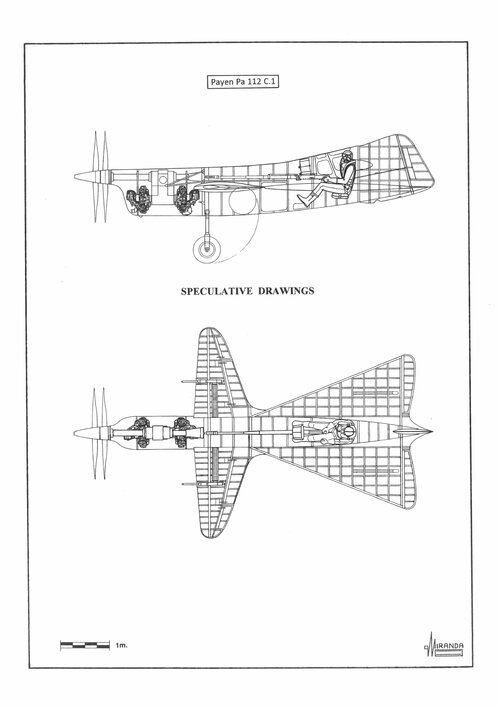
According to AirEnthusiast March 1997 and other sources, the Pa.112 was developed
as a kind of fighter derivative of the Pa.100 and was to be powered by two small radials
in tandem configuration driving a contra prop. Landing gear was a single central wheel and
probably outriggers/skids on the delta wingtips. I've attached a photo of the mock-up,
showing the contra prop quite clearly. Here the heavily framed canopy is missing.
But for questions about Payen aircraft, we have an expert here in this forum, who already
dug out quite a lot of information about those aircraft and so I rather leave it to Deltafan
to say more. ;)
 

Attachments

  • Pa-112_01.jpg
    Pa-112_01.jpg
    247.8 KB · Views: 653
Most of those Payen designs were 'wild', to say the least.

I suppose the nearest equivalent was the infamous GeeBee racer, with its limited visibility, dubious stability, designed for an over-sized engine plus a pilot with an excess of, uh, elan...

How his late-30s designs would have fared against Stukas and ME 109s is moot. Whether he could have got adequate engines --Hence the paired with contra-prop ??-- is another matter...
 
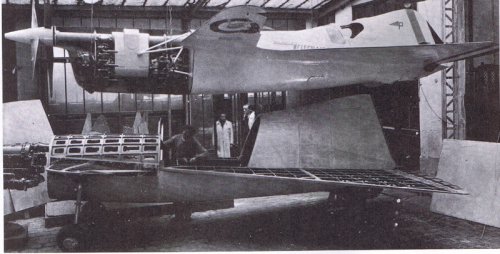
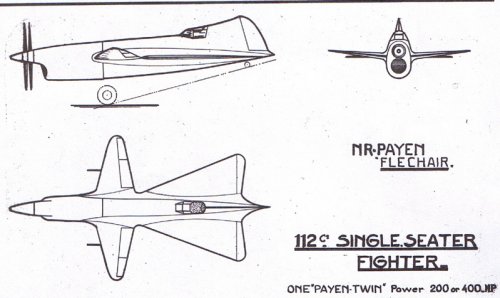
From " l'album du fanatique de l'aviation Nr.5 "

Span 4,2m,length 6,74m,L.W 610kg,max speed 580km/h .

The mockup is the crashed ex PA-100 ,under is the second PA-100.
 

Attachments

  • x.jpg
    x.jpg
    214.2 KB · Views: 545
  • y.jpg
    y.jpg
    158.9 KB · Views: 507
  • z.jpg
    z.jpg
    238.9 KB · Views: 479
Well, it seems that Payen planes are allways interesting :)

If you are not this one, maybe he could help you too :
http://hobby.eyeonentry.com/flechair.htm
http://hobby.eyeonentry.com/index.html

This one too could be helpful (but he failed to fly and it was Pa.100, not Pa.112) :
http://osegouin.free.fr/cncnet/bibli/projets/payenpa100.phtml
http://papykilowatt.free.fr/VIDEOS/payen.wmv

For my own, i'll look for. There are some problems with Payens rights, but we can help, even with PM and even with bad english ;)
 
maccountrypilot you have three PM ;)
Nik said:
Most of those Payen designs were 'wild', to say the least. I suppose the nearest equivalent was the infamous GeeBee racer, with its limited visibility, dubious stability, designed for an over-sized engine plus a pilot with an excess of, uh, elan... How his late-30s designs would have fared against Stukas and ME 109s is moot. Whether he could have got adequate engines --Hence the paired with contra-prop ??-- is another matter...
It seems that he Pa.101 (the Pa.100 could not get the foreseen Regnier 180 hp engine and became Pa.101 with an "over-sized" 380 hp radial engine) had a good stability but a catastrophal visibility (main cause of its failed landing). The less powerful Pa.22 had problem with stability (cause of the two changes of its vertical fin).

Among the Payen projects before the war, there was racer with two Gnome & Rhône 650 Hp radial engines and contra-props, but it seems that this engine was only a study. The (bomber) SNCAC NC-110 (with two double engine) and the racer Bugatti 100 P (with two Bugatti car engines) were not finished when France collapsed and never flown. The first flying french plane with contra-props engines, studied before the war but first fly after the war, the Arsenal VB-10, had a technical nigthmare Hispano-Suiza (double) engine and was abandoned. The protototype of the Latecoère 299A had a more simple Hispano-Suiza double-engine but it was destroyed in 1944 before the first fly. The first french jet engine (Rateau 100 kgp) was built before the collapse of France but was not enough powerful and had a lack of fiability.

Like the Pa.101 could a Payen fighter with a powerful no contra-props engine have flying stability ? Maybe ;)

http://www.rcvortex.com/Roland%20Payen.html
 
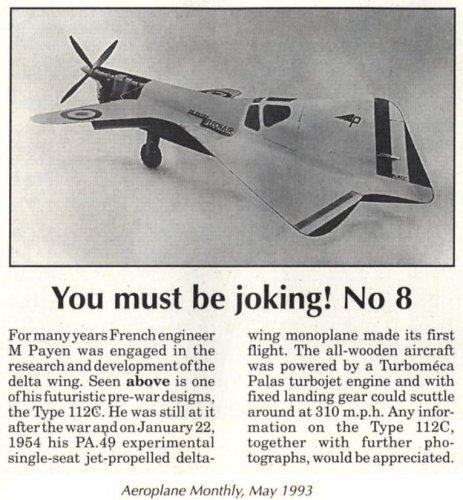
A clipping from Aeroplane Monthly (May 1993) about the Payen Type 112C Flechair attached.
 

Attachments

  • Payen_Type_112C_Image.JPG
    Payen_Type_112C_Image.JPG
    74 KB · Views: 414
Just to be precise: The designation as it appears in the topic's title is incorrect.

It should read Pa.112 C.1 , with "C.1" indicating a single-seat fighter. All official pre-war French designations followed that system of a letter prefix (mission) and numeral (number of seats). There should be no hyphen between the two.
 
Yes, that's the notation in the Designations Section, too, so title
slightly changed.No need to be embarrassed because of being precise ! ;)
 
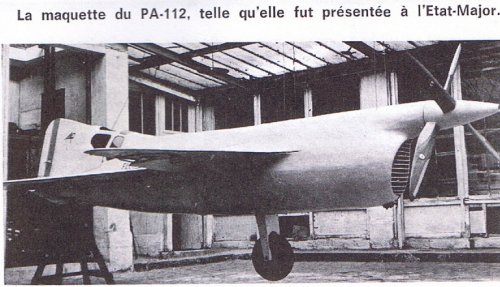
Yes, it's the 1/1 model of the Pa.112-C.1 from 1938-39

with the 2 x 100hp Salmson AD-9 engines and the Baudot contra-rotating propellers system that never worked good... :(
 
- Payen Fighters​

Between 1932 and 1942, Nicolas Payen designed a series of wooden canard-delta airplanes with a radical tandem-wing configuration.

In 1933 he built the Pa 100 Flèche Volante with small wings called machutes and a 67 degree swept delta tailplane, to compete in the 3rd Coupe Deutsch. The machutes had mobile wingtips which acted as ailerons and electrically-operated metallic flaps. The landing gear consisted of one centreline main leg, retracting backwards, and two outrigger auxiliary wheels retracting into the tailplane.

The engine should have been one 180 hp Regnier R6, six-cylinder straight air-cooled, driving a fixed pitch wooden airscrew. But it was not possible to get one in time to participate in the competition and Payen had to adapt his project to the only engine available: one 380 hp Gnôme-Rhône 7Kd Titan Major seven-cylinder radial air-cooled, weighting 270 Kg, totally unsuited for a racing aircraft. It was necessary to install a fixed undercarriage in more advanced position, to compensate the extra weight, and a tail skid. The wingtips ailerons were also changed by others, safer and of conventional type.

The refurbished plane was named Pa 101 Avion-Flèche, had 4.26 m wingspan, 5.75 m length, 2.2 m height, 6.86 sq.m wing surface, 750 kg maximum weight and one estimated maximum speed of 400 kph. It flew for the first time on 17 April 1935, being damaged in an accident just eight days later.

The Pa 101 airframe served as the basis for a new racer project, called Pa 110 CD (Coupe Deutsch). Designed in 1935, it differed from the previous model by its conventional landing gear, retracting backwards into the fuselage sides. It was hoped that it might be able to fly at 490 kph powered by one 200-240 hp Hirth 508D, eight-cylinder inverted-Vee, air-cooled engine, but the project was cancelled due to lack of funding.

When the Spanish Civil War began, the Republican Government had great difficulties in acquiring combat airplanes abroad, due to the international blockade. In the summer of 1936 Nicolas Payen offered the Spanish communists to build the Pa 110 C.1, the military version of the racer, through the Luxembourgian banker Rosenthal.

The power system designed for the fighter was made up of two 220 hp Renault 6Q-01, six-cylinder straight air-cooled engines installed in tandem face-to-face. Both engines were connected to the contra-rotating propellers power shaft by means of a Cotal-Baudot gearbox that allowed to electrically disconnect any of the engines by means of a clutch.

It was going to have an armament of two 7.5 mm Darne machine guns installed under the machutes and one 20 mm H.S. 9 cannon, firing through the propellers hub, but the French Government had banned its export to Spain and had to be replaced by one 23 mm Danish Madsen cannon. The Pa 110 C.1 would have an estimated maximum speed of 460 kph, flying with one engine, and 550 kph with both engines. The estimated range was of 850 km.

The arrival of the Soviet fighters Polikarpov to Spain in October meant the cancellation of the project, which was redesigned as Pa 112 C.1 to adapt it to the Chasseur Monoplace C.1 specification published by the Ministère de l'Air on 3 June 1937.

The Renault 6Q were replaced by two 200-205 hp Salmson 9ND nine-cylinder radial air-cooled (surplus) engines commonly used by the Bloch M.B.81 of the l’Armée de l’Air and by the Besson B. 411 of the l’Aéronavale. Proposed armament was either a 20 mm H.S. 9 or an Oerlikon FFS cannon and two 7.5 mm MAC 34 M39 belt-feed machine guns installed in the interior of the machutes, or two MAC 34A drum-feed installed under the machutes.

A mock-up using the airframe of the Pa 101 was built in 1938. After being examined by technicians of the l’Armée de l’Air, the project was rejected at the beginning of 1939, because of the great complexity of the power system. Payen offered to build the Pa 300 instead, a fighter capable to surpass the 520 kph of the Programme Technique A23 if they provided him with an H.S.12 Y-45 engine. But the military, who had done most of his career flying in biplanes, found the flèche aerodynamic solution to be too radical and preferred to build the Arsenal VG 33.

To fight these prejudices, Payen built the technological demonstrator Pa 22/2 Fléchair, which was captured by the Germans in 1940 while performing aerodynamic tests in the O.N.E.R.A. wind-tunnel of Chalais-Meudon. Under the new administration, the prototype was modified with the installation of a 180 hp Regnier R6B-01 engine and a new open cockpit with the windscreen of one Arsenal VG 33. It made his first flight on 18 October 1941 and was destroyed during an Allied bombing in April 1944.

 

Attachments

  • 046.jpeg
    046.jpeg
    333.4 KB · Views: 171
  • 047.jpeg
    047.jpeg
    397.7 KB · Views: 185
From old site,

oland Payen was the second French aircraft designer, alongside Maurice Delanne, to design and build aircraft in the 1930s with an unusual aerodynamic layout: the tandem biplane, sometimes called the Nienadowicz biplane (after the French-based Russian who first proposed such an aerodynamic layout). The tandem biplane layout involved placing two nearly equally large lifting surfaces spaced apart along the fuselage, with the front wing mounted higher than the rear wing. This wing arrangement caused the front wing to act on the rear wing like a leading-edge slat, increasing lift on the rear wing. This design reduced stall speed (and thus minimum landing speed) and increased the aircraft's permissible center of gravity. The aircraft's maneuverability and controllability were also expected to improve.

Payen's first completed tandem biplane design was the Pa-100 sports aircraft, designed in 1933 and built in two examples. A few years later, Roland Payen began design work at the small SCEPA factory on a subsequent aircraft, designated the Pa-112 , with plans to enter the then-popular Coupe Deutsch de la Meurthe competition in 1939. Engineer François Baudot, former technical director at Blériot, was responsible for the project's technical aspects. The aircraft retained the basic design of its predecessor, which Payen called a Fléchair . It was a cantilever tandem biplane with a trapezoidal front wing equipped with flaps and ailerons, and a delta rear wing with a leading edge sweep of 67 degrees. The rear wing was equipped with flaps acting as elevators. The wingspan was small, significantly shorter than the length of the aircraft's fuselage. The wide, triangular vertical stabilizer housed a glass-enclosed cockpit at its base, and the rudder at its trailing edge. The landing gear was a highly original design, with its wheels unable to retract into the wings due to the thinness of its profile. It consisted of a single main wheel retracted into a compartment in the central fuselage (between the engines and the cockpit), a small tail wheel retracted into a compartment in the rear fuselage, and two auxiliary stabilizing skids on struts extending from under the wings. Power was provided by two lightweight Salmson 7Ac radial engines, each producing just 100 hp, located in the forward fuselage and driving a set of two two-bladed contra-rotating propellers via a Cotal gearbox.

In 1938, before the Pa-112 design was completed, Payen proposed his aircraft to the French Air Ministry, the Ministére de l'Air, as a light, single-seat fighter, the Pa-112C1 . This version was to be armed with two 7.5mm machine guns in the front wing and a single 20mm cannon in the forward fuselage (firing through the propeller shaft). Before the outbreak of war, only a full-size wood and metal mock-up of the aircraft was built, using components from the airframe of a Pa-100. This mock-up was presented to representatives of the French Air Force, the Armée de l'Air, but Payen was not awarded an order for his aircraft. The main reasons were likely the aircraft's unconventional design and/or the unrealistic performance of the proposed low-power engines.

In 1939, Roland Payen built another aircraft, the Pa-22, which fell into German hands after France's defeat. Work on this aircraft continued under the supervision of the Luftwaffe, which showed great interest in the concept of this extraordinary aircraft. The Pa-22 prototype first flew in October 1942. Some of Payen's ideas and the experience gained during the tests were subsequently incorporated into several jet fighter designs in 1944, including the Messerschmitt P.1106 and Lippisch P.13a, as well as the Lippisch DM-1 experimental glider.

As an aside, it might be added that after the war, Roland Payen built, among other things, the Pa-49 experimental jet aircraft, very similar in its turn to the aforementioned Alexander Lippisch machines. This is a perfect illustration of the mutual inspiration between these two outstanding aircraft designers.
 

Similar threads

Back
Top Bottom