The
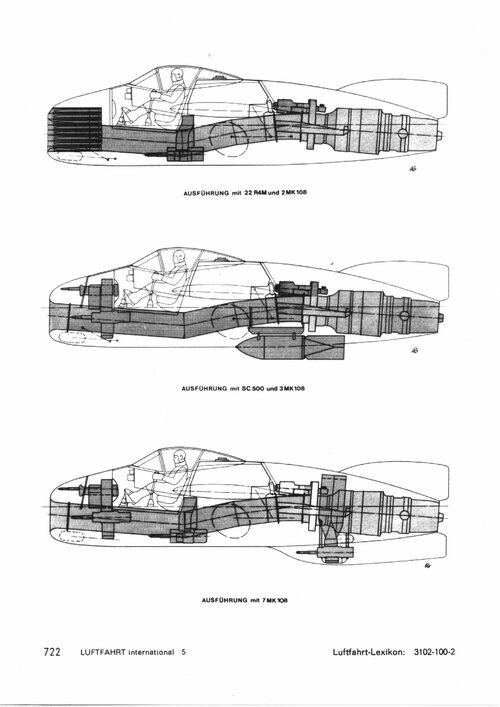
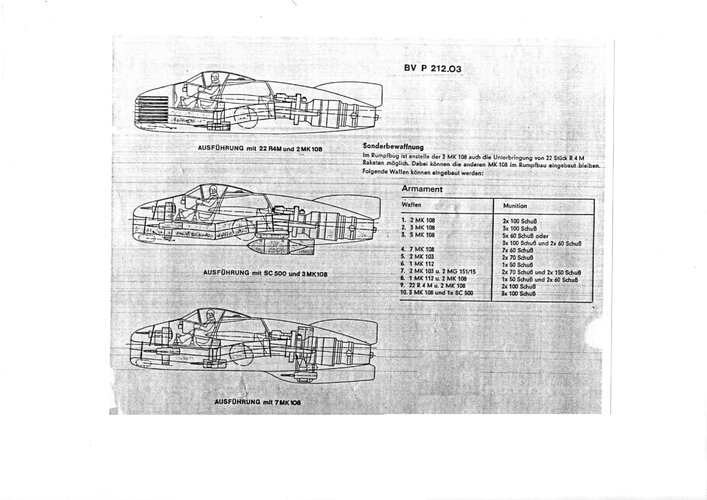
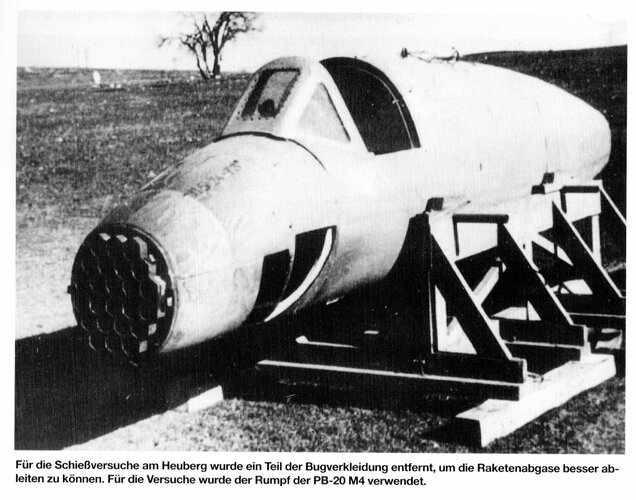
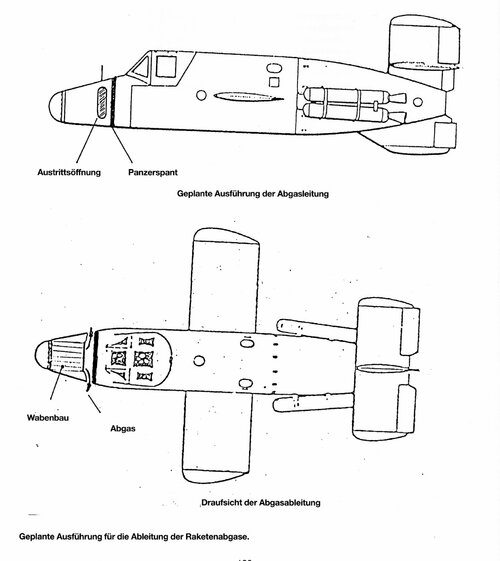
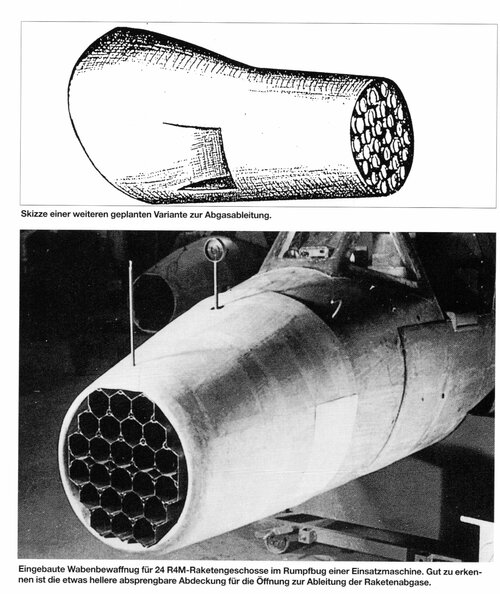
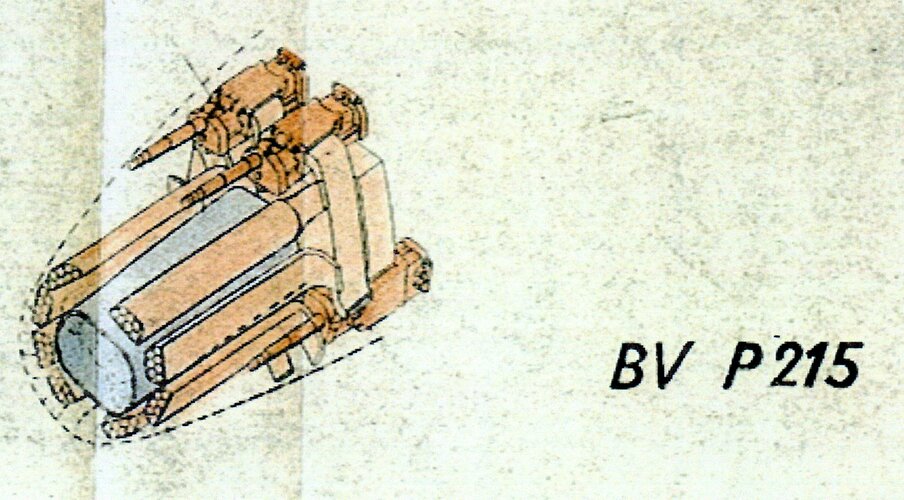
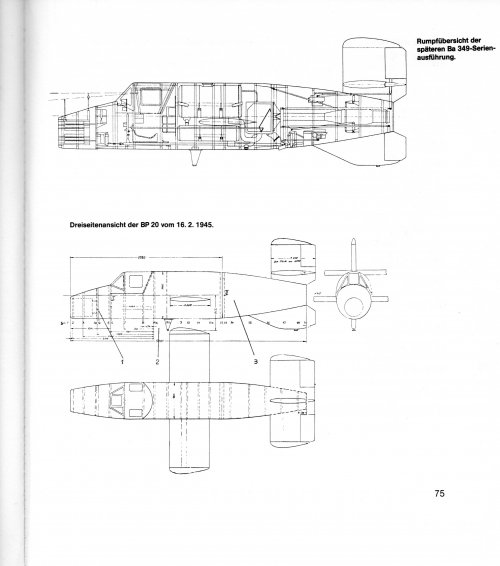
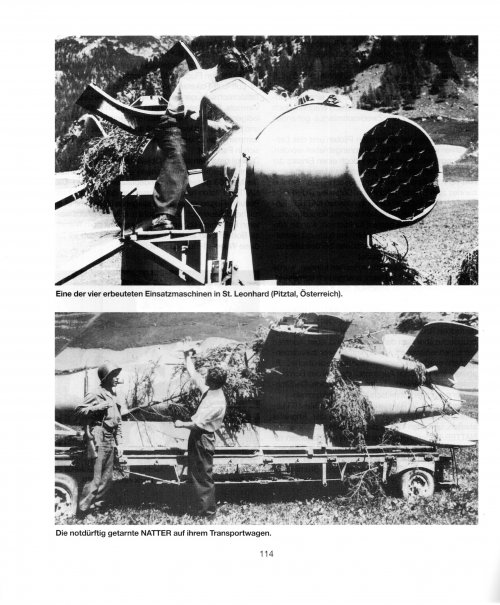
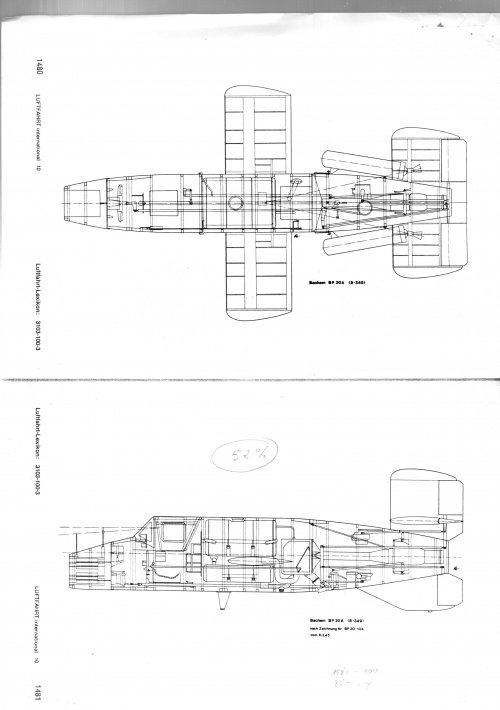
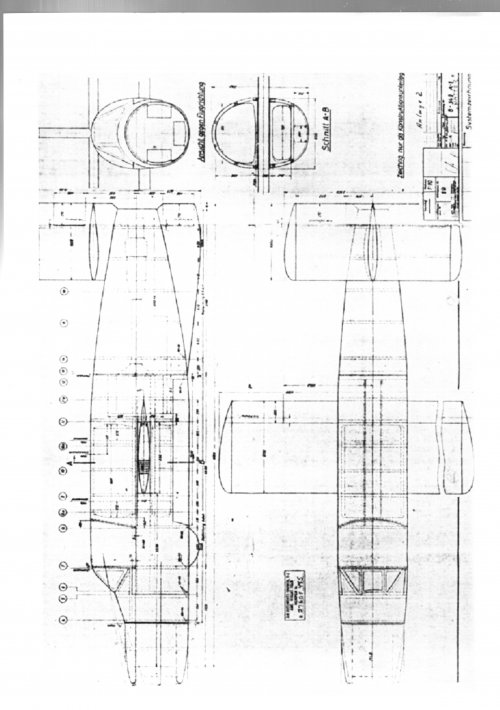
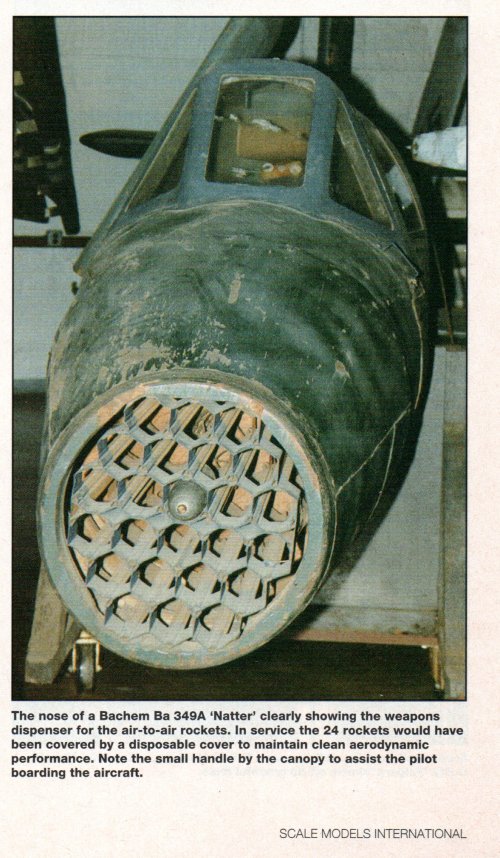
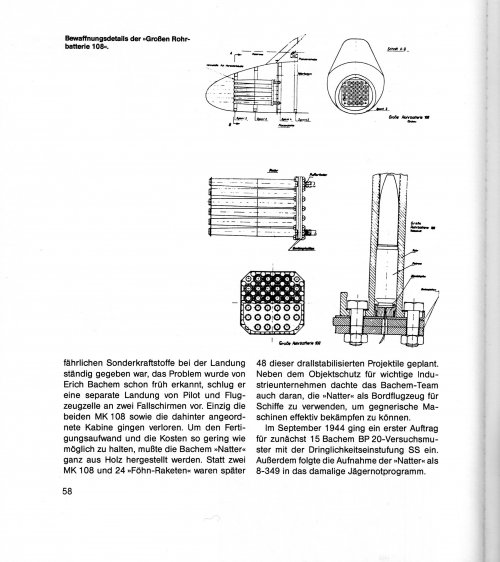
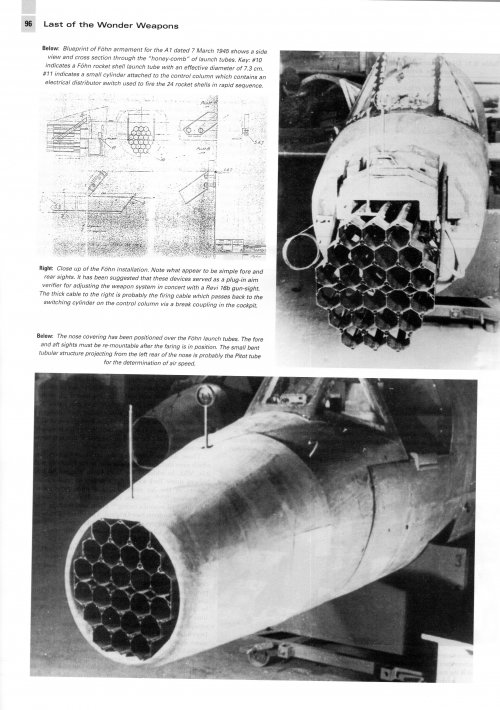
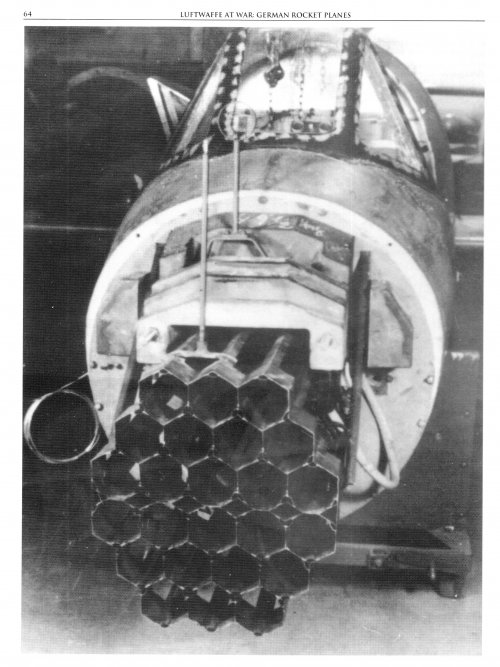
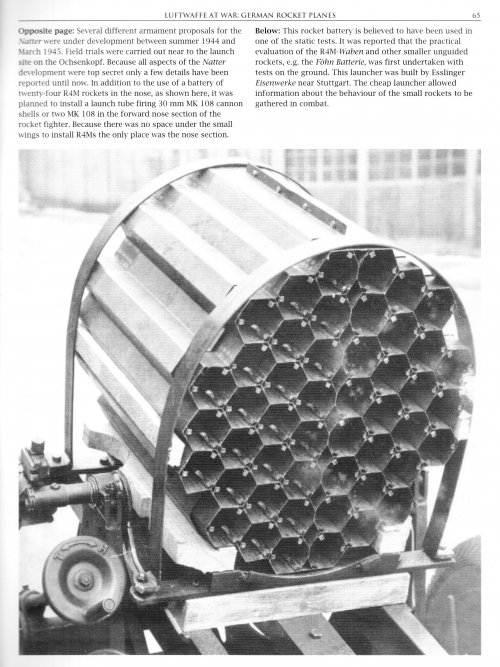
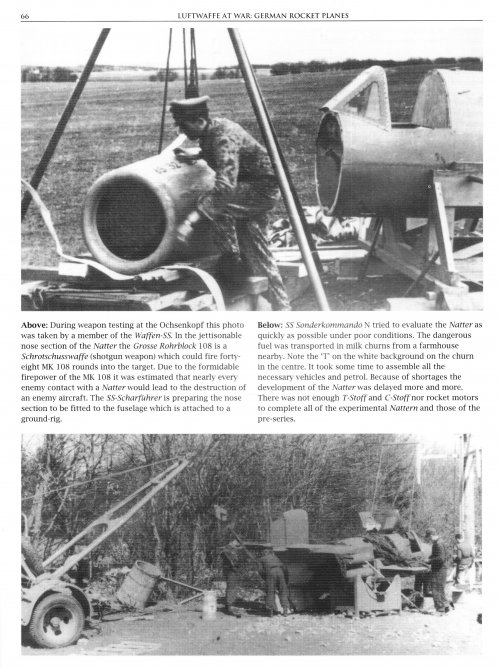
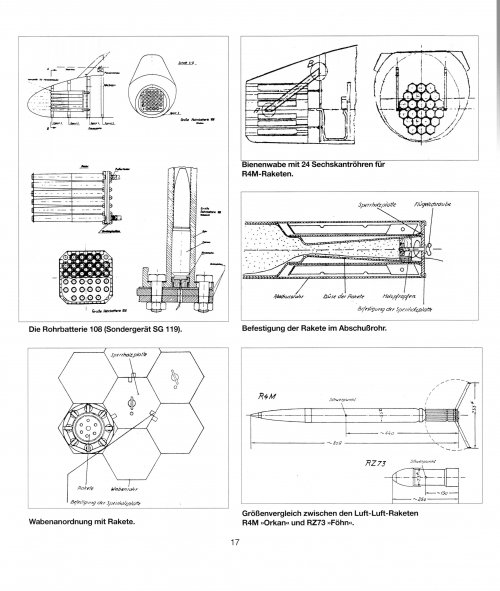
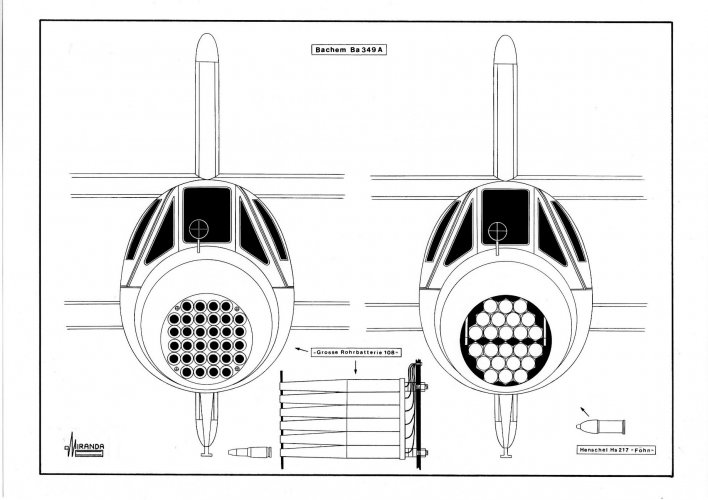
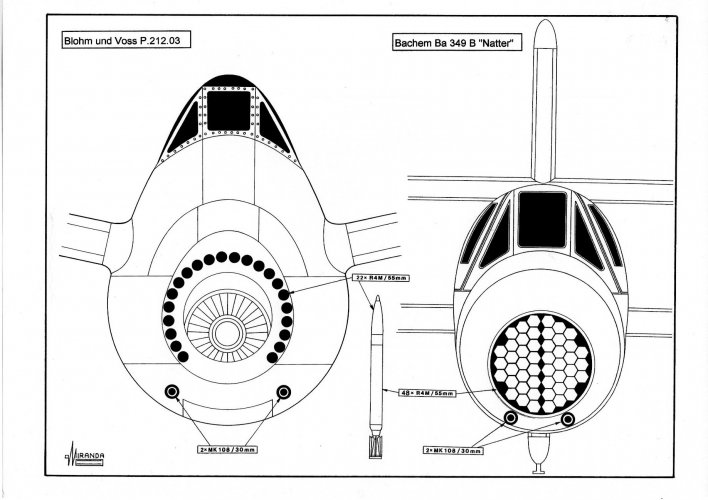
Natter armament consisted of 24 gyro-stabilized 73-mm rockets Hs 217 Föhn that were to be fired in a single salvo from the shortest possible distance from the target.
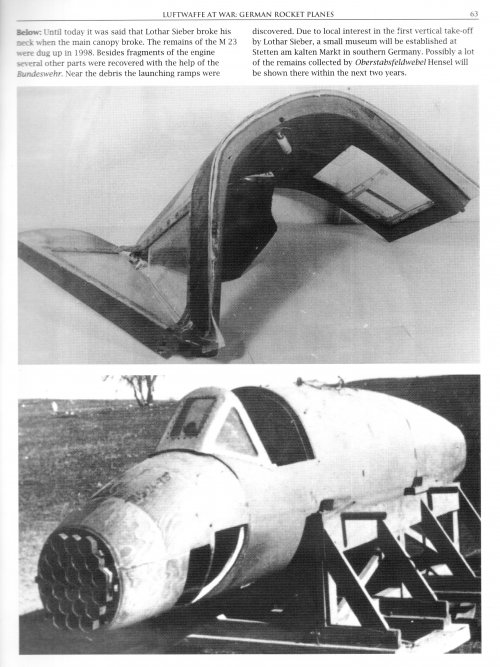
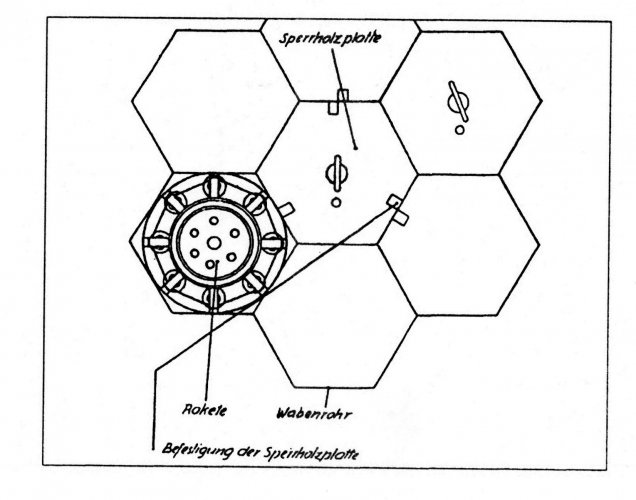
The rockets were stored in a cylindrical honeycomb container mounted on the nose, with a system for laterally discharging the gases produced during shooting, called
Abgasableitung openings, located on either side of the forward fuselage.
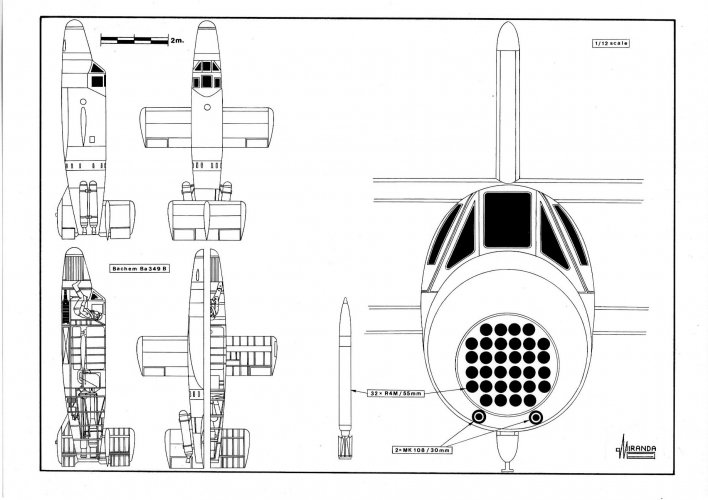
The Ba 349 B was designed to increase the powered flight endurance using one HWK 109-509 B-1 rocket engine, with an additional low-thrust cruising combustion chamber for economic cruise, and increased propellants tankage. This led to a 10 per cent speed decrease, but Type B could maintain combat altitude for eight minutes and could destroy several bombers, multiplying its effectiveness.
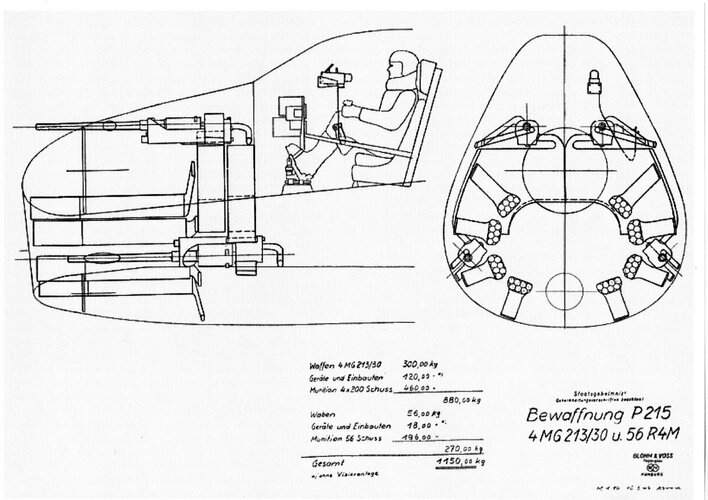
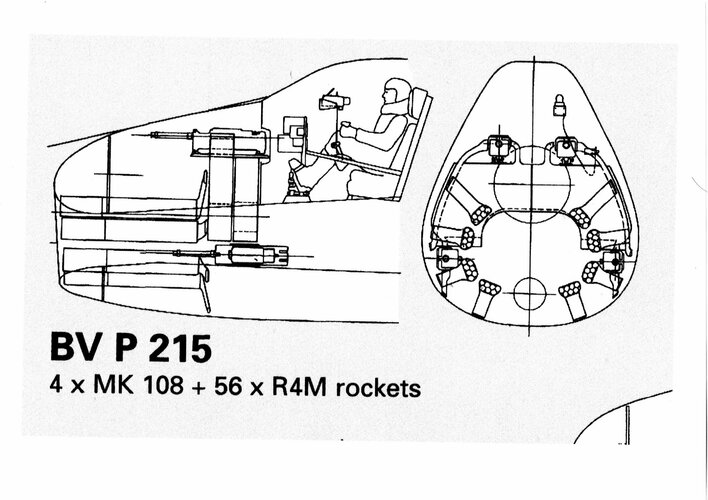
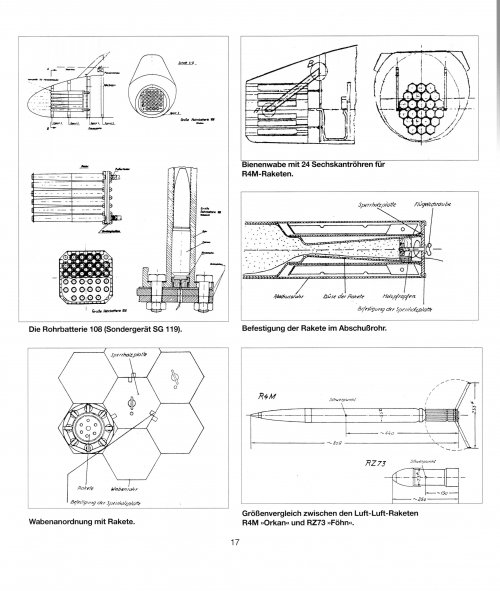
It was necessary to modify its armament by installing two MK 108/30 guns under the pilot's seat and replacing the honeycomb container with a cylinder containing 32 fin-stabilized 55-mm rockets of the type R4M
Orkan.
The R4M had the same ballistics characteristics as the 30 mm shells from MK 108 cannon and both weapons could be fired with the help of one
Revi 16 B gunsight.
The rocket had a range of 1,800 meters and it was estimated that, from such distance, a salvo of twenty-four units had a field of fire of 30 x 14 meters, approximately the size of a B-17 US bomber. The salvo was electrically fired by means of one automatic sequencer
Schaltwalze at 50 milliseconds intervals.
A single R4M should be enough to destroy a heavy bomber and the
Schaltwalze could be programmed to fire only four or five rockets at a time.
Spin-Stabilized Rockets
In 1936 research started to provide the
Luftwaffe with a
Bordrakete unguided rocket capable of being launched from any airplane. After the testing performed at the research center of Tarnewitz in 1937 it was decided to manufacture the RZ 65B (
Rauch Zylinder) model proposed by the Rheinmetall-Borsig Company.
It was a spin-stabilized rocket of 73-mm caliber fitted with a RaZ 51 (
Raketenaufschlag zünder) nose percussion fuse and a powerful explosive charge of 280 gr. of RDX/TNT able, in theory, to shoot down a heavy bomber in just one impact.
The rotation was achieved with six inclined exhaust venturis located at the base of the cylinder, following the Baron von Unge system, improved by Krupp in 1909.
It was a practical design, easy to store, that could be shot from a tube (
Einzelschussrohr) by means of an electrically activated percussion mechanism. The launcher had a slightly higher caliber (75-mm) and the rocket was kept at the center of the tube thanks to the three longitudinal fins fixed to its inner walls to allow the gases to be expelled with minimum friction.
The Germans used many types of rockets based on this principle throughout the war:
The
Nebelwerfer Wurfgerät W.Gr 21, 28 and 32 were successfully used as front line weapons of the
Heeresartillerie and a derivative of the RZ 65B, the 7.3-cm
Propagandagranate, was used for distributing propaganda leaflets.
On the other hand, its use from airplanes proved to be a failure for different reasons:
The process of the venturis drilling at the rocket base was a costly operation that did not adapt well to the German tactics of mass production. The result was not very accurate, affecting the rocket flying path until making it unpredictable. During further tests performed in November 1941, it was proved that after 544 launches only 15% had hit a target with the size of a bomber. In comparison the MG/FF guns of 20-mm, considered an average “transition” design in 1940, had a 26% rate of good shots
The low quality of the DEGN powder as propellant provided the RZ 65B practical range of just 250 m. This meant that the launch airplane had to fly well into the 100 yards area covered by the artillery of the B-17.
The
Luftwaffe did many tests in 1941 trying to adapt the RZ 65B to the design of the airplanes in service at the time. Multiple launchers of four tubes were installed under the wings of a Messerschmitt Bf 109 F-2 and a F-4/R1 and of six tubes in a Focke-Wulf Fw 190 F-9 reaching the conclusion that a salvo of eight to twelve rockets had no possibility to hit a bomber at more than 100 m. The installation of 12 tubes grouped together under the fuselage of the Messerschmitt Bf 110 V19 and of 16 tubes under the wings of a Junkers Ju 88 P-4 did not achieve better results.
The automatic launcher
Trommelgerät was also built with one single tube and a revolver-type drum with seven rockets. The testing was done using a Ju 88 A-4 and the Me 210 V4 proving to have insufficient rate of fire.
A configuration of one single tube, mounted under the rear fuselage of a Messerschmitt Bf 110 E-2 and that should shoot sideways when passing besides a bomber, was tested at Tarnewitz.
After 3,000 test launches, the OKL reached the conclusion that the RZ 65B could only be used from ground
Flakbatteries against low-flying aircraft. To that purpose, a special launcher named “7.3 cm
Föhn Gerät” was built. It was a conventional box launcher that could fire thirty-five rockets in 5 x 7 rows. The launching tubes were replaced by open cells of quadrangular section.
The 360º mount could be elevated -10 to +90-degrees by a layer situated in a steel box on the inner left. Rockets could be fired in a single salvo only.
Another two rockets named RZ 73 and RZ 100, both scaled-up versions of the RZ 65B, were designed by Rheinmetall-Borsig. The RZ 73 was a heavy rocket with a caliber of 158-mm. that was fly tested by a Bf 110 without any positive result. It was decided to transfer its production to the Schneider KG Company to be used in
Flakbatteries as RZ 15/8 or RZ 75.
The RZ 100 was a
Pulkzerstörer (formation destroyer) rocket with a caliber of 420-mm, a length of 1,650 mm and 730 kg of weight. The ground testing from a launch ramp offered good results but its use from airplanes proved not to be feasible.
During the first launch from the fuselage of a Me 210 the torsion-effect and the powerful blast generated by the twelve venturis produced extensive damage in the airplane and the project had to be left aside.
The use of progressively more powerful guns onboard the airplanes in 1944 reached the limits of design making the need for practical air-to-air rocket urgent. It was decided to perfectioning the RZ 65B with a new engine based on cordite which was able to reach a speed of 360-437 m/sec and a range of 1,200 m
The stability was increased by shortening the venturis and reducing the length of the rocket in 26-mm. To the original RaZ 51 fuse a timed self-igniting device was added for safety in case of a miss.
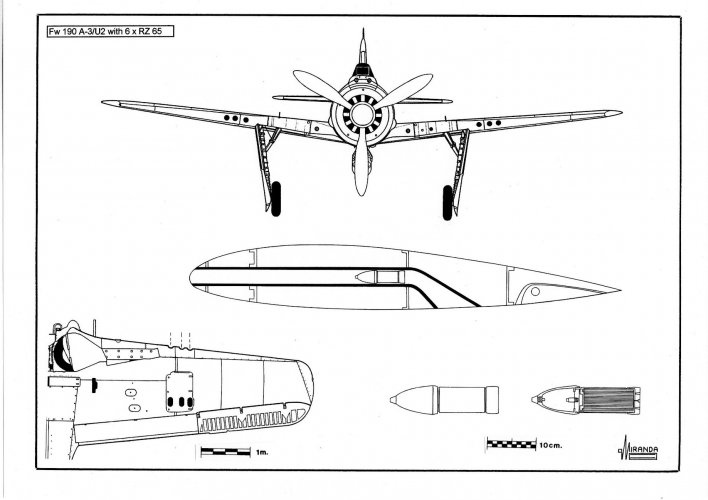
The RZ 65 was modified as anti-tank weapon with armor piercing warhead, carried by Fw 190 A-3/U2
schlacht (assault) airplanes.
The new rocket was named
Föhn and manufactured in number of 15,000 units by the Henschel company since September 1944. It was known as Hs 217 in its air to air version and R.Spgr. 4609 (
Raketensprenggranate) in its
Flak version. The latest could be shot from the “
Föhn Gerät” launchers that have already went into service with the RZ 65B to cover river crossings at Hahn, Satzvoy and Unkel and in some railway flat cars as well as mobile weapon mounted on 3.7 cm Flak 18 carriage.
A “
Föhn Gerät” named “
Vielfachwerfer Föhn” was also planned for the
Kriegsmarine with eighty rockets. At least the destroyer Z34 received them during spring of 1945.
At the beginning of 1945 some testing was performed with the AA infantry weapon. Based upon the Hs 217 it was a “
Einzelschussrohr” sheaf of three tubes that shot from the shoulder like a
Panzerschreck.
It also had secondary use against fortifications and ground vehicles and there were projects with five and seven tubes. All of them were electrically shot using the electromechanical shooting system of a
Panzerschreck.
Some designs of armored glider-fighters and rammers foresaw the use of several
Föhn rockets to be shot from a very short distance against the bombers. The Arado Ar E.381-I parasite rocket fighter carried six
Einzelschussrohre in the wing roots. The armored glider-fighter Zeppelin
Fliegende Panzerfaust carried two
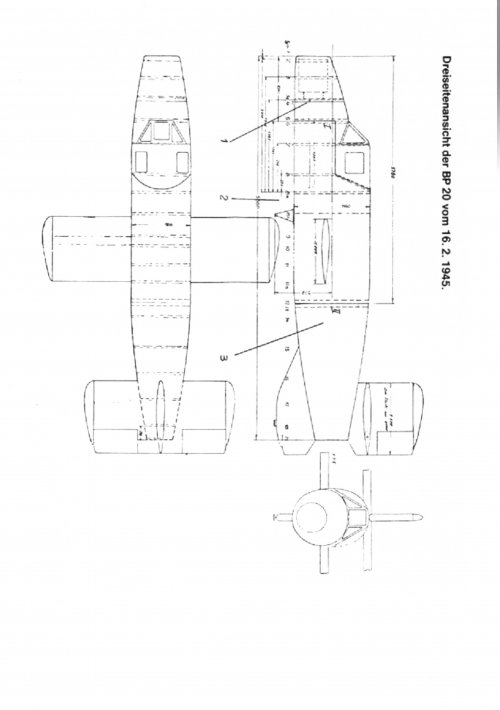
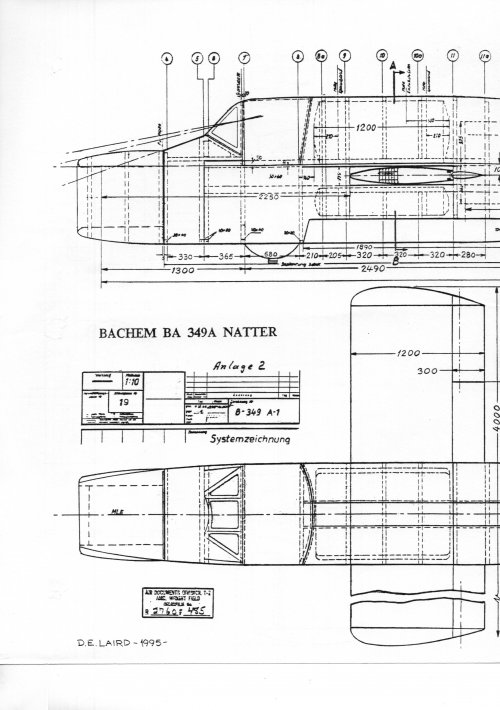
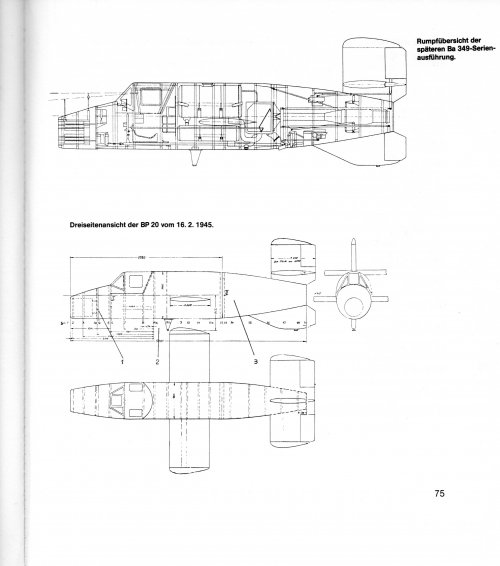
Einzelschussrohre to both sides of the fuselage. The expendable VTOL rocket fighter Bachem Ba 349
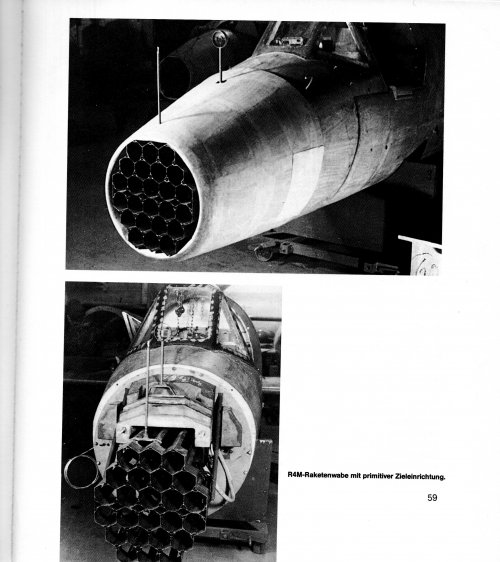
Natter carried a sheaf of 24 hexagonal tubes named
Bienenwabe B3-24 (codename
Krokus) in the nosecone with electromechanical triggers to be launched in a single salvo from a distance to the target of 100 m. A previous version of 28 tubes, named
Raketenwabe was not considered safe for its tendency to explode when the gas exhausts saturated the launcher.
After the failure in the development of their own rockets the
Luftwaffe tried to adapt some of the
Heeresartillerie designs for the air-to-air use.
The first one was the
Wurfgranate WGr.42 with a caliber of 210-mm. It was a spin-stabilized heavy rocket designed to be launched from a
Nebelwerfer NbW 42 five-barreled artillery weapon. The base was closed by a
Venturi block with 22 nozzles each angled at 16-degrees.
The
Luftwaffe’s version “
Bordsprengrakete 1943” was named W.Gr 21 (
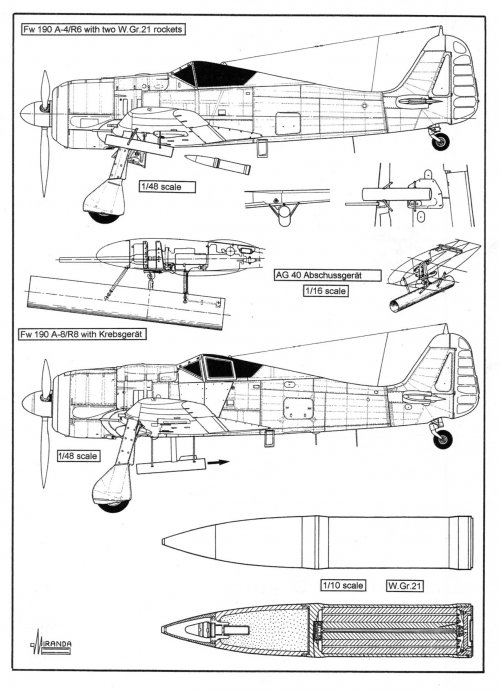
Wurfgranate 21- cm) with a length of 1,250-mm, a weight of 109.55 kg of which 10.17 were of
Hexogen explosive and 18.27 of
Diglykol propellant. Its speed was 320 m/sec and the range 2,200 m. It was fitted with a RaZ 51 impact fuse and a S/30 time-fuse, the warhead being detonated at a pre-set distance between 600 and 1,200 m with high lethality zone of 30 m.
During the first half of 1943 the
Erprobungsstelle testing of adaptation to the airplanes in service started at Tarnewitz.
Werferrohr tubes with a single rocket were installed under the wings of three Fw 190 F-8 doing successful ground launches.
It was patent during the flight shooting tests that the W.Gr. 21 suffered considerable deviations on its path. Starting from 1,000 m onwards, it falls 50 m under the launch level. To correct that flaw the tubes were installed with a +7-degrees pitch calculated to make the rockets converge at 1,400 m. They were fired electrically by means of an ERZ 38 low-tension detonator. Although not very accurate, they achieved certain success during the second half of 1943 and 1944 when aimed with a Revi 16F gunsight shooting from Fw 190, Bf 109 and Bf 110 that carried two
Werferrohr tubes under each wing.
The AG 40 assembly (
Abschussgerät) consisting of two
Werferrohr tubes mounted in a vertical configuration, one above the other, were also installed in some Fw 190s. When two AG 40 were installed together, the assembly was named
Vierersätz. They were tested at least in a Ju 88 A-4.
Two lines of six
Werferrohr tubes with a pitch of +67-degrees were experimentally installed in the fuselage, behind the cabin, of a Ju 88. This setting of armament was named
Reaktiver Bewaffnung and was shot like the
Schräge Musik guns of the night fighters, aiming with a Revi 16B gunsight.
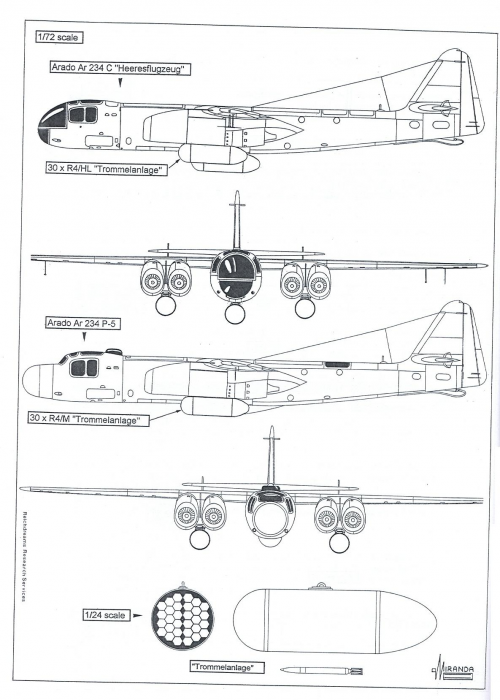
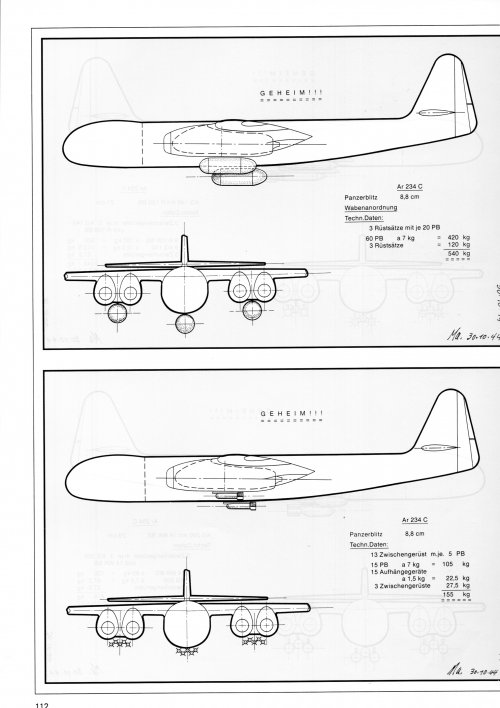
Several devices of the revolver drum type were designed for the automatic launching
-The
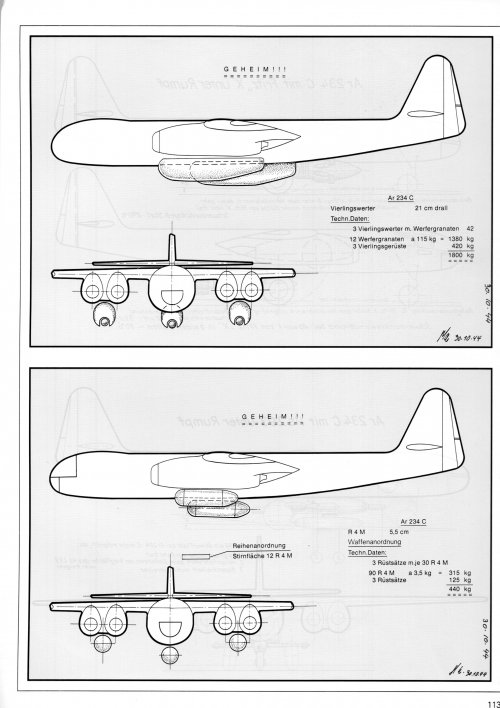
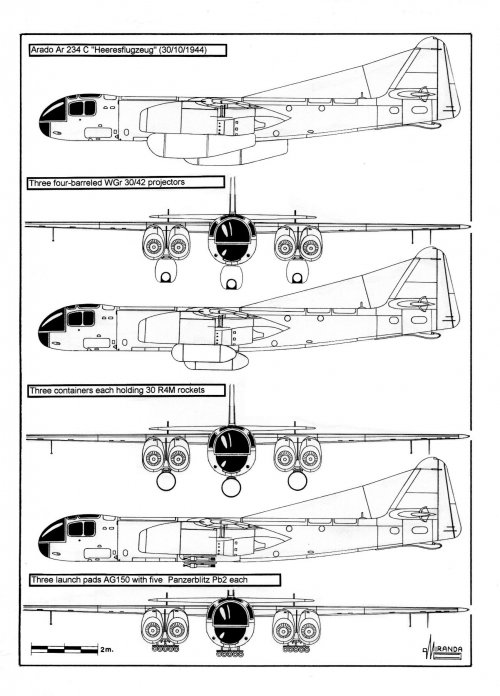
Vierlingswerfer of four tubes with an aerodynamic container to be transported under the wings and fuselage of the Ar 234 C
-The
Werferdrehling of six tubes that should be installed in the nose of a Me 410 A-2 and that was ground tested with little success
-The
Trommelmagazin of 12 tubes designed to be installed in the fuselage of a Ju 88 G-1
-The
Do-Werfer, a variant of the
Werferdrehling for the Ju 88C
-A similar system was installed in a Henschel Hs 129 B
-
Krebs-Gerät.
Some operational tests were conducted with a single aft-firing W.Gr.21 rocket. The
Werferrohr was mounted +7-degrees beneath the fuselage of several Fw 190 A-8 of the JG 3 to be shot rearwards against the bomber “boxes” after a conventional attack with guns.
This device was named
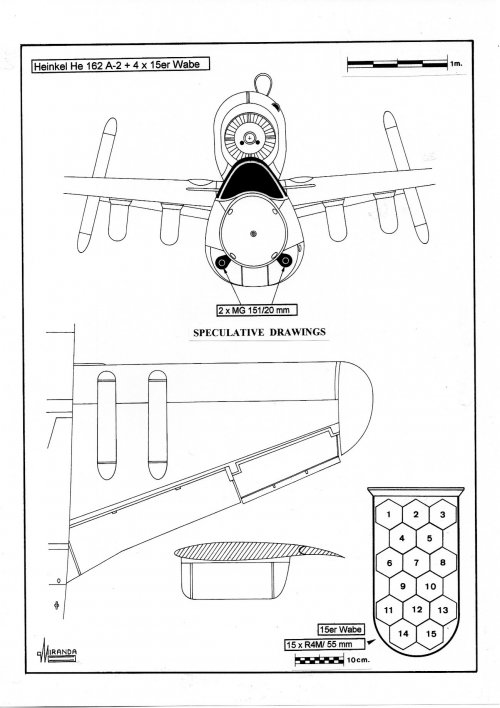
Partian shot by the Allies due to its similarity to the last arrow that the old Scythe horsemen launched backwards when retreating after an attack. The W.Gr.21 was used in combat by the Bf 109 G-5/R2, G-6/R2 and G-10/R2, by the Bf 110 F-2 and G-2/R3, by the Fw 190 A-4/R6 and A-8/R6 and by the Me 262 A-1a of the JG 7.
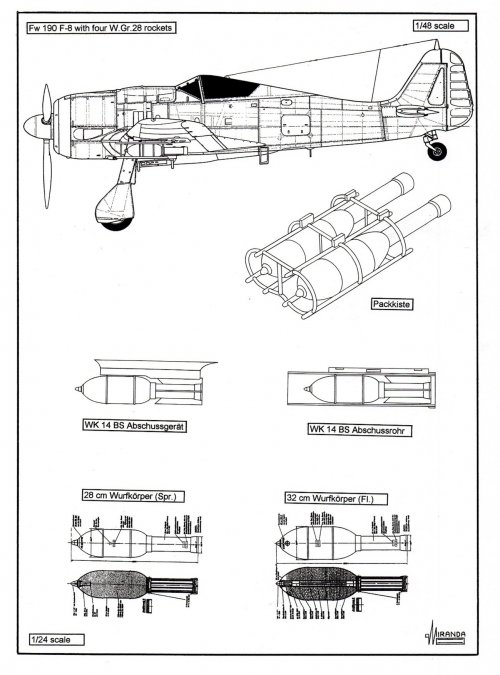
By the beginning of 1944 several launches of the powerful W.Gr. 28/32 rockets of Rheinmetall-Borsig, performed from airplanes, tested its potential use as antitank weapon. They had been designed as front-line artillery that could be shot from its own packing box
Packkiste, from an
Schweres Wurfgerät 40 improvised ramp, from the Nebelwerfer 41 launcher, from the SdKfz 251, half-track vehicle
Stuka-zu-Fuss or from the deck of an immersed Type IX C U-Boat
Do 38 Gerät.
In spite its versatility the use of these rockets for air-to-ground purposes turned out to be impossible due to the low accuracy of its flight path.
Some testings were performed at Tarnewitz installing double launchers under the wings of a Fw 190 A-5/R6 and under the fuselage of a Henschel 129 B. There was also a project of automatic launcher of six tubes, to be installed in a Ju 88 C.
The W.Gr.28 (
Wurf Granate Spreng 28-cm) was a high explosive demolition rocket of 280-mm of caliber, 1,190-mm of length and 83 kg of weight. The warhead contained 50 kg of
Amatol/TNT 40/60. The propellant charge was 6.6 kg of
Diglykol. There were 26
Venturis drilled with a pitch of 12-degrees in the rocket base and it had a range of 1,925 m.
The W.Gr.32 (
Wurf Granate Flamm 50) was an incendiary rocket of 320-mm of caliber with the same engine than the W.Gr.28 and a warhead filled with 50 lt. of
Flammöl Nr. 19, an inflammable fluid made up of kerosene and diesel oil with magnesium fuse. Its length was 1,289-mm and weighed 79 kg. Its range was 2,200 m.
In an attempt improve the accurateness of the rockets, the Kurt-Osterrode Company modified the W.Gr. 28 to convert it from a spin-stabilized to a fin-stabilized weapon. To that purpose, the rocket base was replaced by another in which the
Venturis were drilled with a 0-degrees pitch and four forward swept fins with a span of 290-mm were fixed to the outer part of the engine.
The new 14WK BS (
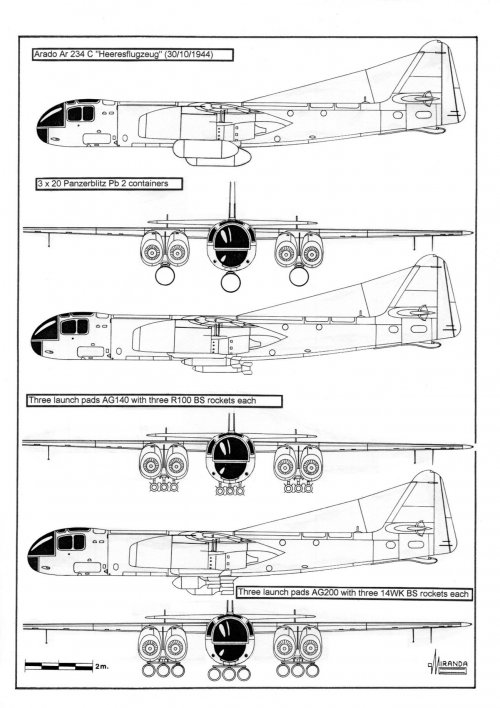
Wurfkörper Brandschrapnelrakete) rocket was launched by means of AG 200 rails in triple mountings and weighted 80 kg. The plan was to use it for the Arado Ar 234
Werferzerstörer (ground attack specialized) version that could transport nine rockets under the engines and the fuselage.
The manufacturing of the Skoda 10.5-cm spin-stabilized
Flakrakete of 19 kg of weight started in 1945. The launcher was named 10.5-cm RW (
Raketenwerfer) and contained 16 rockets. It was manufactured to be used over a 8.8 Flak carriage, over a
Panther tank, and also in naval version.
Other spin-stabilized rockets were used to deploy AA cable barrages against low flying airplanes.
Rheinmetall-Borsig built the RSK 1000 (
Drahtseil-Rakete). It consisted of several rocket engines of 210 mm that shot from vertical tubes located along the outer perimeter of an airfield. When this was attacked by low-flying airplanes, the rockets were shot towing behind them a 1000 m. length cable of steel. When the rocket reached maximum altitude, a parachute positioned instead of the warhead was opened-out and the cable went slowly down. An airplane colliding against it would suffer serious structural damage and the others were forced to fly higher, thus being reached by the light
Flak.
A similar system was also built for the
Kriegsmarine. The RSK 2000 was based on the R.Sprg L/4.8 naval rocket of 86-mm. There was also an anti-aircraft version named
Kurhessen that used the RAg 42 launcher.
An improvement of the system was developed by Krupp AG-Essen with its medium-level Kz.1000 barrage. It used 152-mm rockets and 900 m cables that, not being fixed to the ground, raised themselves up. A parachute of 3,356-mm diameter opened out at the upper end and another, of 153-mm, with an explosive warhead of 1 kg, at the lower end.
Solid-propellants rockets
All three German manufacturers of RATO rockets used the same solid propellant produced by Westfählische-Anhalt Spengstoff (WASAG):
Diglycoldinitrat formed by a mixture, by weight, of nitrocellulose (63%), diethylene glycol nitrate (35%), carbamite (0.5%), wax (0.2%) and graphite (1.2%).
Schmidding 109-513, 1,000 kg peak thrust, 2,220-mm length and 350-mm diameter, used in the Henschel Hs 293H and Hs 298 gliding bombs.
Schmidding 109-533, 1,000-1,200 kg peak thrust, 1,540-mm length and 255-mm diameter, used in the Bachem
Natter, the Heinkel He 162 A-10/A-11, Heinkel P. 1077
Romeo I & II, Heinkel P.1077
Julia, Junkers EF 126
Elli, DFS
Eber II and DVL
Jagdsegler II rammers, in the Zeppelin
Fliegende Panzerfaust and in the Zeppelin Rammer.
Schmidding 109-543, 150 kg peak thrust, 810-mm length and 178-mm diameter, used in the air-to-air missile Henschel Hs 298.
Schmidding 109-553, 1,750 kg peak thrust, 2,370-mm length and 168-mm diameter, used in the anti-aircraft missile
Enzian E-4.
Schmidding 109-563, 500 kg peak thrust, 990-mm length, 168-mm diameter, used in the Messerschmitt P. 1103 rammer.
Schmidding 109-573, launch tests under water.
Schmidding 109-593, 750 kg peak thrust, 990-mm length, 168-mm diameter, RATO.
Schmidding 109-603, 150 kg peak thrust, designed for the Ruhrstahl-Kramer X-4 air-to-air missile, project only.
Rheinmetall-Borsig 109-502, 600-900 kg peak thrust, 1,270-mm length, 175-mm diameter, RATO.
Rheinmetall-Borsig 109-505, 500 kg peak thrust, 1,270-mm length, 178-mm diameter, used in the anti-aircraft missile LFA
Feuerlilie 25.
Rheinmetall-Borsig 109-515, 4,000 kg peak thrust, 1,958-mm length, 146-mm diameter, used in the anti-aircraft missile LFA
Feuerlilie 55.
Rheinmetall-Borsig 109-525, 7,500 kg peak thrust, 1,300-mm length, 510-mm diameter, used in the anti-aircraft missile Rheinmetall-Borsig
Rheintochter R1.
Rheinmetall-Borsig 109-535, 16,000 kg peak thrust, used in the anti-aircraft missile Rheinmetall-Borsig
Rheintochter R1.
Rheinmetall-Borsig 109-545, 14,000 kg peak thrust, used in the anti-aircraft missile Rheinmetall-Borsig
Rheintochter R3.
WASAG 109-506, 68 kg peak trust, used in the Ruhrstahl-Kramer X-7 anti-tank missile.
WASAG 109-512, 1,200 kg peak trust, used in the Hs 293 gliding bomb.
WASAG 109-522, 1,200 kg peak thrust RATO used in the Hs 117.
WASAG 109-532, 69 kg peak trust, RATO used in the Messerschmitt P. 1104.
Diglykolnitrat composition.
-61,5% Nitrozellulose
-34,0% Diäthylenglykoldinitrat
-2,1% Diphenylmethan
-1,4% Ethylphenylmethan
-1,4% Wasser.
Fin-Stabilized Rockets (Air-to-Air)
After the low success obtained in air combat by the spin-stabilised rockets, the Rheinmetall Borsig company designed the R100 (
Rakete, 100 kg) under the direction of doctors Lambrich and Vüllers.
It was a big air to air fin-stabilised rocket able to transport the same payload of HE that the 8.8-cm shells of the
Flakartillerie into a bomber formation and, once there, explode causing the highest possible damage (
Pulkzerstörer).
Its production was proposed in five different versions.
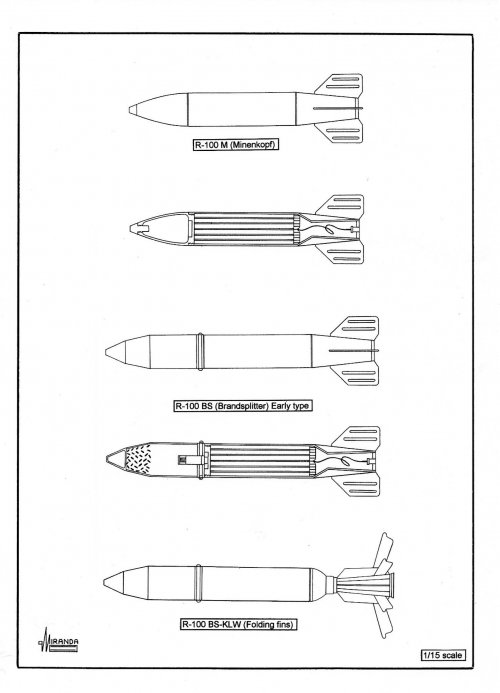
- R100 M Minenkopf/Minengeschoss with conventional HE warhead and RaZ 51 impact fuse.
- R100 BS/I Brandsplitter derived from the R100 M with incendiary pellets warhead and Doppz device (time fuse + impact fuse).
- R100 BS-KLW Brandsplitter-Klappleitwerk derived from the BS/I with folding fins to be launched from a tube like the W. Gr21.
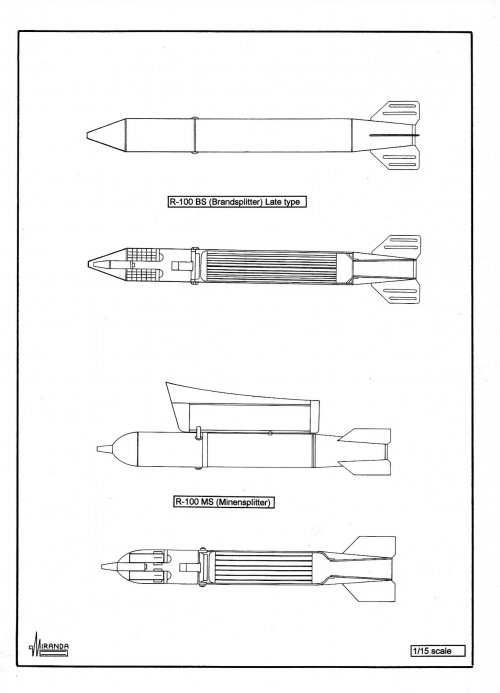
- R100 BS/II, improved version of the BS/I with 1/3 more propellant and a warhead containing 400 BR/44 submunitions. They were incendiary thermite made, 20-mm long cylinders of 55 gr. that deployed in a conical pattern in front of the missile with a lethal radius of 80-100 m.
The explosion was regulated by a ZZ9B
Zündanlage (time fuse + impact fuse).
- R100 MS Minensplitter-Minen Schrapnelrakete derived from the R100 BS/II which warhead contained six submunitions with a length of 220-mm and a diameter of 50-mm, stabilized by four 8-mm. long small fins. Each submunition contained 1 kg of Hexogen and an impact fuse or a hollow charge for anti-armour attacks.
The explosion of the warhead was regulated by a ZZ9b
Zündanlage or by an electro-optic proximity fuse.
| Length | Diameter | Span | Warhead |
| R100 M | 1,462 mm | 210 mm | 428 mm | Hexogen |
| R100 BS/I | 1,722 mm | 210 mm | 428 mm | He + incendiary pellets |
| R100 BS/KLW | 1,830 mm | 210 mm | 663 mm | He + incendiary pellets |
| R100 BS/II | 2,080 mm | 210 mm | 428 mm | He + incendiary pellets |
| R100 MS | 1,825 mm | 210 mm | 406 m | 6 x 50 mm submunitions |
The R100 could be shot at distances between 600 and 2,000 meters from the target, using the automatic triggering system
Oberon. This consisted of a combination of the EZ 42
Adler gyroscopic gunsight with the EG3 navigation system
Elfe 3 and a radio-telemeter of the FuG 218 or FuG 248
Eule types.
The rocket was launched from one 800-mm rail of the AG 140 type. The combination of the two AG 140 was named
Rüstsätz W and of three of them
Rüstsätz W1.
The plan was to use the R100 in the
Werfer-Zerstörer versions of the Ar 234 and Me 262 jets.
The R100 M was first fired successfully in December 1944 without an explosive charge.
In January 1945, 500 R100 BS were ordered for initial test.
The first R100 BS test took place at Tarnewitz (E2
Abteilung) in February 1945, using the Me 262 A-1a (works no. 111994) and the Fw 190 A-6 (works no. 550214) equipped with a FuG 217 J
Neptun Liliput,
Elfe EG3 device and EZ 42 gyro-reflex sight.
By February 28, 1945, only twenty-five R100 BS missiles had been built, ten of which had been released automatically with
Oberon system without problem. An R100 fitted with infra-red equipment and acoustic fuse was reported close to operational readiness in May 1945.
Although being a very accurate and efficient weapon, its production was very costly and both the weight and the required electronic equipment for the launch prevented its use in single engine fighters.
As an alternative to the R100, Dr Fritz Heber (Kurt Heber-Osterrode) received the
order to design the smallest rocket with pop-open fins that could be launched in salvo
with the help of a Revi 16 B gunsight.
To achieve this, a
Diglykol engine was used, able to accelerate it up to 550 m/sec, thus having the same ballistic characteristics of 30-mm shells of the MK 108 cannon.
The original specification required that a single rocket should be enough to destroy
a heavy bomber. Extensive study of battle casualties indicated that 400-g of
Hexogen
penetrating any part of the B-17 bomber would result in their destruction.
Foreseeing that the Allies would combat with heavier airplanes of the B-29
type, it was decided to increase the explosive load up to 500 g.
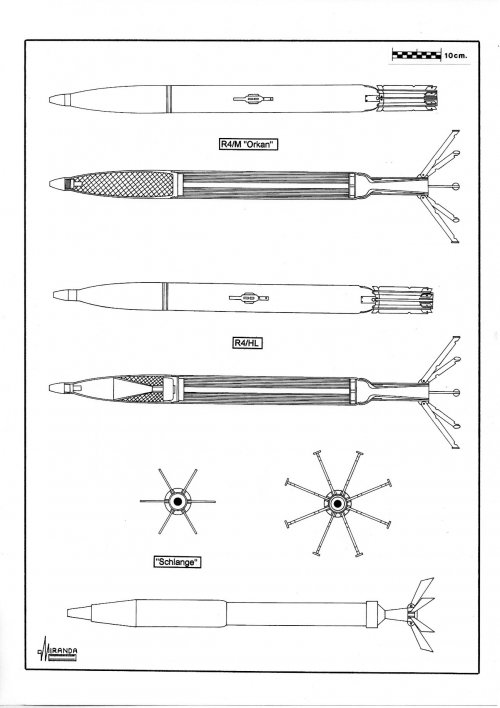
The result was a rocket with a diameter of 5.4-cm and 71-cm length with eight spring-out fins and an AzRz2 impact fuse. It was named R4M
Orkan (
Rakete, 4Kg,
Minenkopf/Minengeschoss) rocket of 4 kg with high explosive, thin-walled warhead.
The R4M had a range of 1,800 m and it was estimated that, from such a distance, a
salvo of twenty-four rockets had a field of fire of 30 x 14 m, approximately the size of a
B-17 bomber.
From the 20,000 units ordered to the DMW-Lübeck, Siemens LGW-Görlitz, LGW
Hakenfelde, Schneider KG, and Kratzau Werke-Sudetenland at the end of 1944, around
12,000 rockets were finished before the end of the war in Europe. Circa 10,000
units were used in combat achieving the destruction of around five hundred planes.
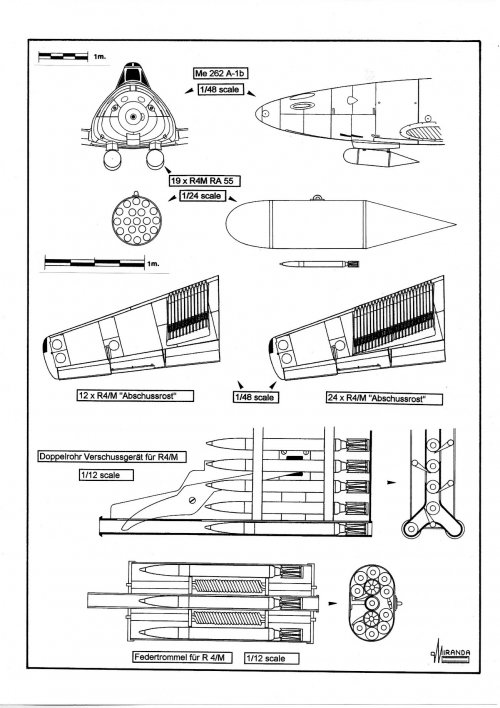
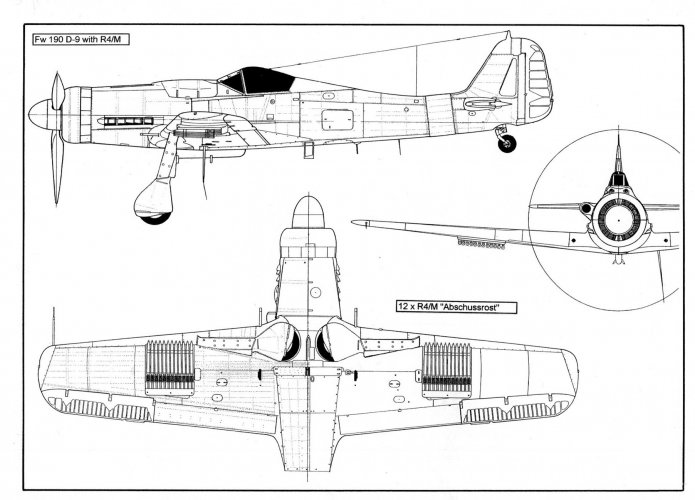
The flight testing was done with a Me163 A-0 rocket plane. Under its wings, two
launchers with twelve rails each known as
Abschussrosten were installed. The R4M were
electrically fired by means of the automatic
Schaltwalze sequencer at 50-milliseconds
intervals.
Some Me 262 A-1a jet fighters of the
Jagdverband 44 were equipped with
Abschussrosten in March 1945.
Some testing was done in February with launchers of seventeen and twenty-four rails
using six Me 262 A-1b in the Messerschmitt experimental plant at Oberammergau.
These airplanes were also tested in combat with great success.
The installation of the
Abschussrosten was also envisaged under the wings of the Fw
190 D-9 interceptors of the I./JG 301 and of the new Ta 152 C-1/R31 and Ta 152 H-1/R11.
The hollow-charge principle was applied to the air-to-air rockets, foreseeing that they
would be necessary to fight against the great B-29 bombers that would soon enter
service.
In addition to the work at TAL and
Waffen F, some research was done at the
high-explosive research Institute at Kempten and at DWM-Lübeck. DWM designed a
hollow-charge of 55-mm using an aluminized explosive filler and copper conical liner.
The R4HL (
Rakete 4Kg
Hollandungskopf) was produced by adapting the new
warhead to the body of an R4M. This was also known as
Jägerfaust.
The plan was to use it together with the R4M in multiple launches, but it was never mass produced.
The R4HL was tested in combat by some Fw 190 A-8/9 of the JG 301.
R4M Technical Data (R4HL) (
Schlange)
Length: 812-mm (790-mm)
Diameter: 55-mm (55-mm) (55-mm)
Wingspan: 215-mm (215-mm)
Total weight: 3.85 kg (-) (3.5 kg)
Maximum speed: 525 m/sec (525 m/sec) (450 m/sec)
Range: 1,500 m (1,500 m).
Fin-stabilized rockets (Anti-Tank)
During the tests performed with different types of antitank ammunition by the
Wehrmacht in 1939, the conclusion was reached that the shaped charges did not work well when used in conventional spin-stabilised shells.
The reason was that the centrifugal forces acting on the jet dispersed it losing most of its drilling power. To avoid this, a fin-stabilised hollow-charge shell known as 8-cm
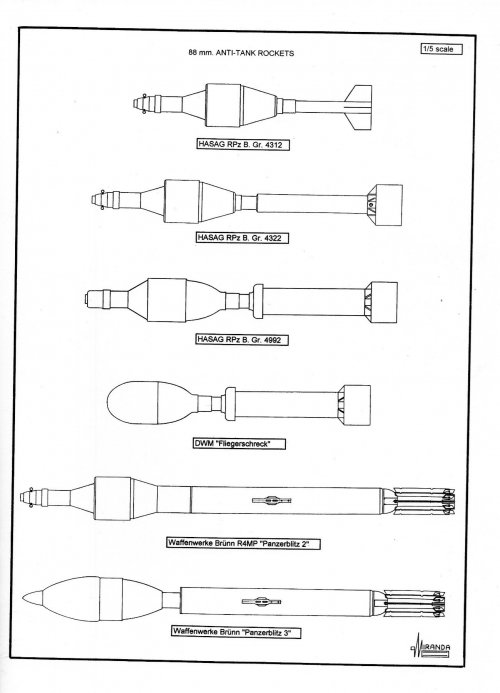
Raketenpanzerbüsche Granate 4992 was built and equipped with a powerful rocket with a range of 180 meters.
The
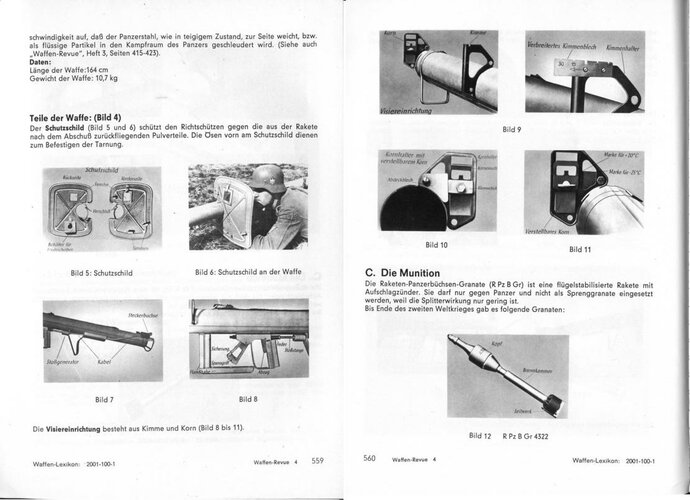
Granate 4992 had 65-cm of length, the 8.8-cm hollow-charge warhead contained 0.667 kg of
Cyclotol (41.2% TNT + 58.8% cyclonite) and the AZ 5095 impact fuse had a 0.0002 seconds delay.
The propellant charge was formed by seven sticks (64% nitrocellulose + 34.5% DEGN + 1% stabiliser).
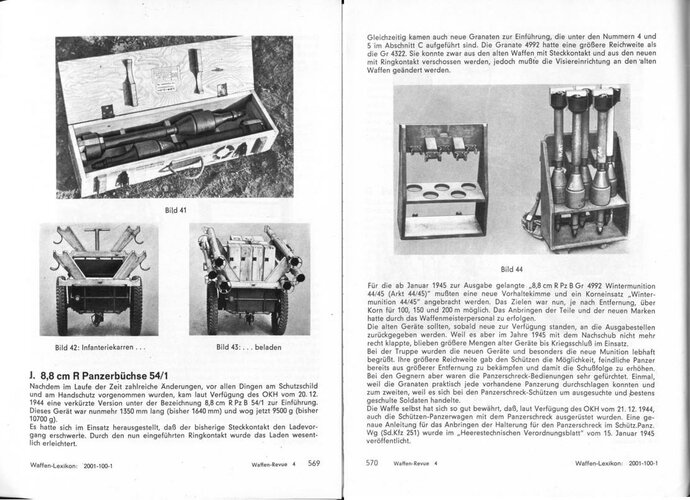
The unofficial denomination of these weapons was
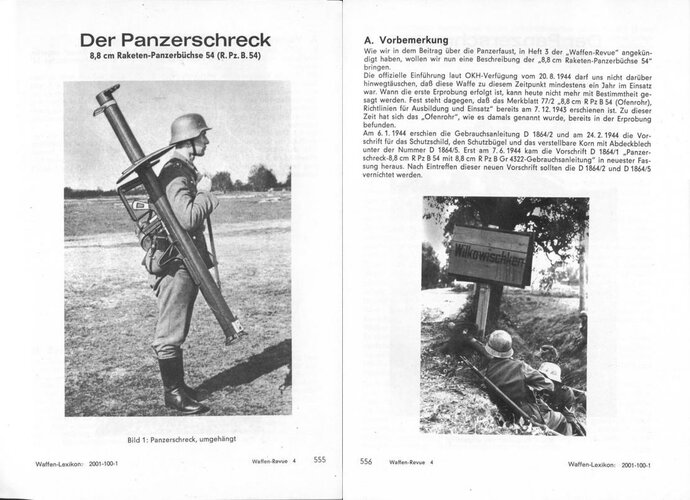
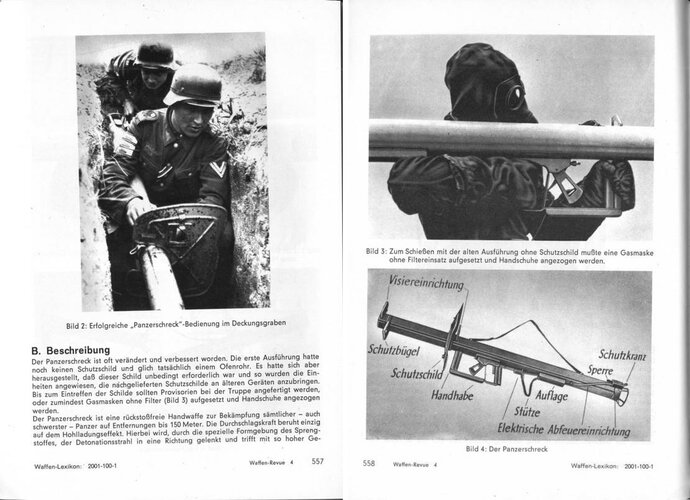
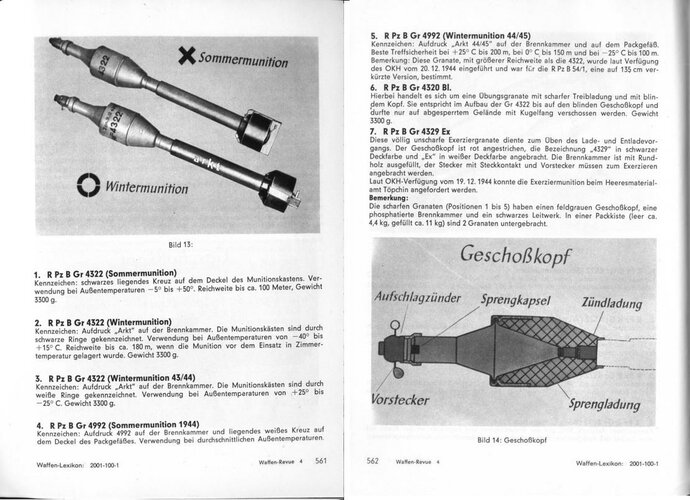
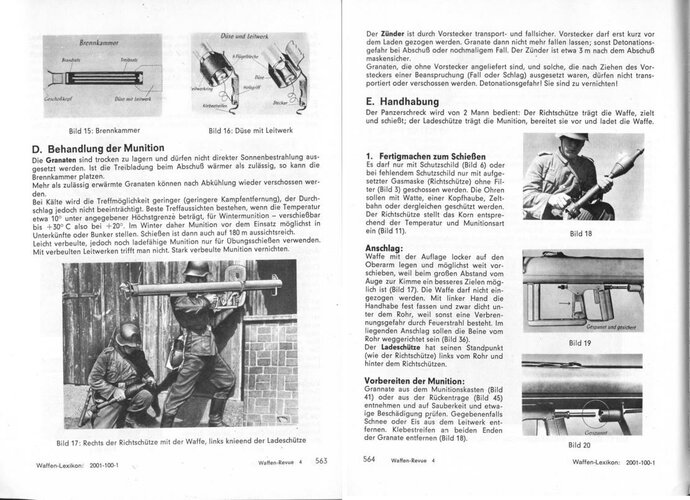
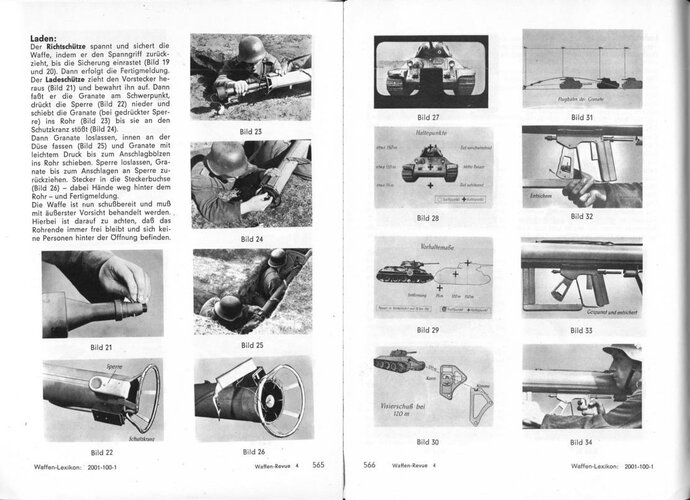
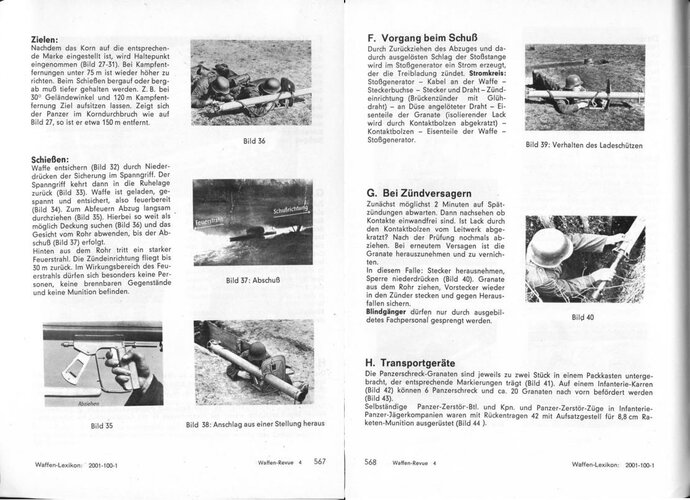
Panzerschreck (tank terror).
They shot from a
Bazooka style tube named
Raketenkpanzerbüsche 43
Ofenrohr
A Flak version known as
Fliegerschreck (airplane terror) was also manufactured. It consisted of a new 8.8-cm grenade with a warhead length of 174-mm especially designed for its use against airplanes. It contained 144
Brandschrapnel incendiary pellets of phosphorus of 1.4 gr each and automatically exploded after running 320 meters by means of a time fuse and a charge of
Nitropenta. The lethal range was 30 meters.
It was shot from an R.Pz.B.54 fitted with a special gunsight calculated for airplanes with a wingspan of 12 meters flying at low altitude.
The DWM firm manufactured 500
Fliegerschreck sets in 1945.
The increasing number of Soviet armoured vehicles forced the creation of new air units specialised in the anti-tank fight. New versions of airplanes were built to perform this task and new “wonder weapons” were designed to be transported by them.
Some of the best antitank guns of the
Wehrmacht were modified for their airborne use with poor results. Those with a low calibre should fly low and slowly to destroy the tanks whereas the heavier ones caused damages to the structure of the airplane when being shot.
While the ‘Wonder Weapons’ of SG series and new recoilless guns were being finished, it was decided to adapt some of the infantry weapons to the available Fw 190s as a provisional measure
Notlösung.
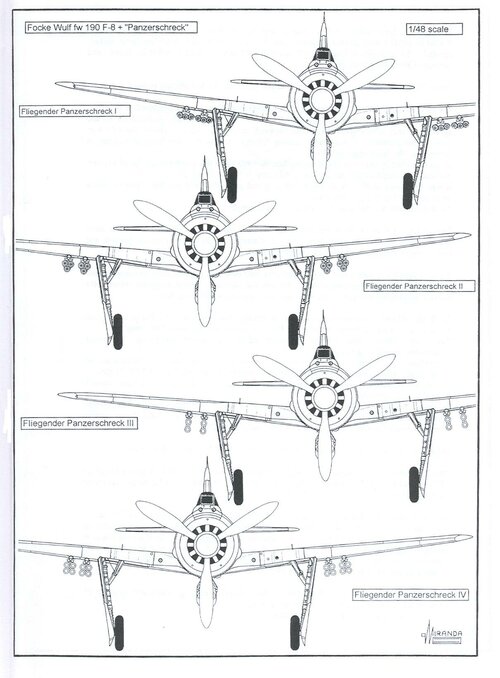
The
Panzerschreck was adapted by means of several designs known as
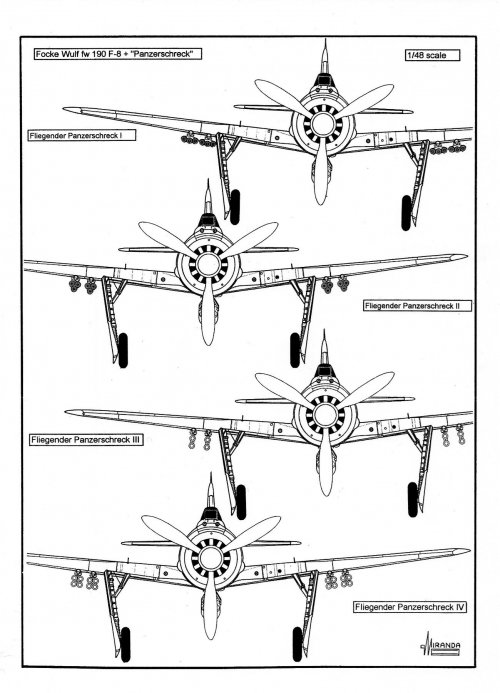
Fliegende Panzerschreck and used in combat by the Fw 190 F-8.
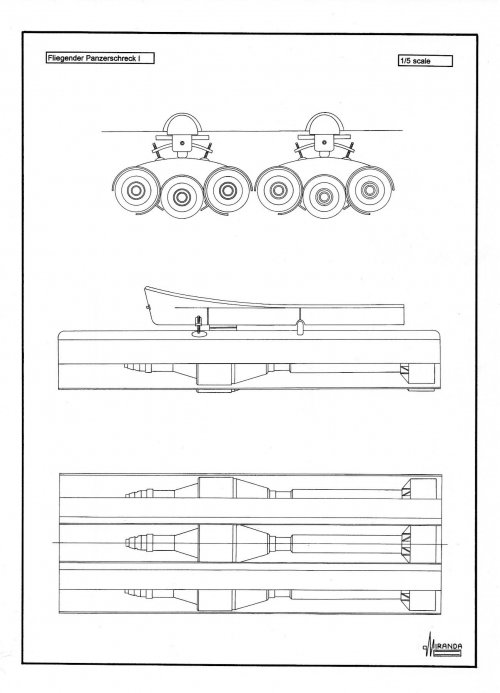
The
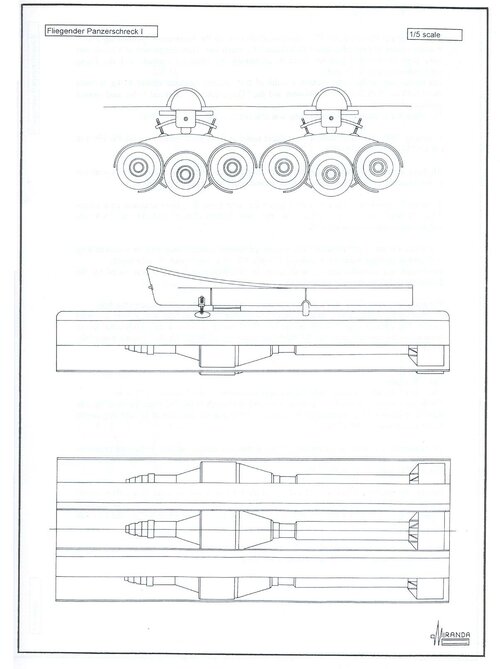
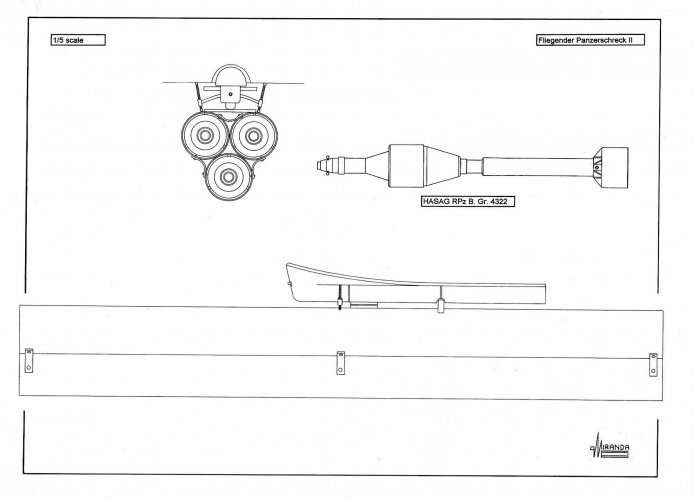
Fliegende Panzerschreck I consisted of a cluster of three tubes with a “C” section and 164-cm of length, joint to a semi-cylindrical holder that could hang under the ETC 50 racks.
The cluster weighted 50 kg including the electrical connections and could shoot three antitank R.Pz.BGr. 4322 grenades.
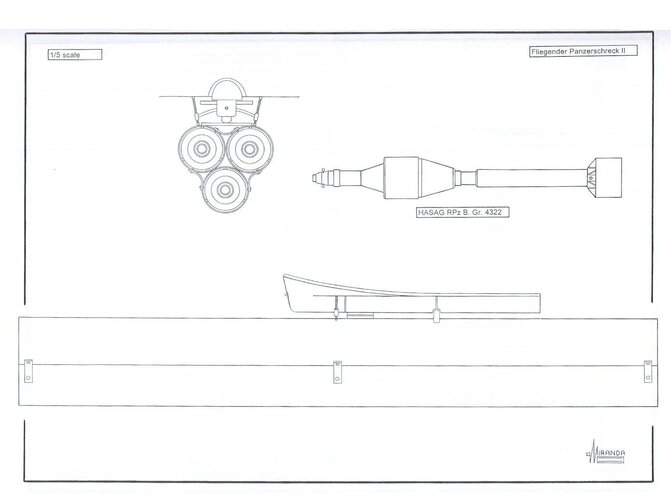
The
Fliegende Panzerschreck II was formed by three tubes of R.Pz.B.54/1 with a length of 135-cm joint together in a bunch of triangular section. It was used in combat suspended under the wings of the Me 210 Ca-1 in October 1994.
The
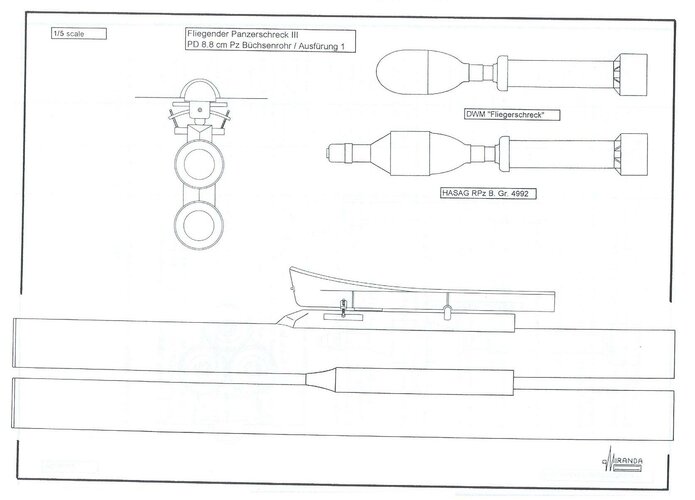
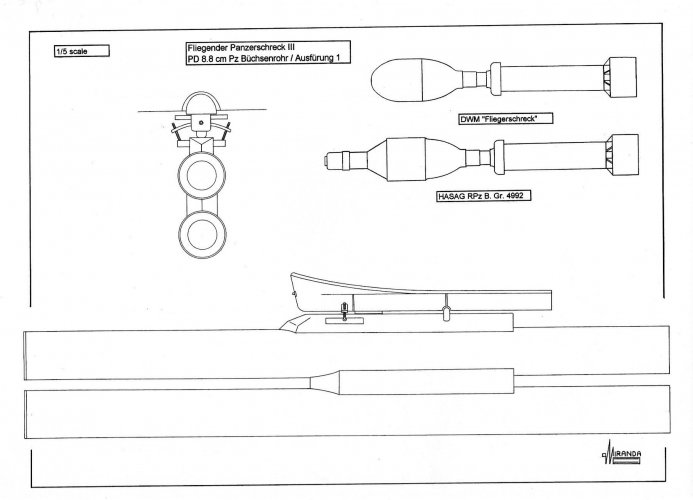
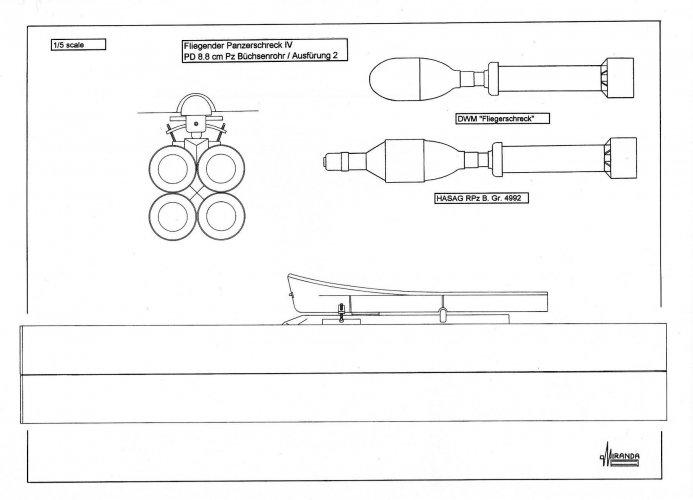
Fliegende Panzerschreck III was integrated by two overlapping tubes of R.Pz.B.54/1 with a length of 135 cm hanging under the ETC 50 racks, four of which could be carried by each Focke-Wulf Fw 190. Its code name was PD 8.8
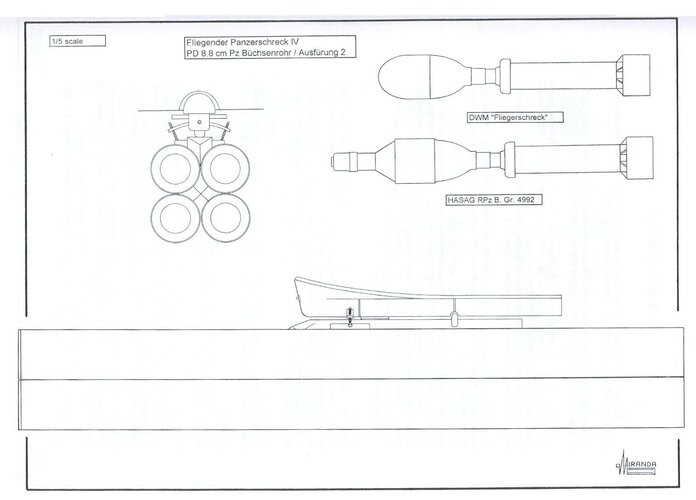
Ausführung 1. The system contained two R.Pz.B.Gr 4992 grenades and weighted 25 kg when loaded, producing less drag than the previous model. In case of emergency, it could be dropped like a bomb. The four tubes mounting was PD 8.8
Ausführung 2.
The final design was the PD 8.8-cm Pz
Büchsenrohr or PD 8.8
Ausführung 3.
It was a cluster of four tubes specially designed for aerial use. Their length was of 99.5- cm only and were joint to a central wooden structure containing the electrical contacts and the fixing mechanism to the ETC 50 racks.
The cluster had quadrangular section, a width of 18.8-cm and weighted around 45 kg. It could shoot both the R.Pz.BGr. 4992 grenades and the
Fliegerschreck designed to be used against airplanes. To reduce the air drag, the wooden structure was cut in angle on its forward section and the tubes opening was covered by a frangible plastic seal.
The Fw 190 F-8 only transported two
Büchsenrohr because they considerably decreased the speed of the airplane.
In August 1944, several Fw 190 F-8 armed with
Parzerschreck I performed operational tests with the EK 26.
In October of the same year, the Fw 190 F-8 of the I./SG 51 performed the operational tests of the
Panzerschreck II in Hungary. In January 1945, the
Buchsenröhr was flight tested in Udetfeld
E-Stelle with the Fw 190 F-8 (W.Nr.580383) coded CM+WL.
Other units using the
Panzerschreck devices were the 5./SG77, 8/SG1 and 6./SG3.
Impressed by the efficiency of the Soviet rocket launchers
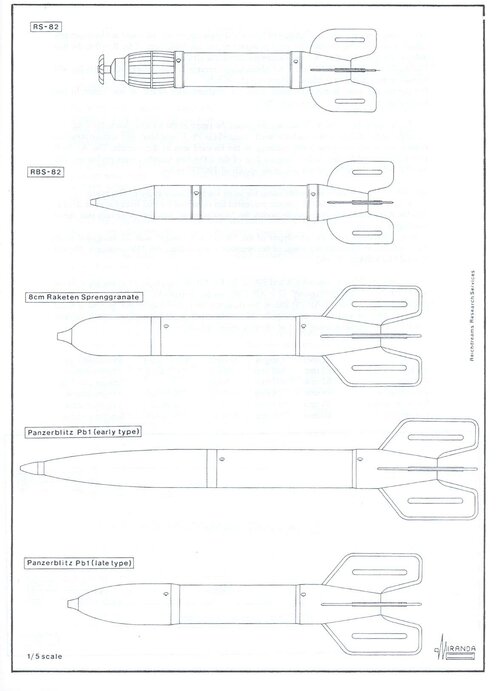
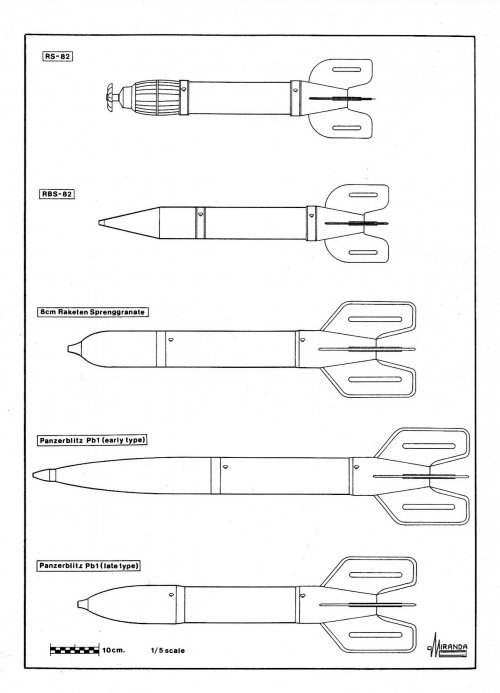
Katyusha the Germans decided to manufacture their own version of the Russian rockets M-8 of 82-mm at the beginning of 1942. It was named 8-cm.
Raketen Sprenggranate and had a length of 744-mm, a diameter of 78-mm and a fragmentation warhead with 0.6 kg of HE.
The Soviet aviation used their own version of the M-8 since 1937. It was known as RS-82 (
Raketnij Snarjad 82-mm) and was launched from RO (
Reaktivnoe Orudie) rails installed under the wings of the airplanes.
The RBS 82 variant, equipped with an armour piercing warhead and a more powerful rocket (ROFS) to destroy tanks and concrete bunkers, entered service in 1942.
The
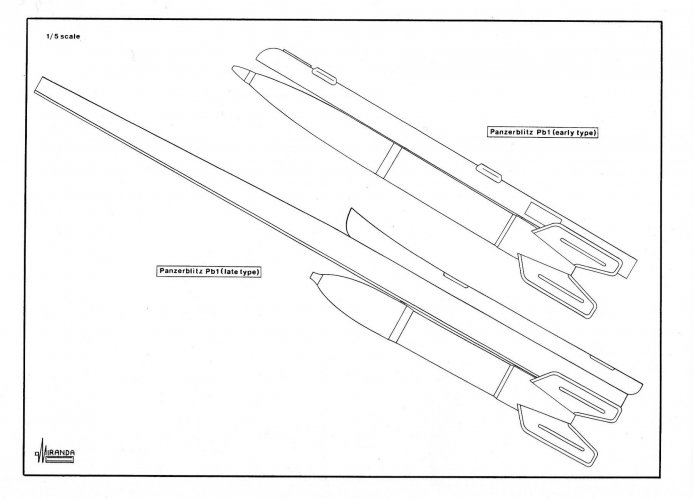
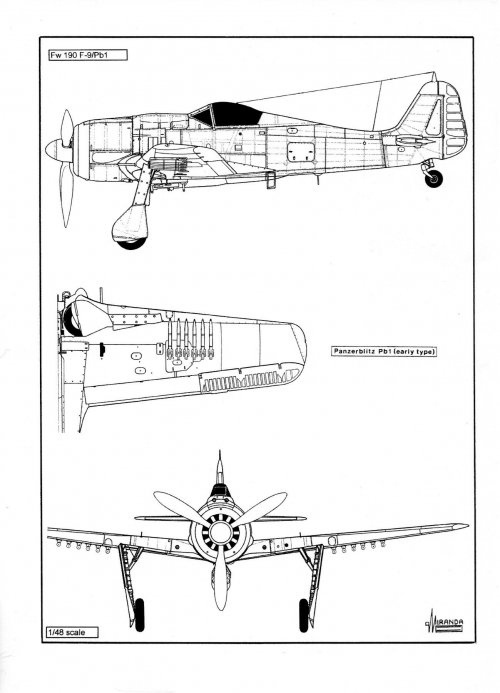
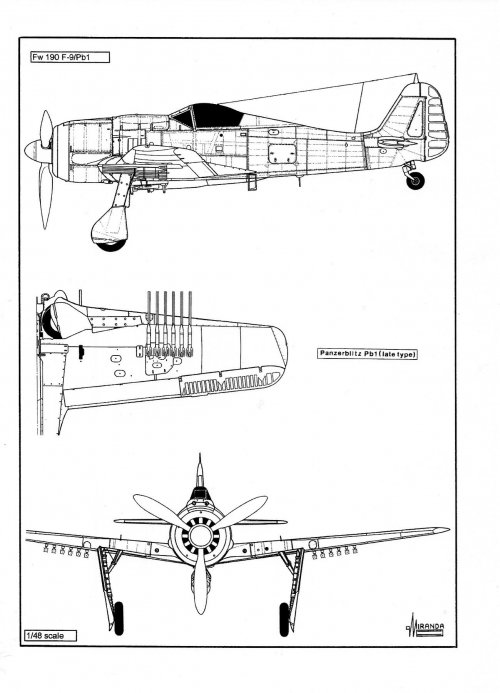
Luftwaffe adopted the idea installing rail launchers on the Henschel Hs 129 B-2 and Focke Wulf Fw 190 F-8 and F-9 airplanes, specialised on antitank fighting. They had six rails of 1,430-mm under each wing.
The Wehrmacht rocket 8-cm RSp. Gr. was renamed
Panzerblitz RSp.Gr. by the
Luftwaffe and operationally tested by the Hs 129 B-2 of the
EKdo 26 in January 1944.
It was used in combat by the Fw 190 F-8 of the II./SG1, II./SG2, III./SG3, II./SG4 and I./SG10 with little success due to the low accuracy of the weapon that was shot with the help of a Revi 16 B gunsight.
Following the Soviet example, an armour piercing version was manufactured equipped with a warhead of 323-mm of length and an AzRz2 impact fuse. It was a longer and heavier rocket than previous one and, although having a more powerful engine, it was inaccurate when firing against targets located at more than 200 meters of distance.
To obtain good results, the pilots of the
Schlacht units should fly low and slow thus suffering heavy losses by the Soviet DCA.
The armour piercing version with 970-mm of length was named
Panzerblitz Pz (
Panzerabwehrrakete) and could be launched from short rails of just 705-mm.
Both versions, afterwards known as
Panzerblitz 1, were developed by the technical team of the Waffernwerke Brünn firm in Czechoslovakia and shared its manufacturing with DWM Lübeck.
The
Panzerblitz Pz was tested on the Fw 190 A-8 W.Nr.733705 in the
E-Stelle Tarnewitz at the end of 1944, being used in combat by the units 7./SG4, 8./SG4, 9./SG4, 3.(Pz)/SG9, I.(Pz)/SG9, 9./SG9, 3./SG1, 6./SG1, 9./SG2, 9./SG77, 13./SG9 and 13./SG151.
The low performance obtained in combat by
Buchsenrohr and
Panzerblitz 1 was consequence of their low flying speed.
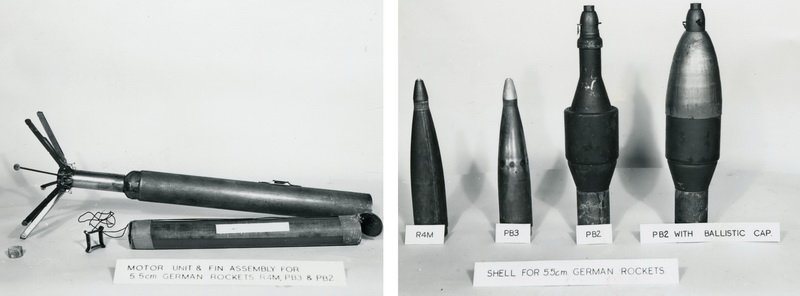
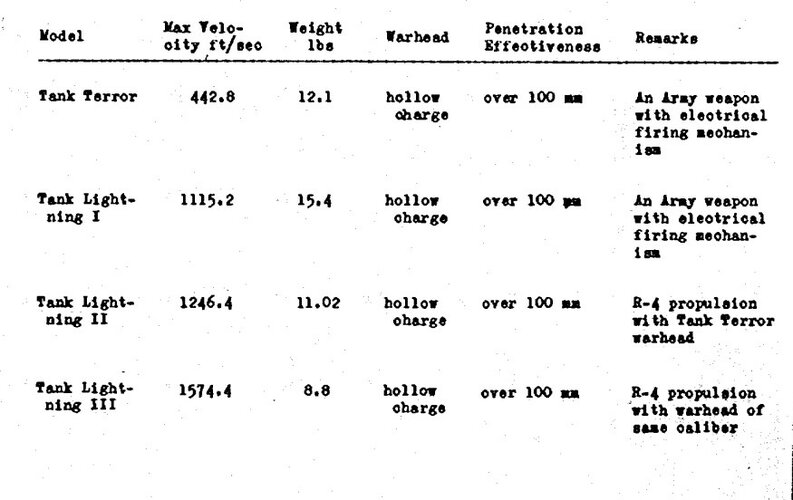
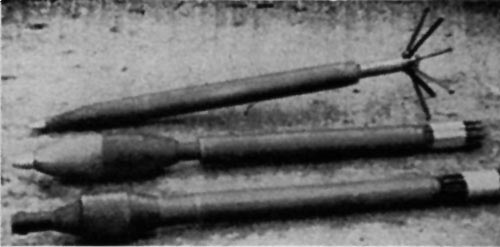
These rockets were not powerful enough to follow a straight trajectory and could not be accurately aimed. It was decided to match the most powerful engine available (that of the R4M) to the best hollow-charge warhead of 8.8-cm
Raketenpanzerbüchse Granate 4992.
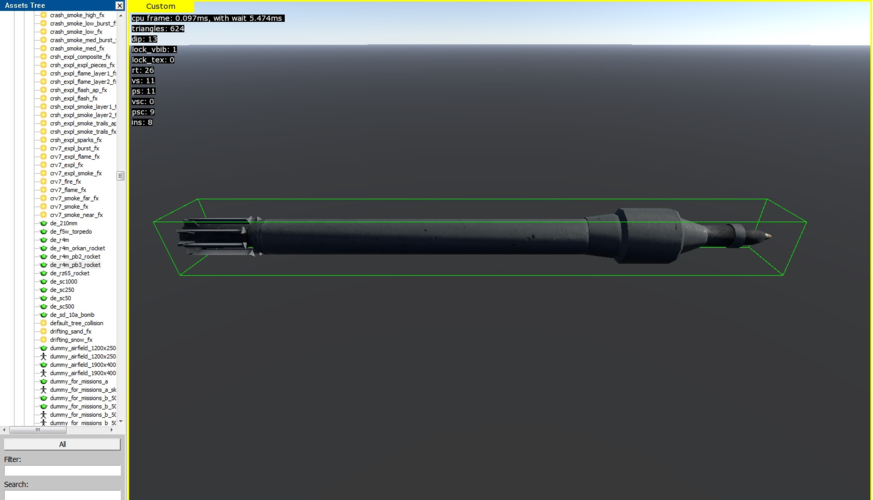
The result was the R4MP (
Rakete 4 Kg
Minenkopf Panzerbüchsengranate) antitank rocket of 4 kg with armour piercing warhead and a speed of 370 m/s.
Developed and manufactured in small series by Waffenwerke Brünn, it was tested by the Luftwaffe under the name
Panzerblitz Pb2.
The higher diameter of the 4992
Granate decreased the range of the weapon due to the drag.
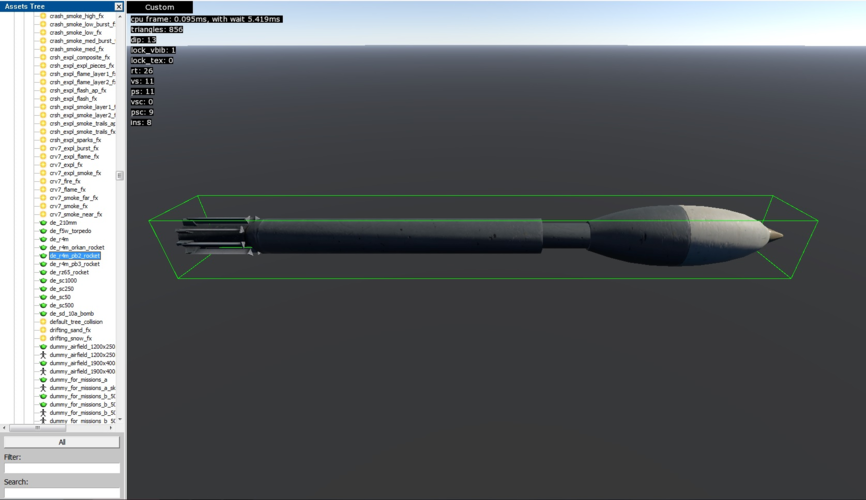
To improve the design, a new rocket named
Panzerblitz Pb 3 was built with a more powerful engine and an aerodynamic ovoid coverage in the forward area of the grenade. The AZ 5095 fuse was replaced by the Az Rz 2 impact fuse of the R4M.
Test launches were performed with the Pb3 before the end of the war obtaining speeds of 480/570 m/sec.
The Pb 4 variant was being studied using the same warhead and a speed of 600 m/sec.
The bigger diameter of the 4992
Granate prevented the launch of the Pb2 from the same devices than the R4M and it was necessary to modify the
Abschussrost launcher of 12 rails into one of seven units known as AG 150.
| Calib. | Length | Weight | Max. speed | Warhead type |
| RS 82 | 82 mm | 560 mm | 6.8 Kg | 315 m/sec | Fragmentation |
| RBS 82 | 82 mm | 607 mm | 15 Kg | - | Armour piercing |
| 8 cm RSpGr | 78 mm | 724 mm | 6.9 Kg | 290 m/sec | Fragmentation |
| Panzerblitz RSp Gr | 78 mm | 915 mm | - | 290 m/sec | Fragmentation |
| Panzerblitz Pz | 93 mm | 705 mm | 6.54 Kg | 374 m/sec | Armour piercing
|


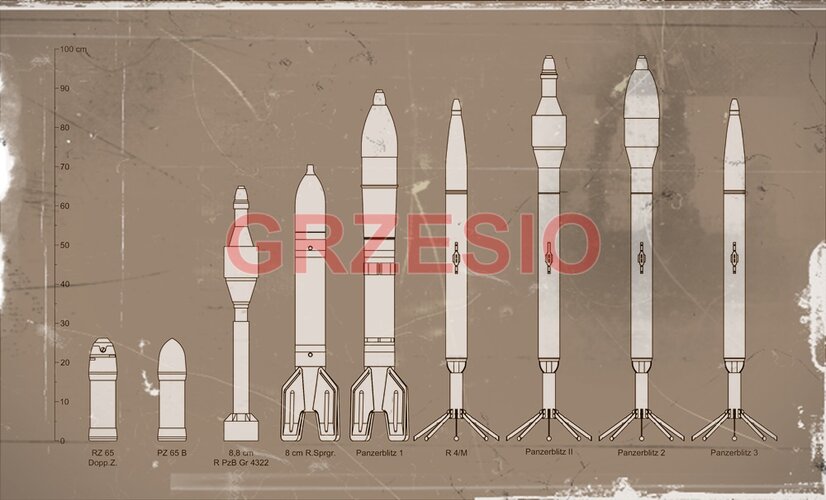

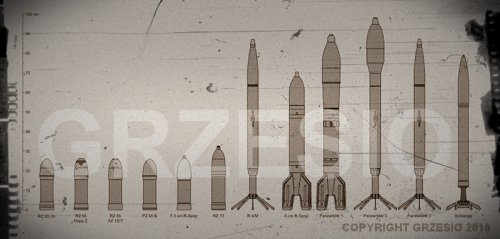
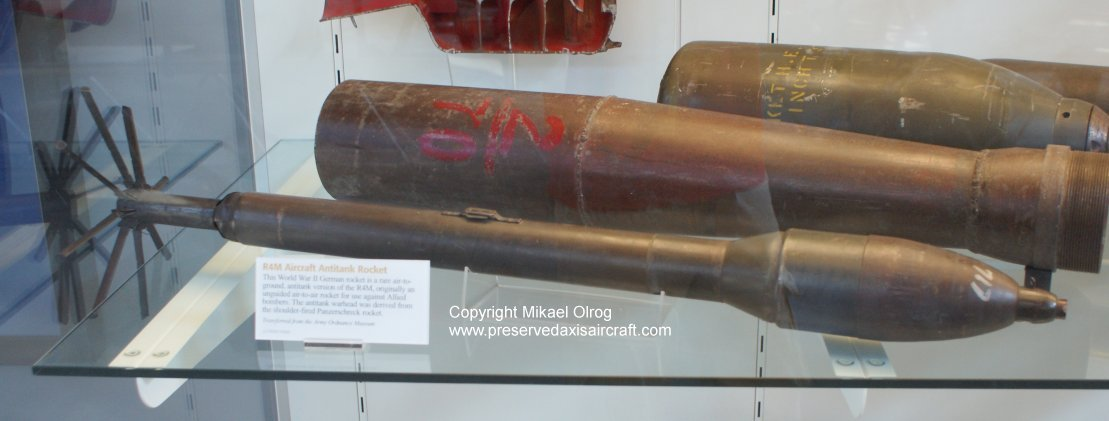
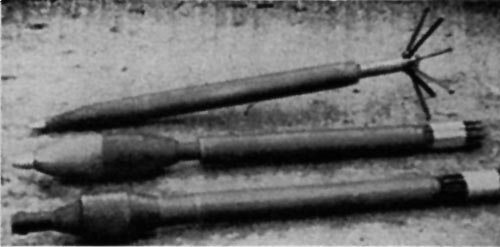
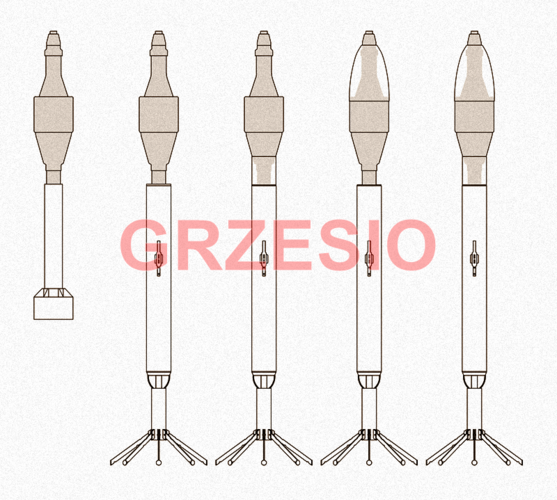
 Panzerschreck warhead (in the 8,8 cm R PzB Gr 4322, Panzerblitz 1 and Panzerblitz 2) was equipped with the AZ 5095/1 impact fuse, which is nicely visible in the 2nd picture in post #44, no matter if the ballistic cap was present or not