What about de-acceleration? Can't reenter at 401km/s.Manned Mars missions require a way to get to mars that can return at any point in time (including the worst possible, when Mars is on the far side of the sun from Earth), not waiting 2 years for a periapsis.
That basically requires NEP. If not Fusion gas-core nuclear-thermal rockets.
It doesn't take much thrust on the traveling ship to go from Earth to Mars in a month. 10 centigees, 0.1m/s/s, will get you from Earth to Mars at average distance in 34 days. Worst case, 47 days in space under just enough acceleration to be really annoying.
However, note that this means a transit delta-v of 401km/s. That's a hell of a lot of reaction mass tankage to deal with, and that would likely require some setup to refuel at Mars orbit.

You are using an out of date browser. It may not display this or other websites correctly.
You should upgrade or use an alternative browser.
You should upgrade or use an alternative browser.
Nuclear Powered Spacecraft
- Thread starter Antonio
- Start date
Scott Kenny
ACCESS: USAP
- Joined
- 15 May 2023
- Messages
- 19,583
- Reaction score
- 28,055
That's a brachistochrone constant-acceleration course. A flip to start decelerating at mid-point is assumed in the formula.What about de-acceleration? Can't reenter at 401km/s.
- Joined
- 26 September 2008
- Messages
- 2,221
- Reaction score
- 1,546
For those who don't know the history, for a long time RTGs were designed to operate in a vacuum, powering spacecraft like Voyager and Cassini. Starting in the 1990s, NASA began development of new RTGs that could operate on a planetary surface. These were the MMRTGs that are powering the Curiosity and Perseverance rovers. Now they have developed an RTG that is once again for in-space, in vacuum operation.
I believe that the original idea was that the MMRTG could also work in space. But the design was really optimized to work on a planet and was not good for in space and vacuum, so they had to abandon that plan.
Years ago I did some work on a study about producing the Pu-238 to power RTGs. I worked with a guy who later became a top expert in the overall history of the program and he told me a lot about that history. Although they don't have moving parts, the materials are pretty sophisticated, so it is a complicated device without moving parts.
Scott Kenny
ACCESS: USAP
- Joined
- 15 May 2023
- Messages
- 19,583
- Reaction score
- 28,055
The only (edit) operational downside is that the thermocouples that turn heat directly into electricity are degraded by the radiation, so over significant time the power output drops by not just the radioactive decay of the fuel, but by the decay of the fuel times the decay of the thermocouples.For those who don't know the history, for a long time RTGs were designed to operate in a vacuum, powering spacecraft like Voyager and Cassini. Starting in the 1990s, NASA began development of new RTGs that could operate on a planetary surface. These were the MMRTGs that are powering the Curiosity and Perseverance rovers. Now they have developed an RTG that is once again for in-space, in vacuum operation.
I believe that the original idea was that the MMRTG could also work in space. But the design was really optimized to work on a planet and was not good for in space and vacuum, so they had to abandon that plan.
Years ago I did some work on a study about producing the Pu-238 to power RTGs. I worked with a guy who later became a top expert in the overall history of the program and he told me a lot about that history. Although they don't have moving parts, the materials are pretty sophisticated, so it is a complicated device without moving parts.
IIRC Voyager started with RITGs making 500w, but over the 50 years since launch the double decay has the current electrical power generation down to something like 2.5W(!)
Last edited:
- Joined
- 26 September 2008
- Messages
- 2,221
- Reaction score
- 1,546
There are other downsides:The only downside is that the thermocouples that turn heat directly into electricity are degraded by the radiation, so over significant time the power output drops by not just the radioactive decay of the fuel, but by the decay of the fuel times the decay of the thermocouples.
IIRC Voyager started with RITGs making 500w, but over the 50 years since launch the double decay has the current electrical power generation down to something like 2.5W(!)
-low power
-low power conversion efficiency
-difficulty of handling*
-cost
When you dig into this stuff deeply, you get really frustrated. The infrastructure cost is high, meaning that it's expensive simply to maintain the capability even when you are not using it. Despite a lot of money and effort, power conversion efficiency has not improved by much. RTGs are incredibly reliable, but that comes with a cost.
*This is mainly in manufacture. Once RTGs are assembled, they're not that difficult to handle except that you have to get rid of the heat.
- Joined
- 26 September 2008
- Messages
- 2,221
- Reaction score
- 1,546
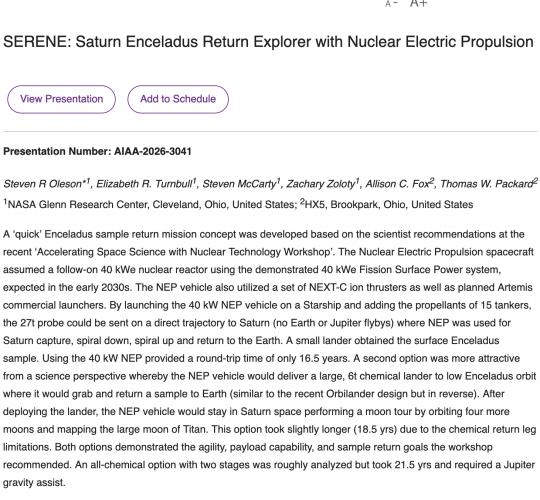
This is being presented at the ASCEND conference this week.
Enceladus sample return missions are real buggers. The mission time is long, and you don't get the data until the end of the mission.
Scott Kenny
ACCESS: USAP
- Joined
- 15 May 2023
- Messages
- 19,583
- Reaction score
- 28,055
Okay, I did gloss over those for the operational downsides.There are other downsides:
-low power
-low power conversion efficiency
-difficulty of handling*
-cost
When you dig into this stuff deeply, you get really frustrated. The infrastructure cost is high, meaning that it's expensive simply to maintain the capability even when you are not using it. Despite a lot of money and effort, power conversion efficiency has not improved by much. RTGs are incredibly reliable, but that comes with a cost.
*This is mainly in manufacture. Once RTGs are assembled, they're not that difficult to handle except that you have to get rid of the heat.
- Joined
- 26 September 2008
- Messages
- 2,221
- Reaction score
- 1,546
Okay, I did gloss over those for the operational downsides.
Yeah, I assumed so, but added that for completeness. The guy I worked with on the Pu-238 study was later hired by NASA to assess the DoE infrastructure, essentially to make sure that NASA was not being ripped off by DoE for the cost. He determined that DoE was not charging NASA for a lot of stuff they could charge for, so it was a fair deal for NASA. He said that Pu-238 is not a great isotope, but the other options are worse.
The Europeans are working with Americium, and there have been proposals in the US to do the same. Americium has a lower energy density than Pu-238, meaning that you have to carry a lot more of it. So the RTGs would be considerably heavier (I think twice as heavy?).
I assume (speculate) that there are additional issues with Americium. One of the things to keep in mind about Pu-238 is that the US has decades of experience working with it. Any change would require a lot of changes in procedures, handling, oversight, etc. So you have to look at the full cost of the material, not just whether it would be cheaper to produce.
Scott Kenny
ACCESS: USAP
- Joined
- 15 May 2023
- Messages
- 19,583
- Reaction score
- 28,055
Sounds about right. Best of a bad bunch.The guy I worked with on the Pu-238 study [...] said that Pu-238 is not a great isotope, but the other options are worse.
- Joined
- 26 September 2008
- Messages
- 2,221
- Reaction score
- 1,546
Sounds about right. Best of a bad bunch.
I just remembered that he said that one of the positive attributes of Pu-238 is that it does not dissolve in water. That must not be the case for other isotopes.
- Joined
- 26 September 2008
- Messages
- 2,221
- Reaction score
- 1,546
View attachment 812662
This is being presented at the ASCEND conference this week.
Enceladus sample return missions are real buggers. The mission time is long, and you don't get the data until the end of the mission.
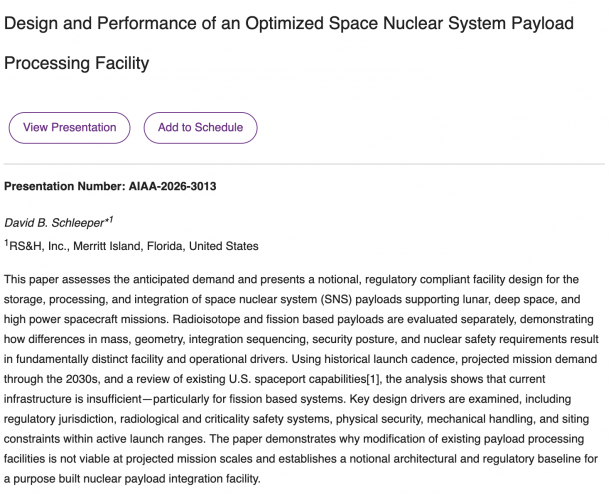
Quoting myself, if you read that abstract, you start to understand how nutty outer planets missions get without a high-powered upper stage to send them out. Sixteen Starship launches for a robotic mission? A 16.5-year mission to get data? Who is going to approve that kind of mission when there are many other options to get other science done for less time and hassle?
I've worked on prioritizing planetary science missions and what scientists want is missions that they can get funded and that they can get done in a reasonable time period. They will not support missions that don't do that. So these mission concepts that are so out there that they're not reasonable will never get considered by the people who actually do the work.
Scott Kenny
ACCESS: USAP
- Joined
- 15 May 2023
- Messages
- 19,583
- Reaction score
- 28,055
The outer planets are just flat that far away when you're talking Hohmann transfer orbits.Quoting myself, if you read that abstract, you start to understand how nutty outer planets missions get without a high-powered upper stage to send them out. Sixteen Starship launches for a robotic mission? A 16.5-year mission to get data? Who is going to approve that kind of mission when there are many other options to get other science done for less time and hassle?
I've worked on prioritizing planetary science missions and what scientists want is missions that they can get funded and that they can get done in a reasonable time period. They will not support missions that don't do that. So these mission concepts that are so out there that they're not reasonable will never get considered by the people who actually do the work.
You absolutely need power sources capable of constant acceleration or at least a month's worth of constant-but-low acceleration at each end of the flight to get to the outer planets in a reasonable length of time.
The only reason Voyager worked is because of a very fortuitous celestial alignment that only happens once every 175 years.
Low acceleration doesn't work for getting into orbit and out of orbit for one of gas giants in a timely manner. It would likely take more time than the transit to the planet. Just as the probe requires to spiral out of earth's orbit to move on its way to the gas giant, it will have to spiral in and out of orbit from gas giant for the return flight.The outer planets are just flat that far away when you're talking Hohmann transfer orbits.
You absolutely need power sources capable of constant acceleration or at least a month's worth of constant-but-low acceleration at each end of the flight to get to the outer planets in a reasonable length of time.
Last edited:
- Joined
- 26 September 2008
- Messages
- 2,221
- Reaction score
- 1,546
The outer planets are just flat that far away when you're talking Hohmann transfer orbits.
You absolutely need power sources capable of constant acceleration or at least a month's worth of constant-but-low acceleration at each end of the flight to get to the outer planets in a reasonable length of time.
The Uranus orbiter studies did not assume this.
- Joined
- 26 September 2008
- Messages
- 2,221
- Reaction score
- 1,546
Just for fun
It seems like a cool mission until you dig into it a little bit. I'm not sure what the helicopters are supposed to do at Mars. I also don't know how they handle communications.
Scott Kenny
ACCESS: USAP
- Joined
- 15 May 2023
- Messages
- 19,583
- Reaction score
- 28,055
Correct, that was poorly phrased on my part.Low acceleration doesn't work for getting into orbit and out of orbit for one of gas giants in a timely manner. It would likely take more time than the transit to the planet. Just as the probe requires to spiral out of earth's orbit to move on its way to the gas giant, it will have to spiral in and out of orbit from gas giant for the return flight.
The low acceleration was for the cruise between planets.
It seems like a cool mission until you dig into it a little bit. I'm not sure what the helicopters are supposed to do at Mars. I also don't know how they handle communications.
The "helicopters" are supposed to do a wide area 'search' for landing sites and looking for buried water ice with ground-penetrating radar.
In other words not much really but a supposed "science" justification for the NEP mission in the first place. As you noted no funding and even less "scientific" interest but as this isn't about "science" or even getting to a working vehicle no real help either.
Edit: Could kill the concept really fast and push for it to be a Mars sample return mission?

Randy
Last edited:
The outer planets are just flat that far away when you're talking Hohmann transfer orbits.
You absolutely need power sources capable of constant acceleration or at least a month's worth of constant-but-low acceleration at each end of the flight to get to the outer planets in a reasonable length of time.
The only reason Voyager worked is because of a very fortuitous celestial alignment that only happens once every 175 years.
Low acceleration doesn't work for getting into orbit and out of orbit for one of gas giants in a timely manner. It would likely take more time than the transit to the planet. Just as the probe requires to spiral out of earth's orbit to move on its way to the gas giant, it will have to spiral in and out of orbit from gas giant for the return flight.
Nuclear "Triton" system to cover all the bases?
The Uranus orbiter studies did not assume this.
Might be wrong but wasn't he talking manned missions?
Randy
Scott Kenny
ACCESS: USAP
- Joined
- 15 May 2023
- Messages
- 19,583
- Reaction score
- 28,055
Wouldn't be fun keeping the LOX in the tanks for the whole trip there and back. I'd recommend Nitrolox (N2O+LOX) for that.Nuclear "Triton" system to cover all the bases?
But yes, it'd work.
Wouldn't be fun keeping the LOX in the tanks for the whole trip there and back. I'd recommend Nitrolox (N2O+LOX) for that.
But yes, it'd work.
Also further studies did factor in using the power generation for keeping your propellants cold, so there's that
Randy
Scott Kenny
ACCESS: USAP
- Joined
- 15 May 2023
- Messages
- 19,583
- Reaction score
- 28,055
That was probably more about keeping the LH2 in the tanks but keeping the oxygen from boiling off was a happy side effect.Also further studies did factor in using the power generation for keeping your propellants cold, so there's that
Personally, I'd want to be using ammonia and nitrolox for that mission.

World B4
my bad y'all
- Joined
- 25 June 2017
- Messages
- 593
- Reaction score
- 558
There's a recent rfp for Martian communications. I think Blue Origin is pushing to use a Blue Ring for the bus, which could be made quickly, but considering any solution has to be pretty fast to help Skyfall... the issue kinda looks like a rushed hot potatoIt seems like a cool mission until you dig into it a little bit. I'm not sure what the helicopters are supposed to do at Mars. I also don't know how they handle communications.
I would love to see a mission to record the vertical surface of parts of Valles Marineris in a managed descent, though that might require too much autonomy to be programmed in the limited time available. Perhaps Noctis Labyrinthus? I am hoping for more input from people who know more about the region and about Martian caves. I don't like the plan of just surveying flat terrain, though that looks like the chosen direction.
Edit: "Kinda" is not the right word to describe how rushed this all is. I think that copter drones could return valuable images from otherwise inaccessible terrain but I think this opportunity will be squandered.
Last edited:
- Joined
- 26 September 2008
- Messages
- 2,221
- Reaction score
- 1,546
There's a recent rfp for Martian communications. I think Blue Origin is pushing to use a Blue Ring for the bus, which could be made quickly, but considering any solution has to be pretty fast to help Skyfall... the issue kinda looks like a rushed hot potato
That is for a Mars Telecommunications Orbiter. I believe that the helicopters cannot transmit and receive directly from an orbiter, but have to transmit through a ground asset (the Ingenuity helicopter transmitted through the Perseverance rover). I don't know what that ground asset will be.
- Joined
- 26 September 2008
- Messages
- 2,221
- Reaction score
- 1,546
Edit: "Kinda" is not the right word to describe how rushed this all is.
There is a rule of thumb for planetary missions. Lower-end missions take about 4-5 years to build and launch. More complicated missions take 5-10 years to build and launch. They are trying to do this mission in under three years. That is not going to happen. At some point, they will look at how much time they have left to make the launch window and it will not be enough and they will have to slip. A slip to the next Mars window (26 months later) will increase the cost.
There is a long history of doing space missions that succeed, and what causes them to fail. Insufficient testing and rushed timelines cause them to fail. We know that from hard experience.
But nobody has to take my word for it. Just wait. We will all see what happens.
Well let me ask you all, if you could control the landing site, where would you go to get the most value?
Where ever the samples are so they could be brought back. In the end that would be the "best" outcome but least likely I'm afraid.
Randy
martinbayer
ACCESS: Above Top Secret
- Joined
- 6 January 2009
- Messages
- 5,072
- Reaction score
- 6,983
In human spaceflight in general, more power/acceleration is *always* the answer for any transportation problem. It is in my view an utter blight on humanity that there are collected Martian soil samples that we can't even retrieve at this point. For shame - pathetic...
World B4
my bad y'all
- Joined
- 25 June 2017
- Messages
- 593
- Reaction score
- 558
Okay we ALL want Mars Sample Return but assuming this mission isn’t directly tied to it and could go anywhere but the poles or a mountaintop, what destination would you most like to see? There’s a pretty long list of vertical surfaces and curious features on Mars.
- Joined
- 26 September 2008
- Messages
- 2,221
- Reaction score
- 1,546
NASA working to streamline development of nuclear electric propulsion demo mission
by Jeff Foust June 4, 2026
WASHINGTON — NASA is working on a streamlined management approach for a nuclear electric propulsion demonstration mission the agency wants to launch in two and a half years.
NASA announced the Space Reactor 1 (SR-1) Freedom mission at its Ignition event in March. The mission would be the first flight demonstration of nuclear electric propulsion, with a nuclear reactor providing power to electric thrusters to send the spacecraft to Mars.
Unlike some other initiatives announced at Ignition, including a lunar base and proposed changes to support commercial space stations, NASA has provided few updates on SR-1 Freedom since the event, even though the agency said then it plans to launch the mission at the end of 2028.
At a June 2 meeting of the National Academies’ Aeronautics and Space Engineering Board and Space Studies Board, NASA officials said the agency discussed planning for SR-1 Freedom at a management council meeting the previous day.
“We talked through the intent to streamline the processes that we’re going through for the development” of the mission, said Lori Glaze, NASA acting associate administrator for exploration systems development. That involves remaining compliant with existing NASA project management requirements “and yet make sure we’re tailoring that to the needs to allow us to go faster.”
“We are, as an agency, very focused on trying to identify the barriers to going quickly and identify how we can try to speed up decision-making,” she added.
The rapid schedule for SR-1 Freedom is enabled by using existing hardware. The Power and Propulsion Element (PPE), the electric propulsion system built for the lunar Gateway, will be repurposed for the mission.
“It’s very far along in its development,” Glaze said of the PPE. “Yes, it will require some modifications, but we’re not starting from zero. We have a spacecraft.”
The nuclear reactor will also leverage existing designs for research reactors by the Department of Energy, although NASA has provided few details about it. “We are in very close collaboration with the Department of Energy,” she said, including modifying a memorandum of understanding between the agencies.
NASA has said little else about how the spacecraft will be built. Designs of the spacecraft released at Ignition show it will have a long truss separating the reactor from the rest of the spacecraft, as well as radiator panels for heat rejection.
SR-1 Freedom will transport to Mars SkyFall, a spacecraft that would deploy in the Martian atmosphere three helicopters based on the Ingenuity rotorcraft that accompanied the Perseverance rover.
“We’re trying to leverage as much as we can with as little new development as possible,” she said. “I know that’s a challenge and always sounds good on paper, but that’s the intent.”
The agency has not disclosed a cost estimate for SR-1 Freedom, and the mission was not included in NASA’s fiscal year 2027 budget request released a week and a half after Ignition.
Glaze did not disclose the projected cost for SR-1 Freedom at the National Academies meeting. She said the mission would make use of funding proposed in the 2027 request along with funds from last year’s budget reconciliation bill, which provided $2.6 billion for the Gateway.
“We’re in the process of looking through how we’re going to realign the resources we have to make sure they have what they need,” she said. The agency does not have a cost estimate for the mission yet, “but right now it all fits.”
Board members expressed some skepticism about the accelerated schedule for SR-1 Freedom, with one noting a two-year development timeline was more consistent with a cubesat. A review analogous to a preliminary design review is planned for the fall, she said, but noted that would be tailored to the streamlined management approach the agency is adopting for the mission.
“It is ambitious. It’s a challenge,” she said of the project and its schedule. “It doesn’t mean we’re going to be successful, but I can tell you we’re doing everything we can to meet the challenge.”

- Joined
- 21 January 2015
- Messages
- 15,006
- Reaction score
- 24,240
L3Harris Press Release:
Getting into the Space Nuclear Power Game with Next-Generation Technology
Finalized design of Next Gen RTG clears path for deep space missions to outer solar system.
Getting into the Space Nuclear Power Game with Next-Generation Technology
Finalized design of Next Gen RTG clears path for deep space missions to outer solar system.
World B4
my bad y'all
- Joined
- 25 June 2017
- Messages
- 593
- Reaction score
- 558
World B4
my bad y'all
- Joined
- 25 June 2017
- Messages
- 593
- Reaction score
- 558
From NIAC 2026
A new gen radioisotope power source design, a little hand wavy with the materials science needed
https://www.nasa.gov/directorates/s...v-power-generation-for-interstellar-missions/
A study regarding the use of AM-241 in lunar space suits for heating purposes
https://www.nasa.gov/directorates/s...a-in-nighttime-and-deep-space-icy-landscapes/
A new gen radioisotope power source design, a little hand wavy with the materials science needed
https://www.nasa.gov/directorates/s...v-power-generation-for-interstellar-missions/
A study regarding the use of AM-241 in lunar space suits for heating purposes
https://www.nasa.gov/directorates/s...a-in-nighttime-and-deep-space-icy-landscapes/
- Joined
- 26 September 2008
- Messages
- 2,221
- Reaction score
- 1,546
From NIAC 2026
A new gen radioisotope power source design, a little hand wavy with the materials science needed
https://www.nasa.gov/directorates/s...v-power-generation-for-interstellar-missions/
A study regarding the use of AM-241 in lunar space suits for heating purposes
https://www.nasa.gov/directorates/s...a-in-nighttime-and-deep-space-icy-landscapes/
For those who don't know, NIAC is the NASA Innovative Advanced Concepts program. NIAC funds very early advanced technology concepts. There is no expectation that these will become useful in the near-term, not even ten years. The program is intended to push forward some tech concepts that could eventually be useful, provided that additional investment is made later on. It's seed corn. It's a good program, but you have to keep in mind what it is for.

Forest Green
ACCESS: USAP
- Joined
- 11 June 2019
- Messages
- 14,545
- Reaction score
- 31,628

Brett Davidson
ACCESS: Top Secret
- Joined
- 26 September 2006
- Messages
- 4,450
- Reaction score
- 12,858
This video examines whether Star Trek-style magnetic shields could become a real engineering solution. It looks at a 2016 study of superconducting magnet configurations, current work by Zenno Astronautics on high-power space magnets, and a hybrid nuclear propulsion concept known as NTER. These technologies are then combined in a notional crewed mission to the Jovian system, with Callisto considered as a relatively sheltered location for surface operations. The video also discusses why purely passive shielding is mass-inefficient, how active magnetic fields could reduce charged-particle exposure, and why assumptions about low-dose radiation risk still shape mission planning.
Forest Green
ACCESS: USAP
- Joined
- 11 June 2019
- Messages
- 14,545
- Reaction score
- 31,628
View: https://x.com/AtomsNotBits/status/2098444483558002789?s=20
View: https://x.com/matthewwmullin/status/2098917800790175875?s=20
Purpose-designed modular power for defense-critical assets
https://antaresindustries.com/View: https://x.com/matthewwmullin/status/2098917800790175875?s=20
Last edited:
Scott Kenny
ACCESS: USAP
- Joined
- 15 May 2023
- Messages
- 19,583
- Reaction score
- 28,055
I want samples from at least one of the obvious lava flows, as well as at least one of the obvious "water"/sedimentary features.Okay we ALL want Mars Sample Return but assuming this mission isn’t directly tied to it and could go anywhere but the poles or a mountaintop, what destination would you most like to see? There’s a pretty long list of vertical surfaces and curious features on Mars.
Other destinations? The Face. In whatever light is required to make it look like a face, and then to stay there until it doesn't.
SleepyJerry
ACCESS: Restricted
- Joined
- 11 February 2026
- Messages
- 13
- Reaction score
- 14
Am-241 has a half-life of approximately 433 years. At equal mass, the power output of Am-241 fuel is only about one-fifth that of Pu-238, with 1kg of americium dioxide producing only about 74W of thermal power. In addition, Am-241 emits gamma rays during decay, which could cause unforeseen issues in missions lasting several decades.Americium has a lower energy density than Pu-238, meaning that you have to carry a lot more of it. So the RTGs would be considerably heavier (I think twice as heavy?).
I assume (speculate) that there are additional issues with Americium. One of the things to keep in mind about Pu-238 is that the US has decades of experience working with it. Any change would require a lot of changes in procedures, handling, oversight, etc. So you have to look at the full cost of the material, not just whether it would be cheaper to produce.
Similar threads
-
 USAF interplanetary spacecraft concept using SPUR
- Started by Triton
- Replies: 15
-

-
-
Douglas RITA (Reusable Interplanetary Transport Approach)
- Started by moin1900
- Replies: 3
-
