Tom Enders, ex Airbus/EADS CEO, now Chair of KNDS (hello MGCS...) and on Helsing's board chucks in his two pennorth....

View: https://x.com/sylviapfeifer/status/2026552179733991646


FT Article

Ex-Airbus chief says German decision to work with France on fighter jet a ‘mistake’


Tom Enders, the former chief executive of Airbus, has described Germany’s decision to develop a fighter jet with France nine years ago as a “strategic mistake” and warned Berlin against launching a national project.

Enders, who served as chief of Airbus and its predecessor company EADS from 2005 to 2019, told the FT that the German government’s 2017 decision to develop a next-generation jet with Paris rather than with London was “motivated primarily by political disappointment over Brexit”.

“In retrospect, this was a strategic mistake,” said Enders, who oversaw the launch of the programme while at the helm of Airbus.

“We should have kept and nurtured our relationship with [Britain’s] BAE Systems. We are looking back to more than 50 years of successful co-operation in fighter aircraft development with the United Kingdom,” he added.

Enders, who is president of the German Council on Foreign Relations and serves on the board of defence technology group Helsing, as well as chair of Franco-German tank maker KNDS, has remained an authoritative figure in the country’s defence circles.

His intervention comes just days after German Chancellor Friedrich Merz cast doubt on the relevance for his country’s military needs of the fighter jet at the heart of the Future Combat Air System (FCAS) with France and Spain.

Launched in 2017 by then chancellor Angela Merkel and France’s Emmanuel Macron, FCAS has always been regarded as a politically driven project following Britain’s decision to leave the EU. Airbus has for the past few decades developed fighter aircraft, notably the Eurofighter Typhoon, in partnership with Britain’s BAE and others.

The €100bn FCAS project has been plagued by power struggles between Airbus’s German-based defence unit and France’s Dassault over work share and leadership on the jet.

With talks between the two countries over how to progress seemingly stalled, Germany’s aerospace trade body BDLI and IG Metall, the country’s powerful trade union, earlier this month called for Berlin to develop its own fighter jet.

Guillaume Faury, the current chief executive of Airbus, last week acknowledged publicly for the first time that one option under consideration would be for Germany and France to develop their own jets under the FCAS umbrella.

Enders said a German national jet programme would “contribute nothing” to the effectiveness of the country’s air force, describing such a plan as an “expression of industrial hubris” that risked becoming a “gigantic misallocation of resources”.

“We would end up with a national prestige project that would drain defence budgets for decades and contribute nothing to the combat effectiveness of the Air Force, even in the medium term,” said Enders.

In the event that FCAS could not be salvaged, Enders said a partnership with the UK and BAE would be a “valid and proven alternative”.

Although BAE is building its own new fighter jet together with Italy’s Leonardo and Japan’s Mitsubishi Heavy Industries, Enders said he thought a partnership was “still a possibility”.

Another alternative, he added, would be to co-operate with Sweden’s national champion Saab, which builds the Gripen fighter jet.
 
The 2026 French budget was finally passed last week, allocating €22.8B to military equipment, up 22% year over year.

This includes ~€450M for FCAS and ~€600M for avionics developments under the Rafale F3/F4 programmes (similar to last year's budget). Annual military equipment spending is scheduled to increase further to ~€30.4B by 2028 (+33%).

Now putting this in historical context compared to past fighter development programs... the peak annual cost of Rafale and F-22 R&D programs was €2-3 billion per year over 10 years (both adjusted for inflation to 2025 levels). Total R&D costs were ~€25B (Rafale) to ~€35B (F-22). This included ~60% for the Air Vehicle (€15-20B), ~15% for the Engine (€4-5B), and 15-25% for Avionics (€4-8B). It's worth keeping these numbers in mind when discussing the path forward for FCAS, specifically whether France & Germany are likely to move forward with 1 vs 2 fighters, shared avionics, shared engine etc, and whether they really need new partners like India to help finance development.
 
Last edited:
FT Article
Ex-Airbus chief says German decision to work with France on fighter jet a ‘mistake’

Tom Enders, the former chief executive of Airbus, has described Germany’s decision to develop a fighter jet with France nine years ago as a “strategic mistake” and warned Berlin against launching a national project.

Amazing how the Financial Times twisted Enders' comments to make them all about France. Here are more typical takes from German media, which highlights that Enders' main message was to push back against German industry lobbying attempts in favor of a 2 fighter solution. Instead he is lobbying for no fighter at all, and for Germany to go all-in on unmanned platforms.

https://www.handelsblatt.com/untern...nes-deutsches-kampfflugzeug-01/100202511.html
FCAS Dilemma – Industry argues over its own German fighter jet
German industry wants to build its own fighter jet. But the plan is meeting with resistance. Former Airbus CEO Tom Enders considers this a mistake – and is calling for a different strategy.

"A German fighter jet would not be a sign of sovereignty, but a mistake," former Airbus CEO Tom Enders told the Handelsblatt newspaper. "We would be investing hundreds of billions of euros – and would run the risk that the system would already be technologically obsolete by the time it enters service," Enders added.

Germany's future lies instead in intelligent, cost-effective drones that can be produced in large numbers. "If we invest incorrectly now, we'll lack the funds for the systems that truly make a difference," says Enders, who today sits on the advisory board of drone manufacturer Helsing, among other things.

Enders is responding to demands from the German Aerospace Industries Association (BDLI) and the IG Metall union. The association and the union want Germany to abandon its plan to jointly develop a successor to the Eurofighter and Rafale fighter jets with France .

https://www.welt.de/wirtschaft/arti...irbus-chefs-vor-einem-deutschen-kampfjet.html
The remarkable warning from the former Airbus CEO about a German fighter jet
The joint European fighter jet project FCAS is on the verge of collapse; the German side recently proposed developing its own aircraft. This idea is now facing prominent opposition.If the FCAS project is abandoned, industry, the IG Metall union, and Airbus are proposing a national fighter jet program. Former Airbus CEO Thomas Enders believes this would be a grave mistake. He describes considerations for building a German fighter jet should the Franco-German project fail as "industrial policy hubris." This would be the wrong approach. "There is a risk of a gigantic misallocation of resources," the 67-year-old writes in an article for the Redaktionsnetzwerk Deutschland (RND) .

Enders thus contradicts a joint initiative by the German Aerospace Industries Association (BDLI), the IG Metall trade union, and also recent statements by his successor at the helm of Airbus, the Frenchman Guillaume Faury. Faury considers a go-it-alone approach by Airbus, possibly with new partners, in the construction of a new fighter jet to be a possibility.Enders' opposition to a national solution is noteworthy because he himself was president of the industry association BDLI from 2005 to 2012 and is now thwarting the association, the union, and even the Airbus Group. He was a member of the board there from 2007 and CEO from 2012 to 2019.

Germany would be technologically capable of developing its own fighter jet, Enders concedes. "However, the costs and time commitment would be enormous." For example, the development and program costs of the US F-35 model are well over 400 billion dollars. "Even conservatively estimated, Germany would have to raise a three-figure billion-dollar sum for development alone. Operational readiness: at the earliest, the end of the 2040s." Enders continues: "We would have a national prestige project that would drain defense budgets for decades and contribute nothing to the combat effectiveness of the air force, even in the medium term."

Enders argues that the joint initiative by the industry association BDLI and the union does not represent a dispassionate assessment of military and technological necessities. In retrospect, the decision by the German government under Chancellor Angela Merkel in 2017 to develop the next generation of fighter jets with Paris rather than London was a strategic error. The purchase of the "exorbitantly expensive F-35 – initiated under the Merkel government – was, after the abandonment of the long-standing partnership with the British, another major mistake."

Enders argues that Germany could participate in the development of the next – possibly last – generation of manned combat aircraft. "The British, with their international GCAP program, or the Swedes would be suitable partners for this." (GCAP: Global Combat Air Programme) Saab, along with Dassault, is the only European manufacturer that has been independently developing combat aircraft for generations.

The misconception held by the BDLI (German Aerospace Industries Association) and IG Metall ( the German metalworkers' union) is that aerial warfare doesn't lie in increasingly complex, manned, high-end platforms with twenty-year development cycles. Instead, highly intelligent autonomous systems (UCAVs – Unmanned Combat Aerial Vehicles – such as drones) are needed in mass production. Enders stated: "Given the current threat landscape, we don't need these capabilities in 2040 or later, but as soon as possible." With its broad industrial and technological capabilities, Germany could achieve a leading position in Europe in the field of unmanned combat aircraft.

Enders argues that the German government should invest wisely in this new field and resist the temptation to buy American platforms simply because they might be available a few years earlier. Strengthening the European and German industrial and technological base should be the absolute priority. He is convinced that autonomy, robotics, and AI will prevail in military aviation. Enders points to tests by Saab and the German defense startup Helsing, where he is co-chairman of the board. "Manned combat aviation will only play a marginal role in twenty years," says Enders.
 
Last edited:
Both Dassault & Airbus pointing the finger at each other for not respecting the initial FCAS agreement...

Trappier placing the blame on Airbus (click link for English translation):
https://translate.google.com/transl...previent-eric-trappier-dassault&client=webapp
"If Airbus maintains its push of not working with Dassault, the project is dead," Trappier asserted.

“Airbus no longer wants to work with Dassault” to develop the SCAF, he continued. “We are strictly adhering to our commitments. It is Airbus that is not respecting the initial agreement,” he declared. While the idea of a two-aircraft solution is gradually gaining traction, having been mentioned in February by the head of Airbus, which represents Germany and Spain in the SCAF program, "France doesn't support the idea of having two aircraft," warned Éric Trappier, reiterating that fragmentation would kill the economic viability of the program.

Also Airbus DS private letter to Macron (click link for English translation):
https://www-latribune-fr.translate....-bottes?_x_tr_sl=auto&_x_tr_tl=en&_x_tr_hl=en
At the request of the President of the Republic, Airbus recently sent a confidential letter to the Élysée Palace, signed by the CEO of Airbus Defence and Space, in which the group is expected to offer solutions to revive the Future Combat Air System (FCAS) project, the renowned European program (Germany, Spain, France), according to multiple sources.

The program is divided into three parts, but Airbus, representing both Germany and Spain, accounts for two-thirds of the SCAF (Future Combat Air System). This is something the Rafale manufacturer absolutely refuses to accept. Consequently, the program is stalled at phase 1B (technological development), which is supposed to lead to phase 2 with the development and design of a demonstrator.

Airbus does not want to be a subcontractor for Dassault

In this letter, a follow-up to the one already sent by the European aircraft manufacturer to the Élysée Palace at the end of December, the head of Airbus Defence and Space reiterated his group's position: there is no question of being a subcontractor for Dassault Aviation in the SCAF program. In this letter, he demands respect for the initial agreements signed by all parties and reviews the cooperation on the SCAF. He also points out that trust has been broken between Germany and Spain on one side, and Dassault Aviation on the other. Interviewed on February 20th on Air&Défense, the weekly program on BFM Business and La Tribune, Airbus CEO Guillaume Faury asserted that "bridges have not been burned" between the two groups. "That is not the case," he clarified.

However, the letter sent by Mike Schoellhorn clearly offers no hope for a possible revival of the program. Neither group is willing to budge. The French government appears to have no leverage to force Dassault Aviation to reach a compromise with Airbus. The President's office, which has been trying to bring the presidents together for several weeks, has yet to convene such a meeting. Even more concerning, the French defense procurement agency ( DGA ) also seems to have lost the trust of Germany and Spain in its role as arbiter of the program.
 
Last edited:
Italian defense journalist's take on yesterday's Dassault earnings presentation... good summary of the governance issues which are at the heart of the current FCAS stalemate, and which are much more important than disagreements over workshare.

https://www.rid.it/shownews/7899/il...-ldquo-no-rdquo-alla-governance-del-programma
The FCAS Question Mark: Why Dassault Says “No” on Program Governance
March 5, 2026 | Marco Giulio Barone (from Paris)

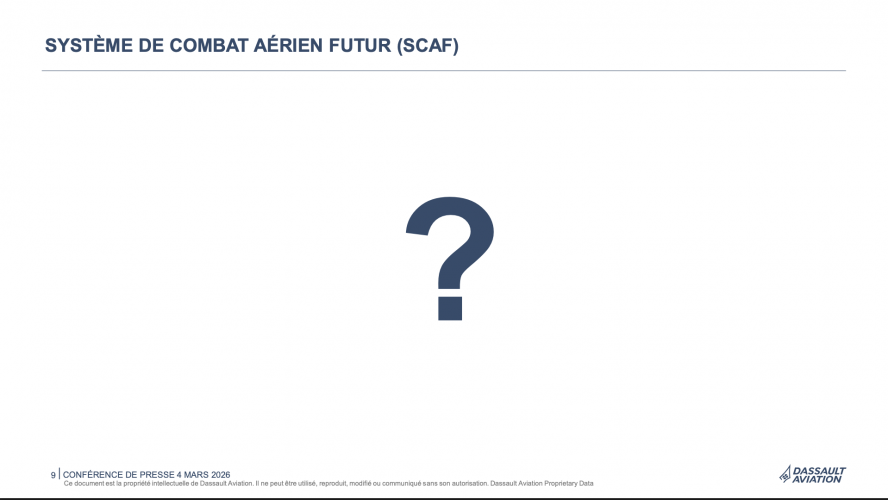
At Dassault's annual press conference, held yesterday in Saint Cloud (Paris), the official slide showed only a question mark over the Système de Combat Aérien du Futur (FCAS/SCAF). The room, however, was packed with German journalists, and from the first questions, it was clear that everyone was there for one thing: to hear what Éric Trappier really thought about FCAS

In the main presentation, SCAF appeared as a simple title followed by a question mark, a visual way of saying that the future trinational fighter remains an open project rather than a defined program. Trappier didn't dedicate a formal speech to the topic, but during the question-and-answer session, he more than made up for it, taking the opportunity to reiterate Dassault's red lines and frustrations in very direct terms.

Trappier made it clear that, from his perspective, what Airbus is promoting closely resembles a Eurofighter-style industrial model. For Trappier, that model is precisely what should be avoided if the three countries want a viable plan, credible timelines, and the level of technical coherence required for a next-generation fighter aircraft.

Trappier made no secret of his criticism of the "co-co-co" governance style that, in his view, characterizes large cooperative platforms like the Eurofighter TYPHOON and the Airbus A-400M (a cooperative model with as many co-leaders as there are countries, all primary and all expected to share leadership equally). Without going into detail, he drew a stark contrast between these large, slow, and compromise-ridden programs and the way the RAFALE was managed, with a clearly identified design authority and a more compact decision-making chain. His message was simple enough for a non-specialist audience: if you replicate the Eurofighter recipe for a 6th - generation system , you shouldn't expect different results.

In other words, the SCAF can't be just another task-sharing exercise; it needs a governance structure that allows someone to actually make decisions, define configurations, and deliver a flight-ready aircraft as quickly as possible, as he has repeatedly insisted. This is the crux of the controversy.

Trappier stated that Dassault could accept Airbus leading the other pillars of the SCAF, but not the first: the new fighter itself. On this central element, he consistently rejected the idea of Airbus leadership and reiterated this position to the German media present in the room. The reason, as he himself explained, is not simply a question of national pride or division of labor. Trappier's argument is that Airbus simply does not currently have the technical expertise to act as a leader in fighter aircraft design in the same way as Dassault, after decades of continuous fighter development culminating in the Rafale.

For him, asking Airbus to lead the fighter pillar would be tantamount to weakening the very heart of the SCAF before it even takes off. As we have already highlighted on RID, behind this leadership debate lies a deeper divergence between the political cultures and industrial reflexes of Paris and Berlin.
Germany tends to favor broader multilateral frameworks and broad participation, both military and industrial, even though this complicates governance and distributes responsibilities. France traditionally favors a more pragmatic approach: a narrow circle of participants, a clear leader, and the willingness to move forward even if not everyone is fully on board. This difference explains why a model similar to the Eurofighter might seem attractive in Berlin, where the priority is often to please partners and ensure their support, while in Paris the priority is often to maintain a strong, sovereign design authority that remains present when difficult configuration decisions need to be made. This also fuels French fears that the SCAF could turn into a political symbol rather than a program built around a technically coherent aircraft.

Indeed, according to Trappier, part of the impasse is as much political as industrial: when Berlin and Paris launched SCAF in 2018, their leaders neither considered these governance issues nor updated the project's architecture in time, when frictions arose. In his view, dividing the effort into successive phases was a structural error; the program should have been funded and launched all at once, from studies to the flying demonstrator, and only then should governments have decided whether to converge on a single system or accept a split. Under this alternative approach, he argued, a demonstrator would already be flying today , rather than having to renegotiate responsibilities and rules of the game at every incremental step, a process that has made any attempt to accelerate the timetable significantly more difficult.

“ The problem is not Germany, but Airbus”
Trappier made an effort to distinguish between Germany as a partner nation and Airbus as an industrial counterpart. He reminded the audience that cooperation with German industry has worked well in the past, citing the Alpha Jet with Dornier as a positive experience of bilateral collaboration. The problem, he believed, lies with Airbus, more specifically, certain parts of Airbus Defence & Space, which, in his view, are unwilling to truly collaborate with Dassault on a model that recognizes Dassault's leadership in the fighter sector.

He also criticized the way Airbus's position was communicated indirectly through German unions and intermediary bodies like the BDLI (German Aerospace Industry Association), rather than being clearly and directly expressed at the executive level. The subtext was clear: Dassault is willing to cooperate, but not to be dragged into a governance system where no one can truly lead and where industrial positions replace direct negotiations.
In this sense, Trappier's comments were not so much aimed at closing the door on SCAF as at saying that, in its current form, the door leads nowhere.

EUROMALE as “compensation”
One of the most striking points of the question-and-answer session was Trappier’s reminder that Airbus’s leadership of the European MALE drone – EUROMALE – was part of the broader balance of power between the two groups. He explained that Dassault was perfectly capable of accepting a subcontractor role on EUROMALE, with Airbus as the lead partner, and that this arrangement had not in itself been a source of friction. What he revealed, however, was that this leadership on EUROMALE was originally intended as a sort of compensation for Dassault's leadership on SCAF. In other words, the grand agreement should have been: Airbus leads the European drone, Dassault leads the new fighter.

The current tensions therefore concern not only the division of work on a single program, but also the perceived disruption of that initial balance. By bringing this back to the negotiating table, Trappier has sent a message not only to Airbus, but also to governments: if the original political agreement is quietly rewritten in favor of one industrial player, it's no surprise that the other will react.

A less analytical and very political story about SCAF
For the German journalists present at Saint Cloud—an unusual sight at Dassault's annual press conference—this question-and-answer session was probably more revealing than any slide. They listened to a CEO who says he's ready to work with German partners and accepts Airbus as the lead partner in some programs, but who refuses to dilute his company's fighter design DNA in a co-co-co structure that, in his view, has already shown its limits.

Ultimately, this is perhaps the simplest way to interpret the single question mark on the SCAF slide. It doesn't mean Dassault has no answers, but rather that, for now, the questions that really matter are political and industrial in nature: who leads what, on what basis, and what lessons can be learned from past European programs.

For Trappier, the paradox is that France no longer has a capacity problem, but only a money problem. Off the record, he summed it up bluntly: if Paris asked Dassault to build a next-generation national fighter, the company would do it, because it can. The bottleneck, he implied, lies in finding the few tens of billions of euros such a project would require at a time when French public finances are already under severe pressure. The industrial expertise, design authority, and a coherent governance model are all there; what's missing is the political will to shoulder the entire financial burden alone, rather than diluting it—and complicating it—in a fragile multinational compromise.

 
The Chief of Staff of the Air Force, General Jérôme Bellanger, speaking about the SCAF yesterday during a meeting with the AJD, recalled that “the operational requirement was shared with our German and Spanish counterparts.”

That said, he insisted that SCAF should not be reduced to the NGF manned aircraft alone.
“There are six other pillars, and above all the cloud pillar — that famous connectivity between manned and unmanned platforms.”

“And that’s something I strongly believe in, and we absolutely want to move forward on this topic with our counterparts.”

SCAF/FCAS:
“If we manage to stay together on the remote carriers / drones part and on the cloud part, I think we will have succeeded in saving the essential,” said General Jérôme Bellanger, Chief of Staff of the French Air and Space Force, speaking before the AJD Presse.

After that, if we now have to build two aircraft, then let’s build two aircraft. But the difficulty with making two aircraft is that we often end up with very different design logics. It is very difficult to make a Rafale and a Eurofighter converge.”

… i think he means making 2 prototypes and then selecting the best ? Otherwise why would you want both fighter to converge ?

Also :
Eric Trappier is not opposed to the two-aircraft solution, but he notes that this is not the scenario validated by France.
Watch the results video — the question is asked by Handelsblatt at 11:40:
https://dassault-aviation.tv/resultats_annuels_2025_questions_reponses-2394-fr.html


Bit of news today from Dassault

https://www.france24.com/en/live-ne...ys-weeks-left-to-save-europe-warplane-project

The key bits I suppose

On Wednesday, Eric Trappier said he was "not a man for co-management".

"We're giving ourselves a little more time -- two to three weeks –- to try to reach an agreement between the French and Germans, between Dassault and Airbus," he said at a forum in Paris.

"I am not in favour of an ambitious industrial project that will serve our armed forces being co-managed. We need a leader."

The FCAS programme was launched in 2017 to replace the Rafale jet and the Eurofighter planes used by Germany and Spain.

It is often seen as a bellwether of defence and security cooperation between France and Germany as the two EU powerhouses seek to put up a united front in the face of a hostile Russia and wavering US security commitment.

Trappier once again stressed that his company was capable of going it alone.

"We are going to build an aircraft to succeed the Rafale. It must be capable of carrying out missions and operating from an aircraft carrier," he said.

"We built the Rafale on our own. We know how to do it on our own, whereas the Eurofighter was built by four countries," he said, referring to Britain, Germany, Italy and Spain.
 
FCAS news from this week's French parliamentary hearings:

1. France's top general, the Chief of Defense Staff, reiterates that the 3 countries are aligned on requirements
I am aware of the tensions surrounding FCAS. What I observe is that, within our air forces and our navy, everyone is in agreement regarding the requirement. The German Air Force, the Spanish Air Force, the French Air Force, and our Navy have reached a consensus. This represents the culmination of several years of work dedicated to defining the military requirement.

There are, however, genuine industrial tensions. From an operational standpoint I sincerely hope that this project comes to fruition. A joint aircraft creates tremendous synergies, greatly simplifies logistics, makes it easier to conduct joint operations, and fosters human exchanges that bring our air forces closer together.
View: https://www.youtube.com/live/4ZLtVZQsNqA?si=VgcNfbiCYI4N6stZ&t=2820

2. French Minister of Armed Forces gives details on negotiations between Dassault & Airbus:
As you know, the FCAS program is under French leadership. However, there is an issue because of an industrial dispute between two manufacturers: one entirely French, the other more European. A mediation process is underway between these industrial partners, focusing on three critical elements: the first is intellectual property; the second is the allocation of tasks—or, to use the industry term, "workshare"; and the third concerns airworthiness certification. These negotiations are currently being conducted by two independent, qualified experts. They are expected to conclude before the end of April, which will provide us with the necessary clarity to move forward.

We remain focused on this crucial "first pillar"—the manned aircraft platform itself. With regards to the second component —the "system of systems" aspect—the manufacturers have demonstrated a greater capacity to work together. The initial stages were not without their difficulties, but they have now reached a point where they are able to collaborate effectively.
View: https://www.youtube.com/live/apH4EPLUFVc?si=IjemuqRNeHGPe11i&t=5955
 
Last edited:
After a month of talks the mediators tasked with salvaging the FCAS project have failed to reach agreement and will submit separate reports to their national governments with the recommendation that the manned fighter be cancelled. Reported by several news agencies today, here's an article which doesn't require subscription. The President and the Chancellor are due to meet at the EU summit at the end of the week and the leaders have the option of overruling the findings of the mediators and still trying to push on.

https://www.japantimes.co.jp/news/2026/04/19/world/european-fcas-warplane/
 
More news. Airbus now basically saying that 2 fighters is probably the way forward, especially now the mediators have said the impasse is real.

https://www.reuters.com/business/ae...ceo-airbus-military-division-says-2026-04-21/
April 21 (Reuters) - Europe must move to build a networked "combat cloud" linking fighters, even if that means the ‌Future Combat Air System (FCAS) ends up operating on different jets, the chief of Airbus' military division Michael Schoellhorn ⁠said at a trade show on Tuesday.
He said Airbus did not sign up to act as a subordinate supplier in a French‑led programme and reiterated support ‌for ⁠a genuinely balanced industrial partnership, as approved by Germany's parliament.

If that proved impossible, ⁠he said, the fighter element could be split off from FCAS, potentially leaving ⁠Europe to field two or three different ⁠next‑generation manned or optionally manned aircraft.
 
Couple of bits, looks like we're in the final stages or deciding if the pause should be extended, or pivot to two planes. Will we get two threads at that point!

https://www.reuters.com/business/ae...ver-fighter-jet-decision-timeline-2026-04-22/
BERLIN/PARIS, April 22 (Reuters) - Germany and France's defence ministers offered differing timelines on Wednesday for a decision on the Franco‑German FCAS fighter jet project, with one saying the two countries' leaders would ‌decide soon and the other saying mediators had sought more time to discuss the matter.
Plans to develop a futuristic air combat system together with Spain are hanging by a thread amid a public dispute over control between France's Dassault Aviation and Airbus, which represents Germany and Spain in the 100 ⁠billion euro ($117 billion) project.

https://www.euractiv.com/news/german-defence-minister-expects-fcas-decision-this-week/
“I expect a decision to be made this week on how to proceed,” Pistorius told reporters on Wednesday. According to him, the decision rests with German Chancellor Friedrich Merz and French President Emmanuel Macron who will both attend an EU leaders’ summit in Cyprus on Thursday and Friday.
 
The merry-go-round continues. The leaders have now decided it's the defence ministers problem.

https://www.euractiv.com/news/franc...-back-in-defence-ministers-hands-macron-says/
German Chancellor Friedrich Merz and French President Emmanuel Macron on Friday once more tasked their respective defence ministers to find a solution to move forward with the struggling Future Combat Air System (FCAS).

“We have instructed our defence ministries to work on several fronts,” including the fighter jet project, Macron told journalists in Cyprus where he is attending a meeting of EU leaders.

Macron’s comments came after he held a breakfast bilateral meeting with Merz.
 
Two aircraft “is the likely scenario right now as we see it,” CEO Johannes Bussmann said April 30. That could necessitate two engine types, he suggested.

The industrial strains among the aircraft-makers are not reflected among engine partners, Bussmann reiterated. “Our collaboration with our French colleagues is working very well,” he said on the company’s first-quarter earnings call.

https://aviationweek.com/defense/aircraft-propulsion/mtu-aero-engines-boss-now-expects-two-fcas-jets
 
Evidence of recent progress on FCAS pillar #3 (Remote Carriers), with the Spanish SATNUS consortium demonstrating coordinated maneuvers by up to 3 remote carriers including formation flight, evasive maneuvers, collaborative navigation, mission replanning and formation breakup.

SATNUS completes NGWS flight demonstration, validating combat air system development​

https://www.gpsworld.com/satnus-com...ion-validating-combat-air-system-development/
 
The most positive news I've seen in a while, although it does strike me as "Who cares about the plane" type of dialogue.

Airbus CEO is 'optimistic' about FCAS combat system despite fighter jet dispute​

https://www.euractiv.com/news/airbu...as-combat-system-despite-fighter-jet-dispute/
The head of the European aerospace company Airbus said he still believes in the Future Combat Air System (FCAS) as a platform, even as he doubles down on developing separate fighter jets.

The struggling €100 billion programme to develop an aerial combat system centred on a next-generation fighter jet has been stuck for over a year due to industry and political differences between France and Germany.

“Collaboration is not a walk in the park,” Airbus CEO Guillaume Faury admitted during the opening remarks of his company’s defence summit on Wednesday.

However, Faury stressed that he continues to believe in a European future combat air system, which is more than just a plane. He pointed out that most of the current difficulties lie in the fighter jet component of the project.
 
Airbus DS head Mike Schoellhorn, playing bad cop to Faury's good cop? He seems to be pushing hard for 2 fighters and 2 engines, arguing that the original design was cost-constrained and not high performance enough and downplaying the extra cost.

Airbus eyes two-aircraft FCAS solution amid wider program reset​

https://www.flightglobal.com/defenc...aft-fcas-solution-amid-wider-programme-reset/
Airbus remains open to a two-aircraft solution within the tri-national Future Combat Air System (FCAS) program if the nations backing the multi-billion-euro project decide to pursue that option. But the airframer is uncertain whether this can be achieved within the current industrial set-up supporting FCAS and is seeking a “partial reset” of the program, said Mike Schoellhorn, head of Airbus Defense & Space, speaking at the company's Defense Summit event in Manching near Munich on 20 May.

Since its inception in 2017, FCAS has been focused on a single aircraft within its manned New Generation Fighter (NGF) component, led by Dassault Aviation on behalf of France. But with competing demands from the FCAS nations – France needs a nuclear-capable jet that can also operate from aircraft carriers while Germany and Spain want an air dominance fighter – there is a growing acknowledgment that this cannot be achieved with a single platform, says Schoellhorn.

Such a solution would be a “compromise that is less and less achievable”, he says, with that initial design shaped by the less intense security environment seen last decade. Guillaume Faury, Airbus chief executive, says as the project was launched “in peace time” – prior to the start of the Ukraine war in 2022 – it was based on “a number of assumptions which are no longer valid today”. This drove the partner nations to accept compromises on specification to “get to a product at a minimum cost”, he says, adding: “Now we are in a scenario of potential conflict, real conflict or war, the specifications become more important.”

On that basis, changes to the scope of the program are needed, he suggests: “I think it's better to face the difficulties and the realities of what will come in the next decade for FCAS now rather than correct it later when we have gone a long way forward.” But he stresses that “the governments have to decide the way forward”.

While the development of two different NGF aircraft has not so far been on the table, Airbus remains open to the concept. “I'm supportive of finding a solution and if the solution cannot be or would not be a one-fighter solution then I support a two-fighter solution,” says Schoellhorn. Although this would increase costs “I don't think this would be by very much”, he says, particularly in relation to the likely cost and complexity of taking the competing requirements “and trying to integrate them into one [aircraft]”.

However, the move would likely face opposition from Dassault, which has frequently been at loggerheads with its partner over leadership of the NGF development. Schoellhorn thinks the two-aircraft solution could be achieved “but what it takes to do that is the will to do it, and [that] has to be there politically and industrially”. “All I am saying is that we have the will to do it and the will to make it happen, I will not speak for any other parties in this because, obviously, if it was easy, then we would already have a solution.”

But whether Airbus and Dassault can continue to work together remains an open question, with Faury noting that “not all companies are capable of co-operating with each other”. Schoellhorn says the company is “open to collaborating with a partner that's willing to collaborate”, but ultimately could be forced to look elsewhere. “Currently it looks like that collaboration with Dassault is not going as we had planned it, so there's alternatives that we need to assess at the right point in time, but that requires a political decision first. “That's where we need an industrial alignment that is better than what we have today, but we also need a political alignment, so you need both to tango and that is currently being thrashed out.”

With the NGF currently in Phase 1B, there is as yet no agreement to support the transition to Phase 2 and the development of a full-scale demonstrator. However, the remaining 'pillars' within the broader FCAS project are progressing well, says Schoellhorn. These include a combat cloud, adjunct fighters, sensors and a new engine.

But it is unclear whether two different NGF aircraft would also require different engines. Schoellhorn says it is too early to say definitively but adds it would “likely not” be the same engine across the two jets. “Is it going to be a family of engines? Possible, but that again takes the same will to make that happen.”
 
A rare Spanish article relaying this week's Airbus summit with a surprisingly skeptical angle.

https://defensayseguridad.es/faury-y-el-fcas-el-problema-no-es-ucrania/

The CEO of Airbus blames FCAS difficulties on the Ukraine war and on a single pillar

Jorge Estévez | May 21, 2026

Guillaume Faury appeared yesterday at the Airbus Defence Summit in Manching with the poise of someone who knows how to measure every word, and the serenity of someone who is also aware that no one expects him to take full responsibility for what he is about to say.

Airbus flexed its muscles yesterday. It also presented a narrative and a vision of European industry. All very timely. All very necessary, and perfectly logical, too. It is, after all, the aeronautical giant upon which a good part of our air transport infrastructure in Spain and much of Europe rests. Therefore, to a large extent, what it said was all true, and to a great degree, legitimate. But it's also worth remembering that the truth can also be dispensed in self-serving doses, or not as finely calculated as some might claim.

The CEO of Airbus insisted that the FCAS is functioning reasonably well as a system and that the difficulties are concentrated in “ one of the seven pillars .” Put that way, it seems almost like a bureaucratic minutia, just another technical discrepancy in that great Franco-German-Spanish Sudoku puzzle that aims (or was) to bring forth the future European air combat system. The problem is that this pillar isn't the catering, nor the shelving, nor the stale ministerial statements we've been enduring for far too long. This pillar is the fighter jet. The NGF. The heart of the FCAS. And when the heart isn't beating, it's of little use to boast that the rest of the body is in good shape.

Faury lamented that “only one of the pillars is being discussed when the other six are functioning well .” It’s a clever, even logical, statement. It’s also a very subtle way of asking us not to focus on the problem itself; or not to focus on it the way we do. Because if the FCAS doesn’t produce a next-generation fighter, the FCAS ceases to be the FCAS and becomes an architecture of good intentions, drones, a combat cloud, and presentations with lots of blue hexagons . All of which matters, of course. Connectivity, sensors, remote carriers , and the combat cloud are not just window dressing. But the program was born around a manned aircraft capable of replacing or complementing the Rafale and the Eurofighter around 2040. Without that aircraft, the whole structure doesn’t just collapse from a ledge: it collapses from the very foundations that supported its initial concept.

Even more debatable is the explanation that links much of the tightening of specifications to the war in Ukraine . Faury argued that the project was launched before the full-scale Russian invasion and that, in the new context of real conflict, the specifications have become more important. It is true that Ukraine has changed priorities, budgets, industrial pace, and threat perceptions in Europe. To deny this would be naive. But it is dishonest to present the war as if it suddenly revealed that France, Germany, and Spain wanted different aircraft . This, as we have said repeatedly, was known from the beginning. France needed an aircraft compatible with its nuclear doctrine and carrier-based operations. Germany and Spain started with different needs, different fleets, different industrial constraints, and different security scenarios. The differences did not originate in Donetsk or Bakhmut: they were written in the program's inception, when it was launched .

The war in Ukraine has perhaps exacerbated impatience, hardened rhetoric, and reduced the political space for funding slow-moving projects. But it didn't invent the disagreement. The disagreement was inherent. The program was launched by France and Germany in 2017 (after the invasion of Crimea, in case that serves as a point of contention) and Spain joined in 2019; since then, differences between Dassault and Airbus regarding industrial leadership and technological ownership have haunted the project like a persistent shadow.

Faury also stated some obvious points, such as that “companies don't all operate the same way ” and that phases 1A and 1B have revealed difficulties in aligning leadership models, corporate governance, and industrial compensation. There's some truth to this, but it's a tautological truism. Not all companies cooperate equally, not all states understand industrial sovereignty in the same way, and not all national champions are willing to share the reins when they believe the car is theirs. That statement was self-evident, requiring no further explanation whatsoever. Dassault is not Airbus, Airbus is not Dassault, France is not Germany, and Spain, as so often happens , is persistently trying to remain a mere guest with little more than a photo opportunity and the corresponding obligation to pay. And all this despite the fact that it is doing its job, professionally and quietly, like everyone else; but, unlike the rest, it isn't resorting to violence in this dispute.

The problem is that this realization comes too late. If, after years of meetings, press releases, preliminary phases, warnings, and smiles for the press (when not outright unacceptable silence), we're still arguing about who's in charge, then Phase 1B isn't just a stage; it's the actual medical report . And not a reassuring one at that. The months of gridlock say a lot about the project, yes. But they say even more about the partners. They speak of jealous industries, ministries scrupulous to the point of absurdity, and political leaders incapable of imposing a consensus framework where technicians, executives, and national pride have been digging trenches as deep as Groucho Marx's for years.

Let's be clear, because the program deserves it, because the reality is that this issue isn't just industrial. It's political. And when neither Paris, nor Berlin, nor Madrid manage to smooth over their differences in a program of this magnitude, the question arises almost unbidden: does Europe truly want to build common capabilities or does it just want to pose in front of common models? Because it's hardly necessary to remind us that we have recent examples of projects that have achieved success in Europe , relative or otherwise, but with operational results. There's the A-400 or the Eurofighter , to name just two, perhaps the most important, but not only them. The European Union can finance studies, create funds, draft roadmaps, and convene summits. It does all of that wonderfully. But a sixth-generation fighter jet isn't built with adjectives. It's built with leadership, money, compromises , and a chain of responsibility that can't be changed every time a member fears it has conceded too much.

Airbus, naturally, argues that an integrated company like itself can better serve diverse national needs. Faury suggested that interests are more aligned within Airbus and that major European programs require companies that are compatible in their governance and working methods. The argument has business logic, so obvious that, again, it hardly needs to be noted. But it also has an obvious consequence: Airbus is implying, without explicitly saying so, that the problem is Dassault . Or, at least, that the cooperation model with Dassault has reached its breaking point (even for Dassault).

The idea of two aircraft with high commonality might sound pragmatic. It might even end up being the least bad solution. Europe already knows quite a bit about aircraft families, differentiated versions, and impossible compromises. But if anything, it's anything but pragmatic; opportunistic, yes; pragmatic, not at all. So it's best not to embellish what would actually be an orderly withdrawal from the original concept in favor of redundancy (something we've experienced before, as we know). Two fighters are not a victory for the FCAS, unless that was the plan from the outset; rather, they are confirmation that the FCAS, as it was sold, perhaps couldn't survive its own partners. It might salvage part of the system, yes, even preserve cooperation on sensors, the combat cloud, drones, and digital architecture. But it would also confirm that Europe, when it comes to the core of military sovereignty, reverts to speaking in the plural, in national terms, and in hushed tones. Nor would it be the end of the world, I insist, because a plurality of devices, properly understood, doesn't harm anyone, but perhaps only if it had arisen naturally, like someone going to 4 dealerships looking for a car instead of 1. This, in reality, would be the same old thing again, the unruly as the culmination of multinational programs after years of delays and cost overruns.

And then there's the boldest claim: that Airbus could develop a new-generation fighter jet on its own. Faury suggested this in the context of tensions with Dassault. Let's pause here for a moment. If anyone in Europe has industrial muscle, as I mentioned before, it's Airbus. That's undeniable. Its aeronautical weight, its experience in complex programs, its multinational base, and its integration capabilities are beyond question. But a sixth-generation fighter isn't simply a flashy evolution of a previous model. It demands mastery of low-observability, mission architecture, sensors, electronic warfare, weapons integration, and, among many other things, propulsion. And the engine doesn't appear to be an afterthought. An engine isn't something you can whip up in a couple of afternoons, nor is it purchased like ordering a test bench for an assembly line.

Airbus can lead in many ways. It can integrate systems. It can even bring order to chaos; absorb industrial workloads, negotiate with states and suppliers, and even bless water. Such is its power and the significance of a multinational of its caliber. But to say that it can do it all alone, without nuance, without critical dependencies, and without serious reflection on its (currently) lacking capabilities, is to replace analysis with marketing. Europe certainly has know-how, but it is fragmented, protected by national interests, and distributed among companies that don't always cooperate out of genuine interest, but rather out of budgetary obligation. European sovereignty , when it moves from the office to the factory floor, becomes considerably less solemn, more mundane, and encounters the natural difficulties of daily operations.

None of the above means that Faury is entirely wrong. He isn't . He is right to warn that European cooperation is no walk in the park. He is right to point out that incompatible industrial models complicate major programs. He is also right to argue that the FCAS should be understood as a system, not as an isolated aircraft. And, of course, he is right to remind us that Europe needs to invest more, produce faster, and reduce dependencies . The security environment has become brutally more volatile since 2022, and the Continent cannot afford to let its major programs become endless seminars on national sensitivities.

But precisely because some things are true, it's essential to be more demanding of those that aren't entirely so. It's not enough to say that six pillars are progressing if the seventh is the one that justifies the whole thing. Nor is it enough to invoke Ukraine to explain disagreements that predate Ukraine. Nor is it enough to present a two-fighter solution as if it were the natural continuation of the project. And it's not enough to suggest that Airbus can do it alone without explaining what capabilities it would have to acquire, partner with, develop, or purchase to avoid ultimately selling a promise.

The FCAS isn't dead. But it's not healthy either. It's in that very European zone where programs don't fail, but are simply prolonged and restructured indefinitely, with the only thing they all have in common being that they become more expensive. The danger isn't that the FCAS will collapse tomorrow. The danger is that it will remain alive for years without making the decision it needs to be born, and that we will continue to waste time, money, and opportunities to address the 6th generation.

Airbus will defend its position, as is to be expected. Dassault will defend its own, as is also to be expected. France, Germany, and Spain will do the same, with varying degrees of intensity and scope. What no one should do is confuse the partisan narrative—understandable as it is—with the complete diagnosis. Because if the FCAS ends up proving anything, it may not be that Europe lacks talent, technology or money, but that Europe knew how to imagine the aircraft of the future, but not who should pilot the program that should manufacture it .
 
French Chief of the Defense staff at the Sénat :
https://www.senat.fr/compte-rendu-commissions/20260427/etran.html#toc5
As for the FCAS (Future Combat Air System), the current military programming law maintains the planned cooperation. I observe that, from a military standpoint, the three air forces — Spanish, German, and French — along with our navy, are in complete agreement when it comes to defining the requirement. The difficulty therefore does not stem from identifying the need.

In 2017, the decision to pursue such a project with Germany was a choice of reason, not passion. We made a rational choice because we needed to demonstrate competitiveness in order to be well positioned for exports. We deliberately targeted the high end of the spectrum because we possess nuclear deterrence. Faced with competitors, it was necessary to bring together the best companies in Europe, particularly French and German firms.
...
I am very disappointed by the difficulties we are seeing, because the armed forces agreed on the requirement that had been defined. Building two aircraft makes no operational sense. We know exactly what we want. The competition between France and Germany is petty when measured against the scale of global challenges. Will we manage to overcome it at the last moment? I do not know, but I sincerely hope so.
...
If the Germans were to abandon the project, that would not mean we were doomed to stop building aircraft. On the other hand, we would miss an incredible opportunity.
...
At the very least, we would need to preserve connectivity standards and the cloud, because fierce competition will take place in this area between Americans and Europeans. Indeed, whoever defines the standard for the data circulating through land, air, and naval combat systems — all of which must interact — controls the combat systems. The black box of tomorrow is the cloud. If we accept a cloud provided by others, we lose sovereignty over our combat systems.
 
Last edited:
If the information is coming from Michel Cabirol at La Tribune that means it's most likely an authorized leak from French gov. sources (Macron's staff or the Defense Ministry) to get ahead of the bad news headlines. 90% of his articles seem to be authorized leaks when the government can't officially comment on something defense related but wants the information to be released.
 
According the german New magazine Der Spiegel
have President Macron and Chancellor Metz terminated the FCAS program.

https://www.spiegel.de/politik/deut...t-fcas-a-7e9fbe17-7f39-4259-981b-e3f00c0da9a9

Now that give France the chance to build there wanted version of Fighter Jet
but what to hell get Luftwaffe now new fighter Jet ?
Berlin had say not further plans to buy F-35
https://breakingdefense.com/2026/06...heaval-what-to-expect-at-the-berlin-air-show/

FCAS uncertainty and transatlantic upheaval: What to expect at the Berlin Air Show​

 
Airbus and some other german companies are creating Team "Gen 6". Its supposed to be a simpler, less complex variant. They also are interrested in working together with Saab within the project.
https://www.spiegel.de/wirtschaft/n...ef=re-in-app-wi&sara_ref=re-so-app-sh#ref=rss
Key quotes below... GCAP, FCAS and partnerships with new countries all being rejected.
IG Metall union wants it to be based on Eurofighter (!).
Considerations are moving towards building a scaled-down, less complex fighter jet compared to the concept envisioned within the FCAS framework. Warfare is evolving in such a way that unmanned aerial vehicles of all kinds are gaining in importance. "We don't want to develop a German copy of FCAS," the alliance stated. The new partners apparently reject cooperation with the British-Italian-Japanese fighter jet consortium GCAP, whose concept does not meet German requirements.

Meanwhile , the IG Metall union is also strongly advocating for the development of a German sixth-generation jet. "The solution isn't for us to join GCAP retroactively," IG Metall board member Jürgen Kerner told SPIEGEL. Within GCAP, the work packages are already distributed. "The way forward would be for Airbus Defence and Space to develop a sixth-generation aircraft based on the Eurofighter, working independently with various partners." "Missing capabilities must be developed with partners," Kerner said, just as Airbus is already collaborating with Saab. "There isn't enough time for new consortia; the negotiations between the participating countries alone would take years."
 

Similar threads

Back
Top Bottom