The FCAS Question Mark: Why Dassault Says “No” on Program Governance
March 5, 2026 | Marco Giulio Barone (from Paris)
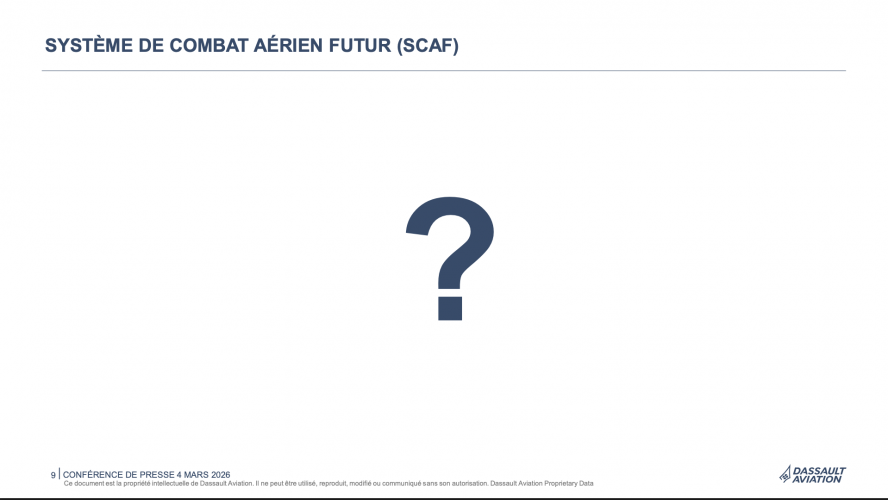
At Dassault's annual press conference, held yesterday in Saint Cloud (Paris), the official slide showed only a question mark over the Système de Combat Aérien du Futur (FCAS/SCAF). The room, however, was packed with German journalists, and from the first questions, it was clear that everyone was there for one thing:
to hear what Éric Trappier really thought about FCAS
In the main presentation, SCAF appeared as a simple title followed by a question mark, a visual way of saying that the future trinational fighter remains an open project rather than a defined program. Trappier didn't dedicate a formal speech to the topic, but during the question-and-answer session, he more than made up for it, taking the opportunity to reiterate Dassault's red lines and frustrations in very direct terms.
Trappier made it clear that, from his perspective,
what Airbus is promoting closely resembles a Eurofighter-style industrial model. For Trappier, that model is precisely what should be avoided if the three countries want a viable plan, credible timelines, and the level of technical coherence required for a next-generation fighter aircraft.
Trappier made no secret of his criticism of the "co-co-co" governance style that, in his view, characterizes large cooperative platforms like the Eurofighter TYPHOON and the Airbus A-400M (a cooperative model with as many co-leaders as there are countries, all primary and all expected to share leadership equally). Without going into detail, he drew a stark contrast between these large, slow, and compromise-ridden programs and the way the RAFALE was managed, with a clearly identified design authority and a more compact decision-making chain.
His message was simple enough for a non-specialist audience: if you replicate the Eurofighter recipe for a 6th - generation system , you shouldn't expect different results.
In other words, the
SCAF can't be just another task-sharing exercise; it needs a governance structure that allows someone to actually make decisions, define configurations, and deliver a flight-ready aircraft as quickly as possible, as he has repeatedly insisted. This is the crux of the controversy.
Trappier stated that
Dassault could accept Airbus leading the other pillars of the SCAF, but not the first: the new fighter itself. On this central element, he consistently rejected the idea of Airbus leadership and reiterated this position to the German media present in the room. The reason, as he himself explained, is
not simply a question of national pride or division of labor. Trappier's argument is that
Airbus simply does not currently have the technical expertise to act as a leader in fighter aircraft design in the same way as Dassault, after decades of continuous fighter development culminating in the Rafale.
For him, asking Airbus to lead the fighter pillar would be tantamount to weakening the very heart of the SCAF before it even takes off.
As we have already highlighted on RID, behind this leadership debate lies a
deeper divergence between the political cultures and industrial reflexes of Paris and Berlin.
Germany tends to favor broader multilateral frameworks and broad participation, both military and industrial, even though this complicates governance and distributes responsibilities.
France traditionally favors a more pragmatic approach: a narrow circle of participants, a clear leader, and the willingness to move forward even if not everyone is fully on board. This difference explains why a model similar to the Eurofighter might seem attractive in Berlin, where the priority is often to please partners and ensure their support, while in Paris the priority is often to maintain a strong, sovereign design authority that remains present when difficult configuration decisions need to be made. This also fuels French fears that the SCAF could turn into a political symbol rather than a program built around a technically coherent aircraft.
Indeed, according to Trappier, part of the impasse is as much political as industrial: when Berlin and Paris launched SCAF in 2018, their leaders neither considered these governance issues nor updated the project's architecture in time, when frictions arose. In his view,
dividing the effort into successive phases was a structural error; the program should have been funded and launched all at once, from studies to the flying demonstrator, and only then should governments have decided whether to converge on a single system or accept a split. Under this alternative approach, he argued,
a demonstrator would already be flying today , rather than having to renegotiate responsibilities and rules of the game at every incremental step, a process that has made any attempt to accelerate the timetable significantly more difficult.
“ The problem is not Germany, but Airbus”
Trappier made an effort to distinguish between Germany as a partner nation and Airbus as an industrial counterpart. He reminded the audience that
cooperation with German industry has worked well in the past, citing the Alpha Jet with Dornier as a positive experience of bilateral collaboration. The problem, he believed, lies with Airbus, more specifically,
certain parts of Airbus Defence & Space, which,
in his view, are unwilling to truly collaborate with Dassault on a model that recognizes Dassault's leadership in the fighter sector.
He also criticized the way Airbus's position was communicated indirectly through German unions and intermediary bodies like the BDLI (German Aerospace Industry Association), rather than being clearly and directly expressed at the executive level. The subtext was clear:
Dassault is willing to cooperate, but not to be dragged into a governance system where no one can truly lead and where industrial positions replace direct negotiations.
In this sense, Trappier's comments were not so much aimed at closing the door on SCAF as at saying that, in its current form, the door leads nowhere.
EUROMALE as “compensation”
One of the most striking points of the question-and-answer session was Trappier’s reminder that Airbus’s leadership of the European MALE drone – EUROMALE – was part of the broader balance of power between the two groups. He explained that
Dassault was perfectly capable of accepting a subcontractor role on EUROMALE, with Airbus as the lead partner, and that this arrangement had not in itself been a source of friction. What he revealed, however, was that this leadership on EUROMALE was originally intended as a sort of compensation for Dassault's leadership on SCAF. In other words,
the grand agreement should have been: Airbus leads the European drone, Dassault leads the new fighter.
The current tensions therefore concern not only the division of work on a single program, but also the perceived disruption of that initial balance. By bringing this back to the negotiating table, Trappier has sent a message not only to Airbus, but also to governments: if the original political agreement is quietly rewritten in favor of one industrial player, it's no surprise that the other will react.
A less analytical and very political story about SCAF
For the German journalists present at Saint Cloud—an unusual sight at Dassault's annual press conference—this question-and-answer session was probably more revealing than any slide. They listened to a
CEO who says he's ready to work with German partners and accepts Airbus as the lead partner in some programs, but who refuses to dilute his company's fighter design DNA in a co-co-co structure that, in his view, has already shown its limits.
Ultimately, this is perhaps the simplest way to interpret the single question mark on the SCAF slide. It doesn't mean Dassault has no answers, but rather that, for now, the questions that really matter are political and industrial in nature: who leads what, on what basis, and what lessons can be learned from past European programs.
For Trappier,
the paradox is that France no longer has a capacity problem, but only a money problem. Off the record, he summed it up bluntly: if Paris asked Dassault to build a next-generation national fighter, the company would do it, because it can.
The bottleneck, he implied,
lies in finding the few tens of billions of euros such a project would require at a time when French public finances are already under severe pressure.
The industrial expertise, design authority, and a coherent governance model are all there; what's missing is the political will to shoulder the entire financial burden alone, rather than diluting it—and complicating it—in a fragile multinational compromise.