
Just a thought, how often would that occur?
Not very often, but exactly how often I would need a crapton of weather data for.


Could the RN work out the chances of nil wind bow cat launches and compare that to other things that affect launchrs, such as sea state and decide the trade off?
They should have been able to do so.
 
Not very often, but exactly how often I would need a crapton of weather data for.


They should have been able to do so.

I just wonder where on the list of risks that are managed and accepted that a broken main cat, no wind, no forward motion and a definate requirement to launch Phantoms at 50,000lbs. Would a snashed prop shaft coupling (Invincible on the way to the Falklands) be a more likely risk, or something else that pushes the bow cat nil wind launch down to 3, 4 or 5 most dangerous capability gap?
 
I just wonder where on the list of risks that are managed and accepted that a broken main cat, no wind, no forward motion and a definate requirement to launch Phantoms at 50,000lbs. Would a snashed prop shaft coupling (Invincible on the way to the Falklands) be a more likely risk, or something else that pushes the bow cat nil wind launch down to 3, 4 or 5 most dangerous capability gap?
That description is starting to sound like a "carrier has been combat-damaged and needs to still launch CAP before a second strike kills it."
 
Just a thought, how often would that occur? Could the RN work out the chances of nil wind bow cat launches and compare that to other things that affect launchrs, such as sea state and decide the trade off?

Unlikely in the atlantic, quite possible in the med, main risk was seen in the EOS mission.

CAP might require using a tanker under those circumstances, if it's an exception more a nuisance than a real problem.

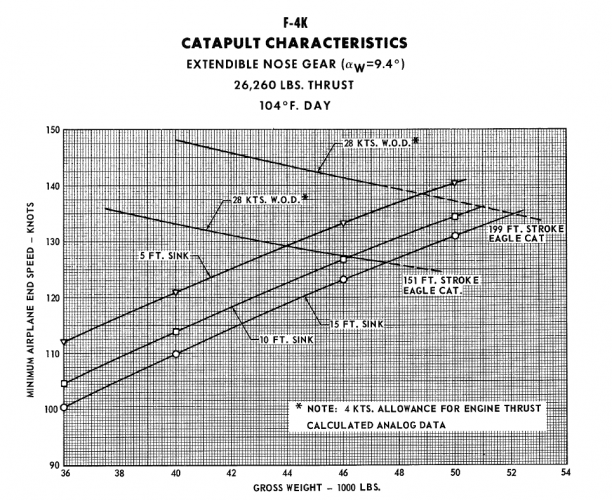
For DLI, with the 151 ft cat and if the carrier can make 28 kts:

The modified F-4J should work with internal fuel only in ISA nil wind, ~1000-2000 lbs less at 40°C.
The F-4K's advantage is melting in the tropics; the J79 F-4 needs about 5-8 kts more, the Spey F-4K 13 kts more vs ISA (both in the hoped-for as in the as-was version).

So even the hoped-for version of the F-4K would only have made internal fuel/46k lbs from the 151 ft cat in 40°C and needing 28 kts ship speed for this:
1775980954293.png


So this was considered an acceptable risk ex ante.

The F-4K as was should be like the modified F-4J, maybe even worse. And also considered an acceptable risk, obviously and for lack of alternatives...
 
If memory serves Spey 202 had water injection.
 
That description is starting to sound like a "carrier has been combat-damaged and needs to still launch CAP before a second strike kills it."

You can't predict battle damage, but a carrier is a highly complex machine with maybe millions of parts that is being used hard. Things are bound to break, and at the most inconvenient times according to Murphy's Law.
 
Unlikely in the atlantic, quite possible in the med, main risk was seen in the EOS mission.
The most likely area of the world's oceans where windless or near windless conditions are likely to be met is in the Intertropical Convergence Zone, known to sailors, particularly those on sailing ships, as "The Doldrums". This lies in the region 5° north and south of the equator but moving with the summer season in each hemisphere. The extremes are shown here.


That is why the East of Suez scenario presented the greatest problem.
 
You can't predict battle damage, but a carrier is a highly complex machine with maybe millions of parts that is being used hard. Things are bound to break, and at the most inconvenient times according to Murphy's Law.
Still sounds like an absolute worst-case issue.
 
Not very often, but exactly how often I would need a crapton of weather data for.
Autumn in Flanders in 1917 was the wettest in 70 years, defying all the met predictions. When the weather was dry (and there were times when it was), the British were carving their way into every German position and annihilating all counter-attacks, and NOTHING the Germans could do was stopping them.

I've read somewhere that the local German army group commander was close to conceding the field, and Ludendorff had to order him not to. The British came THAT CLOSE to winning Passchendaele, not just as an attritional battle but as an actual, major strategic victory; and if the weather had held, they would have done it.

That's how important the weather is. Hopefully in a mid 1960s hot-war scenario, the weather prediction might have been better.
 
I dunno, I still get the impression that the primary reason for Spey Phantoms was to reduce the spend in dollars.

Apparently the F4K had considerably more powerful blown flaps, and the Spey provided more bleed air than the J79.

In any case, I think there was a lot of self-reinforcing reasons that pushed the British down the Spey path. There was the promise of better performance which came with the handy benefit of not needing USD, but when the promises failed the £ became a reason to keep going.
 
Apparently the F4K had considerably more powerful blown flaps, and the Spey provided more bleed air than the J79.

In any case, I think there was a lot of self-reinforcing reasons that pushed the British down the Spey path. There was the promise of better performance which came with the handy benefit of not needing USD, but when the promises failed the £ became a reason to keep going.
Not to mention that the Treasury and Foreign Office are ever loath to admit they have made a mistake.
 
Back
Top Bottom