What does this mean exactly?
  • Cutting out and replacing hull plates that are in bad condition, or just a scrape and repaint?
  • [...]
  • Are reduction gears rebuilt with new bearing etc or are major components replaced?
Refurbishment usually means replacing everything in bad condition.

Reduction gears specifically are probably just "rebuilt" (have bearings replaced) since there should be very little wear in the gears.
 
The plan dates back to the late 1940s, when it was not expected they could get new ships at all before 1954 (and frankly they were mostly correct about that). Illustrious and Indomitable were already dropped early in the program; the problem with upgrading just Implacable and Indefatigable is that they would've required the most work at the time.

This was, in fact, what motivated the Brits to not modernize the two after all the headaches Victorious went through and the existing delays on the ships.

Also, the Implacables are liable to undergo the scope creep Victorious did if they're slotted in in her place.

And the nail in the coffin: by the time the Medium Carrier was being considered the carrier fleet was cut from 12 to 6 ships, meaning that if you have two Implacables being reconstructed instead of one Victorious the urgency is less critical than OTL, not more.
Agreed, but what I was suggesting is the upgrade order be reversed and it start with one of the Implacables instead of one of the Illustrious, possibly because it was realised that Illustrious and Furious were in a poor material state. From my reading the Illustrious were selected because there were three of them hence the design work would be good for all three, remove that factor, the larger, newer Implacables become more attractive.

Ironically, although on paper merging the two hangars and lifting the flight deck to gain a 17'6" height was more complex and difficult than the plan for the Illustrious class, once it was decided to work in a gallery deck between flight deck and hangar, Implacable became more attractive. Add in the replacement work Victorious needed on her propulsion, though it wasn't realised until well into the rebuild, and the Implacables are better again.

This is a proposed tangent from real world to get a medium carrier program, or the 1952 Fleet Carrier, build started in the 50s, maybe there could be a transfer of an Illustrious or two, maybe all three, to Commonwealth navies to support the BPF and free up experienced RN crews for newer, more capable ships.

If memory serves, there was a cabinet decision in 52 or thereabouts to upgrade Victorious and complete Hermes, plus the three Tigers, instead of building the 1952 carrier.

 
Agreed, but what I was suggesting is the upgrade order be reversed and it start with one of the Implacables instead of one of the Illustrious, possibly because it was realised that Illustrious and Furious were in a poor material state. From my reading the Illustrious were selected because there were three of them hence the design work would be good for all three, remove that factor, the larger, newer Implacables become more attractive.

Ironically, although on paper merging the two hangars and lifting the flight deck to gain a 17'6" height was more complex and difficult than the plan for the Illustrious class, once it was decided to work in a gallery deck between flight deck and hangar, Implacable became more attractive. Add in the replacement work Victorious needed on her propulsion, though it wasn't realised until well into the rebuild, and the Implacables are better again.

This is a proposed tangent from real world to get a medium carrier program, or the 1952 Fleet Carrier, build started in the 50s, maybe there could be a transfer of an Illustrious or two, maybe all three, to Commonwealth navies to support the BPF and free up experienced RN crews for newer, more capable ships.

If memory serves, there was a cabinet decision in 52 or thereabouts to upgrade Victorious and complete Hermes, plus the three Tigers, instead of building the 1952 carrier.

The extended Illustrious family of six carriers was a rebuilt "death trap". For a start, the six ships were not homogenous but rather 3+1+2, each with different rebuilt. Mostly because of the armored hangars, the kiss-of-death : with their impact over the whole ship and their different heights - which in turn directly impacted rebuilds.

The Illustrious class comprised four vessels: HM Ships Illustrious, Formidable, Victorious and Indomitable. The last of these was built to a modified design with a second, half-length, hangar deck below the main hangar deck.

The later two ships of the Implacable class were also built to modified designs to carry larger air wings. Implacable and Indefatigable both had two hangar levels, albeit with a limited 14-foot (4.3 m) head room.

On top of that, three of the six suffered severe damage - two from Stukas, one from kamikaze.
 
Last edited:
Agreed, but what I was suggesting is the upgrade order be reversed and it start with one of the Implacables instead of one of the Illustrious, possibly because it was realised that Illustrious and Furious were in a poor material state. From my reading the Illustrious were selected because there were three of them hence the design work would be good for all three, remove that factor, the larger, newer Implacables become more attractive.

Ironically, although on paper merging the two hangars and lifting the flight deck to gain a 17'6" height was more complex and difficult than the plan for the Illustrious class, once it was decided to work in a gallery deck between flight deck and hangar, Implacable became more attractive. Add in the replacement work Victorious needed on her propulsion, though it wasn't realised until well into the rebuild, and the Implacables are better again.
While the resulting ships would be larger and somewhat more capable, I don't think picking the Implacables instead of Victorious really solves any of the problems of the postwar Royal Navy. All of the scope creep that hit Victorious applies to the Implacables. Yes, even the steam plant - while unlike Victorious the Implacables aren't likely to need replacement on hull life grounds, the draw of the steam catapults is still a problem that necessitates re-engining. Yes, the Implacables have more steam output than the Illustriouses, but even Eagle and Ark Royal suffered mightily from the steam draw of the catapults.

This is one of many issues with WW2-era construction, and one suffered by the USN, too: ships with steam plants designed solely for propulsion and modest turbogeneration don't have the reserves to provide for steam catapults on top without a major speed loss.

And as for force structure...

This is a proposed tangent from real world to get a medium carrier program, or the 1952 Fleet Carrier, build started in the 50s, maybe there could be a transfer of an Illustrious or two, maybe all three, to Commonwealth navies to support the BPF and free up experienced RN crews for newer, more capable ships.
I'm sorry, but I still don't see how this gets to either a medium carrier or the 1952 fleet carrier. As I noted in my last post, once the Radical Review goes through the urgency for a medium carrier goes down, and once the 1957 review hits any chance whatsoever is gone.

If memory serves, there was a cabinet decision in 52 or thereabouts to upgrade Victorious and complete Hermes, plus the three Tigers, instead of building the 1952 carrier.
Do you know where that can be found? That could be an interesting POD in itself...
 
This is one of many issues with WW2-era construction, and one suffered by the USN, too: ships with steam plants designed solely for propulsion and modest turbogeneration don't have the reserves to provide for steam catapults on top without a major speed loss.
Bingo. @SSgtC has told us many times how the fifteen Essex-class rebuild with steam catapults (SCB-125) had no choices but to slow down to 19 kt when launching. The following Midways had the same problem, albeit not as bad.

From my reading the Illustrious were selected because there were three of them hence the design work would be good for all three, remove that factor, the twin, larger, newer Implacables become more attractive.

This is the exact 3-1-2 thing I mentionned earlier. As shown in the quote, it triggers difficult decisions postwar. "We could have three rebuild carriers ! Yeah, but we have two larger ones, and with those coming heavy supersonic jets..."

By the way, here's an intriguing question (well a few of them, dang it)

A-With Implacables being larger variants of Victorious, would that make any significant - positive - difference when operating F-4K ?

B-Put otherwise: let's suppose that, by some miracle, in the 1950's the lone Victorious goes to hell and is replaced by the two Implacables, with the same level of very modern rebuild.
How would they handle F-4Ks ?
I'm also wondering, how two Victorious-ized Implacables would compare to the Clemenceaus ?

C-How would the following carriers handle F-4K ?
-HMS Hermes 1959
-HMS Victorious, as per OTL
-Victorious-ized Implacables
-Clemenceaus (1)

(1) nota bene: the Aéronavale wanted MOTS Phantoms but wisely went for the lighter Crusaders. Never wondered how F-4K would fare on the Clems, now that's an interesting what if !
https://www.aircraftinformation.info/JB_AIF/usaf_fighters/f4_22.html
The first YF-4K (XT595) took off on its maiden flight at St Louis on June 27, 1966.
The first pre-production F-4K (XT597) flew for the first time on November 1, 1966.
The first three Royal Navy Phantoms were delivered to Yeovilton on April 29, 1968.
The last Phantom FG.Mk 1 (XV592) was delivered on November 21, 1969.
 
Last edited:
zen: tks for that clip: Amery and Healey were the oiginal Big Beasts of UK 1970s' political jungle.

J.Amery was Minister of Aviation (MoA) signing the Concord Agreement, 11/62 (with no cancellation clause), launching P.1154 and HS681 in 1963, and responsible for Management of TSR.2's R&D through its cost drift to 10/64. For Labour's Defence Minister from 10/64, Healey (after JA in the U-Tube clip) he was a Guilty Man for squander on the 3 military progs, and for MoA Jenkins from 10/64, for squander on Concorde.
It was they, not US, who targeted them all for the axe. Revisionists can't have them in 2 pockets at once - Reds' and LBJ's. They were doing what the Manifesto said: (trying to) delete techno-surrogates for unaffordable Imperialist ambition.
JA held his seat by 14 votes, 10/64 and lost it 31/3/66: Preston N, TSR.2Town: even BAC workers knew TSR.2 was unaffordable.

In the clip he is recalling conversations at which he, like we, was not present. We now have State Dept record of 7/12/64 LBJ talks.
JA spread TSR.2 conspiracy for political ends, though to no avail: Mrs.T did not put him in her 5/79 team - too Right Wing.
 
-Clemenceaus (1)

(1) nota bene: the Aéronavale wanted MOTS Phantoms but wisely went for the lighter Crusaders. Never wondered how F-4K would fare on the Clems, now that's an interesting what if !

First, the MN would need more money. Lots of it.
It barely managed to scrap together 63 Mln $ for 42 Crusaders.
That would buy you maybe 25 F-4B. Or 42 F-4B would be 100+ mln $.
Or less than 20 F-4J. 42 F-4J would be 130+ mln $.
And now for the F-4K, if it is ~3 mln pounds: 9 planes, or 42 F-4K for 300 mln $.o_O

I have not seen a detailed evaluation for the F-4 on the Clemenceau class. I guess things did not get there due to the lack of money.
 
In fact one MASURCA air-defense ship (Suffren frigates) had to be sacrificed to get those 42 Crusaders. Money was tight.
https://en.wikipedia.org/wiki/Suffren-class_frigateThere was a conflict among the French navy, about air defense of the fleet: between 3 MASURCA ships (cruiser Colbert got the third one) 4 T47 modified with RIM-24 Tartar - and 42 Crusaders on the Clems decks.
 
I have not seen a detailed evaluation for the F-4 on the Clemenceau class. I guess things did not get there due to the lack of money.

IIUC the Clems could only operate aircraft 35,000lbs or less, so the Phantom was too heavy. Certainly, they had 151' stroke BS5 catapults, which were not preferred by the RN for regular Phantom launches; they called their 199' stroke BS5As the 'primary' cat and the 151' BS5 the 'secondary' cat.
 
The short standby cat on Ark was good enough for ~45k lbs with the long nose gear.

The uprated bs5 on the Clems were 169ft stroke with higher steam pressure, 110kts @44k lbs, about the same as the 199ft bs5 on Ark. Otherwise, F-8 or F-18 would be out of the question. Deck strength 44k lbs.

Phantom would be pushing the margins of the Clems, especially at arresting. Then again, you could do RN style rebuilds. Ark's cost 30 million L in the late 60s, a brand new Clem was 40 million L in the late 50s...
 
While the resulting ships would be larger and somewhat more capable, I don't think picking the Implacables instead of Victorious really solves any of the problems of the postwar Royal Navy. All of the scope creep that hit Victorious applies to the Implacables. Yes, even the steam plant - while unlike Victorious the Implacables aren't likely to need replacement on hull life grounds, the draw of the steam catapults is still a problem that necessitates re-engining. Yes, the Implacables have more steam output than the Illustriouses, but even Eagle and Ark Royal suffered mightily from the steam draw of the catapults.

This is one of many issues with WW2-era construction, and one suffered by the USN, too: ships with steam plants designed solely for propulsion and modest turbogeneration don't have the reserves to provide for steam catapults on top without a major speed loss.

And as for force structure...


I'm sorry, but I still don't see how this gets to either a medium carrier or the 1952 fleet carrier. As I noted in my last post, once the Radical Review goes through the urgency for a medium carrier goes down, and once the 1957 review hits any chance whatsoever is gone.


Do you know where that can be found? That could be an interesting POD in itself...
I honestly can't remember, but I recall it was a reference to a meeting under Churchill that Mountbatten was excluded from and simply told after the decision had been made. I've been looking for it for a while but cannot remember if it was in a book, an academic paper or online.

I always hope someone with a better memory than me recognises it and can point me back to it.
 
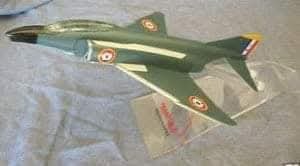
Hopefully not too OT ... MDD. F.4 Phantom for French Navy, display model in Aeronavale colours ... http://aviation.watergeek.eu/precise_models_inc.html
That model makes me wondering... what would an F-4(FN) look like loaded?
The RAF had no problem with skyflash on the OTS F-4Js they acquired after Falklands.

But if the french go with R530, it would not fit the sparrow bays. The wings are maybe too large for semi-recess anyway. So wing inboard, and adapt the outboard pylon for sidewinders?

Sparrow bays an option for the much narrower span 530F/D?
 
That model makes me wondering... what would an F-4(FN) look like loaded?
The RAF had no problem with skyflash on the OTS F-4Js they acquired after Falklands.

But if the french go with R530, it would not fit the sparrow bays. The wings are maybe too large for semi-recess anyway. So wing inboard, and adapt the outboard pylon for sidewinders?

Sparrow bays an option for the much narrower span 530F/D?
It'd probably be possible to replace the Sparrow conformal spots with wider circles for the stupid-fat R530... 264mm?!? 10.5" plus huge wings/fins.

If not, you'd be looking at an R530 on each inboard wing pylon and Sidewinders on the shoulders like normal, fuel tanks on the outboard pylons. 2x SARH and 4x IR, instead of 4+4 like US or UK Phantoms.

Obviously the US would prefer to also sell a pile of Sparrow missiles.
 
Mirage F1s carried their R530s underwing.

640px-Two_French_air_force_Dassault_Mirage_F1C_aircraft.jpg


I would say that the Phantom conformal spots may be used by Magic 1s.

My take would be: two R-530s underwing, two Magic 1s in the front conformal spots. That 4 AAMs.
 
The R550 Magic is a direct swap for the Sidewinder, so that's a no brainer for an F4K(FN).

I imagine the R530 is not worth the effort of integrating with the Phantom, as it would involve changes to both the missile and aircraft for a weapon that is likely worse than the Sparrow.
 
It'd probably be possible to replace the Sparrow conformal spots with wider circles for the stupid-fat R530... 264mm?!? 10.5" plus huge wings/fins.

If not, you'd be looking at an R530 on each inboard wing pylon and Sidewinders on the shoulders like normal, fuel tanks on the outboard pylons. 2x SARH and 4x IR, instead of 4+4 like US or UK Phantoms.

Obviously the US would prefer to also sell a pile of Sparrow missiles.
Which station would the "shoulders" be? We'd have the 4 sparrow bays and the centerline left, I think?

External tanks probably only empty for refueling, we'd be seriously weight constrained an a Clem...
 
I imagine the R530 is not worth the effort of integrating with the Phantom, as it would involve changes to both the missile and aircraft for a weapon that is likely worse than the Sparrow.
Sorry but it doesn't work that way. R.530 was no worse than any Sparrow before the AIM-7F for F-15 : that is the AIM-7B to AIM-7E variants used with very mixed results in Vietnam.
Also, while France did bought AIM-9B before the Magic 1 was available (for the Crusaders and Mirage IIIC too) once it was there, no more Sidewinders.
Bottom line: France won't buy Sparrows with R.530 in existence, because medium range AAM is seen as a strategic capability MATRA is developing. Same story for IR short range AAM, Magic is here to stay.
It should be noted that the Crusader was modified for R530 in its two variants: the SARH and the IR guidance systems. No reason a Phantom wouldn't be similar.
 
AAMs got their big breakthrough only a month appart in spring 1982 : AIM-9L Sidewinder over the Falklands, AIM-7F Sparrow over the Bekaa a months later. There are moment like this in history of technology, were a stagnant field suddenly success.
 
Sorry but it doesn't work that way. R.530 was no worse than any Sparrow before the AIM-7F for F-15 : that is the AIM-7B to AIM-7E variants used with very mixed results in Vietnam.
Also, while France did bought AIM-9B before the Magic 1 was available (for the Crusaders and Mirage IIIC too) once it was there, no more Sidewinders.
Bottom line: France won't buy Sparrows with R.530 in existence, because medium range AAM is seen as a strategic capability MATRA is developing. Same story for IR short range AAM, Magic is here to stay.
It should be noted that the Crusader was modified for R530 in its two variants: the SARH and the IR guidance systems. No reason a Phantom wouldn't be similar.

Leaving aside questions about capability the R530 had a diameter 60mm greater than the Aim7, about 40cm shorter and totally incompatible aerodynamic surfaces so won't fit into the Sparrow sized bays in the Phantoms fuselage.

Of course the French could carry R530s on wing pylons, but that will come at a big performance penalty compared to semi recessed Sparrows.
 
Which station would the "shoulders" be? We'd have the 4 sparrow bays and the centerline left, I think?
Not sure about the station numbers, but I mean the Sidewinder pylons on the sides of the inboard wing pylons.


External tanks probably only empty for refueling, we'd be seriously weight constrained an a Clem...
Yes, that'd be a huge problem.


Leaving aside questions about capability the R530 had a diameter 60mm greater than the Aim7, about 40cm shorter and totally incompatible aerodynamic surfaces so won't fit into the Sparrow sized bays in the Phantoms fuselage.
Depending on what's behind the conformal stations, it may be possible to replace the 7" arcs with 10.5" arcs to carry 530s.
 
Of course the French could carry R530s on wing pylons, but that will come at a big performance penalty compared to semi recessed Sparrows.

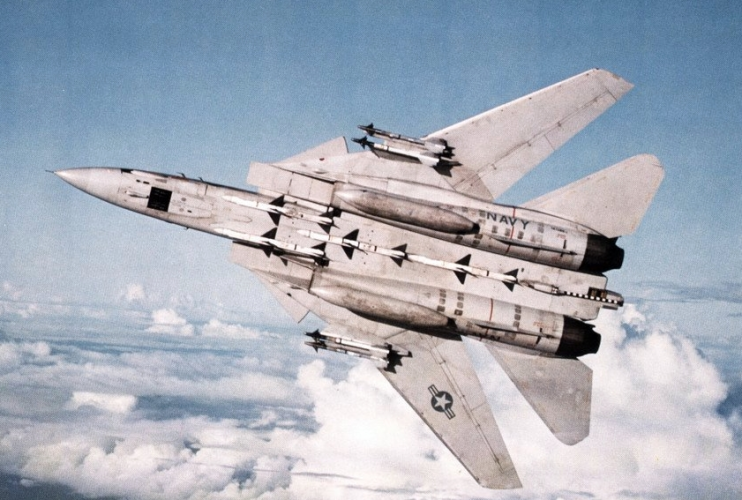
Which begets the question, how effective was that? It was not repeated on the F-14 and F-18. Even the F-111B would have had two Phoenix in the weapons bay and 4 on pylons.
The shape of the R-530 is not so far off the Phoenix, so at least at the two forward sparrow bays, an arrangement like the F-14 for the Phoenix might be possible? https://commons.wikimedia.org/wiki/Category:AIM-54_Phoenix#/media/File:AIM-54_6_Pack.jpg
 
I remember triple underwing pylons with one Sparrow below and a pair of Sidewinders on the sides. It should be feasible to do similar pylons with one R.530 and two Magic-1, total six missiles.
The belly recesses are trickier. I agree R-530 won't fit, that's why I would suggest Magic-1 there, at least on the front recesses. The rear ones, I don't know - moar Magic-1 ?
Total : 8 Magic-1, two R-530. Quite the missile truck, albeit less medium range SARH AAMs for sure.
 
Which begets the question, how effective was that? It was not repeated on the F-14 and F-18.

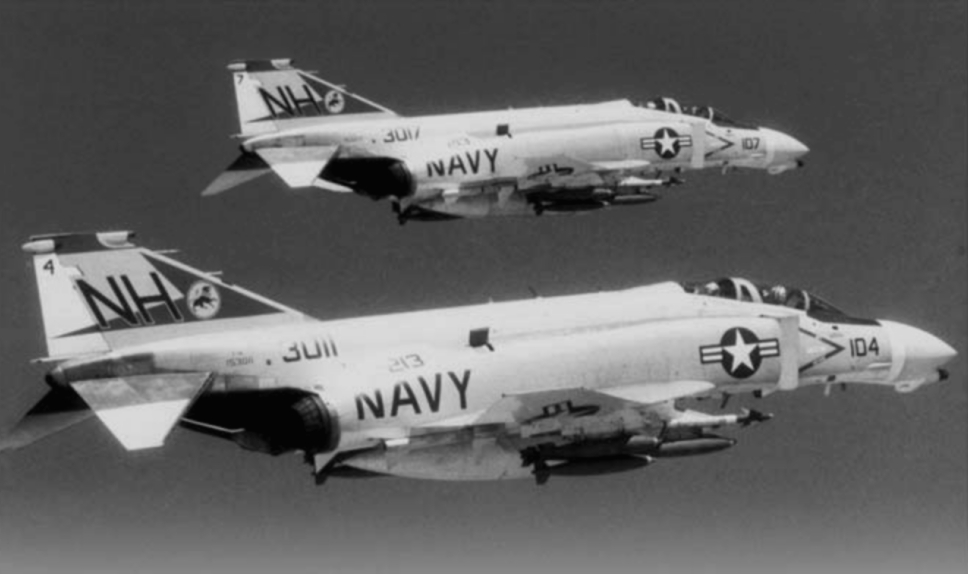
Pylon drag works out to be about the same as the drag of the store on the pylon, making any method of carrying a missile without having a pylon about 50% better from a drag perspective. I don't know the numbers, but about half the fuel in an external drop tank is used to push it through the air, so this drag is no joke. The F14 had semi-recessed sparrow carriage on the fuselage while the F15 and F18 used conformal carriage on the 'corners' of the fuselage to eliminate pylon drag for their sparrows. I suspect wingtip sidewinder carriage is also a means of drag reduction, as the rail is attached directly to the wing.
 

Attachments

  • 1757362588661.png
    1757362588661.png
    839 KB · Views: 25
62348471dccb6e0b79149a8324b13a80e12aeb34.jpeg
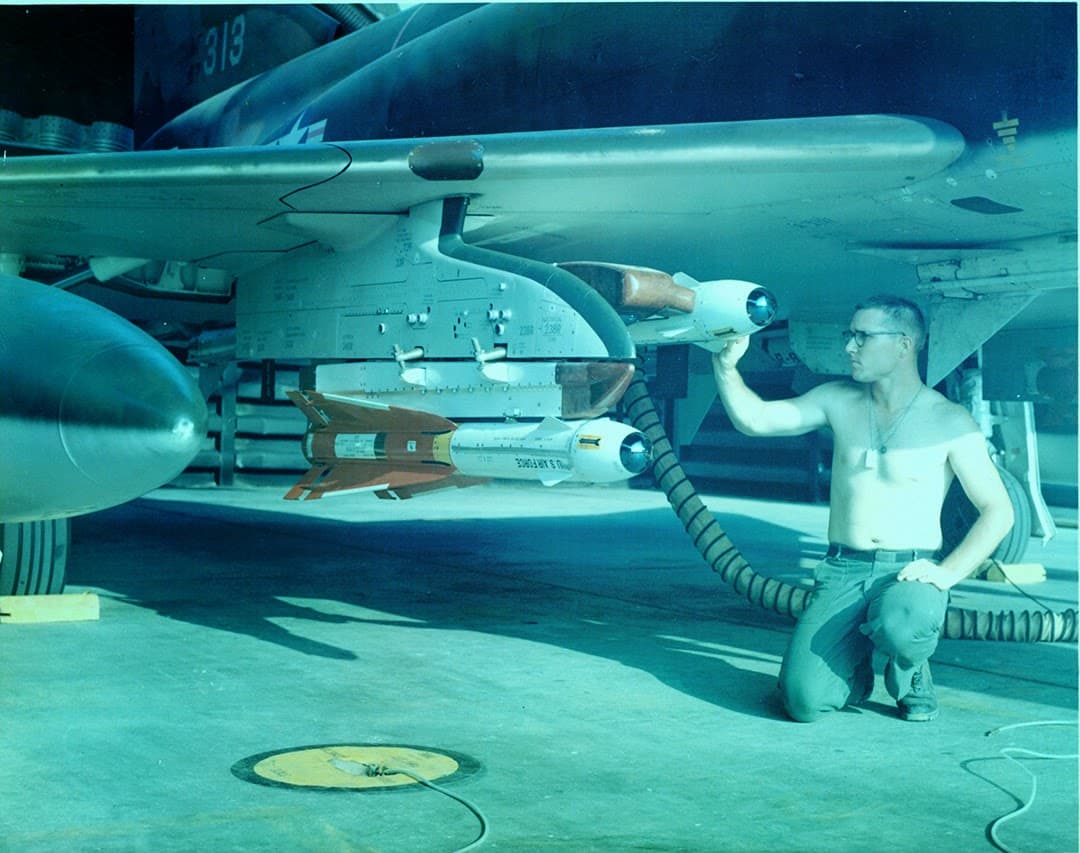
Also worth considering the AIM-4 Falcon load outs on USAF Phantoms, with 1x missile under the inboard pylon and 1x on the shoulder of the same pylon.

So that would allow 2x R530 + 2x Magic. Which would probably be fine for most missions, along with a centerline tank. (And anymore would likely run into catapult and landing weight limitations on the Clemenceaus anyway) Not ideal from a drag perspective of course, but the F-4 had plenty of power.
 
Something I thought of if the French have to use the wing plyons for R530s.

Some Phantoms carried Pave Spike or ECM pods in a stub pylon mounted in the forward Sparrow recess. Perhaps a stub pylon could be fitted with a launcher rail for R550 Magics, the front pair at least. Therefore the F4K(FN) could carry a centreline tank, 4 x R530s on the wings and 2 x R550s in the front Sparrow recesses.

1757389939565.png
 
Something I thought of if the French have to use the wing plyons for R530s.

Some Phantoms carried Pave Spike or ECM pods in a stub pylon mounted in the forward Sparrow recess. Perhaps a stub pylon could be fitted with a launcher rail for R550 Magics, the front pair at least. Therefore the F4K(FN) could carry a centreline tank, 4 x R530s on the wings and 2 x R550s in the front Sparrow recesses.

View attachment 784058
I thought that the Pave Spike and the ECM pods had a 7" diameter section to fit the conformal rails.
 
So that would allow 2x R530 + 2x Magic. Which would probably be fine for most missions, along with a centerline tank. (And anymore would likely run into catapult and landing weight limitations on the Clemenceaus anyway) Not ideal from a drag perspective of course, but the F-4 had plenty of power.

F-4B: missiles + internal fuel about 44k lbs, 48k+ with droptank.
F-4J: about 46k/50k.
Maybe some weight reduction possible, and might stretch the weight limit towards 50k lbs, but that's about it.
 
Pylon drag works out to be about the same as the drag of the store on the pylon, making any method of carrying a missile without having a pylon about 50% better from a drag perspective. I don't know the numbers, but about half the fuel in an external drop tank is used to push it through the air, so this drag is no joke. The F14 had semi-recessed sparrow carriage on the fuselage while the F15 and F18 used conformal carriage on the 'corners' of the fuselage to eliminate pylon drag for their sparrows. I suspect wingtip sidewinder carriage is also a means of drag reduction, as the rail is attached directly to the wing.

I hope it's ok to "quote" this, via https://www.britmodeller.com/forums...8-question-royal-navy-fg-1-phantoms-loadouts/

1757407385011.png

Now if I understand this correctly:
Sparrow in bay: 1.3
Sidewinder (or sp) on pylon 2.8+1.3=4.1
2 Sidewinder on pylon 3.2+1.3+1.3=5.8
1 Sidewinder +1Sp on pylon (if possible) 3.2+1.3+1.3=5.8

For 2 sparrow + 2 sidewinders we have the options:

SP+SW on individual pylon 4.1x4=16.4
SP in bays 1.3+1.3, 1SW on 1 pylon 4.1+4.1 = 10.8
SP in bays 1.3+1.3, 2 SW on 1 pylon 5.8 = 8.4
1SP+1SW on 1 pylon 5.8+5.8 = 11.6
SP on individual pylon 4.1+4.1, 2sw on 1 pylon 5.8=14
 
Back
Top Bottom