Do you have anything from the time of X-ROD? Because, from what I know, at that time, that wasn't possible.No, this is wrong. Radomes can provide ballistic protection.

You are using an out of date browser. It may not display this or other websites correctly.
You should upgrade or use an alternative browser.
You should upgrade or use an alternative browser.
M1 Abrams MBT Replacement
Scott Kenny
ACCESS: USAP
- Joined
- 15 May 2023
- Messages
- 19,651
- Reaction score
- 28,129
Those were only small arms and shell splinters, though.No, this is wrong. Radomes can provide ballistic protection. Ballistically protected MMW radomes for use on armoured vehicles was part of the development of the FCS manned ground vehicles MFRF, multifunctional radio frequency, Ka-band radar/communication system.
Firefinder
ACCESS: Top Secret
- Joined
- 5 October 2019
- Messages
- 1,261
- Reaction score
- 2,387
Generally speaking that all you need for APS sensors.Those were only small arms and shell splinters, though.
Cause well...
If you are eating dedicated anti armor stuff the APS is running, shit gone hot, and you are shotting as well.

Void
ACCESS: Confidential
- Joined
- 1 March 2008
- Messages
- 144
- Reaction score
- 81
This is true but compared to optics which have no protection except small size and luck a ballistic radome is a step up in protection.Those were only small arms and shell splinters, though.
Optics do have protection, though, well, at least the actual camera does.This is true but compared to optics which have no protection except small size and luck a ballistic radome is a step up in protection.

shin_getter
ACCESS: Top Secret
- Joined
- 1 June 2019
- Messages
- 1,491
- Reaction score
- 2,192
There is a implicit valuation of vehicles here. If the tank we are talking is a bolo that can facetank nuclear weapons and shoot up spaceships outside of luna orbit, billions of dollars is nothing.The addition of mmW radar to tanks for APS and as complementary sensor to IIR will likely drive up the costs even further - MBTs risk becoming too expensive.
It doesn't help to calculate that a tank with it will be so and so much more effective ceteris paribus. In the end, the rise in the costs of current tanks (even a plain IFV like Puma is at € 7 million drive away costs, 10+ if you add the periphery) may make them unaffordable in the necessary quantities.
It is more like, even if you added a lot of expensive stuff to current tanks, it still can't reliably perform after a 155mm salvo on its location, deal with minefields, cross a whole host of terrain, project firepower beyond a few kilometers within line of sight, move faster than other land vehicles, and generally do more than the job of a classical tank.
-------------------
Back before the electronics age, the tank gun have a great combination of precision, lethality, range and rate of fire to destroy the opposition at high rates. Since the electronics age, guided projectiles are superior at everything except ammo cost/ weight/volume and minimum range/reaction time. High velocity direct fire guns are just relatively less important.
With the reducing relative importance of the gun, tank design logic is circular. The tank needs to be protected because it is expensive. The tank is expensive because it has a lot of protection systems on it. (but the cost of gun and ammo? that is tech mass produced in hundreds of thousands decades ago)
It makes sense to spend resources to protect expensive, mission critical systems for the combat formation. The MBT isn't it, while improving defenses for things like air defense actually make sense since it is expensive and critical for a formation to survive without being bombed to death by cheap drones.
---------------
I guess when it comes to the tank, there are two lines of thinking.
One is thinking that the purpose of warfare is to destroy the opponent, and moving closer is valuable if it supports the goal but is otherwise not needed.
The other line of thinking appears to be that the purpose of offensive land warfare is to move forward without getting destroyed. However even in this context it is not clear that increasing protection is better than increasing in numbers. People complain about attrition of tank crews, however UGVs work, and if you need spectrum mastery to run mmW radar to survive, you can probably figure out the bandwidth for a tele-tank. Even in the minimal case, tank crews are still much more survivable than infantry even with a shitbox. It does appear that directional antennas like starlink (oh, $400 on boxing day~) are hard to jam in practice even off the shelf, and that is without utilizing the kind of energy and mass that a large vehicle could have, or a network whose relay distance is closer than low earth orbit.
Scott Kenny
ACCESS: USAP
- Joined
- 15 May 2023
- Messages
- 19,651
- Reaction score
- 28,129
The tank is important and in fact mission critical because it is an off road capable big gun, to destroy opposing strongpoints and enemy units.Back before the electronics age, the tank gun have a great combination of precision, lethality, range and rate of fire to destroy the opposition at high rates. Since the electronics age, guided projectiles are superior at everything except ammo cost/ weight/volume and minimum range/reaction time. High velocity direct fire guns are just relatively less important.
With the reducing relative importance of the gun, tank design logic is circular. The tank needs to be protected because it is expensive. The tank is expensive because it has a lot of protection systems on it. (but the cost of gun and ammo? that is tech mass produced in hundreds of thousands decades ago)
It makes sense to spend resources to protect expensive, mission critical systems for the combat formation. The MBT isn't it, while improving defenses for things like air defense actually make sense since it is expensive and critical for a formation to survive without being bombed to death by cheap drones.
Being an off-road capable big gun, it needs to be protected from the artillery, missiles, drones, and tank guns that would destroy it.
Yes, modern air defense systems need to be more mobile and better protected. (Oh, how I wish we had Hammer's Slammers tech)
Thing is even with that drones have shown to be much more useful in taking out strongpoints. generally faster on target and harder counter.The tank is important and in fact mission critical because it is an off road capable big gun, to destroy opposing strongpoints and enemy units.
Being an off-road capable big gun, it needs to be protected from the artillery, missiles, drones, and tank guns that would destroy it.
Yes, modern air defense systems need to be more mobile and better protected. (Oh, how I wish we had Hammer's Slammers tech)
shin_getter
ACCESS: Top Secret
- Joined
- 1 June 2019
- Messages
- 1,491
- Reaction score
- 2,192
Lots of things within combined arms formation is mission critical, yet only the MBT gets 25%+ mass allocated to protection. Consider the infantry, consider the engineering vehicles, consider the air defense, consider the electronics warfare, and so on~
Though in ww2, a single heavy tank with frontal armor immunity on a hill can stall out large formations for hours as there was no good way to attack such a threat and a single tank can inflict unacceptable damage if one just rush it. This is unlike today where there are lots of options and hull down tank on a hill is generally followed by brew up and a lot of allah akba~
Though in ww2, a single heavy tank with frontal armor immunity on a hill can stall out large formations for hours as there was no good way to attack such a threat and a single tank can inflict unacceptable damage if one just rush it. This is unlike today where there are lots of options and hull down tank on a hill is generally followed by brew up and a lot of allah akba~

Big_Zukini
ACCESS: Top Secret
- Joined
- 23 November 2024
- Messages
- 911
- Reaction score
- 1,747
APCs should definitely be at least equally armored if not more. This is a lesson most armies have yet to learn.Lots of things within combined arms formation is mission critical, yet only the MBT gets 25%+ mass allocated to protection. Consider the infantry, consider the engineering vehicles, consider the air defense, consider the electronics warfare, and so on~
Though in ww2, a single heavy tank with frontal armor immunity on a hill can stall out large formations for hours as there was no good way to attack such a threat and a single tank can inflict unacceptable damage if one just rush it. This is unlike today where there are lots of options and hull down tank on a hill is generally followed by brew up and a lot of allah akba~

Kat Tsun
eeeeeeeeeeeeeee
- Joined
- 16 June 2013
- Messages
- 1,887
- Reaction score
- 2,669
Those were only small arms and shell splinters, though.
These are the main threats to APS radars in particular, though.
Splinter and fragments from destroyed grenades will tend to knock out an APS system after 2-3 defeated rounds for that axis/sector (maybe this was a Drummond tweet IDR), due to damage to the radar, to exposed wires, to launchers, etc. Hardening an APS's largest exposed areas (the radar face and launchers) against splinter is immensely valuable.
https://apps.dtic.mil/sti/tr/pdf/ADP023077.pdf
Big_Zukini
ACCESS: Top Secret
- Joined
- 23 November 2024
- Messages
- 911
- Reaction score
- 1,747
Jon Hawkes, not Drummond.These are the main threats to APS radars in particular, though.
Splinter and fragments from destroyed grenades will tend to knock out an APS system after 2-3 defeated rounds for that axis/sector (maybe this was a Drummond tweet IDR), due to damage to the radar, to exposed wires, to launchers, etc. Hardening an APS's largest exposed areas (the radar face and launchers) against splinter is immensely valuable.
https://apps.dtic.mil/sti/tr/pdf/ADP023077.pdf
By the way, the Trophy mechanism for defending munitions is a fast shutter that drops down right before intercept.
A similar system could be made to protect the sensor module, but the form factor probably does not permit that on vehicles not designed from the ground up to fit APS.
Is it ok to post combat footage here?

16_incher
Something might happen
- Joined
- 19 July 2025
- Messages
- 60
- Reaction score
- 224
View: https://x.com/usarmyfast/status/2008577120474419225?s=46
Not sure how real this is but it looks legitimate.
Not sure how real this is but it looks legitimate.

Doesn't really show much to be able to make any sort of commentsView: https://x.com/usarmyfast/status/2008577120474419225?s=46
Not sure how real this is but it looks legitimate.
SlothmanAllen
ACCESS: Confidential
- Joined
- 3 January 2025
- Messages
- 80
- Reaction score
- 192
The turret looks smaller, but maybe that could just be the angle. I don’t see any optics mounted atop the turret, but maybe they are retractable to fit inside the turret? I also don’t see any APS radar on the turret, but maybe it is just the limited field of view? Those are kind of the things I was expecting to be able to see, but these pictures don’t really show much.
The hull looks very different from a traditional Abrams and even the AbramsX. Usually there are two crew openings on the front underneath the main gun.
The hull looks very different from a traditional Abrams and even the AbramsX. Usually there are two crew openings on the front underneath the main gun.
Big_Zukini
ACCESS: Top Secret
- Joined
- 23 November 2024
- Messages
- 911
- Reaction score
- 1,747
It's pre-prototype so of course you won't see any of these. I can see a sight mount, and it seems like an existing stripped down Abrams they modified to test something very specific.The turret looks smaller, but maybe that could just be the angle. I don’t see any optics mounted atop the turret, but maybe they are retractable to fit inside the turret? I also don’t see any APS radar on the turret, but maybe it is just the limited field of view? Those are kind of the things I was expecting to be able to see, but these pictures don’t really show much.
The hull looks very different from a traditional Abrams and even the AbramsX. Usually there are two crew openings on the front underneath the main gun.
At this point I'm guessing there are mainly changes to the hull because the next gen mostly differs from the last in the crew arrangement, and how to mix that arrangement with an increasingly hybridized powerpack.
Fuel tanks around the driver, for example, are probably removed.
First stuff I'm guessing they'll want to add is all sorts of cameras, LiDAR, obstacle sensing radars and such, weapon system mockups, datalinks and BMS, and how the crew can fulfill a mock mission.

Forest Green
ACCESS: USAP
- Joined
- 11 June 2019
- Messages
- 14,581
- Reaction score
- 31,688
Our First Glimpse At The M1E3 Abrams Next-Gen Tank Demonstrator
https://www.twz.com/land/our-first-glimpse-at-the-m1e3-abrams-next-gen-tank-demonstratorReplacement or development?
https://www.secretprojects.co.uk/threads/m1-abrams-developments-and-news.39703/page-7
Some quick analysis, noting however that two small, partial photos don't really give much to work with so this may all prove to be miles off.
First up a quick image comparison between one of the photos, one of the Abrams X demonstrator and one of a normal M1A2 SEPv3, to help the analysis:

Starting with the turret:
First up a quick image comparison between one of the photos, one of the Abrams X demonstrator and one of a normal M1A2 SEPv3, to help the analysis:
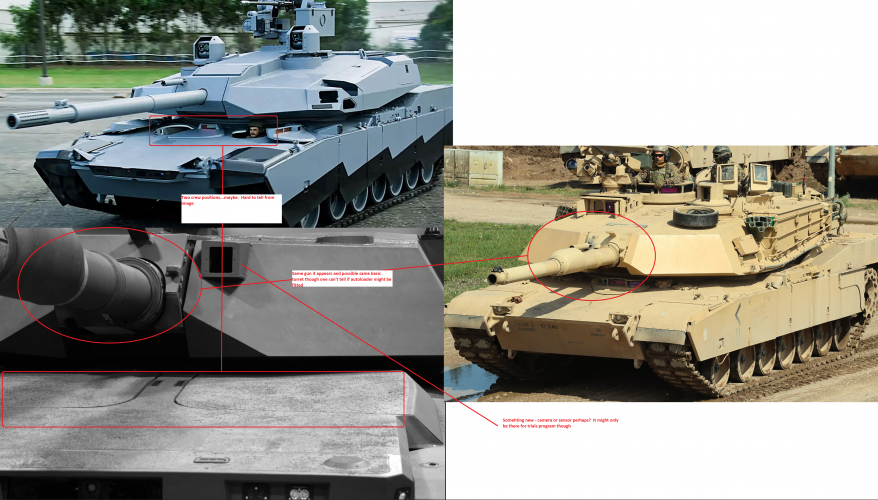
Starting with the turret:
- The turret on the newly released images of the supposed M1E3 looks to be largely the same as the existing M1A2 SEPv3 and not that from the Abrams X.
- There is obviously a sensor/camera or similar on the front which is new, but this might not be a permanent fit but perhaps something related to tests
- The gun appears to still be the standard 120mm M256
- That all said, the turret might still be different inside and could be unmanned/optionally manned and could even have an autoloader. We just can't tell.
- The biggest change appears to be with the hull and it might even be a completely new hull - again though we can't tell for sure
- It certainly does appear to have built in driving lights which is more in line with the Abrams X than the existing M1A2 SEPv3
- Hard to tell re the "hatches". Obviously all M1 Abrams to date have only had a single hatch for the driver. The Abrams X did show two hatches though and perhaps this is what we are seeing on the new photo. That said, they don't show any obvious hinge or similar aspects - perhaps they slide? It could also be that we are looking at the rear of the tank though with the turret turned.

- Joined
- 16 April 2008
- Messages
- 10,600
- Reaction score
- 18,169
Definitely not much to go on, but I think it's fairly clear that we're looking at the hull front here, given the driving lights and general shape of things. With the turret reversed on an M1A2 you can't really see the bottom of the mantlet, for example.
I think there are two side-pivoting crew hatches in the deck (they might go up and then swing over), with the driver's direct-view optics replaced by some form of synthetic vision system. This suggests they have moved at least one crew station down into the hull. And maybe the gunner down below the turret ring in the turret.
The camera next to the main gun is welded on, so I suspect it's permanent, maybe part of a 360° synthetic vision system for situational awareness.
I think there are two side-pivoting crew hatches in the deck (they might go up and then swing over), with the driver's direct-view optics replaced by some form of synthetic vision system. This suggests they have moved at least one crew station down into the hull. And maybe the gunner down below the turret ring in the turret.
The camera next to the main gun is welded on, so I suspect it's permanent, maybe part of a 360° synthetic vision system for situational awareness.
Last edited:
Just reading back through this since I'm very late to the party, but X-ROD is millimeter wave radar homing, isn't it?command guided projectile
From The Chietain:
Ok. Some initial observations. Obviously lots of media will be coming through over the next two days, with their own topics and thoughts. My own video will come soon.
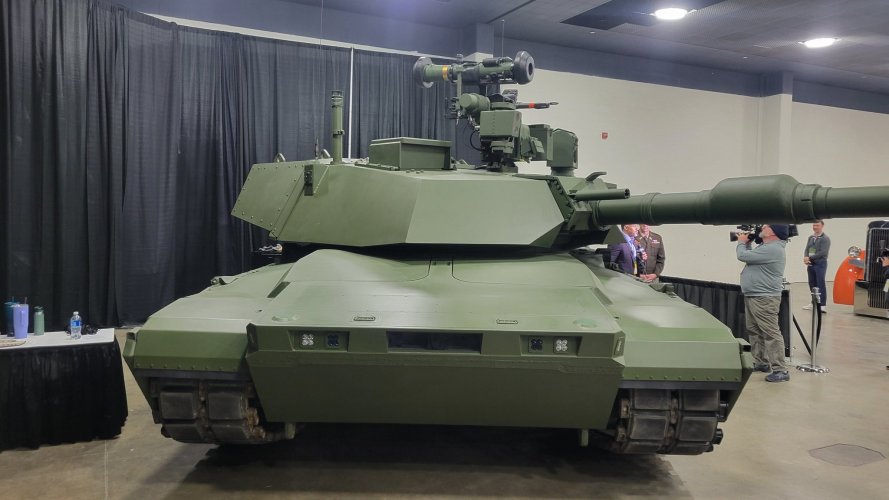
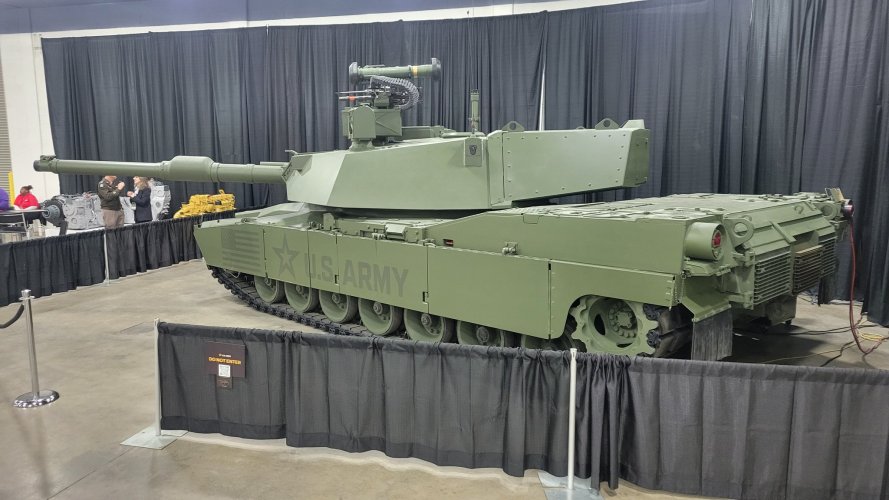
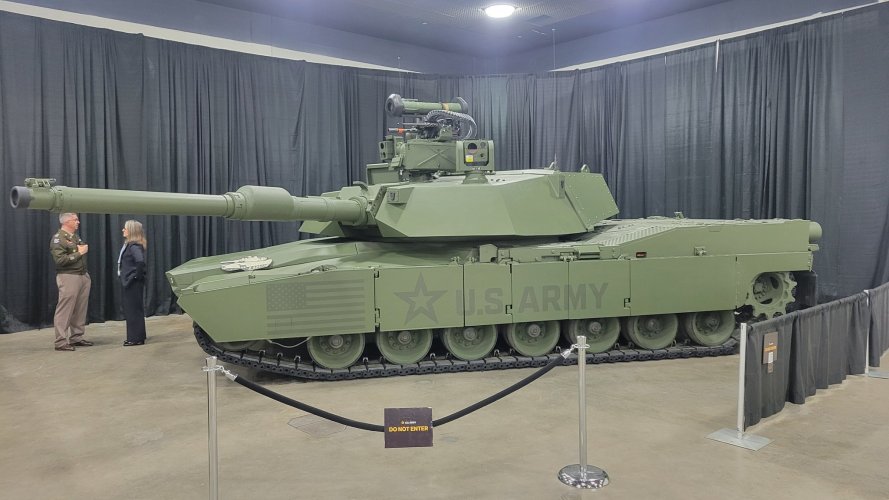
1) Don't get hung up about anything above the hull roof. In fact, don't get hung up about everything below the hull roof either. As suspected, this is a test vehicle which is focused on crew operation. They just needed something to do the turret job, which is why they grabbed an A1 turret and modified it to fit the needs of the crew test program (including autoloader). A bespoke turret is being made with everything incorporated from the beginning instead of added on like the current tank, but that gets integrated after they know for sure what they need from testing. This vehicle has the turbine engine, other test vehicles are running the automotive trials on the Cat. Eventually everything will be put together, but that time is not now.
2) As the RWS is above the hull roof, again, don't get hung up on it. They needed an RWS for testing, that's the one they grabbed. When they brought it to the show, the RWS had an empty rack, it could carry a Javelin, so they put a Javelin on it. The purpose is not to show that the thing can carry or is intended to carry a Javelin specifically, nobody here thinks there is any merit to using space/height/weight for things which things which don't have to be on the tank for the tank to do tank things. They have been very focused on the design on the tank's requirements as a tank. Instead the purpose was to demonstrate "the RWS will be modular and able to be reconfigured as required". For similar reasons, don't get too caught up on the Mk19, secondary armament mix and location has not been finalized. RWS'll shoot down drones though.
3) Power capacity for a coffee maker (110v plug socket) has been provided. (It actually has other uses officially, but you know someone will hook up a Keurig)
4) Confirmed 3 man crew. In theory they expect a hatch up top for admin moves, maintenance access etc, (this vehicle does have one) and a cramped manual backup position if things get desperate.
5) Tank can shoot and move with one crewman. It's not ideal, but it'll work. Again, I can't overstate how important the software you can't see is. Fully configurable crew stations, combat assistance and upgradeability is inherent. When it comes time to let the tank do everything on its own, there will be an app for that.
6) No more broken torsion bars.
7) Whilst I understand why it's a static and closed display, it is, granted, a bit underwhelming to look at in photographs. The interesting stuff is under the hood and the tank on display is a great talking point for the folks here who are very excited about the end design, we could have talked for hours. The engineers will geek out more than the tank nerds, this really is a massive step in capability. The promise this vehicle shows to keep M1's position as "apex predator on the battlefield" is definite, even if those who want to see the final, low profile, 60 ton vehicle right now are disappointed. It takes time to brew perfection.

Ok. Some initial observations. Obviously lots of media will be coming through over the next two days, with their own topics and thoughts. My own video will come soon.
1) Don't get hung up about anything above the hull roof. In fact, don't get hung up about everything below the hull roof either. As suspected, this is a test vehicle which is focused on crew operation. They just needed something to do the turret job, which is why they grabbed an A1 turret and modified it to fit the needs of the crew test program (including autoloader). A bespoke turret is being made with everything incorporated from the beginning instead of added on like the current tank, but that gets integrated after they know for sure what they need from testing. This vehicle has the turbine engine, other test vehicles are running the automotive trials on the Cat. Eventually everything will be put together, but that time is not now.
2) As the RWS is above the hull roof, again, don't get hung up on it. They needed an RWS for testing, that's the one they grabbed. When they brought it to the show, the RWS had an empty rack, it could carry a Javelin, so they put a Javelin on it. The purpose is not to show that the thing can carry or is intended to carry a Javelin specifically, nobody here thinks there is any merit to using space/height/weight for things which things which don't have to be on the tank for the tank to do tank things. They have been very focused on the design on the tank's requirements as a tank. Instead the purpose was to demonstrate "the RWS will be modular and able to be reconfigured as required". For similar reasons, don't get too caught up on the Mk19, secondary armament mix and location has not been finalized. RWS'll shoot down drones though.
3) Power capacity for a coffee maker (110v plug socket) has been provided. (It actually has other uses officially, but you know someone will hook up a Keurig)
4) Confirmed 3 man crew. In theory they expect a hatch up top for admin moves, maintenance access etc, (this vehicle does have one) and a cramped manual backup position if things get desperate.
5) Tank can shoot and move with one crewman. It's not ideal, but it'll work. Again, I can't overstate how important the software you can't see is. Fully configurable crew stations, combat assistance and upgradeability is inherent. When it comes time to let the tank do everything on its own, there will be an app for that.
6) No more broken torsion bars.
7) Whilst I understand why it's a static and closed display, it is, granted, a bit underwhelming to look at in photographs. The interesting stuff is under the hood and the tank on display is a great talking point for the folks here who are very excited about the end design, we could have talked for hours. The engineers will geek out more than the tank nerds, this really is a massive step in capability. The promise this vehicle shows to keep M1's position as "apex predator on the battlefield" is definite, even if those who want to see the final, low profile, 60 ton vehicle right now are disappointed. It takes time to brew perfection.
16_incher
Something might happen
- Joined
- 19 July 2025
- Messages
- 60
- Reaction score
- 224

Big_Zukini
ACCESS: Top Secret
- Joined
- 23 November 2024
- Messages
- 911
- Reaction score
- 1,747
It is very unlikely that cope cages will survive into the mid 2030's. On a modern AFV, if they don't just cover a small sector on the turret, they're detrimental to survivability.Wut no Cope Cage?
jsport
what do you know about surfing Major? you're from-
- Joined
- 27 July 2011
- Messages
- 8,627
- Reaction score
- 6,928
That this doesn't represent a final turret configuration hopefully highlights that a gun decision has not been made. A 120mm configuration represents little change and thus no need to conceal.
Scott Kenny
ACCESS: USAP
- Joined
- 15 May 2023
- Messages
- 19,651
- Reaction score
- 28,129
If they're putting all 3 crew down into the hull, could it be time for the CATTB with the 120mm autoloader? And 48 rounds ready? *evil grin*
Addressed in this:That this doesn't represent a final turret configuration hopefully highlights that a gun decision has not been made. A 120mm configuration represents little change and thus no need to conceal.
Ainen
I really should change my personal text
- Joined
- 25 August 2011
- Messages
- 2,861
- Reaction score
- 4,964
In interview with Chieftain they mentioned they hope CROWS(which in this case comes with radar) to cover it. Plus APS isn't there, on this prototype, yet.Wut no Cope Cage?
jsport
what do you know about surfing Major? you're from-
- Joined
- 27 July 2011
- Messages
- 8,627
- Reaction score
- 6,928
Yep, a "course correction M1". Nothing to do w a M1 replacement. New thread should be created as the E is not a replacement. FASTDRAW, S/W upgrade etc are long over due but really should not be considered as Decisive Lethalit Platform (DLP), a genuine M1 replacement.
Last edited:
Big_Zukini
ACCESS: Top Secret
- Joined
- 23 November 2024
- Messages
- 911
- Reaction score
- 1,747
Gun can be changed to 130mm or 140mm if needed but they're not seeing any requirement to switch from 120mm at the moment. And going even to 130mm is very expensive.That this doesn't represent a final turret configuration hopefully highlights that a gun decision has not been made. A 120mm configuration represents little change and thus no need to conceal.
They're changing a powerpack making it hybrid, turret is unmanned, whole crew sits at the front, and stations are reconfigurable.Yep, a "course correction M1". Nothing to do w a M1 replacement. New thread should be created as the E is not a replacement. FASTDRAW, S/W upgrade etc are long over due but really should not be considered as Decisive Lethalit Platform (DLP), a genuine M1 replacement.
Aside from the hull form, what's M1 about it that has to be changed?
Or do you care less about its function and more about how it looks or what it's named?
Since hull form is largely decided by powerpack, it's very likely it'll also change by mid 2030's.
jsport
what do you know about surfing Major? you're from-
- Joined
- 27 July 2011
- Messages
- 8,627
- Reaction score
- 6,928
IMHO the requirement for N/BLOS remains. All these proposed powered lng rng 120mm half missiles are still limited by the physical shell space limits of a 120mm round form factor,Gun can be changed to 130mm or 140mm if needed but they're not seeing any requirement to switch from 120mm at the moment. And going even to 130mm is very expensive.
They're changing a powerpack making it hybrid, turret is unmanned, whole crew sits at the front, and stations are reconfigurable.
Aside from the hull form, what's M1 about it that has to be changed?
Or do you care less about its function and more about how it looks or what it's named?
Since hull form is largely decided by powerpack, it's very likely it'll also change by mid 2030's.
As stated some time ago by an Army official, 'we're not sure if DLP will even replace the M1'. 'It may just augment it some way, or be a new capability between tank + SPH. We don't want to be pigeon holed into a one for one replacement any time soon'. That is another reason for a course correct on M1 rather than a genuine replacement.
Obviously this does raise the issue of engineering run wild as stated by the Army PM in the video. A comphrensive appraisal of what 2030s missions look like is required. ..have a feeling N/BLOS will be a major component.
Big_Zukini
ACCESS: Top Secret
- Joined
- 23 November 2024
- Messages
- 911
- Reaction score
- 1,747
Is there an official requirement for NLOS or is it your personal preference?IMHO the requirement for N/BLOS remains. All these proposed powered lng rng 120mm half missiles are still limited by the physical shell space limits of a 120mm round form factor,
Yeah but I think inferring NLOS capability from that is over-analyzing.As stated some time ago by an Army official, 'we're not sure if DLP will even replace the M1'. 'It may just augment it some way, or be a new capability between tank + SPH. We don't want to be pigeon holed into a one for one replacement any time soon'.
If a tank today is stand-in and you want it to fight whatever it sees, and you can make it so that it sees both LoS and NLOS in its vicinity with reasonable frequency, then you can make a case to let it shoot NLOS as well. But it shouldn't be a hard requirement.
A powerpack isn't really related to matters like LoS or NLOS. When they decide on a powerpack they'll decide on a hull design.That is another reason for a course correct on M1 rather than a genuine replacement.
Obviously this does raise the issue of engineering run wild as stated by the Army PM in the video. A comphrensive appraisal of what 2030s missions look like is required. ..have a feeling N/BLOS will be a major component.
If you want to incorporate a lot of NLOS just stick those requirements into an artillery project and let the M109 replacement do NLOS.
Or if you want DLP or M1A3 to do purely NLOS then let the M109 replacement do only LoS.
Even in the next gen, a guiding principle is that if you don't have to put it on a tank, don't put it. Better to split the tank's role into multiple vehicles.
jsport
what do you know about surfing Major? you're from-
- Joined
- 27 July 2011
- Messages
- 8,627
- Reaction score
- 6,928
Not keen on arguing for arguments sake, but for example the pervasive need to counter drone launcher sites given the amount of isr data available on the new transparent battlefield would seem to naturally demand a means for even tanks to fire back at threats.Is there an official requirement for NLOS or is it your personal preference
Likewise the deeper one can effect would seem to define NLOS capabilities as obvious.
Contractors are pushing NLOS missiles & rds etc ex: switchblade 600 on a M1. Externally mounted ordinance is dangerous.
No it is obvious.Yeah but I think inferring NLOS capability from that is over-analyzing.
Thinking ur making the requirement argument yourself.If a tank today is stand-in and you want it to fight whatever it sees, and you can make it so that it sees both LoS and NLOS in its vicinity with reasonable frequency, then you can make a case to let it shoot NLOS as well. But it shouldn't be a hard requirement.
One would hope decision-making would not be based on powerpacks but capabilities.A powerpack isn't really related to matters like LoS or NLOS. When they decide on a powerpack they'll decide on a hull design.
Guns should not necessarily define hulls but turret design.
Thought we already discussed the USA may not want to be pinned to a M1 based DLP ie M1 replacement not just a M1 course correction.
The current conflict displays General Support and even Direct Support can not be reliability available in fluid ops & overly wide space ops.If you want to incorporate a lot of NLOS just stick those requirements into an artillery project and let the M109 replacement do NLOS.
This is especially true when the future is demanding maneuvering deep and exploiting as much as possible w deep fires.
As stated the DLP & M1 base requirements may well diverge. Artillery & tanks become the same vehicle. Many have postulated this combining before. Even an original FCS concept depicted such a fusion.Or if you want DLP or M1A3 to do purely NLOS then let the M109 replacement do only LoS.
Contractors want to sell differences in missions & vehicles contrary to mission & vehicle effectiveness.
Fewer vehicles accomplishing more missions and operating deeper as well as faster would seem to be best. Indirect fire vehicles,direct fire vehicles as well as Indirect + direct fire vehicles would seem to afford the most capabilities, Maximumizing cdrs options whilst multiplying adversary dilemmas is the game.Even in the next gen, a guiding principle is that if you don't have to put it on a tank, don't put it. Better to split the tank's role into multiple vehicles.
As drones have taken over the battlefield, APS effectiveness will become central for any vehicle to remain relevant at this point.
If drones can't be defeated then all current vehicles may yet become extinct.
Big_Zukini
ACCESS: Top Secret
- Joined
- 23 November 2024
- Messages
- 911
- Reaction score
- 1,747
I can see how you create a capability to counter LoS ATGM launchers. But I don't see how a tank can close the loop on a drone control station on its own, nor the reason for it to be its job.Not keen on arguing for arguments sake, but for example the pervasive need to counter drone launcher sites given the amount of isr data available on the new transparent battlefield would seem to naturally demand a means for even tanks to fire back at threats.
Likewise the deeper one can effect would seem to define NLOS capabilities as obvious.
Contractors are pushing NLOS missiles & rds etc ex: switchblade 600 on a M1. Externally mounted ordinance is dangerous.
If you want to shut down fire sources ASAP, this is something you'd want to leave to aviation. Combine with network disruptions, and a tank would probably only very rarely see an opportunity to fire at a drone control station.
Thinking ur missing the "if" condition in that sentence.Thinking ur making the requirement argument yourself.
Who in their right mind would commit to a maneuver with already a heavily disrupted logistical and fire support chain?The current conflict displays General Support and even Direct Support can not be reliability available in fluid ops & overly wide space ops.
This is especially true when the future is demanding maneuvering deep and exploiting as much as possible w deep fires.
The M142 is cool in Ukraine and all but I don't think now is a good time to kill the howitzer. And no army seems to think getting rid of howitzers is a good idea.As stated the DLP & M1 base requirements may well diverge. Artillery & tanks become the same vehicle. Many have postulated this combining before. Even an original FCS concept depicted such a fusion.
Contractors want to sell differences in missions & vehicles contrary to mission & vehicle effectiveness.
Unless you're talking about training a tank crew to be both artillery and tank, in which case that's probably gonna create a serious training bottleneck and lots of confusion.
Technically speaking, taking a 155mm rifled gun to a close range encounter isn't ideal nor does it fit well with requirements like protection and weight reduction.
Fewer vehicles but propose splitting 2 vehicles into 3?Fewer vehicles accomplishing more missions and operating deeper as well as faster would seem to be best. Indirect fire vehicles,direct fire vehicles as well as Indirect + direct fire vehicles would seem to afford the most capabilities, Maximumizing cdrs options whilst multiplying adversary dilemmas is the game.
If you're talking about something like the French concept, where an MBT and NLOS vehicle share the same hull and most of a turret, and one has a gun and another has a pack of ATGMs, then sure that could be something.
That's a bold statement that's not based on any current reality.As drones have taken over the battlefield, APS effectiveness will become central for any vehicle to remain relevant at this point.
If drones can't be defeated then all current vehicles may yet become extinct.
Ukrainian and Russian FPV drones are very manpower intensive - which goes counter to what most are trying to achieve by using drones, and struggling to achieve even a fraction of the effectiveness of what they're trying to substitute.
Last edited:
shin_getter
ACCESS: Top Secret
- Joined
- 1 June 2019
- Messages
- 1,491
- Reaction score
- 2,192
It depends on the culture and training of forces, and the nature of conflict.Who in their right mind would commit to a maneuver with already a heavily disrupted logistical and fire support chain?
If it were the (ww2) east front, formations suffering 70%+ losses often have to hold the line and in those formations the "combined arms" often is broken down with shortage in various kinds of assets. The war goes on because the opponent is often in a equally poor state.
It is also common for all kind of very disorganized, random fights to happen in the exploitation phase of combat. In fast tempo-d fights, slowing down to reorganize is giving the opponent time while keeping up the pressure means the opponent can be equally if not more disorganized. There were battles where tanks just drove at top speed through a gap in defenses and overrun the opponent rear while being cut off ( https://en.wikipedia.org/wiki/Raid_on_Tatsinskaya )
There was also many battles with things like very depleted spearheads need to block a breakout of fuel starved forces and forces driving behind each other resulting in both sides being out of supply and all kinds of coordination issues break up combined arms and so on. It can only be a easy fight if one can follow doctrine, in a near peer fight the opponent would try everything to make doctrine not actionable.
The desire for the universal tank as opposed to specialized vehicles also grew out of such experiences, as it simply takes too long to organize and allocate the right specialized vehicles for a task when its a fight for initiative.
-----
In practice though, the M1 is a heavy tank that don't have the operational tempo to confuse the enemy in a era of digital comms and minute-reaction time artillery fights, so it may simply not do maneuver warfare.
Modern tank fleets are tiny, while modern populations are still generally greater than the world war eras. Manpower isn't that big of an issue, and AI is just a budget issue.That's a bold statement that's not based on any current reality.
Ukrainian and Russian FPV drones are very manpower intensive - which goes counter to what most are trying to achieve by using drones, and struggling to achieve even a fraction of the effectiveness of what they're trying to substitute.
yeetmahboi
ACCESS: Top Secret
- Joined
- 6 April 2022
- Messages
- 1,025
- Reaction score
- 1,435
@jsport MBDA offers a powered 120mm NLOS round.
The biggest limitation on NLOS employment on tanks will be elevation limits. Insofar electronics can survive the pressure peaks on current HV tank guns, but existing mounts can't elevate enough to generate artillery level fires. Which leads to existing 120mm needing on board motors and cutting down range and payload performance.
A high elevation 120mm mount can use high velocity propellant to achieve extreme range. In these applications, guns are still better performing than rockets. Air breathing motors are still premature.
The biggest limitation on NLOS employment on tanks will be elevation limits. Insofar electronics can survive the pressure peaks on current HV tank guns, but existing mounts can't elevate enough to generate artillery level fires. Which leads to existing 120mm needing on board motors and cutting down range and payload performance.
A high elevation 120mm mount can use high velocity propellant to achieve extreme range. In these applications, guns are still better performing than rockets. Air breathing motors are still premature.
Scott Kenny
ACCESS: USAP
- Joined
- 15 May 2023
- Messages
- 19,651
- Reaction score
- 28,129
Not that you cannot get a pretty ludicrous range out of a 120mm set for HEAT with Sabot loaded...@jsport MBDA offers a powered 120mm NLOS round.
The biggest limitation on NLOS employment on tanks will be elevation limits. Insofar electronics can survive the pressure peaks on current HV tank guns, but existing mounts can't elevate enough to generate artillery level fires. Which leads to existing 120mm needing on board motors and cutting down range and payload performance.
A high elevation 120mm mount can use high velocity propellant to achieve extreme range. In these applications, guns are still better performing than rockets. Air breathing motors are still premature.
But IIRC the maximum elevation on the current Abrams is only +20deg.
Big_Zukini
ACCESS: Top Secret
- Joined
- 23 November 2024
- Messages
- 911
- Reaction score
- 1,747
If for a given capability you need more manpower than before, you become easier to disrupt.Modern tank fleets are tiny, while modern populations are still generally greater than the world war eras. Manpower isn't that big of an issue, and AI is just a budget issue.
Then that logic must be imposed not only on tanks but also on infantry, and artillery, and APCs, and anything that maneuvers and supports a maneuver.The desire for the universal tank as opposed to specialized vehicles also grew out of such experiences, as it simply takes too long to organize and allocate the right specialized vehicles for a task when its a fight for initiative.
-----
In practice though, the M1 is a heavy tank that don't have the operational tempo to confuse the enemy in a era of digital comms and minute-reaction time artillery fights, so it may simply not do maneuver warfare.
But if you do that, everything you have is a massive bloat that's no longer capable of doing its job.
Kat Tsun
eeeeeeeeeeeeeee
- Joined
- 16 June 2013
- Messages
- 1,887
- Reaction score
- 2,669
Not that you cannot get a pretty ludicrous range out of a 120mm set for HEAT with Sabot loaded...
But IIRC the maximum elevation on the current Abrams is only +20deg.
You would need a high elevation turret but people have already considered this.
Germany developed a double trunnion design for higher elevations (+30 degrees) on MBTs. I suspect in the long run the difference between howitzer and mortar will vanish and the difference between tank and field gun will vanish. There will just be high and low-medium velocity cannon platforms. Both will be equally capable of direct, or indirect, fire.
NLOS rounds would be extremely useful in Ukraine and likely contribute to tank survivability, since they presently cannot conduct mobile operations and act more as field guns anyway, with the caveat that they still want higher elevations. It's a natural role for the tank in a static war to be a protected artillery piece. Also, something the U.S. Army considered during the FCS era was dissimilar fire platforms providing indirect fires in AFATDS or its successor, using the NLOS MRMs and medium caliber cannons to provide plunging fire.
In "Proximity-Based Overmatching Fires From the Total Force" monograph, the authors mention a 9:1 advantage provided by directed NLOS fire from main battle tanks (or any other force composition) and that's probably true. They also mention the most important thing: getting inside the enemy's decision loop and acting before he can.
This isn't practical with mechanized forces, on a highly transparent battlefield like Ukraine, and eventually the Grey Zone will encompass the entire battlefield outside of highly defended FOBs with HPM generators or deep magazines of interceptors and anti-drone netting or something. That's a very real threat going into the next decade and who knows how bad it will look like the 2040s when the PRC and US both have persistent overhead real-time orbital views of the planet.
That's something the M1A3 will need to think about, and it's something KNDS is already thinking about, given their high angle gun mount. Not a stretch to imagine that, if the M1E3 ever gets a finished turret, it might have some considerations for the use of indirect fire. But most NATO militaries are still trying to take in the lessons of 2023-2024 and it's already changed several times over in Ukraine. Sadly, bureaucracies cannot learn quickly, so the lessons of the mechanized phase of Ukraine (2022-late 2023) are likely to be only partially absorbed.
jsport
what do you know about surfing Major? you're from-
- Joined
- 27 July 2011
- Messages
- 8,627
- Reaction score
- 6,928
Given what we r seeing on the Euro front, if the tank can't counter drone launcher/ control sites it will be hit and eventually destroyed minus very good APS. Ranges for tanks being hit are approaching beyond 20km. Tanks defense capabilities must now reach these distances or one is fighting the "last war".I can see how you create a capability to counter LoS ATGM launchers. But I don't see how a tank can close the loop on a drone control station on its own, nor the reason for it to be its job.
On the distributed battlefield the tank/IFV sub- component unit is very far from being guaranteed support assets such arty & aviation.If you want to shut down fire sources ASAP, this is something you'd want to leave to aviation. Combine with network disruptions, and a tank would probably only very rarely see an opportunity to fire at a drone control station.
The current front clearly specifies the need to engage control stations, + ie all drone related nodes on every tank raid.
Not missing the if at all. ..am defining the new norm to survive.Thinking ur missing the "if" condition in that sentence.
Every current Euro-front logistics & and fire support chain is heavily disrupted exerytime. One needs to pay attention. We in the West believe we r above all this disruption and so much more organized. That is far from being proven. Under heavy EW, cyber attack the Western Army's organizational fragility may well be multipled.Who in their right mind would commit to a maneuver with already a heavily disrupted logistical and fire support chain?
..have never even hinted at the replacement of howitzers or any Direct or General Artillery Support.The M142 is cool in Ukraine and all but I don't think now is a good time to kill the howitzer. And no army seems to think getting rid of howitzers is a good idea.
The above is silly spurious lark being thrown. Automation of tank & artillery fire missions is well proven. ..have heard the third shot on the latest Merkava is completely automated to assure hits & thus survival.Unless you're talking about training a tank crew to be both artillery and tank, in which case that's probably gonna create a serious training bottleneck and lots of confusion.
..have never argued for above 140mm from the CAATB project. Obviously, the technology needs to further updated. Nexter claims to still be on 140mm, 120mm research appears to be nostalgic. Again, feeling a spurious distraction is being tossed to distract from serious debate.Technically speaking, taking a 155mm rifled gun to a close range encounter isn't ideal nor does it fit well with requirements like protection and weight reduction.
The US Army official is the one who stated we don't want to be limited to replacing the M1 under DLP. Likewise, we don't want to be excluded from an augmenting vehicle as long as it adds "Decisive Lethality " ie isn't just a augmenting robotic, but something more Decisive.Fewer vehicles but propose splitting 2 vehicles into 3?
If these missiles r atgms/loitering uas maybe. Those magazines r not deep therefore not likely to meet the mail.If you're talking about something like the French concept, where an MBT and NLOS vehicle share the same hull and most of a turret, and one has a gun and another has a pack of ATGMs, then sure that could be something.
IMHO, I am not the one divorced from reality here. More & more Automation will reduce drone manpower requirements @ an accelerating rate. FPVs r aleady a relic of the past for future planning & planners.That's a bold statement that's not based on any current reality.
Ukrainian and Russian FPV drones are very manpower intensive - which goes counter to what most are trying to achieve by using drones, and struggling to achieve even a fraction of the effectiveness of what they're trying to substitute
Last edited:
Similar threads
-
 US Army's 1990s Armored Systems Modernization (ASM) Program (FIFV, Block III Tank, Crusader)
- Started by RyanC
- Replies: 81
-
 Tank Thermal Sights in the Cold War
- Started by Logan Hartke
- Replies: 20