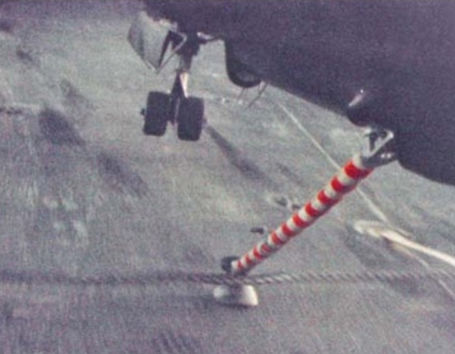
And the hook:

tailhook.jpg


Source:
https://airscapemag.com/2024/12/03/trapping-the-dragon-lady/
Forward of the wheels? Not where I expected to see it.


They had some fun with carriers at the time. That U-2 landing was only a few months after the C-130 on Forrestal.

That naval U-2 program was done to spy the french nuclear testing grounds in the Pacific : Moruroa, corner of no and where.
IIRC the C-130 on carrier program was part of the U-2 on carrier program. Ferrying U-2 bits to carriers.
 
IIRC the C-130 on carrier program was part of the U-2 on carrier program. Ferrying U-2 bits to carriers.
Never knew the two were connected ! Interesting. I did a quick search, and it seems neither the C-1 nor C-2 could carry a J75 turbojet onboard a carrier. Why a J75 ? because it was the engine of the U-2G, the carrier variant of the spyplane. So they hired a C-130 for the job ! A bit overkill, but the C-130 with its STOL capabilities might have been the only cargo plane able to make a carrier landing.

Personal note: it might also be a case of "Lockheed sales pitch fever". "You want a U-2 aboard a carrier ? you need a C-130 to support it. I can do both, of course."
 
Last edited:
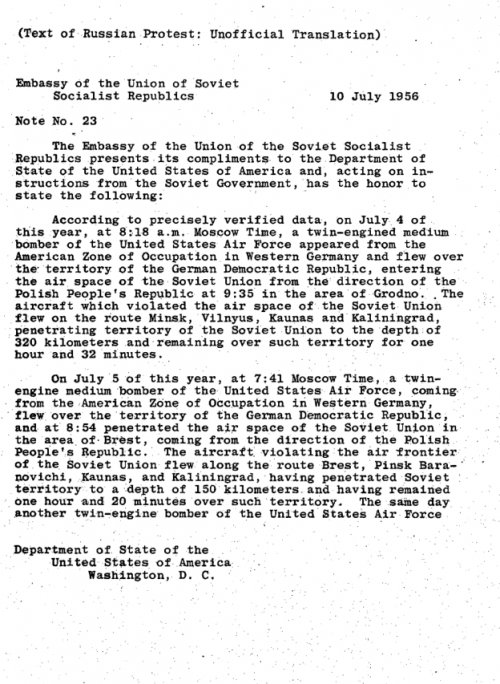
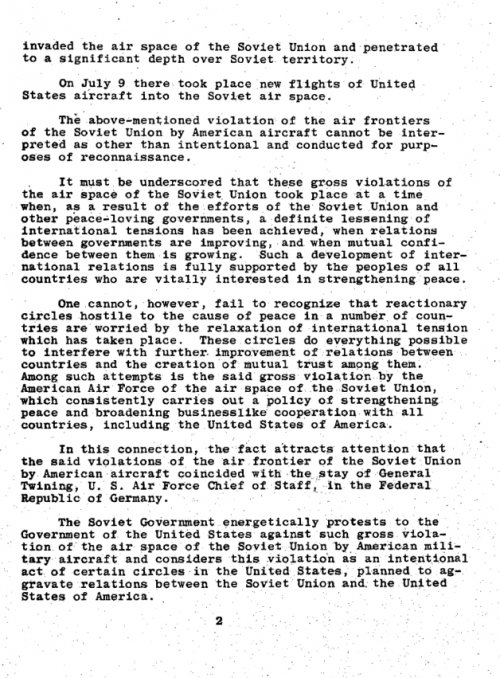
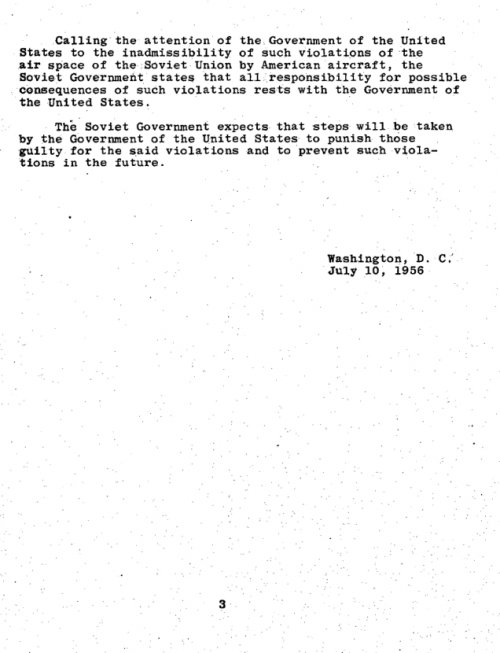
The first U-2 USSR and Central Europe overflights took place between 20 June 1956 and 10 July 1956 after which the Soviet, Polish and Czechoslovak governments are known to have filled in formal protests to the US. That these U-2s were being tracked by the radar there is no doubt. However, the Soviets were unable to visually identify the plane hence claimed it was a twin-engine medium bomber of the USAF (eg. the RB-57) that violated Soviet airspace.

Which Soviet and Warsaw Pact radar systems could have been employed to track the U-2 overflights in June and July 1956? Could that be the A-100-series 'Kama" radar of the SA-1 SAMs around Moscow, or the P-8/P-10 Knife Rest VHF EW radars? Other suspects are the P-20 and P-30.
 
Thank you for sharing ! Very interesting. The number of overflights between 1956 and the 1960 incident was pretty low (24). Ike knew the consequences of a shoot down all too well; and put a tight control, not approving many of them.

Main problem was that the CIA lied to Eisenhower because they were "addicted" to the data provided by the overflights. The whole addiction also fueled by the (ridiculous) "bomber gap" and then the (outrageous) "missile gap", post Sputnik.

List of overflights here https://www.astronauticsnow.com/u2/index.html

4 July 1956 2013 Hervey Stockman Wiesbaden (Germany)
Areas covered: East Germany, Poland, Minsk, Leningrad, Estonia, Latvia, Poland

5 July 1956 2014 Carmine Vito Wiesbaden (Germany)
Areas covered: East Germany, Warsaw, Minsk, Moscow, Eastonia, Latvia, Lithuania, Poland

9 July 1956 2020 Marty Knutson Wiesbaden (Germany)
Areas covered: East Germany, Poland, Minsk, Poland

9 July 1956 2021 Carl Overstreet Wiesbaden (Germany)
Areas covered: Czechoslovakia, Vianna, Hungary, Lvov, Kiev, Minsk, Poland

10 July 1956 2024 Glendon Dunaway Wiesbaden (Germany)
Areas covered: Poland, Kishinev, Kerch, Savastopol, Simferopol, Odessa, Romania, Hungary

20 November 1956 4016 Francis Gary Powers Adana (Turkey)
Areas covered: Iran, Yerevan, Baku, Astara, Caucasus

18 March 1957 4020 James Cherbonneaux Adana (Turkey)
Areas covered: Azerbaijan, Armenia, Georgia

20 June 1957 6005 Albert Rand Eielson (Alaska)
Areas covered: Khailyulya, Ust-Kamchatsk, Kozyrevsk, Karaganskiy-Ostrov

5 August 1957 4035 Buster Edens Lahore (Pakistan)
Areas covered: Afganistan, Tashkent, Tyuratam, Kazalinsk, Aral Sea

11 August 1957 4039 Bill McMurry Lahore (Pakistan)
Areas covered: Ala-Ata, Ust-Kamenogorsk, Sinkiang (Xinjiang)

21 August 1957 4045 Sammy Snider Lahore (Pakistan)
Areas covered: Novokuznetsk, Tomsk

21 August 1957 4048 E.K. Jones Lahore (Pakistan)
Areas covered: Lake Balkhash, Karaganda, Omsk, Alma-Ata

22 August 1957 4049 Tom Birkhead Lahore (Pakistan)
Areas covered: Merket Bazar, Kuldja, Abakan, Krasnoyarsk, Kansk, Sinkiang (Xinjiang)

22 August 1957 4050 James Cherbonneaux Lahore (Pakistan)
Areas covered: Lake Balkhash, Semipalatinsk, Barnaul, Prokop'evsk, Novokuznetsk, Leninogorsk

28 August 1957 4058 E.K. Jones Lahore (Pakistan)
Areas covered: Dushanbe, Tashkent, Tyuratam, Kazalinsk, Aral Sea

10 September 1957 4059 Bill Hall Adana (Turkey)
Areas covered: Krasnovodsk, Gur'ev, Astrakhan, Tbilisi

16 September 1957 6008 Barry Baker Eielson (Alaska)
Areas covered: Kamchatka Peninsula, Milkovo

13 October 1957 2040 Hervey Stockman Giebelstadt (Germany)
Areas covered: Norway, Finland, Murmansk, Kandalaksha

1 March 1958 6011 Tom Crull Atsugi (Japan)
Areas covered: Dalnerechensk, Khabarovsk, Blagoveshchensk, Belagorsk, Komsomolsk, Sovetskaya Gavan'

9 July 1959 4125 Marty Knutson Peshawar (Pakistan)
Areas covered: Tyuratam

6 December 1959 8005 Robert Robinson (RAF) Peshawar (Pakistan)
Areas covered: Kuybyshev, Kapustin Yar, Caucasus

5 February 1960 8009 John MacArthur (RAF) Peshawar (Pakistan)
Areas covered: Tyuratam, Kazan, Crimea

9 April 1960 4155 Robert Ericson Peshawar (Pakistan)
Areas covered: Lake Balkhash, Saryshagan, Semipalatinsk, Kyzylsepe, Dzhezkazgan, Tyuratam

1 May 1960 4154 Francis Gary Powers Peshawar (Pakistan)
Areas covered: Tyuratam, Kyshtym, Sverdlovsk (shot down by a SA-2 Guideline)

 
Last edited:
Which Soviet and Warsaw Pact radar systems could have been employed to track the U-2 overflights in June and July 1956? Could that be the A-100-series 'Kama" radar of the SA-1 SAMs around Moscow, or the P-8/P-10 Knife Rest VHF EW radars? Other suspects are the P-20 and P-30.

It was a trivial target to detect in its early versions. On 05 July 1956 an A-100 radar ar Smolensk tracked a U-2 and calculated its height as 20km.

Project Rainbow, the RCS reduction effort, was started soon after.
 
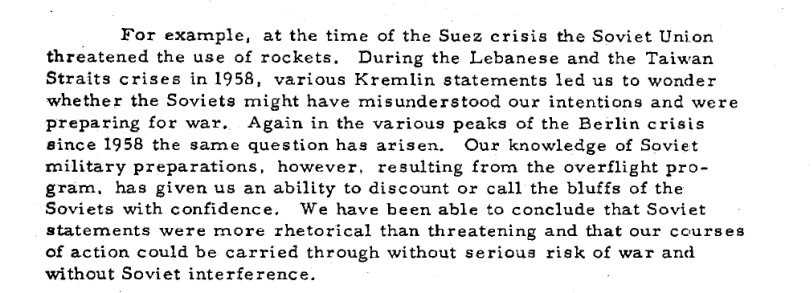
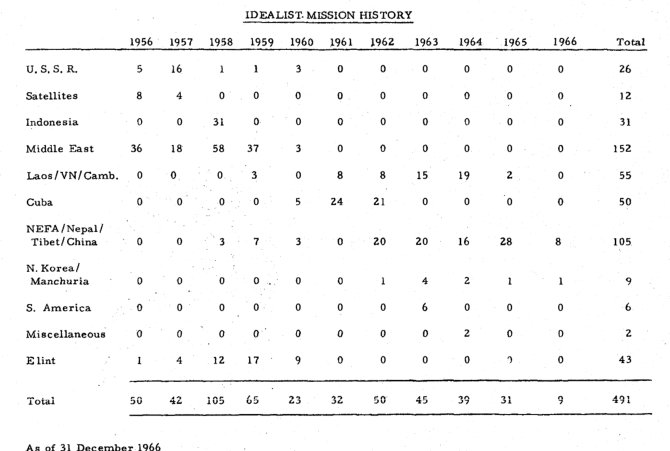
As to the U-2 program's recapitulation, this caption is of a particular interest, especially in the context of the current East-West developments.
 

Attachments

  • summary.jpg
    summary.jpg
    167.6 KB · Views: 142
Last edited by a moderator:
Weird that the number of USSR overflights is 26, plus the numbers per year don't match.
I get
-only 12 for 1957 (so 22)
-but 6 for 1956 (23)
-1959 is also wrong, there were 2 overflights, not 1 (so, back to 24)
 
It was a trivial target to detect in its early versions. On 05 July 1956 an A-100 radar ar Smolensk tracked a U-2 and calculated its height as 20km.

Project Rainbow, the RCS reduction effort, was started soon after.

And Rainbow failed miserably, because the basic U-2 shape couldn't be made stealth - notably the air intakes, exhaust, and cockpit too.
A stealth-ized U-2 would look like this
https://en.wikipedia.org/wiki/Ryan_AQM-91_Firefly
No more cockpit, air intake on top to be masked by the airframe; same for the exhaust plus the twin tail to mask it further.
 
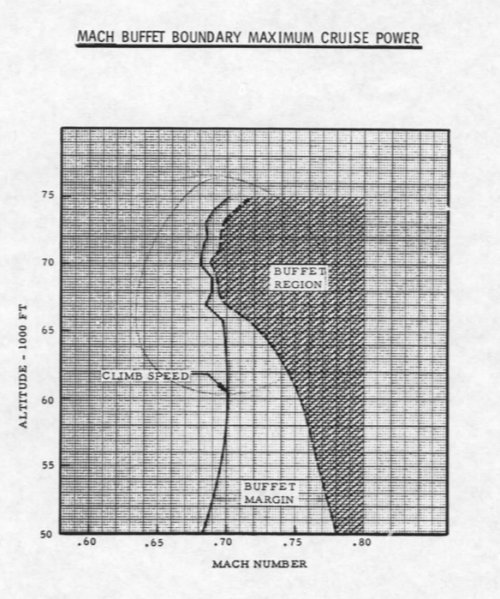
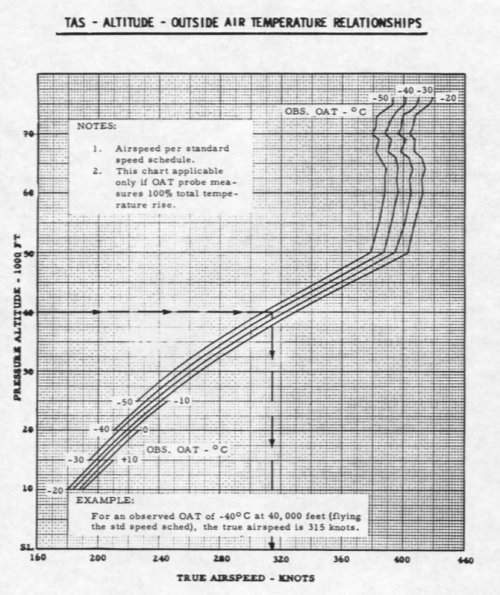
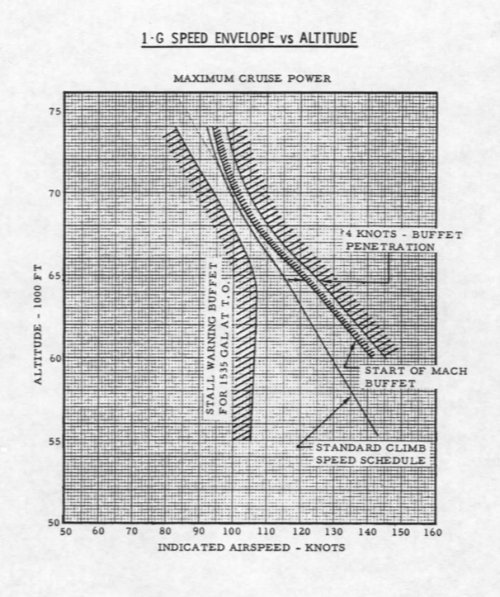
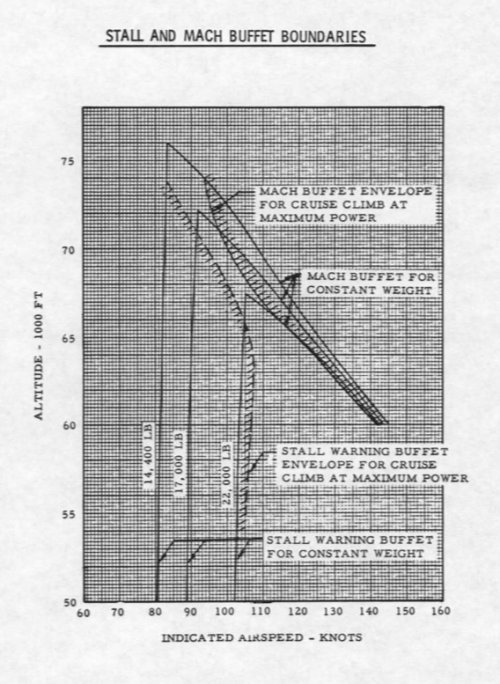
I have a technical question. While there is scarcity of reliable information on the early U-2 performance, the tables below from the U-2C/F manual are a bit puzzling.

The first one clearly states that the cruise speed at 75,000 ft would be ca. 0.7 Mach, or 463 kts. That sounds plausible given the flight times from the Soviet note mentioned in this post.

U-2CF cruise in Mach.jpg

However, the speed envelope values indicated in KIAS are a but puzzling especially to someone who has never reached the amazing altitude of 75,000 ft. Obviously, both the air density and temperature influence the KIAS values significantly compared to the sea level.

TAS alt OAT.jpg

U-2C spd vs alt.jpg

U-2C stall and mach.jpg

Then, can we safely assume that the stall speed of the early U-2 at 70,000 ft was approximately 380 to 420 KIAS, so there was a safe margin between the cruise speed of 463 kts and stall, anyway? Or did I get the tables wrong, especially the IAS and TAS values? I wonder how TAS was calculated and displayed on the early U-2, which did not yet have a Doppler navigation system.
 
Then, can we safely assume that the stall speed of the early U-2 at 70,000 ft was approximately 380 to 420 KIAS, so there was a safe margin between the cruise speed of 463 kts and stall, anyway?
That does not sound right from the stories. Plus, look at the "1-Gee Speed Envelope vs Altitude" chart. There's 10 knots total (indicated) airspeed between stall and mach buffet!
 
When flying at high altitude, early U-2s had to maintain a very specific speed--about 460 mph true airspeed--to stay in the thin margin between stalling and high-speed buffeting. The difference was only about 7 mph, and pilots called this margin the "coffin corner." High altitude engine flame-outs also were troublesome in early U-2s. Later models with better engines eased this problem.

My Bolding.

From https://www.nationalmuseum.af.mil/V...Sheets/Display/Article/197570/flying-the-u-2/
 
@Scott Kenny Thank you for the reply. I assume that the Speed Envelope vs Altitude chart reflected situations up to 1G. Right? Unless the U-2 could easily withstand higher G values. I thought these values were -1,5 G to +3 G.

The matter that you mentioned seems to have been elaborated in wiki, and even the same U-2C graph was used.

https://en.wikipedia.org/wiki/Coffin_corner_(aerodynamics)
https://en.wikipedia.org/wiki/File:CoffinCornerU2.png
Given the wiki description, could an SA-2 explosion under Powers' U-2 at 66,000 to 74,000 ft cause the aircraft to stall given the very thin coffin corner?
 
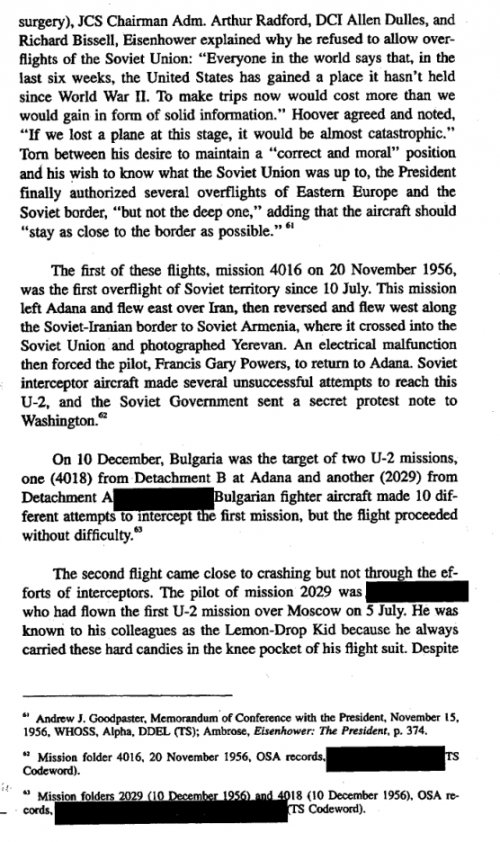
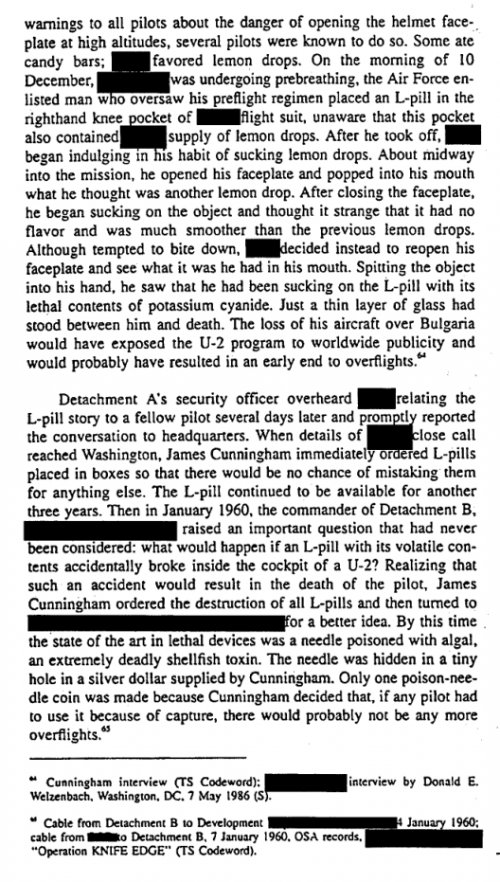
An interesting story from a 1956 U-2 mission, when the pilot almost swallowed a suicide pill. I think the said pilot was Carmine Vito.
 

Attachments

  • lemon drop 1.jpg
    lemon drop 1.jpg
    385.8 KB · Views: 72
  • lemon drop 2.jpg
    lemon drop 2.jpg
    435.6 KB · Views: 76
Last edited by a moderator:
Given the wiki description, could an SA-2 explosion under Powers' U-2 at 66,000 to 74,000 ft cause the aircraft to stall given the very thin coffin corner?
I believe so. It'd need to be a fairly close miss, close enough to have the bird within the shockwave radius.
 
Any thoughts as to where Detachment A ? operated from ? Akrotiri ?

cheers, Joe

edit, found it, established in May 1956 at Lakenheath, England, before moving to Wiesbaden and later Giebelstadt, West Germany
 
I believe so. It'd need to be a fairly close miss, close enough to have the bird within the shockwave radius.

Thanks for the reply. The issue of how exactly Powers' U-2 disintegrated on 1 May 1960 is still unresolved definitely. According to the released documents, he was debriefed on the matter after his release from captivity, but his memory was clearly vague. Anyway, he reported issues with the autopilot some 10 to 20 minutes before seeing a large orange flash under his plane, and mentioned about a force that pushed him forward, perhaps along with his seat within the cockpit. Then, the wing or wings, tail and nose were separated from the fuselage, and the U-2 started to descend rapidly. He remembered seeing the altimeter needle rotating counterclockwise very fast. He did not use the ejection seat, but eventually bailed out after dropping the canopy. The altitude of his flight over Sverdlovsk was ca. 65,000 to 68,000 ft., and he did not mention in the debriefing about any engine flameout or the necessity of descent to restart it.

The orange flash was either an SA-2 missile explosion triggered by proximity fuze, or... something else could happen to the engine. However, a compressor stall was not very likely to happen during a normal cruise flight I presume. Anyway, the U-2 manual said that the engines installed on the bird were immune to any damage that the compressor stalls could cause.
 
Periscope Film posted this footage to YouTube yesterday (2-March-2026) of a TRIM ("Target Radiation Intensity Measurement") equipped U-2. I appreciate that Periscope Film has this footage to post, too bad its brightness level has not been improved further.

The footage opens with a shot of a small pennant/flag which reads "TRIXIE" (Total conjecture on my part, but might this have been another/earlier acronym for the project? Perhaps for "Target Radiation Intensity eXperimental", with the "I" and "E" added for other reasons or just to make it sound better?).

TRIM is described in a Nevada Aviation Hall of Fame biography (attached below) of Lockheed Test Pilot David L. Ferguson (b. 1938- d. 2011), "... Ferguson was first checked out in the U-2. He spent several months flying a high-altitude reconnaissance jet in a variety of programs including projects TRIM (Target Radiation Intensity Measurement) and Have Coffee, measuring the infrared signatures of missile launch plumes, satellites and reentry vehicles."

The footage shows the TRIM sensors prior to and after installation on a U-2. Special markings on the underside and flanks of the aircraft (optical target or calibration markings?) can be seen at the 1min 41sec to 2min 4sec mark of the film (5min 50sec to 60sec mark).

Then there is footage of a US Air Force UH-1F/P (a GE T58-powered variant of the Huey) lifting a sling-load of some sort (it is obscured by the timecode overlaid on the footage) that may or may not be related to the project.

Between 5min 59sec and 6min 50 sec mark of the film there is some nice chase car footage of the TRIM-equipped U-2 taking off.

Then between the 6min 59sec to 7min 18sec mark it appears the two sensor turrets are being filled with cryogenic gases presumably for IR (?) sensor cooling.

9min 20sec to 10min 22 sec mark seems to show a re-entry or some other very fast and hot object used as a test target for the TRIM flight tests.

After that point, it appears to be footage of Kennedy Space Center and the facilities at Cape Canaveral (including an armadillo or two). Note at the front of KSC's then-visitor center the stylized American Bicentennial Star at the 10min 28sec mark, which started to appear on US government buildings, circa ~1974. It was designed by Bruce Blackburn, the same man who designed the NASA "worm" logo). Note also that the Bicentennial Star and US flag do not appear on the side of the VAB here, which would date this KSC/Cape Canaveral footage to sometime between 1974-76 (since the aforementioned star and American flag were not painted on the side of the VAB until 1976).

YouTube - Periscope Film: "1972 LOCKHEED U-2 SPY PLANE TEST FOOTAGE AT EDWARDS AIR FORCE BASE DRAGON LADY 81814"
 

Attachments

  • David L Ferguson - Test Pilot - Nevada Aviation Hall of Fame Bio - Copy.pdf
    96.1 KB · Views: 8
Neat video! It showed a lot of places where I spent a great deal of time at Edwards and KSC/CCAFS.

I hadn't seen the TRIXIE name before. Every reference I've encountered has used the TRIM acronym but I've often seen a projects change names numerous times.

I didn't recall that the TRIM U-2 was operated out of South Base. That's a nice little tidbit.

 
Last edited by a moderator:

Similar threads

Back
Top Bottom