
You are using an out of date browser. It may not display this or other websites correctly.
You should upgrade or use an alternative browser.
You should upgrade or use an alternative browser.
Japanese jet transports and bombers in 1940s?

Adler
Die Wunderwaffe
- Joined
- 27 February 2025
- Messages
- 223
- Reaction score
- 453
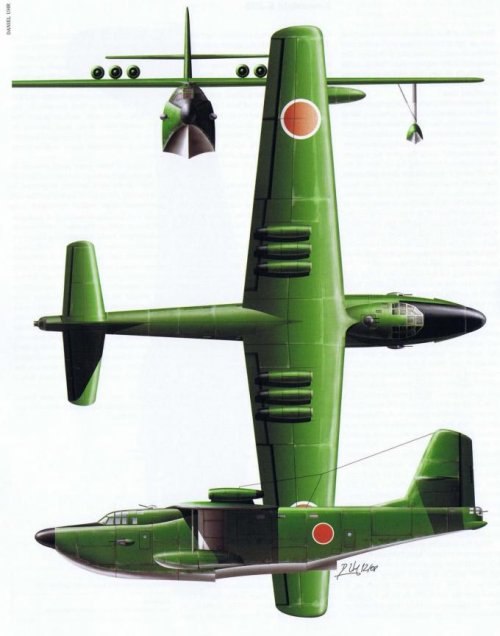
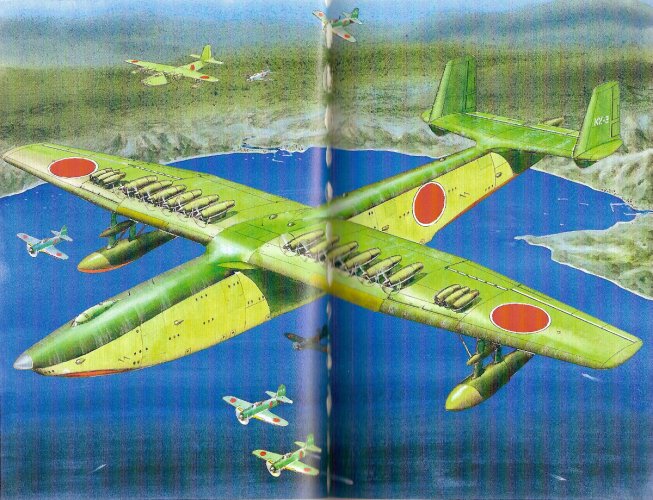
As far as I am aware there were no dedicated jet bombers (albeit a few fighter bombers such as the Nakajima Kikka) developed or designed by the Japanese during WWII, but there was the Kawanishi K 200 and Kawanishi KX-03 transports that were fully or partially powered by jet engines. Neither got built.
Attachments
Adler
Die Wunderwaffe
- Joined
- 27 February 2025
- Messages
- 223
- Reaction score
- 453
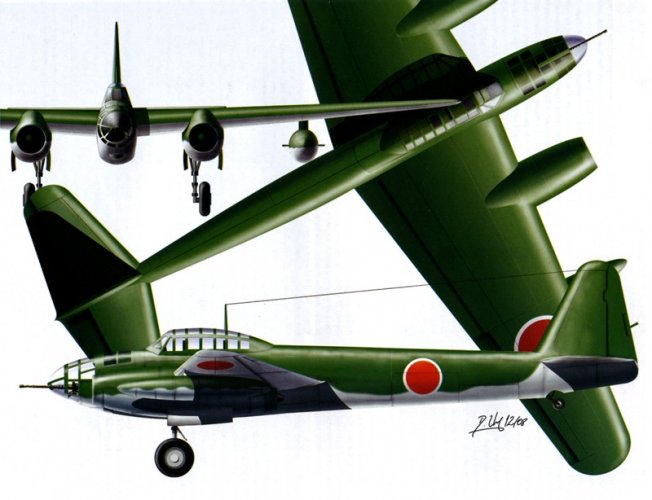
I was not aware of this one, seems like they slapped two jet engines upon the airframe of a prop-powered bomber.There was a medium bomber powered by Jets Yokosuka Tenga and Yokosuka R2Y and I assume there are others maybe we'll just make a list of the Japanese jet aircraft I assume because there's not a lot can we list some? Thanks!
----------------
Japanese jet powered bomber/transports list:
----------------
Fighter Bombers:
Nakajima Kikka - (1x 500kg bomb or 1x 800kg bomb)
Nakajima Ki-201 - (1x 500kg bomb or 1x 800kg bomb)
R2Y2 Keiun Kai - (1x 800kg bomb)
R2Y2 Variant II - (1x 800kg bomb)
R2Y2 Variant III - (1x 800kg bomb)
Bombers:
Yokosuka Tenga - (1,600kg of bombs or 1x 800kg torpedo)
Transports:
Kawanishi K 200
Kawanishi KX-03 (both turboprop and jet propulsion)
----------------
Any that I missed?


QAZ
Interested in Japanese jet development during WWII
Apart from the Kikka/Kikka Kai (a special attack plane, although it could be used conventionally), the only official projects for "jet bombers" by Japan in WWII were the Tenga (which was quickly abandoned) and the R2Y2.
The Tenga was a Ginga-based jet-powered fighter-bomber with twin TR30/Ne-30 turbojets and presumably some kind of fixed forward armament in addition to bombs.
The R2Y2/Keiun Kai was an attack plane consisting of a jet-powered Keiun with Ne-330 turbojets installed under the wings and some kind of bomb or possibly torpedo payload.
Neither plane was manufactured of course.
KX3 was a design study that was not a real project with any kind of schedule of development.
K200 is in my opinion a dubious project that I have only seen referenced in a semi-fictional Japanese book on what-if aircraft. I don't think it was real.
I believe that the heaviest Japanese flying boat that was put to design was the K60 flying boat which was to weigh up to 120t. There was a proposal to power this design with GTPR turboprops but it was nothing but.
The models of jet engines that were developed by Japan in WWII did not lend themselves well to any kind of long-range aircraft.
The Tenga was a Ginga-based jet-powered fighter-bomber with twin TR30/Ne-30 turbojets and presumably some kind of fixed forward armament in addition to bombs.
The R2Y2/Keiun Kai was an attack plane consisting of a jet-powered Keiun with Ne-330 turbojets installed under the wings and some kind of bomb or possibly torpedo payload.
Neither plane was manufactured of course.
KX3 was a design study that was not a real project with any kind of schedule of development.
I believe that the heaviest Japanese flying boat that was put to design was the K60 flying boat which was to weigh up to 120t. There was a proposal to power this design with GTPR turboprops but it was nothing but.
The models of jet engines that were developed by Japan in WWII did not lend themselves well to any kind of long-range aircraft.
Last edited:
Adler
Die Wunderwaffe
- Joined
- 27 February 2025
- Messages
- 223
- Reaction score
- 453
Do you happen to have the K 60 blueprint, diagrams or drawings by any chance?Apart from the Kikka/Kikka Kai (a special attack plane, although it could be used conventionally), the only official projects for "jet bombers" by Japan in WWII were the Tenga (which was quickly abandoned) and the R2Y2.
The Tenga was a Ginga-based jet-powered fighter-bomber with twin TR30/Ne-30 turbojets and presumably some kind of fixed forward armament in addition to bombs.
The R2Y2/Keiun Kai was an attack plane consisting of a jet-powered Keiun with Ne-330 turbojets installed under the wings and some kind of bomb or possibly torpedo payload.
Neither plane was manufactured of course.
KX3 was a design study that was not a real project with any kind of schedule of development.
K200 is in my opinion a dubious project that I have only seen referenced in a semi-fictional Japanese book on what-if aircraft. I don't think it was real.
I believe that the heaviest Japanese flying boat that was put to design was the K60 flying boat which was to weigh up to 120t. There was a proposal to power this design with GTPR turboprops but it was nothing but.
The models of jet engines that were developed by Japan in WWII did not lend themselves well to any kind of long-range aircraft.
QAZ
Interested in Japanese jet development during WWII
Do you happen to have the K 60 blueprint, diagrams or drawings by any chance?
I have a drawing of K60 showing the proposed installation of GTPR turboprops. However I do not immediately have this handy, I may post it later.
Also, I was mistaken about the K200. It was possibly a real project, or at least idea, and I had not done my research, so I edited my comment. K200 was a 200t jet-powered flying boat proposal but was cancelled in the conceptual stage (development did not begin). It is described in Minoru Akimoto's book 巨人機物語 (Story of Giant Planes).
Tokiyasu Tanegashima, who developed the turboprop GTPR, writes that he ordered its construction for a flying boat of "some 300 tons" that was being considered by Kawanishi. The time of this order seems to have been October 1943.
K200 seems to have been proposed in the wake of the cancellation of the intercontinental bomber "TB", so it must have been proposed in 1944, which is too late to be this flying boat of 300t.
In general, the Navy had instructed Kawanishi to study flying boats of 100t~500t class from April 1943 (which the KX3 concept is a result of), so it was probably something related to this.
Last edited:


- Joined
- 22 January 2006
- Messages
- 4,436
- Reaction score
- 2,801
You can use the forum's search engine to locate it by yourselfI'm also interested in some pictures of this aircraft please thanks.
- Joined
- 22 January 2006
- Messages
- 4,436
- Reaction score
- 2,801
It must be noted that jet aircraft can't work without the appropriate jet engine. A quick research from internet:
Japanese jet engine available in August 1945 was Ishikawajima Ne-20. Maximum thrust: 4,7 KN
For comparison:
Junkers Jumo 004 powering the Me262 ( MTOW 7 ton ) and Ar 234 ( MTOW 10 ton ) offered 7,8 KN
GE TG-180 (later J35) was considered the first American turbojet suitable for a B29 replacement, offered 17 KN, but first run was in 1946. The XB-47 ( MTOW 74 ton ) first flight was Dec, 1947 but not entered service until 1951.
Pratt & Whitney YJ57-P-3 turbojet (first run 1951) offered 39 KN. The XB-52 (MTOW 177 ton) first flight was Oct, 1952. The USAF received the first three in 1954. In 1956 the total B-52 force was 16 aircraft.
In 1945, the "jet powered Fugaku" was still 10 years ahead in the future to be made a reality, with the resources of the most advanced super power of that time.
Thus, "Japanese jet transports and bombers in 1940s" sounds a bit optimistic to me...
Japanese jet engine available in August 1945 was Ishikawajima Ne-20. Maximum thrust: 4,7 KN
For comparison:
Junkers Jumo 004 powering the Me262 ( MTOW 7 ton ) and Ar 234 ( MTOW 10 ton ) offered 7,8 KN
GE TG-180 (later J35) was considered the first American turbojet suitable for a B29 replacement, offered 17 KN, but first run was in 1946. The XB-47 ( MTOW 74 ton ) first flight was Dec, 1947 but not entered service until 1951.
Pratt & Whitney YJ57-P-3 turbojet (first run 1951) offered 39 KN. The XB-52 (MTOW 177 ton) first flight was Oct, 1952. The USAF received the first three in 1954. In 1956 the total B-52 force was 16 aircraft.
In 1945, the "jet powered Fugaku" was still 10 years ahead in the future to be made a reality, with the resources of the most advanced super power of that time.
Thus, "Japanese jet transports and bombers in 1940s" sounds a bit optimistic to me...
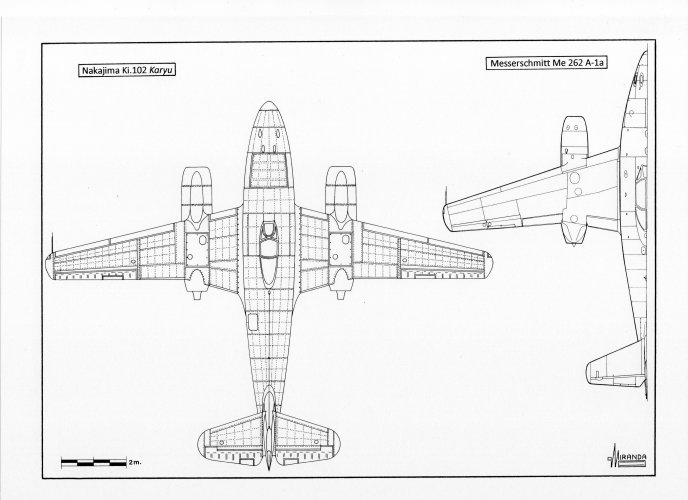
Nakajima Ki.201 Karyu
Just one week before the outbreak of World War Two, the German prototype Heinkel He 178 was flown piloted by Luftwaffe Flugkapitän Erich Warsitz. The He 178 was the first airplane in the world powered by a turbojet.
The new HeS 3B engine had been designed by Dr. Hans-Joachim Pabst von Ohain and consisted of a large 120 cm diameter drum capable of producing 450 kgf static thrust at sea level. Its shape was due to the centrifugal compressor - essentially a centrifugal turbine gas - whose efficiency increased with diameter.
The Allies were also researching centrifugal engines: in May 1941 they built the Power Jets W.1 with 107 cm diameter and 387 kgf and by 1943 they already had the de Havilland Halford H-1 with 127 cm diameter and 1,225 kgf static thrust. With this power, it was possible to build a single engine jet fighter, with the centrifugal turbojet installed inside the fuselage. In 1943, the British chose the Halford to propel their new fighters Gloster E5/42 and De Havilland E6/41 Vampire. The Americans used the same turbojet to power the Lockheed XP-80 prototype, early in 944.
In 1939, the Heinkel-Rostock team was working on the development of the HeS 8 centrifugal turbojet, which was expected to be used to propel the He 280 fighters. With a planned thrust of 700 kgf and a diameter 20 per cent shorter than the HeS 3B, the new turbojet required a great research effort and an extensive test program. Numerous technical problems had to be solved before starting its large-scale production and the HeS 8 suffered numerous delays. By March 1941 it only produced 500 kgf static thrust, 550 kgf by early 1942 and 600 kgf in early 1943.
The root cause was the reduction of the diameter, recommended by the aerodynamicists to minimize the drag produced by the engine nacelles when installed under the wings of the He 280. Trials experience revealed that the most effective way to increase thrust in this type of turbojets was to also increase their diameter, to improve the performance of the centrifugal compressor. In 1939, the HeS 3B, with 93 cm of diameter, produced 450 kgf. In the spring of 1943, the Oberkommando der Luftwaffe decided to cancel all research work with centrifugal turbojets to focus on the development of axial-flow type engines.
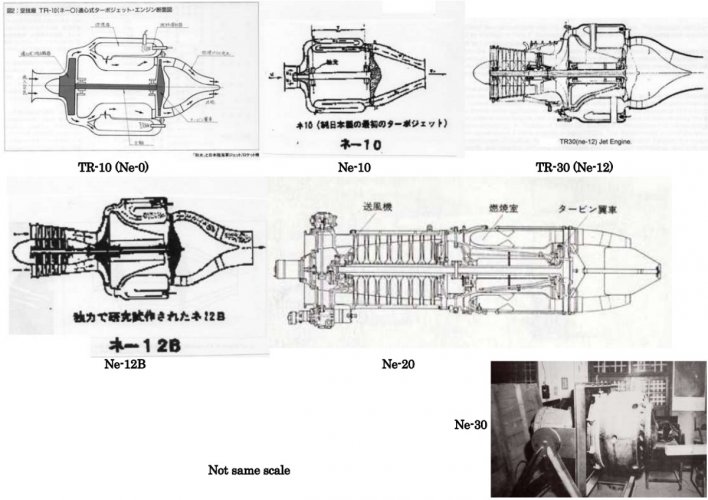
The first Japanese turbojets were centrifugal engines based on the German Heinkel HeS 3B. They burnt a great amount of fuel and could only increase its power by augmenting the diameter of its central section. But such a big size of the engines and their position in the under the wing nacelles would have generated too much drag. In 1942, Vice Admiral Misao Wada, chief of Yokosuka Naval Aero-Technical Arsenal (Kugisho), directed the development of the TR-10 turbojet, the Japanese version of the HeS 3B, with one-stage centrifugal compressor.
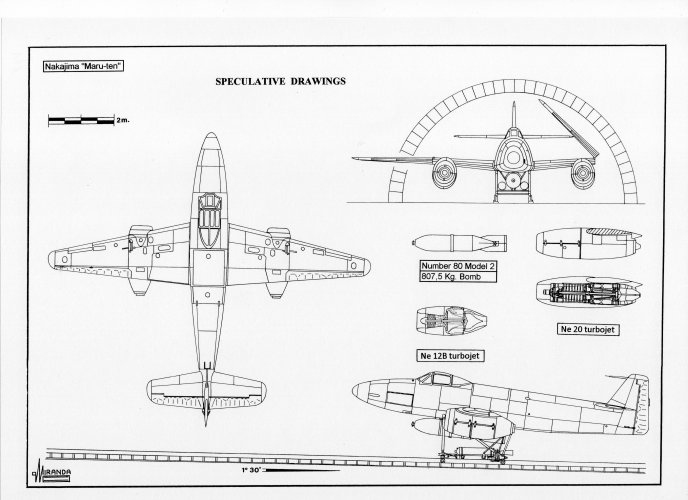
Redesignated Ne-10, the engine was first tested in the summer of 1943 with a thrust of 300 kgf, which was deemed insufficient by the IJN. To increase its efficiency, it was necessary to reduce the RPM, and an additional four-stage axial compressor was mounted in the air-intake. The new engine, Ne-12B, was just 7 per cent more powerful than previous model, weighted 315 kg and had a high rate of fuel consumption of 510 kg per hour. Only forty units were built to power the Nakajima Maru-Ten, the suicide version of the Kikka.
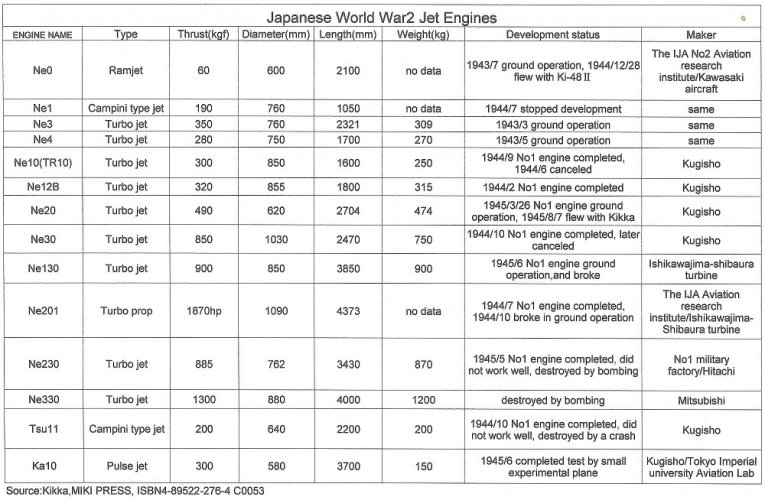
In December 1944, Kugisho was working on the Ne-30, a scaled-up variant of the Ne-12B with 850 kgf static thrust, to power the Keiun recce airplane and the Tenga fast bomber. At any rate, only one prototype of the Ne-30 was built for evaluation purposes. Its manufacturing was cancelled in favour of the new axial-flow type turbojets that were more efficient and could be positioned under the wing without generating too much drag.
In 1945, the Japanese abandoned the development of centrifugal turbojets, just as the Germans did, to focus on the development of the new turbojets, with multi-stage compressors and low RPM, inspired by the BMW 003A. Kugisho manufactured 21 engines of the type Ne-20, with 475 kgf static thrust and 11,000 RPM. Two Ne-20 were flight tested successfully whit the Kikka prototype in August 1945. Kugisho continued to work until the end of the war on the Ne-20-KAI, with special steel Mn,Cr,V alloy, 570 kgf and 650º C temperature limit, to power the Kikka pre-production series.
Ishikawajima-Shibaura built a prototype of the Ne-130 turbojet, 900 kgf and 9,000 RPM, to power the production series of the Tenga fast bomber and the Karyu fighter. Nakajima-Hitachi built the prototype of the Ne-230, with 885 kgf and 8,100 RPM, to power the Karyu fighter. Mitsubishi could not complete the prototype of the Ne-330, damaged by an air raid.
The Ne-330 had 1,300 kgf (estimated) static thrust and 7,600 RPM, had been designed to power the Keiun heavy fighter. The Japanese turbojets started with gasoline and, during the acceleration, were run on pine root oil with 20 percent gasoline or with a mixture of wood turpentine and charcoal.
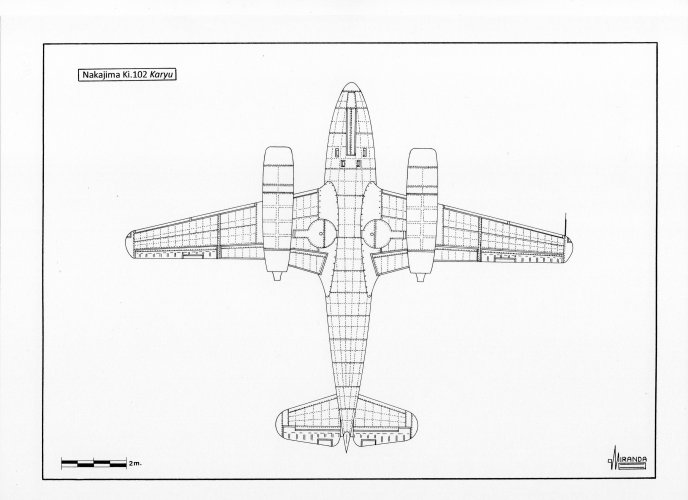
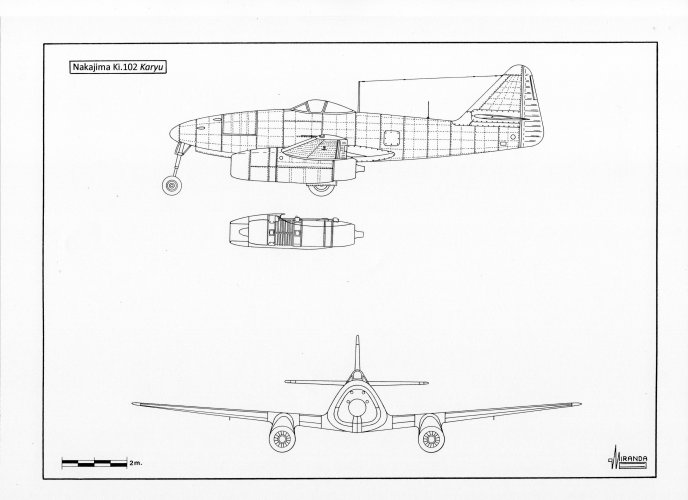
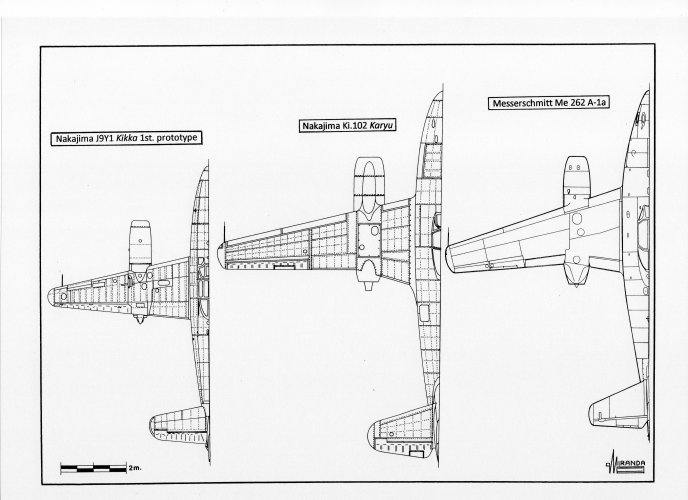
In January 1945, the Koku Hombu instructed Nakajima to design a version of the Mersserschmitt Me 262 A-1 adapted to suit Japanese production capabilities. The new airplane, denominated Karyu, was a common project of the IJA/IJN which design phase ended in June 1945. The IJA version, with the kitai number Ki.201, would be powered by two Ne-230 turbojets and armed with 2x30 mm Ho-155 II and 2x20 mm Ho-5 cannons.
The IJN version powered by two Ne-130 turbojets, would be armed with 2x30 mm Type 5 and 2x20 mm Type 99 cannons. The Karyu was designed by Iwao Shibuya as high-altitude interceptor and anti-landing ships strike fighter able to carry a 500-800 kg bomb. It was hoped that the Karyu could also act as an all-weather interceptor guided by the TaChi-3 ground radar in combination with a TaKi-15 airborne IFF transponder with 150 km range. By the end of war, the prototype was only 50 percent completed at Nakajima-Mitaka plant.
At any rate, only one prototype of the Ne-30 was built for evaluation purposes. Its manufacturing was cancelled in favour of the new axial type turbojets Ne-130 and Ne-330 that were more efficient and could be positioned under the wing without generating too much drag.
Ki.201 technical data (with Ne-230)
Wingspan: 13.7 m, length: 11.5 m, height: 4.05 m, wing area: 25 sq. m, max speed: 812 kph, max weight: 6,962 kg, ceiling: 12,000 m, range: 980 km.
Attachments
Nakajima Kikka
Presented to the Kaigun Koku Hombu on 14 September 1944, as a candidate to the Kokoku Heiki No.2 project, the J9N1/MXN1 (speculative designations) Maru-Ten was a suicide bomber armed with one (fixed) Number 80 Model 2 bomb of 807.5 kg. Lacking an undercarriage, it took off from a cart propelled by two Toku-Ro.1 Type 2 rockets running over 200 m of rails.
As with the projected Ohka 43-Otsu project of Kugisho, the Maru-Ten was armed with two 13 mm Type 3 machine guns to defend from the Allied fighters. It also had foldable wings that could be hidden in caves and railroad tunnels. On September 1944 the IJN issued the ‘19-shi specification’ calling for a special attack bomber with 693 kph max speed and 350 take off run when using two 450 kgf RATOG bottles.
In November 1944, after a series of tests made with a Betty bomber, it was concluded that the Ne-12B centrifugal turbojet, with only 320 kgf static thrust, did not produce anywhere near the power required to propel this aircraft that had a range of just 204 km, due to its high rate of fuel consumption of 510 kg/h.
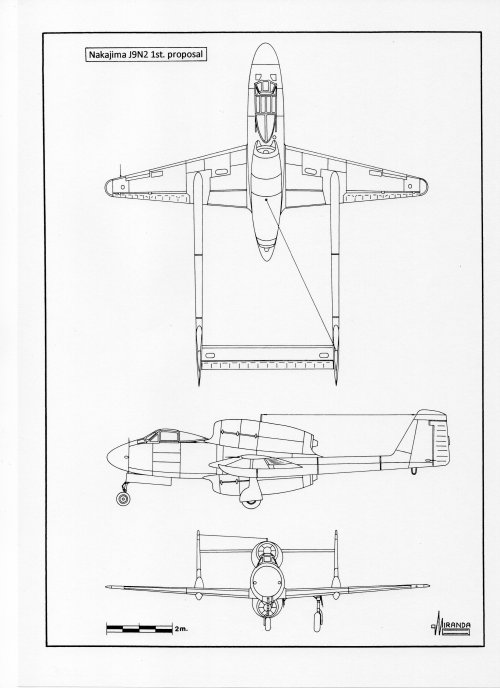
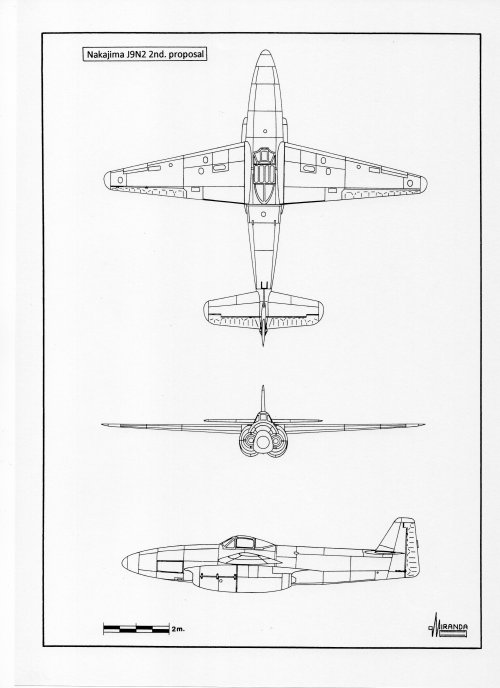
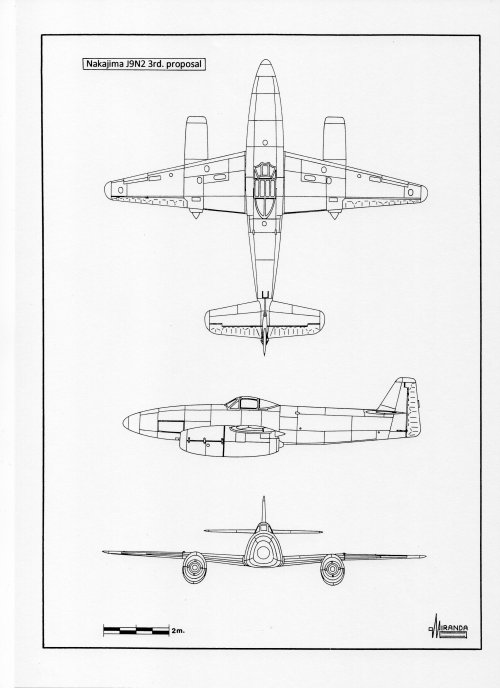
On 9 December, the Kaigun Koku Hombu decided to modify the project ‘19-shi special attack bomber’ into the 620 kph ‘anti-invasion’ fast bomber J9N2/MXN2 (speculative designations), propelled by two Yokosuka/Kugisho Ne-20 axial turbojets with 475-490 kgf static thrust, tricycle type landing gear, armoured windshield, automatic extinguisher devices and two Type 99, 20 mm cannon, but the weight of the (launchable) bomb had to be reduced to 500 kg.
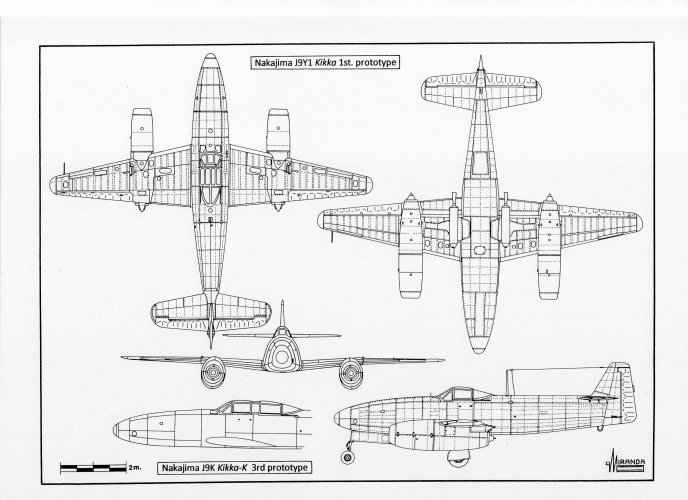
With the possibility of using the Ne 20 axial turbojet, with only 62 cm of diameter, Nakajima proposed to Kaigun Koku Hombu three possible configurations for the ‘anti-invasion’ fast bomber. The first proposal consisted of a twin boom airframe with two Ne 20 turbojets mounted on the upper and lower sides of the fuselage. In the second proposal, they were located under the wing roots; the third proposal was a variant of the Maru-Ten with the engines mounted under the wings. The mock-up was presented to the IJN on 28 January 1945, receiving the official designation Kikka/Kitsuka.
The first Nakajima/Yokosuka Kikka (J9Y1 speculative designation) prototype was based upon the third proposal and flew for the first time on 7 August 1945. To gain some time, it was built with the main landing gear of an A6M5 Zero-Sen and the tailwheel of a P1Y Ginga as a nosewheel.
First prototype technical data
Wingspan: 10 m, length: 9.25 m, height: 3.05 m, wing area: 13.2 sq. m, max weight: 3,950 kg, max speed: 677 kph, service ceiling: 10,700 m.
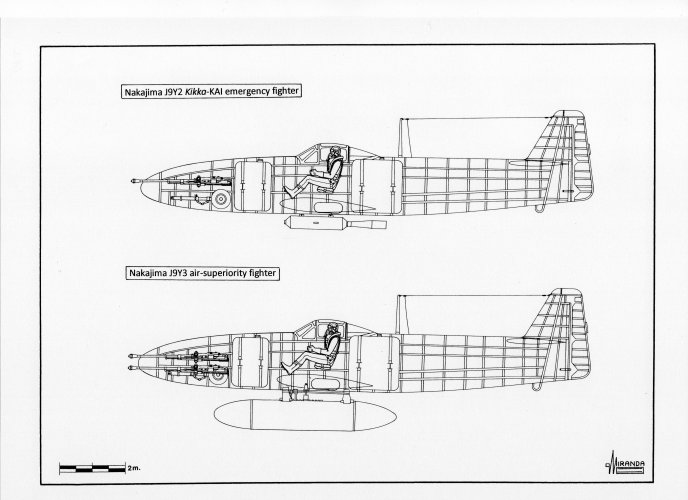
The prototype was used as the basis for an emergency fighter project (J9Y2 Kikka-KAI speculative designation) powered by two Ne 20-KAI turbojets with 570-650 kgf static thrust and armed with a Type 5, 30 mm cannon. The wing area was extended to 14.51 sqm for a 12,300 m service ceiling and a time to climb to 10,000 m of 20 minutes. The estimated maximum weight for this version was 4,152 kg and the maximum speed of 785 kph.
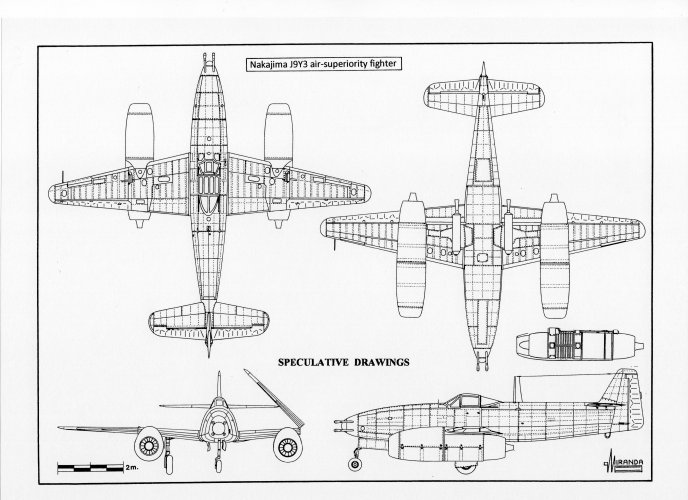
The possibility of using the new Ishikawajima-Shibaura Ne 130 turbojets, with 900 kgf static thrust, allowed the design of an air-superiority fighter (J9Y3 speculative designation) with combat flaps and leading-edge slots to improve maneuverability, armed with four Type 5, 30 mm cannon. The protection for the pilot consisted of one 70 mm thick armored windshield and 12 mm steel plates at the back of the seat. The two fuselage fuel tanks of 330 and 425 liters were protected with 22 mm thick leak-proof rubber. The estimated maximum weight for this version was 4,232 kg and the max speed of 713 kph
On 13 June 1945, the Kaigun Koku Hombu decided the mass production of the special attack bomber and of the emergency fighter. At the time of Japanese surrender a second prototype was completed and 18 pre-production airplanes were in various stages of assembly. The third prototype Kikka-K was a two-seat trainer/reconnaissance variant (J9K speculative designation) with 721 kph estimated max speed.
Attachments
Yokosuka Ginga, Kawanishi Kyokko, Nakajima Byakko and Kugisho Tenga
The Yokosuka P1Y1 Ginga was designed in 1940, following a specification of the IJN (clearly inspired by the Junkers Ju 88) requiring a fast bomber that would be suitable for dive-bombing and low-altitude torpedo attack.
On March 1945 some units of the P1Y1 Model 11 of the 762nd Kokutai were equipped with an H-6 ASV radar to perform nigh attacks against U.S. Navy ships. The P1Y was tested in alternative roles.
Early in 1944 the Kawanishi Company was instructed by the Kaigun Koku Hombu to produce a night fighter variant under the designation P1Y2-S Kyokko Model 26. The new planes would be powered by two 1,850 hp Mitsubishi MK4T-A Kasei 25a radial engines, that were considered safer than the Homare 12 del Ginga, and armed with a
Type 5, 30 mm cannon angled at 35-degree in Schräge Musik configuration. The prototype flew in June 1944 and Kawanishi modified a total of 96 Ginga airframes.
Between March and November of 1944, a certain number of Kyokko entered service with the Kokutais Nos. 302 and 321, but they were not successful against the B-29s. The low speed of 523 kph and the service ceiling of 9,400 m only proved disappointing. The plan was to install the FD-2 AI radar in the series version.
Kakajima also built the P1Y1-S Byakko night fighter, a Ginga armed with two Type 99-2, 20 mm cannons, angled at 30-degree in Schräge Musik configuration. In the summer of 1945, the P1Y1-S performed operational tests with the 302nd Kokutai basedo in Atsugi. Byakko performed better than Kyokko but also did not enter service. At least one P1Y1-S was equipped with a H-5/FD-1 AI radar, an experimental version of the H-6 ASV with Yagi antenna, that had been specially designed to generate less drag in the nose.
In July 1945, the first flight tests of the Mukade conversion were conducted in the Arsenal of Yokosuka. The Mukade was a modification of the Ginga specialized in long range strafing role against the US bases of B-29s. The project was inspired by the ventral armament of the Gekko and consisted of twelve 20 mm cannons angled at 30-degree downwards and fired from an altitude of 200 m over the rows of refuelled and bombed-up B-29s. It was hoped that a fireball effect would take place with entire ranks of Superfortress blowing each other up.
The Mukade tactics were part of the Operation Ken-Go consisting of attempting an attack against the USAAF base at Iwo Jima using thirty-six Gingas of the Mitate Unit No.6, thirty-six Mukade and thirty G4M bombers that had been modified for transporting suicide commands. There was also the project of the P1Y3 Mod.33, a Ginga with enlarged fuselage and extended wingspan specially modified as a mother ship for the Ohka Mod.22 jet bomber. The Model 33 did not go beyond the drawing board.
After the Battle of the Coral Sea in May 1942 the IJN admitted the need to have a ground based fast reconnaissance airplane. Little afterwards, the Naval Air Arsenal at Yokosuka received the specification 17 Shi to design an aircraft that could fly at 666 kph at an altitude of 6,000 m. Under the project name Y-30, it was assigned to two teams that would study the different possibilities of a single or a twin-engine airplane.
The R1Y1 Seiun would have had a classic airframe and been propelled by a Mitsubishi 24-cylinder, liquid cooled, 2,500 hp experimental engine. The R1Y2 Gyoun would be an evolution from the Ginga with two Mitsubishi Mk10A (Ha-214) 2,400 hp radial engines. The Seiun engine did not prove to be acceptable on the medium term and the estimated performance of the Gyoun showed that it did not comply with the requirements of the 17 Shi. Dr. Masao Yamana, of Kugisho, suggested the use of German inline engines, paired inside the fuselage, to build the R2Y1 Keiun with a single nose propeller and long power shaft. The formula did not work and the team of Kugisho proposed to the IJN its transformation into a suicide fast bomber with two Ne-30 turbojets.
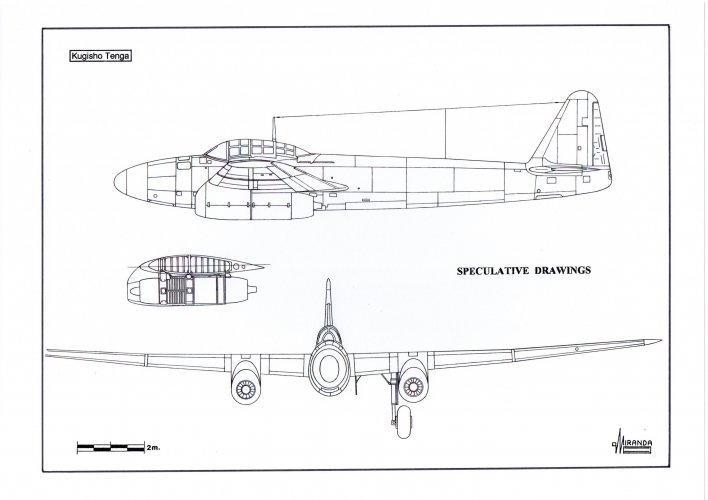
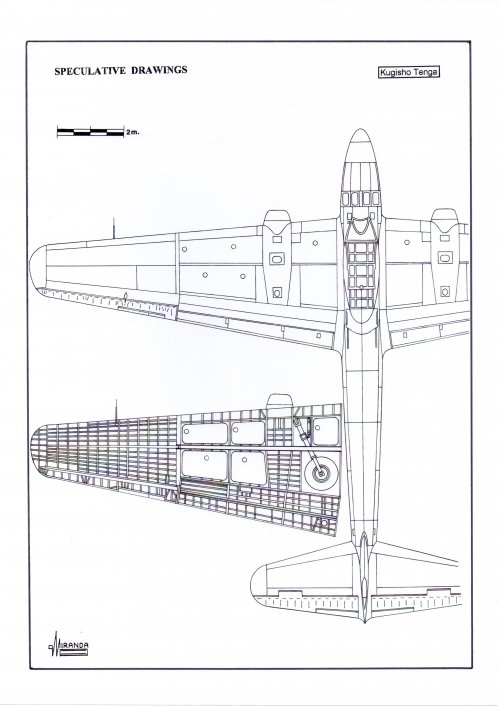
The opportunity to have these new engines reactivated the Gyoun, using a Yokosuka P1Y1 Ginga as a prototype, propelled by the two turbojets under the wing nacelles. The final model was known as Tenga and would have probably been propelled by two Ne-130 turbojets with a power equivalent to that of a German Jumo 004. The most important modifications, compared to the Ginga series, included the adoption of a solid nose cone and the installation of the main undercarriage legs between the engines and the fuselage.
Tenga technical data
Wingspan: 20 m, length: 15 m, height: 4.30 m, wing area: 55 sq. m, max weight: 10,500 kg, estimated max speed: 700-750 kph, estimated service ceiling: over 10,000 m, engines: two Ne-30 centrifugal turbojets with 850 kgf peak thrust or two Ne-130 axial turbojets with 900 kgf peak thrust.
The Yokosuka P1Y1 Ginga was designed in 1940, following a specification of the IJN (clearly inspired by the Junkers Ju 88) requiring a fast bomber that would be suitable for dive-bombing and low-altitude torpedo attack.
On March 1945 some units of the P1Y1 Model 11 of the 762nd Kokutai were equipped with an H-6 ASV radar to perform nigh attacks against U.S. Navy ships. The P1Y was tested in alternative roles.
Early in 1944 the Kawanishi Company was instructed by the Kaigun Koku Hombu to produce a night fighter variant under the designation P1Y2-S Kyokko Model 26. The new planes would be powered by two 1,850 hp Mitsubishi MK4T-A Kasei 25a radial engines, that were considered safer than the Homare 12 del Ginga, and armed with a
Type 5, 30 mm cannon angled at 35-degree in Schräge Musik configuration. The prototype flew in June 1944 and Kawanishi modified a total of 96 Ginga airframes.
Between March and November of 1944, a certain number of Kyokko entered service with the Kokutais Nos. 302 and 321, but they were not successful against the B-29s. The low speed of 523 kph and the service ceiling of 9,400 m only proved disappointing. The plan was to install the FD-2 AI radar in the series version.
Kakajima also built the P1Y1-S Byakko night fighter, a Ginga armed with two Type 99-2, 20 mm cannons, angled at 30-degree in Schräge Musik configuration. In the summer of 1945, the P1Y1-S performed operational tests with the 302nd Kokutai basedo in Atsugi. Byakko performed better than Kyokko but also did not enter service. At least one P1Y1-S was equipped with a H-5/FD-1 AI radar, an experimental version of the H-6 ASV with Yagi antenna, that had been specially designed to generate less drag in the nose.
In July 1945, the first flight tests of the Mukade conversion were conducted in the Arsenal of Yokosuka. The Mukade was a modification of the Ginga specialized in long range strafing role against the US bases of B-29s. The project was inspired by the ventral armament of the Gekko and consisted of twelve 20 mm cannons angled at 30-degree downwards and fired from an altitude of 200 m over the rows of refuelled and bombed-up B-29s. It was hoped that a fireball effect would take place with entire ranks of Superfortress blowing each other up.
The Mukade tactics were part of the Operation Ken-Go consisting of attempting an attack against the USAAF base at Iwo Jima using thirty-six Gingas of the Mitate Unit No.6, thirty-six Mukade and thirty G4M bombers that had been modified for transporting suicide commands. There was also the project of the P1Y3 Mod.33, a Ginga with enlarged fuselage and extended wingspan specially modified as a mother ship for the Ohka Mod.22 jet bomber. The Model 33 did not go beyond the drawing board.
After the Battle of the Coral Sea in May 1942 the IJN admitted the need to have a ground based fast reconnaissance airplane. Little afterwards, the Naval Air Arsenal at Yokosuka received the specification 17 Shi to design an aircraft that could fly at 666 kph at an altitude of 6,000 m. Under the project name Y-30, it was assigned to two teams that would study the different possibilities of a single or a twin-engine airplane.
The R1Y1 Seiun would have had a classic airframe and been propelled by a Mitsubishi 24-cylinder, liquid cooled, 2,500 hp experimental engine. The R1Y2 Gyoun would be an evolution from the Ginga with two Mitsubishi Mk10A (Ha-214) 2,400 hp radial engines. The Seiun engine did not prove to be acceptable on the medium term and the estimated performance of the Gyoun showed that it did not comply with the requirements of the 17 Shi. Dr. Masao Yamana, of Kugisho, suggested the use of German inline engines, paired inside the fuselage, to build the R2Y1 Keiun with a single nose propeller and long power shaft. The formula did not work and the team of Kugisho proposed to the IJN its transformation into a suicide fast bomber with two Ne-30 turbojets.
The opportunity to have these new engines reactivated the Gyoun, using a Yokosuka P1Y1 Ginga as a prototype, propelled by the two turbojets under the wing nacelles. The final model was known as Tenga and would have probably been propelled by two Ne-130 turbojets with a power equivalent to that of a German Jumo 004. The most important modifications, compared to the Ginga series, included the adoption of a solid nose cone and the installation of the main undercarriage legs between the engines and the fuselage.
Tenga technical data
Wingspan: 20 m, length: 15 m, height: 4.30 m, wing area: 55 sq. m, max weight: 10,500 kg, estimated max speed: 700-750 kph, estimated service ceiling: over 10,000 m, engines: two Ne-30 centrifugal turbojets with 850 kgf peak thrust or two Ne-130 axial turbojets with 900 kgf peak thrust.
Attachments

blackkite
Don't laugh, don't cry, don't even curse, but.....
- Joined
- 31 May 2007
- Messages
- 9,515
- Reaction score
- 9,661
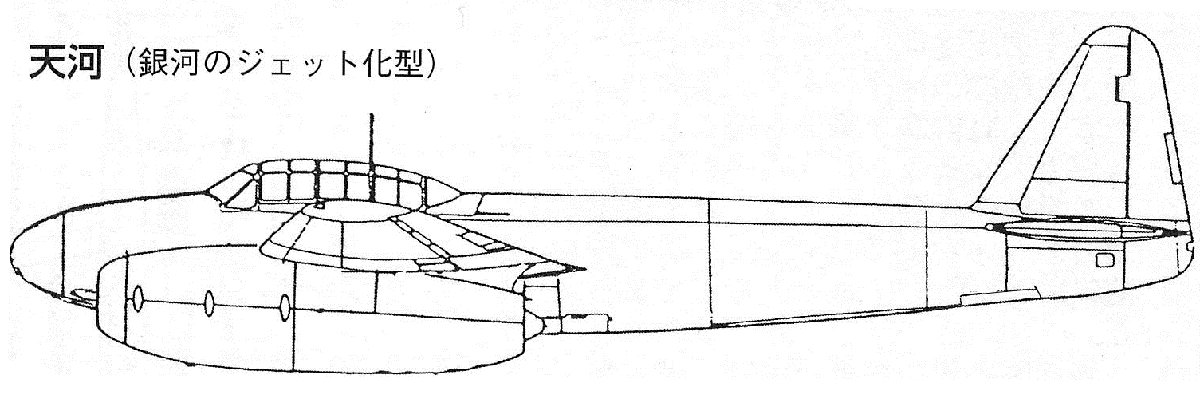
Tenga (天河) is a jet fighter-bomber and land bomber planned by the Imperial Japanese Navy.
Overview
The development of the Tenga was started in 1943, and continued in 1944 when the prototype model was reorganized, but it was still in the planning stage when the Pacific War ended. Some documents also claim that in 1945, a study group was set up at the arsenal to begin development of the Tenga.
The engines to be installed were either the Ne30 (TR30) axial-flow turbojet engine (thrust: 850 kg) developed by the arsenal or the Ne230 axial-flow turbojet engine (thrust: 885 kg) developed by Hitachi.
The Ginga was to be tested with the Ne 30, and a prototype of the Tenga was to be built later. Some sources claim that the Tenga was a direct jet version of the Ginga, which could be described as a Ginga Kai. The first Ne 30 was completed in October 1944, but was never fully tested before the end of the war.
Source : Japanese wikipedia
Overview
The development of the Tenga was started in 1943, and continued in 1944 when the prototype model was reorganized, but it was still in the planning stage when the Pacific War ended. Some documents also claim that in 1945, a study group was set up at the arsenal to begin development of the Tenga.
The engines to be installed were either the Ne30 (TR30) axial-flow turbojet engine (thrust: 850 kg) developed by the arsenal or the Ne230 axial-flow turbojet engine (thrust: 885 kg) developed by Hitachi.
The Ginga was to be tested with the Ne 30, and a prototype of the Tenga was to be built later. Some sources claim that the Tenga was a direct jet version of the Ginga, which could be described as a Ginga Kai. The first Ne 30 was completed in October 1944, but was never fully tested before the end of the war.
Source : Japanese wikipedia
blackkite
Don't laugh, don't cry, don't even curse, but.....
- Joined
- 31 May 2007
- Messages
- 9,515
- Reaction score
- 9,661
Attachments
blackkite
Don't laugh, don't cry, don't even curse, but.....
- Joined
- 31 May 2007
- Messages
- 9,515
- Reaction score
- 9,661
Attachments

blackkite
Don't laugh, don't cry, don't even curse, but.....
- Joined
- 31 May 2007
- Messages
- 9,515
- Reaction score
- 9,661
QAZ
Interested in Japanese jet development during WWII
I think it's possible that the large flying boat "K200" may have been a real project, because it is briefly referenced as a 200t jet-powered flying boat concept by historian Minoru Akimoto in his 2002 book 巨人機物語.
However, there are several things about this supposed project that I find pretty strange.
The designation "K200" is a type of designation called the Service Plane Prototype Plan Number (実用機試製計画番号). These were introduced around the start of the Pacific War and were assigned by the Navy. Each sequential project received a number incremented by 10. A modification to a project would be incremented by 1.
However, the highest Kawanishi project number that can seemingly be found is the K100 (17-Shi Land-based Bomber).
If "K200" was real, it would imply that there is an unknown K110, K120, [...] K190 between it. Not impossible but seems implausible.
Furthermore, it seems oddly coincidental that the number "K200" would be assigned to a 200t-class flying boat. I can't help but think this could be a speculative designation invented by some author.
K60, "K120", and "K200" are described in Hideki Sakurai's 2001 semi-fictional book 最終決戦兵器. In this book, K60 is described as an 80t flying boat, K120 is described as a 120t flying boat, and K200 as a flying boat powered by 6 turbojet engines (oddly it is assumed to be 60t here).
In reality, the adopted K60 plan seems to have had a mass of 120t, and the designation "K120" is probably a mistake caused by confusion, as there were multiple plans including K60 designs with a smaller mass. I also think it's highly likely that "K200" could be a fake or at least partially fabricated project.
Finally, the Navy briefly directing the development of a massive, turbojet powered flying boat in 1944 seems a bit bizarre and far-fetched, both considering the situation of materials at the time, and the impracticality of a flying boat powered by high-consumption turbojets. I would expect the range of such a plane to be unsatisfactory.
In my opinion, without further information, I can only say that "K60" and "KX-3" were definitely real. As mentioned, K60 was a real Navy project, while KX-3 was a design study ordered by the Navy.
However, there are several things about this supposed project that I find pretty strange.
The designation "K200" is a type of designation called the Service Plane Prototype Plan Number (実用機試製計画番号). These were introduced around the start of the Pacific War and were assigned by the Navy. Each sequential project received a number incremented by 10. A modification to a project would be incremented by 1.
However, the highest Kawanishi project number that can seemingly be found is the K100 (17-Shi Land-based Bomber).
If "K200" was real, it would imply that there is an unknown K110, K120, [...] K190 between it. Not impossible but seems implausible.
Furthermore, it seems oddly coincidental that the number "K200" would be assigned to a 200t-class flying boat. I can't help but think this could be a speculative designation invented by some author.
K60, "K120", and "K200" are described in Hideki Sakurai's 2001 semi-fictional book 最終決戦兵器. In this book, K60 is described as an 80t flying boat, K120 is described as a 120t flying boat, and K200 as a flying boat powered by 6 turbojet engines (oddly it is assumed to be 60t here).
In reality, the adopted K60 plan seems to have had a mass of 120t, and the designation "K120" is probably a mistake caused by confusion, as there were multiple plans including K60 designs with a smaller mass. I also think it's highly likely that "K200" could be a fake or at least partially fabricated project.
Finally, the Navy briefly directing the development of a massive, turbojet powered flying boat in 1944 seems a bit bizarre and far-fetched, both considering the situation of materials at the time, and the impracticality of a flying boat powered by high-consumption turbojets. I would expect the range of such a plane to be unsatisfactory.
In my opinion, without further information, I can only say that "K60" and "KX-3" were definitely real. As mentioned, K60 was a real Navy project, while KX-3 was a design study ordered by the Navy.
blackkite
Don't laugh, don't cry, don't even curse, but.....
- Joined
- 31 May 2007
- Messages
- 9,515
- Reaction score
- 9,661
The K-60 is a flying boat planned by the Imperial Japanese Navy. Some sources say that the K-60 was called the "17th Experimental Large Flying Boat," while others say that it was not given a military name.
Background
In June 1939, the Navy planned the development of the K-60 by Kawanishi Aircraft as a successor to the 12th Experimental Large Flying Boat (later the Type 2 Flying Boat) in the "Practical Aircraft Prototype Plan from 1939 to 1942." At this point, the K-60 was supposed to be a four-engine aircraft with a 2,000 hp engine, but in the original "Practical Aircraft Prototype Plan from 1941 to 1944" created in 1941, the plan was changed to a four-engine super-large aircraft with a 4,000 hp engine.
The performance requirements of the Naval General Staff included a maximum speed of 519 km/h (at an altitude of 5,000 m), a practical ceiling of 10,000 m, and a cruising range of 9,260 km or 10,733 km. In response to this, the Naval Air Headquarters prepared four proposals between June and September 1941, using Mitsubishi Heavy Industries' ME2A "Nu" liquid-cooled H-type 24-cylinder engine (takeoff power of 2,500 hp), ME3A "Wa" engine (takeoff power of 5,000 hp) consisting of two Nu engines connected in parallel, or "Ken-2" air-cooled double-row radial 18-cylinder engine (takeoff power of 2,400 hp).
The first plan was for four Wa-go,
the second plan was for two Nu-go and two Wa-go,
the third plan was for four Nu-go,
and the fourth plan was for four Ken-2-go.
The first plan was selected as the most suitable, ignoring budget and manufacturing capacity.
After that, Kawanishi was scheduled to start trial production, and in 1941 Kawanishi was ordered to prepare the basic design, but there were many technical problems, such as the Nu-go being unlikely to be completed. In addition, the actual experience of the Pacific War had led to changes in the intended uses of flying boats, and there was a shortage of materials, so at the end of 1942 (Showa 17), development was halted after only planning.
After the first plan was decided, the Naval Aviation Technical Arsenal was scheduled to complete the first unit in March 1945 (Showa 20), and Kawanishi was scheduled to complete the first unit at the end of September 1945.
Aircraft
The first draft of the K-60 was a super-large aircraft with a wing area 2.5 times larger and a total weight just under 3.9 times that of the HK2 flying boat, but no specific use was presented by the Navy, and Kawanishi assumed it would be used for transport between the Japanese mainland and the south.
The plan was to use laminar flow wings on the outer wings, and to use suction and blowing devices to control the boundary layer, thereby reducing the increased air resistance of the main wings by housing both the engine and the cooler within the main wings, and to blow cooling air out from the engine's forced cooling fan to the rear, improving performance. It was also considered to use a laminated wood propeller and a takeoff acceleration rocket.
The K-60 was said to be the largest flying boat ever designed by Japan, but since its development was kept a top military secret, no detailed documents remain.
Specifications (first draft, planned values)
Source: Giant Machine Story, pages 119-122.
• Length: 43.24 m
• Wing width: 60.0 m
• Wing area: 400.0 m2
• Weight: 61,500 kg
• Total weight: 120,000 kg
• Engine: Mitsubishi Wa-go liquid-cooled 48-cylinder (takeoff 5,000 hp) x 4
• Maximum speed: 561 km/h
• Cruising speed: 370 km/h
• Practical ceiling: 9,950 m
• Range: 11,038 km
• Armament:
• 2 x 20 mm twin machine guns
• 1 x 13 mm machine gun
• 8 x 7.7 mm machine guns
• 8,000 kg bombs or torpedoes
Background
In June 1939, the Navy planned the development of the K-60 by Kawanishi Aircraft as a successor to the 12th Experimental Large Flying Boat (later the Type 2 Flying Boat) in the "Practical Aircraft Prototype Plan from 1939 to 1942." At this point, the K-60 was supposed to be a four-engine aircraft with a 2,000 hp engine, but in the original "Practical Aircraft Prototype Plan from 1941 to 1944" created in 1941, the plan was changed to a four-engine super-large aircraft with a 4,000 hp engine.
The performance requirements of the Naval General Staff included a maximum speed of 519 km/h (at an altitude of 5,000 m), a practical ceiling of 10,000 m, and a cruising range of 9,260 km or 10,733 km. In response to this, the Naval Air Headquarters prepared four proposals between June and September 1941, using Mitsubishi Heavy Industries' ME2A "Nu" liquid-cooled H-type 24-cylinder engine (takeoff power of 2,500 hp), ME3A "Wa" engine (takeoff power of 5,000 hp) consisting of two Nu engines connected in parallel, or "Ken-2" air-cooled double-row radial 18-cylinder engine (takeoff power of 2,400 hp).
The first plan was for four Wa-go,
the second plan was for two Nu-go and two Wa-go,
the third plan was for four Nu-go,
and the fourth plan was for four Ken-2-go.
The first plan was selected as the most suitable, ignoring budget and manufacturing capacity.
After that, Kawanishi was scheduled to start trial production, and in 1941 Kawanishi was ordered to prepare the basic design, but there were many technical problems, such as the Nu-go being unlikely to be completed. In addition, the actual experience of the Pacific War had led to changes in the intended uses of flying boats, and there was a shortage of materials, so at the end of 1942 (Showa 17), development was halted after only planning.
After the first plan was decided, the Naval Aviation Technical Arsenal was scheduled to complete the first unit in March 1945 (Showa 20), and Kawanishi was scheduled to complete the first unit at the end of September 1945.
Aircraft
The first draft of the K-60 was a super-large aircraft with a wing area 2.5 times larger and a total weight just under 3.9 times that of the HK2 flying boat, but no specific use was presented by the Navy, and Kawanishi assumed it would be used for transport between the Japanese mainland and the south.
The plan was to use laminar flow wings on the outer wings, and to use suction and blowing devices to control the boundary layer, thereby reducing the increased air resistance of the main wings by housing both the engine and the cooler within the main wings, and to blow cooling air out from the engine's forced cooling fan to the rear, improving performance. It was also considered to use a laminated wood propeller and a takeoff acceleration rocket.
The K-60 was said to be the largest flying boat ever designed by Japan, but since its development was kept a top military secret, no detailed documents remain.
Specifications (first draft, planned values)
Source: Giant Machine Story, pages 119-122.
• Length: 43.24 m
• Wing width: 60.0 m
• Wing area: 400.0 m2
• Weight: 61,500 kg
• Total weight: 120,000 kg
• Engine: Mitsubishi Wa-go liquid-cooled 48-cylinder (takeoff 5,000 hp) x 4
• Maximum speed: 561 km/h
• Cruising speed: 370 km/h
• Practical ceiling: 9,950 m
• Range: 11,038 km
• Armament:
• 2 x 20 mm twin machine guns
• 1 x 13 mm machine gun
• 8 x 7.7 mm machine guns
• 8,000 kg bombs or torpedoes
QAZ
Interested in Japanese jet development during WWII
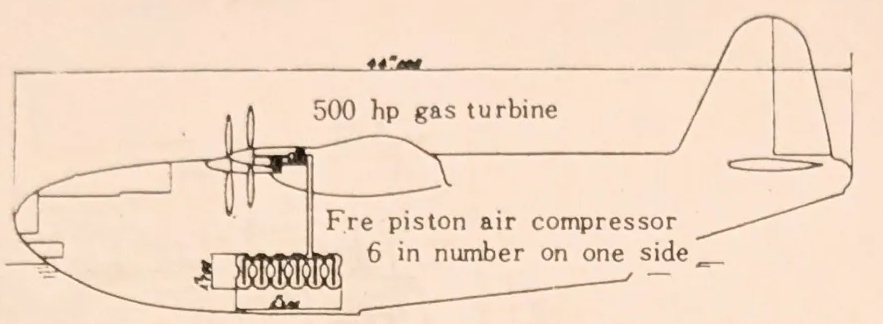
Here's a simple drawing of K60. This is the only drawn representation of this plane I have ever seen that actually comes from a wartime report. It was made by Captain Tokiyasu Tanegashima for a theoretical application of a turboprop engine he was studying at this time. Early on, he was considering the use of free piston gas compressors to feed aircraft turbine engines, rather than what would later become the conventional turboprop. "500" is a typo for "5000".

Airborne2001
ACCESS: Secret
- Joined
- 19 June 2020
- Messages
- 377
- Reaction score
- 541
I have waited YEARS for even just a basic diagram of the K-60. Thank you so much.View attachment 781196
Here's a simple drawing of K60. This is the only drawn representation of this plane I have ever seen that actually comes from a wartime report. It was made by Captain Tokiyasu Tanegashima for a theoretical application of a turboprop engine he was studying at this time. Early on, he was considering the use of free piston gas compressors to feed aircraft turbine engines, rather than what would later become the conventional turboprop. "500" is a typo for "5000".
Similar threads
-

-
-
-
 Kawanishi 9-Shi Night Recce Seaplane > Type 94 Transport Seaplane (E10K)
- Started by blackkite
- Replies: 3
-
 Nakajima Ki-201 Karyu and "J9N/J9Y" Kikka
- Started by Michel Van
- Replies: 145