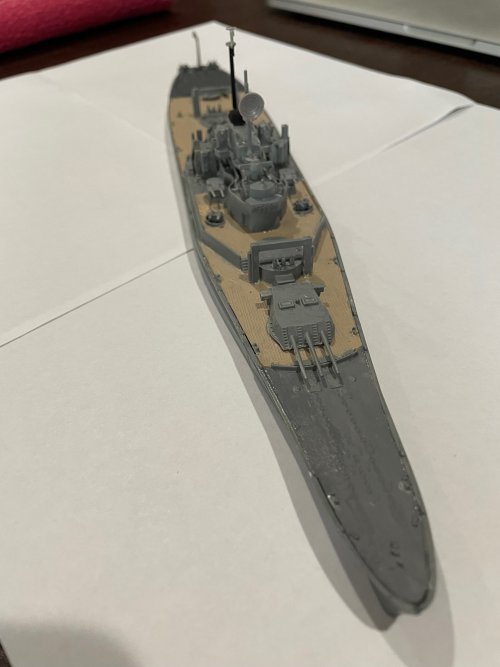
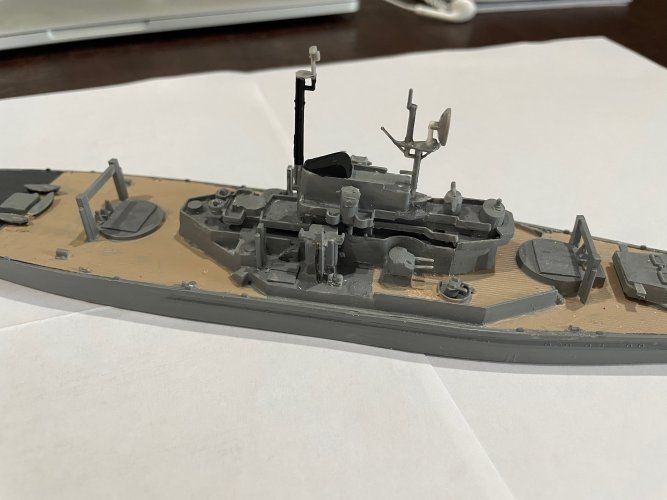
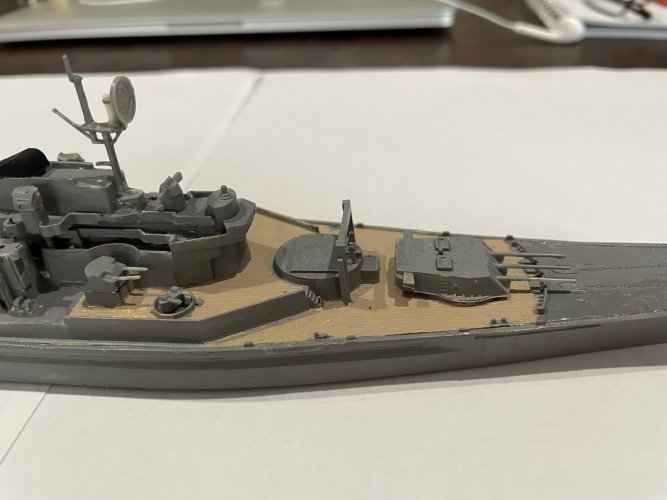
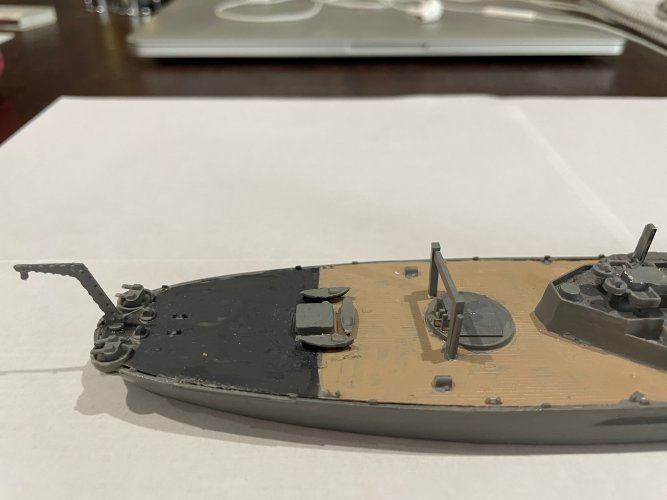
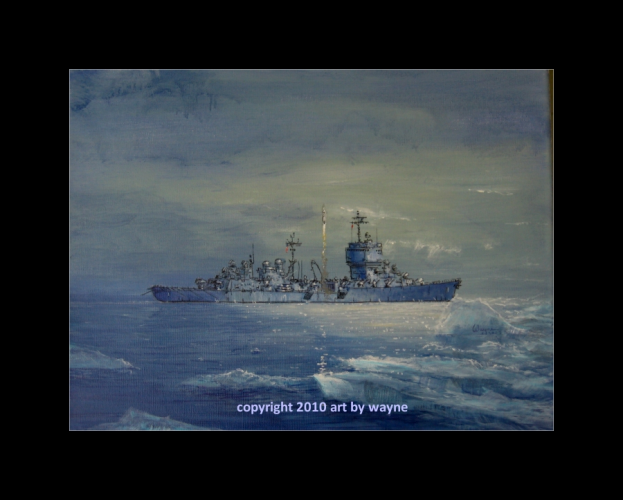
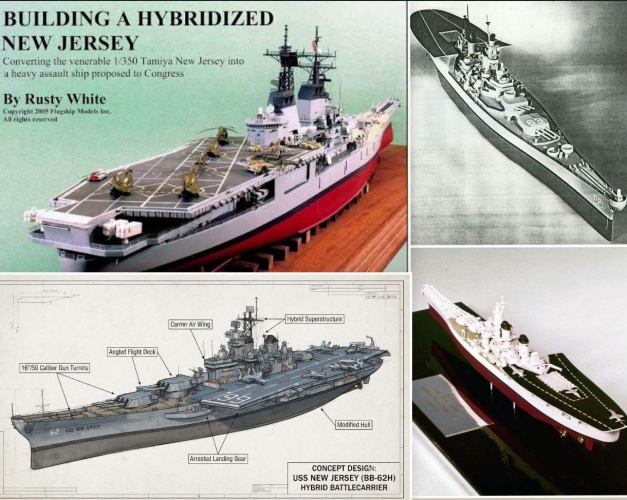
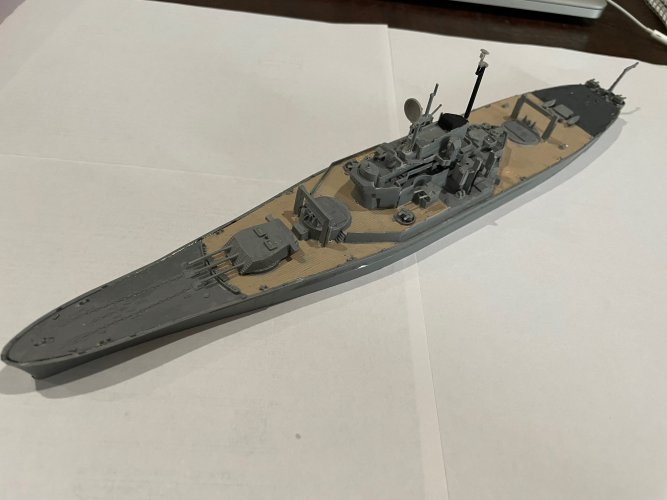
I thought I had shared this here, but cannot find such a post. My inventive idea for this concept, not really based on any actual plans,
A Massachusetts model with parts from the spares box.
The invisible part of the concept is removing the inner shafts and their engines and boilers to trade speed for storage space.
The forward turret is retained for protection of convoys against the hypothetical Soviet BBs and BCs.
 

Attachments

  • IMG_5315.jpeg
    IMG_5315.jpeg
    2.5 MB · Views: 234
  • IMG_5316.jpeg
    IMG_5316.jpeg
    2.5 MB · Views: 129
  • IMG_5317.jpeg
    IMG_5317.jpeg
    2.6 MB · Views: 113
  • IMG_5318.jpeg
    IMG_5318.jpeg
    2.4 MB · Views: 109
  • IMG_5319.jpeg
    IMG_5319.jpeg
    2.5 MB · Views: 125
For South Dakota and North Carolina such conversion was proposed, as of sketch drawings were produces that is unknown. For Iowa class the Iowa and Wisconsin was studied:

Friedman's statement:

View attachment 815967

View attachment 815968
Hypothetically speaking, if the incomplete Kentucky & Illinois had been converted to oilers while under construction, with no 16" guns or magazines, 2 shafts instead of 4, and an oiler- sized crew, would they have been able to carry significantly more oil than the proposed modification to Iowa & Wisconsin?
 
Hypothetically speaking, if the incomplete Kentucky & Illinois had been converted to oilers while under construction, with no 16" guns or magazines, 2 shafts instead of 4, and an oiler- sized crew, would they have been able to carry significantly more oil than the proposed modification to Iowa & Wisconsin?
LIkely but I do not know the internal volume of the Iowa class. You can check that as the plans are avaliable online.
 
Hypothetically speaking, if the incomplete Kentucky & Illinois had been converted to oilers while under construction, with no 16" guns or magazines, 2 shafts instead of 4, and an oiler- sized crew, would they have been able to carry significantly more oil than the proposed modification to Iowa & Wisconsin?
Sure, the unused enginerooms and boiler rooms would be available to use as oil stowage, if you ripped all the worky-bits out.

But the better use of Kentucky and Illinois engines and boilers is to drop them into the Sacramento-class AOEs.
 
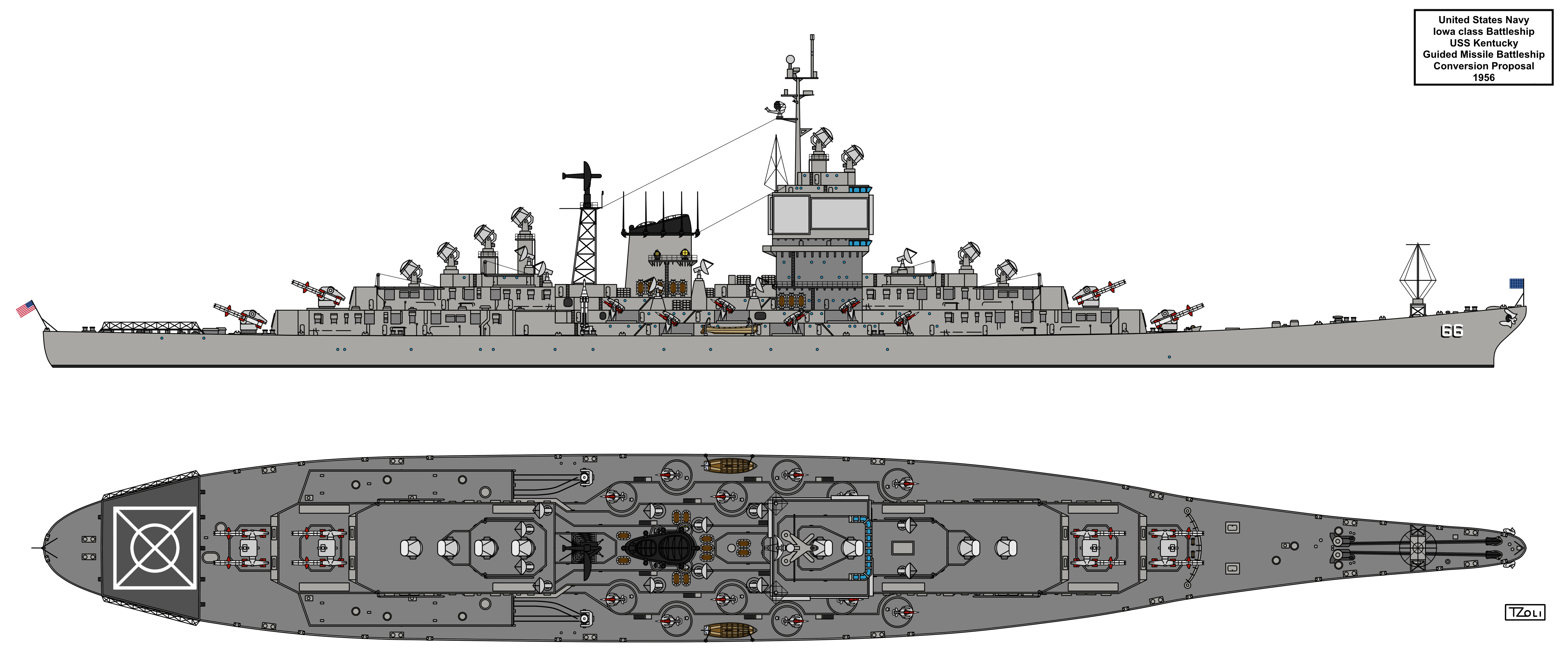
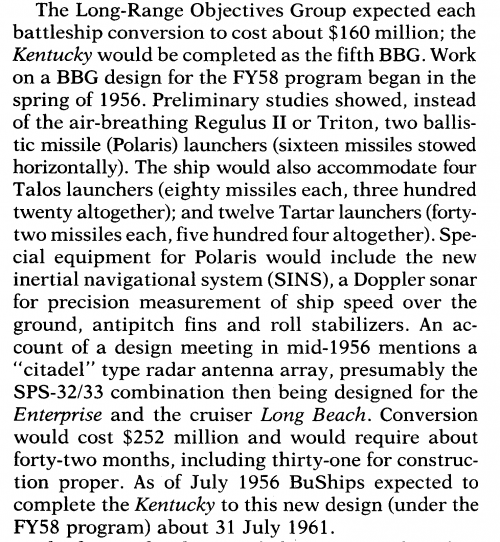
And the other Iowa BBG conversion at this time, the 1956 Kentucky BBG proposal:
https://www.deviantart.com/tzoli/art/USS-Kentucky-Guided-Missile-Battleship-1956-798556573
dd7fu71-ad7d8a82-3274-49d3-9e62-7f10645819bf.png


And the sensors:
SPS-12 - Surveillance radar
SPS-30 - Height finder radar
SPS-43 - Air search radar
12x SPG-51 - Tartar Illumination/tracking radars
8x SPG-49 - Talos Illumination/tracking radars
4x SPS-32 SCANFAR Search radars
4x SPS-33 SCANFAR Tracking radars
This looks seriously impressive.
 
It would definitely have been an impressive ship, although considering later experience I think they should have replaced one Tartar launcher per side with a 5"/54 Mark 42. Long Beach (CGN-9) originally didn't have any guns but they threw two 5"/38 enclosed single mounts on her because it was determined they were good to have for the naval equivalent of shooting at tin cans.
 
It would definitely have been an impressive ship, although considering later experience I think they should have replaced one Tartar launcher per side with a 5"/54 Mark 42. Long Beach (CGN-9) originally didn't have any guns but they threw two 5"/38 enclosed single mounts on her because it was determined they were good to have for the naval equivalent of shooting at tin cans.
I think I would have done two 5"/54 Mk42 per side. Because seriously, what threat would need 480x Tartar/Standards? Or a launch rate of 6 missiles every 6 seconds per broadside?
 
I think I would have done two 5"/54 Mk42 per side. Because seriously, what threat would need 480x Tartar/Standards? Or a launch rate of 6 missiles every 6 seconds per broadside?
The threat Yamato faced when sunk? Or a massive Tupolev bomber strike against the US mainland?
 
It would definitely have been an impressive ship, although considering later experience I think they should have replaced one Tartar launcher per side with a 5"/54 Mark 42. Long Beach (CGN-9) originally didn't have any guns but they threw two 5"/38 enclosed single mounts on her because it was determined they were good to have for the naval equivalent of shooting at tin cans.
To my knowledge it was President John Fitzgerald Kennedy's order, after he witnessed a wargame where one or two drone aircrafts could not be shot down by the entire fleet SAM system due to issues with lock-on and missile launcher errors and hence demanded a last ditch gun defense for every ship.
I've not yet found this exact wargame though.
 
The threat Yamato faced when sunk?
The combined strike of iirc 4 US carriers?


Or a massive Tupolev bomber strike against the US mainland?
Still talking about something that fought through ~320x Talos to meed all those Tartar/Standards. Even assuming abysmal 10% intercept rates, that's an attack on the order of 80-100 bombers/cruise missiles.
 
The combined strike of iirc 4 US carriers?


Still talking about something that fought through ~320x Talos to meed all those Tartar/Standards. Even assuming abysmal 10% intercept rates, that's an attack on the order of 80-100 bombers/cruise missiles.
Include fighter escorts and submarine launched missiles?
Friedman does not states the full reasoning. He does not even states the Tartar launcher types so it is even possible that twice the amount of Tartar launch rails we are talking about including twice the associated radars.
 
I think I would have done two 5"/54 Mk42 per side. Because seriously, what threat would need 480x Tartar/Standards? Or a launch rate of 6 missiles every 6 seconds per broadside?
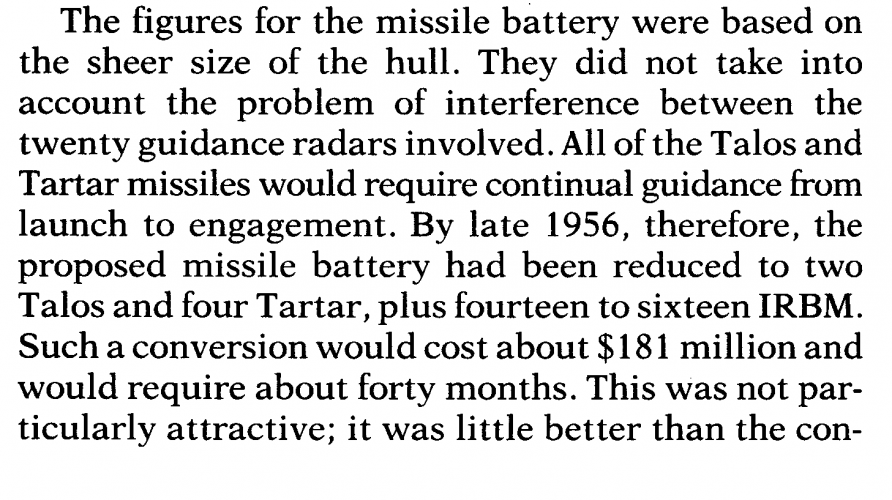
If I recall correctly, this proposal was actually based on what could be put on the hull, not from any realistic mission requirement. Very quickly the design was limited by fire control systems interfering with each other instead of by what type and how many launchers would fit.

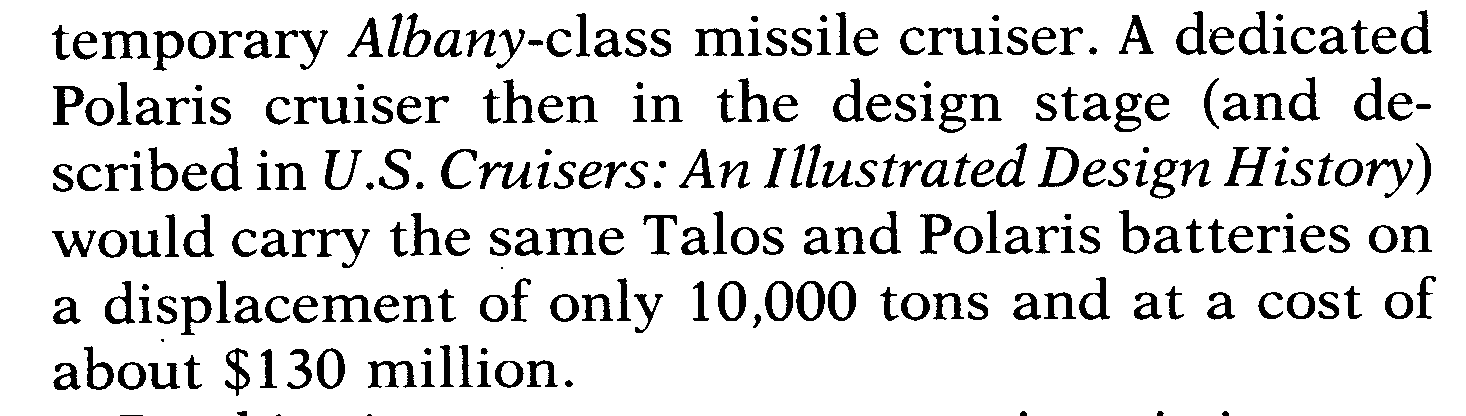
They ended up with the conclusion that if you had a practical layout for the fire control that actually made the launchers effective, you would not have more launchers on board then an Albany already had, except that you had the weight and volume reserves to put in Polaris or Regulus or something like it as well.

Do note that Tzoli's drawing above already has issues with the belowdeck components of launchers and directors pushing into missile magazines, which I am not sure about where the issue originates but it is in any case not an good representation of anything that would be build.
 
Include fighter escorts and submarine launched missiles?
Friedman does not states the full reasoning. He does not even states the Tartar launcher types so it is even possible that twice the amount of Tartar launch rails we are talking about including twice the associated radars.
Mk 13's were still fitted with 2 SPG-51 per launcher as the Mk 13's rate of fire and amount of missiles in the air was pretty close to the Mk 11, even if the Mk 11 had 2 launch rails. Exceptions are the Perry class (which does not use SPG-51 at all) and the Mk 22 (which had a lower rate of fire and a smaller magazine) which was combined with a single SPG-51 if I recall correctly. I can think of no exceptions to this rule.
 
This is from Friedman's US Battleships I presume?

I seem to recall a schematic of this design which had the Talos launchers aft side by side instead of stacked on top of each other. The concept art for an Iowa with SCANFAR that I have seen (which is of much later date so not sure how accurate it is) also shows this (I've attached it to this post)
 

Attachments

  • 1782572194520.png
    1782572194520.png
    648.1 KB · Views: 162
This is from Friedman's US Battleships I presume?

I seem to recall a schematic of this design which had the Talos launchers aft side by side instead of stacked on top of each other. The concept art for an Iowa with SCANFAR that I have seen (which is of much later date so not sure how accurate it is) also shows this (I've attached it to this post)
Yes
I've also seen art with the Long Beach Preliminary superstructure, the one with the octogon arrangement
 
To my knowledge it was President John Fitzgerald Kennedy's order, after he witnessed a wargame where one or two drone aircrafts could not be shot down by the entire fleet SAM system due to issues with lock-on and missile launcher errors and hence demanded a last ditch gun defense for every ship.
I've not yet found this exact wargame though.
No, the result of the failed 1962 demonstration was the 3T Get Well or Improvement programme led by the Surface Missile System Technical Planning
Group under Captain Robert Irvine. The result was the Standard family and an aborted Improved Talos project including new illuminators (SPG-61 or -51T), were the low manoeuvrability of the missile itself became the limiting factor. The guns were added for surface / shore targets.
 
I found this post in facebook about Iowa convertion, but is in spanish language. The author is a spanish named Nova Barcelona, and spanish are some gritty when write about military matters. The article have a less know image:
View: https://www.facebook.com/permalink.php?story_fbid=pfbid02XyZc8QavLNyekekWm7oozMPSURu4xfkGj8SYYpYULiPHfDbR5bt8n3fVpfqM6Me2l&id=100008694451112
1787148795986.png
 
The correct way to do it would be to make a sketch (for example, in Shipbucket's style in Paint) and feed it to AI to visualize. My personal experience is, that AI grasps technical ideas much better, when it have a picture to work with.

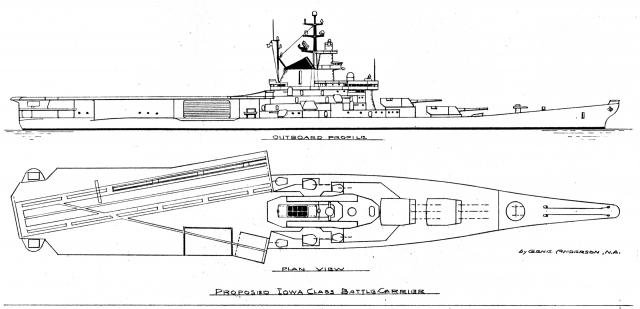
Maybe start with something that was actually proposed, such as the Gene Anderson proposal. OK, the Anderson proposal probably wouldn't have worked in reality, but it would be a better starting point than the above image.

DRW
 

Attachments

  • img021.jpg
    img021.jpg
    29.2 KB · Views: 76
There are some limited usages for AI in our area, such as converting blueprints into renderings for visualization, and STL files for 3D printing, but most of what's out there is bloody well nonsense.

As for building up the Kentucky (and perhaps Illinois) we need to look back at the time that would be happening. Big missiles needed big ships, and big ships were more stable and could carry larger magazines. As noted some of those designs ignored the reality of radar interference, so in the end the likeliest build for Kentucky would either have been one Talos each fore and aft with Tartars ports and starboard, but that's nothing more than an Albany. Given the number of battleships in reserve, did the Navy need another ship with big guns? There are no other battleship fleets by this time, the few remaining operated by allies or non-hostiles.
She also needs a very large crew complement, even without the many AA guns.

To have K and I built requires the Soviets to build their own BBs and BCs.

No battlecarriers either. Perhaps in the 1950s the BBH/BBL commando update with a helicopter deck and hangar, davits for boats, but even that ignores the many available flight decks. In the 1980s sticking aviation fuel and aircraft armament above the armored box renders the ship useless as a battle-ship, and operating aircraft requires maneuvering room that requires being away from the shore for bombardment.
 
As for building up the Kentucky (and perhaps Illinois) we need to look back at the time that would be happening. Big missiles needed big ships, and big ships were more stable and could carry larger magazines. As noted some of those designs ignored the reality of radar interference, so in the end the likeliest build for Kentucky would either have been one Talos each fore and aft with Tartars ports and starboard, but that's nothing more than an Albany. Given the number of battleships in reserve, did the Navy need another ship with big guns? There are no other battleship fleets by this time, the few remaining operated by allies or non-hostiles.
She also needs a very large crew complement, even without the many AA guns.
Exactly.

Can't fit any more missile systems than an Albany in the 1950s, and instead of ~1200 crew of the Albany you'd need about 1800-2000 crew for an Iowa. (1980s crew was 1800, I'm adding a few more to fit fins to the Talos)

Once the Mk11/Mk13s were available you might be able to do better. But you're still talking a lot more crew than any Cruiser in US service. The later nuclear cruisers, like the California-class, were actually down to around 600 crew.
 

Similar threads

Back
Top Bottom