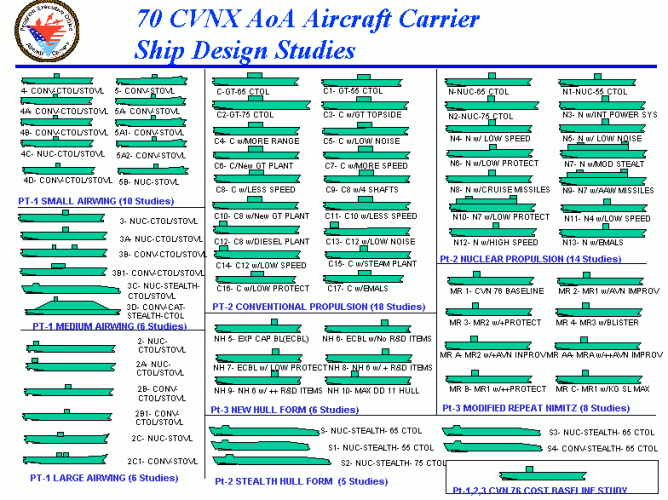
Entire QE program is 6 billion pounds, of which PoW(i.e. not lead ship) was ~2. I.e. a very good example of ship class which would indeed produce 8 ships in price of ~3, each of them having several times aviation capability of LHA.
Buying ships that cannot perform the missions asked of the Navy is a false economy, and the QEs as built cannot perform the missions the USN asks of its carriers. Just adding catapults is an extra couple of billion pounds.

If you want cheaper carriers, argue conventional supercarriers, not smaller carriers.
 
It's a very irrelevant capability difference in meaningful terms. LHA-6 and QE2 are broadly comparable in general terms. Both host about two or three squadrons of F-35B and both can support limited air mobile Marine operations.
If my memory serves me right, demonstrated flight tempo from LHAs is low twin digit sorties burst, single digit overtime. And doctrinal way to start generating sorties for marine air always was to drop off damn ship onto forward airstrip ASAP.

QE2 is designed for twice the airwing, but more importantly for ~160 sorties burst, high two digits continuous. This is almost CVN level, and order of magnitude more than landing ships.
It's another thing that UK can't afford to even fill them out, but principal design capability of big 80/20 flat deck is still there.
Buying ships that cannot perform the missions asked of the Navy is a false economy, and the QEs as built cannot perform the missions the USN asks of its carriers. Just adding catapults is an extra couple of billion pounds.
I won't insist, esp. since nothing prohibits placing catapults there(specific design in question was always meant for US cats).
But for STOVL specifically the catch is ability to fully employ already procured capability (F-35B) at sea. Ideally you can mix both, but cat-trap sets and different landing facilities will add significant premium.
 
Smaller CATOBAR fleet carrier is a false economy for the USN. This have been acknowledged, the inverse has been debunked, and only drones and new manufacturing process are bringing back a potential resurgence.

The US is not like the USSR where they could build 3 different frontline MBTs in parallel or the PLAN which spits out more seagoing steel than most European navies have every year. America’s industry is still dwindling, and their politicians are stupid, but the two has been excellent at building super carriers so leave it as be. As proven from historical rhetorics, if the USN ever buys CVLs it will pay with its big boats.
 
Perhaps future aircraft carriers will continue to develop in a larger direction...
 
The first two ships a still greatly compromised though, a different deck layout for example would go a very long way in generating superior sortie rates.

And while I understand your second point, I doubt having a lower tier CV fleet will result in the CVNs getting killed off altogether.

The killer advantage of the CVNs is CAG magazine depth, they can support full-intensity flight ops for at least two weeks.

The LHAs have magazines about 20 times smaller.
 
The killer advantage of the CVNs is CAG magazine depth, they can support full-intensity flight ops for at least two weeks.

The LHAs have magazines about 20 times smaller.
Also the CVNs don't have to have fuel bunkers to make the boat go. Enterprise had a lot more aviation fuel than the Kitty Hawks.
 
You also have the force multipliers a CVN carry.

Such as the E2 Hawkeye, IE a literal Eye of Sauron that can guide in all the Task Force weapons without showing were said task force is.

Or the new ASW Drones the USN is fucking with base off the Predator Family, that's going to make Sub lives FUN.

As seen by the French Charles. To get those you need to drop aircraft to use. Which cuts into the sortie rate and other issues as well. Big helps stops that since it's design for that.

Also both are outright impossible to launch from a QE LHA type.
 
Yes, but no as well. The US also did once studies that led towards ships like the Zumwalts which all three needed an in-depth modification to be even somewhat viable today.
If the USN had actually built all 30something planned Zs, the AGS would have been affordable. LRLAP is essentially a rocket-boosted Excalibur, so I'd expect prices comparable to Excalibur and not exceeding double the cost of Excalibur. The base ammo buy for ~30 ships would be ~18,000 rounds, just to load the ships. Plus at least that much more for a single reload. Likely on the order of 3-4 full reloads per ship for the total buy. That's more than twice the original planned buy for Excalibur, with according impacts on per-shell price.


Studies, especially studies done a good while ago, don't mean that circumstances haven't changed.
While true, the circumstances for "What makes a viable carrier" hasn't changed.
 
If my memory serves me right, demonstrated flight tempo from LHAs is low twin digit sorties burst, single digit overtime. And doctrinal way to start generating sorties for marine air always was to drop off damn ship onto forward airstrip ASAP.

QE2 is designed for twice the airwing, but more importantly for ~160 sorties burst, high two digits continuous. This is almost CVN level, and order of magnitude more than landing ships.
It's another thing that UK can't afford to even fill them out, but principal design capability of big 80/20 flat deck is still there.

The USN isn't going to increase the size of LHA wings to accommodate a bigger carrier, and you have to assume an identical amount of resources, so an LHA air wing on a QE2 does nothing but make a bigger ship.

It may not necessarily be bad, for example it could do the Sea Control mission of the LHAs, but it is wasteful when there is already a shortage of LHAs to CVNs. The biggest thing the QE does is automate a lot of tasks that are likely done by manned rates on the LHAs. This doesn't require an angled deck, or conventional carrier layout, but it might ask for more beam I suppose. The lack of a well deck and helicopter spots on the QE is rather concerning too.

For an assault carrier, which wears a second hat as a medium carrier, you'd want something more like Dual Tram Line or a twin angled QE.

The killer advantage of the CVNs is CAG magazine depth, they can support full-intensity flight ops for at least two weeks.

Absolutely not. They can support high intensity operations for about 5 days, maybe 6-7 (haha), as shown in the CVW9 demo in June 1997. You start running into UNREP bottlenecks after 96 hours though, where you spend more time replenishing ammo and spare parts than you do flying combat missions, but SGR is always asymptotic.
 
LHA-6 is basically a medium carrier, and costs about $3-4 billion, so you can get "about three" for a single Ford.
And the thing that really kills this idea? Three Flight-0 America class operating in the carrier role, still can't equal the combat capabilities of a single Ford. Their planes are shorter ranged, with smaller payloads, they can't operate AEW&C aircraft, and they lack the aviation stores storage capacity to sustain combat. Not to mention their sortie rate when operating as a full carrier is abysmal
 
And the thing that really kills this idea? Three Flight-0 America class operating in the carrier role, still can't equal the combat capabilities of a single Ford. Their planes are shorter ranged, with smaller payloads, they can't operate AEW&C aircraft, and they lack the aviation stores storage capacity to sustain combat. Not to mention their sortie rate when operating as a full carrier is abysmal

I have no idea what this means. The point is that there's no real reason to split the 11 LHAs and 11 CVNs into 8 CVNs and 2-3 CVVs, because you would just end up replacing the LHAs with a slightly better, but underutilized, flattop, or you'd end up with a worse CVN. It's probably true the USN can optimize its present air wing around a smaller carrier, but it also wants a bigger carrier plane, and it won't be increasing the size of USMC air wings to compensate for a larger LHA/CVV.
 
Last edited:
Keep the big CVNs, can carry a lot of fixed-wing fire power and they have been working fine for decades now. Now with that said, China developing and building an LHA-type ship with a single EMALS provides a catapult launch option and could give you a mixed CTOL and STOVL aircraft capability. They do have be careful in regards to aircraft recovery, I didn't look close at some of the recent images but I assume there are arresting cables? The nice thing about a CVN, you can carry a lot of fuel for the air wing, you don't have to worry about fuel for ship propulsion.
 
I have no idea what this means. The point is that there's no real reason to split the 11 LHAs and 11 CVNs into 8 CVNs and 2-3 CVVs, because you would just end up replacing the LHAs with a slightly better, but underutilized, flattop, or you'd end up with a worse CVN. It's probably true the USN can optimize its present air wing around a smaller carrier, but it also wants a bigger carrier plane, and it won't be increasing the size of USMC air wings to compensate for a larger LHA/CVV.
Idea was to split 11+11 into something more like 8+8+11. Aka get way more ships via few relatively dumber(but still big enough) vessels. 11 delivers ~3 deployed ships at sea, which at conjunctions now results in just 1 guaranteed ship on station (and zero near China). Yes, normal deployment math produce higher numbers, but as we can see, shit happens.

16 will bump said numbers to ~5 guaranteed at sea/3 guaranteed operational(1 near China?) for a similar situation. Which is a major boost.

Replacing 11 with 8+3 for slightly lower opex is of course terminally stupid.

p.s. splitting LHAs in a similar fashion (LHAs +fixed wing sea control/asw carriers) to get even more hulls § match USMC structure changes would also be a plan, but at this point it's clearly going to be shiplover talking in me offtop. Though I do think that optimization of fleet structure downwards intro more specialist ships would indeed help USN bring numbers up.
They of course want the opposite, but shipbuilding(and money) just aren't there.
 
Last edited:
Idea was to split 11+11 into something more like 8+8+11.

The economics of this won't work unless you increase the shipbuilding budget.

In which case you'll get more use by having 12+12 or 14+14 or something.

Aka get way more ships via few relatively dumber(but still big enough) vessels.

It's not about bigness. Steel and air are cheap. You can of course make ships cheap, but it requires actual sacrifices, in survivability and performance primarily. If the UK built every Invincible to the standard and equipment fits of Ocean, it might have had six to ten Invincibles instead of three, but no navy would make that trade. It would be stupid.

The actual American solution would be increasing the defense budget to a little over $1 trillion and sustaining that for a decade or two.

That will alleviate most of the supply problems for things like F-35 and also give shipyards the leverage to modernize and expand a bit. Buy a couple more carriers and you might come out with 12-13 carriers in the 2050s instead of the present 10-11. A 12x12 of CVNs and ARGs would meet all requirements for the foreseeable future, including war with China and simultaneous global response needs, and there's no particular reason to build past that. 8+8 would demand 16 LHAs, for instance, because every strike carrier needs a MEU ARG/ESG.

That's only slightly more likely as America canceling three Fords to pay for a new class of medium carrier it will buy eight of.
 
Last edited:
I have no idea what this means. The point is that there's no real reason to split the 11 LHAs and 11 CVNs into 8 CVNs and 2-3 CVVs,
If CVNs are too slow to build (or somebody doesn't fund them on time) a couple of CVVs might start making sense. Build them in South Korea lol.

Cant imagine why every carrier needs a matching ARG. A CVV would more likely reinforce an existing CBG so no need to expand the LHA fleet. I have to say, an America class would still make sense as a helicopter carrier for ASW or whatever, or the CVV might be exclusively a drone carrier. And F35B could do CAP or other things, it might not be a strike asset since theres already a CVN in the group.
 
Cant imagine why every carrier needs a matching ARG. A CVV would more likely reinforce an existing CBG so no need to expand the LHA fleet. I have to say, an America class would still make sense as a helicopter carrier for ASW or whatever, or the CVV might be exclusively a drone carrier. And F35B could do CAP or other things, it might not be a strike asset since theres already a CVN in the group.
It's not that each Carrier has a matching Amphib group. It's that the organization of the USMC requires 12 Amphib groups.

Honestly, I think that the US needs to build back up to 15 carriers, but that's going to take a while.
 
It's not that each Carrier has a matching Amphib group. It's that the organization of the USMC requires 12 Amphib groups.

Honestly, I think that the US needs to build back up to 15 carriers, but that's going to take a while.
Might not be happening while China dumping US Treasury Bonds...
 
Might not be happening while China dumping US Treasury Bonds...
Thing is, China owes the US almost as much as the US owes China. Technically it's the debts of the 1912 Republic of China, but the PRC's One China Policy means that it's the debt of the PRC. So if China tries to call the debt, the US just writes off an equal amount of PRC debt.
 
That would backfire big time on the PRC and as Scott pointed out the US has the means to do so.
But thats not whats happening. They are just selling and pressuring Chinese banks not to renew their US bond investments. So it qill soak upliquidity in Europe where the bond must be going.
 
Honestly, I think that the US needs to build back up to 15 carriers, but that's going to take a while.
Doubtful they Navy can actually handle the manpower demand of even more carriers, and doubtful the Navy gets the money for this. The US cannot even effectively keep 11 CVNs active these days, having such abysmal maintenance schedules and crew rotation that overstretching a deployment has become the new normal, rather than an exception. Trying to increase the Fleet to 15 Ford Class CVNs would ultimately break the US Navy in this day and age. A force that is already struggling with maintaining what they have, replacing what they have to retire and retaining the qualified personelle on and off their ships. In short, it's not feasible and the USN is most likely very aware of this.
 
If CVNs are too slow to build (or somebody doesn't fund them on time) a couple of CVVs might start making sense.
How is adding a second class going to speed up the production of the first? If you don't have the money to build CVNs fast enough, where are you going to get the extra money for another class of carriers? Just dump whatever resources you would use for this imaginary class into the CVNs. THAT would speed up the process.
 
Doubtful they Navy can actually handle the manpower demand of even more carriers, and doubtful the Navy gets the money for this. The US cannot even effectively keep 11 CVNs active these days, having such abysmal maintenance schedules and crew rotation that overstretching a deployment has become the new normal, rather than an exception. Trying to increase the Fleet to 15 Ford Class CVNs would ultimately break the US Navy in this day and age. A force that is already struggling with maintaining what they have, replacing what they have to retire and retaining the qualified personelle on and off their ships. In short, it's not feasible and the USN is most likely very aware of this.
It's amusing how people seem to think budgets can't change. Compare the Carter years to the Reagan years.
 
It's amusing how people seem to think budgets can't change. Compare the Carter years to the Reagan years.
It's amusing how people seem to think budgets can just increase, increase, increase, increase without consequences and that everyone, including in the government, just nods and goes along. There are many things the US (Navy) needs and can afford and operate. 15 CVNs is just unrealistic, borderline unreasonable even. A country with very limited ship building, a country where nuclear reactors are a bottleneck for systems that are powered by them, a country and Navy that has barely enough qualified people right now, having trouble to keep these people within the Navy.

The reasons for why this is unrealistic are numerous and substantial. The reasons for it boil down to "it would be kinda cool" and not much else. I'm sure if you ask the right person they'll tell you the Navy needs 100 CVNs.
 
It's amusing how people seem to think budgets can just increase, increase, increase, increase without consequences and that everyone, including in the government, just nods and goes along. There are many things the US (Navy) needs and can afford and operate. 15 CVNs is just unrealistic, borderline unreasonable even. A country with very limited ship building, a country where nuclear reactors are a bottleneck for systems that are powered by them, a country and Navy that has barely enough qualified people right now, having trouble to keep these people within the Navy.

The reasons for why this is unrealistic are numerous and substantial. The reasons for it boil down to "it would be kinda cool" and not much else. I'm sure if you ask the right person they'll tell you the Navy needs 100 CVNs.
Yeah, we didn't even get 15 as part of Lehman's 600-ship navy plan during the Reagan years. 12 is doable though. The rest of that can be changed.
 
Yeah, we didn't even get 15 as part of Lehman's 600-ship navy plan during the Reagan years. 12 is doable though. The rest of that can be changed.
An increase from 11 to 12 can be done, totally agreed. As for the rest being able to change, in theory yes. But I currently don't see the USN on a trajectory that facilitates that necessary change. And, which is kinda what I was alluding towards the whole time, it may be more reasonable to adapt to the current situation and procure accordingly, than hoping for a miracle change with regards to US shipbuilding, personelle retention and enlistment to facilitate this. I think you have a lot of optimism and believe in the competence of the Navy, I'm on the other hand rather pessimistic about it when I look at how bad it got even during my limited lifetime. So you're not conceptually wrong, I just don't see it happening any time soon.
 
An increase from 11 to 12 can be done, totally agreed. As for the rest being able to change, in theory yes. But I currently don't see the USN on a trajectory that facilitates that necessary change. And, which is kinda what I was alluding towards the whole time, it may be more reasonable to adapt to the current situation and procure accordingly, than hoping for a miracle change with regards to US shipbuilding, personelle retention and enlistment to facilitate this. I think you have a lot of optimism and believe in the competence of the Navy, I'm on the other hand rather pessimistic about it when I look at how bad it got even during my limited lifetime. So you're not conceptually wrong, I just don't see it happening any time soon.
Yeah, the rot is far deeper than just hiring more people. It will take a generation of effort to fix. (And I have NO confidence in the Navy at the moment.)
 
Focusing on carrier size is probably not the right lens. IMHO the biggest issue with Ford is the technological choices which drive up cost & complexity.

I'd love to see a cost vs. capability analysis between a modern Kitty Hawk-sized conventional carrier (~85,000t full load) and a Ford. Take out the most expensive and sophisticated pieces of kit which account for over 30% of Ford's cost (nuclear propulsion, electromagnetic weapons elevators, EMALS, AAG etc). Bring back steam cats (powered by auxiliary steam boilers) and hydraulic arrestor gear. Install the same manpower and cost-saving technologies already in CVF (manpower reduction, gas turbine/diesel propulsion etc). Perhaps expand fuel bunkerage a little to reduce concerns about replenishment (also serves as a torpedo protection belt)... if cheaper use the Ford hull, flight deck and combat system as a starting point, changing propulsion & internal arrangements only.

How much cost could you shave without significantly impacting capability? How much could the build rate be accelerated by adopting a modular build leveraging non-nuclear yards (further reducing costs)? How many extra CVs could you then afford? What would be the capability and vulnerability benefit of having more decks (e.g. more dual carrier ops vs. single carrier ops today)?

IMHO it's unlikely that Ford would come out as the right choice.
 
Last edited:
Focusing on carrier size is probably not the right lens. IMHO the biggest issue with Ford is the technological choices which drive up cost & complexity.

I'd love to see a cost vs. capability analysis between a modern Kitty Hawk-sized conventional carrier (~85,000t full load) and a Ford. Take out the most expensive and sophisticated pieces of kit which account for over 30% of Ford's cost (nuclear propulsion, electromagnetic weapons elevators, EMALS, AAG etc). Bring back steam cats (powered by auxiliary steam boilers) and hydraulic arrestor gear. Install the same manpower and cost-saving technologies already in CVF (manpower reduction, gas turbine/diesel propulsion etc). Perhaps expand fuel bunkerage a little to reduce concerns about replenishment (also serves as a torpedo protection belt)... if cheaper use the Ford hull, flight deck and combat system as a starting point, changing propulsion & internal arrangements only.

How much cost could you shave without significantly impacting capability? How much could the build rate be accelerated by adopting a modular build leveraging non-nuclear yards (further reducing costs)? How many extra CVs could you then afford? What would be the capability and vulnerability benefit of having more decks (e.g. more dual carrier ops vs. single carrier ops today)?

IMHO it's unlikely that Ford would come out as the right choice.

"I'd love to see a cost vs. capability analysis between a modern Kitty Hawk-sized conventional carrier (~85,000t full load) and a Ford. "

100% guarantee it's been covered in at least two studies and been found wanting. The one where the Nimitz class was conceived and the one for Ford. Probably the best real-world comparison would be Enterprise vs America / JFK. (CVN-65 vs CV-66/67.) So the USN already had real world experience to go from when designing the Nimitz and Ford classes. And they went with 100k ton nuclear both times.

There is more to "cost" than money. Sure, you save a few bucks up front, but what does it cost you in capability for the half century it will be in service? There's a reason they keep going with nuclear for carriers whenever possible.
 
Last edited:
@H_K I don't think ditching EMALS would be viable tbh. It's just that much more versatile and outright better than steam cats (which is why Chinese CV, LHD and the future French CVN adopt it too). Cutting nuclear propulsion is certainly a big cost saving factor and doesn't put even more stress on the reactor supply chain and qualified nuclear personelle. In essence we're talking about a US version of Fujian here. But could the US construct such a ship and actually end up vastly cheaper? After all no ship constructed in the US and by US citizens is cheap. I personally think America Class LHA with a single EM cat and angled deck would ultimately be better if it's just about cost, compared to a conventional Ford Class CV, so to speak.
 
@H_K I don't think ditching EMALS would be viable tbh. It's just that much more versatile and outright better than steam cats (which is why Chinese CV, LHD and the future French CVN adopt it too). Cutting nuclear propulsion is certainly a big cost saving factor and doesn't put even more stress on the reactor supply chain and qualified nuclear personelle. In essence we're talking about a US version of Fujian here. But could the US construct such a ship and actually end up vastly cheaper? After all no ship constructed in the US and by US citizens is cheap. I personally think America Class LHA with a single EM cat and angled deck would ultimately be better if it's just about cost, compared to a conventional Ford Class CV, so to speak.
No RCOH is a couple billion less lifetime just to start. We know how much more expensive nuclear reactors are compared to gas turbines. And the operational cost gap was nearly $30 million a year per carrier back in the steam days and would be assuredly less now that we don't have to deal with steam. The numbers are all out there and publicly available.

So yes, there would be significant cost savings, both up front and over the lifetime of the ship. The question is whether it's worth the loss of capability involved.
 
Actually, Americans might not have a choice. Does the US even still have a steam catapult industry?
CVN-77 is going to be operating till ~2060 so at minimum the maintenance know-how and parts supply is being maintained somewhere. So it becomes a question of building new steam catapults... given that an EMALS shipset costs over $1B there's ample opportunity to pay someone to restart production, especially since NAVSEA owns the C-13 catapult technology.
 
Guess what the USN decided. Twice.
Pretty much! When people with a lot more experience and better analytical tools say what the answer is, I tend to listen. I just think it's a lot more of a debate than smaller carriers.
 
CVN-77 is going to be operating till ~2060 so at minimum the maintenance know-how and parts supply is being maintained somewhere. So it becomes a question of building new steam catapults... given that an EMALS shipset costs over $1B there's ample opportunity to pay someone to restart production, especially since NAVSEA owns the C-13 catapult technology.
Let's go back to coal-fired boilers too, because reasons.
 
Doubtful they Navy can actually handle the manpower demand of even more carriers, and doubtful the Navy gets the money for this. The US cannot even effectively keep 11 CVNs active these days, having such abysmal maintenance schedules and crew rotation that overstretching a deployment has become the new normal, rather than an exception. Trying to increase the Fleet to 15 Ford Class CVNs would ultimately break the US Navy in this day and age. A force that is already struggling with maintaining what they have, replacing what they have to retire and retaining the qualified personelle on and off their ships. In short, it's not feasible and the USN is most likely very aware of this.
That can be addressed, and in fact is in process. Chasing out a thousand places where there's a billion dollars in fraud, waste, and abuse happening in the government finances means there's a trillion dollars "more" than can be spent on the required infrastructure and personnel. (how much FW&A did DOGE find? only 215bn so far?)

The major issue I can see is the time between launching one ship and laying down the next. It's been ~2 years (ignoring 2020) from Ford launched to JFK laid down, and from JFK launched to Enterprise laid down. Why is there a 2 year gap? I am assuming that there is a need for a gap to reset the big drydock, but how fast can that really be done? 6 months? 1 month?

Reducing that time to one year between launching one carrier and laying down the next and doing nothing else would bring Enterprise in 2030, Doris Miller in ~2035, Clinton in 2040, W in about 2045. A new carrier every 5 years. Not every 10.

If we can reduce the time needed for construction from 8 years to 7 starting with Doris Miller on top of reducing the time between launching and laying down by a year, we'd be looking at 2034, 2038, and 2042-43. If we can reduce the time for construction starting with Enterprise (there's still ~half the ship to build) we'd bring those deliveries forward another year and get ahead of the shrinking carrier fleet. A new carrier delivered every ~4 years.
 

Similar threads

Back
Top Bottom