Yes, because CGBL was explicitly about providing a comparator for other cruiser design projects, while MEU was serious enough to have artwork generated. They provide context for where thinking was when SC-21 started.
Ok I wasn’t even going to bother engaging with this anymore because it’s so removed from FFG(X) it isn’t funny, but this is so egregious I can’t ignore it. MEU was the government equivalent of “make me something cool” except it had a purpose: demonstrate what technology will be available in the coming years. The artwork depicts laser weaponry with ~30 degrees arcs to port iirc and similar to starboard, a flight deck (as if the navy didn’t have any of those), and the list goes on. The artwork is not indicative of an intention to build the things, it is essentially government marketing. That does not mean the Navy intends to build the thing, they have no use for such a platform same way they had no use for the SL-7 battlecruiser or the oft feted DOD war plans for a zombie apocalypse. This still happens today, exploration of future LSC technology has been happening for the past 25 years to varying degrees even though none of them were actually laid down. We just don’t know about them because they are sensitive programs directly pertaining to DDG(X).
No one else will get the topic back on track so I will. Here are the facts:
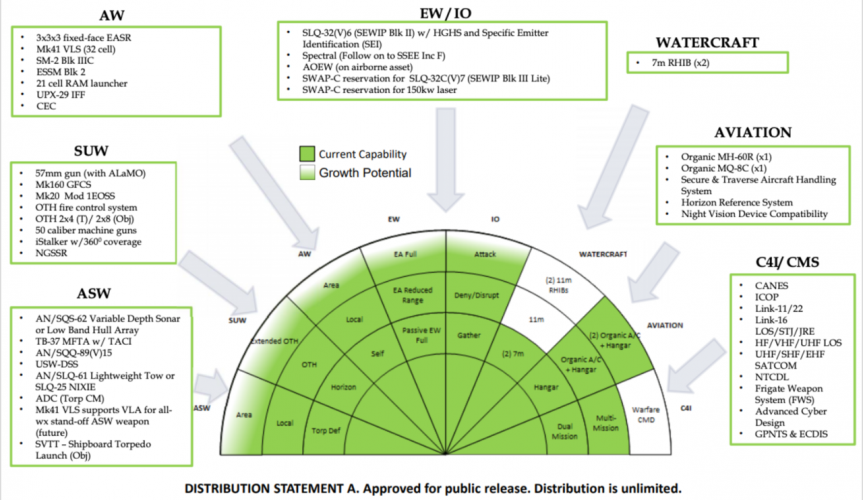
1) the Constellation class program was formulated to create an ASW focused, but multi-mission capable frigate. To this end it was required to have a series of high end systems primarily so it could work with a CSG in high threat environments and independently during peacetime/LIC.
The attached image is a handy starting point for understanding desired capability.
2) Constellation was to be acquired by modifying an existing design. To this end five designs were down selected. We know the most about FMM (as it was selected) and BIW thanks to that_person (who has sadly left SPF). This was chosen to speed up and simplify the acquisition process but this has/was criticised due to exacting but logical American requirements not fitting well to foreign designs. As Kat Tsun pointed out, American naval yards operate differently to foreign naval yards. Where American naval yards mostly serve the military, foreign naval yards serve both military and civil clients leading to less stringent requirements for foreign ships. FREMM is a good example of this. As standard she features only 80% the bulkheads required for a US Navy design. Another example is the Fridtjof Nansen class which used commercial grade pumps and equipment (in part leading to the loss of the Helge Insted).
2.1) The process for initial entry development, as reported by the head of BIW’s bid, was very good. It featured excellent communication of requirements through monthly meetings and consultation. Bidders were able to craft their entry specifically to Navy requirements. It was also assumed that entries would comply with the level II survivability standards required, as outlined in OPNAV 9070. Further accepting a contract creates a legal obligation to meet these requirements or face penalties. FMM and NAVSEA must have both believed their design could meet these requirements.
2.2) FMM’s entry was the closest to what the Navy wanted, in theory. In hindsight it is fair to say they didn’t understand the scope of changes required for their design to meet OPNAV 9070 and NAVSEA failed to recognise this to their detriment. NAVSEA absolutely should’ve caught that and sought some sort of solution before selecting FMM but it is still fundamentally the responsibility of the contractor. FMM had never designed a platform above level I survivability standard which likely contributed significant to this failure. It is important to note that selection is not a choice between finished designs. With the benefit of hindsight it is fair to say that FMM was likely the wrong choice. While their design has the least compromises (particularly IEP), they required the greater number of changes. My personal opinion remains that the BIW design, while lacking optimal range and IEP, was the best choice as per that_person’s discussion with the BIW lead.
2.3) An often repeated argument is that changing NAVSEA requirements led to the FMM entry going from 85 to 10% parts commonality with the original design. This does not make sense, it is never mentioned in senate reports nor by the GAO. So what went so wrong? Well, as mentioned before, FMM obviously underestimated the changes required to bring their design to level II survivability standards. These changes ultimately reduced commonality far more than the mythical changing NAVSEA requirements. This is a common theme. FMMs LCS were always delivered late, the Freedom class was hundreds of tons overweight and littered with quality control issues.
2.4) I once again point everyone towards that_person’s post to explore alternatives to FMM’s entry:
https://www.secretprojects.co.uk/threads/ffg-x.33649/post-857076
3) Why it went wrong is fairly obvious with the benefit of hindsight. FMM didn’t understand their own entry and NAVSEA under appreciated the scope of changes required to the FREMM hull. However that does not negate the simple fact that the FFG(X) program requirements are neither superfluous or arbitrary. As demonstrated by Zumwalt when she was undergoing testing with a CSG, allowing an extra Burke to operate in the air warfare role instead of as an ASW picket is extremely beneficial to protecting the carrier asset that forms the crux of fleet striking power. this requirement is still filled, I suppose we can assume early model Burkes will be retailed once DDG(X) comes online but I digress, that is irrelevant. This role is not negated, as some have claimed, by the lack of a bow sonar. Explicitly going forward Connie would function as a node for off ship systems rather than hunting and killing submarines herself. Further, while a bow sonar is indeed nice to have, the VDS and TA are the significantly more valuable shipboard sensors and the hybrid drive makes it far quieter than the Burke. Hence it is the superior choice for ASW.
3.1) As for the aforementioned “independent operations”, Connie was not envisaged as a ship to subdue Houthi type threats alone, the size of the platform alone makes her inadequate for the task. Her magazine depth is not for fulfilling the role of a Burke (or DDG(X)) but supplementing them and filling gaps they cannot. Independent operations are not dissimilar to standard peacetime Burke duties, allowing Burkes to operate at a lower tempo. During operations similar to what was seen during Desert Shield Constellation provides a greater degree of self defence capability than LCS while providing greater flexibility than a Burke. Ultimately all three platforms, LCS for minesweeping, surface warfare and aviation support, Constellation for ASW l, surface warfare, and local air defence, and, Burke for large scale air defence, would provide a formidable force. Constellation in bridges the gap between the LCS and Burke lessening LCS reliance on the Burke air defense umbrella and allowing the area access mission.
Constellation is not a convoy escort ship in the traditional sense. The Navy explicitly states that her role as an escort is for logistics ships that are supporting combat operations in low and medium intensity conflict zones, as stated in 2017. Planning states that other ships will be diverted along less threatened SLOCs in safer waters to reduce strain on the fleet. This is aided by the the locales America is expected to fight her next major wars in and the relative forces levelled against her.
4) It is most likely Constellation was cancelled as it is viewed as an inoffensive and easy political win. There is also a not insignificant group who wish to cancel it in favour of Golden Dome and other systems that reduce Americas global presence while ideally “protecting the homeland”, as evidenced by this article:
https://www.defenceconnect.com.au/n...tion-frigate-program-ahead-of-strategic-shift
This decision may not be at all rational and given all indications I find it highly unlikely that this was directed by the navy. I do not seek to debate this point, only to acknowledge it as a significant factor. This decision is a mistake. True, as I have already gone over, it was not an excellent program at the time of cancellation but it was past the worst and was finally nearing its potential. The core of the ship is such that the systems are proven and hence many likely complications have been foreseen and accounted for.
4.1) Why is it invaluable? Simple, there is no other ship to fill its place. More Burkes is an unacceptable choice, Burke is coming to a close. That is why DDG(X) is a non negotiable program. At best a Connie replacement SSC is 4-5 years of refinement and design away providing no meaningful time advantage over Connie herself. There is also no platform that can be modified within this timeframe with the growth potential of Connie. As mentioned previously the Navy needs a ship to fill Constellation’s projected spot and there’s no ship for the job but Constellation.
4.2) This opens the door to a purpose built and designed American FFG which, while I wholeheartedly endorse, doesn’t address operational requirements now or indeed within the next 10 years. Procuring Constellation first is both the logical and only practical choice.