
You are using an out of date browser. It may not display this or other websites correctly.
You should upgrade or use an alternative browser.
You should upgrade or use an alternative browser.
F-35 if was airforce only
- Thread starter Cjc
- Start date

Largely the same as it is now - the F-35A is arguably the least compromised of all variants.

Colonial-Marine
UAVs are now friend, drones are the real enemy.
- Joined
- 5 October 2009
- Messages
- 1,717
- Reaction score
- 1,827
Maybe a few inches greater overall length.
Maybe Lockheed would have gone with a V-tail similar to what the McDonnell Douglas or Northrop envisioned in their various fighter designs during that time.
Maybe Lockheed would have gone with a V-tail similar to what the McDonnell Douglas or Northrop envisioned in their various fighter designs during that time.
Would probably have ended up something more akin to the Joint Advanced Strike Technology (JAST)

- Joined
- 3 October 2007
- Messages
- 1,960
- Reaction score
- 1,286
Actually,IIRC,. USAF and USMC were working on a joint aircraft using the DARPA-developed lift/fan fuel tank concept. Their requirements, aside from range and type of, were pretty similar and that's what made it feasible. The big compromises came when the decision to make a carrier capable version as well (type of approach, required strength of pitch control, visibility over the nose, provision for internal stronger structure, etc.).
Colonial-Marine
UAVs are now friend, drones are the real enemy.
- Joined
- 5 October 2009
- Messages
- 1,717
- Reaction score
- 1,827
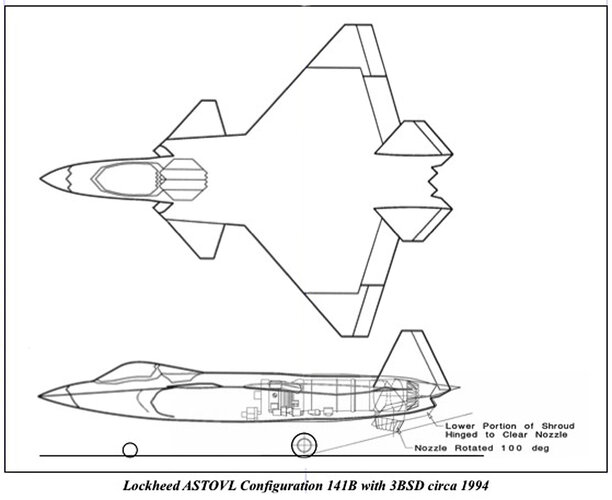
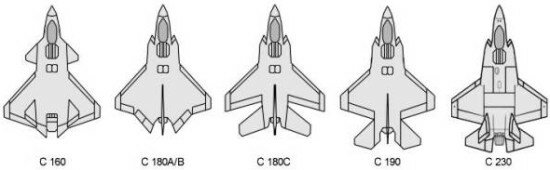
I believe that would be CALF which built upon the ASTOVL project. If they went forward without the CATOBAR requirement the Lockheed design would look quite different. Probably very close to their "Configuration 160" design which was the last before the addition of a carrier variant to the picture.Actually,IIRC,. USAF and USMC were working on a joint aircraft using the DARPA-developed lift/fan fuel tank concept. Their requirements, aside from range and type of, were pretty similar and that's what made it feasible. The big compromises came when the decision to make a carrier capable version as well (type of approach, required strength of pitch control, visibility over the nose, provision for internal stronger structure, etc.).
As explained to me by someone here the canard layout was better for the limited length imposed by the requirement it fit within a LHA/LHD elevator. When Lockheed switched to a layout with a more conventional tail performance probably suffered somewhat due to having to work within those dimensions.
So without the STOVL requirement I think a conventional layout would be selected by Lockheed, probably resembling a smaller, single engine F-22 in some respects as the F-35 does.
Judging from other projects Northrop's design (assuming they don't end up a supporting member in a team) would probably look a lot like a smaller F-23 with chin intake.
I'd imagine McDonnell's design would end up pretty similar to their JAST design but I could be wrong.
No guess as to what Boeing does.
Attachments
Last edited:

- Joined
- 29 November 2010
- Messages
- 2,306
- Reaction score
- 5,276
that could be another interesting "what if"Actually,IIRC,. USAF and USMC were working on a joint aircraft using the DARPA-developed lift/fan fuel tank concept. Their requirements, aside from range and type of, were pretty similar and that's what made it feasible. The big compromises came when the decision to make a carrier capable version as well (type of approach, required strength of pitch control, visibility over the nose, provision for internal stronger structure, etc.).
USN decides to go all into the STOVL concept. only As and Bs are acquired. Future carrier fleet will consists of Bs and Ospreys (cargo, awacs and tanker variants). Ford ends up being a large Queen Elizabeth.
Two-seater variants have been replaced by ground-bound simulators for the pilot-training role.I would think a two-seat variant would have gone ahead unabated and with that other specialised variants derived...
Regards
Pioneer
These days, a two-seater would only be useful for electronic counter-measures.
- Joined
- 21 May 2006
- Messages
- 3,262
- Reaction score
- 2,885
Exactly what I was insinuating my dear riggerrob , as well as SEAD perhaps.....I would think a two-seat variant would have gone ahead unabated and with that other specialised variants derived...
Regards
Pioneer
These days, a two-seater would only be useful for electronic counter-measures.
Regards
Pioneer
Jumping from here: Trillion Dollar Trainwreck: How the F-35 Hollowed out the US Air Force by Bill Sweetman
Assuming the AIr Force goes alone and develops the F-35 (lets say McD wins with "F-24") alone, what does the Navy and Marines/UK do? What do their designs look like?
Assuming the AIr Force goes alone and develops the F-35 (lets say McD wins with "F-24") alone, what does the Navy and Marines/UK do? What do their designs look like?
Last edited:
Scott Kenny
ACCESS: USAP
- Joined
- 15 May 2023
- Messages
- 19,656
- Reaction score
- 28,137
If it was just USAF, I suspect that the F-35 would be several feet longer. Because it was the USMC that forced the short length due to LHA elevators. Closer to Legacy Hornet size than F-16.
If it was the original USAF/USMC proposal, it'd stay about the same length, but likely be a canard version to make the overall packaging work better.
Marines and UK would likely go with something like the P1216. Not stealthy but still VSTOL.
If it was the original USAF/USMC proposal, it'd stay about the same length, but likely be a canard version to make the overall packaging work better.
Navy would probably have A/F-X replacing the A-6 and F-14.Assuming the AIr Force goes alone and develops the F-35 (lets say McD wins with "F-24") alone, what does the Navy and Marines/UK do? What do their designs look like?
Marines and UK would likely go with something like the P1216. Not stealthy but still VSTOL.
insidersource
ACCESS: Top Secret
- Joined
- 24 March 2025
- Messages
- 521
- Reaction score
- 745
Jumping from here: Trillion Dollar Trainwreck: How the F-35 Hollowed out the US Air Force by Bill Sweetman
Assuming the AIr Force goes alone and develops the F-35 (lets say McD wins with "F-24") alone, what does the Navy and Marines/UK do? What do their designs look like?
The X-35 and X-32 flew in 2000. The contracts for the X-32 and X-35 were awarded in 1996. So I will assume this as the decision starting point. We would have been far better off with 3 different aircraft than the F-35.
USAF
The USAF would have gone back to the Multi-Role Fighter MRF designs. This program ran between 1990-1993. These designs all used a single F119 engine from the F-22. The USAF might have used the F-16 cockpit with the APG-80 AESA radar used on the Block 60 F-16 that were delivered in 2003. It would have resulted in a design lighter, faster and cheaper than the F-35A. It would have entered service 5+ years earlier than the F-35A.
https://www.globalsecurity.org/military/systems/aircraft/mrf.htm
Marines and UK Navy
The AV-8B was in production until 2003. The UK Navy and Marines would have then ordered more Harriers. The AV-8B Harrier II Plus had the APG-65 radar from older hornets. The Harrier cockpit could have had a refresh with three MFDs like the Hornet. An automated hover system could be added for a massive improvement in safety. The same small APG-80 AESA radar could have been fitted. The engine thrust and fuel efficiency improved by 10% with no weight increase to the aircraft. This aircraft could have been called the AV-8C Harrier III
With the money saved the Marines could have developed a small two seat tilt rotor attack aircraft instead of the AH-1Z Viper attack helicopter. It would have had greater range and endurance than the Harrier and Cobra. The two seat cockpit will be great for close air support. The US Army probably have purchased this tilt rotor attack aircraft for CAS and tank busting and the USAF could have retired the A-10 fleet.
US Navy
In 1996 the US Navy was about to order the Super Hornet with the intention it was going to be short term solution. The Navy would have gone back to the A/F-X studies from 1993. The A (attack) coming before the F (fighter) means a focus on long range ground attack over dog fighting.
https://www.globalsecurity.org/military/systems/aircraft/a-x.htm
This resulting aircraft would have been larger and longer ranged than the F-35C and it would have had a two seat cockpit. I picture a larger F-35C powered by two F110 engines. Using the twin seat cockpit from the Super Hornet with a larger APG-77 radar from the F-22. It would have arrived 5+ years before the F-35C. Every carrier would now have a squadron of these 1,000nm combat radius stealth strike aircraft. Perfect for a Pacific's conflict.
The US military would be vastly more capable now.
I also think the USAF would have purchased this large twin engine twin seat Navy fighter. The current USAF fleet would look like the following:
200 F-22 stealth single seat air dominance
300 A/F-X stealth long range twin seat strike fighter.
1500 MRF affordable stealth single seat strike fighter.
Australia for example would have ordered the A/F-X to replace its F-111 fleet. The lighter MRF would have replaced its Hornets. Most of Europe would have gone with the MRF. It would have been highly exportable as it would have been the low end aircraft in the USAF fleet. This means less ITAR restrictions.
The fact that both the F-16 and F-15 are still in production shows how the F-35A was a train wreck and it did hollow out the USAF.
Last edited:
Scott Kenny
ACCESS: USAP
- Joined
- 15 May 2023
- Messages
- 19,656
- Reaction score
- 28,137
Or something from CALF, though that was shared with the Marines.The X-35 and X-32 flew in 2000. The contracts for the X-32 and X-35 were awarded in 1996. So I will assume this as the decision starting point. We would have been far better off with 3 different aircraft than the F-35.
USAF
The USAF would have gone back to the Multi-Role Fighter MRF designs. This program ran between 1990-1993. These designs all used a single F119 engine from the F-22. The USAF might have used the F-16 cockpit with the APG-80 AESA radar used on the Block 60 F-16 that were delivered in 2003. It would have resulted in a design lighter, faster and cheaper than the F-35A. It would have entered service 5+ years earlier than the F-35A.
https://www.globalsecurity.org/military/systems/aircraft/mrf.htm
Disagree here, even the Harrier II was a 1950s design, just with 40 years development and some advances in materials carrying it.Marines and UK Navy
The AV-8B was in production until 2003. The UK Navy and Marines would have then ordered more Harriers. The AV-8B Harrier II Plus had the APG-65 radar from older hornets. The Harrier cockpit could have had a refresh with three MFDs like the Hornet. An automated hover system could be added for a massive improvement in safety. The same small APG-80 AESA radar could have been fitted. The engine thrust and fuel efficiency improved by 10% with no weight increase to the aircraft. This aircraft could have been called the AV-8C Harrier III
IMO the better bet would have been to run with the BAe P1216 (or 1214 for the forward-swept wings and smaller spot factor). That was a 1970s/80s design.
I doubt that the Corps could have afforded developing an attack tilt-rotor solo, regardless of the amount of money saved. Even if the XV-15 basically was that thing already.With the money saved the Marines could have developed a small two seat tilt rotor attack aircraft instead of the AH-1Z Viper attack helicopter. It would have had greater range and endurance than the Harrier and Cobra. The two seat cockpit will be great for close air support.
And that would likely run immediately afoul of the Key West Agreement and have hit pieces put out by USAF, Inc., just like the AH-56 did.The US Army probably have purchased this tilt rotor attack aircraft for CAS and tank busting and the USAF could have retired the A-10 fleet.
I was leaning more towards a fully stealthy Tomcat, but yes it'd be a big beast. IIRC both the NG and LockMart proposals for A/F-X were swing-wings.US Navy
In 1996 the US Navy was about to order the Super Hornet with the intention it was going to be short term solution. The Navy would have gone back to the A/F-X studies from 1993. The A (attack) coming before the F (fighter) means a focus on long range ground attack over dog fighting.
https://www.globalsecurity.org/military/systems/aircraft/a-x.htm
This resulting aircraft would have been larger and longer ranged than the F-35C and it would have had a two seat cockpit. I picture a larger F-35C powered by two F110 engines. Using the twin seat cockpit from the Super Hornet with a larger APG-77 radar from the F-22. It would have arrived 5+ years before the F-35C. Every carrier would now have a squadron of these 1,000nm combat radius stealth strike aircraft. Perfect for a Pacific's conflict.
Maybe? USAF does not like buying Navy planes if they can avoid it. Might see one of the FB-22 proposals happen instead, probably the one with space for a 5000lb on the centerline, flanked by a pair of 2000lb bombs. Not sure if they stretched the side bays enough for AMRAAMs in that.I also think the USAF would have purchased this large twin engine twin seat Navy fighter.
Very likely correct, though I have a question about the Oz Hornets: what were they bought to replace, again? Mirage III?Australia for example would have ordered the A/F-X to replace its F-111 fleet. The lighter MRF would have replaced its Hornets. Most of Europe would have gone with the MRF. It would have been highly exportable as it would have been the low end aircraft in the USAF fleet. This means less ITAR restrictions.
- Joined
- 5 May 2007
- Messages
- 2,018
- Reaction score
- 4,280
P.1214 and P.1216 are really the same line - the forward-swept wing version of P.1214 was a dead end and the later work was done under P.1216. It died in 1986-1987 when the UK decided to go ahead with Eurofighter instead.IMO the better bet would have been to run with the BAe P1216 (or 1214 for the forward-swept wings and smaller spot factor). That was a 1970s/80s design.
For the USMC and Royal Navy, you're certainly looking at something out of the ASTOVL/SSF/CALF lineage. The two services trying to do that alone without a stakeholder with more funding is... challenging. The logic of CALF and the Air Force version actually seems pretty unassailable to me, and I think that effort swallowing up MRF is pretty likely. Which leaves the USN on the outside, trying to push ahead with A/F-X. Which would be very capable, but I have a hard time seeing them getting a larger, more capable aircraft into service earlier than the F-35C.
As far as the RAF goes, I think their thoughts are illustrated by the fact that (1) ASTOVL and CALF didn't include them, and (2) the RAF planned on buying more Eurofighters than they needed to replace the remaining Phantoms, Buccaneers and Jaguars - with the excess equating to the number of Harriers. No evidence on that point, but it's a gap that's wiggling its eyebrows at me.
yeetmahboi
ACCESS: Top Secret
- Joined
- 6 April 2022
- Messages
- 1,025
- Reaction score
- 1,435
It's pretty hard to build a stealth F-16 in an age of austerity. The logic around JSF is that the crowd of stakeholders will drive cost down. Cut that precondition out and you lose the other half of the clause.
The only way AF gets its own single F135 strike fighter if there was a threat to validate that need. Else you get F16XLs. In retrospect more warmed over F-16s might have been better. Of course freed cash might have been wasted elsewhere. The peace dividend era was a real pariah global military development when the lack of threats drove a technological jump ahead (ultimately failed, but by external factor) to maintain superiority for some 40 years. Then you got J-20.
The only way AF gets its own single F135 strike fighter if there was a threat to validate that need. Else you get F16XLs. In retrospect more warmed over F-16s might have been better. Of course freed cash might have been wasted elsewhere. The peace dividend era was a real pariah global military development when the lack of threats drove a technological jump ahead (ultimately failed, but by external factor) to maintain superiority for some 40 years. Then you got J-20.

- Joined
- 11 February 2007
- Messages
- 4,146
- Reaction score
- 8,894
See the Advanced Harrier Projects thread for what was actually being discussed, Harrier III Low, Medium and High, Harrier 21 and Sea Harrier 3A, B and P.1227.Marines and UK Navy
The AV-8B was in production until 2003. The UK Navy and Marines would have then ordered more Harriers. The AV-8B Harrier II Plus had the APG-65 radar from older hornets. The Harrier cockpit could have had a refresh with three MFDs like the Hornet. An automated hover system could be added for a massive improvement in safety. The same small APG-80 AESA radar could have been fitted. The engine thrust and fuel efficiency improved by 10% with no weight increase to the aircraft. This aircraft could have been called the AV-8C Harrier III
AV-8C was an upgraded AV-8A.
Scott Kenny
ACCESS: USAP
- Joined
- 15 May 2023
- Messages
- 19,656
- Reaction score
- 28,137
Tragic. Aside from the coolness of the FSW of P1214, the more important part to me is the better spot factor. P1214 with wings folded was smaller than a Harrier, IIRC.P.1214 and P.1216 are really the same line - the forward-swept wing version of P.1214 was a dead end and the later work was done under P.1216. It died in 1986-1987 when the UK decided to go ahead with Eurofighter instead.
I mean, they did successfully drag Harrier to completion without a bigger-budget stakeholder.For the USMC and Royal Navy, you're certainly looking at something out of the ASTOVL/SSF/CALF lineage. The two services trying to do that alone without a stakeholder with more funding is... challenging. The logic of CALF and the Air Force version actually seems pretty unassailable to me, and I think that effort swallowing up MRF is pretty likely.
But I suspect that CALF would win over MRF. Assuming 1:1 replacement of AV-8B and Sea Harrier, you're looking at an additional ~500 airframes to sell, potentially. Maybe another 150 if you can convince RAF to buy.
Helps that the decision is getting made a couple years sooner.Which leaves the USN on the outside, trying to push ahead with A/F-X. Which would be very capable, but I have a hard time seeing them getting a larger, more capable aircraft into service earlier than the F-35C.
Not sure Eurofighters are really a replacement for Buccaneers or Jaguars, but sure, RAF can dream.As far as the RAF goes, I think their thoughts are illustrated by the fact that (1) ASTOVL and CALF didn't include them, and (2) the RAF planned on buying more Eurofighters than they needed to replace the remaining Phantoms, Buccaneers and Jaguars - with the excess equating to the number of Harriers. No evidence on that point, but it's a gap that's wiggling its eyebrows at me.
I suspect they'd get permission to 1:1 the Lightnings (finally) and Phantoms. Buccs and Jags would more likely get caught up in the US CALF buy, and if RAF is buying CALF for Buccs and Jags it's buying CALF for Harrier. Maybe the RAF will even preserve the VSTOL capabilities of Harrier, though the UK doesn't really have an operational need for that anymore. Not like the USMC does with the Harrier or F-35 half-squadron getting assigned to the MEU.

- Joined
- 6 September 2006
- Messages
- 5,316
- Reaction score
- 11,545
I suspect without F-35B the RAF ignores the RN and pushes for FOAS to be funded instead to replace the Tornado.
The RAF didn't officially join Future Carrier Borne Aircraft (FCBA) until 2001 - promptly becoming Future Joint Combat Aircraft (FJCA). FJCA and CVF overlapped with FOAS. The RN's solution was Joint Force 2000 – a CVF-based FAA/RAF FJCA force with the implication that the RAF should defer FOAS until 2020. Once politically locked into this compromise the RAF made sure that F-35B was acquired so that it didn't clash with Typhoon or FOAS. Of course as we know now that 2020 postponement meant death for the FOAS programme. Without JSF and some serious haggling and analysis of carrier versus land-based airpower (shades of 1966) then its possible the RAF would have won out with FOAS. What that would have looked like is a whole other what-if story. But the RN may well have still tagged onto whatever US VSTOL programme remained for the USMC.
The RAF didn't officially join Future Carrier Borne Aircraft (FCBA) until 2001 - promptly becoming Future Joint Combat Aircraft (FJCA). FJCA and CVF overlapped with FOAS. The RN's solution was Joint Force 2000 – a CVF-based FAA/RAF FJCA force with the implication that the RAF should defer FOAS until 2020. Once politically locked into this compromise the RAF made sure that F-35B was acquired so that it didn't clash with Typhoon or FOAS. Of course as we know now that 2020 postponement meant death for the FOAS programme. Without JSF and some serious haggling and analysis of carrier versus land-based airpower (shades of 1966) then its possible the RAF would have won out with FOAS. What that would have looked like is a whole other what-if story. But the RN may well have still tagged onto whatever US VSTOL programme remained for the USMC.
- Joined
- 5 May 2007
- Messages
- 2,018
- Reaction score
- 4,280
Discussed in the RAF 1990s thread. The plan seems to have been that the Tornado ADV would replace the Lightnings and most of the Phantoms - which happened. Eurofighter was always meant to be multirole, and would replace the remaining Phantoms and Jaguars, and probably release two squadrons of Tornado IDS to replace the maritime strike Buccaneers. Which still left ~50 Eurofighters looking for a home.I suspect they'd get permission to 1:1 the Lightnings (finally) and Phantoms. Buccs and Jags would more likely get caught up in the US CALF buy, and if RAF is buying CALF for Buccs and Jags it's buying CALF for Harrier. Maybe the RAF will even preserve the VSTOL capabilities of Harrier, though the UK doesn't really have an operational need for that anymore. Not like the USMC does with the Harrier or F-35 half-squadron getting assigned to the MEU.
Force reductions at the end of the Cold War meant that plan fell by the wayside, of course. I bring it up here mostly to illustrate that the numbers didn't add up, and the gap is Harrier-sized. Using Eurofighter (by then Typhoon) as the Tornado replacement, rather than alongside Tornado, eliminated that gap.
I've never been entirely clear on what FOAS was supposed to be. I suspect that part of the postponment was that the RAF wasn't sure, either.I suspect without F-35B the RAF ignores the RN and pushes for FOAS to be funded instead to replace the Tornado.
yeetmahboi
ACCESS: Top Secret
- Joined
- 6 April 2022
- Messages
- 1,025
- Reaction score
- 1,435
I still think the Marines could've gotten a STOVL plane. Most of the stuff they ask for they usually get in the end. Maybe some of the Harrier 21 proposals. Maybe a SDLF plane. Maybe they throw STOVL under the bus and buy light carriers.
The question is that will the RN accepts a non stealthy STOVL strike fighter. Or will they go for Rafale or naval EF?
I like the idea of a KF-21 program some 20 years prior. JAST could be used to mature technologies like affordable, scalable VLO, PGMs and sensors. An uprated F100/110 for the initial lot with upgrade paths for more powerful follow on engines like a multinational funded 3 stream.
USAF could buy a supersonic A/F-X to replace F-15E and slot in the RTS role. Invite the RAF to participate and the RAAF as well as their F-111 fleet wore out.
The question is that will the RN accepts a non stealthy STOVL strike fighter. Or will they go for Rafale or naval EF?
I like the idea of a KF-21 program some 20 years prior. JAST could be used to mature technologies like affordable, scalable VLO, PGMs and sensors. An uprated F100/110 for the initial lot with upgrade paths for more powerful follow on engines like a multinational funded 3 stream.
USAF could buy a supersonic A/F-X to replace F-15E and slot in the RTS role. Invite the RAF to participate and the RAAF as well as their F-111 fleet wore out.
insidersource
ACCESS: Top Secret
- Joined
- 24 March 2025
- Messages
- 521
- Reaction score
- 745
OrdersIt's pretty hard to build a stealth F-16 in an age of austerity. The logic around JSF is that the crowd of stakeholders will drive cost down. Cut that precondition out and you lose the other half of the clause.
F-35A: 2800 aircraft
F-35B: 500 aircraft
F-35C: 350 aircraft
75% of the order book is for the A model. There was more than enough customer demand for a non compromised version that would have been a better stealthy F-16 replacement.
The USAF MRF proposals were F119 powered. They were sleaker, lighter and faster than the F-35A. Most likely greater export potential.The only way AF gets its own single F135 strike fighter if there was a threat to validate that need
Both the Rafale and Eurofighter aren't stealthy. The US built AV-8 Harrier II already had a big wing compared to the British Harriers. Add the tweaked engines and a small APG-80 AESA radar and it would probably have the best radar of any fighter in Europe.The question is that will the RN accepts a non stealthy STOVL strike fighter. Or will they go for Rafale or naval EF?
I do not think the air frame is that important. Avionics and sensors would make the Harrier very modern and lethal. A full digital cockpit in the Harrier with automated hover, a small AESA radar and targeting pod. Then add the 10% fuel burn and thrust improvements and it would be a cheap upgrade. The UAE funded the block 60 F-16 development including the small AESA radar, cockpit displays and the improved thrust GE engine.Disagree here, even the Harrier II was a 1950s design, just with 40 years development and some advances in materials carrying it.
Remember only 500 F-35B have been ordered.
The AH-1Z Viper helicopter was effectively a full cleansheet attack helicopter. Cancelling both the AH-1Z and F-35B would easily be able to pay for an upgraded Harrier and small tilt rotor.I doubt that the Corps could have afforded developing an attack tilt-rotor solo, regardless of the amount of money saved. Even if the XV-15 basically was that thing already.
I wonder what happens when they fit weapons on the V-280. That would be a breach due to the speed.And that would likely run immediately afoul of the Key West Agreement and have hit pieces put out by USAF, Inc., just like the AH-56 did.
Only one of the 5 teams had swing wing. The swing wing Lockheed submission was based off the NATF which was based off the YF-22 and was deemed unsuitable due to weight.I was leaning more towards a fully stealthy Tomcat, but yes it'd be a big beast. IIRC both the NG and LockMart proposals for A/F-X were swing-wings.
In 1990 the Navy had two clean sheets stealth programs NATF and A-X. One was subsonic ground attack and the other was a Mach 2+ air to air fighter. When the Navy decided to merge to a single new aircraft it really does require a cleansheet design.
Trying to add payload volume and range to the supersonic fighter quickly exceeds the carrier weight limits. Trying to make a subsonic ground attack design fly supersonic by adding afterburner engines is also a bad decision. This drawing below was flight tested and is probably the most accurate to what would meet the requirement.
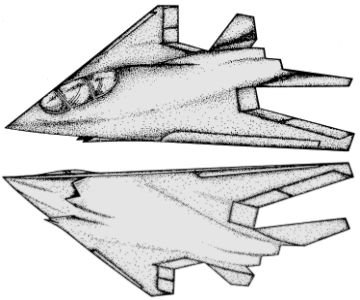
Obviously this design wouldn't hit Mach 2 but it would have similar speeds to a loaded Super Hornet. Sufficient speed, stealthy, long range, large payload. Compromises have to be made to fit on the carrier.
I think this design planned to use afterburner F412 engines which was meant to have 24,000lb of thrust. The F414 used the larger core of the F412 but with a small diameter fan to fit inside the same footprint of the F404. The F412 had a larger fan and higher bypass ratio for improved fuel efficiency and was planned to used in the subsonic A-12. Adding an afterburner would create an engine half way between the F414 and F110 in size and thrust.
While this Navy design would be incredibly slow compared to the F-22. But as a replacement for the A-6 intruder this new design would be a rocket ship.
The USAF was actually looking at the US Navy A/F-X as a F-111 replacement. So the payload and range must have been very decent. The FB-22 proposals no doubt would have retained high speed. I rank the slower A/F-X design higher as it's more optimised for the light bomber role.Maybe? USAF does not like buying Navy planes if they can avoid it. Might see one of the FB-22 proposals happen instead, probably the one with space for a 5000lb on the centerline, flanked by a pair of 2000lb bombs. Not sure if they stretched the side bays enough for AMRAAMs in that.
Yes Mirage III. I think the RAAF would have been fine with a smaller USAF MRF to replace the Hornets and the larger Navy A/F-X would be an even better replacement for the F-111 than the F-35A could ever be.Very likely correct, though I have a question about the Oz Hornets: what were they bought to replace, again? Mirage III?
Last edited:
Similar threads
-
-
alternate British airforce proposal
- Started by Cjc
- Replies: 0
-
-
-
"The steal of the century" - South Korea KF-X screws the F-35, 2030...
- Started by Archibald
- Replies: 6