Continued production of B-52

Cjc

ACCESS: Secret
Joined
15 October 2021
Messages
486
Reaction score
451
I was curious if there were any ideas about how b-52 production could be continued after its OTL discontinuation date (1962). I would imagine it is probably not possible to have production countiue until today (like with the tu-95 or h-6) but I think if the b-70 program had been shut down earlier or if the b-52 as a conventional bomber had been proven earlier the production could countiue until the 70's.

What do ya'll think.
 
The USAF doesn't seem to have been interest in trickle-building B-52s - all 102 B-52Hs were built in a 15-month span, and while this is faster than most of the production run it's not that much faster.
 
As I understand it, LeMay wanted to continue production, but the Kennedy admin (McNamara again?) overruled. Personally I think it was a mistake; I think stopping production of a capability until it's replacement is in production is foolish. By that logic, the B-52 would have continued until the B-1, the B-1 until the B-2, and the B-2 would still be in production pending the B-21, assuming it even gets off the drawing board if there is a B-2D or somesuch around. The production numbers would be lower, more like what is being mooted for the B-21 than the 100+ of the B-52 or the nearly 50 of the B-1 production years.
 
There may have been an argument for continuing to produce a small number of attrition replacement airframes, but that's like 1-2 per year. And I suspect that Boeing would complain about having to keep such a huge production line virtually idle.
 
I would imagine it is probably not possible to have production countiue until today
Since they are already apparently using 3d printing to replace at least some parts that are not produced anymore, it may be technically possible to set-up a full replication of them, probably. If ordered.

But yes, the whole logistics of the thing requires a large batch order.
 
I'd rather they not shuttle away the Valkyrie, but at least with more B-52 there's something to show anyway.
 
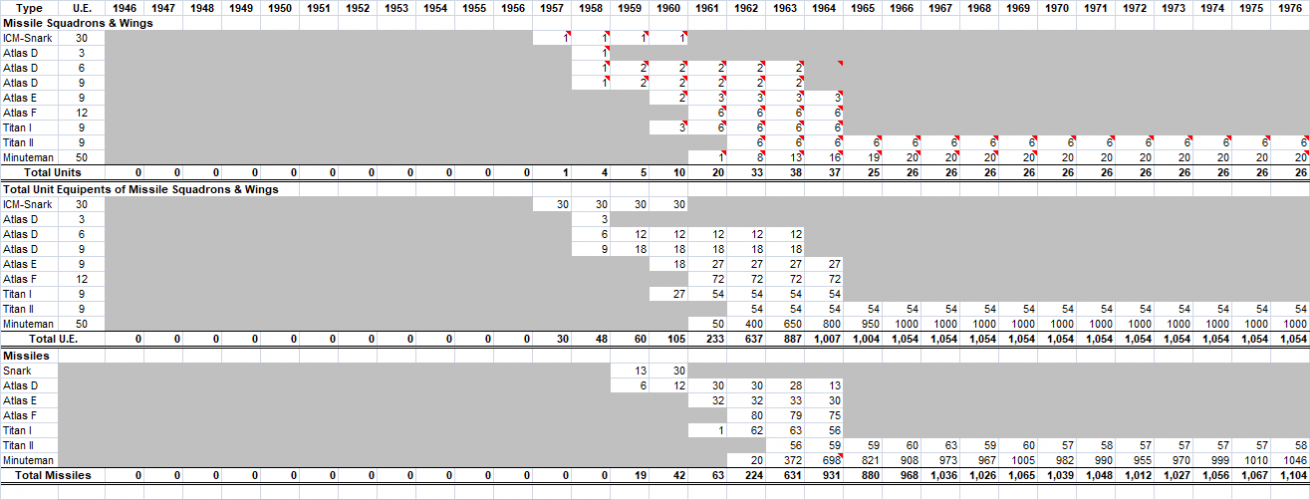
Why build more B-52 when ICBM numbers are growing?

1962 was the peak year of Atlas deployment.
Titan I production missiles from early 1962.
Titan II first launch March 1962.
Minuteman I first launch Feb 1961. Deployed from 1963. 800 built by 1965.
Minuteman II development started 1962.

Where is the need for more B-52 dropping gravity bombs? They were even having to be equipped with the AGM-28 Hound Dog nuclear tipped missile to get them through Soviet defences. 1963/64 were the peak deployment years for that weapon.

1960 saw the supersonic B-58 Hustler begin to enter service.
 
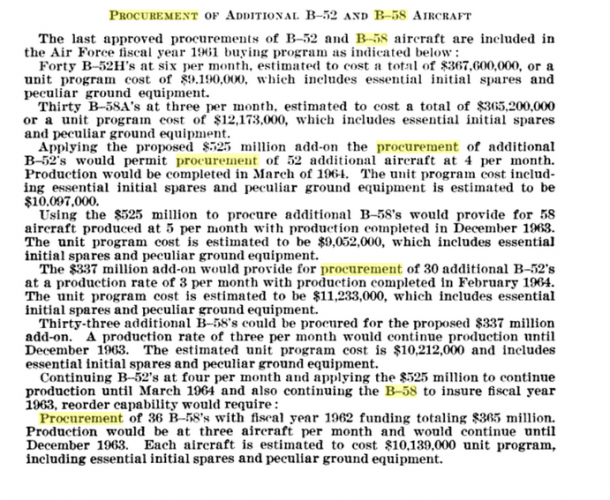
I while back I found the numbers on Google Books: the 1961-62 military hearings are available there for free as downloadable pdfs. Additional B-52H and B-58, a few dozen of them.

Capture d’écran 2026-04-04 124312.png
 
Why build more B-52 when ICBM numbers are growing?

1962 was the peak year of Atlas deployment.
Titan I production missiles from early 1962.
Titan II first launch March 1962.
Minuteman I first launch Feb 1961. Deployed from 1963. 800 built by 1965.
Minuteman II development started 1962.
According to Norman Polmar.
SAC ICBMs to 1976.png
 
Last edited:
I was curious if there were any ideas about how b-52 production could be continued after its OTL discontinuation date (1962). I would imagine it is probably not possible to have production countiue until today (like with the tu-95 or h-6) but I think if the b-70 program had been shut down earlier or if the b-52 as a conventional bomber had been proven earlier the production could countiue until the 70's.

What do ya'll think.
Well, the earlier cancellation of B-70 & switching of efforts on Skybolt missile might be the best shot. But general problem with B-52 continued production - the plane is too adaptable. Too easy to refit & modify. No need to build new airframes, when you could rebuild old ones basically as you wish.

If you want a continued heavy bomber production, I say it would be better to replace B-52 with B-60. B-60 was far less adaptable; to incorporate major refits, new airframes would need to be made. So if B-52 would fail & USAF would chose cheaper B-60 - don't forget, both were viewed as temporary, intermediate solution fo decade at most! - then production would likely continue till late 1960s.
 
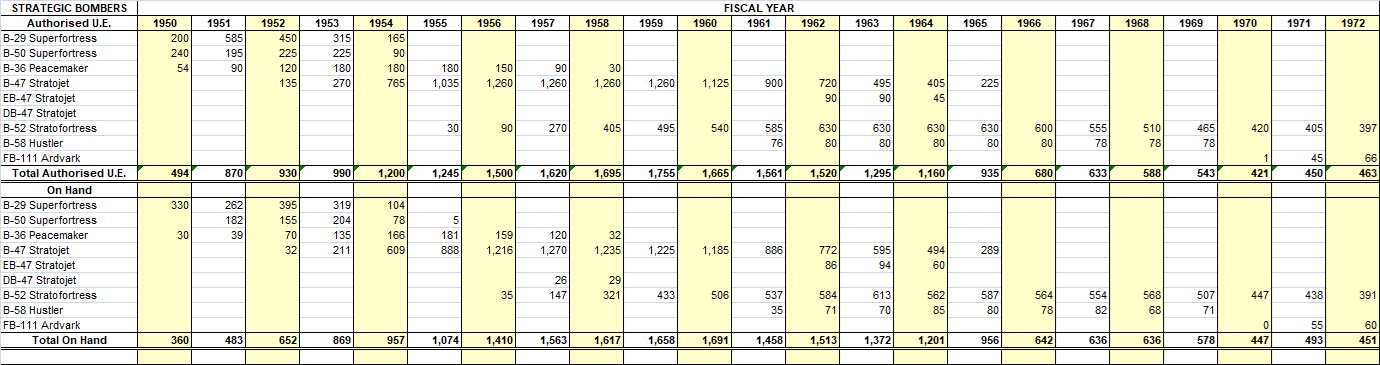
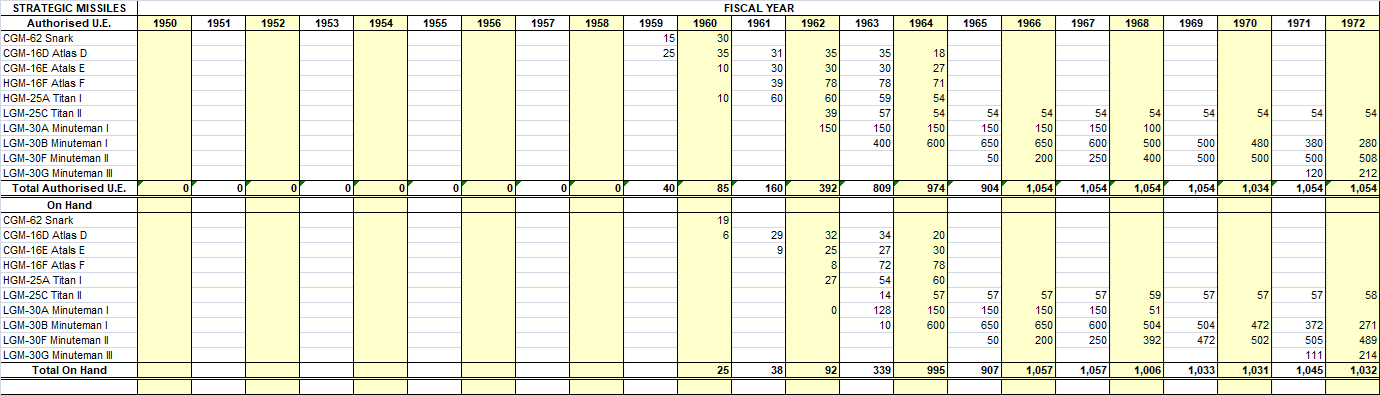
According to the USAF Statistical Yearbooks 1950-72

Strategic Bombers - Authorised Unit Equipment and Aircraft on Hand
1950-72 Strategic Bombers.png

Strategic Missiles - Authorised Unit Equipment and Missiles on Hand
1950-72 Strategic Missiles.png
 
I was curious if there were any ideas about how B-52 production could be continued after its OTL discontinuation date (1962). I would imagine it is probably not possible to have production continue until today (like with the Tu-95 or H-6) but I think if the B-70 program had been shut down earlier or if the B-52 as a conventional bomber had been proven earlier the production could continue until the 70's.

What do ya'll think.
As the FB-111A was intended to replace the B-52C-through-F and the B-58 maybe build more B-52Hs instead of the FB-111As to replace the earlier marks of B-52.
 
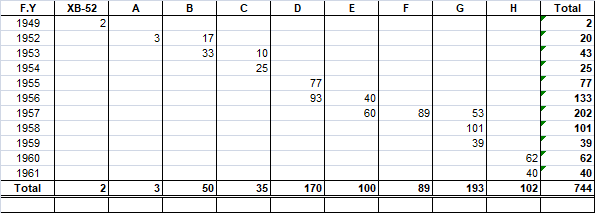
The last B-52H and last B-58A, 744 and 116 of their kind, rolled out the same day... October 26, 1962. Right into the Cuban missile crisis and the day before the world almost ended - B-59 sub and Rudolph Anderson U-2 scary close calls.
 
As far as I know the first two digits in the serial number of a USAF aircraft refer to the fiscal year in which it was ordered. E.g. B-52H 60-0001 was the first aircraft ordered in Fiscal Year 1960 which ran from 1st June 1959 to 30th June 1960. Is that correct?
 
As far as I know the first two digits in the serial number of a USAF aircraft refer to the fiscal year in which it was ordered. E.g. B-52H 60-0001 was the first aircraft ordered in Fiscal Year 1960 which ran from 1st June 1959 to 30th June 1960. Is that correct?
That's my understanding of the how, but I don't think that is correct for the when. IIRC the Federal fiscal year ends in September.
 
That's my understanding of the how, but I don't think that is correct for the when. IIRC the Federal fiscal year ends in September.
The US Fiscal Year ran from 1st July to 30th June until the end of FY76. It's run from 1st October to 30th September since FY77. The gap was filled by the "transitional quarter" that ran from 1st July 1976 to 30th September 1976. The change was made under the Congressional Budget and Impoundment Control Act, 1974, passed on 12th July 1974.
 
To prove that the B-52J isn't a new idea, the article on the Stratofortress in Normal Polmar's World Combat Aircraft Directory has a B-52I in the list of variants, which it says was the unofficial designation of "improved" B-52G/H refitted with large commercial turbofan engines for improved performance.

That project wasn't carried out, but 161 Air National Guard and Air Force Reserve KC-135As re-engined with Pratt & Whitney TF33-PW-102 engines from retired 707 airliners and 417 KC-135As were re-engined with CFM56 engines.
 
Last edited:
The last B-52H and last B-58A, 744 and 116 of their kind, rolled out the same day... October 26, 1962. Right into the Cuban missile crisis and the day before the world almost ended - B-59 sub and Rudolph Anderson U-2 scary close calls.
For what it's worth

137 B-58s ordered according to Joe Bauger's serial lists (https://www.crouze.com/baugher/usaf_serials/usafserials.html) this is of which 21 were cancelled and 116 built: 2 XB-58, 11 YB-58A, 86 B-58A and 17 RB-58A as follows:
  • 1955 - 13 ordered and built.
    • 2 XB-58 with the serials 55-660/661.
    • 11 YB-58A with the serials 55-662/672.
  • 1958 - 18 ordered of which 1 cancelled and 17 built.
    • 17 with the serials 58-1007/1023 all ordered as YB-58A and completed as RB-58A.
    • 1 RB-58A with the serial 58-1024 cancelled. I suspect that this aircraft was ordered as a YB-58A too.
  • 1959 - 36 ordered and built.
    • 36 B-58A with the serials 59-2428/2463.
  • 1960 - 40 ordered, 20 cancelled and 20 built.
    • 1 B-58B with the serial 60-1109 Convair cancelled.
    • 20 B-58A with the serials 60-1110/1129 built.
    • 19 RB-58A with the serials 60-1130/1148 cancelled.
  • 1961 - 30 ordered and built
    • 30 B-58A with the serials 61-2051/2080.
Totals
  • 137 Ordered: 2 XB-58, 11 YB-58A, 86 B-58A, 1 B-58B and 37 RB-58A.
  • 21 Cancelled: 20 RB-58A and one B-58B.
  • 116 Built: 2 XB-58, 11 YB-58A, 86 B-58A and 17 RB-58A
The Wikipedia article on the B-58 says one prototype B-58B was ordered (S/N 60-1109) and a total purchase of 185 envisioned, but the entire project was cancelled before construction began, due to budgetary considerations.
 
Last edited:
As said upthread, B-58 was loathed by Powers and LeMay because it had insufficent range - they didn't wanted medium bombers, only heavies. It should have replaced the mass of B-47s (1300 something) but ballistic missiles proved much cheaper and invulnerable.
B-70 was kinda the supersonic strategic bomber SAC truly wanted, but Mach 3 made it outrageously expensive. After many false starts and 76 FB-111A because McNamara, the B-1A was exactly what SAC wanted, eventually the B-1B got into production.
 
Where is the need for more B-52 dropping gravity bombs?
Seven to ten years after the line had closed down!!! And I'm not sure even at that point whether it's possible to open it again, if only to replace war losses.

If you travelled back into the past and told Boeing and the Air Force "I'm from the future and I'm telling you right now that the B-52 is still in service in 2026; keep the line open and build at least hundred more", you would wind up in a lunatic asylum.
 
Seven to ten years after the line had closed down!!! And I'm not sure even at that point whether it's possible to open it again, if only to replace war losses.
The OP says don't close the line in the first place. That being written, although I don't know if it would be feasible for the B-52, the USAF did do it for the C-5 Galaxy and sort of did it for the B-1 when the Reagan Administration ordered the B-1B after the Carter Administration cancelled the B-1A. I know the B-1A only reached the prototype stage so strictly speaking there was no production to restart, which is why I wrote sort of.

I don't know of any other American military aircraft that were put back into production between the 1960s and now, but the French put the Transall and Atlantic back into production in the 1980s. However, is it true that the DoD gave serious consideration to putting the Skyraider back into production during the Vietnam War?
 
Last edited:
I was curious if there were any ideas about how B-52 production could be continued after its OTL discontinuation date (1962). I would imagine it is probably not possible to have production continue until today (like with the Tu-95 or H-6) but I think if the B-70 program had been shut down earlier or if the B-52 as a conventional bomber had been proven earlier the production could continue until the 70's.

What do ya'll think.
In a way production has continued since 1962. They've been re-sparred, re-skinned, had their avionics replaced and been refurbished so many times that the surviving B-52s are effectively new aircraft several times over. Much like Trigger's Broom.
View: https://www.youtube.com/watch?v=LAh8HryVaeY&t=1s
 
I was curious if there were any ideas about how B-52 production could be continued after its OTL discontinuation date (1962). I would imagine it is probably not possible to have production continue until today (like with the Tu-95 or H-6) but I think if the B-70 program had been shut down earlier or if the B-52 as a conventional bomber had been proven earlier the production could continue until the 70's.

What do ya'll think.
As Boeing, Pratt & Whitney and their subcontractors were making spare parts and refurbishing a fleet that in 1982 numbered about 340 aircraft (70 B-52D and 270 B-52G/H) with another 187 in storage (Source: An Illustrated Guide to the USAF by Bill Gunston) building a handful of new aircraft per year might not be much of a stretch.

An example from the motor industry is the Jensen Interceptor which was put back into production in the 1980s by Jensen Parts & Service, the firm that maintained and serviced old Jensens.
 
Last edited:
I was curious if there were any ideas about how B-52 production could be continued after its OTL discontinuation date (1962). I would imagine it is probably not possible to have production continue until today (like with the Tu-95 or H-6) but I think if the B-70 program had been shut down earlier or if the B-52 as a conventional bomber had been proven earlier the production could continue until the 70's.

What do ya'll think.
There's a sort of precedent for Boeing continuing to build the B-52 in small numbers with the Boeing 707. The last new 707 airliner (No. 917) was delivered in 1978 but the company continued to build the aircraft in small numbers for military customers (mainly AWACS but also some KE-3 tankers and E-6 Mercuries) until 1991 which brought the total number of airframes to 1,010.
 
Last edited:
The OP says don't close the line in the first place. That being written, although I don't know if it would be feasible for the B-52, the USAF did do it for the C-5 Galaxy and sort of did it for the B-1 when the Reagan Administration ordered the B-1B after the Carter Administration cancelled the B-1A. I know the B-1A only reached the prototype stage so strictly speaking there was no production to restart, which is why I wrote sort of.

I don't know of any other American military aircraft that were put back into production between the 1960s and now, but the French put the Transall and Atlantic back into production in the 1960s. However, is it true that the DoD gave serious consideration to putting the Skyraider back into production during the Vietnam War?
C-2; C-2A: 1965–1968, C-2A(R): 1985–1989. But the E-2 was still in production, so I'm not sure that counts.
 
Maintaining B-52 production until the peace dividend would likely have resulted in the cancellation of the B-1 program. In its place, the FB-111H would have been introduced, and to fill the remaining gap, a few more B-2s would have been produced, along with perhaps a more adequate successor to the F-117
 
Those additional 30 or 52 B-52Hs considered in those hearings would have been nice to have but I can't imagine you'd get any more beyond that. A new variant following the B-52H in production probably wouldn't offer enough improvement to be worthwhile. What was needed was a whole new bomber, but unfortunately the timing wasn't right for the XB-70. A full production run of the more-versatile B-1A would have probably been the best outcome for SAC, but that was sadly cancelled as well.

It might have made sense to bring the B-52G fleet up to B-52H standard. As far as I know there were no major changes to the aircraft's structure unlike the difference between the B-52G and earlier variants.

Those same hearings also considered continued B-58 production beyond the last 30 B-58As ordered. I wonder if these would have been one of the improved variants considered for that program?
 
The USAF doesn't seem to have been interest in trickle-building B-52s - all 102 B-52Hs were built in a 15-month span, and while this is faster than most of the production run it's not that much faster.
IIRC the B-52 line was set up for 8 aircraft/month, and the B-70 line was designed to do 5 aircraft/month.

The problem here is that production rate, and the subsequent drawdown. The USAF built up to a large force of B-52s very quickly, then almost immediately started drawing it down as it was replaced by ICBMs. As a result, there was never a shortage of them - any projected shortfall against requirements could be met by slowing withdrawals. By the time the B-52 force had hit the target size, it had been out of production for a decade and the B-1A was due along shortly.

So to maintain B-52 production, you need to either build the force up more slowly, or try to maintain it at a larger size. The former probably means an earlier decision in favour of missiles, and a trajectory for SAC bombers similar to Soviet long-range aviation. The latter means a decision not to go all-in on missiles, and ongoing production to keep pace with attrition and obsolescence.

Interestingly enough, an 8 aircraft/month rate would take nearly 19 years to reach LeMay's goal of 1,800 B-52s. It took about 20 years to get from the B-52 entering service to when the B-1A might reasonably have entered service. You can imagine that being the kind of force size that justifies continuous full-scale production.

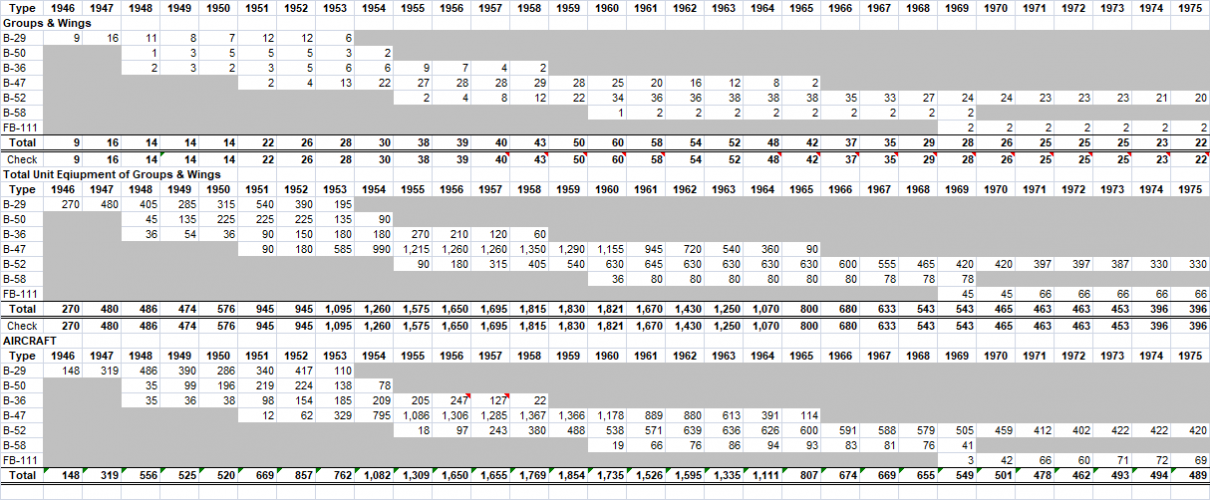
Maintaining 630 aircraft - OTL's peak B-52 force - would keep the plant about one-third occupied, which probably isn't economic. Maintaining 255 aircraft - the post-missile force - would require just one aircraft a month.
 
Assuming for the sake of argument that there will always be a role for them and there will always be money for refurbishment, how long can you keep the existing ones flying? I know that optimistic projections call for them to be in service a hundred years from first flight of the prototype, but after that?
 
Assuming for the sake of argument that there will always be a role for them and there will always be money for refurbishment, how long can you keep the existing ones flying? I know that optimistic projections call for them to be in service a hundred years from first flight of the prototype, but after that?
At the 100-year mark, you'd need to replace the upper wing skins. Which would be expensive and time consuming to do.
 
Wait, LeMay wanted 1800 BUFFs ? :eek: :eek: :eek: :eek: :eek: (then again, he wanted 10 000 Minutemans so, hardly surprising)

By the way, when did the force peaked at 630 ? (out of 744 built) ?
 
Well, there's something like 50+ B-52's in various states of 'disassembly' lying around at AMARC at Davis Monthan AFB in Tucson AZ that can be used for parts to keep the ones that are flying flying.
 
Wait, LeMay wanted 1800 BUFFs ? :eek: :eek: :eek: :eek: :eek: (then again, he wanted 10 000 Minutemans so, hardly surprising)
Not surprising at all, it was 40 wings each of three 15-aircraft bomber squadrons and one aircraft refuelling squadron, for 1800 B-52s and (presumably) 800 KC-135s. Another 1000 or so KC-135s would bring it up to a 1:1 ratio of bombers to tankers. That's not so far off the peak B-47/B-36 force, which was somewhere north of 1,200 B-47s and 300 B-36s.

The 10,000 Minuteman figure is one that gets repeated a lot, but I've not seen it linked to an original source. The largest ICBM force I've seen evidence for being seriously discussed was 2,500 static Minuteman, 415 mobile Minuteman, and 275 Titan II.
 
Not surprising at all, it was 40 wings each of three 15-aircraft bomber squadrons and one aircraft refuelling squadron, for 1800 B-52s and (presumably) 800 KC-135s. [...] That's not so far off the peak B-47/B-36 force, which was somewhere north of 1,200 B-47s and 300 B-36s.
Following up on this figure, the earliest force target for SAC based on requirements was for 33 medium bomb wings of 45 B-47s each and 30 heavy bomb wings of 30 B-36s each, totalling 1,845 strategic bombers.
 
Back
Top Bottom