- Joined
- 19 February 2007
- Messages
- 1,644
- Reaction score
- 3,484
Easy. Leave out the gas. Next problem?All those black boxes are parts of it. It's big and complicated, and I honestly don't see how it could be fit on F-104.

Easy. Leave out the gas. Next problem?All those black boxes are parts of it. It's big and complicated, and I honestly don't see how it could be fit on F-104.

The F-104A HM-55 test flight seemed to be in a similar fashion to the F-104C's Project Grindstone. Though Project Grindstone turned out to be draggy; how difficult would it have been to wire the underwing hardpoints for the Super Falcon?Getting rid of the M61 on an early F-104 was to leave it virtually disarmed.

I'm not sure F-104 fire control system could work with them.The F-104A HM-55 test flight seemed to be in a similar fashion to the F-104C's Project Grindstone. Though Project Grindstone turned out to be draggy; how difficult would it have been to wire the underwing hardpoints for the Super Falcon?
I was hoping the F-104 could take some derivative of the TARAN-18 instead...I'm not sure F-104 fire control system could work with them.
No, its far too big to fit inside. Reducing its diameter would essentially nullify all advantages.I was hoping the F-104 could take some derivative of the TARAN-18 instead...

Checked the possibility with Gemini & Chat GPT. They seems to think, that it's possible - at least theoretically - to adapt the NASARR (F-104 main radar) to work with AIM-9C seeker.

AIs do not think.Checked the possibility with Gemini & Chat GPT. They seems to think
True, but they are good in catching obvious flaws, like "no, this radar is working on completely different frequency, it can't be done". Of course, I do not consider their answers to be definite; just that they didn't manage to find obvious flaws.LLMs have no actually technical knowledge and are primed to say "yes" to whatever you ask about.
You are right, I'm sorry.Pity the AI can't tell people not to clutter up project threads with what-if fantasy musings.
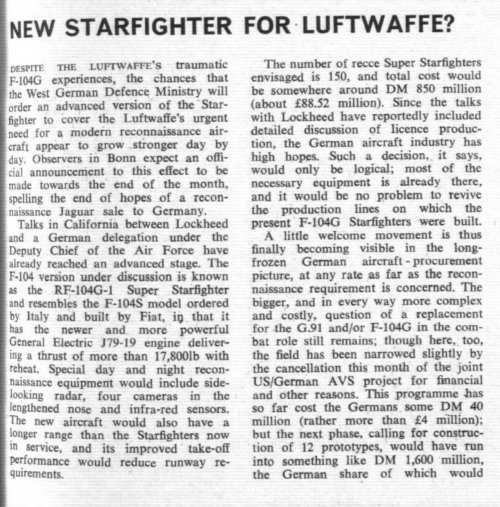
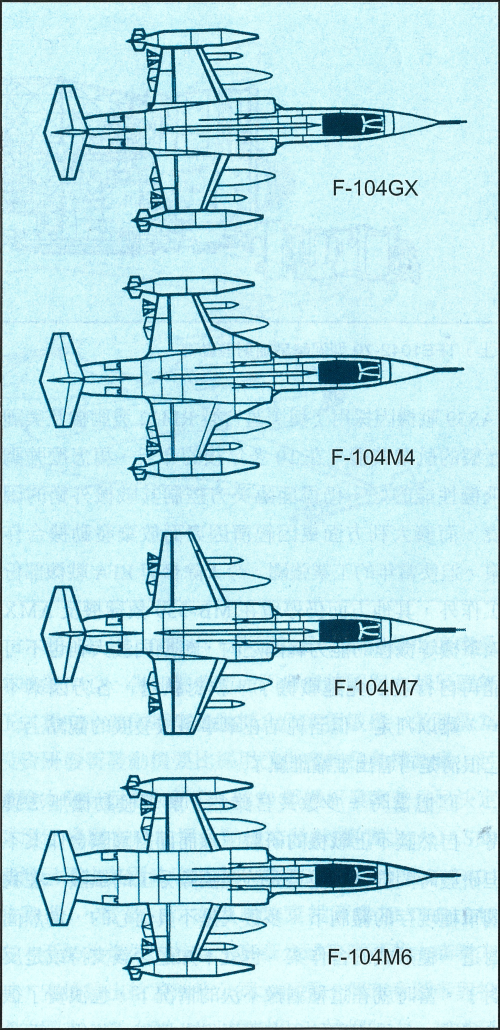
In that booklet about the Taiwanese IDF-development there are at least three Starfighter-based designs ...
3. F-104M6 +2x TFE-1042
Last iteration of CL-1195 was the -.5 (-4 not used). Trying to develop a less radically changed "S" for the European licensees to build, Lockheed drafted this last design using two GE1/J1A2 engine, the same that had originally selected for the Northrop P-530 Cobra (for more infos see here http://www.flightglobal.com/PDFArchive/View/1970/1970 - 0032.html ).
......
Only major difference was the moving cone inlets.
Yes.Also, would the moving cone inlets work like the one for MiG-21 except in halves?
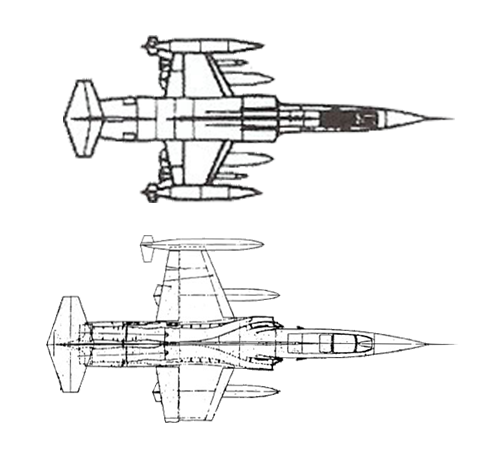
Very cool!As a byproduct of a FD Scale project, here is the top view comparison between F-104M6 and CL-1195-5.
That would be to maintain CG. IIRC the F404 was advertised as being half the length of the J79.The CL-1195-5 has its fuselage lengthened, seemingly to accommodate a larger pair of wings. Its GE1/J1A2s are also mounted aft of where the J79 would be in a stock F-104.
That depends entirely on where the engine CG is.The TFE-1042 is in fact shorter than even the CL-1195-5's engine installation such that it can be mounted as far aft as CL-1195-5's engines and still seemingly maintain F-104G's overall length.


A new info for me,
the Lockheed F-104 intended to reach Mach 3 ?,Air Pictorial 9/1956.
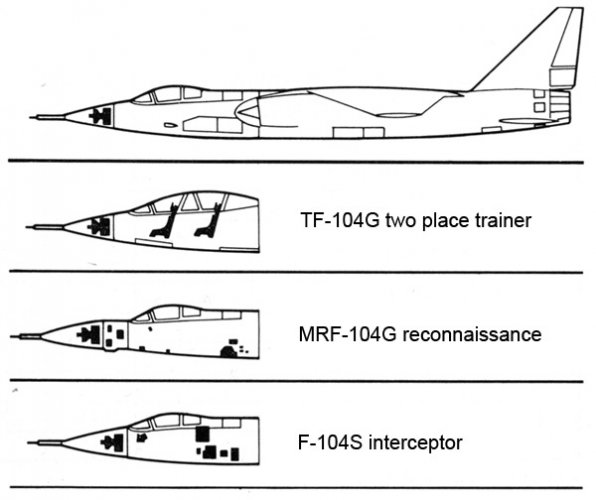
Recon variants are always ugly.Ignoring the Lancer rear fuselage, this little sketch from Air Enthusiast September 1971 shows the gruesome shape of the Marineflieger's short-lived MRF-104G proposal:
Caption was "Reconnaissance: radar, infrared, photographic"
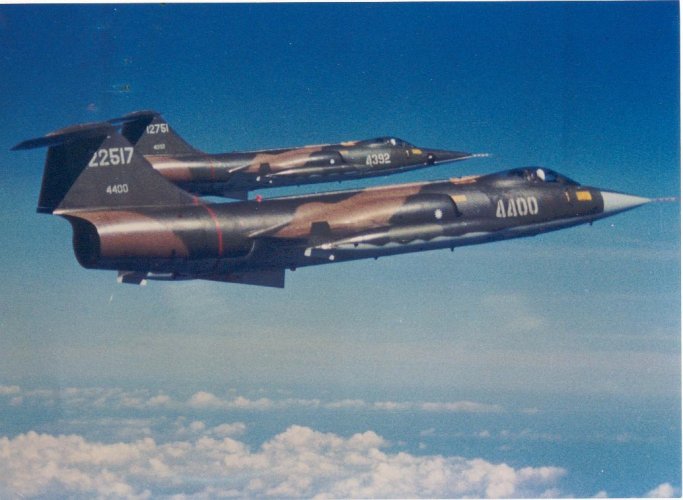
Starting in 1984, under Project “Ali Shan No.8” the 41st Sqn, 42nd Sqn and 48 Sqn of 2nd Wing received 39 F-104G and 27 TF-104G, all of them ex-Luftwaffe (German Air Force).
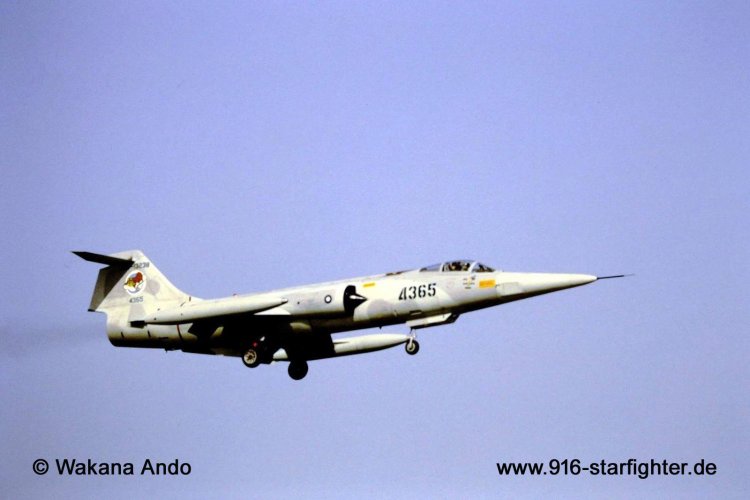
2021: 63-13238 coded 4365, modified RF-104G LOROP "Stargazer", withdrawn from use, scrapped.
7015: 67-14889 coded 4397, modified to RF-104G LOROP "Stargazer", withdrawn from use, scrapped.
8068: 65-12751 coded 4392, crashed May 31, 1988 during practice of low altitude pass at TaoYuan AB carrying LOROP training nose (DBR), pilot Chung was safe.
8183: 63-13690 coded 4386, modified to RF-104G LOROP "Stargazer", crashed September 11, 1987 near the coast into the sea near Nan Ao Town, pilot ejected, but was missing.
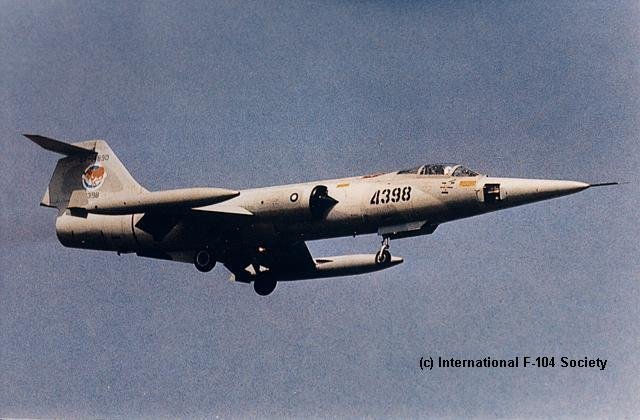
8204: 67-14890 coded 4398 (modified to RF-104G LOROP "Stargazer"), displayed at Kang Le Recreation Park at Hsinchu City, near Hsinchu AB.
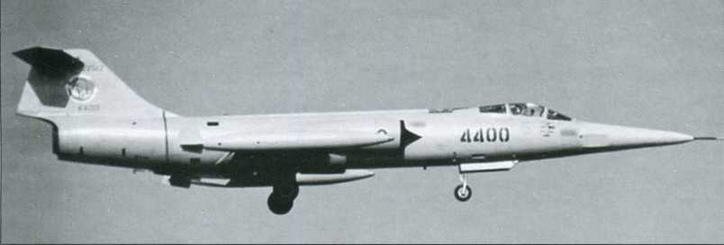
8230: 67-22517 coded 4400 (modified to RF-104G LOROP "Stargazer"), displayed in Xihu Military Aircraft Park, Xihu Town, Changhua County.
A few of Taiwan F-104s got big LOROP cameras in large noses. They were used to look into the PRC, I mean at least its coastal areas.
https://916-starfighter.de/F-104_RoCAF_serials.htm
A few of Taiwan F-104s got big LOROP cameras in large noses. They were used to look into the PRC, I mean at least its coastal areas.
https://916-starfighter.de/F-104_RoCAF_serials.htm
Some pages from a Lockheed report on the CL-1010-2 big wing -104.
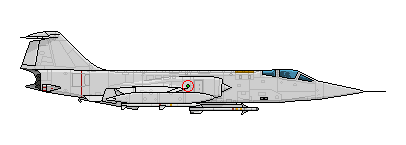
You don't get to see too many F-89s these days, but if you ever find one - They're a lot bigger than they look, with a lot of fuselage."Could not", or "was not equipped to"? Because you can change equipment fits!
How much space did the SAGE gear take? You say it fit into F-89s, so it should be able to be stuffed into the space of the M61 cannon.
At the very least the F-101B/F-4D/E datalink should be able to fit into that space.
You don't get to see too many F-89s these days, but if you ever find one - They're a lot bigger than they look, with a lot of fuselage.
The thing is - the SAGE Datalink tied in to the E- and MG- Series Radar/Fire Control Systems, and their descendants.
The F-104A and its simple radar, with no autopilot, didn't have the "bones" for SAGE.
Whether TARAN, which comes across as a somewhat shrunk MA-1 from the F-106 could be integrated is in interesting question. But then, you'd have to fit all the scopes and controls, etc. into the F-104 cockpit. It did fit in a Mirage, though.

Japan had a SAGE Equivalent in BADGE (Base Air Defense Ground Environment) which performed the same Sensor Fusion, Battlespace Coordination, and Direction functions.I remember trying to match the drawing of the F-104 with that of the F-89H's wingtip pods...... and found each pod being almost as thick as the F-104's fuselage
I was partially inspired into asking about TARAN by the picture of F-104A test flying with the AIM-26 and by Lockheed having offered Falcon-armed CL-1010-3 to Japan. I wonder if there is any serious study being done and, since it's already more readily known that the F-104 is not compatible with SAGE (which Japan didn't have anyway) but would need automated fire control typically associated with the F-102/106 to effectively use the Falcon missiles, what part of SAGE the F-104 can do without so as to reduce the size of the FCS.
F-104 dogfighter project:
http://www.edwardsflighttest.com/pics/F-104-Dogfighter.pdfDon't think it's connected to the High wing Lancer project...
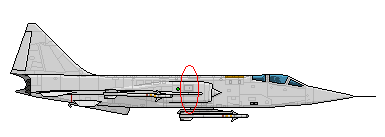
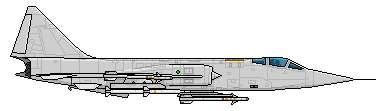
Speaking as an airframe mechanic, my guess would be to rearrange the suck-in doors to split above and below the LERX.The leading edge extensions would reach areas allocated for auxiliary intake doors on the original F-104.
Speaking as an airframe mechanic, my guess would be to rearrange the suck-in doors to split above and below the LERX.
Depending on what the structures look like inside the inlets that could be really easy or it could be really messy, I'd need to see pictures of an F-104 inlet without the skin on it.
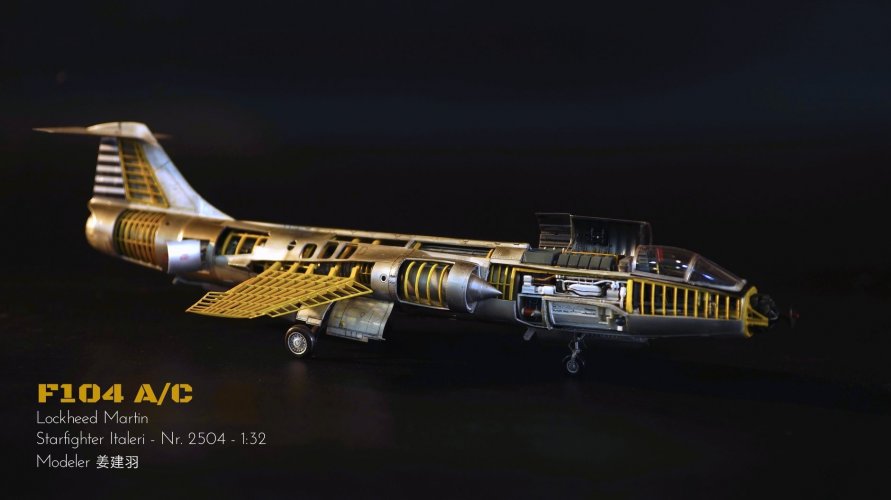
OK, assuming that the model is gorrect, it'd be an easy modification to adjust where the suck-in doors are.
Sorry, no. They are access doors for allowing the maintainers the access to "duct dive" and inspect the J79 engine Inlet Guide Vanes and Compressor Rotor blades for Foreign Object Damage (FOD).The leading edge extensions would reach areas allocated for auxiliary intake doors on the original F-104.
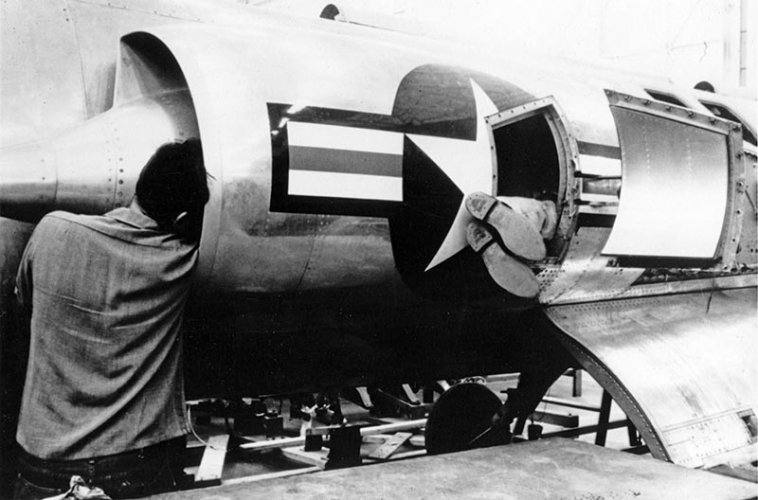
That actually makes it easier, since you can just add a small piece of the LERX to the access door and unscrew it.Sorry, no. They are access doors for allowing the maintainers the access to "duct dive" and inspect the J79 engine Inlet Guide Vanes and Compressor Rotor blades for Foreign Object Damage (FOD).
Note the multiple fasteners and the lack of any means of door actuation.
Sorry, no. They are access doors for allowing the maintainers the access to "duct dive" and inspect the J79 engine Inlet Guide Vanes and Compressor Rotor blades for Foreign Object Damage (FOD).