uk 75

ACCESS: Above Top Secret
Senior Member
Joined
27 September 2006
Messages
6,555
Reaction score
7,329
The Soviet Navy evolved anti ship missiles for its warships sooner than the West because it was faced with NATO's large surface fleets and their aircraft carriers.
The spur to Western nations seems to have been the arrival of new Soviet large surface units in the 60s and the sinking of an Israeli destroyer by a Soviet supplied SSM in 1967.
It was initially the large number of Anti aircraft missiles which were also given an anti surface role. Even the humble Seacat was looked at in an anti fast patrol boat role.
By the 1970s three systems had rmerged which could be fitted easily in box or tube launchers. Otomat was Italy's solution but lost out to Exocet in the competition for the RN and West German navies. The US Harpoon arrived later and has become the West's main system.
In comparison with Soviet and later Russian and Chinese weapons Harpoon requires more hits to kill a target like a cruiser or aircraft carrier.
In the 60s the US Navy still relied on nuclear tipped Talos and Terrier SAGW to kill big ships.
Supersonic weapons were planned to replace Harpoon and co if the Cold War had continued.
The UK only had two weapons suitable to compete with Exocet. The CF299 Seadart was designed with a secondary anti ship capability. The unloved Martel airframe formed the basis for a sub launched USGW which the RN needed desperately for its nuclear hunter killer subs from the 60s on. They had to wait until 1982 to get Sub Harpoon instead. Yet Martel went on to be the basis of the impressive Sea Eagle ASM.
With a bit more focus and resources especially when it became clear new aircraft carriers were not affordable, the RN might have been equipped with Martel based systems instead of Exocet and Harpoon.
The RN's submarines might then have received a supersonic replacement in the 90s.
 
I suppose the main stimulus that may boost the Western development of anti-ship missiles in Cold War may be Soviet own carriers. If USSR developed carrier aviation by 1950s (there were a lot of plans for carriers in Soviet Navy since late 1920s), then the local superiority of NATO naval aviation over the sea could not be guaranteed. Not only air strikes against Soviet fleets would be much more problematic - but also NATO navies would probably be forced to relegate larger percentage of their carrier air wings toward interceptors. Which would diminish the strike potential of NATO carriers significantly.

In such scenario, it's perfectly possible that West would get much more interested in developing ship- and aircraft-launched anti-ship missiles as well. Both to provide strike forces with standoff weapon, and to make sure that surface ships could carry strike capabilities too.
 
The Admiralty were looking for a ship-launched anti-ship missile in the early 1950s. Napier Seahorse, AW Project 525 and Blue Slug date back to the first hints of the Sverdlov-class. Blue Slug/AW Project 512 was specifically aimed at the destruction of Sverdlov with the requirement issued in September 1953.

Chris
 
Last edited:
I always see Blueslug as being similar to the add on surface role for the big US T missiles as it used a Seaslug launcher rather than a simpler launcher like the Swedish and Russian weapons developed in the 50s.
 
The Soviet Navy evolved anti ship missiles for its warships sooner than the West because it was faced with NATO's large surface fleets and their aircraft carriers.
The spur to Western nations seems to have been the arrival of new Soviet large surface units in the 60s and the sinking of an Israeli destroyer by a Soviet supplied SSM in 1967.
It was initially the large number of Anti aircraft missiles which were also given an anti surface role. Even the humble Seacat was looked at in an anti fast patrol boat role.
By the 1970s three systems had rmerged which could be fitted easily in box or tube launchers. Otomat was Italy's solution but lost out to Exocet in the competition for the RN and West German navies. The US Harpoon arrived later and has become the West's main system.
In comparison with Soviet and later Russian and Chinese weapons Harpoon requires more hits to kill a target like a cruiser or aircraft carrier.
In the 60s the US Navy still relied on nuclear tipped Talos and Terrier SAGW to kill big ships.
Supersonic weapons were planned to replace Harpoon and co if the Cold War had continued.
The UK only had two weapons suitable to compete with Exocet. The CF299 Seadart was designed with a secondary anti ship capability. The unloved Martel airframe formed the basis for a sub launched USGW which the RN needed desperately for its nuclear hunter killer subs from the 60s on. They had to wait until 1982 to get Sub Harpoon instead. Yet Martel went on to be the basis of the impressive Sea Eagle ASM.
With a bit more focus and resources especially when it became clear new aircraft carriers were not affordable, the RN might have been equipped with Martel based systems instead of Exocet and Harpoon.
The RN's submarines might then have received a supersonic replacement in the 90s.
Certainly there could have been more.

Starting with Green Cheese, of which a surface launched option would have been interesting.
Fairey's Sea Skimmer was also a potent concept, Harpoon/Exocet a decade earlier.

Blue Slug offered an system compatible with the County Sea Slug missile system and launcher.

In the 60's there was speculative concept of a 24" diameter ramjet missile.

Fleetfoot never was achieved, only Otomat got close.

Seems a waste that submarines Martell work wasn't translated to Sea Eagle from the get go.

An Anti-ship Sea Dart variant was sketched out.
 
Well there was also the short-lived proposals for a cruise-missile submarine armed with Regulus before the Admiralty wisely decided to concentrate on the nuclear attack sub programme instead.

Turning Martel into Sea Eagle sooner does seem a lost opportunity but Exocet and Harpoon worked out ok. Of course Sea Skua was developed alongside the Lynx specifically to destroy FACs and small vessels - which was a smart move as it meant a smaller missile could be used to avoid overkill against a small fast craft and kept the parent ship further away to match the range of the FAC's missiles.

Was Green Cheese really a missile or a glorified powered free-fall bomb? Would take some rocket motor to get it off a ship and decent enough distance away.
I need to re-read Chris Gibson's works on Fairey Sea Skimmer - neat concept but did Fairey actually know enough to make it work?

Maybe a buy of Rb08s from Sweden would have been a wise move? Rb08s for Avons type swap deal?
 
The French supposedly considered an antiship missile compatible with the Malafon launcher (quite possibly the same airframe with a different front end). It seems like an obvious idea that was ultimately a dead end.
 
For the US Navy, the antiship missile started with air launched ones. The first program to develop such a weapon was Gorgon in early WW 2. Through the 70's the US could get by with using their available SAM's in a secondary role as ASM's and for good reason. A large missile like Talos or Terrier would result in a mission kill--even if the target wasn't sunk--in a matter of just one to three hits.

Given that the USN was carrier-centric, using air-to-surface missiles as the primary ship killers makes sense.
 
I am hoping that carrier-centric force projection model-heavy on logistics-gives way to space advocates. Anti-ship missiles can't reach Rods from God.
 
For the US Navy, the antiship missile started with air launched ones. The first program to develop such a weapon was Gorgon in early WW 2.
Well, to be exact, the first program was SWOD, started in 1941. Granted, it was unpowered glide bombs, but it was a first practical foray into standoff weapon. And it produced actual result, combat-proved ASM-N-2 Bat with active radar seeker in 1945. Despite lacking the engine, it was essentially the grandmother of all later ASM's.
 
For the US Navy, the antiship missile started with air launched ones. The first program to develop such a weapon was Gorgon in early WW 2.
Well, to be exact, the first program was SWOD, started in 1941. Granted, it was unpowered glide bombs, but it was a first practical foray into standoff weapon. And it produced actual result, combat-proved ASM-N-2 Bat with active radar seeker in 1945. Despite lacking the engine, it was essentially the grandmother of all later ASM's.
Those are glide and guided bombs. Gorgon was a program building guided missiles for various purposes.

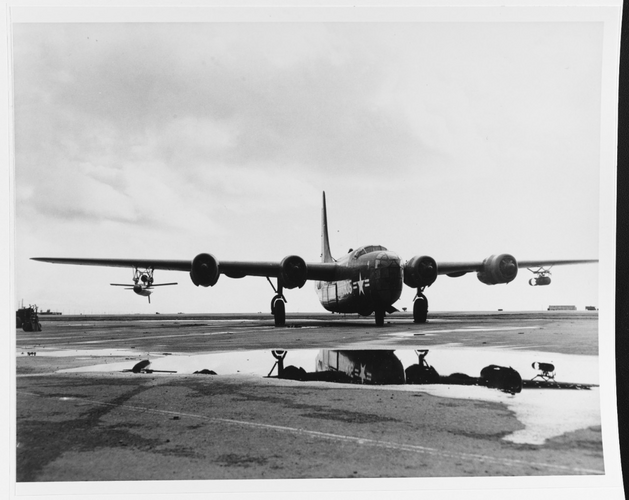
1649874758537.png

The starboard wing has a Gorgon II series missile on this PB4Y. This would have used a seeker system similar to the Bat glide bomb but would be powered (variously) by a small turbojet, rocket motor, or pulse jet engine. That makes it a true ASM versus glide bomb or guided bomb like say Pelican or Bat.
 
I know Firebee was considered as an interim SSM before Harpoon. I wonder what night have happened if it had been adopted earlier as a more permanent weapon. Give it folding wings and solid-rocket boosters, a radar seeker and a warhead in place of the recovery systems (and maybe the belly fuel tank), launch it from a large canister like P-15, and you get something much more like a western version of a Soviet ASCM. Especially with the slightly later supersonic versions of Firebee. (which are ~29 feet/8.9m long and about just over 2200 lb/1000 kg)
 
Last edited:
Those are glide and guided bombs. Gorgon was a program building guided missiles for various purposes.
I knew; I wrote a whole article about them.


Still, the Gorgon program essentially never get out of testing phase, and the only anti-ship version of it was post-war proposal to fit the ASM-N-2 "Bat" seeker on Gorgon IIC and Gorgon IV. The first was tested & even worked relatively fine, but Bat seeker was viewed as obsolete already.

So I still consider the Bat as the first "real" anti-ship missile. Despite lacking the engine, it have essentially all other elements of it. Standoff range, autonomous guidance with the ability to lock on specific target (of course, on Bat it was done manually... and wasn't very reliable, that's for sure...)
 
I know Firebee was considered as an interim SSM before Harpoon. I wonder what night have happened if it had been adopted earlier as a more permanent weapon, presumably with radar instead of the improvised TV seeker planned for the interim fit, with a warhead in place of the recovery systems. Give it folding wings and RATO boosters, launch it from a large canister like P-15, and you get something much more like a western version of a Soviet ASCM. Especially with the slightly later supersonic versions of Firebee.
Heh, have same thinking several years ago. :)
 
For the US Navy, the antiship missile started with air launched ones. The first program to develop such a weapon was Gorgon in early WW 2. Through the 70's the US could get by with using their available SAM's in a secondary role as ASM's and for good reason. A large missile like Talos or Terrier would result in a mission kill--even if the target wasn't sunk--in a matter of just one to three hits.

Given that the USN was carrier-centric, using air-to-surface missiles as the primary ship killers makes sense.
And the USN carrier aviation community was dragged kicking and screaming into long range AShMs. By the time of the Falklands War, USN carrier air’s anti ship capability was little better than Argentina’s. Bombs away!
 
They had laser-guided bombs, Walleyes, and ARMs. Hardly just dumb bombs.
Yeah, real long range stuff and the ARMs weren’t a substitute. Not exactly refuting my point.

 
Yeah, real long range stuff and the ARMs weren’t a substitute. Not exactly refuting my point.

Every single one of the weapons listed means Navy strike aircraft don't need to drop their ordnance right on top of enemy warships to hit anything. That's not "little better".

A proper combined-arms attack with Walleyes and anti-radiation missiles can shut down the Sea Darts and allow Corsairs to leisurely drop Walleyes at high altitude from beyond visual range. Hardly "little better".
 
They had laser-guided bombs, Walleyes, and ARMs. Hardly just dumb bombs.
By 1982, all USN supercarriers have at least six Harpoon-capable Intruders in the air wing. Not much, of course, but was considered enough to hit the high-value ships with area SAM's (missile cruisers, helicopter cruisers, aircraft carrying cruisers) inside the defensive order. And with long-range SAM's disabled or at least hampered, the combination of Walleye & Paveways were deemed sufficient.
 
Every single one of the weapons listed means Navy strike aircraft don't need to drop their ordnance right on top of enemy warships to hit anything. That's not "little better".

A proper combined-arms attack with Walleyes and anti-radiation missiles can shut down the Sea Darts and allow Corsairs to leisurely drop Walleyes at high altitude from beyond visual range. Hardly "little better".
Just ignore the linked article. USN first aircraft carrying Harpoon were P-3s in 1979. Naval aviation was a wrench in the gears of long range AShMs. They got with it by the late 80s.

“Reporting
to Attack Squadron 66 in late October of 1973 while it was deployed aboard USS
Independence. Independence was then operating in the Eastern Mediterranean
during the US/Soviet crisis associated with the Yom Kippur War. I quickly
discerned that the Navy had neither the weapons nor the doctrine to effectively
counter the anti-ship missile-armed Soviet Fifth Eskadra.1 The best we could do at
the time was to “birddog” Soviet ships – orbit overhead of their formations waiting
for smoke to appear on deck indicating a missile launch. We started working on
anti-ship tactics after that cruise, but we were limited by only having freefall
bombs. In my view at the time, even with optimally executed tactics, we would
likely lose 2-4 aircraft per single ship attack. The air wing could be effectively put
out of commission attacking a six ship formation. It took four years to get
Harpoon to the fleet, which gave us at least a fighting chance against well-armed”

And not on aircraft until 1979.

 
Last edited:
And the USN carrier aviation community was dragged kicking and screaming into long range AShMs. By the time of the Falklands War, USN carrier air’s anti ship capability was little better than Argentina’s. Bombs away!
That's largely because the USN recognized that their existing SAMs were generally sufficient as anti-ship missile substitutes for their surface fleet while the preference for air-to-surface weapons were to use existing more general-purpose guided ones for this role. They simply saw no reason to put a specialized anti-ship missile into service.

US naval aviation had, and has, to do with what BuAir and BuOrd will give them in terms of munitions. They can ask for all sorts of stuff on a wish list but what they end up with is the result of a committee with lots of lawyers and accounts making many of the decisions.
 
That's largely because the USN recognized that their existing SAMs were generally sufficient as anti-ship missile substitutes for their surface fleet while the preference for air-to-surface weapons were to use existing more general-purpose guided ones for this role. They simply saw no reason to put a specialized anti-ship missile into service.

US naval aviation had, and has, to do with what BuAir and BuOrd will give them in terms of munitions. They can ask for all sorts of stuff on a wish list but what they end up with is the result of a committee with lots of lawyers and accounts making many of the decisions.
More likely they were not asking for anything they thought might endanger their fiefdom.

You’re assuming all parts of the USN were in unison. I highly doubt that the surface warfare people wanted to just play carrier defenders and I’d bet heavy use of SAMs as ASuW weapons (line of sight only range) would have the carrier commander screaming over the nets.


Muir, Malcolm. Black Shoes and Blue Water: Surface Warfare in the United States Navy, 1945-1975. Contributions to Naval History, no. 6. Washington, DC: Naval Historical Center, Department of the Navy, 1996.
 
Just ignore the linked article. USN first aircraft carrying Harpoon were P-3s in 1979. Naval aviation was a wrench in the gears of long range AShMs. They got with it by the late 80s.

“Reporting
to Attack Squadron 66 in late October of 1973 while it was deployed aboard USS
Independence. Independence was then operating in the Eastern Mediterranean
during the US/Soviet crisis associated with the Yom Kippur War. I quickly
discerned that the Navy had neither the weapons nor the doctrine to effectively
counter the anti-ship missile-armed Soviet Fifth Eskadra.1 The best we could do at
the time was to “birddog” Soviet ships – orbit overhead of their formations waiting
for smoke to appear on deck indicating a missile launch. We started working on
anti-ship tactics after that cruise, but we were limited by only having freefall
bombs. In my view at the time, even with optimally executed tactics, we would
likely lose 2-4 aircraft per single ship attack. The air wing could be effectively put
out of commission attacking a six ship formation. It took four years to get
Harpoon to the fleet, which gave us at least a fighting chance against well-armed”

And not on aircraft until 1979.

That Navy anti-shipping strike from aircraft was inadequate does not refute my point that comparing it to Argentina's capabilities is rather off-base.
 
That Navy anti-shipping strike from aircraft was inadequate does not refute my point that comparing it to Argentina's capabilities is rather off-base.
I concede that point.

The USN’s anti-ship inadequacy wasn’t just limited to carrier air, unfortunately.
 
Just a question, what ships are these earlier AShMs aimed at?

IIUC by about 1970 the Soviets had 2 Moskva class helicopter cruisers, 8 Kynda/Kresta cruisers and 24 Kanin/Kashin class destroyers.

The same year the RN for example had Eagle, Ark Royal and Hermes and 8 Counties, which might be able to handle the Soviets alone with their Buccaneers.
 
Just a question, what ships are these earlier AShMs aimed at?

IIUC by about 1970 the Soviets had 2 Moskva class helicopter cruisers, 8 Kynda/Kresta cruisers and 24 Kanin/Kashin class destroyers.

The same year the RN for example had Eagle, Ark Royal and Hermes and 8 Counties, which might be able to handle the Soviets alone with their

What weapons would those Buccaneers be using that wouldn’t involve almost directly overflying those ships?

The USN & RN were like it or not rather late to the AShM party.
 
They had laser-guided bombs, Walleyes, and ARMs. Hardly just dumb bombs.
Saw HARM artwork from back in the 70s/80s that showed a USN aircraft attacking a Kresta I/II with HARM. The idea was HARM would take out the radar (mission kill) then it could be finished off with other munitions.
 
What weapons would those Buccaneers be using that wouldn’t involve almost directly overflying those ships?

The USN & RN were like it or not rather late to the AShM party.

None, but I'd question how crucial that was during the 60s and early 70s.

Iirc in the late 60s the Tartar had a reaction time of 30 seconds and the early 70s Sea Dart had a reaction time of 12 seconds. In addition 60s British radars (the ones I know most about) weren't great at discerning targets from clutter at very low level and with objects in the background.

I can't imagine Soviet radars and naval SAMs being substantially better than Western ones in about 1970, so their chances of shooting down multiple buccaneers incoming at ultra low level on converging bearings would be quite low.

Late 70s is a different matter.
 
I can't imagine Soviet radars and naval SAMs being substantially better than Western ones in about 1970, so their chances of shooting down multiple buccaneers incoming at ultra low level on converging bearings would be quite low.
Well, we have Osa-M specifically for that since 1971.
 
Well, we have Osa-M specifically for that since 1971.

Sure, and the Martel in TV and Anti-radar guided versions entered service in 1972.

I'd suggest that overall western anti ship missiles appeared pretty close to when they were really needed. It would have been nice to have them in service maybe 5 years earlier, but I'd suggest it wasn't crucial.
 
I suppose the main stimulus that may boost the Western development of anti-ship missiles in Cold War may be Soviet own carriers. If USSR developed carrier aviation by 1950s (there were a lot of plans for carriers in Soviet Navy since late 1920s), then the local superiority of NATO naval aviation over the sea could not be guaranteed. Not only air strikes against Soviet fleets would be much more problematic - but also NATO navies would probably be forced to relegate larger percentage of their carrier air wings toward interceptors. Which would diminish the strike potential of NATO carriers significantly.

In such scenario, it's perfectly possible that West would get much more interested in developing ship- and aircraft-launched anti-ship missiles as well. Both to provide strike forces with standoff weapon, and to make sure that surface ships could carry strike capabilities too.
The major problem for surface launched AShMs is guidance.

Talos and any other SARH missiles, are limited to the radar horizon. ~50-60km

Big missiles can have effective ARH seekers, even using 1950s tech. But we're talking at least a 12" radar dish, if not larger, so I mean BIG missiles. Problem with those is that you don't know what they will lock onto.

TV/imaging guided (DSMAC) can be better, but now we're getting into guidance modes that are probably too fancy to do with 1950s or 60s technology.


I am hoping that carrier-centric force projection model-heavy on logistics-gives way to space advocates. Anti-ship missiles can't reach Rods from God.
RFGs will take a very sophisticated guidance system, since a carrier can move some 15nmi in the time it takes for the RFG to arrive (~30min). What happens when you make an RFG dive in at a steeper angle to hit the ship? Depending on just how close an RFG is to burning up, you might force a miss that way.
 
TV/imaging guided (DSMAC) can be better, but now we're getting into guidance modes that are probably too fancy to do with 1950s or 60s technology.
Actually no; don't forget that Walleye was essentially build on 1950s technology. The problem with optical-contrast seeker is that missile must maintain the line-of-sight with launcher ship, so operator could manually lock the seeker on target. While radar or infrared seeker could lock on target themselves - by merely seeking the strongest signal - the optical constrast seeker can't, since there maybe a lot of contrasting spots and without human input seeker could easily lock on something totally not related to the target.

Problem with those is that you don't know what they will lock onto.
Well, even 1950s tech allowed some tricks. First of all, if you got range and target course, you could set your seeker to activate only close to the target approximate location. So it would start to seek only relatively close to intended target.

Seconsdly, seeker could be relatively easily set to compare signals and home on strongest one - for example, ignoring escort signatures and homing on carrier behind them.

And, of course, there was also man-in-the-loop option, like P-35 have. The misslile climbed on high altitude, activated its seeker and transmitted data to the launch platform. Operator make sence of what exactly missile saw, and locked the seeker on intended target. The missile then dived down, and approached the target on low altitude, seeker already locked & tracking.
 
Sure, and the Martel in TV and Anti-radar guided versions entered service in 1972.

I'd suggest that overall western anti ship missiles appeared pretty close to when they were really needed. It would have been nice to have them in service maybe 5 years earlier, but I'd suggest it wasn't crucial.
“Reporting
to Attack Squadron 66 in late October of 1973 while it was deployed aboard USS
Independence. Independence was then operating in the Eastern Mediterranean
during the US/Soviet crisis associated with the Yom Kippur War. I quickly
discerned that the Navy had neither the weapons nor the doctrine to effectively
counter the anti-ship missile-armed Soviet Fifth Eskadra.1 The best we could do at
the time was to “birddog” Soviet ships – orbit overhead of their formations waiting
for smoke to appear on deck indicating a missile launch. We started working on
anti-ship tactics after that cruise, but we were limited by only having freefall
bombs. In my view at the time, even with optimally executed tactics, we would
likely lose 2-4 aircraft per single ship attack. The air wing could be effectively put
out of commission attacking a six ship formation. It took four years to get
Harpoon to the fleet, which gave us at least a fighting chance against well-armed”
 
And the USN carrier aviation community was dragged kicking and screaming into long range AShMs. By the time of the Falklands War, USN carrier air’s anti ship capability was little better than Argentina’s. Bombs away!
The major problem for surface launched AShMs is guidance.

Talos and any other SARH missiles, are limited to the radar horizon. ~50-60km

Big missiles can have effective ARH seekers, even using 1950s tech. But we're talking at least a 12" radar dish, if not larger, so I mean BIG missiles. Problem with those is that you don't know what they will lock onto.

TV/imaging guided (DSMAC) can be better, but now we're getting into guidance modes that are probably too fancy to do with 1950s or 60s technology.


RFGs will take a very sophisticated guidance system, since a carrier can move some 15nmi in the time it takes for the RFG to arrive (~30min). What happens when you make an RFG dive in at a steeper angle to hit the ship? Depending on just how close an RFG is to burning up, you might force a miss that way.
I mean... Walleye (and thence Condor) were doing good work with electro-optical (and in-flight datalink / Operator-In-The-Loop), with demo drops in '63 and combat use by '67. Condor seems to have worked pretty well, though a bit iffy on the datalink.

It would also seem to me that AAM-N-10, AGM-76 Falcon ARM, and AGM-78 Standard ARM would have all been reasonable lightweight anti-ship missiles (though AAM-N-10's 110lbs warhead is a bit small). Falcon ARM and Standard ARM rocking ~200-250lbs warheads isn't nothing (especially as in the 60s something like a W45 / W72 would also be on the table, and a couple kilotons will fix almost any lethality issue).

Going back a bit further you've got stuff like Corvus, which is pretty on the money for big AShM. I think the better question is Why did the USN lose interest in AShM, and I think there the answer has more to do with the over-emphasis on SLOC in the period before The Maritime Strategy of the 80s and probably some programmatic dysfunction, given how obvious an idea Skipper (AGM-123) seems, and how long it took to get in service (1985).
 

Similar threads

Back
Top Bottom